Membrane Transport and the Membrane Potential www.freelivedoctor.com
Extracellular Environment Includes all parts of the body outside of cells Cells receive nourishment  Cells release waste Cells interact (through chemical mediators) www.freelivedoctor.com
Body Fluids Two compartments Intracellular (~67% of body’s H 2 0) Extracellular (~33% of body’s H 2 0) Blood plasma: about 20% of this Tissue fluid (or interstitial fluid) Includes extracellular matrix Lymph www.freelivedoctor.com
Extracellular matrix Connective tissue Fibers Collegen about 15 kinds In the basal lamina bind to carbo on plasma membrane Then binds to matrix of CT Proteoglycans and glycoproteins Binds ET to CT Elastin www.freelivedoctor.com
Extracellular matrix Ground substance Interstitial fluid is in the hydrated gel Chemically complex Molecules linked to the fibers Carbohydrates on plasma membrane Glycoproteins Proteoglycans Integrins  Kind of glycoprotein From cytoskeleton to extracellular matrix “ glue” cells to matrix Relay signals between these compartments www.freelivedoctor.com
Transport across cell membrane Plasma (cell) membrane Is selectively permeable Generally not permeable to  Proteins Nucleic acids Selectively permeable to Ions Nutrients Waste It is a biological interface between the two compartments www.freelivedoctor.com
Transport across cell membrane Plasma (cell) membrane Site of chemical reactions Enzymes located in it Receptors: can bond to molecular signals Transporter molecules Recognition factors: allow for cellular adhesion www.freelivedoctor.com
Transport across cell membrane Transport categories Based on structure Carrier-mediated Facilitated diffusion Active transport Non-carrier mediated Diffusion Osmosis Bulk flow (pressure gradients) Vesicle mediated Exocytosis Endocytosis Pinocytosis phagocytosis www.freelivedoctor.com
Transport across cell membrane Based on energy requirements Passive transport Based on concentration gradient Does not use metabolic energy Active transport Against a gragient Uses metabolic energy Involves specific carriers www.freelivedoctor.com
Diffusion and Osmosis Cell membrane separates ICF from ECF. Cell membrane is selectively permeable. Mechanisms to transport molecules and ions through the cell membrane: Carrier mediated transport Non-carrier mediated transport www.freelivedoctor.com
Diffusion and Osmosis Energy requirements for transport through the cell membrane: Passive transport: Net movement down a concentration gradient. Active transport: Net movement against a concentration gradient. Requires energy. www.freelivedoctor.com
Diffusion Physical process that occurs: Concentration difference  across the membrane Membrane is   permeable  to the diffusing substance. Molecules/ions are in constant state of random motion due to their thermal energy. Eliminates a concentration gradient and distributes the molecules uniformly. www.freelivedoctor.com
Diffusion Slide number: 1 www.freelivedoctor.com Solute Solvent
Diffusion Slide number: 2 www.freelivedoctor.com Solute Solvent
Diffusion Slide number: 3 www.freelivedoctor.com
Diffusion Slide number: 4 www.freelivedoctor.com
Diffusion Through Cell Membrane Cell membrane permeable to: Non-polar molecules (0 2 )  Lipid soluble molecules (steroids)  Small polar covalent bonds (C0 2 ) H 2 0 (small size, lack charge) Cell membrane impermeable to: Large polar molecules (glucose) Charged inorganic ions (Na + ) www.freelivedoctor.com
Rate of Diffusion Dependent upon: The magnitude of concentration gradient. Driving force of diffusion. Permeability of the membrane. Neuronal cell membrane 20 x more permeable to K +  than Na + . Temperature. Higher temperature, faster diffusion rate. Surface area of the membrane. Microvilli increase surface area. www.freelivedoctor.com
Osmosis Net diffusion of H 2 0 across a selectively permeable membrane. 2 requirements for osmosis: Must be difference in solute concentration on the 2 sides of the membrane. Membrane must be impermeable to the  solute. Osmotically active solutes : solutes that cannot pass freely through the membrane. www.freelivedoctor.com
Effects of Osmosis Movement of H 2 0 form high concentration of H 2 0 to lower concentration of H 2 0. www.freelivedoctor.com
H 2 0 moves by osmosis into the lower H 2 0 concentration until equilibrium is reached (270 g/l glucose). www.freelivedoctor.com
The force that would have to be exerted to prevent osmosis. Indicates how strongly the solution “draws” H 2 0 into it by osmosis. www.freelivedoctor.com
www.freelivedoctor.com
Molality and Osmolality Ratio of solute to H 2 0 critical to osmosis. Use molality (1.0 m): 1 mole of solute is dissolved in 1 kg H 2 0. Osmolality (Osm): Total molality of a solution. Plasma osmolality = 300 mOsm/l. www.freelivedoctor.com
NaCl ionized when dissolved in H 2 0 forms 1 mole of Na +  and 1 mole of Cl - , thus has a concentration of 2 Osm. Glucose when dissolved in H 2 0 forms 1 mole, thus has a concentration of 1 Osm. www.freelivedoctor.com
Tonicity The effect of a solution on the osmotic movement of H 2 0. Isotonic: Equal tension to plasma. RBCs will not gain or lose H 2 0. www.freelivedoctor.com
Tonicity Hypotonic:  Osmotically active solutes in a lower osmolality and osmotic pressure than plasma. RBC will hemolyse. Hypertonic: Osmotically active solutes in a higher osmolality and osmotic pressure than plasma. RBC will crenate. www.freelivedoctor.com
Regulation of Plasma Osmolality Maintained in narrow range. Reguatory Mechanisms: Osmoreceptors stimulate hypothalamus: ADH released. Thirst increased. www.freelivedoctor.com
Carrier-Mediated Transport Transport across cell membrane by protein carriers. Characteristics of protein carriers: Specificity: Interact with specific molecule only. Competition: Molecules with similar chemical structures compete for carrier site. Saturation: Carrier sites filled. www.freelivedoctor.com
Transport maximum (Tm): Carriers have become saturated. Competition: Molecules X and Y compete for same carrier. www.freelivedoctor.com
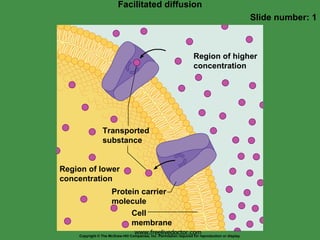
Facilitated Diffusion Facilitated diffusion: Passive: ATP not needed.  Powered by thermal energy. Involves transport of substance through cell membrane from higher to lower concentration. www.freelivedoctor.com
www.freelivedoctor.com
Facilitated diffusion Slide number: 1 Copyright © The McGraw-Hill Companies, Inc. Permission required for reproduction or display. Region of lower concentration Region of higher concentration www.freelivedoctor.com Cell membrane Protein carrier molecule Transported substance
Facilitated diffusion Slide number: 2 Copyright © The McGraw-Hill Companies, Inc. Permission required for reproduction or display. Region of lower concentration Region of higher concentration www.freelivedoctor.com Cell membrane Protein carrier molecule
Facilitated diffusion Slide number: 3 Copyright © The McGraw-Hill Companies, Inc. Permission required for reproduction or display. Region of lower concentration Region of higher concentration www.freelivedoctor.com Protein carrier molecule Transported substance
Active Transport Movement of molecules and ions against their concentration gradients. From lower to higher concentrations. Requires ATP. 2 Types of Active Transport: Primary Secondary www.freelivedoctor.com
Primary Active Transport ATP directly required for the function of the carriers. Molecule or ion binds to carrier site. Binding stimulates phosphorylation (breakdown of ATP). Conformational change moves molecule to other side of membrane. www.freelivedoctor.com
Na +  - K +  ATP-ase Pump Primary active transport. Carrier protein is also an ATP enzyme that converts ATP to ADP and P i . www.freelivedoctor.com
P Extracellular   fluid 1. Three sodium ions (Na + ) and adenosine   triphosphate (ATP) bind to the carrier protein. 2. The ATP breaks down to adenosine   diphosphate (ADP) and a phosphate (P) and   releases energy. 3 .  The carrier protein changes shape, and the   Na +  are transported across the membrane. 4 .  The Na +  diffuse away from the carrier protein. 5 .  Two potassium ions (K + ) bind to the carrier   protein. 6 .  The phosphate is released. 7 .  The carrier protein changes shape,   transporting K +  across the membrane, and the   K +  diffuse away from the carrier protein. The   carrier protein can again bind to Na +  and ATP. Cytoplasm Na + ATP K + ADP 1 3 Na + Na + K + P K + 4 5 6 7 www.freelivedoctor.com Breakdown of ATP (releases energy) Carrier protein changes shape (requires energy) 2 Carrier protein resumes original shape ATP binding site Carrier protein
Extracellular   fluid Three sodium ions (Na + ) and adenosine triphosphate (ATP) bind to the carrier protein. Cytoplasm Na + ATP www.freelivedoctor.com ATP binding site Carrier protein
P K + ADP Na + The ATP breaks down to adenosine diphosphate (ADP) and a phosphate (P) and releases energy. www.freelivedoctor.com Breakdown of ATP (releases energy)
K + Na + The carrier protein changes shape, and the Na +  are transported across the membrane. www.freelivedoctor.com Carrier protein changes shape (requires energy)
The Na +  diffuse away from the carrier protein. Na + www.freelivedoctor.com
Two potassium ions (K + ) bind to the carrier protein. K + www.freelivedoctor.com
The phosphate is released. P www.freelivedoctor.com
The carrier protein changes shape, transporting K +  across the membrane, and the K +  diffuse away from the carrier protein. The carrier protein can again bind to Na +  and ATP. K + www.freelivedoctor.com Carrier protein resumes original shape
Secondary Active Transport Coupled transport. Energy needed for uphill movement obtained from downhill transport of Na + . www.freelivedoctor.com
Secondary  Active Transport Cotransport (symport): Molecule or ion moving in the same direction. Countertransport (antiport): Molecule or ion is moved in the opposite direction. www.freelivedoctor.com
Membrane Transport of Glucose Glucose transport is an example of: Cotransport Primary active transport Facilitated diffusion www.freelivedoctor.com
Bulk Transport Many large molecules are moved at the same time. Exocytosis Endocytosis www.freelivedoctor.com
Proteins and phosphates are negatively charged at normal cellular pH. These anions attract positively charged cations that can diffuse through the membrane pores. Membrane more permeable to K +  than Na + . Concentration gradients for Na +  and K + . Na + / K + ATP pump 3 Na +  out for 2 K +  in. All contribute to unequal charge across the membrane. Membrane Potential www.freelivedoctor.com
www.freelivedoctor.com
Theoretical voltage produced across the membrane if only 1 ion could diffuse through the membrane. Potential difference: Magnitude of difference in charge on the 2 sides of the membrane. Equilibrium Potentials www.freelivedoctor.com
Potential difference of – 90 mV, if K +  were the only diffusible ion. www.freelivedoctor.com
Nernst Equation Membrane potential that would exactly balance the diffusion gradient and prevent the net movement of a particular ion. Equilibrium potential for K +  = - 90 mV. Equilibrium potential for Na +  = + 65 mV. www.freelivedoctor.com
Resting Membrane Potential Resting membrane potential is less than E k  because some Na +  can also enter the cell. The slow rate of Na +  efflux is accompanied by slow rate of K +  influx. - 65 mV www.freelivedoctor.com
www.freelivedoctor.com

Membranes And Transport

  • 1.
    Membrane Transport andthe Membrane Potential www.freelivedoctor.com
  • 2.
    Extracellular Environment Includesall parts of the body outside of cells Cells receive nourishment Cells release waste Cells interact (through chemical mediators) www.freelivedoctor.com
  • 3.
    Body Fluids Twocompartments Intracellular (~67% of body’s H 2 0) Extracellular (~33% of body’s H 2 0) Blood plasma: about 20% of this Tissue fluid (or interstitial fluid) Includes extracellular matrix Lymph www.freelivedoctor.com
  • 4.
    Extracellular matrix Connectivetissue Fibers Collegen about 15 kinds In the basal lamina bind to carbo on plasma membrane Then binds to matrix of CT Proteoglycans and glycoproteins Binds ET to CT Elastin www.freelivedoctor.com
  • 5.
    Extracellular matrix Groundsubstance Interstitial fluid is in the hydrated gel Chemically complex Molecules linked to the fibers Carbohydrates on plasma membrane Glycoproteins Proteoglycans Integrins Kind of glycoprotein From cytoskeleton to extracellular matrix “ glue” cells to matrix Relay signals between these compartments www.freelivedoctor.com
  • 6.
    Transport across cellmembrane Plasma (cell) membrane Is selectively permeable Generally not permeable to Proteins Nucleic acids Selectively permeable to Ions Nutrients Waste It is a biological interface between the two compartments www.freelivedoctor.com
  • 7.
    Transport across cellmembrane Plasma (cell) membrane Site of chemical reactions Enzymes located in it Receptors: can bond to molecular signals Transporter molecules Recognition factors: allow for cellular adhesion www.freelivedoctor.com
  • 8.
    Transport across cellmembrane Transport categories Based on structure Carrier-mediated Facilitated diffusion Active transport Non-carrier mediated Diffusion Osmosis Bulk flow (pressure gradients) Vesicle mediated Exocytosis Endocytosis Pinocytosis phagocytosis www.freelivedoctor.com
  • 9.
    Transport across cellmembrane Based on energy requirements Passive transport Based on concentration gradient Does not use metabolic energy Active transport Against a gragient Uses metabolic energy Involves specific carriers www.freelivedoctor.com
  • 10.
    Diffusion and OsmosisCell membrane separates ICF from ECF. Cell membrane is selectively permeable. Mechanisms to transport molecules and ions through the cell membrane: Carrier mediated transport Non-carrier mediated transport www.freelivedoctor.com
  • 11.
    Diffusion and OsmosisEnergy requirements for transport through the cell membrane: Passive transport: Net movement down a concentration gradient. Active transport: Net movement against a concentration gradient. Requires energy. www.freelivedoctor.com
  • 12.
    Diffusion Physical processthat occurs: Concentration difference across the membrane Membrane is permeable to the diffusing substance. Molecules/ions are in constant state of random motion due to their thermal energy. Eliminates a concentration gradient and distributes the molecules uniformly. www.freelivedoctor.com
  • 13.
    Diffusion Slide number:1 www.freelivedoctor.com Solute Solvent
  • 14.
    Diffusion Slide number:2 www.freelivedoctor.com Solute Solvent
  • 15.
    Diffusion Slide number:3 www.freelivedoctor.com
  • 16.
    Diffusion Slide number:4 www.freelivedoctor.com
  • 17.
    Diffusion Through CellMembrane Cell membrane permeable to: Non-polar molecules (0 2 ) Lipid soluble molecules (steroids) Small polar covalent bonds (C0 2 ) H 2 0 (small size, lack charge) Cell membrane impermeable to: Large polar molecules (glucose) Charged inorganic ions (Na + ) www.freelivedoctor.com
  • 18.
    Rate of DiffusionDependent upon: The magnitude of concentration gradient. Driving force of diffusion. Permeability of the membrane. Neuronal cell membrane 20 x more permeable to K + than Na + . Temperature. Higher temperature, faster diffusion rate. Surface area of the membrane. Microvilli increase surface area. www.freelivedoctor.com
  • 19.
    Osmosis Net diffusionof H 2 0 across a selectively permeable membrane. 2 requirements for osmosis: Must be difference in solute concentration on the 2 sides of the membrane. Membrane must be impermeable to the solute. Osmotically active solutes : solutes that cannot pass freely through the membrane. www.freelivedoctor.com
  • 20.
    Effects of OsmosisMovement of H 2 0 form high concentration of H 2 0 to lower concentration of H 2 0. www.freelivedoctor.com
  • 21.
    H 2 0moves by osmosis into the lower H 2 0 concentration until equilibrium is reached (270 g/l glucose). www.freelivedoctor.com
  • 22.
    The force thatwould have to be exerted to prevent osmosis. Indicates how strongly the solution “draws” H 2 0 into it by osmosis. www.freelivedoctor.com
  • 23.
  • 24.
    Molality and OsmolalityRatio of solute to H 2 0 critical to osmosis. Use molality (1.0 m): 1 mole of solute is dissolved in 1 kg H 2 0. Osmolality (Osm): Total molality of a solution. Plasma osmolality = 300 mOsm/l. www.freelivedoctor.com
  • 25.
    NaCl ionized whendissolved in H 2 0 forms 1 mole of Na + and 1 mole of Cl - , thus has a concentration of 2 Osm. Glucose when dissolved in H 2 0 forms 1 mole, thus has a concentration of 1 Osm. www.freelivedoctor.com
  • 26.
    Tonicity The effectof a solution on the osmotic movement of H 2 0. Isotonic: Equal tension to plasma. RBCs will not gain or lose H 2 0. www.freelivedoctor.com
  • 27.
    Tonicity Hypotonic: Osmotically active solutes in a lower osmolality and osmotic pressure than plasma. RBC will hemolyse. Hypertonic: Osmotically active solutes in a higher osmolality and osmotic pressure than plasma. RBC will crenate. www.freelivedoctor.com
  • 28.
    Regulation of PlasmaOsmolality Maintained in narrow range. Reguatory Mechanisms: Osmoreceptors stimulate hypothalamus: ADH released. Thirst increased. www.freelivedoctor.com
  • 29.
    Carrier-Mediated Transport Transportacross cell membrane by protein carriers. Characteristics of protein carriers: Specificity: Interact with specific molecule only. Competition: Molecules with similar chemical structures compete for carrier site. Saturation: Carrier sites filled. www.freelivedoctor.com
  • 30.
    Transport maximum (Tm):Carriers have become saturated. Competition: Molecules X and Y compete for same carrier. www.freelivedoctor.com
  • 31.
    Facilitated Diffusion Facilitateddiffusion: Passive: ATP not needed. Powered by thermal energy. Involves transport of substance through cell membrane from higher to lower concentration. www.freelivedoctor.com
  • 32.
  • 33.
    Facilitated diffusion Slidenumber: 1 Copyright © The McGraw-Hill Companies, Inc. Permission required for reproduction or display. Region of lower concentration Region of higher concentration www.freelivedoctor.com Cell membrane Protein carrier molecule Transported substance
  • 34.
    Facilitated diffusion Slidenumber: 2 Copyright © The McGraw-Hill Companies, Inc. Permission required for reproduction or display. Region of lower concentration Region of higher concentration www.freelivedoctor.com Cell membrane Protein carrier molecule
  • 35.
    Facilitated diffusion Slidenumber: 3 Copyright © The McGraw-Hill Companies, Inc. Permission required for reproduction or display. Region of lower concentration Region of higher concentration www.freelivedoctor.com Protein carrier molecule Transported substance
  • 36.
    Active Transport Movementof molecules and ions against their concentration gradients. From lower to higher concentrations. Requires ATP. 2 Types of Active Transport: Primary Secondary www.freelivedoctor.com
  • 37.
    Primary Active TransportATP directly required for the function of the carriers. Molecule or ion binds to carrier site. Binding stimulates phosphorylation (breakdown of ATP). Conformational change moves molecule to other side of membrane. www.freelivedoctor.com
  • 38.
    Na + - K + ATP-ase Pump Primary active transport. Carrier protein is also an ATP enzyme that converts ATP to ADP and P i . www.freelivedoctor.com
  • 39.
    P Extracellular fluid 1. Three sodium ions (Na + ) and adenosine triphosphate (ATP) bind to the carrier protein. 2. The ATP breaks down to adenosine diphosphate (ADP) and a phosphate (P) and releases energy. 3 . The carrier protein changes shape, and the Na + are transported across the membrane. 4 . The Na + diffuse away from the carrier protein. 5 . Two potassium ions (K + ) bind to the carrier protein. 6 . The phosphate is released. 7 . The carrier protein changes shape, transporting K + across the membrane, and the K + diffuse away from the carrier protein. The carrier protein can again bind to Na + and ATP. Cytoplasm Na + ATP K + ADP 1 3 Na + Na + K + P K + 4 5 6 7 www.freelivedoctor.com Breakdown of ATP (releases energy) Carrier protein changes shape (requires energy) 2 Carrier protein resumes original shape ATP binding site Carrier protein
  • 40.
    Extracellular fluid Three sodium ions (Na + ) and adenosine triphosphate (ATP) bind to the carrier protein. Cytoplasm Na + ATP www.freelivedoctor.com ATP binding site Carrier protein
  • 41.
    P K +ADP Na + The ATP breaks down to adenosine diphosphate (ADP) and a phosphate (P) and releases energy. www.freelivedoctor.com Breakdown of ATP (releases energy)
  • 42.
    K + Na+ The carrier protein changes shape, and the Na + are transported across the membrane. www.freelivedoctor.com Carrier protein changes shape (requires energy)
  • 43.
    The Na + diffuse away from the carrier protein. Na + www.freelivedoctor.com
  • 44.
    Two potassium ions(K + ) bind to the carrier protein. K + www.freelivedoctor.com
  • 45.
    The phosphate isreleased. P www.freelivedoctor.com
  • 46.
    The carrier proteinchanges shape, transporting K + across the membrane, and the K + diffuse away from the carrier protein. The carrier protein can again bind to Na + and ATP. K + www.freelivedoctor.com Carrier protein resumes original shape
  • 47.
    Secondary Active TransportCoupled transport. Energy needed for uphill movement obtained from downhill transport of Na + . www.freelivedoctor.com
  • 48.
    Secondary ActiveTransport Cotransport (symport): Molecule or ion moving in the same direction. Countertransport (antiport): Molecule or ion is moved in the opposite direction. www.freelivedoctor.com
  • 49.
    Membrane Transport ofGlucose Glucose transport is an example of: Cotransport Primary active transport Facilitated diffusion www.freelivedoctor.com
  • 50.
    Bulk Transport Manylarge molecules are moved at the same time. Exocytosis Endocytosis www.freelivedoctor.com
  • 51.
    Proteins and phosphatesare negatively charged at normal cellular pH. These anions attract positively charged cations that can diffuse through the membrane pores. Membrane more permeable to K + than Na + . Concentration gradients for Na + and K + . Na + / K + ATP pump 3 Na + out for 2 K + in. All contribute to unequal charge across the membrane. Membrane Potential www.freelivedoctor.com
  • 52.
  • 53.
  • 54.
    Theoretical voltage producedacross the membrane if only 1 ion could diffuse through the membrane. Potential difference: Magnitude of difference in charge on the 2 sides of the membrane. Equilibrium Potentials www.freelivedoctor.com
  • 55.
    Potential difference of– 90 mV, if K + were the only diffusible ion. www.freelivedoctor.com
  • 56.
    Nernst Equation Membranepotential that would exactly balance the diffusion gradient and prevent the net movement of a particular ion. Equilibrium potential for K + = - 90 mV. Equilibrium potential for Na + = + 65 mV. www.freelivedoctor.com
  • 57.
    Resting Membrane PotentialResting membrane potential is less than E k because some Na + can also enter the cell. The slow rate of Na + efflux is accompanied by slow rate of K + influx. - 65 mV www.freelivedoctor.com
  • 58.