FUZZY RULE BASED
CLASSIFICATION SYSTEM
FORMATION OF RULES
 The formation of rules is in general the canonical rule formation.
 For any linguistic variable, there are three general forms in which the canonical
rules can be formed.
(1) Assignment statements
(2) Conditional statements
(3) Unconditional statements
ASSIGNMENT STATEMENTS
 These statements are those in which the variable is assignment with the value.
 The variable and the value assigned are combined by the assignment operator
“=.”
 The assignment statements are necessary in forming fuzzy rules.
The examples of this type of statements are:
CONDITIONAL STATEMENTS
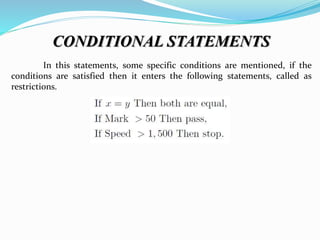
In this statements, some specific conditions are mentioned, if the
conditions are satisfied then it enters the following statements, called as
restrictions.
UNCONDITIONAL STATEMENTS
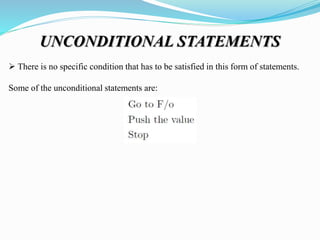
 There is no specific condition that has to be satisfied in this form of statements.
Some of the unconditional statements are:
PROPERTIES OF SET OF RULES
The properties for the sets of rules are
– Completeness,
– Consistency,
– Continuity,
– Interaction.
(a) Completeness
A set of IF–THEN rules is complete if any combination of input values result in an
appropriate output value.
(b) Consistency
A set of IF–THEN rules is inconsistent if there are two rules with the same rules-
antecedent but different rule-consequents.
(c) Continuity
A set of IF–THEN rules is continuous if it does not have neighboring rules with
output fuzzy sets that have empty intersection.
(d) Interaction
In the interaction property, suppose that is a rule, “IF x is A THEN y is B,” this
meaning is represented by a fuzzy relation R2, then the composition of A and R
does not deliver B
FUZZY INFERENCE SYSTEM
 Fuzzy Inference System (FIS) in usually known by several forms like Fuzzy
Rule Based System, Fuzzy Associative Memory and Fuzzy Models, Fuzzy Expert
System.
 This Fuzzy Rule Based System is an integral portion of Fuzzy logic.
 Fuzzy Inference System mainly finds its application in decision making.
 Appropriate rules are formulated by the Fuzzy Inference System based on
which the decision is taken.
 Fuzzy Set, Fuzzy Reasoning and Fuzzy rules are the backbone for Fuzzy
System.
 fuzzy rules are utilized in the Fuzzy System for decision making. AND or OR is
used as the connector for the fuzzified rules.
 The Fuzzy System takes a crisp input which is fuzzified by the fuzzifier and the
fuzzy system gives an output which is a fuzzy score that is defuzzified to a crisp
output.
WORKING OF FUZZY SYSTEM
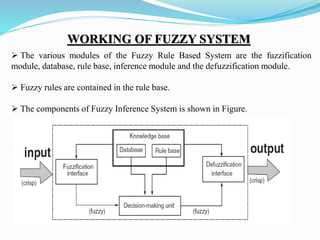
 The various modules of the Fuzzy Rule Based System are the fuzzification
module, database, rule base, inference module and the defuzzification module.
 Fuzzy rules are contained in the rule base.
 The components of Fuzzy Inference System is shown in Figure.
 The fuzzification method is used to convert crsip input to fuzzy.
 The rule base comprises of the collection of fuzzy rules.
 This rule base and the data base are jointly knows as the knowledge-base.
 Inference module takes the fuzzy input from the fuzzifier and the knowledge as
input and inference a fuzzy score.
 Defuzzification converts the fuzzy score back to crisp outputs.
 The Fuzzy Inference System performs the following steps for fuzzy reasoning.
 The first step is called as fuzzification.
 In this step, input variables on the antecedent are compared with the membership
values of every linguistic term.
 In the second step, membership values of the premise are combined to obtain
good weight for every rule.
 This is done using the MIN operator.
 In the next step, the consequents of the rule is generated based on the weight.
 The next step is defuzzification.
 In this step, the consequents are combined to get the crisp output.
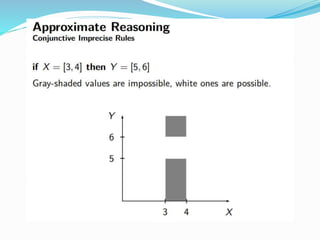
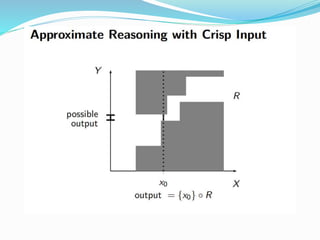
Fuzzy Rule Bases
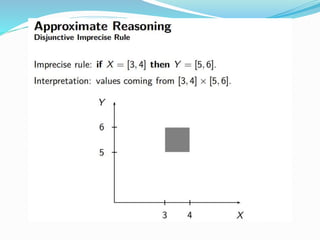
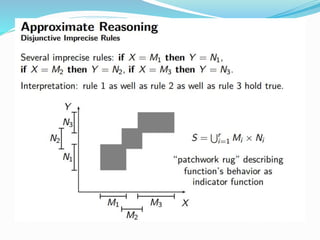
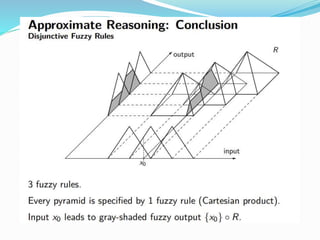
 Approximate Reasoning
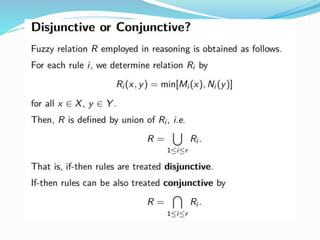
 Disjunctive Rules
 Conjunctive Rules
 Fuzzy Relational Equations
Iv unit-rule rule base

Iv unit-rule rule base

  • 1.
  • 2.
    FORMATION OF RULES The formation of rules is in general the canonical rule formation.  For any linguistic variable, there are three general forms in which the canonical rules can be formed. (1) Assignment statements (2) Conditional statements (3) Unconditional statements
  • 3.
    ASSIGNMENT STATEMENTS  Thesestatements are those in which the variable is assignment with the value.  The variable and the value assigned are combined by the assignment operator “=.”  The assignment statements are necessary in forming fuzzy rules. The examples of this type of statements are:
  • 4.
    CONDITIONAL STATEMENTS In thisstatements, some specific conditions are mentioned, if the conditions are satisfied then it enters the following statements, called as restrictions.
  • 5.
    UNCONDITIONAL STATEMENTS  Thereis no specific condition that has to be satisfied in this form of statements. Some of the unconditional statements are:
  • 6.
    PROPERTIES OF SETOF RULES The properties for the sets of rules are – Completeness, – Consistency, – Continuity, – Interaction.
  • 7.
    (a) Completeness A setof IF–THEN rules is complete if any combination of input values result in an appropriate output value. (b) Consistency A set of IF–THEN rules is inconsistent if there are two rules with the same rules- antecedent but different rule-consequents. (c) Continuity A set of IF–THEN rules is continuous if it does not have neighboring rules with output fuzzy sets that have empty intersection. (d) Interaction In the interaction property, suppose that is a rule, “IF x is A THEN y is B,” this meaning is represented by a fuzzy relation R2, then the composition of A and R does not deliver B
  • 8.
    FUZZY INFERENCE SYSTEM Fuzzy Inference System (FIS) in usually known by several forms like Fuzzy Rule Based System, Fuzzy Associative Memory and Fuzzy Models, Fuzzy Expert System.  This Fuzzy Rule Based System is an integral portion of Fuzzy logic.  Fuzzy Inference System mainly finds its application in decision making.  Appropriate rules are formulated by the Fuzzy Inference System based on which the decision is taken.  Fuzzy Set, Fuzzy Reasoning and Fuzzy rules are the backbone for Fuzzy System.  fuzzy rules are utilized in the Fuzzy System for decision making. AND or OR is used as the connector for the fuzzified rules.
  • 9.
     The FuzzySystem takes a crisp input which is fuzzified by the fuzzifier and the fuzzy system gives an output which is a fuzzy score that is defuzzified to a crisp output.
  • 10.
    WORKING OF FUZZYSYSTEM  The various modules of the Fuzzy Rule Based System are the fuzzification module, database, rule base, inference module and the defuzzification module.  Fuzzy rules are contained in the rule base.  The components of Fuzzy Inference System is shown in Figure.
  • 11.
     The fuzzificationmethod is used to convert crsip input to fuzzy.  The rule base comprises of the collection of fuzzy rules.  This rule base and the data base are jointly knows as the knowledge-base.  Inference module takes the fuzzy input from the fuzzifier and the knowledge as input and inference a fuzzy score.  Defuzzification converts the fuzzy score back to crisp outputs.  The Fuzzy Inference System performs the following steps for fuzzy reasoning.  The first step is called as fuzzification.  In this step, input variables on the antecedent are compared with the membership values of every linguistic term.
  • 12.
     In thesecond step, membership values of the premise are combined to obtain good weight for every rule.  This is done using the MIN operator.  In the next step, the consequents of the rule is generated based on the weight.  The next step is defuzzification.  In this step, the consequents are combined to get the crisp output.
  • 13.
    Fuzzy Rule Bases Approximate Reasoning  Disjunctive Rules  Conjunctive Rules  Fuzzy Relational Equations