Artificial Intelligence &Machine Learning
Course Code : 4803 & 4829
Group-3
Submitted to:
Prof. Engr. Md. Razu Ahmed
Professor & Chairman
Dept. of CCE, IIUC
Submitted by:
Syed Md Azizul Alam (E211016)
Mehraj Ibne Halim (E211018)
Al Mahmud Arafat (E211019R)
2.
Fuzzy Logic
Traditional Logic(Classical/Binary Logic):
• Based on two-valued logic: Either 0 or 1
• Used in most digital circuits, computers, and decision-making
• Works well when the data is clear-cut (ex, ON/OFF, TRUE/FALSE)
Example:
• Temperature > 30°C Hot (1)
→
• Temperature 30°C Not Hot (0)
≤ →
• it's either hot or not.
Fuzzy Logic:
• Allows intermediate values between 0 and 1 (like 0.2, 0.5, 0.9 etc.)
• Captures uncertainty, like real-life situations
• Instead of absolute truth, it assigns degrees of truth
Example:
• Temperature = 32°C
• 0.7 Hot, 0.3 Warm
• Not fully hot, not fully warm — it’s partially both
3.
Fuzzy Logic
Fuzzy Sets:A set where elements have degrees of membership.
Membership Function (MF): Maps input to a value between 0 and 1.
Variables like “Temperature” with values like Cold, Warm, Hot.
Fuzzification: Converts crisp input to fuzzy values using MF.
Defuzzification: Converts fuzzy output back to crisp values.
50 70 90 110
30
10
Temp. (F°)
Freezing Cool Warm Hot
0
1
Fuzzy Inference System(FIS)
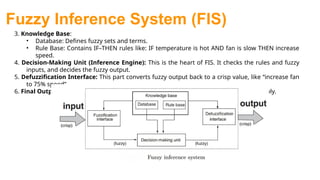
A Fuzzy Inference System (FIS) uses human-like reasoning to make smart decisions. It
works in five steps, as shown in the diagram.
1. Input (Crisp): The system receives a clear input value (example: 35°C temperature).
2. Fuzzification Interface: This part converts crisp input into fuzzy terms, like “hot” or
“warm”. Now the system can think like humans.
6.
Fuzzy Inference System(FIS)
3. Knowledge Base:
• Database: Defines fuzzy sets and terms.
• Rule Base: Contains IF–THEN rules like: IF temperature is hot AND fan is slow THEN increase
speed.
4. Decision-Making Unit (Inference Engine): This is the heart of FIS. It checks the rules and fuzzy
inputs, and decides the fuzzy output.
5. Defuzzification Interface: This part converts fuzzy output back to a crisp value, like “increase fan
to 75% speed”.
6. Final Output (Crisp): A clear action is given — easy for machines to understand and apply.
7.
Method of FIS
MamdaniFuzzy Inference System
How It Works:
1. Fuzzification: Converts inputs into fuzzy
values (ex, Low, Medium, High).
2. Rule Application: Uses rules like “IF
temperature IS High, THEN fan speed IS
High”.
3. Aggregation: Combines all the rules' results.
4. Defuzzification: Converts fuzzy result back
into a crisp value.
Example: Used in control systems like air
conditioning.
8.
Method of FIS
Takagi-SugenoFuzzy Inference System
How It Works:
1. Fuzzification: Converts inputs into fuzzy values.
2. Rule Application: Uses rules like “IF temperature
IS High, THEN fan speed = a * temperature + b”.
3. Aggregation: Combines the results with
weighted averages.
4. Defuzzification: Converts the final fuzzy result to
a crisp value.
Example: Used in more precise calculations or
optimizations.




![[DSC Europe 25] Dragan Jerosimovic - The Anatomy of a Narrative Simulation.pdf](https://cdn.slidesharecdn.com/ss_thumbnails/vzputuprdqr6zwbrwdcw-1-dragan-jerosimovic-the-anatomy-of-a-narrative-simulation-260114111931-9d04fba2-thumbnail.jpg?width=640&height=640&fit=bounds)


![[DSC Europe 25] Stefan Brankovic - #ResumeIsDead. AI-Powered Interviews and C...](https://cdn.slidesharecdn.com/ss_thumbnails/qnmbsv0xq3uysdrq3sev-2-stefan-brankovic-job-bolt-260114111931-a065aa3d-thumbnail.jpg?width=640&height=640&fit=bounds)


