Fuzzy Inference Systems
J.-S. Roger Jang (
J.-S. Roger Jang ( 張智星
張智星 )
)
CS Dept., Tsing Hua Univ., Taiwan
http://www.cs.nthu.edu.tw/~jang
jang@cs.nthu.edu.tw
jang@cs.nthu.edu.tw
Fuzzy Inference Systems
2
Fuzzy Inference Systems
Outline
Introduction
Mamdani fuzzy inference systems
Sugeno fuzzy inference systems
Tsukamoto fuzzy inference systems
Fuzzy modeling
3
Fuzzy Inference Systems
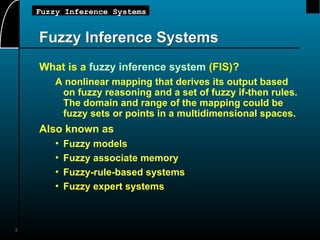
What is a fuzzy inference system (FIS)?
A nonlinear mapping that derives its output based
on fuzzy reasoning and a set of fuzzy if-then rules.
The domain and range of the mapping could be
fuzzy sets or points in a multidimensional spaces.
Also known as
• Fuzzy models
• Fuzzy associate memory
• Fuzzy-rule-based systems
• Fuzzy expert systems
4
Fuzzy Inference Systems
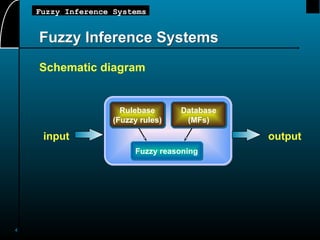
Schematic diagram
Rulebase
(Fuzzy rules)
Database
(MFs)
Fuzzy reasoning
input output
5
Fuzzy Inference Systems
Operating block diagram
6
Fuzzy Inference Systems
Max-Star Composition
Max-product composition:
In general, we have max-* composition:
where * is a T-norm operator.
  
R R
y
R R
x z x y y z
1 2 1 2
 ( , ) [ ( , ) ( , )]

  
R R
y
R R
x z x y y z
1 2 1 2
 ( , ) [ ( , )* ( , )]

7
Fuzzy Inference Systems
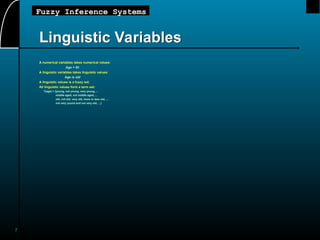
Linguistic Variables
A numerical variables takes numerical values:
Age = 65
A linguistic variables takes linguistic values:
Age is old
A linguistic values is a fuzzy set.
All linguistic values form a term set:
T(age) = {young, not young, very young, ...
middle aged, not middle aged, ...
old, not old, very old, more or less old, ...
not very yound and not very old, ...}
8
Fuzzy Inference Systems
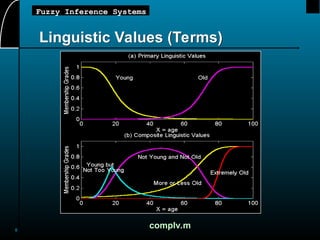
Linguistic Values (Terms)
complv.m
9
Fuzzy Inference Systems
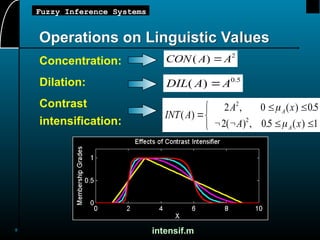
Operations on Linguistic Values
CON A A
( )  2
DIL A A
( ) .
 0 5
INT A
A x
A x
A
A
( )
, ( ) .
( ) , . ( )




 
   
2 0 05
2 05 1
2
2


Concentration:
Dilation:
Contrast
intensification:
intensif.m
10
Fuzzy Inference Systems
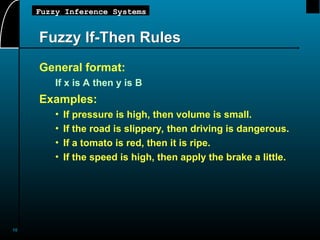
Fuzzy If-Then Rules
General format:
If x is A then y is B
Examples:
• If pressure is high, then volume is small.
• If the road is slippery, then driving is dangerous.
• If a tomato is red, then it is ripe.
• If the speed is high, then apply the brake a little.
11
Fuzzy Inference Systems
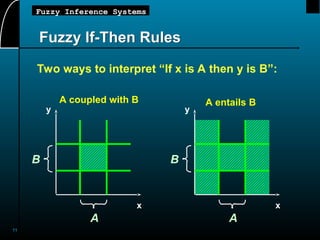
Fuzzy If-Then Rules
A coupled with B
A
A
B B
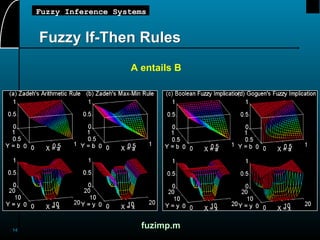
A entails B
Two ways to interpret “If x is A then y is B”:
y
x
x
y
12
Fuzzy Inference Systems
Fuzzy If-Then Rules
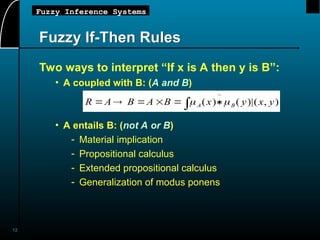
Two ways to interpret “If x is A then y is B”:
• A coupled with B: (A and B)
• A entails B: (not A or B)
- Material implication
- Propositional calculus
- Extended propositional calculus
- Generalization of modus ponens
R A B A B x y x y
A B
     
 
( ) ( )|( , )
~
13
Fuzzy Inference Systems
Fuzzy If-Then Rules
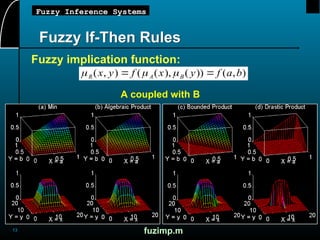
Fuzzy implication function:
  
R A B
x y f x y f a b
( , ) ( ( ), ( )) ( , )
 
fuzimp.m
A coupled with B
14
Fuzzy Inference Systems
Fuzzy If-Then Rules
A entails B
fuzimp.m
15
Fuzzy Inference Systems
Compositional Rule of Inference
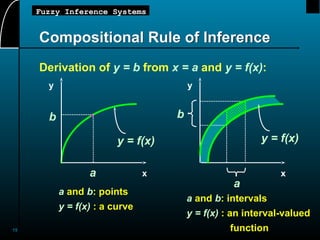
Derivation of y = b from x = a and y = f(x):
a and b: points
y = f(x) : a curve
a
b
y
x
x
y
a and b: intervals
y = f(x) : an interval-valued
function
a
b
y = f(x) y = f(x)
16
Fuzzy Inference Systems
Compositional Rule of Inference
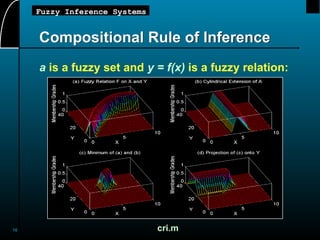
a is a fuzzy set and y = f(x) is a fuzzy relation:
cri.m
17
Fuzzy Inference Systems
Fuzzy Reasoning
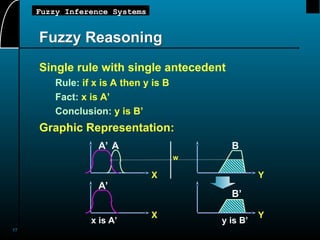
Single rule with single antecedent
Rule: if x is A then y is B
Fact: x is A’
Conclusion: y is B’
Graphic Representation:
A
X
w
A’ B
Y
x is A’
B’
Y
A’
X
y is B’
18
Fuzzy Inference Systems
Fuzzy Reasoning
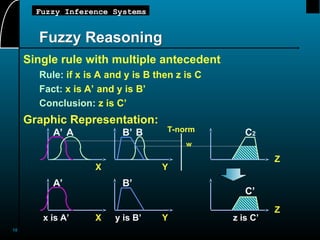
Single rule with multiple antecedent
Rule: if x is A and y is B then z is C
Fact: x is A’ and y is B’
Conclusion: z is C’
Graphic Representation:
A B T-norm
X Y
w
A’ B’ C2
Z
C’
Z
X Y
A’ B’
x is A’ y is B’ z is C’
19
Fuzzy Inference Systems
Fuzzy Reasoning
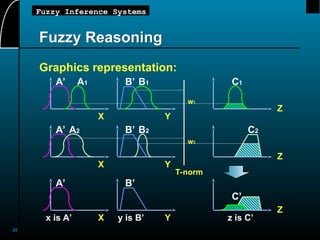
Multiple rules with multiple antecedent
Rule 1: if x is A1 and y is B1 then z is C1
Rule 2: if x is A2 and y is B2 then z is C2
Fact: x is A’ and y is B’
Conclusion: z is C’
Graphic Representation: (next slide)
20
Fuzzy Inference Systems
Fuzzy Reasoning
Graphics representation:
A1 B1
A2 B2
T-norm
X
X
Y
Y
w1
w2
A’
A’ B’
B’ C1
C2
Z
Z
C’
Z
X Y
A’ B’
x is A’ y is B’ z is C’
21
Fuzzy Inference Systems
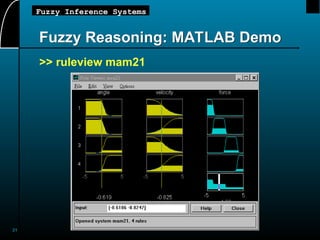
Fuzzy Reasoning: MATLAB Demo
>> ruleview mam21
22
Fuzzy Inference Systems
Other Variants
Some terminology:
• Degrees of compatibility (match)
• Firing strength
• Qualified (induced) MFs
• Overall output MF

Fuzzy Inference Systems by J S Rager Jan

  • 1.
    Fuzzy Inference Systems J.-S.Roger Jang ( J.-S. Roger Jang ( 張智星 張智星 ) ) CS Dept., Tsing Hua Univ., Taiwan CS Dept., Tsing Hua Univ., Taiwan http://www.cs.nthu.edu.tw/~jang http://www.cs.nthu.edu.tw/~jang jang@cs.nthu.edu.tw jang@cs.nthu.edu.tw Fuzzy Inference Systems
  • 2.
    2 Fuzzy Inference Systems Outline Introduction Mamdanifuzzy inference systems Sugeno fuzzy inference systems Tsukamoto fuzzy inference systems Fuzzy modeling
  • 3.
    3 Fuzzy Inference Systems FuzzyInference Systems What is a fuzzy inference system (FIS)? A nonlinear mapping that derives its output based on fuzzy reasoning and a set of fuzzy if-then rules. The domain and range of the mapping could be fuzzy sets or points in a multidimensional spaces. Also known as • Fuzzy models • Fuzzy associate memory • Fuzzy-rule-based systems • Fuzzy expert systems
  • 4.
    4 Fuzzy Inference Systems FuzzyInference Systems Schematic diagram Rulebase (Fuzzy rules) Database (MFs) Fuzzy reasoning input output
  • 5.
    5 Fuzzy Inference Systems FuzzyInference Systems Operating block diagram
  • 6.
    6 Fuzzy Inference Systems Max-StarComposition Max-product composition: In general, we have max-* composition: where * is a T-norm operator.    R R y R R x z x y y z 1 2 1 2  ( , ) [ ( , ) ( , )]     R R y R R x z x y y z 1 2 1 2  ( , ) [ ( , )* ( , )] 
  • 7.
    7 Fuzzy Inference Systems LinguisticVariables A numerical variables takes numerical values: Age = 65 A linguistic variables takes linguistic values: Age is old A linguistic values is a fuzzy set. All linguistic values form a term set: T(age) = {young, not young, very young, ... middle aged, not middle aged, ... old, not old, very old, more or less old, ... not very yound and not very old, ...}
  • 8.
    8 Fuzzy Inference Systems LinguisticValues (Terms) complv.m
  • 9.
    9 Fuzzy Inference Systems Operationson Linguistic Values CON A A ( )  2 DIL A A ( ) .  0 5 INT A A x A x A A ( ) , ( ) . ( ) , . ( )           2 0 05 2 05 1 2 2   Concentration: Dilation: Contrast intensification: intensif.m
  • 10.
    10 Fuzzy Inference Systems FuzzyIf-Then Rules General format: If x is A then y is B Examples: • If pressure is high, then volume is small. • If the road is slippery, then driving is dangerous. • If a tomato is red, then it is ripe. • If the speed is high, then apply the brake a little.
  • 11.
    11 Fuzzy Inference Systems FuzzyIf-Then Rules A coupled with B A A B B A entails B Two ways to interpret “If x is A then y is B”: y x x y
  • 12.
    12 Fuzzy Inference Systems FuzzyIf-Then Rules Two ways to interpret “If x is A then y is B”: • A coupled with B: (A and B) • A entails B: (not A or B) - Material implication - Propositional calculus - Extended propositional calculus - Generalization of modus ponens R A B A B x y x y A B         ( ) ( )|( , ) ~
  • 13.
    13 Fuzzy Inference Systems FuzzyIf-Then Rules Fuzzy implication function:    R A B x y f x y f a b ( , ) ( ( ), ( )) ( , )   fuzimp.m A coupled with B
  • 14.
    14 Fuzzy Inference Systems FuzzyIf-Then Rules A entails B fuzimp.m
  • 15.
    15 Fuzzy Inference Systems CompositionalRule of Inference Derivation of y = b from x = a and y = f(x): a and b: points y = f(x) : a curve a b y x x y a and b: intervals y = f(x) : an interval-valued function a b y = f(x) y = f(x)
  • 16.
    16 Fuzzy Inference Systems CompositionalRule of Inference a is a fuzzy set and y = f(x) is a fuzzy relation: cri.m
  • 17.
    17 Fuzzy Inference Systems FuzzyReasoning Single rule with single antecedent Rule: if x is A then y is B Fact: x is A’ Conclusion: y is B’ Graphic Representation: A X w A’ B Y x is A’ B’ Y A’ X y is B’
  • 18.
    18 Fuzzy Inference Systems FuzzyReasoning Single rule with multiple antecedent Rule: if x is A and y is B then z is C Fact: x is A’ and y is B’ Conclusion: z is C’ Graphic Representation: A B T-norm X Y w A’ B’ C2 Z C’ Z X Y A’ B’ x is A’ y is B’ z is C’
  • 19.
    19 Fuzzy Inference Systems FuzzyReasoning Multiple rules with multiple antecedent Rule 1: if x is A1 and y is B1 then z is C1 Rule 2: if x is A2 and y is B2 then z is C2 Fact: x is A’ and y is B’ Conclusion: z is C’ Graphic Representation: (next slide)
  • 20.
    20 Fuzzy Inference Systems FuzzyReasoning Graphics representation: A1 B1 A2 B2 T-norm X X Y Y w1 w2 A’ A’ B’ B’ C1 C2 Z Z C’ Z X Y A’ B’ x is A’ y is B’ z is C’
  • 21.
    21 Fuzzy Inference Systems FuzzyReasoning: MATLAB Demo >> ruleview mam21
  • 22.
    22 Fuzzy Inference Systems OtherVariants Some terminology: • Degrees of compatibility (match) • Firing strength • Qualified (induced) MFs • Overall output MF

Editor's Notes

  • #1 ... In this talk, we are going to apply two neural network controller design techniques to fuzzy controllers, and construct the so-called on-line adaptive neuro-fuzzy controllers for nonlinear control systems. We are going to use MATLAB, SIMULINK and Handle Graphics to demonstrate the concept. So you can also get a preview of some of the features of the Fuzzy Logic Toolbox, or FLT, version 2.
  • #2 Specifically, this is the outline of the talk. Wel start from the basics, introduce the concepts of fuzzy sets and membership functions. By using fuzzy sets, we can formulate fuzzy if-then rules, which are commonly used in our daily expressions. We can use a collection of fuzzy rules to describe a system behavior; this forms the fuzzy inference system, or fuzzy controller if used in control systems. In particular, we can can apply neural networks?learning method in a fuzzy inference system. A fuzzy inference system with learning capability is called ANFIS, stands for adaptive neuro-fuzzy inference system. Actually, ANFIS is already available in the current version of FLT, but it has certain restrictions. We are going to remove some of these restrictions in the next version of FLT. Most of all, we are going to have an on-line ANFIS block for SIMULINK; this block has on-line learning capability and it ideal for on-line adaptive neuro-fuzzy control applications. We will use this block in our demos; one is inverse learning and the other is feedback linearization.
  • #3 A fuzzy set is a set with fuzzy boundary. Suppose that A is the set of tall people. In a conventional set, or crisp set, an element is either belong to not belong to a set; there nothing in between. Therefore to define a crisp set A, we need to find a number, say, 5??, such that for a person taller than this number, he or she is in the set of tall people. For a fuzzy version of set A, we allow the degree of belonging to vary between 0 and 1. Therefore for a person with height 5??, we can say that he or she is tall to the degree of 0.5. And for a 6-foot-high person, he or she is tall to the degree of .9. So everything is a matter of degree in fuzzy sets. If we plot the degree of belonging w.r.t. heights, the curve is called a membership function. Because of its smooth transition, a fuzzy set is a better representation of our mental model of all? Moreover, if a fuzzy set has a step-function-like membership function, it reduces to the common crisp set.
  • #4 Here I like to emphasize some important properties of membership functions. First of all, it subjective measure; my membership function of all?is likely to be different from yours. Also it context sensitive. For example, I 5?1? and I considered pretty tall in Taiwan. But in the States, I only considered medium build, so may be only tall to the degree of .5. But if I an NBA player, Il be considered pretty short, cannot even do a slam dunk! So as you can see here, we have three different MFs for all?in different contexts. Although they are different, they do share some common characteristics --- for one thing, they are all monotonically increasing from 0 to 1. Because the membership function represents a subjective measure, it not probability function at all.