INTRODUCTION TO CHANNEL MODEL
AND CHANNEL CAPACITY
PRESENTED BY-
SHILPA DE(35000116019)
CONTENTS:
•BINARY SYMMETRIC CHANNEL
•DISCRETE MEMORYLESS CHANNEL
•TYPES OF CHANNEL
•EXAMPLES OF CHANNEL
•CHANNEL CAPACITY
•CROSSOVER PROBABILITY
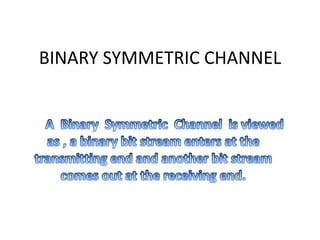
BINARY SYMMETRIC CHANNEL
Representation of a Binary Symmetric
Channel
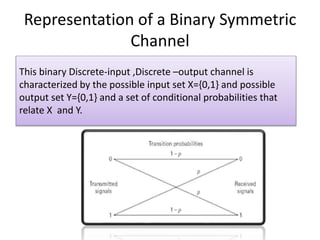
This binary Discrete-input ,Discrete –output channel is
characterized by the possible input set X={0,1} and possible
output set Y={0,1} and a set of conditional probabilities that
relate X and Y.
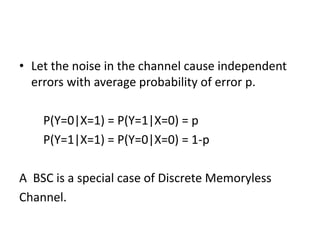
• Let the noise in the channel cause independent
errors with average probability of error p.
P(Y=0|X=1) = P(Y=1|X=0) = p
P(Y=1|X=1) = P(Y=0|X=0) = 1-p
A BSC is a special case of Discrete Memoryless
Channel.
Representation of DMC
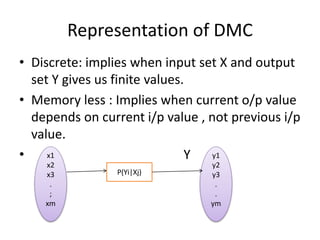
• Discrete: implies when input set X and output
set Y gives us finite values.
• Memory less : Implies when current o/p value
depends on current i/p value , not previous i/p
value.
• X Yx1
x2
x3
.
;
xm
y1
y2
y3
.
.
ym
P(Yi|Xj)
DEFINITION OF DMC
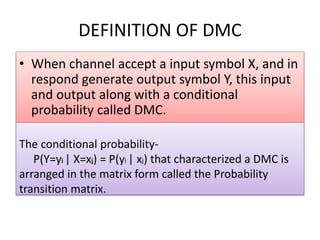
• When channel accept a input symbol X, and in
respond generate output symbol Y, this input
and output along with a conditional
probability called DMC.
The conditional probability-
P(Y=yi | X=xj) = P(yi | xj) that characterized a DMC is
arranged in the matrix form called the Probability
transition matrix.
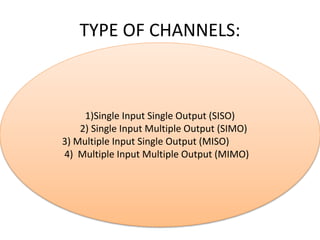
TYPE OF CHANNELS:
1)Single Input Single Output (SISO)
2) Single Input Multiple Output (SIMO)
3) Multiple Input Single Output (MISO)
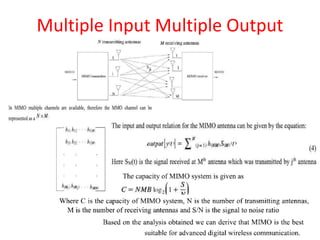
4) Multiple Input Multiple Output (MIMO)
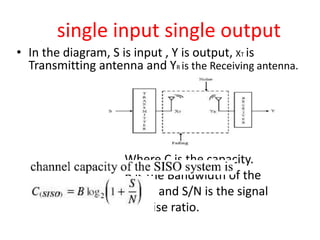
single input single output
• In the diagram, S is input , Y is output, XT is
Transmitting antenna and YR is the Receiving antenna.
Where C is the capacity.
B is the Bandwidth of the
signal and S/N is the signal
to noise ratio.
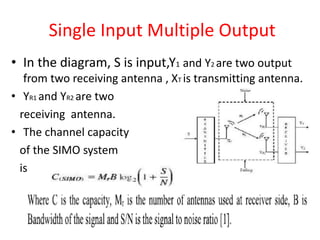
• In the diagram, S is input,Y1 and Y2 are two output
from two receiving antenna , XT is transmitting antenna.
• YR1 and YR2 are two
receiving antenna.
• The channel capacity
of the SIMO system
is
Single Input Multiple Output
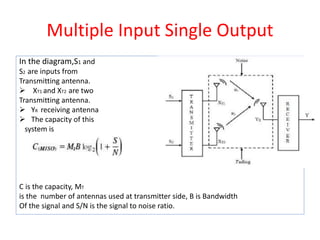
In the diagram,S1 and
S2 are inputs from
Transmitting antenna.
 XT1 and XT2 are two
Transmitting antenna.
 YR receiving antenna
 The capacity of this
system is
C is the capacity, MT
is the number of antennas used at transmitter side, B is Bandwidth
Of the signal and S/N is the signal to noise ratio.
Multiple Input Single Output
Multiple Input Multiple Output
SOME EXAMPLE OF CHANNEL
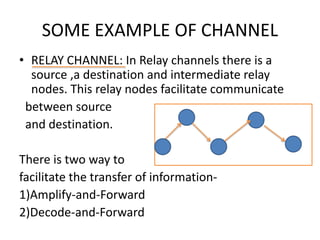
• RELAY CHANNEL: In Relay channels there is a
source ,a destination and intermediate relay
nodes. This relay nodes facilitate communicate
between source
and destination.
There is two way to
facilitate the transfer of information-
1)Amplify-and-Forward
2)Decode-and-Forward
RELAY CHANNEL
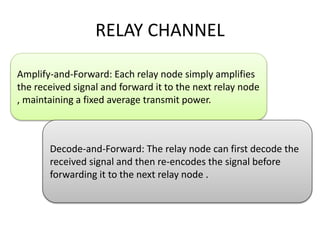
Amplify-and-Forward: Each relay node simply amplifies
the received signal and forward it to the next relay node
, maintaining a fixed average transmit power.
Decode-and-Forward: The relay node can first decode the
received signal and then re-encodes the signal before
forwarding it to the next relay node .
MULTIPLE ACCESS CHANNEL
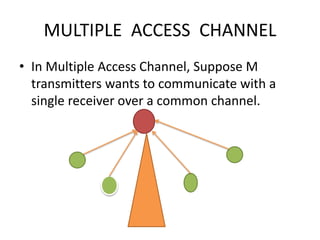
• In Multiple Access Channel, Suppose M
transmitters wants to communicate with a
single receiver over a common channel.
BROADCAST CHANNEL
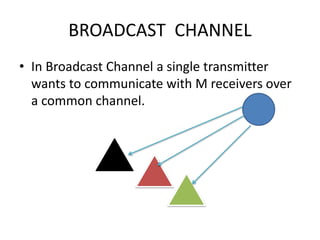
• In Broadcast Channel a single transmitter
wants to communicate with M receivers over
a common channel.
CHANNEL CAPACITY:
The channel capacity of a discrete
memoryless channel is defined as-
The maximum average mutual
information in any single use of the
channel,where the maximization is
over all possible input probabilities.
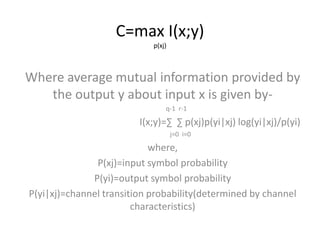
C=max I(x;y)
p(xj)
Where average mutual information provided by
the output y about input x is given by-
q-1 r-1
I(x;y)=∑ ∑ p(xj)p(yi|xj) log(yi|xj)/p(yi)
j=0 i=0
where,
P(xj)=input symbol probability
P(yi)=output symbol probability
P(yi|xj)=channel transition probability(determined by channel
characteristics)
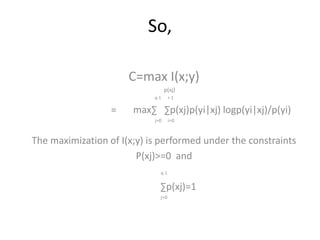
So,
C=max I(x;y)
p(xj)
q-1 r-1
= max∑ ∑p(xj)p(yi|xj) logp(yi|xj)/p(yi)
j=0 i=0
The maximization of I(x;y) is performed under the constraints
P(xj)>=0 and
q-1
∑p(xj)=1
j=0
Units:
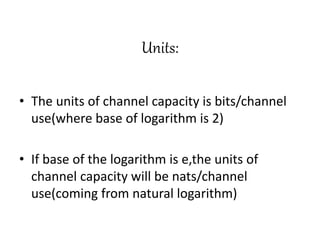
• The units of channel capacity is bits/channel
use(where base of logarithm is 2)
• If base of the logarithm is e,the units of
channel capacity will be nats/channel
use(coming from natural logarithm)
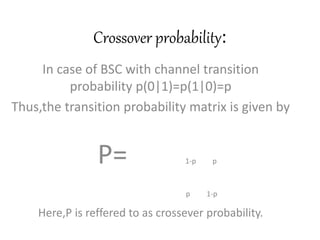
Crossover probability:
In case of BSC with channel transition
probability p(0|1)=p(1|0)=p
Thus,the transition probability matrix is given by
P= 1-p p
p 1-p
Here,P is reffered to as crossever probability.
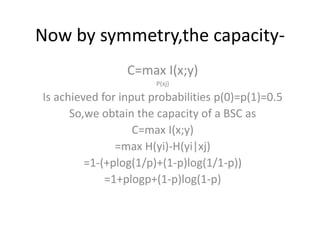
Now by symmetry,the capacity-
C=max I(x;y)
P(xj)
Is achieved for input probabilities p(0)=p(1)=0.5
So,we obtain the capacity of a BSC as
C=max I(x;y)
=max H(yi)-H(yi|xj)
=1-(+plog(1/p)+(1-p)log(1/1-p))
=1+plogp+(1-p)log(1-p)
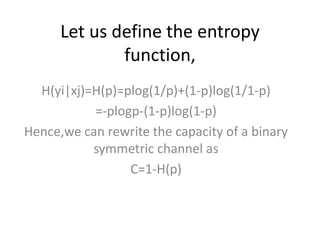
Let us define the entropy
function,
H(yi|xj)=H(p)=plog(1/p)+(1-p)log(1/1-p)
=-plogp-(1-p)log(1-p)
Hence,we can rewrite the capacity of a binary
symmetric channel as
C=1-H(p)
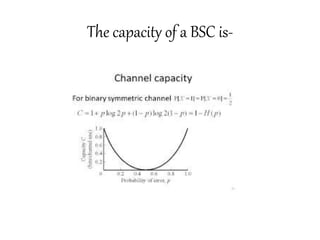
The capacity of a BSC is-
Now,from previous equation of
channel capacity-
•For p=0(noise free channel),the capacity is
1bit/channel use.Here we can successfully transmit 1 bit
of information.
For p=0.5,the channel capacity is 0.Output gives no
information about input.it occurs when the channel is
broken.
•For 0.5<p<1,the capacity increases with increasing p.
•For p=1,again channel capacity is 1 bit/channel use.
REFFERENCE:
1. INFORMATION THEORY,CODING
AND CRYPTOGRAPHY(RANJAN
BOSE)
2. www.geeksforgeeks.com
3. www.wikepedia.com
THANK YOU

Binary symmetric channel review

  • 1.
    INTRODUCTION TO CHANNELMODEL AND CHANNEL CAPACITY
  • 2.
  • 3.
    CONTENTS: •BINARY SYMMETRIC CHANNEL •DISCRETEMEMORYLESS CHANNEL •TYPES OF CHANNEL •EXAMPLES OF CHANNEL •CHANNEL CAPACITY •CROSSOVER PROBABILITY
  • 4.
  • 5.
    Representation of aBinary Symmetric Channel This binary Discrete-input ,Discrete –output channel is characterized by the possible input set X={0,1} and possible output set Y={0,1} and a set of conditional probabilities that relate X and Y.
  • 6.
    • Let thenoise in the channel cause independent errors with average probability of error p. P(Y=0|X=1) = P(Y=1|X=0) = p P(Y=1|X=1) = P(Y=0|X=0) = 1-p A BSC is a special case of Discrete Memoryless Channel.
  • 7.
    Representation of DMC •Discrete: implies when input set X and output set Y gives us finite values. • Memory less : Implies when current o/p value depends on current i/p value , not previous i/p value. • X Yx1 x2 x3 . ; xm y1 y2 y3 . . ym P(Yi|Xj)
  • 8.
    DEFINITION OF DMC •When channel accept a input symbol X, and in respond generate output symbol Y, this input and output along with a conditional probability called DMC. The conditional probability- P(Y=yi | X=xj) = P(yi | xj) that characterized a DMC is arranged in the matrix form called the Probability transition matrix.
  • 9.
    TYPE OF CHANNELS: 1)SingleInput Single Output (SISO) 2) Single Input Multiple Output (SIMO) 3) Multiple Input Single Output (MISO) 4) Multiple Input Multiple Output (MIMO)
  • 10.
    single input singleoutput • In the diagram, S is input , Y is output, XT is Transmitting antenna and YR is the Receiving antenna. Where C is the capacity. B is the Bandwidth of the signal and S/N is the signal to noise ratio.
  • 11.
    • In thediagram, S is input,Y1 and Y2 are two output from two receiving antenna , XT is transmitting antenna. • YR1 and YR2 are two receiving antenna. • The channel capacity of the SIMO system is Single Input Multiple Output
  • 12.
    In the diagram,S1and S2 are inputs from Transmitting antenna.  XT1 and XT2 are two Transmitting antenna.  YR receiving antenna  The capacity of this system is C is the capacity, MT is the number of antennas used at transmitter side, B is Bandwidth Of the signal and S/N is the signal to noise ratio. Multiple Input Single Output
  • 13.
  • 14.
    SOME EXAMPLE OFCHANNEL • RELAY CHANNEL: In Relay channels there is a source ,a destination and intermediate relay nodes. This relay nodes facilitate communicate between source and destination. There is two way to facilitate the transfer of information- 1)Amplify-and-Forward 2)Decode-and-Forward
  • 15.
    RELAY CHANNEL Amplify-and-Forward: Eachrelay node simply amplifies the received signal and forward it to the next relay node , maintaining a fixed average transmit power. Decode-and-Forward: The relay node can first decode the received signal and then re-encodes the signal before forwarding it to the next relay node .
  • 16.
    MULTIPLE ACCESS CHANNEL •In Multiple Access Channel, Suppose M transmitters wants to communicate with a single receiver over a common channel.
  • 17.
    BROADCAST CHANNEL • InBroadcast Channel a single transmitter wants to communicate with M receivers over a common channel.
  • 18.
    CHANNEL CAPACITY: The channelcapacity of a discrete memoryless channel is defined as- The maximum average mutual information in any single use of the channel,where the maximization is over all possible input probabilities.
  • 19.
    C=max I(x;y) p(xj) Where averagemutual information provided by the output y about input x is given by- q-1 r-1 I(x;y)=∑ ∑ p(xj)p(yi|xj) log(yi|xj)/p(yi) j=0 i=0 where, P(xj)=input symbol probability P(yi)=output symbol probability P(yi|xj)=channel transition probability(determined by channel characteristics)
  • 20.
    So, C=max I(x;y) p(xj) q-1 r-1 =max∑ ∑p(xj)p(yi|xj) logp(yi|xj)/p(yi) j=0 i=0 The maximization of I(x;y) is performed under the constraints P(xj)>=0 and q-1 ∑p(xj)=1 j=0
  • 21.
    Units: • The unitsof channel capacity is bits/channel use(where base of logarithm is 2) • If base of the logarithm is e,the units of channel capacity will be nats/channel use(coming from natural logarithm)
  • 22.
    Crossover probability: In caseof BSC with channel transition probability p(0|1)=p(1|0)=p Thus,the transition probability matrix is given by P= 1-p p p 1-p Here,P is reffered to as crossever probability.
  • 23.
    Now by symmetry,thecapacity- C=max I(x;y) P(xj) Is achieved for input probabilities p(0)=p(1)=0.5 So,we obtain the capacity of a BSC as C=max I(x;y) =max H(yi)-H(yi|xj) =1-(+plog(1/p)+(1-p)log(1/1-p)) =1+plogp+(1-p)log(1-p)
  • 24.
    Let us definethe entropy function, H(yi|xj)=H(p)=plog(1/p)+(1-p)log(1/1-p) =-plogp-(1-p)log(1-p) Hence,we can rewrite the capacity of a binary symmetric channel as C=1-H(p)
  • 25.
    The capacity ofa BSC is-
  • 26.
    Now,from previous equationof channel capacity- •For p=0(noise free channel),the capacity is 1bit/channel use.Here we can successfully transmit 1 bit of information. For p=0.5,the channel capacity is 0.Output gives no information about input.it occurs when the channel is broken. •For 0.5<p<1,the capacity increases with increasing p. •For p=1,again channel capacity is 1 bit/channel use.
  • 27.
    REFFERENCE: 1. INFORMATION THEORY,CODING ANDCRYPTOGRAPHY(RANJAN BOSE) 2. www.geeksforgeeks.com 3. www.wikepedia.com
  • 28.