Presented by
Zahid Husain
M.Pharm (Pharmaceutics)
Faculty of Pharmacy, Integral University, Lucknow
DRUG
INTERACTIONS
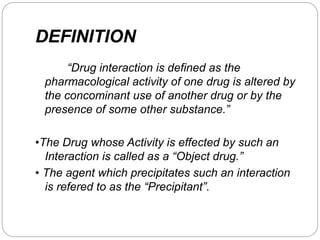
DEFINITION
“Drug interaction is defined as the
pharmacological activity of one drug is altered by
the concominant use of another drug or by the
presence of some other substance.”
•The Drug whose Activity is effected by such an
Interaction is called as a “Object drug.”
• The agent which precipitates such an interaction
is refered to as the “Precipitant”.
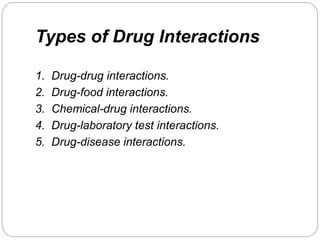
Types of Drug Interactions
1. Drug-drug interactions.
2. Drug-food interactions.
3. Chemical-drug interactions.
4. Drug-laboratory test interactions.
5. Drug-disease interactions.
The Net Effect of a Drug
Interaction is,
•Generally quantitative i.e.increased or decreased
effect.
•Seldom qualitative i.e.rapid or slower effect.
•Precipitation of newer or increased adverse effect.
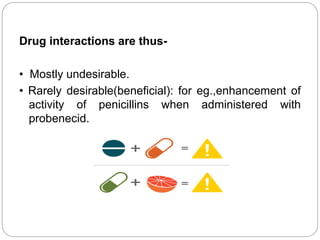
Drug interactions are thus-
• Mostly undesirable.
• Rarely desirable(beneficial): for eg.,enhancement of
activity of penicillins when administered with
probenecid.
Factors Contributing to Drug
Interactions
1. Multiple drug therapy.
2. Multiple prescribers.
3. Multiple pharmacological effects of drug.
4. Multiple diseases/predisposing illness.
5. Poor patient compliance.
6. Advancing age of patient.
7. Drug-related factors.
Mechanisms of drug
interactions
 The three mechanisms by which an interaction
can develop are-
1. Pharmaceutical interactions.
2. pharmacokinetic interactions.
3. Pharmacodynamic interactions.
Pharmaceutical interactions
 Also called as incompatibility. it is a
physicochemical interaction that occous when
drugs are mixed in IV Infusions causing
precipitation or inactivation of active principles .
Example:- Ampicillin ,chlorpromazine & barbituates
interact with dextran in solutions and are broken
down or from chemical compounds.
Pharmacokinetic Interactions
“These interactions are those in which ADME
properties of the object drug is altered by the
precipitant and hence such interactions are also
called as ADME interactions”.
 The resultant effect is altered plasma
concentration of the object drug.
These are classified as:
1. Absorption interactions
2. Distribution interactions
3. Metabolism interactions
4. Excretion interactions.
Absorption Interactions
Are those where the absorption of the object drug
is altered. The net effect of such an interaction is:
 Faster or slower drug absorption.
 More, or, less complete drug absorption.
Distribution Interactions
 Are those where the distribution pattern of the
object drug is altered ,
The major mechanism for distribution
interaction is alteration in protein-drug binding.
Metabolism Interactions
 Are those where the metabolism of the object
drug is altered.
Mechanisms of metabolism interactions include:
1. Enzyme induction: Increased rate of
metabolism.
2. Enzyme inhibition: Decreased rate of
metabolism. It is the most significant interaction in
comparison to other interactions and can be fatal.
Excretion Interactions
Are these where the excretion pattern of the
object drug is altered. Major mechanisms of
excretion interactions are-
 Alteration in renal blood flow
 Alteration of urine pH
 Competition for active secretions
 Forced diuresis
Pharmacodynamic interactions
 Are those in which the activity of the object drug
at its site of action is altered by the precipitant.
Such interactions may be direct or indirect.
These are of two types:
1.direct pharmacodynamic interactions.
2. Indirect pharmacodynamic interactions.
Direct Pharmacodynamic
Interactions
 In which drugs having similar or opposing
pharmacological effects are used concurrently.
The three consequences of direct interactions are,
1. Antagonism.
2. Addition or summation.
3. Synergism or potentiation.
Antagonism
 The interacting drugs have opposing actions.
Example: Acetylcholine and noradrenaline have
opposing effects on heart rate.
Addition or summation:
 The interacting drugs have similar actions and the
resultant effect is the some of individual drug
responses.
Example: CNS depressants like sedatives and
hypnotics,…etc
Synergism or potentiation:
 It is an enhancement of action of one drug by
another.
Example: Alcohol enhances the analgesics activity
Indirect pharmacodynamic
interaction
 In which both the object and the precipitant drugs
have unrelated effects.but the latter in Some way
alerts the effects but latter in some way alerts the
effects of the former.
Example: salicylates decrease the ability of the
platelets to aggregate thus impairing the
Homeostasis if warfarin indused bleeding
occurs.
Consequences Of Drug
Interactions
The consequences of drug interactions may be:
 Major: Life threatening.
 Moderate: Deterioration of patients status.
 Minor: Little effect.
Reducing The Risk Of Drug
Interactions
1. Identify the patients risk factors.
2. Take through drug history.
3. Be knowledge about the actions of the drugs
being used.
4. Consider therapeutic alternatives.
5. Avoid complex therapeutic regiments when
possible.
6. Educate the patient.
7. Monitor therapy.
Influence Of Smoking On Drug
Interactions
 Smoking increases the activity of drug
metabolizing enzymes in the liver, With the result
that certain therapeutic agents.
Example: Diazepam, propoxyphene, theophylline,
olanzapine.
 Are metabolized more rapidly, and their effect is
decreased.
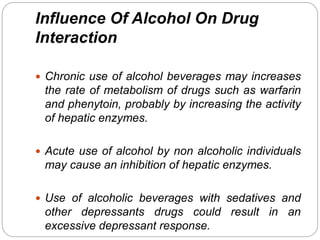
Influence Of Alcohol On Drug
Interaction
 Chronic use of alcohol beverages may increases
the rate of metabolism of drugs such as warfarin
and phenytoin, probably by increasing the activity
of hepatic enzymes.
 Acute use of alcohol by non alcoholic individuals
may cause an inhibition of hepatic enzymes.
 Use of alcoholic beverages with sedatives and
other depressants drugs could result in an
excessive depressant response.
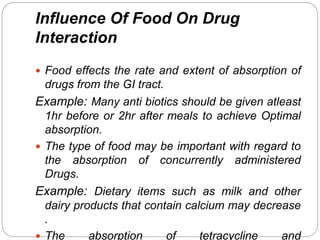
Influence Of Food On Drug
Interaction
 Food effects the rate and extent of absorption of
drugs from the GI tract.
Example: Many anti biotics should be given atleast
1hr before or 2hr after meals to achieve Optimal
absorption.
 The type of food may be important with regard to
the absorption of concurrently administered
Drugs.
Example: Dietary items such as milk and other
dairy products that contain calcium may decrease
.
 The absorption of tetracycline and
Thank You

Drug interaction

  • 1.
    Presented by Zahid Husain M.Pharm(Pharmaceutics) Faculty of Pharmacy, Integral University, Lucknow DRUG INTERACTIONS
  • 2.
    DEFINITION “Drug interaction isdefined as the pharmacological activity of one drug is altered by the concominant use of another drug or by the presence of some other substance.” •The Drug whose Activity is effected by such an Interaction is called as a “Object drug.” • The agent which precipitates such an interaction is refered to as the “Precipitant”.
  • 3.
    Types of DrugInteractions 1. Drug-drug interactions. 2. Drug-food interactions. 3. Chemical-drug interactions. 4. Drug-laboratory test interactions. 5. Drug-disease interactions.
  • 4.
    The Net Effectof a Drug Interaction is, •Generally quantitative i.e.increased or decreased effect. •Seldom qualitative i.e.rapid or slower effect. •Precipitation of newer or increased adverse effect.
  • 5.
    Drug interactions arethus- • Mostly undesirable. • Rarely desirable(beneficial): for eg.,enhancement of activity of penicillins when administered with probenecid.
  • 6.
    Factors Contributing toDrug Interactions 1. Multiple drug therapy. 2. Multiple prescribers. 3. Multiple pharmacological effects of drug. 4. Multiple diseases/predisposing illness. 5. Poor patient compliance. 6. Advancing age of patient. 7. Drug-related factors.
  • 7.
    Mechanisms of drug interactions The three mechanisms by which an interaction can develop are- 1. Pharmaceutical interactions. 2. pharmacokinetic interactions. 3. Pharmacodynamic interactions.
  • 8.
    Pharmaceutical interactions  Alsocalled as incompatibility. it is a physicochemical interaction that occous when drugs are mixed in IV Infusions causing precipitation or inactivation of active principles . Example:- Ampicillin ,chlorpromazine & barbituates interact with dextran in solutions and are broken down or from chemical compounds.
  • 9.
    Pharmacokinetic Interactions “These interactionsare those in which ADME properties of the object drug is altered by the precipitant and hence such interactions are also called as ADME interactions”.  The resultant effect is altered plasma concentration of the object drug. These are classified as: 1. Absorption interactions 2. Distribution interactions 3. Metabolism interactions 4. Excretion interactions.
  • 10.
    Absorption Interactions Are thosewhere the absorption of the object drug is altered. The net effect of such an interaction is:  Faster or slower drug absorption.  More, or, less complete drug absorption.
  • 11.
    Distribution Interactions  Arethose where the distribution pattern of the object drug is altered , The major mechanism for distribution interaction is alteration in protein-drug binding.
  • 12.
    Metabolism Interactions  Arethose where the metabolism of the object drug is altered. Mechanisms of metabolism interactions include: 1. Enzyme induction: Increased rate of metabolism. 2. Enzyme inhibition: Decreased rate of metabolism. It is the most significant interaction in comparison to other interactions and can be fatal.
  • 13.
    Excretion Interactions Are thesewhere the excretion pattern of the object drug is altered. Major mechanisms of excretion interactions are-  Alteration in renal blood flow  Alteration of urine pH  Competition for active secretions  Forced diuresis
  • 14.
    Pharmacodynamic interactions  Arethose in which the activity of the object drug at its site of action is altered by the precipitant. Such interactions may be direct or indirect. These are of two types: 1.direct pharmacodynamic interactions. 2. Indirect pharmacodynamic interactions.
  • 15.
    Direct Pharmacodynamic Interactions  Inwhich drugs having similar or opposing pharmacological effects are used concurrently. The three consequences of direct interactions are, 1. Antagonism. 2. Addition or summation. 3. Synergism or potentiation.
  • 16.
    Antagonism  The interactingdrugs have opposing actions. Example: Acetylcholine and noradrenaline have opposing effects on heart rate. Addition or summation:  The interacting drugs have similar actions and the resultant effect is the some of individual drug responses. Example: CNS depressants like sedatives and hypnotics,…etc Synergism or potentiation:  It is an enhancement of action of one drug by another. Example: Alcohol enhances the analgesics activity
  • 17.
    Indirect pharmacodynamic interaction  Inwhich both the object and the precipitant drugs have unrelated effects.but the latter in Some way alerts the effects but latter in some way alerts the effects of the former. Example: salicylates decrease the ability of the platelets to aggregate thus impairing the Homeostasis if warfarin indused bleeding occurs.
  • 18.
    Consequences Of Drug Interactions Theconsequences of drug interactions may be:  Major: Life threatening.  Moderate: Deterioration of patients status.  Minor: Little effect.
  • 19.
    Reducing The RiskOf Drug Interactions 1. Identify the patients risk factors. 2. Take through drug history. 3. Be knowledge about the actions of the drugs being used. 4. Consider therapeutic alternatives. 5. Avoid complex therapeutic regiments when possible. 6. Educate the patient. 7. Monitor therapy.
  • 20.
    Influence Of SmokingOn Drug Interactions  Smoking increases the activity of drug metabolizing enzymes in the liver, With the result that certain therapeutic agents. Example: Diazepam, propoxyphene, theophylline, olanzapine.  Are metabolized more rapidly, and their effect is decreased.
  • 21.
    Influence Of AlcoholOn Drug Interaction  Chronic use of alcohol beverages may increases the rate of metabolism of drugs such as warfarin and phenytoin, probably by increasing the activity of hepatic enzymes.  Acute use of alcohol by non alcoholic individuals may cause an inhibition of hepatic enzymes.  Use of alcoholic beverages with sedatives and other depressants drugs could result in an excessive depressant response.
  • 22.
    Influence Of FoodOn Drug Interaction  Food effects the rate and extent of absorption of drugs from the GI tract. Example: Many anti biotics should be given atleast 1hr before or 2hr after meals to achieve Optimal absorption.  The type of food may be important with regard to the absorption of concurrently administered Drugs. Example: Dietary items such as milk and other dairy products that contain calcium may decrease .  The absorption of tetracycline and
  • 23.