City of College Station
Intelligent Transportation System
Master Plan
Presentation to City Council
June 26, 2014
AGENDA
• What is and why implement ITS
• The College Station plan
• Examples in action
Problem -
Our transportation infrastructure –
highways and arterials, ports, and
airways – are simply over used.
Congestion has impacted every aspect
of our daily lives.
Problem -
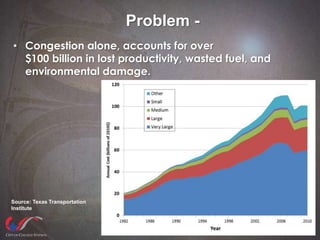
• Congestion alone, accounts for over
$100 billion in lost productivity, wasted fuel, and
environmental damage.
Source: Texas Transportation
Institute
Fact -
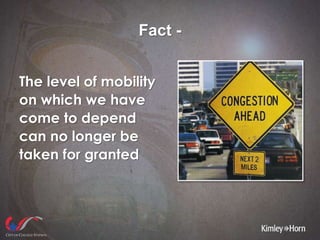
The level of mobility
on which we have
come to depend
can no longer be
taken for granted
WHAT IS ITS?
What is ITS?
• Intelligent Transportation System (ITS) is:
– Technology that is leveraged to :
• collect important information
• convey important information
• share information
• ITS helps make informed decisions
• ITS improves transportation safety and
mobility
• ITS enhances productivity
ITS
• ITS compliments traditional capacity
building practices
• ITS compliments current initiatives for
traffic management (Game Day)
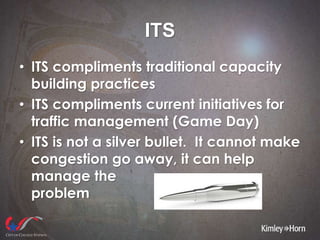
• ITS is not a silver bullet. It cannot make
congestion go away, it can help
manage the
problem
ITS MASTER PLAN
BENEFITS
• Provides vision for ITS deployment in
the City
• Describes how system components
work together now and in the future
• Identifies opportunities for resource
sharing
Steps to Create the Plan
• Determine goals
• Develop concept of operations
• Identify state of the practice
• Determine technology and equipment
• Identify communications network topology
• Develop requirements
• Develop plan
Goals of ITS
• Improve safety and mobility
• Enhance security
• Increase staff efficiency
• Communicate to field devices
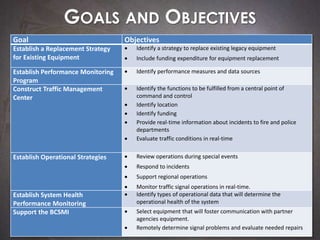
GOALS AND OBJECTIVES
Goal Objectives
Establish a Replacement Strategy
for Existing Equipment
 Identify a strategy to replace existing legacy equipment
 Include funding expenditure for equipment replacement
Establish Performance Monitoring
Program
 Identify performance measures and data sources
Construct Traffic Management
Center
 Identify the functions to be fulfilled from a central point of
command and control
 Identify location
 Identify funding
 Provide real-time information about incidents to fire and police
departments
 Evaluate traffic conditions in real-time
Establish Operational Strategies  Review operations during special events
 Respond to incidents
 Support regional operations
 Monitor traffic signal operations in real-time.
Establish System Health
Performance Monitoring
 Identify types of operational data that will determine the
operational health of the system
Support the BCSMI  Select equipment that will foster communication with partner
agencies equipment.
 Remotely determine signal problems and evaluate needed repairs
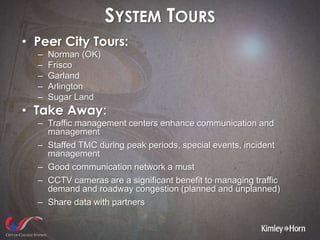
SYSTEM TOURS
• Peer City Tours:
– Norman (OK)
– Frisco
– Garland
– Arlington
– Sugar Land
• Take Away:
– Traffic management centers enhance communication and
management
– Staffed TMC during peak periods, special events, incident
management
– Good communication network a must
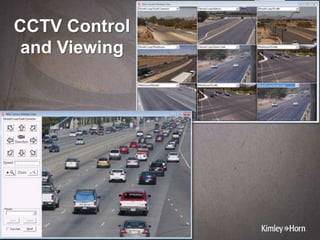
– CCTV cameras are a significant benefit to managing traffic
demand and roadway congestion (planned and unplanned)
– Share data with partners
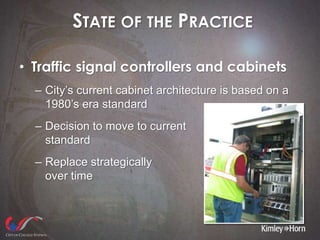
STATE OF THE PRACTICE
• Traffic signal controllers and cabinets
– City’s current cabinet architecture is based on a
1980’s era standard
– Decision to move to current
standard
– Replace strategically
over time
STATE OF THE PRACTICE
• Traffic management software
– Need a modern system to provide command
and control to all ITS devices
– Based on proven success
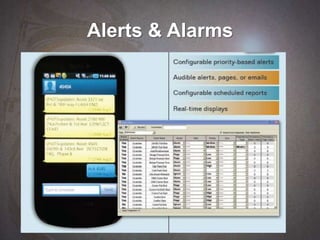
– Provide alerts, alarms, reports
– Real-time information
– Provide better management of the complete
system
– Support BCSMI where possible/practical
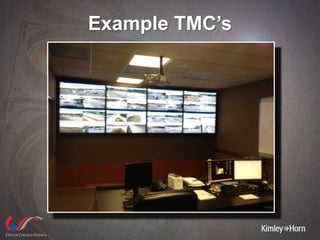
Example TMC’s
Implementation Plan
• Start with most needed
• Enhance capabilities
• Implement in phases
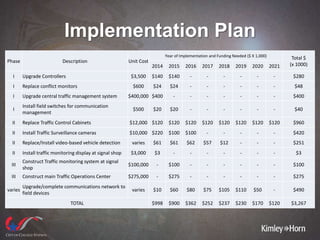
Implementation Plan
Phase Description Unit Cost
Year of Implementation and Funding Needed ($ X 1,000)
Total $
(x 1000)2014 2015 2016 2017 2018 2019 2020 2021
I Upgrade Controllers $3,500 $140 $140 - - - - - - $280
I Replace conflict monitors $600 $24 $24 - - - - - - $48
I Upgrade central traffic management system $400,000 $400 - - - - - - - $400
I
Install field switches for communication
management
$500 $20 $20 - - - - - - $40
II Replace Traffic Control Cabinets $12,000 $120 $120 $120 $120 $120 $120 $120 $120 $960
II Install Traffic Surveillance cameras $10,000 $220 $100 $100 - - - - - $420
II Replace/Install video-based vehicle detection varies $61 $61 $62 $57 $12 - - - $251
II Install traffic monitoring display at signal shop $3,000 $3 - - - - - - - $3
III
Construct Traffic monitoring system at signal
shop
$100,000 - $100 - - - - - - $100
III Construct main Traffic Operations Center $275,000 - $275 - - - - - - $275
varies
Upgrade/complete communications network to
field devices
varies $10 $60 $80 $75 $105 $110 $50 - $490
TOTAL $998 $900 $362 $252 $237 $230 $170 $120 $3,267
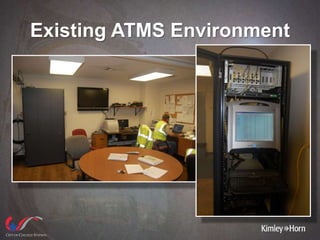
EXISTING ATMS
Existing ATMS Environment
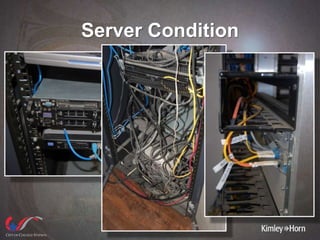
Server Condition
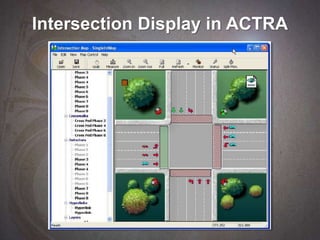
Intersection Display in ACTRA
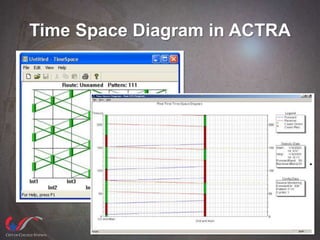
Time Space Diagram in ACTRA
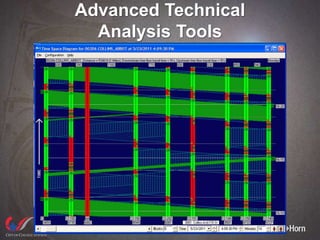
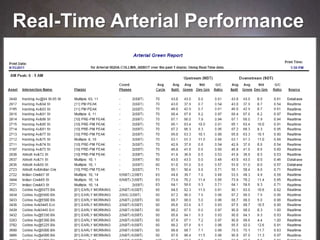
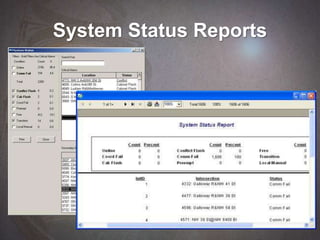
FUTURE ATMS
Advanced Technical
Analysis Tools
Real-Time Arterial Performance
26
System Status Reports
Alerts & Alarms
28
CCTV Control
and Viewing
ITS IN ACTION
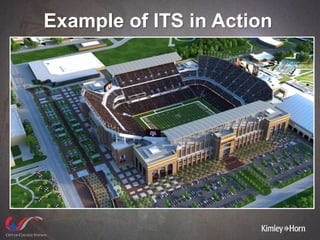
Example of ITS in Action
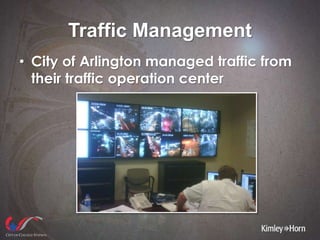
Traffic Management
• City of Arlington managed traffic from
their traffic operation center
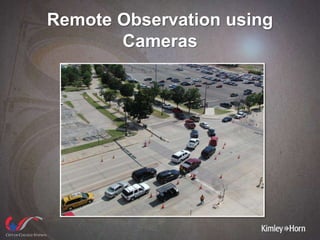
Remote Observation using
Cameras
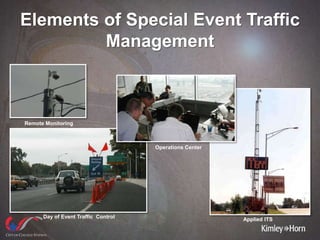
Elements of Special Event Traffic
Management
Day of Event Traffic Control
Remote Monitoring
Operations Center
Applied ITS
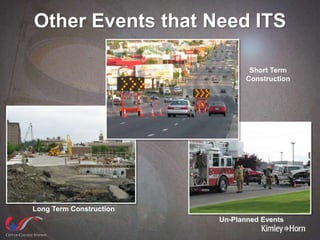
Other Events that Need ITS
Long Term Construction
Short Term
Construction
Un-Planned Events
WHAT’S NEXT
• Leverage funding to
maximize the
replacement of aging
equipment
• Implement technology
for advanced traffic
management
QUESTIONS?

ITS Master Plan

  • 1.
    City of CollegeStation Intelligent Transportation System Master Plan Presentation to City Council June 26, 2014
  • 2.
    AGENDA • What isand why implement ITS • The College Station plan • Examples in action
  • 3.
    Problem - Our transportationinfrastructure – highways and arterials, ports, and airways – are simply over used. Congestion has impacted every aspect of our daily lives.
  • 4.
    Problem - • Congestionalone, accounts for over $100 billion in lost productivity, wasted fuel, and environmental damage. Source: Texas Transportation Institute
  • 5.
    Fact - The levelof mobility on which we have come to depend can no longer be taken for granted
  • 6.
  • 7.
    What is ITS? •Intelligent Transportation System (ITS) is: – Technology that is leveraged to : • collect important information • convey important information • share information • ITS helps make informed decisions • ITS improves transportation safety and mobility • ITS enhances productivity
  • 8.
    ITS • ITS complimentstraditional capacity building practices • ITS compliments current initiatives for traffic management (Game Day) • ITS is not a silver bullet. It cannot make congestion go away, it can help manage the problem
  • 9.
    ITS MASTER PLAN BENEFITS •Provides vision for ITS deployment in the City • Describes how system components work together now and in the future • Identifies opportunities for resource sharing
  • 10.
    Steps to Createthe Plan • Determine goals • Develop concept of operations • Identify state of the practice • Determine technology and equipment • Identify communications network topology • Develop requirements • Develop plan
  • 11.
    Goals of ITS •Improve safety and mobility • Enhance security • Increase staff efficiency • Communicate to field devices
  • 12.
    GOALS AND OBJECTIVES GoalObjectives Establish a Replacement Strategy for Existing Equipment  Identify a strategy to replace existing legacy equipment  Include funding expenditure for equipment replacement Establish Performance Monitoring Program  Identify performance measures and data sources Construct Traffic Management Center  Identify the functions to be fulfilled from a central point of command and control  Identify location  Identify funding  Provide real-time information about incidents to fire and police departments  Evaluate traffic conditions in real-time Establish Operational Strategies  Review operations during special events  Respond to incidents  Support regional operations  Monitor traffic signal operations in real-time. Establish System Health Performance Monitoring  Identify types of operational data that will determine the operational health of the system Support the BCSMI  Select equipment that will foster communication with partner agencies equipment.  Remotely determine signal problems and evaluate needed repairs
  • 13.
    SYSTEM TOURS • PeerCity Tours: – Norman (OK) – Frisco – Garland – Arlington – Sugar Land • Take Away: – Traffic management centers enhance communication and management – Staffed TMC during peak periods, special events, incident management – Good communication network a must – CCTV cameras are a significant benefit to managing traffic demand and roadway congestion (planned and unplanned) – Share data with partners
  • 14.
    STATE OF THEPRACTICE • Traffic signal controllers and cabinets – City’s current cabinet architecture is based on a 1980’s era standard – Decision to move to current standard – Replace strategically over time
  • 15.
    STATE OF THEPRACTICE • Traffic management software – Need a modern system to provide command and control to all ITS devices – Based on proven success – Provide alerts, alarms, reports – Real-time information – Provide better management of the complete system – Support BCSMI where possible/practical
  • 16.
  • 17.
    Implementation Plan • Startwith most needed • Enhance capabilities • Implement in phases
  • 18.
    Implementation Plan Phase DescriptionUnit Cost Year of Implementation and Funding Needed ($ X 1,000) Total $ (x 1000)2014 2015 2016 2017 2018 2019 2020 2021 I Upgrade Controllers $3,500 $140 $140 - - - - - - $280 I Replace conflict monitors $600 $24 $24 - - - - - - $48 I Upgrade central traffic management system $400,000 $400 - - - - - - - $400 I Install field switches for communication management $500 $20 $20 - - - - - - $40 II Replace Traffic Control Cabinets $12,000 $120 $120 $120 $120 $120 $120 $120 $120 $960 II Install Traffic Surveillance cameras $10,000 $220 $100 $100 - - - - - $420 II Replace/Install video-based vehicle detection varies $61 $61 $62 $57 $12 - - - $251 II Install traffic monitoring display at signal shop $3,000 $3 - - - - - - - $3 III Construct Traffic monitoring system at signal shop $100,000 - $100 - - - - - - $100 III Construct main Traffic Operations Center $275,000 - $275 - - - - - - $275 varies Upgrade/complete communications network to field devices varies $10 $60 $80 $75 $105 $110 $50 - $490 TOTAL $998 $900 $362 $252 $237 $230 $170 $120 $3,267
  • 19.
  • 20.
  • 21.
  • 22.
  • 23.
  • 24.
  • 25.
  • 26.
  • 27.
  • 28.
  • 29.
  • 30.
  • 31.
    Example of ITSin Action
  • 32.
    Traffic Management • Cityof Arlington managed traffic from their traffic operation center
  • 33.
  • 34.
    Elements of SpecialEvent Traffic Management Day of Event Traffic Control Remote Monitoring Operations Center Applied ITS
  • 35.
    Other Events thatNeed ITS Long Term Construction Short Term Construction Un-Planned Events
  • 36.
    WHAT’S NEXT • Leveragefunding to maximize the replacement of aging equipment • Implement technology for advanced traffic management
  • 37.