1 |
Queensland Intelligent Transport
Systems Pilot Project
Dr Miranda Blogg, AITPM 2016
2 |2 |
Our values, our diversity
3 |3 |
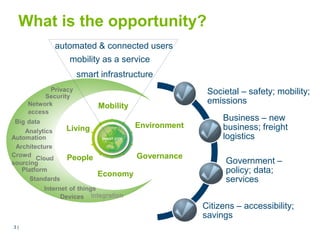
What is the opportunity?
Mobility
People
EnvironmentLiving
Governance
automated & connected users
Economy
smart infrastructure
mobility as a service
Societal – safety; mobility;
emissions
Business – new
business; freight
logistics
Government –
policy; data;
services
Citizens – accessibility;
savings
4 |4 |
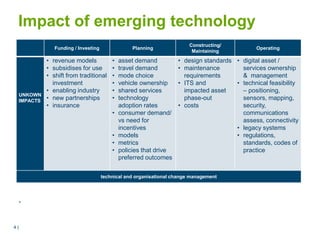
Impact of emerging technology
.
Funding / Investing Planning
Constructing/
Maintaining
Operating
UNKOWN
IMPACTS
• revenue models
• subsidises for use
• shift from traditional
investment
• enabling industry
• new partnerships
• insurance
• asset demand
• travel demand
• mode choice
• vehicle ownership
• shared services
• technology
adoption rates
• consumer demand/
vs need for
incentives
• models
• metrics
• policies that drive
preferred outcomes
• design standards
• maintenance
requirements
• ITS and
impacted asset
phase-out
• costs
• digital asset /
services ownership
& management
• technical feasibility
– positioning,
sensors, mapping,
security,
communications
assess, connectivity
• legacy systems
• regulations,
standards, codes of
practice
technical and organisational change management
5 |5 |
ITS pilot project
• March 2015 - A plan for Intelligent Transport Systems
(ITS) in Queensland – identifies pilot projects for
cooperative intelligent transport services (C-ITS) and
automated vehicles (AV)
• May 2016 – Business case approved by the department
to pilot these new technologies
6 |6 |
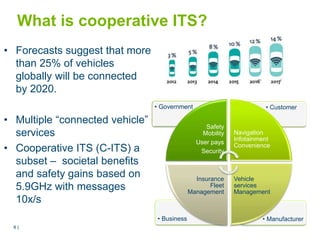
• Forecasts suggest that more
than 25% of vehicles
globally will be connected
by 2020.
• Multiple “connected vehicle”
services
• Cooperative ITS (C-ITS) a
subset – societal benefits
and safety gains based on
5.9GHz with messages
10x/s
• Manufacturer• Business
• Customer• Government
Safety
Mobility
User pays
Security
Navigation
Infotainment
Convenience
Vehicle
services
Management
Insurance
Fleet
Management
What is cooperative ITS?
7 |7 |
What is cooperative ITS?
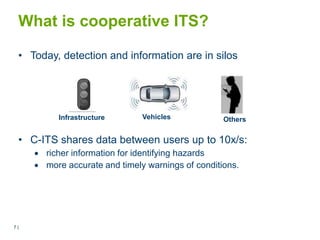
• Today, detection and information are in silos
• C-ITS shares data between users up to 10x/s:
 richer information for identifying hazards
 more accurate and timely warnings of conditions.
VehiclesInfrastructure Others
8 |8 |
Toyota C-ITS applications
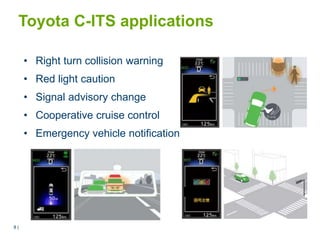
• Right turn collision warning
• Red light caution
• Signal advisory change
• Cooperative cruise control
• Emergency vehicle notification
9 |9 |
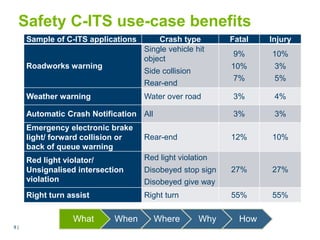
Safety C-ITS use-case benefits
What When Where Why How
Sample of C-ITS applications Crash type Fatal Injury
Roadworks warning
Single vehicle hit
object
Side collision
Rear-end
9%
10%
7%
10%
3%
5%
Weather warning Water over road 3% 4%
Automatic Crash Notification All 3% 3%
Emergency electronic brake
light/ forward collision or
back of queue warning
Rear-end 12% 10%
Red light violator/
Unsignalised intersection
violation
Red light violation
Disobeyed stop sign
Disobeyed give way
27% 27%
Right turn assist Right turn 55% 55%
10 |10 |
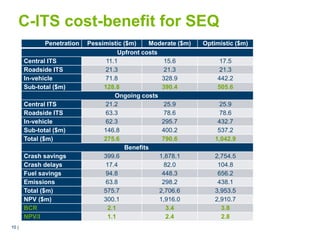
C-ITS cost-benefit for SEQ
Penetration Pessimistic ($m) Moderate ($m) Optimistic ($m)
Upfront costs
Central ITS 11.1 15.6 17.5
Roadside ITS 21.3 21.3 21.3
In-vehicle 71.8 328.9 442.2
Sub-total ($m) 128.8 390.4 505.6
Ongoing costs
Central ITS 21.2 25.9 25.9
Roadside ITS 63.3 78.6 78.6
In-vehicle 62.3 295.7 432.7
Sub-total ($m) 146.8 400.2 537.2
Total ($m) 275.6 790.6 1,042.9
Benefits
Crash savings 399.6 1,878.1 2,754.5
Crash delays 17.4 82.0 104.8
Fuel savings 94.8 448.3 656.2
Emissions 63.8 298.2 438.1
Total ($m) 575.7 2,706.6 3,953.5
NPV ($m) 300.1 1,916.0 2,910.7
BCR 2.1 3.4 3.8
NPV/I 1.1 2.4 2.8
11 |11 |
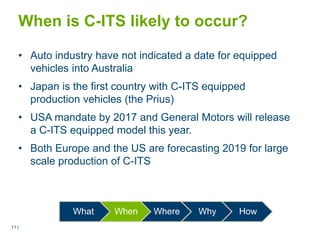
When is C-ITS likely to occur?
• Auto industry have not indicated a date for equipped
vehicles into Australia
• Japan is the first country with C-ITS equipped
production vehicles (the Prius)
• USA mandate by 2017 and General Motors will release
a C-ITS equipped model this year.
• Both Europe and the US are forecasting 2019 for large
scale production of C-ITS
What When Where Why How
12 |12 |
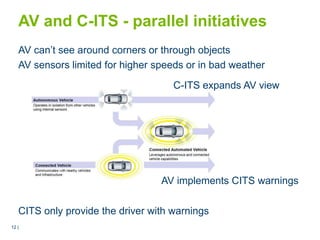
AV and C-ITS - parallel initiatives
CITS only provide the driver with warnings
AV can’t see around corners or through objects
AV sensors limited for higher speeds or in bad weather
AV implements CITS warnings
C-ITS expands AV view
13 |13 |
Why is government involved?
• AVs are dependent on governments to maintain the
physical asset and provide supportive policy, legislation and
regulations
• In addition, C-ITS is dependent on government to provide:
 arrangements for radio communications
 ITS infrastructure and data
 operation of a security system
 positioning augmentation
What When Where Why How
14 |14 |
How is government involved?
What When Where Why How
• Austroads program and guidelines for AV and C-ITS
• Transport and Infrastructure Senior Officials' Committee
(TISOC) draft national policy & action plan for AV and C-ITS
• National Transport Commission (NTC) review of regulation
and development of a framework
• Queensland state and safety action plan
 Harvest new technology and prepare for connected and
autonomous vehicles
 Better manage safety and speed through new technology
15 |15 |
How will the department be involved?
What When Where Why How
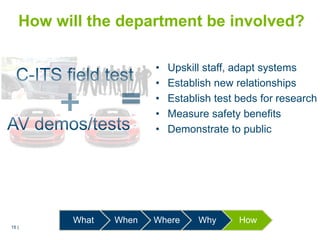
• Upskill staff, adapt systems
• Establish new relationships
• Establish test beds for research
• Measure safety benefits
• Demonstrate to public
16 |16 |
How will the department be involved?
What When Where Why How
• The pilots focus on the following:
 EU standards for the ITS station and system architecture
 5.9 and 3G/4G network access
 Positioning augmentation solutions (national need)
 Security credential management system (national need)
17 |
Thank you

Queensland’s Intelligent Transport Systems (ITS) Pilot Projects

  • 1.
    1 | Queensland IntelligentTransport Systems Pilot Project Dr Miranda Blogg, AITPM 2016
  • 2.
    2 |2 | Ourvalues, our diversity
  • 3.
    3 |3 | Whatis the opportunity? Mobility People EnvironmentLiving Governance automated & connected users Economy smart infrastructure mobility as a service Societal – safety; mobility; emissions Business – new business; freight logistics Government – policy; data; services Citizens – accessibility; savings
  • 4.
    4 |4 | Impactof emerging technology . Funding / Investing Planning Constructing/ Maintaining Operating UNKOWN IMPACTS • revenue models • subsidises for use • shift from traditional investment • enabling industry • new partnerships • insurance • asset demand • travel demand • mode choice • vehicle ownership • shared services • technology adoption rates • consumer demand/ vs need for incentives • models • metrics • policies that drive preferred outcomes • design standards • maintenance requirements • ITS and impacted asset phase-out • costs • digital asset / services ownership & management • technical feasibility – positioning, sensors, mapping, security, communications assess, connectivity • legacy systems • regulations, standards, codes of practice technical and organisational change management
  • 5.
    5 |5 | ITSpilot project • March 2015 - A plan for Intelligent Transport Systems (ITS) in Queensland – identifies pilot projects for cooperative intelligent transport services (C-ITS) and automated vehicles (AV) • May 2016 – Business case approved by the department to pilot these new technologies
  • 6.
    6 |6 | •Forecasts suggest that more than 25% of vehicles globally will be connected by 2020. • Multiple “connected vehicle” services • Cooperative ITS (C-ITS) a subset – societal benefits and safety gains based on 5.9GHz with messages 10x/s • Manufacturer• Business • Customer• Government Safety Mobility User pays Security Navigation Infotainment Convenience Vehicle services Management Insurance Fleet Management What is cooperative ITS?
  • 7.
    7 |7 | Whatis cooperative ITS? • Today, detection and information are in silos • C-ITS shares data between users up to 10x/s:  richer information for identifying hazards  more accurate and timely warnings of conditions. VehiclesInfrastructure Others
  • 8.
    8 |8 | ToyotaC-ITS applications • Right turn collision warning • Red light caution • Signal advisory change • Cooperative cruise control • Emergency vehicle notification
  • 9.
    9 |9 | SafetyC-ITS use-case benefits What When Where Why How Sample of C-ITS applications Crash type Fatal Injury Roadworks warning Single vehicle hit object Side collision Rear-end 9% 10% 7% 10% 3% 5% Weather warning Water over road 3% 4% Automatic Crash Notification All 3% 3% Emergency electronic brake light/ forward collision or back of queue warning Rear-end 12% 10% Red light violator/ Unsignalised intersection violation Red light violation Disobeyed stop sign Disobeyed give way 27% 27% Right turn assist Right turn 55% 55%
  • 10.
    10 |10 | C-ITScost-benefit for SEQ Penetration Pessimistic ($m) Moderate ($m) Optimistic ($m) Upfront costs Central ITS 11.1 15.6 17.5 Roadside ITS 21.3 21.3 21.3 In-vehicle 71.8 328.9 442.2 Sub-total ($m) 128.8 390.4 505.6 Ongoing costs Central ITS 21.2 25.9 25.9 Roadside ITS 63.3 78.6 78.6 In-vehicle 62.3 295.7 432.7 Sub-total ($m) 146.8 400.2 537.2 Total ($m) 275.6 790.6 1,042.9 Benefits Crash savings 399.6 1,878.1 2,754.5 Crash delays 17.4 82.0 104.8 Fuel savings 94.8 448.3 656.2 Emissions 63.8 298.2 438.1 Total ($m) 575.7 2,706.6 3,953.5 NPV ($m) 300.1 1,916.0 2,910.7 BCR 2.1 3.4 3.8 NPV/I 1.1 2.4 2.8
  • 11.
    11 |11 | Whenis C-ITS likely to occur? • Auto industry have not indicated a date for equipped vehicles into Australia • Japan is the first country with C-ITS equipped production vehicles (the Prius) • USA mandate by 2017 and General Motors will release a C-ITS equipped model this year. • Both Europe and the US are forecasting 2019 for large scale production of C-ITS What When Where Why How
  • 12.
    12 |12 | AVand C-ITS - parallel initiatives CITS only provide the driver with warnings AV can’t see around corners or through objects AV sensors limited for higher speeds or in bad weather AV implements CITS warnings C-ITS expands AV view
  • 13.
    13 |13 | Whyis government involved? • AVs are dependent on governments to maintain the physical asset and provide supportive policy, legislation and regulations • In addition, C-ITS is dependent on government to provide:  arrangements for radio communications  ITS infrastructure and data  operation of a security system  positioning augmentation What When Where Why How
  • 14.
    14 |14 | Howis government involved? What When Where Why How • Austroads program and guidelines for AV and C-ITS • Transport and Infrastructure Senior Officials' Committee (TISOC) draft national policy & action plan for AV and C-ITS • National Transport Commission (NTC) review of regulation and development of a framework • Queensland state and safety action plan  Harvest new technology and prepare for connected and autonomous vehicles  Better manage safety and speed through new technology
  • 15.
    15 |15 | Howwill the department be involved? What When Where Why How • Upskill staff, adapt systems • Establish new relationships • Establish test beds for research • Measure safety benefits • Demonstrate to public
  • 16.
    16 |16 | Howwill the department be involved? What When Where Why How • The pilots focus on the following:  EU standards for the ITS station and system architecture  5.9 and 3G/4G network access  Positioning augmentation solutions (national need)  Security credential management system (national need)
  • 17.

Editor's Notes

  • #3 Values In 2013 the Queensland Public Service launched new values to help revitalise the public service. These are customers first, ideas into action, unleash potential, be courageous and empower people. At TMR we are working hard to embed these in our culture and we are already working more collaboratively, more productively and smarter. Diversity We have a responsibility to ensure our employee pool reflects and better serves the diverse nature of the Queensland community. Diversity brings different perspectives into the workplace. An inclusive workplace ensures employees feel confident and supported to contribute and participate fully in the workforce. Diverse and inclusive teams: generate new ideas challenge the status-quo introduce fresh ways of looking at problems offer a wider range of potential solutions.
  • #10 Sample of applications used in the cost benefit assessment with no automation, assuming 100% penetration
  • #11 Roll out assumed from 2020 for a 30 year assessment period Government costs likely all central and roadside ITS Pessimistic assumes the death of C-ITS post 2030 Costs dependant on penetration Assessment based on the table of apps in slide 8 plus several emissions apps