Vivek Ogra, Director – Technology & Innovation
VBSOFT India Limited
TALKING TRANSIT
07.04.2016 , NEW DELHI, INDIA
ITS Implementation in STUs for Improving Efficiency
Challenges in Implementation & Contract Management
TRANSIT ITS IS WELL DEVELOPED & OFFERS MANY BENEFITS
Crucial Role Played by Transit ITS
ITS
Reliability
Security
& Safety
Commuter
Relations
Enhanced
Transit
Information
Automated
Fare
Services
Integrated
Planning
and
Scheduling
• Mobility on Demand,
• Connected Vehicles, and
• Automated and Autonomous
Vehicles.
FUTURE
Enhancement in
Service Quality
and Reliability
through the use
of ITS data for
Planning,
Management
and Big Data
leading to
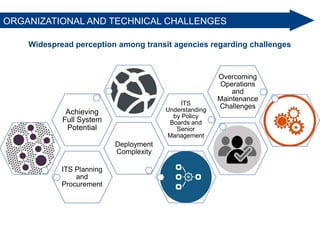
ORGANIZATIONAL AND TECHNICAL CHALLENGES
ITS Planning
and
Procurement
Deployment
Complexity
Achieving
Full System
Potential
ITS
Understanding
by Policy
Boards and
Senior
Management
Overcoming
Operations
and
Maintenance
Challenges
Widespread perception among transit agencies regarding challenges
UNDERSTANDING ITS – A CHALLENGE
Transit ITS suffers
from a
semantics
challenge
Computer – Assisted Dispatch
/ Automatic Vehicle Location
(CAD / AVL), Advanced Public
Transportation System
(APTS), ITS, etc.
All This > Creates
Confusion
• General lack of Standardization of
Technology and Use in Indian Context
• Lack of Functional Clarity
• Benefits of ITS are not defined
properly.
• Costs v/s benefits hard to define in
absence of standards driven
environment
REASONS
Lack of clarity
on funding for
management
and
maintenance
Could Lead to
Failure
Lack of
leadership in
planning and
deploying ITS
projects
Leads to Deficit
in Realizing
Benefits
Lack of
Resources
needs for
technical
needs
assessment
for systems
engineering
Lack of
Differentiation
between IT
v/s ITS
Lack of
investment in
internal ITS
expertise
within transit
agencies
RESULTS INTO
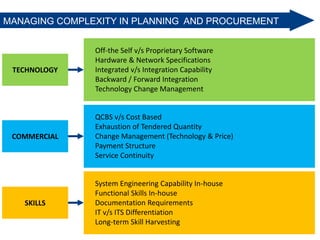
MANAGING COMPLEXITY IN PLANNING AND PROCUREMENT
TECHNOLOGY
COMMERCIAL
SKILLS
Off-the Self v/s Proprietary Software
Hardware & Network Specifications
Integrated v/s Integration Capability
Backward / Forward Integration
Technology Change Management
QCBS v/s Cost Based
Exhaustion of Tendered Quantity
Change Management (Technology & Price)
Payment Structure
Service Continuity
System Engineering Capability In-house
Functional Skills In-house
Documentation Requirements
IT v/s ITS Differentiation
Long-term Skill Harvesting
MANAGING SYSTEM DEPLOYMENT COMPLEXITY
ITS PROJECTS ARE GENERALLY COMPLEX TO DEPLOY
SYSTEM
ENGINEERING
PROCESS
INTERNAL
TECHNICAL
PROCESSES
UNFORESEEN
TECHNICAL
CHALLENGES
HUMAN AND
ORGANIZATIONAL
ISSUES
•Action item list
•System
Implementation
plan
•Communication
Plan
•Change
Management Plan
•Risk Management
Plan
•Quality Assurance
Plan
•Milestone Approval
•Installation Issues
•Data Preparation
and Integrity
•Involvement of
Maintenance
Department
•Due diligence at
design stage
•Underdeveloped
product by
suppliers
•Need for
interface and
integration with
third party
system causes
challenges and
latent costs –
Interface
Standards
•Inter-
departmental
ownership or
infrastructure
support
•Mid-stream
staffing changes
at agency or at
suppliers end
MANAGING OPERATIONS & MAINTENANCE CHALLENGES
TECHNICAL
CHALLENGES
ORGANIZATIONAL
CHALLENGES
OPERATIONAL
CHALLENGES
ONGOING
RELATIONS AND
SUPPLIERS
•Integration Of
various systems
•Integration of
components and
systems origination
from different
suppliers
•Proprietary
technology
•Maintenance of
large volume of
data
•Computing and
communications
efficacy
•Organizational Lead
for ITS operations
•Organizational
planning and
negotiation to
ensure ongoing
effective operations
and maintenance
•Organizational
Resistance
•Create basic staff
comprehension of
new technologies
•Unlearn, relearn
process
•Documenting
operating problems
•Operator
compliance
•Need and process
balance
Warranty
Management
Support & Training
Discovery of needs
after the deployment
– SE Process
MANAGING DELIVERY OF FULL SYSTEM POTENTIAL
TRANSIT ITS DATA
IS A VALUABLE
RESOURCE
ORGANIZATIONAL
READYNESS TO
BUILD ON ITS TO
REVISE BUSINESS
PRACTICES
INDUSTRY
STANDARDIZED
METHODOLOGIES
UNFULFILLED OR
UNDER-EXPLORED
BENEFITS
Data ownership
with agency to
ensure rightful
custody and reuse
Data Quality
Management
Expertise to
match, clean and
maintain data
Create expertise of
analytics
Data Interop
Under utilized
capabilities of ITS
by control Staff
lack of decision
support system
use
Lack of use of ITS
for standardized
service restoration
New opportunities
analysis deficit
Measuring the
accuracy of real-
time passenger
info
Measurement
accuracy of
commuter counts
Measuring
performance of
the system as a
whole
Connection
Protection
Yard Management
Vehicle Health
Monitoring
Real-time
proactive control
Integration of
fixed route transit
with flexible and
demand
responsive transit
ITS AS GATEWAY TO THE FUTURE
The future will see a growing trend towards interfaces, coordination and
integration of ITS technologies between different agencies:
• Regional Real-time Passenger Information Portals and Displays
• Multi-Agency Connection Protection
• Multi-Agency Advanced Fare Collection
• Transit Signal Priority
• Integrated Transit and Traffic Control Centres
• Integrated Corridor Management
• Lack of use of Standards
• Lack of scalability of legacy
systems
• Lack of ITS Strategic Plans
• Lack of participation in
Regional ITS Architecture
Process etc.
• Transit Big Data
• Mobility on Demand
• Connected Vehicles
• Autonomous and
Automated Vehicles
• Interest in ITS
• Technology Vision
• Knowledge
• Internal Expertise
• Interaction /
coordination within
organizations
ISSUES OPPORTUNITIES REQUIREMENT
RECOMMENDATION FOR FUTURE
Expand
Dissemination of
Transit ITS Best
Practices
Documentation and
Dissemination of
Transit ITS Benefits
and Business Case
Standardized
Methodologies and
Tools
Research and
Demonstration
Related to Unfulfilled
Benefits of ITS

ITS Implementation Challenges

  • 1.
    Vivek Ogra, Director– Technology & Innovation VBSOFT India Limited TALKING TRANSIT 07.04.2016 , NEW DELHI, INDIA ITS Implementation in STUs for Improving Efficiency Challenges in Implementation & Contract Management
  • 2.
    TRANSIT ITS ISWELL DEVELOPED & OFFERS MANY BENEFITS Crucial Role Played by Transit ITS ITS Reliability Security & Safety Commuter Relations Enhanced Transit Information Automated Fare Services Integrated Planning and Scheduling • Mobility on Demand, • Connected Vehicles, and • Automated and Autonomous Vehicles. FUTURE Enhancement in Service Quality and Reliability through the use of ITS data for Planning, Management and Big Data leading to
  • 3.
    ORGANIZATIONAL AND TECHNICALCHALLENGES ITS Planning and Procurement Deployment Complexity Achieving Full System Potential ITS Understanding by Policy Boards and Senior Management Overcoming Operations and Maintenance Challenges Widespread perception among transit agencies regarding challenges
  • 4.
    UNDERSTANDING ITS –A CHALLENGE Transit ITS suffers from a semantics challenge Computer – Assisted Dispatch / Automatic Vehicle Location (CAD / AVL), Advanced Public Transportation System (APTS), ITS, etc. All This > Creates Confusion • General lack of Standardization of Technology and Use in Indian Context • Lack of Functional Clarity • Benefits of ITS are not defined properly. • Costs v/s benefits hard to define in absence of standards driven environment REASONS Lack of clarity on funding for management and maintenance Could Lead to Failure Lack of leadership in planning and deploying ITS projects Leads to Deficit in Realizing Benefits Lack of Resources needs for technical needs assessment for systems engineering Lack of Differentiation between IT v/s ITS Lack of investment in internal ITS expertise within transit agencies RESULTS INTO
  • 5.
    MANAGING COMPLEXITY INPLANNING AND PROCUREMENT TECHNOLOGY COMMERCIAL SKILLS Off-the Self v/s Proprietary Software Hardware & Network Specifications Integrated v/s Integration Capability Backward / Forward Integration Technology Change Management QCBS v/s Cost Based Exhaustion of Tendered Quantity Change Management (Technology & Price) Payment Structure Service Continuity System Engineering Capability In-house Functional Skills In-house Documentation Requirements IT v/s ITS Differentiation Long-term Skill Harvesting
  • 6.
    MANAGING SYSTEM DEPLOYMENTCOMPLEXITY ITS PROJECTS ARE GENERALLY COMPLEX TO DEPLOY SYSTEM ENGINEERING PROCESS INTERNAL TECHNICAL PROCESSES UNFORESEEN TECHNICAL CHALLENGES HUMAN AND ORGANIZATIONAL ISSUES •Action item list •System Implementation plan •Communication Plan •Change Management Plan •Risk Management Plan •Quality Assurance Plan •Milestone Approval •Installation Issues •Data Preparation and Integrity •Involvement of Maintenance Department •Due diligence at design stage •Underdeveloped product by suppliers •Need for interface and integration with third party system causes challenges and latent costs – Interface Standards •Inter- departmental ownership or infrastructure support •Mid-stream staffing changes at agency or at suppliers end
  • 7.
    MANAGING OPERATIONS &MAINTENANCE CHALLENGES TECHNICAL CHALLENGES ORGANIZATIONAL CHALLENGES OPERATIONAL CHALLENGES ONGOING RELATIONS AND SUPPLIERS •Integration Of various systems •Integration of components and systems origination from different suppliers •Proprietary technology •Maintenance of large volume of data •Computing and communications efficacy •Organizational Lead for ITS operations •Organizational planning and negotiation to ensure ongoing effective operations and maintenance •Organizational Resistance •Create basic staff comprehension of new technologies •Unlearn, relearn process •Documenting operating problems •Operator compliance •Need and process balance Warranty Management Support & Training Discovery of needs after the deployment – SE Process
  • 8.
    MANAGING DELIVERY OFFULL SYSTEM POTENTIAL TRANSIT ITS DATA IS A VALUABLE RESOURCE ORGANIZATIONAL READYNESS TO BUILD ON ITS TO REVISE BUSINESS PRACTICES INDUSTRY STANDARDIZED METHODOLOGIES UNFULFILLED OR UNDER-EXPLORED BENEFITS Data ownership with agency to ensure rightful custody and reuse Data Quality Management Expertise to match, clean and maintain data Create expertise of analytics Data Interop Under utilized capabilities of ITS by control Staff lack of decision support system use Lack of use of ITS for standardized service restoration New opportunities analysis deficit Measuring the accuracy of real- time passenger info Measurement accuracy of commuter counts Measuring performance of the system as a whole Connection Protection Yard Management Vehicle Health Monitoring Real-time proactive control Integration of fixed route transit with flexible and demand responsive transit
  • 9.
    ITS AS GATEWAYTO THE FUTURE The future will see a growing trend towards interfaces, coordination and integration of ITS technologies between different agencies: • Regional Real-time Passenger Information Portals and Displays • Multi-Agency Connection Protection • Multi-Agency Advanced Fare Collection • Transit Signal Priority • Integrated Transit and Traffic Control Centres • Integrated Corridor Management • Lack of use of Standards • Lack of scalability of legacy systems • Lack of ITS Strategic Plans • Lack of participation in Regional ITS Architecture Process etc. • Transit Big Data • Mobility on Demand • Connected Vehicles • Autonomous and Automated Vehicles • Interest in ITS • Technology Vision • Knowledge • Internal Expertise • Interaction / coordination within organizations ISSUES OPPORTUNITIES REQUIREMENT
  • 10.
    RECOMMENDATION FOR FUTURE Expand Disseminationof Transit ITS Best Practices Documentation and Dissemination of Transit ITS Benefits and Business Case Standardized Methodologies and Tools Research and Demonstration Related to Unfulfilled Benefits of ITS