CHAPTER 4
Listening and Responding
Copyright © 2022 W. W. Norton & Company
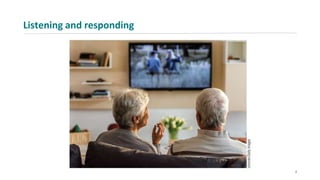
Listening and responding
2
4.1 Listening as a process
• Hearing vs. listening
• Active listening vs. passive listening
3
4
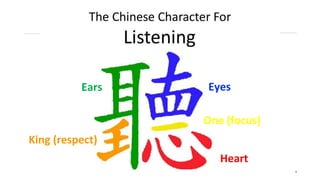
Ears
King (respect)
Eyes
One (focus)
Heart
Hearing versus listening
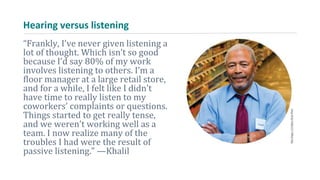
“Frankly, I’ve never given listening a
lot of thought. Which isn’t so good
because I’d say 80% of my work
involves listening to others. I’m a
floor manager at a large retail store,
and for a while, I felt like I didn’t
have time to really listen to my
coworkers’ complaints or questions.
Things started to get really tense,
and we weren’t working well as a
team. I now realize many of the
troubles I had were the result of
passive listening.” —Khalil
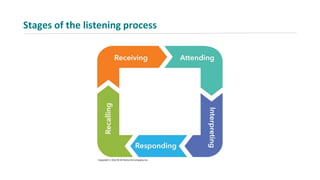
Stages of the listening process
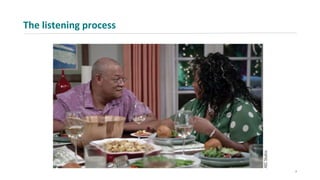
The listening process
7
Back-channel cues (1)
• The responses that you make as part of the listening
process are a form of feedback that are called back-
channel cues.
• Nonverbal back-channel cues
• Verbal back-channel cues
8
Back-channel cues (2)
9
Conversational turn-taking
• Conversational turn-taking is the method by
which you alternate between being a speaker and a
listening.
• Turn-yielding signals
• Turn-denying signals
• You use turn-requesting signals.
10
Listening styles (1)
Your listening style is your preferred way of making
sense of spoken messages. Your attitudes, goals,
interests, gender, and personality may influence your
listening preferences.
11
Listening styles (2)
12
4.2 The challenges of listening
• Listening fatigue
• The difference between the rate at which a person
speaks and your ability to process spoken messages
is called the speech-thought differential.
• Sensory overload
13
Types of listening (1)
• Selective listening
• In situations where we’d rather not acknowledge or
have to deal with something, we purposely insulate
or block out what we’re hearing.
• Pseudolistening
• Defensive listening
• Narcissistic listening
• Stage-hogging
• Monopolizing
• One-upping
14
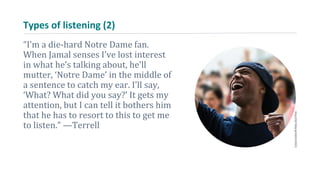
Types of listening (2)
“I’m a die-hard Notre Dame fan.
When Jamal senses I’ve lost interest
in what he’s talking about, he’ll
mutter, ‘Notre Dame’ in the middle of
a sentence to catch my ear. I’ll say,
‘What? What did you say?’ It gets my
attention, but I can tell it bothers him
that he has to resort to this to get me
to listen.” —Terrell
Types of listening (3)
16
Close-mindedness
• Close-minded listening often coincides with
monopolizing.
• A close-minded listener might say things like:
 “It doesn’t matter what you say.”
 ”I’ve heard this all before.”
 “I don’t have time for this.”
 “My mind is made up . . . period!”
 “You’re entitled to your opinion.”
17
Interrupting
• Interrupting occurs when you say something
before someone has finished speaking.
• One form of interrupting is gap-filling, which occurs
when you interrupt to finish a person’s thoughts or
story or add details to a story.
18
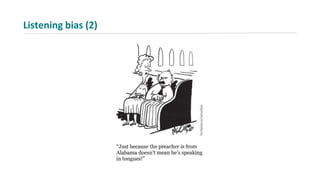
Listening bias (1)
• A listening bias is a set of preconceived ideas or beliefs that affect
how you listen to others.
• You may also listen to speakers differently if they speak with an
accent—a distinctive way of speaking a language—different than
your own.
• A dialect is a distinct way of speaking your first language.
Listening bias (2)
Hearing impairment
• Hearing loss can occur suddenly as a result of an
accident, deafening noise, or illness.
• There has been a sharp increase in hearing loss,
possibly due to the use of personal audio devices.
• Individuals who suffer hearing loss experience
increased listening fatigue as a result of greater
effort to understand.
21
4.3 Ways to improve listening and responding skills
• If you give your conversational partners as much
time as they need to communicate what’s on their
minds, it also gives you more time to decode and
form a comprehensive understanding of the
information they provide.
22
Postpone effectively (1)
• Postponement is when you delay a conversation
until you are ready to communicate effectively.
• Four ways to postpone effectively:
 State the reason for postponement.
 Recognize the person’s need to communicate.
 Agree on a time to reconvene.
 Follow through.
23
Postpone effectively (2)
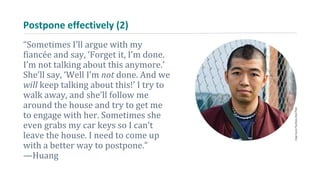
“Sometimes I’ll argue with my
fiancée and say, ‘Forget it, I’m done.
I’m not talking about this anymore.’
She’ll say, ‘Well I’m not done. And we
will keep talking about this!’ I try to
walk away, and she’ll follow me
around the house and try to get me
to engage with her. Sometimes she
even grabs my car keys so I can’t
leave the house. I need to come up
with a better way to postpone.”
—Huang
Paraphrase (1)
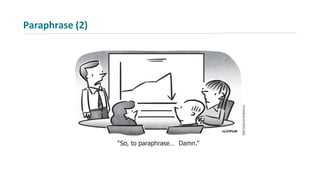
• Another technique that may enhance your listening and
responding skills is paraphrasing—briefly restating in your own
words what you heard someone say in an attempt to capture the
essence of their message.
• Paraphrases often begin with sentence starters like: “So,” “Sounds
like,” “What I heard you say was,” or “In other words . . .”
Paraphrase (2)
Metacommunication
• Receptivity is a person’s willingness to receive a
message or engage in a conversation.
• Check to see if the receiver is ready to listen.
• Ask the receiver to paraphrase you.
27
Mirror your conversational partner (1)
Mirroring occurs when you consciously and
subconsciously imitate or reflect a speaker’s emotional
state and communicate behaviors, such as vocal tones,
speech patterns, gestures, and facial expressions.
28
Mirror your conversational partner (2)
29
Practice with recall tests
• Taking time to recall and process the information
others share with you trains you to focus, concentrate,
and sharpen your memory.
• People love it when you show an interest in them and
remember the things they’ve shared with you in
earlier conversations.
• Also pay attention to the information people leave
out.
30
Listen and respond empathetically (1)
• Empathetic listening occurs when you listen in
order to identify with and share the feelings of
another person.
• What are the other person's communication goals,
and how can you respond accordingly?
31
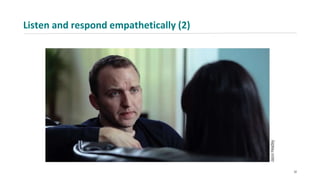
Listen and respond empathetically (2)
32
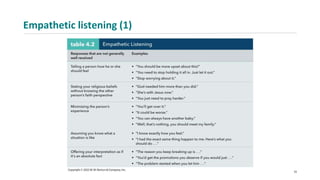
Empathetic listening (1)
33
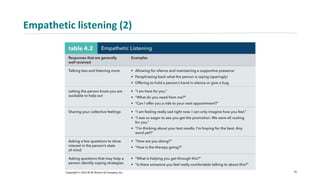
Empathetic listening (2)
34
Credits
This concludes the Lecture PowerPoint presentation for Chapter 4.
For more resources, please visit It’s Interpersonal, An Introduction
to Relational Communication, at:
http://digital.wwnorton.com/interpersonal
Copyright © 2022 W. W. Norton & Company

It's Interpersonal Ch. 4

  • 1.
    CHAPTER 4 Listening andResponding Copyright © 2022 W. W. Norton & Company
  • 2.
  • 3.
    4.1 Listening asa process • Hearing vs. listening • Active listening vs. passive listening 3
  • 4.
  • 5.
    Hearing versus listening “Frankly,I’ve never given listening a lot of thought. Which isn’t so good because I’d say 80% of my work involves listening to others. I’m a floor manager at a large retail store, and for a while, I felt like I didn’t have time to really listen to my coworkers’ complaints or questions. Things started to get really tense, and we weren’t working well as a team. I now realize many of the troubles I had were the result of passive listening.” —Khalil
  • 6.
    Stages of thelistening process
  • 7.
  • 8.
    Back-channel cues (1) •The responses that you make as part of the listening process are a form of feedback that are called back- channel cues. • Nonverbal back-channel cues • Verbal back-channel cues 8
  • 9.
  • 10.
    Conversational turn-taking • Conversationalturn-taking is the method by which you alternate between being a speaker and a listening. • Turn-yielding signals • Turn-denying signals • You use turn-requesting signals. 10
  • 11.
    Listening styles (1) Yourlistening style is your preferred way of making sense of spoken messages. Your attitudes, goals, interests, gender, and personality may influence your listening preferences. 11
  • 12.
  • 13.
    4.2 The challengesof listening • Listening fatigue • The difference between the rate at which a person speaks and your ability to process spoken messages is called the speech-thought differential. • Sensory overload 13
  • 14.
    Types of listening(1) • Selective listening • In situations where we’d rather not acknowledge or have to deal with something, we purposely insulate or block out what we’re hearing. • Pseudolistening • Defensive listening • Narcissistic listening • Stage-hogging • Monopolizing • One-upping 14
  • 15.
    Types of listening(2) “I’m a die-hard Notre Dame fan. When Jamal senses I’ve lost interest in what he’s talking about, he’ll mutter, ‘Notre Dame’ in the middle of a sentence to catch my ear. I’ll say, ‘What? What did you say?’ It gets my attention, but I can tell it bothers him that he has to resort to this to get me to listen.” —Terrell
  • 16.
  • 17.
    Close-mindedness • Close-minded listeningoften coincides with monopolizing. • A close-minded listener might say things like:  “It doesn’t matter what you say.”  ”I’ve heard this all before.”  “I don’t have time for this.”  “My mind is made up . . . period!”  “You’re entitled to your opinion.” 17
  • 18.
    Interrupting • Interrupting occurswhen you say something before someone has finished speaking. • One form of interrupting is gap-filling, which occurs when you interrupt to finish a person’s thoughts or story or add details to a story. 18
  • 19.
    Listening bias (1) •A listening bias is a set of preconceived ideas or beliefs that affect how you listen to others. • You may also listen to speakers differently if they speak with an accent—a distinctive way of speaking a language—different than your own. • A dialect is a distinct way of speaking your first language.
  • 20.
  • 21.
    Hearing impairment • Hearingloss can occur suddenly as a result of an accident, deafening noise, or illness. • There has been a sharp increase in hearing loss, possibly due to the use of personal audio devices. • Individuals who suffer hearing loss experience increased listening fatigue as a result of greater effort to understand. 21
  • 22.
    4.3 Ways toimprove listening and responding skills • If you give your conversational partners as much time as they need to communicate what’s on their minds, it also gives you more time to decode and form a comprehensive understanding of the information they provide. 22
  • 23.
    Postpone effectively (1) •Postponement is when you delay a conversation until you are ready to communicate effectively. • Four ways to postpone effectively:  State the reason for postponement.  Recognize the person’s need to communicate.  Agree on a time to reconvene.  Follow through. 23
  • 24.
    Postpone effectively (2) “SometimesI’ll argue with my fiancée and say, ‘Forget it, I’m done. I’m not talking about this anymore.’ She’ll say, ‘Well I’m not done. And we will keep talking about this!’ I try to walk away, and she’ll follow me around the house and try to get me to engage with her. Sometimes she even grabs my car keys so I can’t leave the house. I need to come up with a better way to postpone.” —Huang
  • 25.
    Paraphrase (1) • Anothertechnique that may enhance your listening and responding skills is paraphrasing—briefly restating in your own words what you heard someone say in an attempt to capture the essence of their message. • Paraphrases often begin with sentence starters like: “So,” “Sounds like,” “What I heard you say was,” or “In other words . . .”
  • 26.
  • 27.
    Metacommunication • Receptivity isa person’s willingness to receive a message or engage in a conversation. • Check to see if the receiver is ready to listen. • Ask the receiver to paraphrase you. 27
  • 28.
    Mirror your conversationalpartner (1) Mirroring occurs when you consciously and subconsciously imitate or reflect a speaker’s emotional state and communicate behaviors, such as vocal tones, speech patterns, gestures, and facial expressions. 28
  • 29.
  • 30.
    Practice with recalltests • Taking time to recall and process the information others share with you trains you to focus, concentrate, and sharpen your memory. • People love it when you show an interest in them and remember the things they’ve shared with you in earlier conversations. • Also pay attention to the information people leave out. 30
  • 31.
    Listen and respondempathetically (1) • Empathetic listening occurs when you listen in order to identify with and share the feelings of another person. • What are the other person's communication goals, and how can you respond accordingly? 31
  • 32.
    Listen and respondempathetically (2) 32
  • 33.
  • 34.
  • 35.
    Credits This concludes theLecture PowerPoint presentation for Chapter 4. For more resources, please visit It’s Interpersonal, An Introduction to Relational Communication, at: http://digital.wwnorton.com/interpersonal Copyright © 2022 W. W. Norton & Company

Editor's Notes

  • #3 Sometimes we’re unable to be fully present when listening to our relational partners. Bit if we want to become skilled communicators and foster healthy relationships, we need to engage in active listening. Photo credit: simonkr/Getty Images
  • #6 Photo credit: Tetra Images, LLC/Alamy Stock Photo
  • #7 Figure 4.1 Listening Process Photo credit: W. W. Norton & Company, Inc.
  • #8 In this clip from the TV comedy Black-ish, Earl (Laurence Fishburne) explains how he met his new fiancée, Lynette (Loretta Devine). Describe how the listening process helped Earl initiate a relationship with Lynette. How does Earl’s son Andrew (Anthony Anderson) rely on this same process to reduce his uncertainty regarding Lynette and Earl’s whirlwind engagement? On YouTube, search using the keywords “Pops Has a New Fiancee – black-ish.” Photo credit: ABC Studios
  • #10 Switched at Birth is a TV drama featuring hearing-impaired and deaf actors. Identify examples of positive and negative back-channel cues in this tense scene between Emmett (Sean Berdy), his brother Travis (Ryan Lane), and Emmett’s mother, Melody (Marlee Matlin). How do their back-channel cues (verbal from signing and nonverbal from eye contact and body movements) affect the way they come across and listen to each other? Which back-channel cues are negative and which are positive? On YouTube, search using the keywords: “Season 5, Episode 7: Travis and Emmett Argue Over Dinner.” Photo credit: Freeform Original Productions
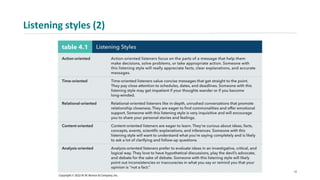
  • #13 Table 4.1 Listening Styles Photo credit: W. W. Norton & Company, Inc.
  • #16 Photo credit: Tetra Images, LLC/Alamy Stock Photo
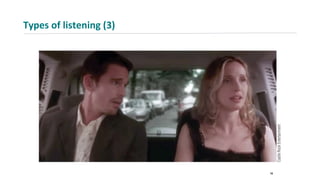
  • #17 In the film Before Sunset, Jesse (Ethan Hawke) and Celine (Julie Delpy) reunite nine years after they shared a romantic interlude. They spend part of a day together while Jesse promotes a book about their experience. How would you describe Celine’s listening behavior in this scene? Compare your answers to the concept of narcissistic listening and the behaviors of stage-hogging and monopolizing. On YouTube, search using the keywords, “Before Sunset (7/10) Movie CLIP – Stop the Car (2004).” Photo credit: Castle Rock Entertainment
  • #21 Photo credit: Tim Oliphant via CartoonStock
  • #25 Photo credit: Plus/Alamy Stock Photo
  • #27 Photo credit: Mark Anderson/Andertoons
  • #30 In this clip from Bachelor in Paradise, Demi Burnett speaks to her former girlfriend Kristian Haggerty about her inner conflict and ultimate realization. Notice the mirroring behaviors in their interactions. What were they? What effect did their behaviors appear to have on their conversation? On YouTube, search using the keywords: “Demi’s Girlfriend Kristian Arrives!” Photo credit: ABC Studios
  • #33 How often do you privately resent being told how you should think or what you should do? Receiving advice isn’t what we usually want, as illustrated in this humorous video. How would you describe the empathetic listening behavior of the guy sitting on the couch? On YouTube, search using the keywords “It’s Not About The Nail.” Photo credit: Jason Headey
  • #34 Table 4.2 Empathetic Listening Photo credit: W.W. Norton & Company, Inc.
  • #35 Table 4.2 Empathetic Listening Photo credit: W.W. Norton & Company, Inc.