CHAPTER 9
Interpersonal Conflict
Copyright © 2022 W. W. Norton & Company
Interpersonal conflict
2
9.1 The nature of interpersonal conflict
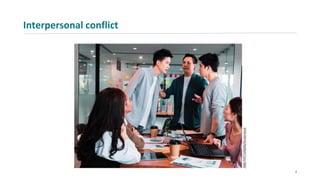
• Interpersonal conflict is a perceived struggle or
tension between two or more relational partners.
• Overt conflict is communicated in a clear,
straightforward manner.
• On the other hand, covert conflict is expressed
indirectly—usually masked by relational partners or
with no open acknowledgment.
3
What is conflict?
“Two weeks before my wedding, my
fiancé’s mother asked for pictures so
she could put a PowerPoint
presentation together to show during
our rehearsal dinner. I told her I
wasn’t a big fan of the idea. After our
conversation, she went ahead and told
my fiancé to send her the pictures. I
felt like she went behind my back and
didn’t take my feelings into
consideration.” —Dakotah
4
Conflict escalation
• A conflict spiral occurs when relational
partners address conflict in an increasingly
hostile and mean-spirited manner.
• Past-digging occurs when you bring up a
negative memory you have about your relational
partner.
• Two of the most common and damaging types of
past-digging is beltlining and gunny-sacking.
5
Conflict rituals
• A conflict ritual is a reoccurring pattern of
communication that sparks and inflames conflict.
• To de-escalate a conflict is to decrease its intensity
and scope.
6
Common causes of conflict (1)
• Change
• Incompatible values
• Scare resources
• Interdependence
• Memory disputes
• Meta-conflict
• Undesirable behaviors
7
Common causes of conflict (2)
8
Common causes of conflict (3)
9
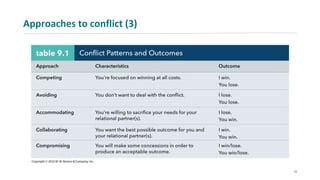
Approaches to conflict (1)
• Competing is a way of approaching conflict where
you prioritize getting what you want above all else.
• Avoiding vs. skirting
• Sniping occurs when you allude to a conflict but
then back away from it.
• Accommodating
• Collaborating
• Compromising
10
Approaches to conflict (2)
11
Approaches to conflict (3)
12
Approaches to conflict (4)
13
Misconceptions about conflict
• One misconception is that conflict is always bad
for a relationship—that it is deconstructive.
• If you work through conflict effectively, it is
constructive—Constructive conflict results in
positive relational outcomes.
14
9.2 Power in relationships
• Interpersonal power is the ability to influence a
relational partner’s thoughts, feelings, and
behaviors.
• You are abdicratic if you prefer to relinquish
control in most cases.
• If you’re a power seeker, you’re more autocratic.
• In the middle of the two ends of the power
spectrum is the democratic orientation.
15
Power orientations
16
Sources of power (1)
• Power currency is a desired resource that confers
interpersonal power on the person who possesses it.
• The principle of least interest suggests that a
relational partner who doesn’t value the
relationship as much or has the least interest in
continuing it holds more power in the relationship.
17
Sources of power (2)
18
Sources of power (3)
“My parents rely a lot on me to take care of
my younger siblings. This includes driving
them to school and work. They bought me
a nice car, and I spent a lot of money
detailing it and adding expensive rims.
When I told them I was ready to move out,
they said the car would have to stay with
them so my younger brother could drive
it—even though I paid for all of the repairs
and maintenance for four years! They also
offered to pay more of my tuition if I
stayed home. I feel like they want to
control every part of my life.” —Fernando
19
Compliance-gaining strategies (1)
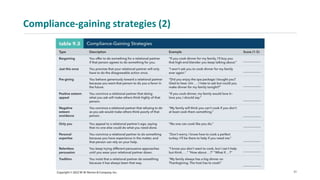
• Compliance-gaining strategies are the
communication tactics you use to get others to do
what you want them to do.
• A power play is when you use a compliance-
gaining tactic on someone repeatedly because it
gets you what you want.
20
Compliance-gaining strategies (2)
21
Compliance-gaining strategies (3)
22
9.3 Managing conflict effectively
• Approach conflict strategically.
• A benefit-of-the-doubt message is a statement
that conveys that you believe a person’s intentions
or behaviors are or were good, understandable, or
innocent.
• I-statements
• Validation
23
Encourage solution-based IPC (1)
• Solution-based communication focuses on
potential solutions rather than the behaviors that
started the conflict.
• A dual-perspective is the ability to understand
your own and your relational partner’s thoughts,
feelings, and needs.
24
Encourage solution-based IPC (2)
25
Encourage solution-based IPC (3)
“I confronted my supervisor after she
mentioned my slow sales numbers in
front of other staff members during a
meeting. She said, ‘I’m sorry. You have
every right to be upset. I made you look
bad when I was trying to motivate the
team by throwing challenges out. I
shouldn’t single anyone out. I will see
that it doesn’t happen again. I really
appreciate that you came to me. Is
there anything else I can do to rectify
this?’ She also appeared genuinely
concerned. I felt much better after
talking to her.” —Danielle
26
Follow conflict resolution steps (1)
27
Follow conflict resolution steps (1)
28
Credits
This concludes the Lecture PowerPoint presentation for Chapter 9.
For more resources, please visit It’s Interpersonal, An Introduction
to Relational Communication, at:
http://digital.wwnorton.com/interpersonal
Copyright © 2022 W. W. Norton & Company

It's Interpersonal Ch. 9

  • 1.
    CHAPTER 9 Interpersonal Conflict Copyright© 2022 W. W. Norton & Company
  • 2.
  • 3.
    9.1 The natureof interpersonal conflict • Interpersonal conflict is a perceived struggle or tension between two or more relational partners. • Overt conflict is communicated in a clear, straightforward manner. • On the other hand, covert conflict is expressed indirectly—usually masked by relational partners or with no open acknowledgment. 3
  • 4.
    What is conflict? “Twoweeks before my wedding, my fiancé’s mother asked for pictures so she could put a PowerPoint presentation together to show during our rehearsal dinner. I told her I wasn’t a big fan of the idea. After our conversation, she went ahead and told my fiancé to send her the pictures. I felt like she went behind my back and didn’t take my feelings into consideration.” —Dakotah 4
  • 5.
    Conflict escalation • Aconflict spiral occurs when relational partners address conflict in an increasingly hostile and mean-spirited manner. • Past-digging occurs when you bring up a negative memory you have about your relational partner. • Two of the most common and damaging types of past-digging is beltlining and gunny-sacking. 5
  • 6.
    Conflict rituals • Aconflict ritual is a reoccurring pattern of communication that sparks and inflames conflict. • To de-escalate a conflict is to decrease its intensity and scope. 6
  • 7.
    Common causes ofconflict (1) • Change • Incompatible values • Scare resources • Interdependence • Memory disputes • Meta-conflict • Undesirable behaviors 7
  • 8.
    Common causes ofconflict (2) 8
  • 9.
    Common causes ofconflict (3) 9
  • 10.
    Approaches to conflict(1) • Competing is a way of approaching conflict where you prioritize getting what you want above all else. • Avoiding vs. skirting • Sniping occurs when you allude to a conflict but then back away from it. • Accommodating • Collaborating • Compromising 10
  • 11.
  • 12.
  • 13.
  • 14.
    Misconceptions about conflict •One misconception is that conflict is always bad for a relationship—that it is deconstructive. • If you work through conflict effectively, it is constructive—Constructive conflict results in positive relational outcomes. 14
  • 15.
    9.2 Power inrelationships • Interpersonal power is the ability to influence a relational partner’s thoughts, feelings, and behaviors. • You are abdicratic if you prefer to relinquish control in most cases. • If you’re a power seeker, you’re more autocratic. • In the middle of the two ends of the power spectrum is the democratic orientation. 15
  • 16.
  • 17.
    Sources of power(1) • Power currency is a desired resource that confers interpersonal power on the person who possesses it. • The principle of least interest suggests that a relational partner who doesn’t value the relationship as much or has the least interest in continuing it holds more power in the relationship. 17
  • 18.
  • 19.
    Sources of power(3) “My parents rely a lot on me to take care of my younger siblings. This includes driving them to school and work. They bought me a nice car, and I spent a lot of money detailing it and adding expensive rims. When I told them I was ready to move out, they said the car would have to stay with them so my younger brother could drive it—even though I paid for all of the repairs and maintenance for four years! They also offered to pay more of my tuition if I stayed home. I feel like they want to control every part of my life.” —Fernando 19
  • 20.
    Compliance-gaining strategies (1) •Compliance-gaining strategies are the communication tactics you use to get others to do what you want them to do. • A power play is when you use a compliance- gaining tactic on someone repeatedly because it gets you what you want. 20
  • 21.
  • 22.
  • 23.
    9.3 Managing conflicteffectively • Approach conflict strategically. • A benefit-of-the-doubt message is a statement that conveys that you believe a person’s intentions or behaviors are or were good, understandable, or innocent. • I-statements • Validation 23
  • 24.
    Encourage solution-based IPC(1) • Solution-based communication focuses on potential solutions rather than the behaviors that started the conflict. • A dual-perspective is the ability to understand your own and your relational partner’s thoughts, feelings, and needs. 24
  • 25.
  • 26.
    Encourage solution-based IPC(3) “I confronted my supervisor after she mentioned my slow sales numbers in front of other staff members during a meeting. She said, ‘I’m sorry. You have every right to be upset. I made you look bad when I was trying to motivate the team by throwing challenges out. I shouldn’t single anyone out. I will see that it doesn’t happen again. I really appreciate that you came to me. Is there anything else I can do to rectify this?’ She also appeared genuinely concerned. I felt much better after talking to her.” —Danielle 26
  • 27.
  • 28.
  • 29.
    Credits This concludes theLecture PowerPoint presentation for Chapter 9. For more resources, please visit It’s Interpersonal, An Introduction to Relational Communication, at: http://digital.wwnorton.com/interpersonal Copyright © 2022 W. W. Norton & Company

Editor's Notes

  • #3 Conflict and power struggles are inevitable in close, interdependent relationships. Our ability to communicate a conflict and work through it will affect our relationships. A coworker who lacks skills in conflict management may turn a simple meeting into a very tense situation.​
  • #5 Photo credit: Bukas Presseagentur GmbH/Alamy Stock Photo
  • #9 In this scene from the 2020 TV series Party of Five, Javier (Bruno Bichir) and his son Emilio (Brandon Larracuente) rely on technology to stay connected after Javier and his wife Gloria are deported to Mexico. An issue gets brought up. How would you use this scene to define interpersonal conflict? What do you think is the cause of their conflict? Does it appear to be expressed more in a covert or overt way? On YouTube, search using the keywords: “Party of Five Season 1, Episode 6 – Javier is worried Emilio is hiding something.” ​ Photo credit: Pamplona Productions
  • #10 Photo credit: Jack Ziegler via CartoonStock
  • #12 In the TV series Pose, several teenagers who are rejected by their families form a family unit with Blanca (Mj Rodriguez), a transgender woman. Blanca is determined to see them realize their potential. Compare this scene between Blanca and Helena (Charlayne Woodard), the lead instructor at a prestigious dance school, to the seven sources of conflict highlighted in this section. Which source of conflict is evident in the clip? How might this source of conflict unfold from an IPC standpoint in both a positive way and a negative way? On YouTube, search using the keywords: “Pose Season 1 Real Mothers Scene.” ​ Photo credit: Color Force
  • #13 Table 9.1 Approaches to Conflict Photo credit: W. W. Norton and Company, Inc.
  • #14 In this scene from the TV series Station 19, firefighter Victoria (Barrett Doss) confronts her best friend Travis (Jay Hayden) about his decision to order a rookie to leave his side when his injuries and an intense fire threatened both of their lives. Which of the conflict approaches does Victoria use? On YouTube, search using the keywords: “Station 19 Victoria Tells Travis Why’s She’s Mad ​at Him.” ​ Photo credit: Trip the Light
  • #17 Figure 9.1 Power Orientations Photo Credit: W. W. Norton & Company, Inc.
  • #19 Table 9.2 French and Raven’s Five Power Bases Photo credit: W. W. Norton and Company, Inc.
  • #20 Photo credit: Gelpi/Shutterstock
  • #22 Table 9.3 Compliance-Gaining Strategies Photo credit: W. W. Norton and Company, Inc.
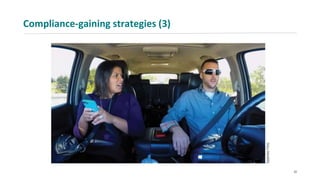
  • #23 In this scene from the TV series Bridezilla, a couple, Lessika and Jeremy, are having a conflict regarding an important aspect of their wedding. How do they use their communication to get what they want? Do you see an example of a compliance-gaining strategy in this clip? On YouTube, search using the keywords: “Altar Aftermath – Bridezillas.” ​ Photo credit: September Films
  • #26 Photo credit: P.C. Vey Via CartoonStock
  • #27 Photo credit: Jacon Lund/Shutterstock
  • #28 Figure 9.2 Conflict Resolution Steps Photo credit: W. W. Norton and Company, Inc
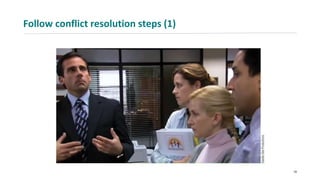
  • #29 In The Office, the regional manager of the Scranton branch of the Dunder Mifflin Paper Company, Michael Scott (Steve Carell), attempts to use some of the conflict resolution steps you’ve just read about with his employees Pam (Jenna Fischer), Angela (Angela Kinsey), and Oscar (Oscar Nunez). Which steps did he use? What did he do well and what could he have done better? On YouTube, search using the keywords: “The Office – Conflict Resolution.”  ​ ​ Photo credit: Deedle-Dee Productions