CHAPTER 7
Emotional Expression
Copyright © 2022 W. W. Norton & Company
Emotional intelligence
• Emotional intelligence (EI) is the ability to
identify, manage, and express your emotions
effectively.
• Empathy is the ability to understand,
appreciate, and value what someone else is
feeling.
2
Emotional expression
3
7.2 Emotional challenges
• Emotional labor is the effort it takes to generate,
manage, and mask your emotions.
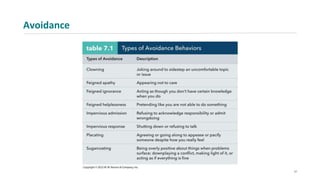
• Avoidance is the act of evading or skirting a
person, interaction, or conversational topic.
• Passive-aggressiveness is a form of indirect
hostility that allows the sender to appear
outwardly noncombative.
4
Irrational thinking (1)
• Many of our negative, debilitative emotions are
supported by irrational beliefs, also referred to as
fallacies.
• The fallacy of approval is the belief that it’s
essential to seek and win everyone’s acceptance
and admiration.
• When you’re convinced that a communication
choice will definitely result in a certain outcome,
you’re committing the fallacy of causation.
5
Irrational thinking (3)
• The fallacy of overgeneralization entails taking a
single instance and believing that it’s an enduring
absolute.
• You subscribe to the fallacy of perfection if you think
it’s essential to communication exceptionally well all
the time.
• The fallacy of should is the belief that others ought to
think and behave just as you do.
6
Communicate your emotions competently (1)
• Postpone conversations strategically.
• Perspective-taking is the act of imagining that
you are the other person in a given situation.
• Express your emotions asynchronously.
• Use I-language and “I feel . . . because . . . I need”
statements—a sentence structure that helps you
focus on the behavior that affects you and what
you’d like your relational partner to do.
7
7.3 Improving emotional expression
• The following seven questions will identify and
manage your emotions:
 What am I feeling?
 Why do I feel this way?
 How can I look at my situation differently?
 What can I do to make myself feel better?
 What is outside of my control?
 What is right about my life?
 What hasn’t changed in my life?
8
Emotional expression
9
7.1 Emotion and IPC
• An emotion (or feeling) is a psychological or
physiological response to an activating event.
• Blended emotions vs. conflicting emotions
• Meta-emotion is an emotion about an emotion—or
a feeling about a feeling.
• Compared to an emotion, a mood is an emotional
state that lacks a clear cause or contextual stimulus.
10
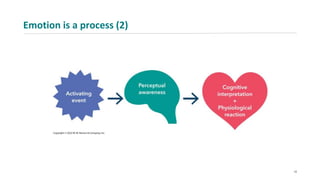
Emotion is a process (1)
• Emotional experience is the internal sensation and
identification of your own emotions.
• The rational-emotive theory (RET) is the idea that
your cognitive interpretation of an event has more to
do with your emotion than the activating event does.
• Emotional contagion vs. emotional expression
11
Emotion is a process (2)
12
Emotional experience and expression
13
Emotions are facilitative and debilitative (1)
• Facilitative emotions are emotions that help you
improve the quality of your communication and
enhance relational outcomes.
• Debilitative emotions are emotions that interfere
with your ability to communicate and produce
negative relational outcomes.
14
Emotions are facilitative and debilitative (2)
“At age 19 I was always angry and
frustrated with my mom. We argued a
lot, often in nasty ways, which hurt our
relationship. These same emotions—
anger and frustration—motivated me to
venture out and become independent.
After I moved out, we got along much
better. It really helped improve our
relationship!” —Lorana
15
The influence of culture and gender
• Throughout your life you’ll receive direct and
indirect messages encouraging you to adhere to
certain emotional display rules, or the social dos
and don’ts of emotional expression.
• Belonging to an organizational or societal culture
can influence how you express your feelings.
• Gender socialization plays a significance role in how
we experience and express emotion.
16
Avoidance
17
Displacement and trapping (1)
• Displacement occurs when you lash out at someone
who is not the cause of your negative emotions.
• Trapping is the act of asking someone to
communication in a certain way and the making that
person regret doing what you’ve asked.
18
Displacement and trapping (2)
19
Withholding
• Withholding occurs when you purposely deprive
someone of something they want or need in order
to express your negative feelings and exert control.
• Withholding can also be used to manipulate and
control a person’s behavior.
20
Irrational thinking (2)
21
Irrational thinking (4)
22
Identify and manage your emotions
‟When I was a kid, I remember standing
in the yard with my mom and sister. We
had just given our dog Lucky a bath. She
jumped out of the outdoor tub and
started shaking her fur like crazy to dry
off. She put her whole body into it. My
mom said, ‘See, you can do the same
thing when you are angry or upset, just
shake it off.’ We stood there and shook
our bodies just like Lucky. It was
hilarious. Later, whenever one of us
would get upset, someone would say,
‘Just shake it off,’ and imitate our
beloved dog. It was hard not to laugh or
smile.” —Devon
23
Communicate your emotions competently (2)
24
Communicate your emotions competently (3)
• Validation is the act of recognizing another
person’s stated or unstated thoughts, feelings, and
needs.
• Convey more gratitude—make it a point every day
to communicate the positive things you see in your
relational partners.
25
Communicate your emotions competently (4)
26
Practice and seek forgiveness effectively
• Forgiveness is an emotional process that requires
time and the ability to reconstruct your thoughts.
• If you are seeking forgiveness:
 Admit your wrongdoing, apologize sincerely,
do not repeat the transgression, try to make
amends, listen to your relational partners, and
validate their feelings.
27
Express your love to stay in love
• There are certain practices that may reinforce a
deeper romantic and emotional connection:
 Stare into your romantic partner’s eyes for at
least two minutes on a regular basis while
holding hands.
 Exercise together.
 Engage in more spontaneous activities with
each other.
 Hold hands when talking about thorny topics.
 If it’s a part of your relationship, talk openly in
a loving way about your sex life.
28
Credits
This concludes the Lecture PowerPoint presentation for Chapter 7.
For more resources, please visit It’s Interpersonal, An Introduction to
Relational Communication, at:
http://digital.wwnorton.com/interpersonal
Copyright © 2022 W. W. Norton & Company

It's Interpersonal Ch. 7

  • 1.
    CHAPTER 7 Emotional Expression Copyright© 2022 W. W. Norton & Company
  • 2.
    Emotional intelligence • Emotionalintelligence (EI) is the ability to identify, manage, and express your emotions effectively. • Empathy is the ability to understand, appreciate, and value what someone else is feeling. 2
  • 3.
  • 4.
    7.2 Emotional challenges •Emotional labor is the effort it takes to generate, manage, and mask your emotions. • Avoidance is the act of evading or skirting a person, interaction, or conversational topic. • Passive-aggressiveness is a form of indirect hostility that allows the sender to appear outwardly noncombative. 4
  • 5.
    Irrational thinking (1) •Many of our negative, debilitative emotions are supported by irrational beliefs, also referred to as fallacies. • The fallacy of approval is the belief that it’s essential to seek and win everyone’s acceptance and admiration. • When you’re convinced that a communication choice will definitely result in a certain outcome, you’re committing the fallacy of causation. 5
  • 6.
    Irrational thinking (3) •The fallacy of overgeneralization entails taking a single instance and believing that it’s an enduring absolute. • You subscribe to the fallacy of perfection if you think it’s essential to communication exceptionally well all the time. • The fallacy of should is the belief that others ought to think and behave just as you do. 6
  • 7.
    Communicate your emotionscompetently (1) • Postpone conversations strategically. • Perspective-taking is the act of imagining that you are the other person in a given situation. • Express your emotions asynchronously. • Use I-language and “I feel . . . because . . . I need” statements—a sentence structure that helps you focus on the behavior that affects you and what you’d like your relational partner to do. 7
  • 8.
    7.3 Improving emotionalexpression • The following seven questions will identify and manage your emotions:  What am I feeling?  Why do I feel this way?  How can I look at my situation differently?  What can I do to make myself feel better?  What is outside of my control?  What is right about my life?  What hasn’t changed in my life? 8
  • 9.
  • 10.
    7.1 Emotion andIPC • An emotion (or feeling) is a psychological or physiological response to an activating event. • Blended emotions vs. conflicting emotions • Meta-emotion is an emotion about an emotion—or a feeling about a feeling. • Compared to an emotion, a mood is an emotional state that lacks a clear cause or contextual stimulus. 10
  • 11.
    Emotion is aprocess (1) • Emotional experience is the internal sensation and identification of your own emotions. • The rational-emotive theory (RET) is the idea that your cognitive interpretation of an event has more to do with your emotion than the activating event does. • Emotional contagion vs. emotional expression 11
  • 12.
    Emotion is aprocess (2) 12
  • 13.
  • 14.
    Emotions are facilitativeand debilitative (1) • Facilitative emotions are emotions that help you improve the quality of your communication and enhance relational outcomes. • Debilitative emotions are emotions that interfere with your ability to communicate and produce negative relational outcomes. 14
  • 15.
    Emotions are facilitativeand debilitative (2) “At age 19 I was always angry and frustrated with my mom. We argued a lot, often in nasty ways, which hurt our relationship. These same emotions— anger and frustration—motivated me to venture out and become independent. After I moved out, we got along much better. It really helped improve our relationship!” —Lorana 15
  • 16.
    The influence ofculture and gender • Throughout your life you’ll receive direct and indirect messages encouraging you to adhere to certain emotional display rules, or the social dos and don’ts of emotional expression. • Belonging to an organizational or societal culture can influence how you express your feelings. • Gender socialization plays a significance role in how we experience and express emotion. 16
  • 17.
  • 18.
    Displacement and trapping(1) • Displacement occurs when you lash out at someone who is not the cause of your negative emotions. • Trapping is the act of asking someone to communication in a certain way and the making that person regret doing what you’ve asked. 18
  • 19.
  • 20.
    Withholding • Withholding occurswhen you purposely deprive someone of something they want or need in order to express your negative feelings and exert control. • Withholding can also be used to manipulate and control a person’s behavior. 20
  • 21.
  • 22.
  • 23.
    Identify and manageyour emotions ‟When I was a kid, I remember standing in the yard with my mom and sister. We had just given our dog Lucky a bath. She jumped out of the outdoor tub and started shaking her fur like crazy to dry off. She put her whole body into it. My mom said, ‘See, you can do the same thing when you are angry or upset, just shake it off.’ We stood there and shook our bodies just like Lucky. It was hilarious. Later, whenever one of us would get upset, someone would say, ‘Just shake it off,’ and imitate our beloved dog. It was hard not to laugh or smile.” —Devon 23
  • 24.
    Communicate your emotionscompetently (2) 24
  • 25.
    Communicate your emotionscompetently (3) • Validation is the act of recognizing another person’s stated or unstated thoughts, feelings, and needs. • Convey more gratitude—make it a point every day to communicate the positive things you see in your relational partners. 25
  • 26.
    Communicate your emotionscompetently (4) 26
  • 27.
    Practice and seekforgiveness effectively • Forgiveness is an emotional process that requires time and the ability to reconstruct your thoughts. • If you are seeking forgiveness:  Admit your wrongdoing, apologize sincerely, do not repeat the transgression, try to make amends, listen to your relational partners, and validate their feelings. 27
  • 28.
    Express your loveto stay in love • There are certain practices that may reinforce a deeper romantic and emotional connection:  Stare into your romantic partner’s eyes for at least two minutes on a regular basis while holding hands.  Exercise together.  Engage in more spontaneous activities with each other.  Hold hands when talking about thorny topics.  If it’s a part of your relationship, talk openly in a loving way about your sex life. 28
  • 29.
    Credits This concludes theLecture PowerPoint presentation for Chapter 7. For more resources, please visit It’s Interpersonal, An Introduction to Relational Communication, at: http://digital.wwnorton.com/interpersonal Copyright © 2022 W. W. Norton & Company

Editor's Notes

  • #4 The emotions we experience, like the romantic ones felt by this couple, play a powerful role in our interpersonal communication. When we express and manage them effectively, our emotions can lead to healthy and happy relationships. Photo credit: Rawpixel.com/Shutterstock
  • #10 The emotions we experience, like the romantic ones felt by this couple, play a powerful role in our interpersonal communication. When we express and manage them effectively, our emotions can lead to healthy and happy relationships. Photo credit: Rawpixel.com/Shutterstock
  • #13 Figure 7.1 Process of Emotion Photo credit: W. W. Norton & Company, Inc.
  • #14 Real Housewives of Atlanta reality star Phaedra Parks and her son Ayden are experiencing significant emotions on their way to Ayden’s first day of school. Use the process of emotion—the activating event, perceptual awareness, cognitive interpretation, and physiological reaction—to describe their emotional experience. How do they express their emotions? On YouTube, search using the keywords: “RHOA: Ayden brings Phaedra to tears on his first day of school.” ​ ​ ​Photo credit: BRAVO
  • #16 Photo credit: Neil McAllister/Alamy Stock Photo
  • #18  Table 7.1 Types of Avoidance Behaviors Photo credit: W. W. Norton & Company, Inc.
  • #20 Photo credit: Tom Cheney/The New Yorker Collection/The Cartoon Bank
  • #22 After hitting his first career home run in the major leagues, San Diego Padres outfielder Travis Jankowski returns to the bullpen expecting to receive enthusiastic congratulations from his teammates. Whether his teammates reacted this way intentionally or not, how might a situation like this fit the description of withholding? When was the last time you used withholding to convey a message to someone? What was the result? On YouTube, search using the keywords: “SD@SF: Jankowski gets silent treatment after home run.” ​ Photo credit: MLB
  • #23 In this scene from the reality show Teen Mom, Cheyenne and her boyfriend Zach sit down to discuss what happened at a family barbecue. At what point in their conversation do you hear examples of the fallacy of should and the fallacy of overgeneralization? How is Cheyenne and Zach’s conversation about this incident productive? On YouTube, search using the keywords: “Communication is Key | Teen Mom OG | MTV.” ​ Photo credit: MTV
  • #24 Photo credit: Neil McAllister/Alamy Stock Photo
  • #25 Photo credit: David Sipress via Cartoon Collections
  • #27 In this clip from the movie The Break-Up, after hosting a dinner for their parents, Brooke (Jennifer Aniston) and her romantic partner Gary (Vince Vaughn) get into a major argument. After watching this scene pinpoint instances where Gary and Brooke could have validated each other using any of the AAAAI validation approaches. How would validation help them to steer their conversation in a more positive, productive direction? On YouTube search using the keywords: “The BreakUp-fighting scene (2006).” ​ Photo credit: Mosaic Media Group/Wild West Pictures Show Productions