CHAPTER 11
Communication
and Technology
Copyright © 2022 W. W. Norton & Company
11.1 The nature of technology-mediated communication
• Technology-mediated communication (TMC) is
the process of exchanging and assigning meaning to
messages that are facilitated by technology channels
and applications.
• According to the media ecology perspective
(MEP), technology reshapes and reorganizes your
interpersonal communication values, perceptions,
and behaviors.
2
Interpersonal challenges of TMC
• Less richness
• Digital infidelity is the act of secretly exchanging
sexual, romantic, or flirtatious messages online with
someone who is not your current romantic partner.
• Phone snubbing is the act of making it seem like
your time on your cell phone is more important that
your time with a relational partner.
3
Technology’s addictive potential (1)
• Dopamine loop is the cycle of pleasure-seeking
behavior caused by the brain chemical dopamine.
• You use technology, technology gratifies you, and
dopamine causes you to seek more gratification.
4
11.2 The disinhibition effect
• The disinhibition effect is the tendency to express
yourself more candidly and less guardedly when
using asynchronous channels.
• Catharsis is the release of negative emotions such
as stress, fear, or guilt as a result of divulging
personal struggles and secrets.
5
The bright side of disinhibition (1)
• Self-disclosure is generally a gradual process when it
happens in person, but it may occur at a faster pace
electronically.
• Hyperpersonal communication is a form of online
communication in which self-disclosure becomes
intimate and revealing more quickly than it would likely
occur in F2F or V2V contexts.
6
The dark side of disinhibition (1)
• Sexting is the exchanging of nude or seminude
photos, videos, and sexually suggestive language
via text messaging.
• Flaming is the hostile exchange of online
messages, often in the form of insults.
• Cyberbullying is the act of repeatedly posting
disparaging remarks or photos about another
person online. It may include taunts, negative
comparisons, put-downs, gossip, and threats.
7
The dark side of disinhibition (2)
• Cyberstalking is the act of ongoing surveillance
paired with the malicious use of technology.
• Ghosting is the act of cutting off all
communication with no explanation.
• Catfishing is the act of pretending to be someone
you’re not online.
• Post-cyber-disclosure panic is the dread, regret,
or anxiety you feel after sending an online
message.
8
11.3 Using communication technology effectively
• Office etiquette and email use
• Cell phone etiquette
• Navigating social media
• Responding to provocative electronic
messages
• Digital detoxes
9
Technology and bedtime use (1)
• People who use electronic devices right before
going to bed are less likely to report getting a good
night’s sleep or waking up refreshed.
• Chronic sleep deprivation (CSD) is a cumulative
reduction in the length and quality of sleep.
10
CHAPTER 12
Ethics and Civility
Copyright © 2022 W. W. Norton & Company
12.1 Significance of ethical IPC
• Interpersonal communication ethics are the set of
beliefs, values, and principles that guide
communication behaviors within a relationship.
• Your IPC ethics help you determine whether a
communication choice is right or wrong, moral or
immoral.
12
Five ethical ideals (1)
• The National Communication Association has
established a Credo for Ethical Communication.
• To help remember these ideals, use the acronym
RRIFT:
 Respect
 Responsibility
 Integrity
 Fairness
 Truthfulness
13
The golden and platinum rules
• The golden rule encourages you to treat others the
way you wish to be treated.
• Another perspective to consider is the platinum
rule: treat others the way they wish to be treated.
14
Moral absolutism and relativism
• Moral absolutism, or the objective view of ethics,
suggests that certain behaviors are always right and
others are always wrong.
• Moral relativism, or the subjective view of ethics,
considers the particular circumstances surrounding
an action to determine whether it is ethical.
15
Ethical communication strengthens relationships
• Interpersonal trust is a person’s firm belief in the ability,
reliability, and honesty of another person.
• Relational partners can avoid feelings of uncertainty, insecurity,
worry, cynicism, disappointment, resentment, anger, and
sadness if they establish and maintain trust in each other.
16
Unethical communication damages relationships (1)
• A relational transgression is an unethical action
taken by someone you know that hurts you or
makes you feel betrayed.
• The lingering negative feelings you have as a result
of a relational transgression are referred to as
ongoing negative affect.
• Projection is the mental process of assuming that a
relational partner is guilty of doing something—or is
capable of doing something—that you’ve done
yourself.
17
Institutional and legal consequences of unethical IPC (1)
• Harassment is any behavior that makes a person feel
uncomfortable, threatened, or unsafe.
• If a company or organization fails to take action to stop
harassment in the workplace, the Equal Employment
Opportunity Commission can fine it for perpetuating a hostile
work environment.
18
12.2 Deception within relationships
• Deception is communication behavior that deliberately
misleads another person, including any communication that is
not completely honest or forthcoming.
• If your deception is successful, you may experience duping
delight: a feeling of gratification the moment you realize you
just fooled someone and got away with it.
19
Is deception always unethical? (1)
• Misleading or dishonest communication meant to help the
receiver is called benevolent deception.
• Another form of deception that may not raise any ethical
concerns is deceptive affection (DA), which occurs when
we don’t express our true feelings.
20
Detecting deception
• Under certain conditions, a person who is trying to deceive you
may:
 Speak with a higher-pitched voice
 Appear nervous or anxious
 Pause when a question is very easy to answer
 Add unnecessary details to an answer
 Give a very short answer when more elaboration would be
expected
 Alter their rate of speech
 Stumble over their words
 Avoid eye contact or look at you more directly for a longer
period of time 21
Confronting deception
• Direct approach
• Indirect approach
• Covert methods
22
12.3 Ways to improve ethical decision-making
• Confront unethical communication constructively
• Use I-language, beginning your sentences with
phrases such as “I need,” “I value,” or “I
appreciate.”
• Recognize and encourage ethical behaviors
• Own your communication choices.
23
Disagree with civility (1)
• Civility is the level of politeness and courtesy you extend to a
conversational partner.
• If you want to influence a person’s thinking and keep a
conversation from becoming hostile, you have a greater chance
of doing so with active listening.
24
Communication and technology
25
Phone snubbing
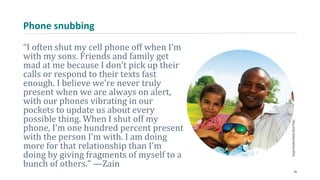
“I often shut my cell phone off when I’m
with my sons. Friends and family get
mad at me because I don’t pick up their
calls or respond to their texts fast
enough. I believe we’re never truly
present when we are always on alert,
with our phones vibrating in our
pockets to update us about every
possible thing. When I shut off my
phone, I’m one hundred percent present
with the person I’m with. I am doing
more for that relationship than I’m
doing by giving fragments of myself to a
bunch of others.” —Zain
26
Technology’s addictive potential (2)
27
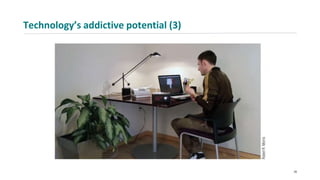
Technology’s addictive potential (3)
28
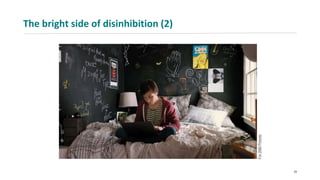
The bright side of disinhibition (2)
29
The bright side of disinhibition (3)
“I find it way easier to start
relationships online. I can tell if the
other person isn’t interested based on
how long it takes to get a response, the
length of the response, and content of
the message. Approaching someone in
person is riskier and more nerve-
racking. What if they don’t like me?
Getting publicly rejected is much more
embarrassing than being rejected
online.” —Boyd
30
Navigating social media
“Recently a guy messaged me on social
media to tell me he’s seen me around
campus. He was wondering if he could get
my number so he could ask me out. I
couldn’t help but think: Where and when
did he see me, how did he get my name, and
why hadn’t he approached me to say hello
or even introduce himself? I had never
seen him before, so it kind of creeped me
out. Instead of going back and forth with
online messages, I simply told him to
introduce himself to me the next time he
saw me, and we can go from there.”
—Monica
31
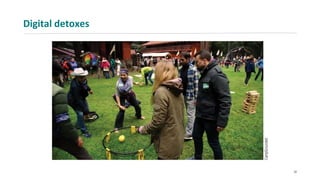
Digital detoxes
32
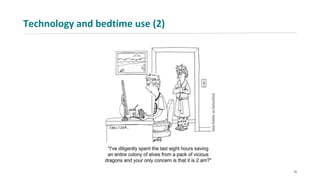
Technology and bedtime use (2)
33
Credits
This concludes the Lecture PowerPoint presentation for Chapter 11.
For more resources, please visit It’s Interpersonal, An Introduction to
Relational Communication, at:
http://digital.wwnorton.com/interpersonal
Copyright © 2022 W. W. Norton & Company

It's Interpersonal Ch. 11

  • 1.
  • 2.
    11.1 The natureof technology-mediated communication • Technology-mediated communication (TMC) is the process of exchanging and assigning meaning to messages that are facilitated by technology channels and applications. • According to the media ecology perspective (MEP), technology reshapes and reorganizes your interpersonal communication values, perceptions, and behaviors. 2
  • 3.
    Interpersonal challenges ofTMC • Less richness • Digital infidelity is the act of secretly exchanging sexual, romantic, or flirtatious messages online with someone who is not your current romantic partner. • Phone snubbing is the act of making it seem like your time on your cell phone is more important that your time with a relational partner. 3
  • 4.
    Technology’s addictive potential(1) • Dopamine loop is the cycle of pleasure-seeking behavior caused by the brain chemical dopamine. • You use technology, technology gratifies you, and dopamine causes you to seek more gratification. 4
  • 5.
    11.2 The disinhibitioneffect • The disinhibition effect is the tendency to express yourself more candidly and less guardedly when using asynchronous channels. • Catharsis is the release of negative emotions such as stress, fear, or guilt as a result of divulging personal struggles and secrets. 5
  • 6.
    The bright sideof disinhibition (1) • Self-disclosure is generally a gradual process when it happens in person, but it may occur at a faster pace electronically. • Hyperpersonal communication is a form of online communication in which self-disclosure becomes intimate and revealing more quickly than it would likely occur in F2F or V2V contexts. 6
  • 7.
    The dark sideof disinhibition (1) • Sexting is the exchanging of nude or seminude photos, videos, and sexually suggestive language via text messaging. • Flaming is the hostile exchange of online messages, often in the form of insults. • Cyberbullying is the act of repeatedly posting disparaging remarks or photos about another person online. It may include taunts, negative comparisons, put-downs, gossip, and threats. 7
  • 8.
    The dark sideof disinhibition (2) • Cyberstalking is the act of ongoing surveillance paired with the malicious use of technology. • Ghosting is the act of cutting off all communication with no explanation. • Catfishing is the act of pretending to be someone you’re not online. • Post-cyber-disclosure panic is the dread, regret, or anxiety you feel after sending an online message. 8
  • 9.
    11.3 Using communicationtechnology effectively • Office etiquette and email use • Cell phone etiquette • Navigating social media • Responding to provocative electronic messages • Digital detoxes 9
  • 10.
    Technology and bedtimeuse (1) • People who use electronic devices right before going to bed are less likely to report getting a good night’s sleep or waking up refreshed. • Chronic sleep deprivation (CSD) is a cumulative reduction in the length and quality of sleep. 10
  • 11.
    CHAPTER 12 Ethics andCivility Copyright © 2022 W. W. Norton & Company
  • 12.
    12.1 Significance ofethical IPC • Interpersonal communication ethics are the set of beliefs, values, and principles that guide communication behaviors within a relationship. • Your IPC ethics help you determine whether a communication choice is right or wrong, moral or immoral. 12
  • 13.
    Five ethical ideals(1) • The National Communication Association has established a Credo for Ethical Communication. • To help remember these ideals, use the acronym RRIFT:  Respect  Responsibility  Integrity  Fairness  Truthfulness 13
  • 14.
    The golden andplatinum rules • The golden rule encourages you to treat others the way you wish to be treated. • Another perspective to consider is the platinum rule: treat others the way they wish to be treated. 14
  • 15.
    Moral absolutism andrelativism • Moral absolutism, or the objective view of ethics, suggests that certain behaviors are always right and others are always wrong. • Moral relativism, or the subjective view of ethics, considers the particular circumstances surrounding an action to determine whether it is ethical. 15
  • 16.
    Ethical communication strengthensrelationships • Interpersonal trust is a person’s firm belief in the ability, reliability, and honesty of another person. • Relational partners can avoid feelings of uncertainty, insecurity, worry, cynicism, disappointment, resentment, anger, and sadness if they establish and maintain trust in each other. 16
  • 17.
    Unethical communication damagesrelationships (1) • A relational transgression is an unethical action taken by someone you know that hurts you or makes you feel betrayed. • The lingering negative feelings you have as a result of a relational transgression are referred to as ongoing negative affect. • Projection is the mental process of assuming that a relational partner is guilty of doing something—or is capable of doing something—that you’ve done yourself. 17
  • 18.
    Institutional and legalconsequences of unethical IPC (1) • Harassment is any behavior that makes a person feel uncomfortable, threatened, or unsafe. • If a company or organization fails to take action to stop harassment in the workplace, the Equal Employment Opportunity Commission can fine it for perpetuating a hostile work environment. 18
  • 19.
    12.2 Deception withinrelationships • Deception is communication behavior that deliberately misleads another person, including any communication that is not completely honest or forthcoming. • If your deception is successful, you may experience duping delight: a feeling of gratification the moment you realize you just fooled someone and got away with it. 19
  • 20.
    Is deception alwaysunethical? (1) • Misleading or dishonest communication meant to help the receiver is called benevolent deception. • Another form of deception that may not raise any ethical concerns is deceptive affection (DA), which occurs when we don’t express our true feelings. 20
  • 21.
    Detecting deception • Undercertain conditions, a person who is trying to deceive you may:  Speak with a higher-pitched voice  Appear nervous or anxious  Pause when a question is very easy to answer  Add unnecessary details to an answer  Give a very short answer when more elaboration would be expected  Alter their rate of speech  Stumble over their words  Avoid eye contact or look at you more directly for a longer period of time 21
  • 22.
    Confronting deception • Directapproach • Indirect approach • Covert methods 22
  • 23.
    12.3 Ways toimprove ethical decision-making • Confront unethical communication constructively • Use I-language, beginning your sentences with phrases such as “I need,” “I value,” or “I appreciate.” • Recognize and encourage ethical behaviors • Own your communication choices. 23
  • 24.
    Disagree with civility(1) • Civility is the level of politeness and courtesy you extend to a conversational partner. • If you want to influence a person’s thinking and keep a conversation from becoming hostile, you have a greater chance of doing so with active listening. 24
  • 25.
  • 26.
    Phone snubbing “I oftenshut my cell phone off when I’m with my sons. Friends and family get mad at me because I don’t pick up their calls or respond to their texts fast enough. I believe we’re never truly present when we are always on alert, with our phones vibrating in our pockets to update us about every possible thing. When I shut off my phone, I’m one hundred percent present with the person I’m with. I am doing more for that relationship than I’m doing by giving fragments of myself to a bunch of others.” —Zain 26
  • 27.
  • 28.
  • 29.
    The bright sideof disinhibition (2) 29
  • 30.
    The bright sideof disinhibition (3) “I find it way easier to start relationships online. I can tell if the other person isn’t interested based on how long it takes to get a response, the length of the response, and content of the message. Approaching someone in person is riskier and more nerve- racking. What if they don’t like me? Getting publicly rejected is much more embarrassing than being rejected online.” —Boyd 30
  • 31.
    Navigating social media “Recentlya guy messaged me on social media to tell me he’s seen me around campus. He was wondering if he could get my number so he could ask me out. I couldn’t help but think: Where and when did he see me, how did he get my name, and why hadn’t he approached me to say hello or even introduce himself? I had never seen him before, so it kind of creeped me out. Instead of going back and forth with online messages, I simply told him to introduce himself to me the next time he saw me, and we can go from there.” —Monica 31
  • 32.
  • 33.
  • 34.
    Credits This concludes theLecture PowerPoint presentation for Chapter 11. For more resources, please visit It’s Interpersonal, An Introduction to Relational Communication, at: http://digital.wwnorton.com/interpersonal Copyright © 2022 W. W. Norton & Company

Editor's Notes

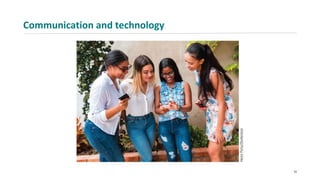
  • #26 Technology channels and their various applications, such as cell phones and dating apps, respectively, significantly expand our capacity to develop and maintain relationships. In this photo, a woman uses her cell phone to communicate, perhaps with a potential date, while her friends look on in delight. Photo credit: Hector Pertuz/Shutterstock
  • #27 Photo credit: Sergey Novikov/Alamy Stock Photo
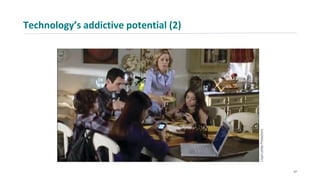
  • #28 Claire Dunphy (Julie Bowen) is ignored by members of her family once too often and declares a weeklong ban on all personal devices. Her husband Phil (Ty Burrell) turns the ban into a contest. Watch what happens in this episode of Modern Family. What appears to influence the Dunphys’ communication more: the technology itself or the users of the technology? On YouTube, search using the keywords: “Modern Family - No Internet Contest.”  ​ ​ Photo credit: Lloyd-Levitan Productions
  • #29 Two doctoral students at MIT, Robert Morris and Dan McDuff, were at one point spending a combined 50 hours a week on social media. They were inspired to invent a “shocking” device to help them overcome their online compulsion. Is there a real market for something like this? Would you benefit from their device? Why or why not? On YouTube, search using the keywords: “Pavlov Poke.” ​ Photo credit: Robert R. Morris
  • #30 In Love, Simon, Simon Spier (Nick Robinson) meets “Blue,” a male student who goes to the same high school, online. Their anonymity creates a safe space to get to know each other. Simon starts to fall in love with Blue and tries to figure out who he is, leading to many humorous and dramatic moments at school. How do your online and in-person relationships differ? Identify the various technology channels and applications shown in this clip and relate their use to the disinhibition effect. On YouTube, search using the keywords: “Love, Simon Official Trailer #2 2018.” ​ Photo credit: Fox 2000 Pictures
  • #31 Photo credit: samuel wordley/Alamy Stock Photo
  • #32 Photo credit: samuel wordley/Alamy Stock Photo
  • #33 Adults at Camp Grounded in Mendocino, California, surrender their electronic devices in exchange for solar carving, stilt walking, dodgeball, superfood truffle making, and acro-yoga. As you watch this video, imagine you’re there as a camper. How might you benefit from an experience like this? On YouTube, search using the keywords: “Camp Grounded - Mendocino, California Session 2016.” ​ Photo credit: CampGrounded
  • #34 Photo credit: Steve Smeltzer via CartoonStock