Chapter 3.1
Choosing a Topic
Copyright © 2022 W. W. Norton & Company
Introduction
• Most presenters are required, invited, or decide to speak because
they are experts on a subject, passionate about the topic, or
recognized leaders or celebrities
• In a speech course, you are speaking to demonstrate your ability
to develop and deliver an effective presentation, not because you
are a recognized expert in a specific subject area.
• Your choice of topic should be based on the three fundamental
elements of the rhetorical speechmaking process: Speaker,
Audience, and Purpose
2
Speaker and Topic
• To find a good topic, think carefully about your interests, your
abilities, your beliefs, and your values
• If you aren’t interested in your topic, your audience won’t be
either
3
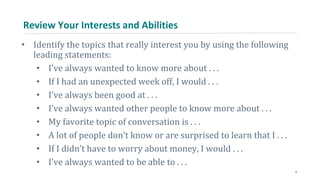
Review Your Interests and Abilities
• Identify the topics that really interest you by using the following
leading statements:
• I’ve always wanted to know more about . . .
• If I had an unexpected week off, I would . . .
• I’ve always been good at . . .
• I’ve always wanted other people to know more about . . .
• My favorite topic of conversation is . . .
• A lot of people don’t know or are surprised to learn that I . . .
• If I didn’t have to worry about money, I would . . .
• I’ve always wanted to be able to . . .
4
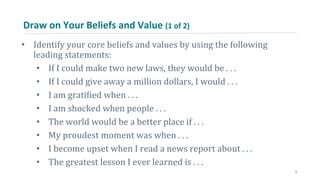
Draw on Your Beliefs and Value (1 of 2)
• Identify your core beliefs and values by using the following
leading statements:
• If I could make two new laws, they would be . . .
• If I could give away a million dollars, I would . . .
• I am gratified when . . .
• I am shocked when people . . .
• The world would be a better place if . . .
• My proudest moment was when . . .
• I become upset when I read a news report about . . .
• The greatest lesson I ever learned is . . .
5
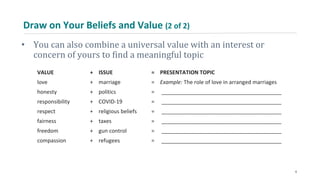
Draw on Your Beliefs and Value (2 of 2)
• You can also combine a universal value with an interest or
concern of yours to find a meaningful topic
VALUE + ISSUE = PRESENTATION TOPIC
love + marriage = Example: The role of love in arranged marriages
honesty + politics = ________________________________________
responsibility + COVID-19 = ________________________________________
respect + religious beliefs = ________________________________________
fairness + taxes = ________________________________________
freedom + gun control = ________________________________________
compassion + refugees = ________________________________________
6
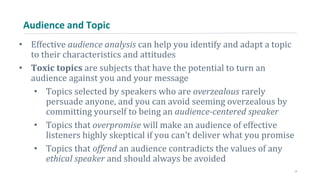
Audience and Topic
• Effective audience analysis can help you identify and adapt a topic
to their characteristics and attitudes
• Toxic topics are subjects that have the potential to turn an
audience against you and your message
• Topics selected by speakers who are overzealous rarely
persuade anyone, and you can avoid seeming overzealous by
committing yourself to being an audience-centered speaker
• Topics that overpromise will make an audience of effective
listeners highly skeptical if you can’t deliver what you promise
• Topics that offend an audience contradicts the values of any
ethical speaker and should always be avoided
7
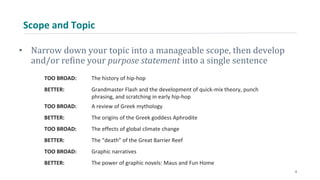
Scope and Topic
• Narrow down your topic into a manageable scope, then develop
and/or refine your purpose statement into a single sentence
TOO BROAD: The history of hip-hop
BETTER: Grandmaster Flash and the development of quick-mix theory, punch
phrasing, and scratching in early hip-hop
TOO BROAD: A review of Greek mythology
BETTER: The origins of the Greek goddess Aphrodite
TOO BROAD: The effects of global climate change
BETTER: The “death” of the Great Barrier Reef
TOO BROAD: Graphic narratives
BETTER: The power of graphic novels: Maus and Fun Home
8
Begin Your Research Now
• Research is a systematic search or investigation designed to find
useful and appropriate supporting material related to your topic
• Start researching as soon as you have some initial thoughts about
the rhetorical situation and your topic
• Doing research early will help you sharpen the scope and purpose
of a presentation on a particular topic, or even point you toward a
better topic
• If you already have extensive knowledge about your topic, doing
research requires reviewing your knowledge about the subject
and selecting and organizing the information you need to support
your presentation’s purpose
9
Still Stuck? Ask Other People!
• The people closest to you may have an intuitive sense of the
subjects that interest you most and about which you can sound
credible
• You can also look online by searching the phrase “speech topics”
• Speech topic websites may help you find general subject areas that
you haven’t considered but that may be interesting to you and
your audience
10
Conclusion
• Choose a topic only after you have:
• thought carefully about your interests, abilities, and values
• weighed your audience’s needs and expectations against your
own
• confirmed that your sense of purpose is clear
• Support your topic with relevant and engaging research findings
• If your research turns up a better approach or topic, change
course if you can
11
Credits
This concludes the Lecture PowerPoint presentation for Chapter 3.1.
For more resources, please visit The Norton Field Guide to Speaking:
http://digital.wwnorton.com/nfgspeaking.
Copyright © 2022 W. W. Norton & Company

Norton Field Guide for Speaking 3.1

  • 1.
    Chapter 3.1 Choosing aTopic Copyright © 2022 W. W. Norton & Company
  • 2.
    Introduction • Most presentersare required, invited, or decide to speak because they are experts on a subject, passionate about the topic, or recognized leaders or celebrities • In a speech course, you are speaking to demonstrate your ability to develop and deliver an effective presentation, not because you are a recognized expert in a specific subject area. • Your choice of topic should be based on the three fundamental elements of the rhetorical speechmaking process: Speaker, Audience, and Purpose 2
  • 3.
    Speaker and Topic •To find a good topic, think carefully about your interests, your abilities, your beliefs, and your values • If you aren’t interested in your topic, your audience won’t be either 3
  • 4.
    Review Your Interestsand Abilities • Identify the topics that really interest you by using the following leading statements: • I’ve always wanted to know more about . . . • If I had an unexpected week off, I would . . . • I’ve always been good at . . . • I’ve always wanted other people to know more about . . . • My favorite topic of conversation is . . . • A lot of people don’t know or are surprised to learn that I . . . • If I didn’t have to worry about money, I would . . . • I’ve always wanted to be able to . . . 4
  • 5.
    Draw on YourBeliefs and Value (1 of 2) • Identify your core beliefs and values by using the following leading statements: • If I could make two new laws, they would be . . . • If I could give away a million dollars, I would . . . • I am gratified when . . . • I am shocked when people . . . • The world would be a better place if . . . • My proudest moment was when . . . • I become upset when I read a news report about . . . • The greatest lesson I ever learned is . . . 5
  • 6.
    Draw on YourBeliefs and Value (2 of 2) • You can also combine a universal value with an interest or concern of yours to find a meaningful topic VALUE + ISSUE = PRESENTATION TOPIC love + marriage = Example: The role of love in arranged marriages honesty + politics = ________________________________________ responsibility + COVID-19 = ________________________________________ respect + religious beliefs = ________________________________________ fairness + taxes = ________________________________________ freedom + gun control = ________________________________________ compassion + refugees = ________________________________________ 6
  • 7.
    Audience and Topic •Effective audience analysis can help you identify and adapt a topic to their characteristics and attitudes • Toxic topics are subjects that have the potential to turn an audience against you and your message • Topics selected by speakers who are overzealous rarely persuade anyone, and you can avoid seeming overzealous by committing yourself to being an audience-centered speaker • Topics that overpromise will make an audience of effective listeners highly skeptical if you can’t deliver what you promise • Topics that offend an audience contradicts the values of any ethical speaker and should always be avoided 7
  • 8.
    Scope and Topic •Narrow down your topic into a manageable scope, then develop and/or refine your purpose statement into a single sentence TOO BROAD: The history of hip-hop BETTER: Grandmaster Flash and the development of quick-mix theory, punch phrasing, and scratching in early hip-hop TOO BROAD: A review of Greek mythology BETTER: The origins of the Greek goddess Aphrodite TOO BROAD: The effects of global climate change BETTER: The “death” of the Great Barrier Reef TOO BROAD: Graphic narratives BETTER: The power of graphic novels: Maus and Fun Home 8
  • 9.
    Begin Your ResearchNow • Research is a systematic search or investigation designed to find useful and appropriate supporting material related to your topic • Start researching as soon as you have some initial thoughts about the rhetorical situation and your topic • Doing research early will help you sharpen the scope and purpose of a presentation on a particular topic, or even point you toward a better topic • If you already have extensive knowledge about your topic, doing research requires reviewing your knowledge about the subject and selecting and organizing the information you need to support your presentation’s purpose 9
  • 10.
    Still Stuck? AskOther People! • The people closest to you may have an intuitive sense of the subjects that interest you most and about which you can sound credible • You can also look online by searching the phrase “speech topics” • Speech topic websites may help you find general subject areas that you haven’t considered but that may be interesting to you and your audience 10
  • 11.
    Conclusion • Choose atopic only after you have: • thought carefully about your interests, abilities, and values • weighed your audience’s needs and expectations against your own • confirmed that your sense of purpose is clear • Support your topic with relevant and engaging research findings • If your research turns up a better approach or topic, change course if you can 11
  • 12.
    Credits This concludes theLecture PowerPoint presentation for Chapter 3.1. For more resources, please visit The Norton Field Guide to Speaking: http://digital.wwnorton.com/nfgspeaking. Copyright © 2022 W. W. Norton & Company