Introduction to
Computer Applications
Lecture # 15
Computer Security Risks
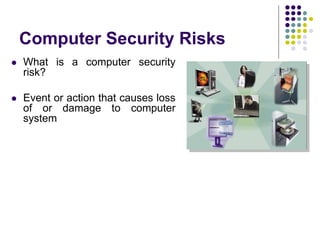
 What is a computer security
risk?
 Event or action that causes loss
of or damage to computer
system
Virus
 A computer virus is a computer program that can
replicate itself and spread from one computer to another.
 The term "virus" is also commonly but misused to refer
to other types of malware, including but not limited to
adware and spyware programs that do not have the
reproductive ability.
 A true virus can spread from one computer to another
(in some form of executable code) when its host is taken
to the target computer; for instance because a user sent
it over a network or the Internet, or carried it on a
removable medium such as a floppy disk, CD, DVD, or
USB drive.
Types of Virus
 Not all computer viruses behave, replicate, or infect
the same way. There are several different categories
of viruses and malware. Below I list and discuss
some of the most common types of computer
viruses.
 Trojan Horse
 Worms
Trojan Horse
 A Trojan horse program has the appearance of having a useful and
desired function. While it may advertise its activity after launching, this
information is not apparent to the user beforehand. Secretly the
program performs other, undesired functions.
 A Trojan Horse neither replicates nor copies itself, but causes damage
or compromises the security of the computer.
 A Trojan Horse must be sent by someone or carried by another
program and may arrive in the form of a joke program or software of
some sort.
 The malicious functionality of a Trojan Horse may be anything
undesirable for a computer user, including data destruction or
compromising a system by providing a means for another computer to
gain access, thus bypassing normal access controls.
Worms
 A worm is a program that makes and facilitates the
distribution of copies of itself; for example, from one disk
drive to another, or by copying itself using email or another
transport mechanism.
 The worm may do damage and compromise the security of
the computer. It may arrive via exploitation of a system
vulnerability or by clicking on an infected e-mail.
Types of virus continued ……
 Bootsector Virus:
A virus which attaches itself to the first part of the hard disk that
is read by the computer upon bootup. These are normally spread
by floppy disks.
 Macro Virus:
Macro viruses are viruses that use another application's macro
programming language to distribute themselves. They infect
documents such as MS Word or MS Excel and are typically
spread to other similar documents.
 Memory Resident Viruses:
Memory Resident Viruses reside in a computers volitale memory
(RAM). They are initiated from a virus which runs on the
computer and they stay in memory after it's initiating program
closes.
Types of virus continued ……
 Rootkit Virus:
A rootkit virus is an undetectable virus which attempts to allow
someone to gain control of a computer system. The term rootkit
comes from the linux administrator root user. These viruses are
usually installed by trojans and are normally disguised as
operating system files.
 Polymorphic Viruses:
A polymorphic virus not only replicates itself by creating multiple
files of itself, but it also changes it's digital signature every time it
replicates. This makes it difficult for less sophisticated antivirus
software to detect.
 Logic Bombs/Time Bombs:
These are viruses which are programmed to initiate at a specific
date or when a specific event occurs. Some examples are a virus
which deletes your photos on Halloween, or a virus which deletes
a database table if a certain employee gets fired.
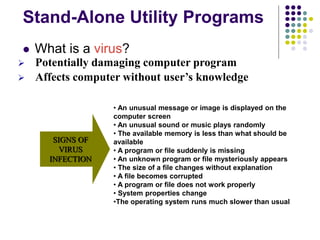
Stand-Alone Utility Programs
 What is a virus?
 Potentially damaging computer program
 Affects computer without user’s knowledge
SIGNS OF
VIRUS
INFECTION
• An unusual message or image is displayed on the
computer screen
• An unusual sound or music plays randomly
• The available memory is less than what should be
available
• A program or file suddenly is missing
• An unknown program or file mysteriously appears
• The size of a file changes without explanation
• A file becomes corrupted
• A program or file does not work properly
• System properties change
•The operating system runs much slower than usual
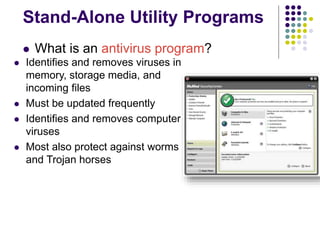
Stand-Alone Utility Programs
 What is an antivirus program?
 Identifies and removes viruses in
memory, storage media, and
incoming files
 Must be updated frequently
 Identifies and removes computer
viruses
 Most also protect against worms
and Trojan horses
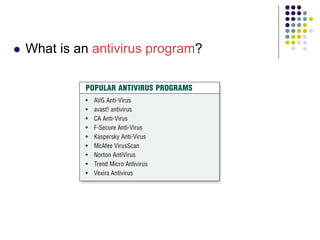
 What is an antivirus program?
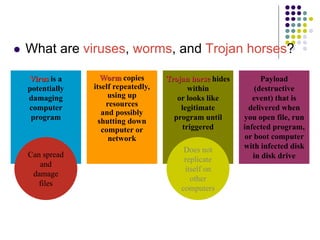
 What are viruses, worms, and Trojan horses?
Virus is a
potentially
damaging
computer
program
Worm copies
itself repeatedly,
using up
resources
and possibly
shutting down
computer or
network
Trojan horse hides
within
or looks like
legitimate
program until
triggered
Payload
(destructive
event) that is
delivered when
you open file, run
infected program,
or boot computer
with infected disk
in disk drive
Can spread
and
damage
files
Does not
replicate
itself on
other
computers
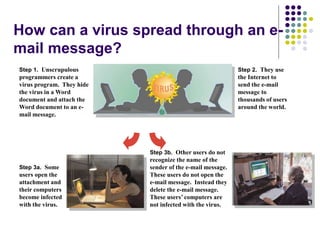
How can a virus spread through an e-
mail message?
Step 1. Unscrupulous
programmers create a
virus program. They hide
the virus in a Word
document and attach the
Word document to an e-
mail message.
Step 2. They use
the Internet to
send the e-mail
message to
thousands of users
around the world.
Step 3b. Other users do not
recognize the name of the
sender of the e-mail message.
These users do not open the
e-mail message. Instead they
delete the e-mail message.
These users’ computers are
not infected with the virus.
Step 3a. Some
users open the
attachment and
their computers
become infected
with the virus.
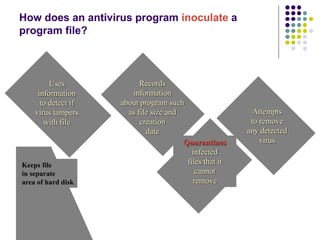
Keeps file
in separate
area of hard disk
How does an antivirus program inoculate a
program file?
Records
information
about program such
as file size and
creation
date
Attempts
to remove
any detected
virus
Uses
information
to detect if
virus tampers
with file
Quarantines
infected
files that it
cannot
remove
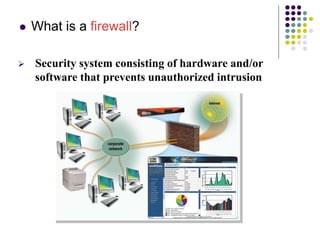
 What is a firewall?
 Security system consisting of hardware and/or
software that prevents unauthorized intrusion
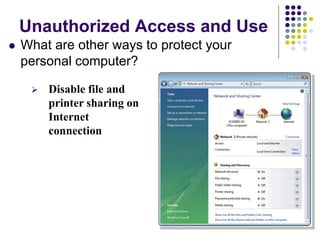
Unauthorized Access and Use
 What are other ways to protect your
personal computer?
 Disable file and
printer sharing on
Internet
connection
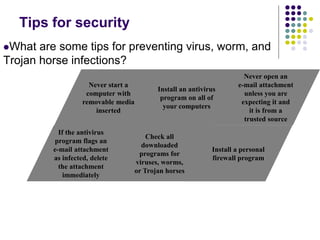
Tips for security
What are some tips for preventing virus, worm, and
Trojan horse infections?
Install a personal
firewall program
If the antivirus
program flags an
e-mail attachment
as infected, delete
the attachment
immediately
Never start a
computer with
removable media
inserted
Never open an
e-mail attachment
unless you are
expecting it and
it is from a
trusted source
Install an antivirus
program on all of
your computers
Check all
downloaded
programs for
viruses, worms,
or Trojan horses
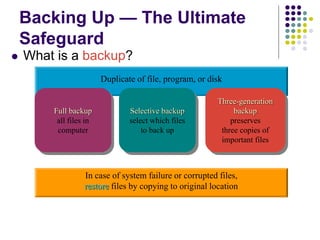
Backing Up — The Ultimate
Safeguard
 What is a backup?
Duplicate of file, program, or disk
Full backup
all files in
computer
Selective backup
select which files
to back up
Three-generation
backup
preserves
three copies of
important files
In case of system failure or corrupted files,
restore files by copying to original location
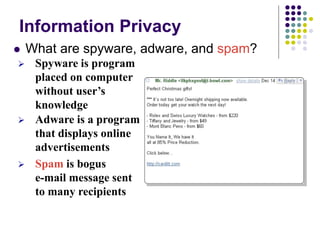
Information Privacy
 What are spyware, adware, and spam?
 Spyware is program
placed on computer
without user’s
knowledge
 Adware is a program
that displays online
advertisements
 Spam is bogus
e-mail message sent
to many recipients
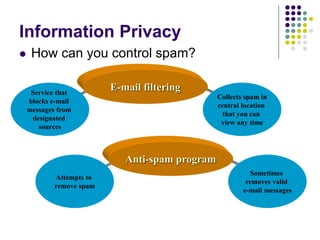
Information Privacy
 How can you control spam?
Collects spam in
central location
that you can
view any time
Service that
blocks e-mail
messages from
designated
sources
E-mail filtering
Sometimes
removes valid
e-mail messages
Attempts to
remove spam
Anti-spam program
Questions??

Itc lec 15 Computer security risks

  • 1.
  • 2.
    Computer Security Risks What is a computer security risk?  Event or action that causes loss of or damage to computer system
  • 3.
    Virus  A computervirus is a computer program that can replicate itself and spread from one computer to another.  The term "virus" is also commonly but misused to refer to other types of malware, including but not limited to adware and spyware programs that do not have the reproductive ability.  A true virus can spread from one computer to another (in some form of executable code) when its host is taken to the target computer; for instance because a user sent it over a network or the Internet, or carried it on a removable medium such as a floppy disk, CD, DVD, or USB drive.
  • 4.
    Types of Virus Not all computer viruses behave, replicate, or infect the same way. There are several different categories of viruses and malware. Below I list and discuss some of the most common types of computer viruses.  Trojan Horse  Worms
  • 5.
    Trojan Horse  ATrojan horse program has the appearance of having a useful and desired function. While it may advertise its activity after launching, this information is not apparent to the user beforehand. Secretly the program performs other, undesired functions.  A Trojan Horse neither replicates nor copies itself, but causes damage or compromises the security of the computer.  A Trojan Horse must be sent by someone or carried by another program and may arrive in the form of a joke program or software of some sort.  The malicious functionality of a Trojan Horse may be anything undesirable for a computer user, including data destruction or compromising a system by providing a means for another computer to gain access, thus bypassing normal access controls.
  • 6.
    Worms  A wormis a program that makes and facilitates the distribution of copies of itself; for example, from one disk drive to another, or by copying itself using email or another transport mechanism.  The worm may do damage and compromise the security of the computer. It may arrive via exploitation of a system vulnerability or by clicking on an infected e-mail.
  • 7.
    Types of viruscontinued ……  Bootsector Virus: A virus which attaches itself to the first part of the hard disk that is read by the computer upon bootup. These are normally spread by floppy disks.  Macro Virus: Macro viruses are viruses that use another application's macro programming language to distribute themselves. They infect documents such as MS Word or MS Excel and are typically spread to other similar documents.  Memory Resident Viruses: Memory Resident Viruses reside in a computers volitale memory (RAM). They are initiated from a virus which runs on the computer and they stay in memory after it's initiating program closes.
  • 8.
    Types of viruscontinued ……  Rootkit Virus: A rootkit virus is an undetectable virus which attempts to allow someone to gain control of a computer system. The term rootkit comes from the linux administrator root user. These viruses are usually installed by trojans and are normally disguised as operating system files.  Polymorphic Viruses: A polymorphic virus not only replicates itself by creating multiple files of itself, but it also changes it's digital signature every time it replicates. This makes it difficult for less sophisticated antivirus software to detect.  Logic Bombs/Time Bombs: These are viruses which are programmed to initiate at a specific date or when a specific event occurs. Some examples are a virus which deletes your photos on Halloween, or a virus which deletes a database table if a certain employee gets fired.
  • 9.
    Stand-Alone Utility Programs What is a virus?  Potentially damaging computer program  Affects computer without user’s knowledge SIGNS OF VIRUS INFECTION • An unusual message or image is displayed on the computer screen • An unusual sound or music plays randomly • The available memory is less than what should be available • A program or file suddenly is missing • An unknown program or file mysteriously appears • The size of a file changes without explanation • A file becomes corrupted • A program or file does not work properly • System properties change •The operating system runs much slower than usual
  • 10.
    Stand-Alone Utility Programs What is an antivirus program?  Identifies and removes viruses in memory, storage media, and incoming files  Must be updated frequently  Identifies and removes computer viruses  Most also protect against worms and Trojan horses
  • 11.
     What isan antivirus program?
  • 12.
     What areviruses, worms, and Trojan horses? Virus is a potentially damaging computer program Worm copies itself repeatedly, using up resources and possibly shutting down computer or network Trojan horse hides within or looks like legitimate program until triggered Payload (destructive event) that is delivered when you open file, run infected program, or boot computer with infected disk in disk drive Can spread and damage files Does not replicate itself on other computers
  • 13.
    How can avirus spread through an e- mail message? Step 1. Unscrupulous programmers create a virus program. They hide the virus in a Word document and attach the Word document to an e- mail message. Step 2. They use the Internet to send the e-mail message to thousands of users around the world. Step 3b. Other users do not recognize the name of the sender of the e-mail message. These users do not open the e-mail message. Instead they delete the e-mail message. These users’ computers are not infected with the virus. Step 3a. Some users open the attachment and their computers become infected with the virus.
  • 14.
    Keeps file in separate areaof hard disk How does an antivirus program inoculate a program file? Records information about program such as file size and creation date Attempts to remove any detected virus Uses information to detect if virus tampers with file Quarantines infected files that it cannot remove
  • 15.
     What isa firewall?  Security system consisting of hardware and/or software that prevents unauthorized intrusion
  • 16.
    Unauthorized Access andUse  What are other ways to protect your personal computer?  Disable file and printer sharing on Internet connection
  • 17.
    Tips for security Whatare some tips for preventing virus, worm, and Trojan horse infections? Install a personal firewall program If the antivirus program flags an e-mail attachment as infected, delete the attachment immediately Never start a computer with removable media inserted Never open an e-mail attachment unless you are expecting it and it is from a trusted source Install an antivirus program on all of your computers Check all downloaded programs for viruses, worms, or Trojan horses
  • 18.
    Backing Up —The Ultimate Safeguard  What is a backup? Duplicate of file, program, or disk Full backup all files in computer Selective backup select which files to back up Three-generation backup preserves three copies of important files In case of system failure or corrupted files, restore files by copying to original location
  • 19.
    Information Privacy  Whatare spyware, adware, and spam?  Spyware is program placed on computer without user’s knowledge  Adware is a program that displays online advertisements  Spam is bogus e-mail message sent to many recipients
  • 20.
    Information Privacy  Howcan you control spam? Collects spam in central location that you can view any time Service that blocks e-mail messages from designated sources E-mail filtering Sometimes removes valid e-mail messages Attempts to remove spam Anti-spam program
  • 21.