Computer viruses
Efforts by :- Aagman Saini
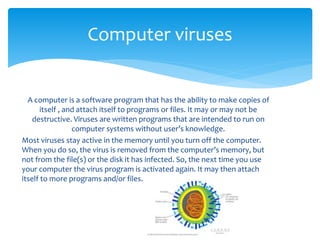
A computer is a software program that has the ability to make copies of
itself , and attach itself to programs or files. It may or may not be
destructive. Viruses are written programs that are intended to run on
computer systems without user’s knowledge.
Most viruses stay active in the memory until you turn off the computer.
When you do so, the virus is removed from the computer’s memory, but
not from the file(s) or the disk it has infected. So, the next time you use
your computer the virus program is activated again. It may then attach
itself to more programs and/or files.
Computer viruses
Different viruses can do different things. It can do the following:-
 It can infect executable program files such as word processors,
spread sheets, & operating systems.
 It can infect disks by attaching itself to special programs on the
hard disks, called boot records. these are the programs that the
computer uses to start itself up.
What does a computer virus do?
When you experience strange behaviour on your
screen, it is possible that a virus has infected your
computer. It may corrupt or damage the files,
programs, & data.
Warning signals
If we group the viruses by their target, we can divide them in
the following ways:-
 Program viruses
 Boot viruses
 Macro viruses
 Malware
 Worms
 Trojan horses
 Spyware
 spam
Types of computer viruses
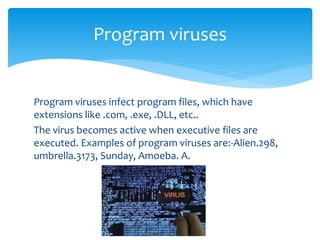
Program viruses infect program files, which have
extensions like .com, .exe, .DLL, etc..
The virus becomes active when executive files are
executed. Examples of program viruses are:-Alien.298,
umbrella.3173, Sunday, Amoeba. A.
Program viruses
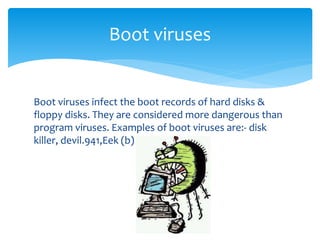
Boot viruses infect the boot records of hard disks &
floppy disks. They are considered more dangerous than
program viruses. Examples of boot viruses are:- disk
killer, devil.941,Eek (b)
Boot viruses
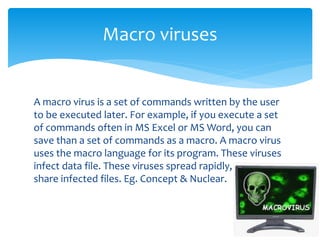
A macro virus is a set of commands written by the user
to be executed later. For example, if you execute a set
of commands often in MS Excel or MS Word, you can
save than a set of commands as a macro. A macro virus
uses the macro language for its program. These viruses
infect data file. These viruses spread rapidly, as users
share infected files. Eg. Concept & Nuclear.
Macro viruses
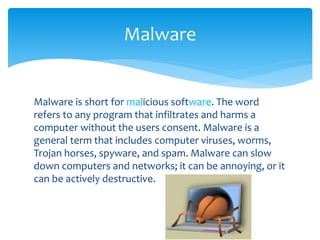
Malware is short for malicious software. The word
refers to any program that infiltrates and harms a
computer without the users consent. Malware is a
general term that includes computer viruses, worms,
Trojan horses, spyware, and spam. Malware can slow
down computers and networks; it can be annoying, or it
can be actively destructive.
Malware
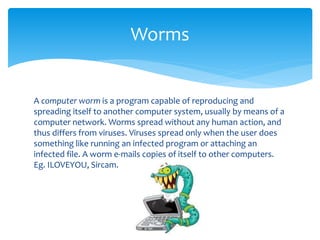
A computer worm is a program capable of reproducing and
spreading itself to another computer system, usually by means of a
computer network. Worms spread without any human action, and
thus differs from viruses. Viruses spread only when the user does
something like running an infected program or attaching an
infected file. A worm e-mails copies of itself to other computers.
Eg. ILOVEYOU, Sircam.
Worms
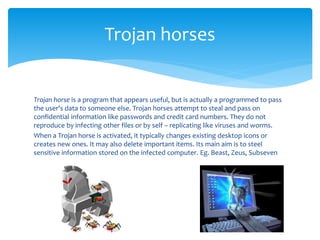
Trojan horse is a program that appears useful, but is actually a programmed to pass
the user’s data to someone else. Trojan horses attempt to steal and pass on
confidential information like passwords and credit card numbers. They do not
reproduce by infecting other files or by self – replicating like viruses and worms.
When a Trojan horse is activated, it typically changes existing desktop icons or
creates new ones. It may also delete important items. Its main aim is to steel
sensitive information stored on the infected computer. Eg. Beast, Zeus, Subseven
Trojan horses
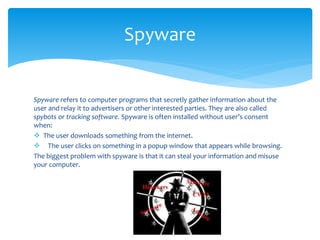
Spyware refers to computer programs that secretly gather information about the
user and relay it to advertisers or other interested parties. They are also called
spybots or tracking software. Spyware is often installed without user’s consent
when:
 The user downloads something from the internet.
 The user clicks on something in a popup window that appears while browsing.
The biggest problem with spyware is that it can steal your information and misuse
your computer.
Spyware
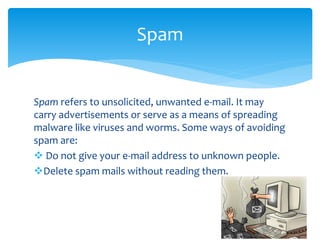
Spam refers to unsolicited, unwanted e-mail. It may
carry advertisements or serve as a means of spreading
malware like viruses and worms. Some ways of avoiding
spam are:
 Do not give your e-mail address to unknown people.
Delete spam mails without reading them.
Spam
Here are some basic rules to avoid virus definitions:
 Restrict access to your system, both offline & online.
 Only allow trustworthy users to use the system.
 Never use an unknown disk.
 Install & use antivirus software & keep it updated
 Scan files you download from internet
 Keep your programs & data on separate disks, if possible.
Preventing virus infections
Antivirus software refers to applications designed to
detect & remove viruses from computer systems.
However, certain types of viruses are difficult to remove
& files damaged may be lost forever. Whenever the
computer starts up, the antivirus software starts
automatically & keeps check on every file . If it detects a
virus it tries to remove it.
Anti virus software
Virus definition are the database of viruses that
antivirus software scans for. This database needs to be
updated regularly, because new viruses are being
developed & released all the time if it is not updated
antivirus software will not know about new viruses &
will not be able to catch them.
Updating virus definitions
Virus definition are the database of viruses that
antivirus software scans for. This database needs to be
updated regularly, because new viruses are being
developed & released all the time if it is not updated
antivirus software will not know about new viruses &
will not be able to catch them.
Free antivirus software
Nowadays, free antiviruses programs like AVG & Avast
are becoming popular. they are easy to install & use & it
runs efficiently in the background. Updates happen
automatically.
Computer viruses

Computer viruses

  • 1.
  • 2.
    A computer isa software program that has the ability to make copies of itself , and attach itself to programs or files. It may or may not be destructive. Viruses are written programs that are intended to run on computer systems without user’s knowledge. Most viruses stay active in the memory until you turn off the computer. When you do so, the virus is removed from the computer’s memory, but not from the file(s) or the disk it has infected. So, the next time you use your computer the virus program is activated again. It may then attach itself to more programs and/or files. Computer viruses
  • 3.
    Different viruses cando different things. It can do the following:-  It can infect executable program files such as word processors, spread sheets, & operating systems.  It can infect disks by attaching itself to special programs on the hard disks, called boot records. these are the programs that the computer uses to start itself up. What does a computer virus do?
  • 4.
    When you experiencestrange behaviour on your screen, it is possible that a virus has infected your computer. It may corrupt or damage the files, programs, & data. Warning signals
  • 5.
    If we groupthe viruses by their target, we can divide them in the following ways:-  Program viruses  Boot viruses  Macro viruses  Malware  Worms  Trojan horses  Spyware  spam Types of computer viruses
  • 6.
    Program viruses infectprogram files, which have extensions like .com, .exe, .DLL, etc.. The virus becomes active when executive files are executed. Examples of program viruses are:-Alien.298, umbrella.3173, Sunday, Amoeba. A. Program viruses
  • 7.
    Boot viruses infectthe boot records of hard disks & floppy disks. They are considered more dangerous than program viruses. Examples of boot viruses are:- disk killer, devil.941,Eek (b) Boot viruses
  • 8.
    A macro virusis a set of commands written by the user to be executed later. For example, if you execute a set of commands often in MS Excel or MS Word, you can save than a set of commands as a macro. A macro virus uses the macro language for its program. These viruses infect data file. These viruses spread rapidly, as users share infected files. Eg. Concept & Nuclear. Macro viruses
  • 9.
    Malware is shortfor malicious software. The word refers to any program that infiltrates and harms a computer without the users consent. Malware is a general term that includes computer viruses, worms, Trojan horses, spyware, and spam. Malware can slow down computers and networks; it can be annoying, or it can be actively destructive. Malware
  • 10.
    A computer wormis a program capable of reproducing and spreading itself to another computer system, usually by means of a computer network. Worms spread without any human action, and thus differs from viruses. Viruses spread only when the user does something like running an infected program or attaching an infected file. A worm e-mails copies of itself to other computers. Eg. ILOVEYOU, Sircam. Worms
  • 11.
    Trojan horse isa program that appears useful, but is actually a programmed to pass the user’s data to someone else. Trojan horses attempt to steal and pass on confidential information like passwords and credit card numbers. They do not reproduce by infecting other files or by self – replicating like viruses and worms. When a Trojan horse is activated, it typically changes existing desktop icons or creates new ones. It may also delete important items. Its main aim is to steel sensitive information stored on the infected computer. Eg. Beast, Zeus, Subseven Trojan horses
  • 12.
    Spyware refers tocomputer programs that secretly gather information about the user and relay it to advertisers or other interested parties. They are also called spybots or tracking software. Spyware is often installed without user’s consent when:  The user downloads something from the internet.  The user clicks on something in a popup window that appears while browsing. The biggest problem with spyware is that it can steal your information and misuse your computer. Spyware
  • 13.
    Spam refers tounsolicited, unwanted e-mail. It may carry advertisements or serve as a means of spreading malware like viruses and worms. Some ways of avoiding spam are:  Do not give your e-mail address to unknown people. Delete spam mails without reading them. Spam
  • 14.
    Here are somebasic rules to avoid virus definitions:  Restrict access to your system, both offline & online.  Only allow trustworthy users to use the system.  Never use an unknown disk.  Install & use antivirus software & keep it updated  Scan files you download from internet  Keep your programs & data on separate disks, if possible. Preventing virus infections
  • 15.
    Antivirus software refersto applications designed to detect & remove viruses from computer systems. However, certain types of viruses are difficult to remove & files damaged may be lost forever. Whenever the computer starts up, the antivirus software starts automatically & keeps check on every file . If it detects a virus it tries to remove it. Anti virus software
  • 16.
    Virus definition arethe database of viruses that antivirus software scans for. This database needs to be updated regularly, because new viruses are being developed & released all the time if it is not updated antivirus software will not know about new viruses & will not be able to catch them. Updating virus definitions Virus definition are the database of viruses that antivirus software scans for. This database needs to be updated regularly, because new viruses are being developed & released all the time if it is not updated antivirus software will not know about new viruses & will not be able to catch them.
  • 17.
    Free antivirus software Nowadays,free antiviruses programs like AVG & Avast are becoming popular. they are easy to install & use & it runs efficiently in the background. Updates happen automatically.