Presented By : Shehrevar Davierwala
Contact : shehrevar@live.com
 Computer virus
 Actions of virus
 Types of virus
 Difference between computer virus, worms and Trojans Horse
 Anti virus software
 Symptoms of infected computer
 What to do on suspecting virus attack
 Types of antivirus
 Antivirus software factors
 Actions of antivirus
 General precautions
VIRUS
VIRUS (Vital Information Resource Under Seize)
 It is a software use to infect a computer. After virus code is written it is
integrated with in an essential programmed.
 Once the programmed is executed the virus code is activated and attacks
copies of itself to other programmers.
 A common type virus is a boot virus which is stored in the boot sector of disk
if the disk is left in the drive when the machine is infected with FLOPPY, CD,
hard disk expecting to the find the operating there once the machine is effected
the boot virus may replicate it self on to all the floppies.
 A virus current be attach data it must attack to be removable programmed
that is down loaded into or installed in the computer, the virus attacked
programmed most be executed in order to active the virus.
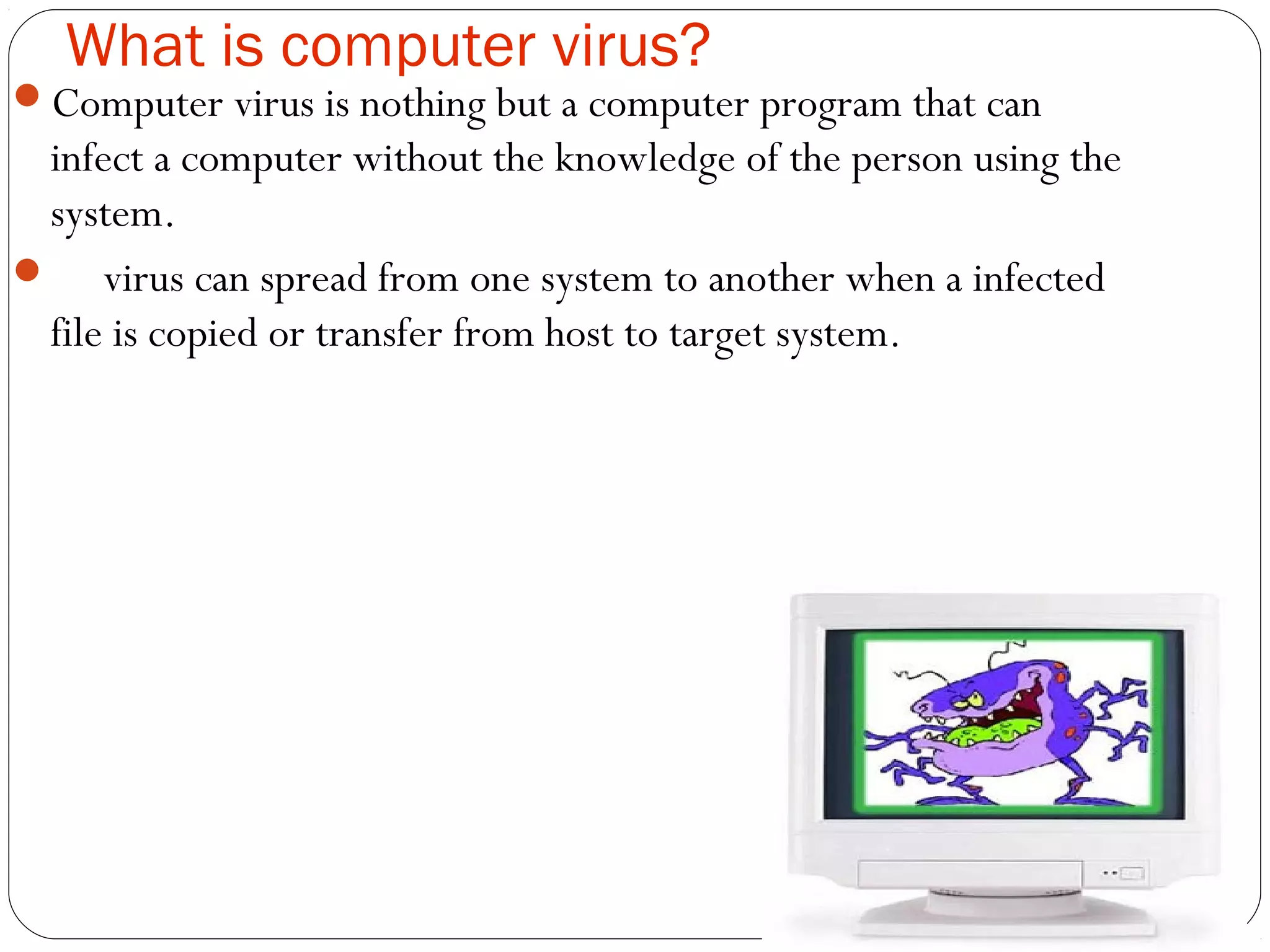
What is computer virus?
Computer virus is nothing but a computer program that can
infect a computer without the knowledge of the person using the
system.
 virus can spread from one system to another when a infected
file is copied or transfer from host to target system.
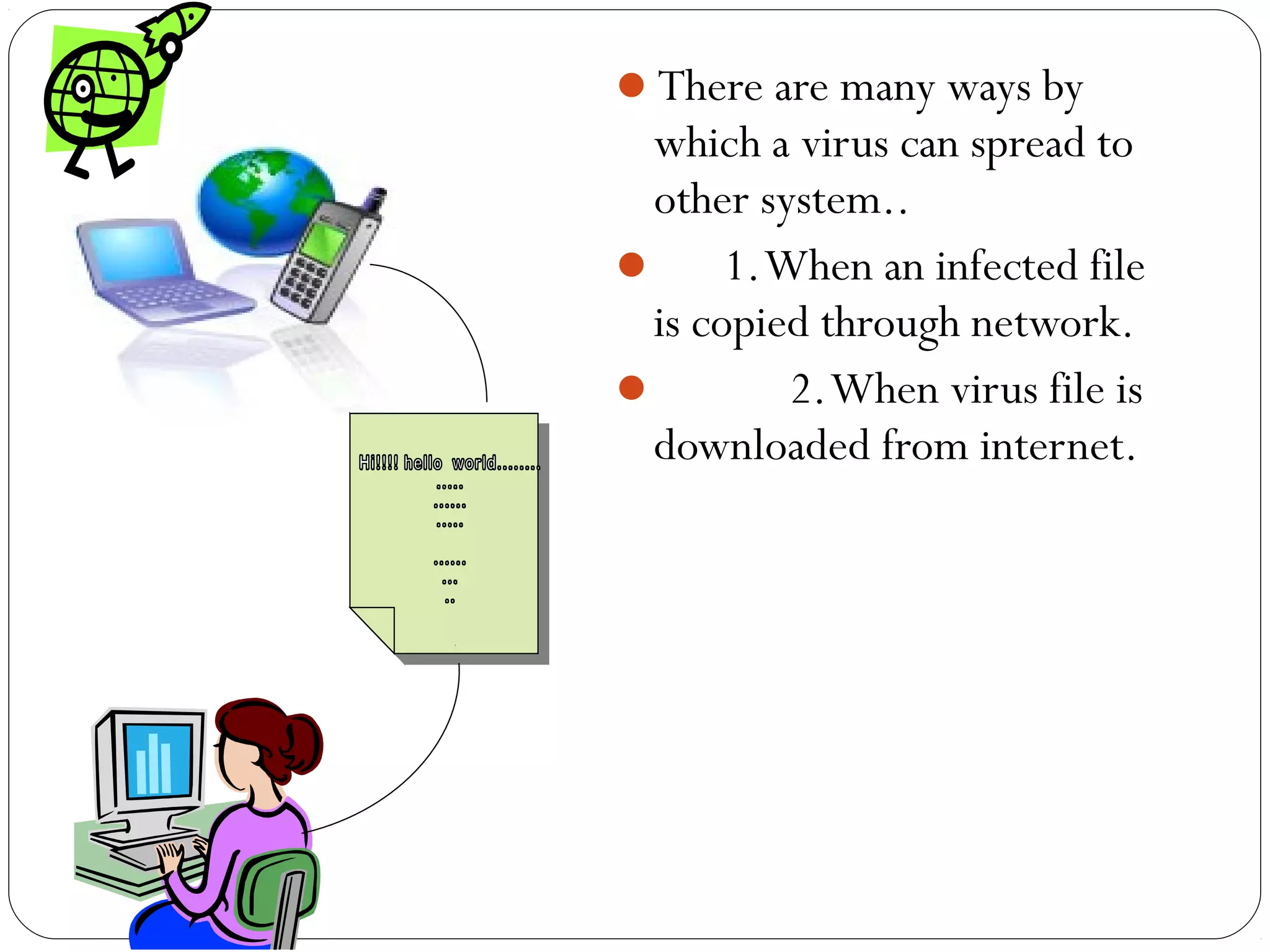
There are many ways by
which a virus can spread to
other system..
 1.When an infected file
is copied through network.
 2.When virus file is
downloaded from internet.
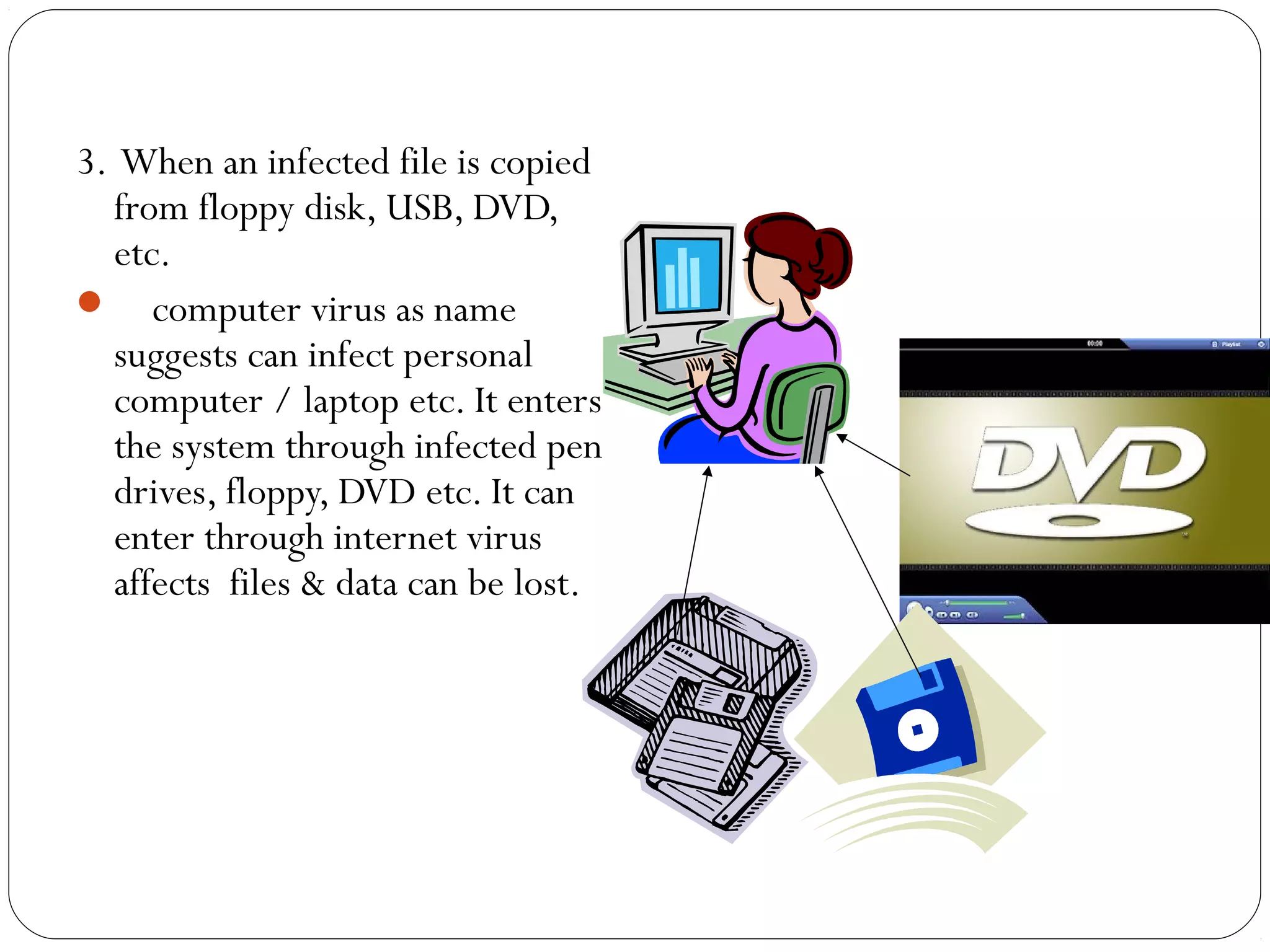
3. When an infected file is copied
from floppy disk, USB, DVD,
etc.
 computer virus as name
suggests can infect personal
computer / laptop etc. It enters
the system through infected pen
drives, floppy, DVD etc. It can
enter through internet virus
affects files & data can be lost.
Action of virus on Computer
 Any unwanted activity on the computer is treated as virus/worm. In actual
these are programs and codes written by some computer.
Virus can cause on computer such as
 1.It may take space on Hard Disk.
 2.Opening some programs.
 3.Generating some messages.
 4.Slow down the computer.
 5.Delete your valuable data.
 6.Unwanted activity over screen.
 7.Crash the Hard Disk.
 8.Unable to boot.
Types of viruses
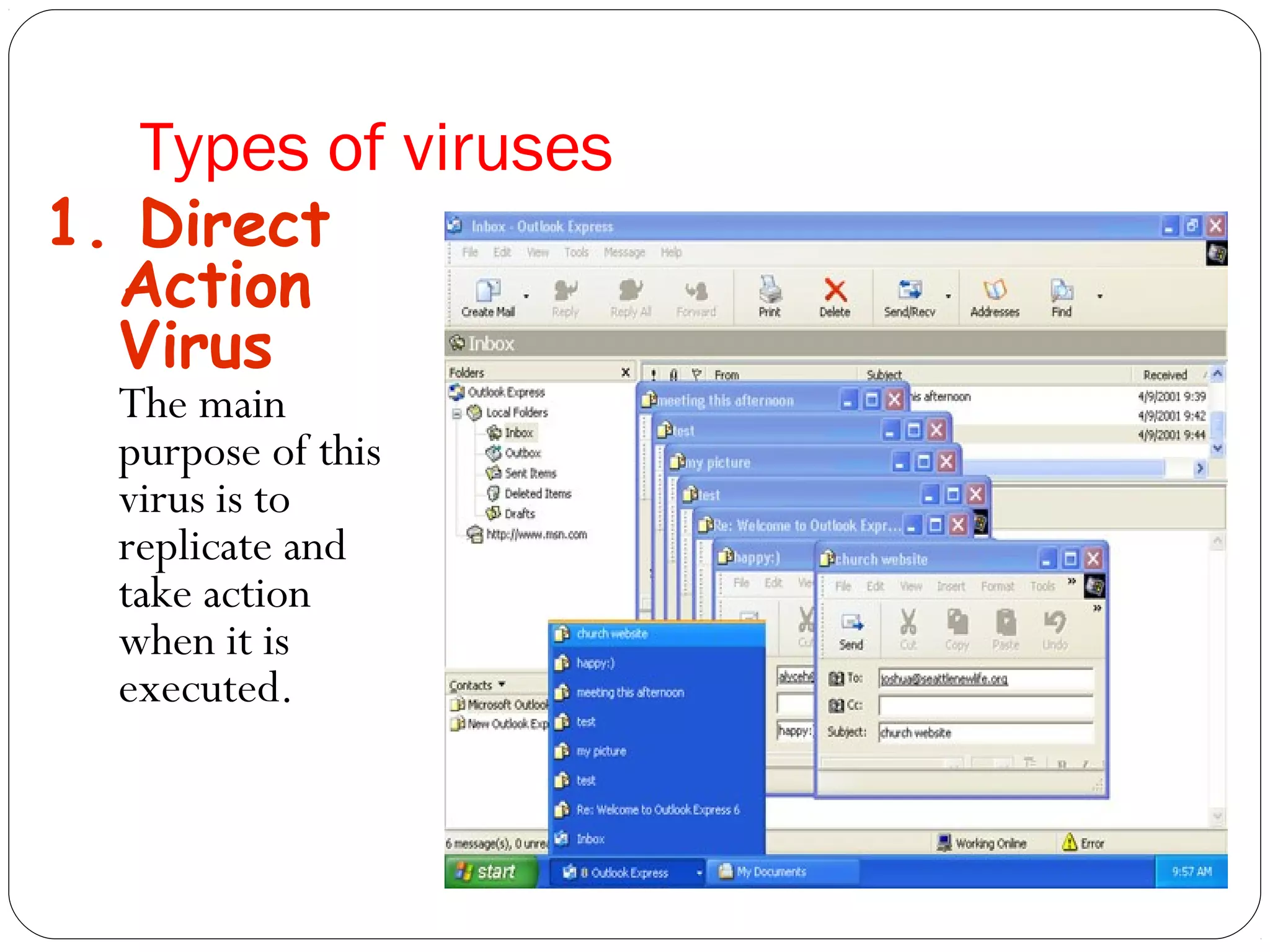
1. Direct
Action
Virus
The main
purpose of this
virus is to
replicate and
take action
when it is
executed.
2. Resident
Viruses
This type of virus is a
permanent which dwells in
the RAM memory.
3.Overwrite Virus
Virus of this kind is characterized by
the fact that it deletes the information
contained in the files that it infects,
rendering them partially or totally
useless once they have been infected.
 The only way to clean a file infected by
an overwrite virus is to delete the file
completely, thus losing the original
content.
The object
oriented analysis
and design is
divided into two
phases – OOA
(Object Oriented
Analysis) and
OOD (Object
Oriented Design)
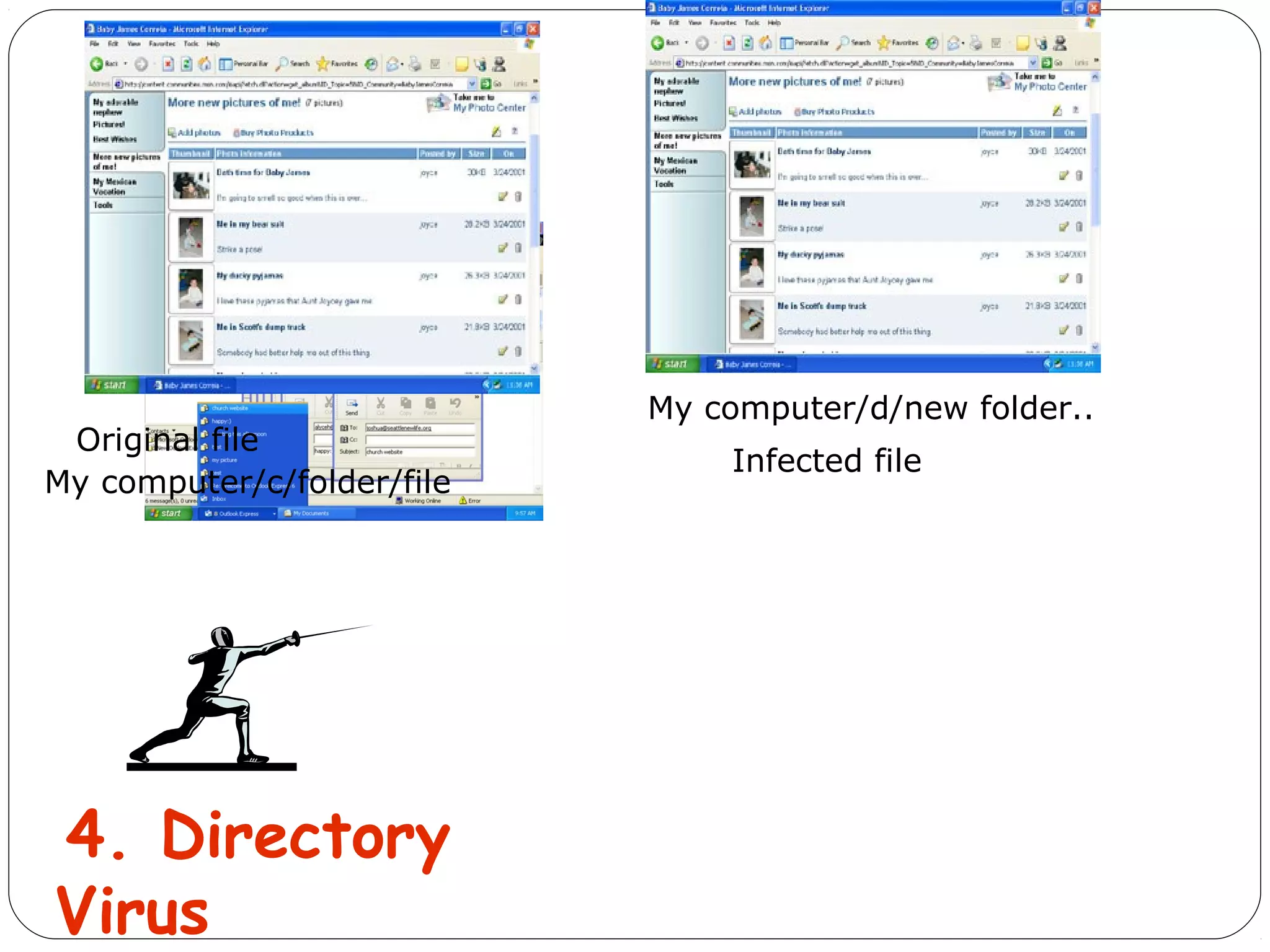
Original file
My computer/c/folder/file
Infected file
My computer/d/new folder..
4. Directory
Virus
Difference Between a Computer Virus, Worm and Trojan
Horse
1. Computer Virus-1. Computer Virus-
A computer virus attaches itself to a program or file enabling it to
spread from one computer to another, leaving infections as it travels
like a human virus. 1. It effects while
others can damage your hardware, software or files. Almost all viruses
are attached to an executable file, which means the virus may exist on
your computer but it actually cannot infect your computer unless you
run or open the infected program. 2. It is important
to note that a virus cannot be spread without a human action, (such as
running an infected program) to keep it going. 
3. People continue the spread of a computer virus,
mostly unknowingly, by sharing infecting files or sending e-mails with
viruses as attachments in the e-mail.
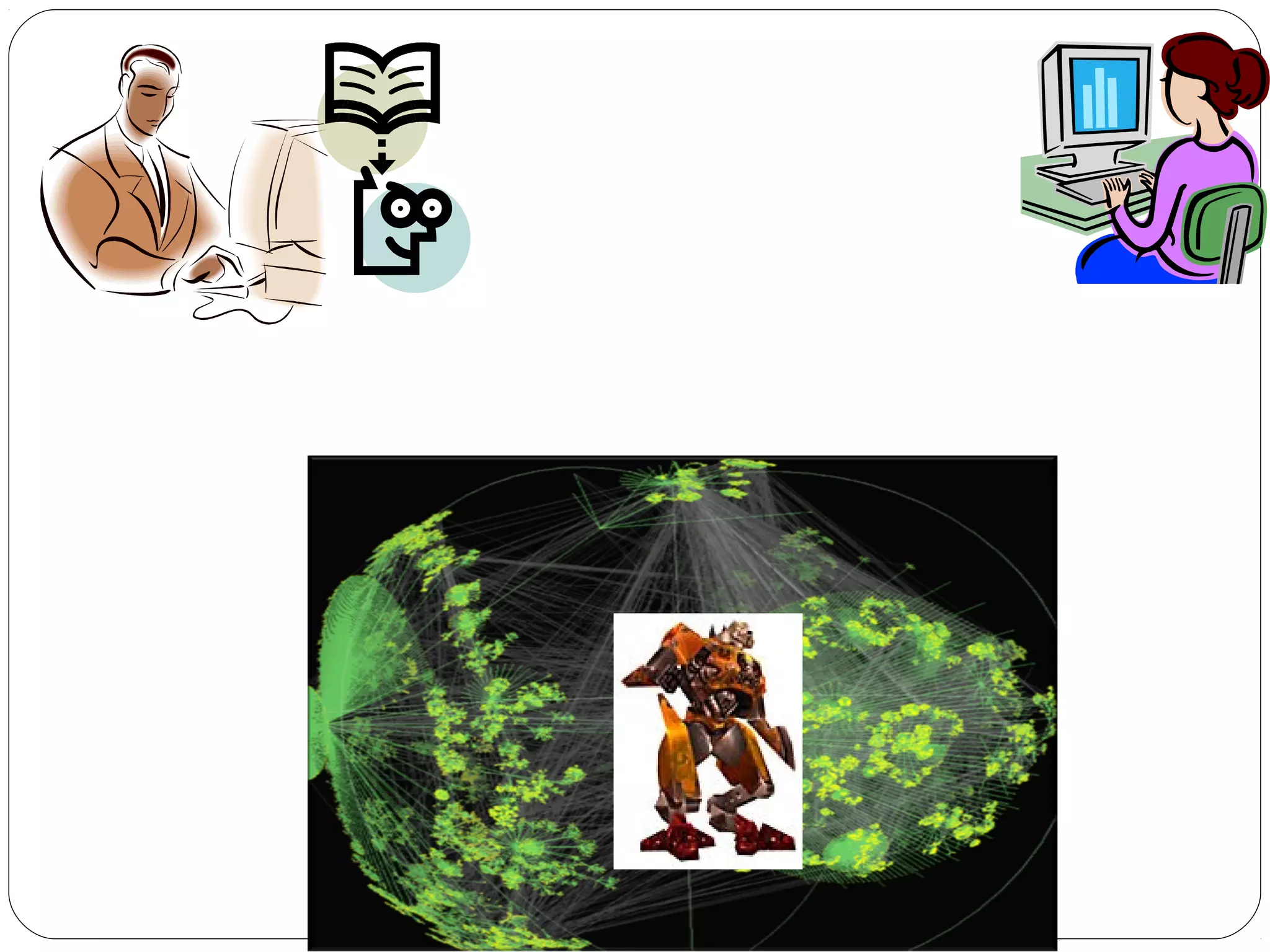
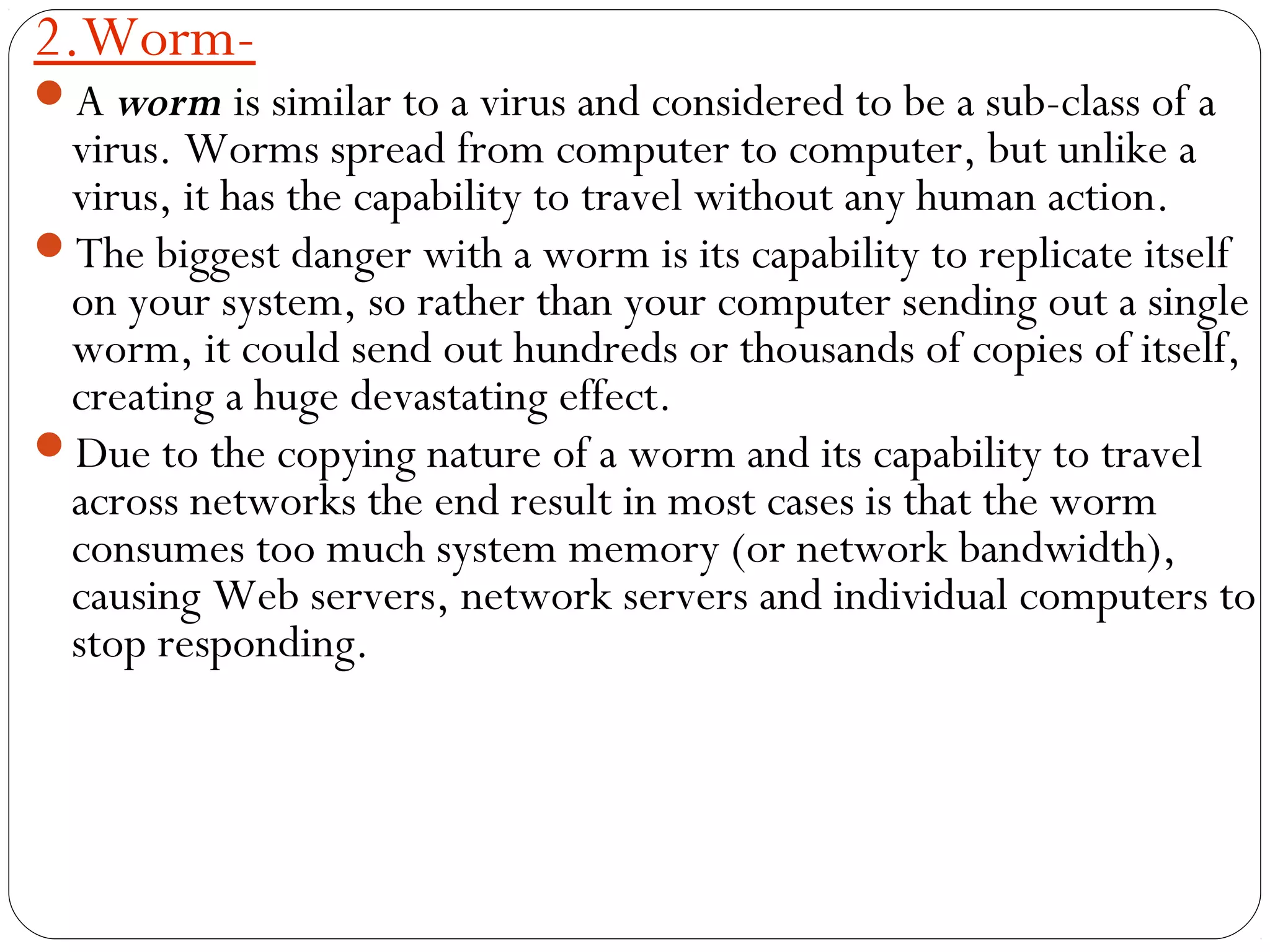
2.Worm-
A worm is similar to a virus and considered to be a sub-class of a
virus. Worms spread from computer to computer, but unlike a
virus, it has the capability to travel without any human action.
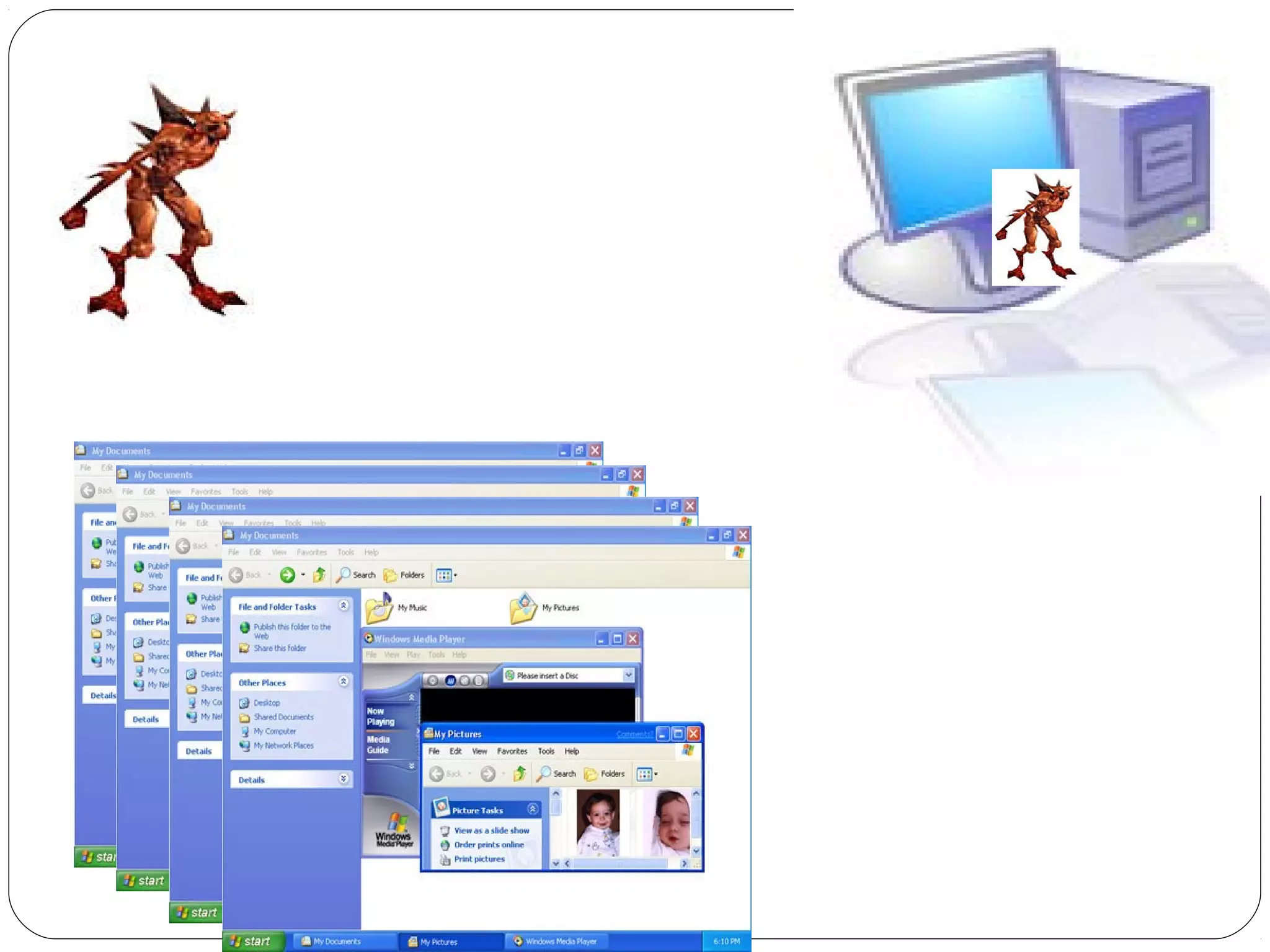
The biggest danger with a worm is its capability to replicate itself
on your system, so rather than your computer sending out a single
worm, it could send out hundreds or thousands of copies of itself,
creating a huge devastating effect. 
Due to the copying nature of a worm and its capability to travel
across networks the end result in most cases is that the worm
consumes too much system memory (or network bandwidth),
causing Web servers, network servers and individual computers to
stop responding.
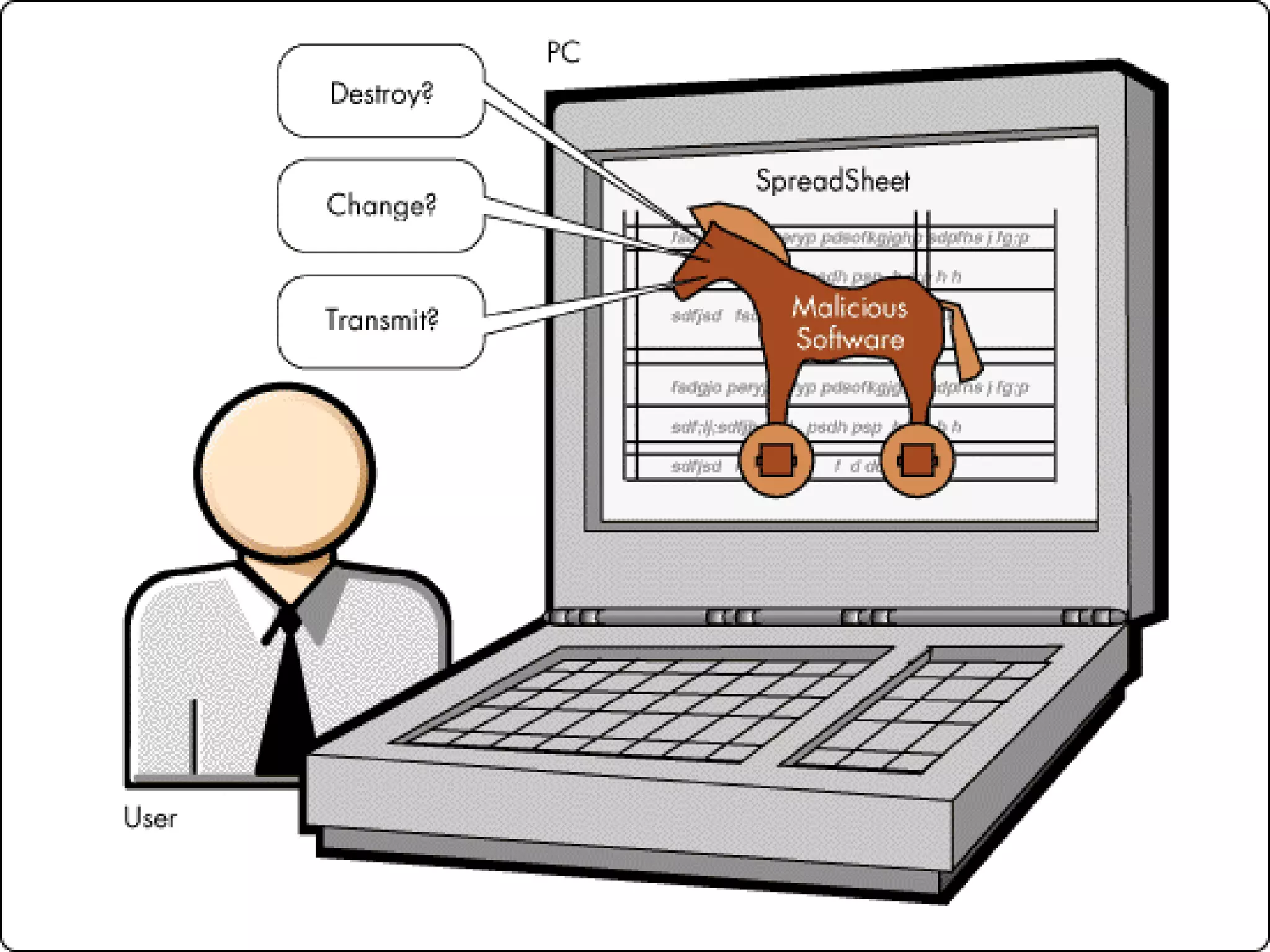
3.Trojan Horse-
When a Trojan is activated on your computer, the results can vary.
Some Trojans are designed to be more annoying than malicious
(like changing your desktop, adding silly active desktop icons) or
they can cause serious damage by deleting files and destroying
information on your system.
Trojans are also known to create a backdoor on your computer that
gives malicious users access to your system, possibly allowing
confidential or personal information to be compromised.
 Unlike viruses and worms, Trojans do not reproduce by infecting
other files nor do they self-replicate.
Antivirus software
An antivirus is a computer program that identify and remove
computer viruses and other malicious software like worms
and Trojans from an infected computer. Not only this,
antivirus software also protects the computer from further
virus attacks.
Symptoms of infected computer
●In My Computer, autoplay option appears instead of open in every
drive you enter i.e. when you click drive letters(C,D,E etc) a
window opens to select any one program to select any one
program to open with.
●Computer becomes slow & there is noticeable delay in characters
to appear on screen when you press in keyboard
● command prompts doesn't open, if it does
close suddenly.
● You cannot open system utilities like Task
Manager, Regedit, Msconfig it opens and
suddenly closes.
What to do on Suspecting virus attack
●Disconnect the suspected computer system from the internet
as well as from the local network.
●Start the system in safe mode or from the windows boot disk,
if it displays any problem in starting.
●Take backup of all data to an external drive.
 Install antivirus software if you do not have it installed.
 Now, download the latest virus definition updates from the
internet (do it on a separate computer)
 Perform a full system scan.
Top Anti-Virus Software
 Shield Deluxe - Antivirus &
Antispyware.
 Spyware Doctor & Antivirus
 F Pront Antivirus
 Bit Defender Antivirus Plus
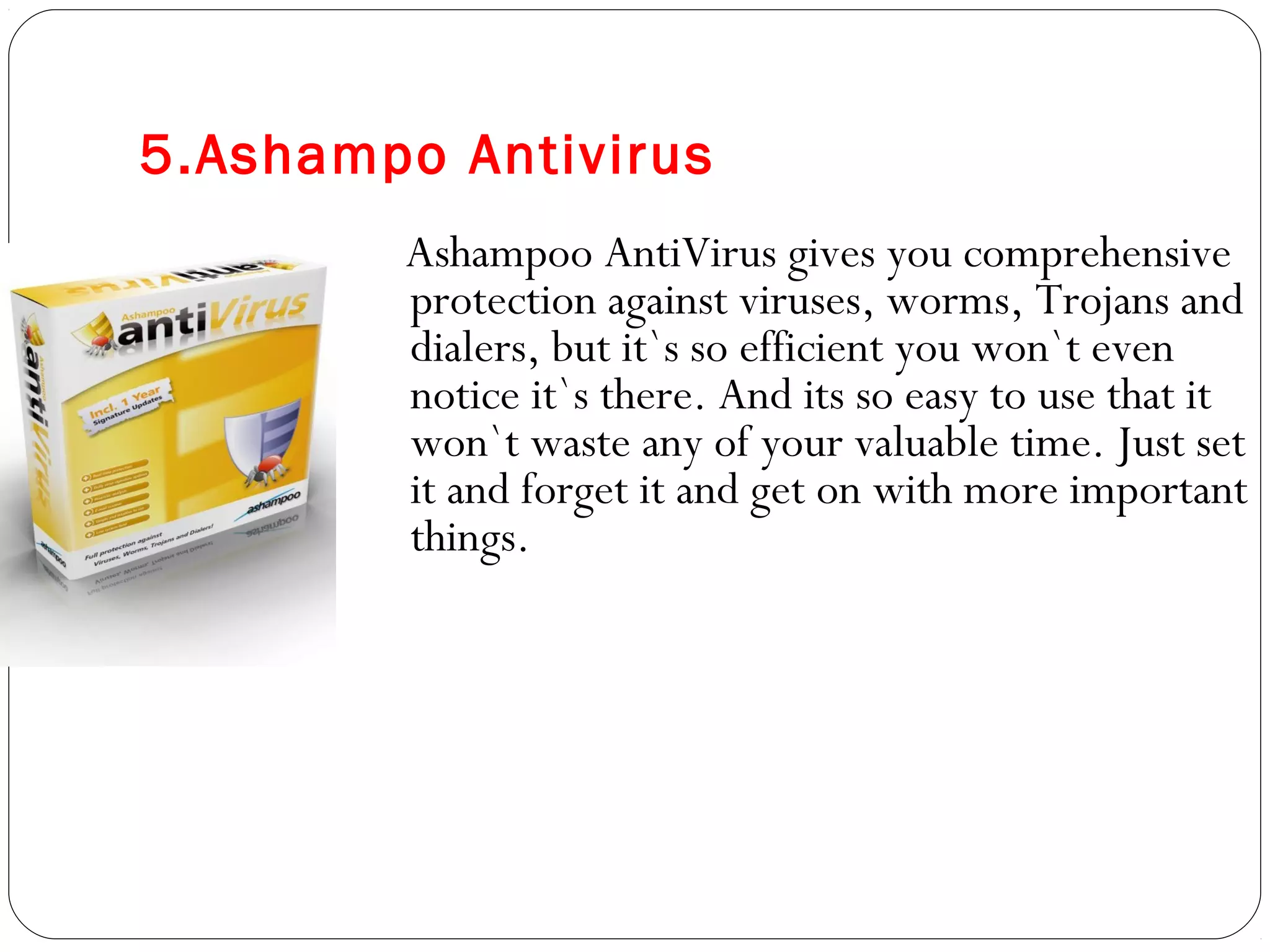
 Ashampo Antivirus
1. Shield Deluxe - Antivirus &
AntiSpyware.
The Shield Deluxe 2009, powered by BitDefender award
winning Antivirus engine. It
provides advanced proactive protection against viruses,
spyware, attacks and identity theft.
Stay one step ahead of the latest e-Threats while
maintaining superior performance that keeps your PC
running smoothly. The Shield
Deluxe is simple to install and set up, while offering
advanced users a range of versatile settings for fine-tuning
the program.
$29.99 to register  
2. Spyware Doctor & Antivirus-
Award-winning spyware and virus protection to
secure your PC.
Spyware Doctor with AntiVirus is a top-rated
malware, spyware & virus removal utility that
detects, removes and protects your PC from
thousands of potential spyware, adware, trojans,
viruses, keyloggers, spybots and tracking threats.
3. F Pront Antivirus
Tired of clunky AV programs that slow down your
computer and constantly interfere with your work or
when you send email? F-PROT Antivirus for Windowsis
legendary for their high security, streamlined efficiency
and very low resource consumption. F-PROT for
Windows runs as good on Win XP Pro as it does on
Win98. Many millions have chosen F-PROT worldwide.
F-PROT will keep your computer secure and keep out of
your way.
4.BitDefender Antivirus Plus
NEW Bit Defender Antivirus Plus v10 integrates
ANTIVIRUS, ANTISPYWARE, FIREWALL and
ANTISPAM modules into one comprehensive
security package that protects your personal
computer.
5.Ashampo Antivirus
Ashampoo AntiVirus gives you comprehensive
protection against viruses, worms, Trojans and
dialers, but it`s so efficient you won`t even
notice it`s there. And its so easy to use that it
won`t waste any of your valuable time. Just set
it and forget it and get on with more important
things.
Antivirus software factors
1. How frequently are virus definitions update?
Virus definitions can be considered as rules which the antivirus
software will use to determine whether a program is
malicious or not.
The latest virus definitions are the better chance of detection.
2. Is automatic update of virus definitions available?
Having the virus definitions updated automatically not only
ensures that your software is up to date but it eliminates the
possibility of you forgetting to manually update them.
3. Does the software has the option to set up routine scanning of
the computer?
The best way to ensure your computer really has no viruses is to
have an antivirus program which can be set up to perform
automatic scans of the system on a regular basis.
4. How much resource it consumes while performing a scan?
It is really a headache working on other applications while an
antivirus program is scanning the computer, specially when your
computer has low memory.
When an antivirus program consume considerable amount of
CPU & memory.
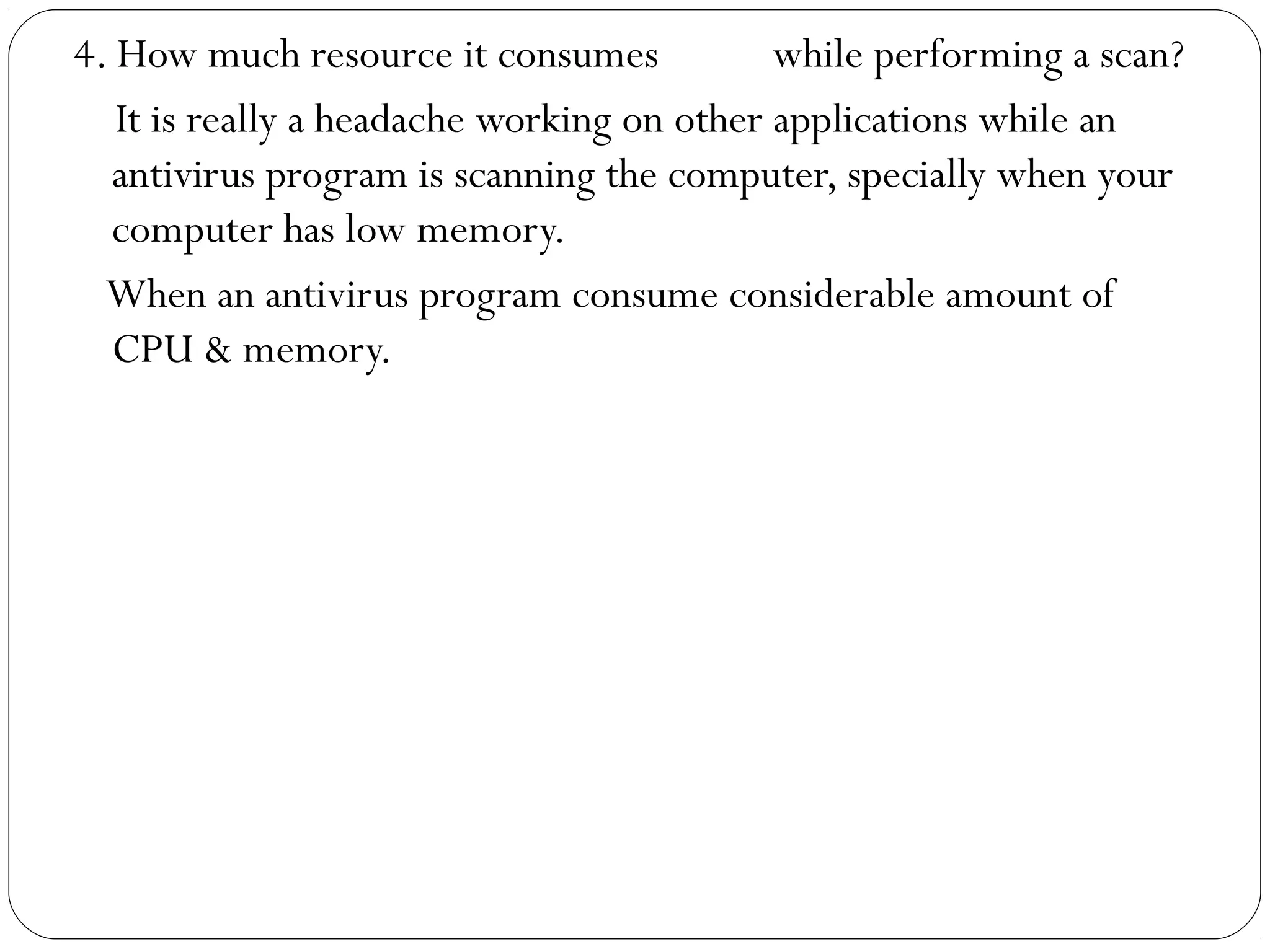
Anti-Virus Action
1.Attempt to
repair the file
by removing
the virus itself
from the file.
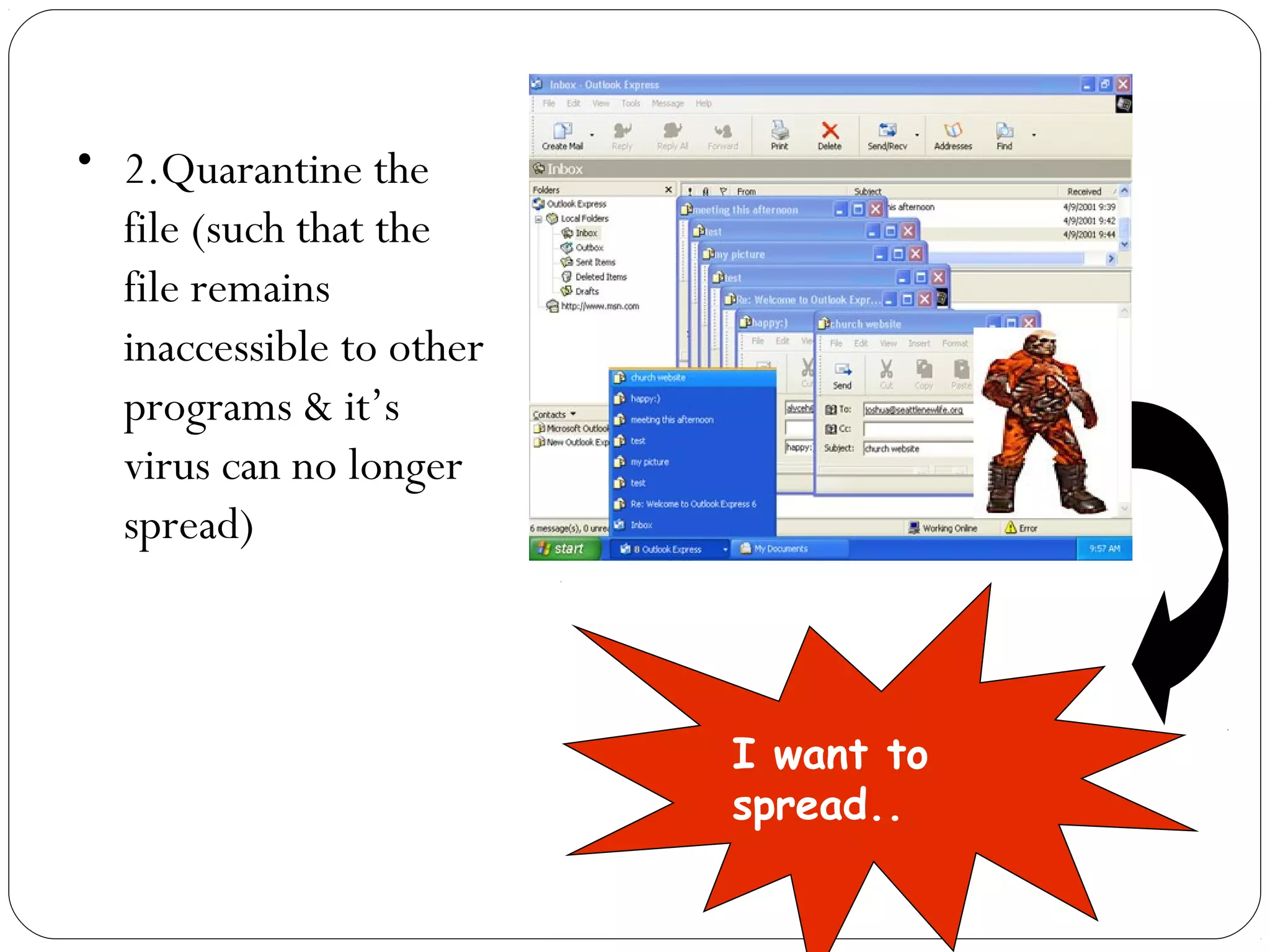
• 2.Quarantine the
file (such that the
file remains
inaccessible to other
programs & it’s
virus can no longer
spread)
I want to
spread..
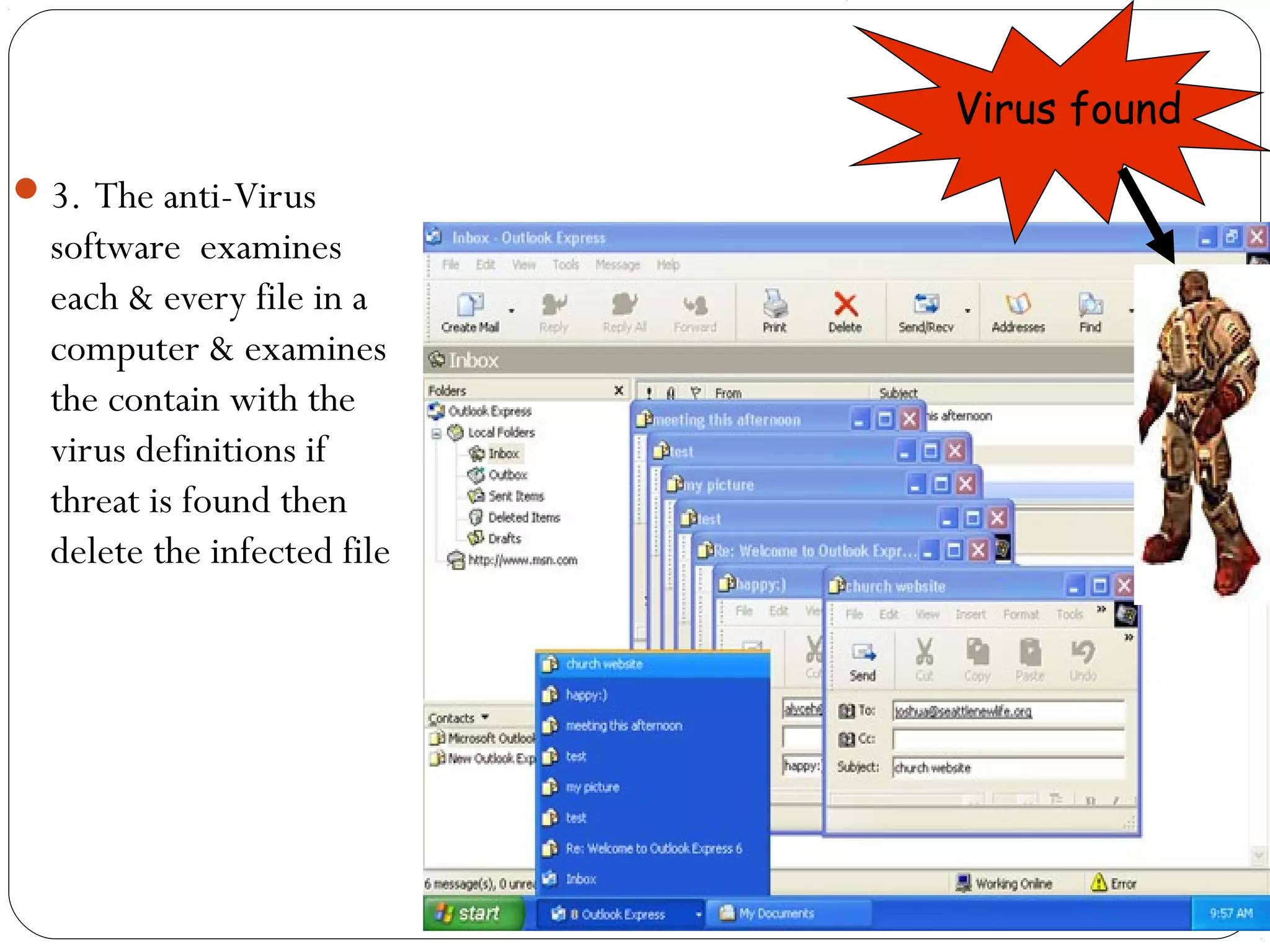
3. The anti-Virus
software examines
each & every file in a
computer & examines
the contain with the
virus definitions if
threat is found then
delete the infected file
Virus found
General precautions
When inserting removable media (floppy, CD, flash drive etc)
scan the whole device with the antivirus software before opening
it.
If you have internet access, make sure you use internet security
software.
Get window updates.
From time to time, update your installed software to their latest
version. e.g. (MS office, java, flash player etc)
You should have an updated antivirus guarding your PC all time.
THANK YOU !

Virus project

  • 1.
    Presented By :Shehrevar Davierwala Contact : shehrevar@live.com
  • 2.
     Computer virus Actions of virus  Types of virus  Difference between computer virus, worms and Trojans Horse  Anti virus software  Symptoms of infected computer  What to do on suspecting virus attack  Types of antivirus  Antivirus software factors  Actions of antivirus  General precautions
  • 3.
    VIRUS VIRUS (Vital InformationResource Under Seize)  It is a software use to infect a computer. After virus code is written it is integrated with in an essential programmed.  Once the programmed is executed the virus code is activated and attacks copies of itself to other programmers.  A common type virus is a boot virus which is stored in the boot sector of disk if the disk is left in the drive when the machine is infected with FLOPPY, CD, hard disk expecting to the find the operating there once the machine is effected the boot virus may replicate it self on to all the floppies.  A virus current be attach data it must attack to be removable programmed that is down loaded into or installed in the computer, the virus attacked programmed most be executed in order to active the virus.
  • 4.
    What is computervirus? Computer virus is nothing but a computer program that can infect a computer without the knowledge of the person using the system.  virus can spread from one system to another when a infected file is copied or transfer from host to target system.
  • 5.
    There are manyways by which a virus can spread to other system..  1.When an infected file is copied through network.  2.When virus file is downloaded from internet.
  • 6.
    3. When aninfected file is copied from floppy disk, USB, DVD, etc.  computer virus as name suggests can infect personal computer / laptop etc. It enters the system through infected pen drives, floppy, DVD etc. It can enter through internet virus affects files & data can be lost.
  • 7.
    Action of viruson Computer  Any unwanted activity on the computer is treated as virus/worm. In actual these are programs and codes written by some computer. Virus can cause on computer such as  1.It may take space on Hard Disk.  2.Opening some programs.  3.Generating some messages.  4.Slow down the computer.  5.Delete your valuable data.  6.Unwanted activity over screen.  7.Crash the Hard Disk.  8.Unable to boot.
  • 9.
    Types of viruses 1.Direct Action Virus The main purpose of this virus is to replicate and take action when it is executed.
  • 10.
    2. Resident Viruses This typeof virus is a permanent which dwells in the RAM memory.
  • 11.
    3.Overwrite Virus Virus ofthis kind is characterized by the fact that it deletes the information contained in the files that it infects, rendering them partially or totally useless once they have been infected.  The only way to clean a file infected by an overwrite virus is to delete the file completely, thus losing the original content. The object oriented analysis and design is divided into two phases – OOA (Object Oriented Analysis) and OOD (Object Oriented Design)
  • 12.
    Original file My computer/c/folder/file Infectedfile My computer/d/new folder.. 4. Directory Virus
  • 13.
    Difference Between aComputer Virus, Worm and Trojan Horse 1. Computer Virus-1. Computer Virus- A computer virus attaches itself to a program or file enabling it to spread from one computer to another, leaving infections as it travels like a human virus. 1. It effects while others can damage your hardware, software or files. Almost all viruses are attached to an executable file, which means the virus may exist on your computer but it actually cannot infect your computer unless you run or open the infected program. 2. It is important to note that a virus cannot be spread without a human action, (such as running an infected program) to keep it going.  3. People continue the spread of a computer virus, mostly unknowingly, by sharing infecting files or sending e-mails with viruses as attachments in the e-mail.
  • 15.
    2.Worm- A worm issimilar to a virus and considered to be a sub-class of a virus. Worms spread from computer to computer, but unlike a virus, it has the capability to travel without any human action. The biggest danger with a worm is its capability to replicate itself on your system, so rather than your computer sending out a single worm, it could send out hundreds or thousands of copies of itself, creating a huge devastating effect.  Due to the copying nature of a worm and its capability to travel across networks the end result in most cases is that the worm consumes too much system memory (or network bandwidth), causing Web servers, network servers and individual computers to stop responding.
  • 17.
    3.Trojan Horse- When aTrojan is activated on your computer, the results can vary. Some Trojans are designed to be more annoying than malicious (like changing your desktop, adding silly active desktop icons) or they can cause serious damage by deleting files and destroying information on your system. Trojans are also known to create a backdoor on your computer that gives malicious users access to your system, possibly allowing confidential or personal information to be compromised.  Unlike viruses and worms, Trojans do not reproduce by infecting other files nor do they self-replicate.
  • 19.
    Antivirus software An antivirusis a computer program that identify and remove computer viruses and other malicious software like worms and Trojans from an infected computer. Not only this, antivirus software also protects the computer from further virus attacks.
  • 20.
    Symptoms of infectedcomputer ●In My Computer, autoplay option appears instead of open in every drive you enter i.e. when you click drive letters(C,D,E etc) a window opens to select any one program to select any one program to open with. ●Computer becomes slow & there is noticeable delay in characters to appear on screen when you press in keyboard
  • 21.
    ● command promptsdoesn't open, if it does close suddenly. ● You cannot open system utilities like Task Manager, Regedit, Msconfig it opens and suddenly closes.
  • 22.
    What to doon Suspecting virus attack ●Disconnect the suspected computer system from the internet as well as from the local network. ●Start the system in safe mode or from the windows boot disk, if it displays any problem in starting. ●Take backup of all data to an external drive.
  • 23.
     Install antivirussoftware if you do not have it installed.  Now, download the latest virus definition updates from the internet (do it on a separate computer)  Perform a full system scan.
  • 24.
    Top Anti-Virus Software Shield Deluxe - Antivirus & Antispyware.  Spyware Doctor & Antivirus  F Pront Antivirus  Bit Defender Antivirus Plus  Ashampo Antivirus
  • 25.
    1. Shield Deluxe- Antivirus & AntiSpyware. The Shield Deluxe 2009, powered by BitDefender award winning Antivirus engine. It provides advanced proactive protection against viruses, spyware, attacks and identity theft. Stay one step ahead of the latest e-Threats while maintaining superior performance that keeps your PC running smoothly. The Shield Deluxe is simple to install and set up, while offering advanced users a range of versatile settings for fine-tuning the program. $29.99 to register  
  • 26.
    2. Spyware Doctor& Antivirus- Award-winning spyware and virus protection to secure your PC. Spyware Doctor with AntiVirus is a top-rated malware, spyware & virus removal utility that detects, removes and protects your PC from thousands of potential spyware, adware, trojans, viruses, keyloggers, spybots and tracking threats.
  • 27.
    3. F ProntAntivirus Tired of clunky AV programs that slow down your computer and constantly interfere with your work or when you send email? F-PROT Antivirus for Windowsis legendary for their high security, streamlined efficiency and very low resource consumption. F-PROT for Windows runs as good on Win XP Pro as it does on Win98. Many millions have chosen F-PROT worldwide. F-PROT will keep your computer secure and keep out of your way.
  • 28.
    4.BitDefender Antivirus Plus NEWBit Defender Antivirus Plus v10 integrates ANTIVIRUS, ANTISPYWARE, FIREWALL and ANTISPAM modules into one comprehensive security package that protects your personal computer.
  • 29.
    5.Ashampo Antivirus Ashampoo AntiVirusgives you comprehensive protection against viruses, worms, Trojans and dialers, but it`s so efficient you won`t even notice it`s there. And its so easy to use that it won`t waste any of your valuable time. Just set it and forget it and get on with more important things.
  • 30.
    Antivirus software factors 1.How frequently are virus definitions update? Virus definitions can be considered as rules which the antivirus software will use to determine whether a program is malicious or not. The latest virus definitions are the better chance of detection.
  • 31.
    2. Is automaticupdate of virus definitions available? Having the virus definitions updated automatically not only ensures that your software is up to date but it eliminates the possibility of you forgetting to manually update them.
  • 32.
    3. Does thesoftware has the option to set up routine scanning of the computer? The best way to ensure your computer really has no viruses is to have an antivirus program which can be set up to perform automatic scans of the system on a regular basis.
  • 33.
    4. How muchresource it consumes while performing a scan? It is really a headache working on other applications while an antivirus program is scanning the computer, specially when your computer has low memory. When an antivirus program consume considerable amount of CPU & memory.
  • 34.
    Anti-Virus Action 1.Attempt to repairthe file by removing the virus itself from the file.
  • 35.
    • 2.Quarantine the file(such that the file remains inaccessible to other programs & it’s virus can no longer spread) I want to spread..
  • 36.
    3. The anti-Virus softwareexamines each & every file in a computer & examines the contain with the virus definitions if threat is found then delete the infected file Virus found
  • 37.
    General precautions When insertingremovable media (floppy, CD, flash drive etc) scan the whole device with the antivirus software before opening it. If you have internet access, make sure you use internet security software.
  • 38.
    Get window updates. Fromtime to time, update your installed software to their latest version. e.g. (MS office, java, flash player etc) You should have an updated antivirus guarding your PC all time.
  • 39.