Customer Relationship Management    IACT 401 IT Strategic Planning Seminar By Nurhazman Abdul Aziz Hoh Whay, Loh Imtiyaz R.
Objective of this seminar About the Author Article 1: Keeping eBusiness Perspective Evolution of eBusiness Solution Article 2: Where is the benefit in CRM technology investment Evaluation Conclusion Agenda
We are going to cover 2 article by Tim Coltman, linking up the strategic viewpoint from both articles why Customer Relationships Management is important in an IT strategic planning. We are also going to used the aid of real scenario (video), from a top CRM Solution provider to enforce the article 2, with much understanding. Apart from that we are going to related this article to other previous articles, as well as other articles and source and that be match and enforce in today ideas.  Objective of this seminar
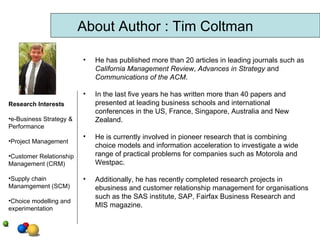
About Author : Tim Coltman He has published more than 20 articles in leading journals such as  California Management Review ,  Advances in Strategy  and  Communications of the ACM . In the last five years he has written more than 40 papers and presented at leading business schools and international conferences in the US, France, Singapore, Australia and New Zealand.  He is currently involved in pioneer research that is combining choice models and information acceleration to investigate a wide range of practical problems for companies such as Motorola and Westpac.  Additionally, he has recently completed research projects in ebusiness and customer relationship management for organisations such as the SAS institute, SAP, Fairfax Business Research and MIS magazine.  Research Interests e-Business Strategy & Performance Project Management Customer Relationship Management (CRM) Supply chain Manamgement (SCM) Choice modelling and experimentation
Article 1: Keep eBusiness Perspective Objective Two related questions is raised in this article “… where is eBusiness concentrated …?” “… why is eBusiness occurring as it is …?” The objective of article is to determine the appropriateness of eBusiness  to a firm/organisation
Where is eBusiness concentrated? “…  The actual impact of eBusiness on the way people shop and the way  business is conducted on a day to day basis ( theory in use ) contrasts  sharply with the way it is talk about and reported by the techno-elite and popular media ( espoused theory ) ...” Coltman, (2002) Espoused theories VS Theories in use
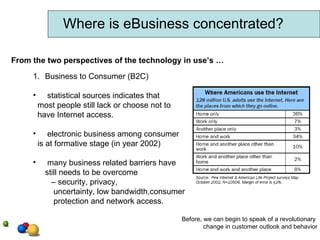
Where is eBusiness concentrated? From the two perspectives of the technology in use’s … Business to Consumer (B2C) statistical sources indicates that most people still lack or choose not to have Internet access. electronic business among consumer is at formative stage (in year 2002) many business related barriers have still needs to be overcome –  security, privacy, uncertainty, low bandwidth,consumer protection and network access. Before, we can begin to speak of a revolutionary  change in customer outlook and behavior
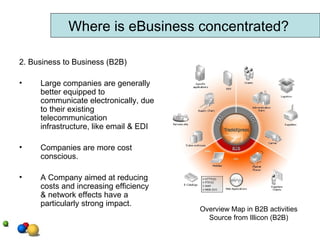
Where is eBusiness concentrated? 2. Business to Business (B2B) Large companies are generally better equipped to communicate electronically, due to their existing telecommunication infrastructure, like email & EDI Companies are more cost conscious. A Company aimed at reducing costs and increasing efficiency & network effects have a particularly strong impact. Overview Map in B2B activities Source from Illicon (B2B)
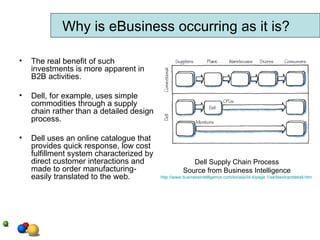
The real benefit of such investments is more apparent in B2B activities.  Dell, for example, uses simple commodities through a supply chain rather than a detailed design process.  Dell uses an online catalogue that provides quick response, low cost fulfillment system characterized by direct customer interactions and made to order manufacturing-easily translated to the web. Why is eBusiness occurring as it is? Dell Supply Chain Process Source from Business Intelligence http://www.businessintelligence.com/ex/asp/id.4/page.1/xe/biextractdetail.htm
Predictions of the impact of e-business included: Brands will die out. The Internet will be a major threat to brands making brand strength weaker In reality, it is most likely to gravitate towards brands as a way to simplify choices, reduce costs and build trust.  Middleman will die – computer network revolution is to remove middleman.  The key is to find ways to move into a new distribution channel without jeopardizing existing channel relationships. Why is eBusiness occurring as it is?
Scale is irrelevant – Size will be less important for online form Networks either virtual or real, work to a relatively simple logic, larger the network the more attractive they are to the customer. Companies such as Microsoft can benefit due to standardization, & bargaining power to encourage cooperation among fellow channel members. Lower Prices – E-business leads to more efficient markets, lower prices.  While the cost of getting the right item to the customer is cheaper, there is no guarantee this result in lower prices. Why is eBusiness occurring as it is?
The common assumption regarding the criteria of revolution is generally derived from technology itself.  What must be considered is whether the occurrences of e-business  is driven by technology itself or the changes occurring in business management and how it affects the use of technology.  Makes reference to Manuel Castells who was a professor of Sociology at the University of California, Berkey. He stressed that revolutions are influenced not only by the technologies impact but rather characterized by their “ pervasiveness across all domains of human activity”  (pg.9)  States Social requirements still govern technology but technology does not govern social requirements.  Emphasizes how E-business is not a phenomenon that evolved on its own rather development was progressed by other movements such as the Online and Computer revolution.  You say you want a revolution?
Despite the advance changes in information and technology, there has not been any significant change in the way business decisions are made.  Basic principles such: Identifying customer value Assembling the right people Assembling the right processes and technical resources Are as relevant today as they have always been.  The areas that have been modified as a direct result of technological advancement include hierarchies within firms, established supplier relationships and order/payments systems. One must be reminded that this has not changed the business in general, rather the psychology of the business.  Final Wrap
E-Business is not for everyone As B2C is yet to take off to its full potential, E-Business  businesses may not be the most feasible option for organisations who are after short term profit rewards. Brands that revolve around Emotional associations may adapt better to  e-Business than brands that rely on facts and beliefs.  Coltman stresses the Media attention that surrounds e-Business can often be misleading. World renown online businesses such as Amazon.com and e-Bay represent specialised categories and to not represent how E-business is an ideal solution that all organisations should invest in.  Author Conclusion
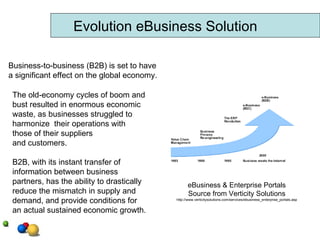
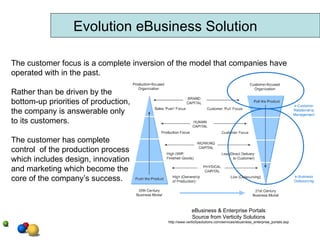
Evolution eBusiness Solution Business-to-business (B2B) is set to have  a significant effect on the global economy.  The old-economy cycles of boom and  bust resulted in enormous economic  waste, as businesses struggled to  harmonize  their operations with  those of their suppliers  and customers.  B2B, with its instant transfer of  information between business  partners, has the ability to drastically  reduce the mismatch in supply and  demand, and provide conditions for  an actual sustained economic growth.  eBusiness & Enterprise Portals Source from Verticity Solutions http://www.verticitysolutions.com/services/ebusiness_enterprise_portals.asp
The customer focus is a complete inversion of the model that companies have operated with in the past.  Rather than be driven by the  bottom-up priorities of production,  the company is answerable only  to its customers.  The customer has complete  control  of the production process  which includes design, innovation  and marketing which become the  core of the company’s success.  Evolution eBusiness Solution eBusiness & Enterprise Portals Source from Verticity Solutions http://www.verticitysolutions.com/services/ebusiness_enterprise_portals.asp
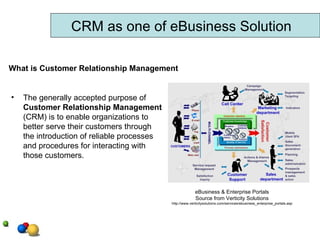
The generally accepted purpose of  Customer Relationship Management  (CRM) is to enable organizations to better serve their customers through the introduction of reliable processes and procedures for interacting with those customers.   CRM as one of eBusiness Solution What is Customer Relationship Management eBusiness & Enterprise Portals Source from Verticity Solutions http://www.verticitysolutions.com/services/ebusiness_enterprise_portals.asp
In today's competitive business environment, a successful CRM strategy cannot be implemented by only installing and integrating a software package designed to support CRM processes.  A holistic approach to CRM is vital for an efficient and effective CRM policy. This approach includes training of employees, modification of business processes based on customers' needs and an adoption of relevant IT-systems (including soft- and maybe hardware) and/or usage of IT-Services that enable the organization or company to follow its CRM strategy.  CRM-Services can even replace the acquisition of additional hardware or CRM software-Licence.  Customer Relationship Management
Qualitative Benefits of CRM Before, starting into the discussion into “ where the benefits in CRM technology Investment” by Coltman, 2005. Let’s take a look into the  Qualitative  Benefits of CRM , but ONYX Software, a CRM solution providers. Their client is Netegrity, a security software Solution company. This will give us an ideal about what will the next article discuss about, Including the strategic planning. http://www.onyx.com/customers/video/library/netegrity/?id=6 Qualitative Benefits of CRM as an introduction to the benefit
Article 2 Objective Identify the human and technology capabilities required to  successfully execute a CRM program Introduction Customer Relationship Management (CRM) is not only a tool but can be thought of as being apart of a deeply embedded strategic disposition. Unfortunately, CRM  failed to live up to expectations.  Software glitches, poorly trained staff and disparate legacy systems continue to characterize CRM  technology today. Therefore, CRM programs must be feasible and this requires a wider understanding of the structural and behavioral limits to organizational alignment. Article 2 : Where are the benefits of CRM technology investment?
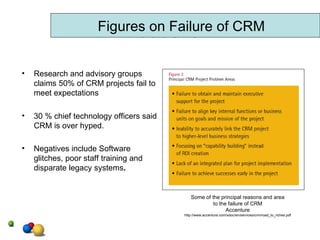
Introduction Research and advisory groups claims 50% of CRM projects fail to meet expectations 30 % chief technology officers said CRM is over hyped.  Negatives include Software glitches, poor staff training and disparate legacy systems .   Some of the principal reasons and area to the failure of CRM Accenture http://www.accenture.com/xdoc/en/services/crm/road_to_riches.pdf Figures on Failure of CRM
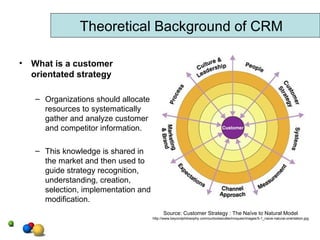
What is a customer orientated strategy Organizations should allocate resources to systematically gather and analyze customer and competitor information. This knowledge is shared in the market and then used to guide strategy recognition, understanding, creation, selection, implementation and modification.  Theoretical Background of CRM Source: Customer Strategy : The Naïve to Natural Model http://www.beyondphilosophy.com/ourtoolsandtechniques/images/5-1_naive-natural-orientation.jpg
For CRM to be successful: Programs must be feasible Wide understanding of organization structure & behavior.  An adroit combination of human, business and technological capabilities is required to successfully execute a customer strategy.  Each capability is nested within an intricate organizational system of interrelated and interdependent resources.  Bharadwaj    classifies IT based resources as  IT Infrastructure Technological and managerial skills Knowledge assets and synergy. Theoretical Background of CRM
Tippins and Sohi    IT competency consists of three components: Extent till firm possesses body of technical knowledge of IT systems.  Extent to which firm uses IT Number of IT artifacts.  Such combinations drives CRM processes such as cross selling, up-selling, marketing & fulfillment, customer service and support, field service operations and retention management.  These technologies are vital for integration of customer content, customer contact info, end to end business processes.  Theoretical Background of CRM
3 measures of customer relating capabilities are: Skills and experiences at converting data to customer knowledge Level of CRM information structure CRM business alignment of incentives, customer strategy and structure. Large companies should not be overly concerned with reactive responses to expressed needs, rather they seek a proactive orientation that directs attention towards latent or unarticulated demand.  Theoretical Background of CRM
What to take into account with CRM Close relationships are path dependant Close relationships require investment in relationship specific assets Close relationships take a long time to materialize Targeted customers may not be receptive.   Theoretical Background of CRM
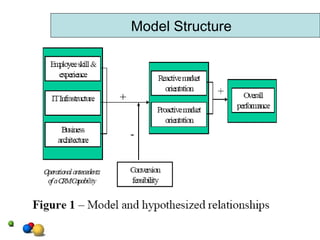
Day and Wensley model is based on a relatively simple deterministic relationship between sources of advantage, positions of advantage and performance. The relevance of this model to an  assessment of CRM performance  is threefold: enables one to assess the contribution that superior CRM capabilities ― human, technological and business capabilities ― have on competitive advantage. recognizes the mediating impact that positional advantage (i.e., customer orientation) has on performance. captures the path dependent nature of performance, prior investment in sources of CRM advantage is used to enhance future performance and sustain competitive advantage. Model Structure
Model Structure
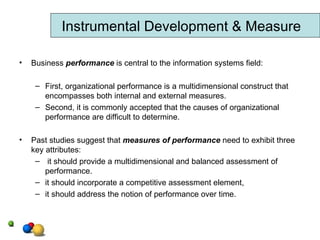
Business  performance  is central to the information systems field: First, organizational performance is a multidimensional construct that encompasses both internal and external measures. Second, it is commonly accepted that the causes of organizational performance are difficult to determine. Past studies suggest that  measures of performance   need to exhibit three key attributes: it should provide a multidimensional and balanced assessment of performance. it should incorporate a competitive assessment element, it should address the notion of performance over time. Instrumental Development & Measure
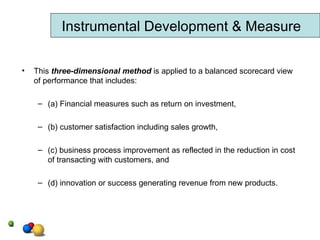
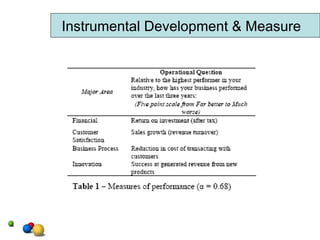
This  three-dimensional method  is applied to a balanced scorecard view of performance that includes:  (a) Financial measures such as return on investment,  (b) customer satisfaction including sales growth,  (c) business process improvement as reflected in the reduction in cost of transacting with customers, and (d) innovation or success generating revenue from new products. Instrumental Development & Measure
Instrumental Development & Measure
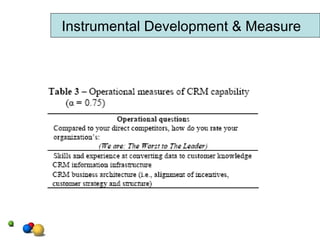
To fully capture the expansive nature of CRM a similar approach is taken to implement a  CRM capability . Three items were used to establish the higher order construct CRM capability. The three measures of customer relating capability are:  (1) skills and experience at converting data to customer knowledge,  (2) level of CRM information infrastructure, and  (3) CRM business alignment of incentives, customer strategy and structure. Instrumental Development & Measure
Instrumental Development & Measure
The  main effects model  reveals a number of other interesting findings. First, a CRM capability is primarily driven by human skills and experience that is supported by appropriate business architecture (i.e.,incentives and structures). Second, the effect of conversion effectiveness is quite robust with negative and significant effects on both measures of market orientation Discussion & Structural Model
Quantitative Benefit of CRM Earlier on, we were looking at the Qualitative Benefit of CRM, as an introduction to the article. Now, let’s take a look at some of the  Quantitative Benefits of CRM  provided ONYX Software.  This will summaries and putting us in a good strong viewpoint about “where is the  benefit in CRM technology investment?”  http://www.onyx.com/customers/video/library/netegrity/?id=6
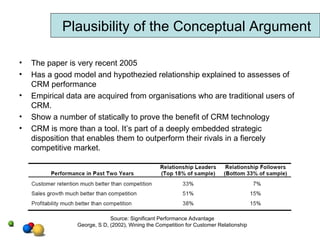
The paper is very recent 2005 Has a good model and hypothezied relationship explained to assesses of CRM performance Empirical data are acquired from organisations who are traditional users of CRM.  Show a number of statically to prove the benefit of CRM technology  CRM is more than a tool. It’s part of a deeply embedded strategic disposition that enables them to outperform their rivals in a fiercely competitive market. Supporting Idea:  Plausibility of the Conceptual Argument Source: Significant Performance Advantage George, S D, (2002), Wining the Competition for Customer Relationship
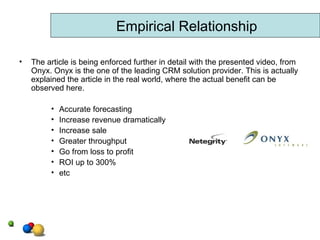
The article is being enforced further in detail with the presented video, from Onyx. Onyx is the one of the leading CRM solution provider. This is actually explained the article in the real world, where the actual benefit can be observed here.  Accurate forecasting Increase revenue dramatically Increase sale Greater throughput Go from loss to profit ROI up to 300% etc Empirical Relationship
Empirical Relationship Main article states that “IT infrastructure is relatively unimportant compared to what the marketing divisions of companies like Siebel, Oracle and SAP would like us to believe.” A study by George S. Day and Christoper Van den Bulte, in the article –  “Superiority in Customer Relationship Management: Consequences for Competitive Advantage and Performance”. They states that IT is merely a necessary condition for CRM, it contributes little to either relational advantage or performance. The main implication for managers aiming for CRM leaderships is “how firms organize their effort”  Like incentives, measures oragnisation structure  and accountabilities.  Supporting that IT Infrastructure is Unimportant
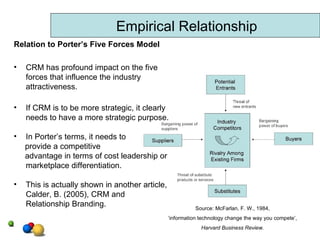
Relation to Porter’s Five Forces Model CRM has profound impact on the five forces that influence the industry attractiveness. If CRM is to be more strategic, it clearly needs to have a more strategic purpose.  In Porter’s terms, it needs to  provide a competitive  advantage in terms of cost leadership or marketplace differentiation. This is actually shown in another article,  Calder, B. (2005), CRM and Relationship Branding. Empirical Relationship Source: McFarlan, F. W., 1984,  ‘ information technology change the way you compete’,  Harvard Business Review.
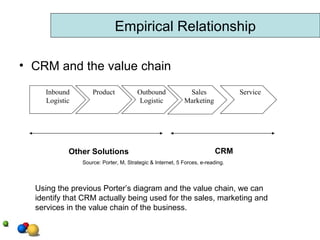
` CRM and the value chain Empirical Relationship Inbound Logistic Product Outbound Logistic Sales Marketing Service CRM Other Solutions Using the previous Porter’s diagram and the value chain, we can identify that CRM actually being used for the sales, marketing and services in the value chain of the business. Source: Porter, M, Strategic & Internet, 5 Forces, e-reading.
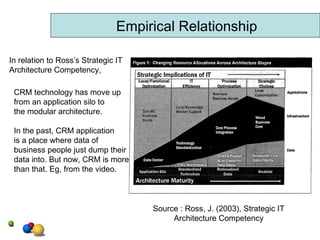
Empirical Relationship In relation to Ross’s Strategic IT  Architecture Competency, CRM technology has move up from an application silo to the modular architecture. In the past, CRM application is a place where data of  business people just dump their data into. But now, CRM is more than that. Eg, from the video. Source : Ross, J. (2003), Strategic IT Architecture Competency
Generalization CRM is a business strategy that can optimize profitability, revenue and customer satisfaction. However,  a combination of human and technological capabilities is required .  Furthermore, it must be  feasible  and requires  wider understanding of the structural  and  behavioral   limits to organisational alignment. CRM capability is primarily driven by human skills and experience that is supported by appropriate business architecture. IT infrastructure is relatively unimportant. CRM capabilities are  stronger on proactive market orientation  compared to reactive market orientation.
Author’s Conclusion Article 2 CRM programs should be directed towards customer value that competitor’s cannot match. More relationship building is not necessarily better, but rather building the right type of relationship is the key to performance improvement.
Author’s Conclusion Overview from both articles Author’s stressed on the importance of identifying customer value, be it e-business and CRM. They should be targeted towards these values. The  theories-in-use  for e-business and CRM show a different story compared to the  espoused theories   that techno-elite or by marketing divisions of big companies.
Seminar Conclusion We have covered from the top view of eBusiness Operation, right down to one of the solution, Customer Relationship Management. taking the consideration for strategic planning to implement such  solution planning try to relate with real life situation, by presenting the videos from a real CRM solution provider, providing a strategic implementation to another company. went further to investigate if this article relates to the previous articles  In short, CRM is not merely a technology, but it needs human and business capabilities, and work better from the proactive market orientation.
Suggestion Article is too statistical and technical Improve on the explanation of empirical results and models. The list of measures used are not exhaustive and should include other factors. E.g. Profitability, motivation, etc. Rather hard to understand at first glance because it did not convince whether CRM is really worth investing.
Any questions and discussion to share with us? Any points to bring up, which we have miss? Lastly, we are still learning in this subject of IT Strategic Planning (CRM), as the three of us never have the real experience before. We really appreciate your presence and thank you. And we would like to thanks Noel Parker for his advice in this field too. Questions & Discussion
References Coltman, T (2002), Keeping eBusiness in Perspective, IACT 401 e-reading Coltman, T (2005), Where is the benefit of CRM technologies investment, IACT 401 e-reading Pew Internet & American Life project Survey,  Nearly a quarter of online Americans use the Internet at places besides home or work,  (online), available:  http://www.pewinternet.org/ Ilicon (B2B) , ILLICOM's position in the B2B integration marke, Online, Available:  www.illicom.com/uk/marches_integration_b2b_uk.htm   Business Intelligence, Dell Supply Chain Process. Online, Available:  http://www.businessintelligence.com/ex/asp/id.4/page.1/xe/biextractdetail.htm Verticity Solutions, eBusiness & Enterprise Portals Online, Available:  http://www.verticitysolutions.com/services/ebusiness_enterprise_portals.asp Onyx Softwar, Customer Success: Netegrity, Online:  http://www.onyx.com/customers/video/library/netegrity/?id=6 Accenture ,Some of the principal reasons and area to the failure of CRM, online, Available:  http://www.accenture.com/xdoc/en/services/crm/road_to_riches.pdf Beyond Philosophy, Customer Strategy : The Naïve to Natural Model, Online, Available:  http://www.beyondphilosophy.com/ourtoolsandtechniques/images/5-1_naive-natural-orientation.jpg Harris, L.C. (2001)  Market Orientation and Performance: Objective and Subjective Empirical Evidence from UK Companies.  Journal of Management Studies, 38(1):17-43. Day, G.S. (2002),  Winning the Competition for Customer Relationships . The Wharton School:Pennsylvania. Coltman, T., T.M. Devinney, and D.F. Midgley (2003),  Strategic drivers and organizational impediments to ebusiness permance: a latent class assessment , in  AGSM Working Paper Series . Day, G.S. and C.V.Den Bulte (2002)  Superiority in Customer Relationship Management: Consequences for Competitive Advantage and Performance , in  Marketing Science Institute .Cambridge. Ross, J. Creating a strategic IT Architecture Competency, IACT 401 ereading Porter, M, Strategic & Internet, 5 Forces, e-reading. Calder, B. (2005), CRM and Relationship Branding, Online, Avaliable: http://www.medill.northwestern.edu/faculty/malthouse/ftp/crmbrand.pdf

IT Strategic Planning (Case Studies)

  • 1.
    Customer Relationship Management  IACT 401 IT Strategic Planning Seminar By Nurhazman Abdul Aziz Hoh Whay, Loh Imtiyaz R.
  • 2.
    Objective of thisseminar About the Author Article 1: Keeping eBusiness Perspective Evolution of eBusiness Solution Article 2: Where is the benefit in CRM technology investment Evaluation Conclusion Agenda
  • 3.
    We are goingto cover 2 article by Tim Coltman, linking up the strategic viewpoint from both articles why Customer Relationships Management is important in an IT strategic planning. We are also going to used the aid of real scenario (video), from a top CRM Solution provider to enforce the article 2, with much understanding. Apart from that we are going to related this article to other previous articles, as well as other articles and source and that be match and enforce in today ideas. Objective of this seminar
  • 4.
    About Author :Tim Coltman He has published more than 20 articles in leading journals such as California Management Review , Advances in Strategy and Communications of the ACM . In the last five years he has written more than 40 papers and presented at leading business schools and international conferences in the US, France, Singapore, Australia and New Zealand. He is currently involved in pioneer research that is combining choice models and information acceleration to investigate a wide range of practical problems for companies such as Motorola and Westpac. Additionally, he has recently completed research projects in ebusiness and customer relationship management for organisations such as the SAS institute, SAP, Fairfax Business Research and MIS magazine. Research Interests e-Business Strategy & Performance Project Management Customer Relationship Management (CRM) Supply chain Manamgement (SCM) Choice modelling and experimentation
  • 5.
    Article 1: KeepeBusiness Perspective Objective Two related questions is raised in this article “… where is eBusiness concentrated …?” “… why is eBusiness occurring as it is …?” The objective of article is to determine the appropriateness of eBusiness to a firm/organisation
  • 6.
    Where is eBusinessconcentrated? “… The actual impact of eBusiness on the way people shop and the way business is conducted on a day to day basis ( theory in use ) contrasts sharply with the way it is talk about and reported by the techno-elite and popular media ( espoused theory ) ...” Coltman, (2002) Espoused theories VS Theories in use
  • 7.
    Where is eBusinessconcentrated? From the two perspectives of the technology in use’s … Business to Consumer (B2C) statistical sources indicates that most people still lack or choose not to have Internet access. electronic business among consumer is at formative stage (in year 2002) many business related barriers have still needs to be overcome – security, privacy, uncertainty, low bandwidth,consumer protection and network access. Before, we can begin to speak of a revolutionary change in customer outlook and behavior
  • 8.
    Where is eBusinessconcentrated? 2. Business to Business (B2B) Large companies are generally better equipped to communicate electronically, due to their existing telecommunication infrastructure, like email & EDI Companies are more cost conscious. A Company aimed at reducing costs and increasing efficiency & network effects have a particularly strong impact. Overview Map in B2B activities Source from Illicon (B2B)
  • 9.
    The real benefitof such investments is more apparent in B2B activities. Dell, for example, uses simple commodities through a supply chain rather than a detailed design process. Dell uses an online catalogue that provides quick response, low cost fulfillment system characterized by direct customer interactions and made to order manufacturing-easily translated to the web. Why is eBusiness occurring as it is? Dell Supply Chain Process Source from Business Intelligence http://www.businessintelligence.com/ex/asp/id.4/page.1/xe/biextractdetail.htm
  • 10.
    Predictions of theimpact of e-business included: Brands will die out. The Internet will be a major threat to brands making brand strength weaker In reality, it is most likely to gravitate towards brands as a way to simplify choices, reduce costs and build trust. Middleman will die – computer network revolution is to remove middleman. The key is to find ways to move into a new distribution channel without jeopardizing existing channel relationships. Why is eBusiness occurring as it is?
  • 11.
    Scale is irrelevant– Size will be less important for online form Networks either virtual or real, work to a relatively simple logic, larger the network the more attractive they are to the customer. Companies such as Microsoft can benefit due to standardization, & bargaining power to encourage cooperation among fellow channel members. Lower Prices – E-business leads to more efficient markets, lower prices. While the cost of getting the right item to the customer is cheaper, there is no guarantee this result in lower prices. Why is eBusiness occurring as it is?
  • 12.
    The common assumptionregarding the criteria of revolution is generally derived from technology itself. What must be considered is whether the occurrences of e-business is driven by technology itself or the changes occurring in business management and how it affects the use of technology. Makes reference to Manuel Castells who was a professor of Sociology at the University of California, Berkey. He stressed that revolutions are influenced not only by the technologies impact but rather characterized by their “ pervasiveness across all domains of human activity” (pg.9) States Social requirements still govern technology but technology does not govern social requirements. Emphasizes how E-business is not a phenomenon that evolved on its own rather development was progressed by other movements such as the Online and Computer revolution. You say you want a revolution?
  • 13.
    Despite the advancechanges in information and technology, there has not been any significant change in the way business decisions are made. Basic principles such: Identifying customer value Assembling the right people Assembling the right processes and technical resources Are as relevant today as they have always been. The areas that have been modified as a direct result of technological advancement include hierarchies within firms, established supplier relationships and order/payments systems. One must be reminded that this has not changed the business in general, rather the psychology of the business. Final Wrap
  • 14.
    E-Business is notfor everyone As B2C is yet to take off to its full potential, E-Business businesses may not be the most feasible option for organisations who are after short term profit rewards. Brands that revolve around Emotional associations may adapt better to e-Business than brands that rely on facts and beliefs. Coltman stresses the Media attention that surrounds e-Business can often be misleading. World renown online businesses such as Amazon.com and e-Bay represent specialised categories and to not represent how E-business is an ideal solution that all organisations should invest in. Author Conclusion
  • 15.
    Evolution eBusiness SolutionBusiness-to-business (B2B) is set to have a significant effect on the global economy. The old-economy cycles of boom and bust resulted in enormous economic waste, as businesses struggled to harmonize their operations with those of their suppliers and customers. B2B, with its instant transfer of information between business partners, has the ability to drastically reduce the mismatch in supply and demand, and provide conditions for an actual sustained economic growth. eBusiness & Enterprise Portals Source from Verticity Solutions http://www.verticitysolutions.com/services/ebusiness_enterprise_portals.asp
  • 16.
    The customer focusis a complete inversion of the model that companies have operated with in the past. Rather than be driven by the bottom-up priorities of production, the company is answerable only to its customers. The customer has complete control of the production process which includes design, innovation and marketing which become the core of the company’s success. Evolution eBusiness Solution eBusiness & Enterprise Portals Source from Verticity Solutions http://www.verticitysolutions.com/services/ebusiness_enterprise_portals.asp
  • 17.
    The generally acceptedpurpose of Customer Relationship Management (CRM) is to enable organizations to better serve their customers through the introduction of reliable processes and procedures for interacting with those customers. CRM as one of eBusiness Solution What is Customer Relationship Management eBusiness & Enterprise Portals Source from Verticity Solutions http://www.verticitysolutions.com/services/ebusiness_enterprise_portals.asp
  • 18.
    In today's competitivebusiness environment, a successful CRM strategy cannot be implemented by only installing and integrating a software package designed to support CRM processes. A holistic approach to CRM is vital for an efficient and effective CRM policy. This approach includes training of employees, modification of business processes based on customers' needs and an adoption of relevant IT-systems (including soft- and maybe hardware) and/or usage of IT-Services that enable the organization or company to follow its CRM strategy. CRM-Services can even replace the acquisition of additional hardware or CRM software-Licence. Customer Relationship Management
  • 19.
    Qualitative Benefits ofCRM Before, starting into the discussion into “ where the benefits in CRM technology Investment” by Coltman, 2005. Let’s take a look into the Qualitative Benefits of CRM , but ONYX Software, a CRM solution providers. Their client is Netegrity, a security software Solution company. This will give us an ideal about what will the next article discuss about, Including the strategic planning. http://www.onyx.com/customers/video/library/netegrity/?id=6 Qualitative Benefits of CRM as an introduction to the benefit
  • 20.
    Article 2 ObjectiveIdentify the human and technology capabilities required to successfully execute a CRM program Introduction Customer Relationship Management (CRM) is not only a tool but can be thought of as being apart of a deeply embedded strategic disposition. Unfortunately, CRM failed to live up to expectations. Software glitches, poorly trained staff and disparate legacy systems continue to characterize CRM technology today. Therefore, CRM programs must be feasible and this requires a wider understanding of the structural and behavioral limits to organizational alignment. Article 2 : Where are the benefits of CRM technology investment?
  • 21.
    Introduction Research andadvisory groups claims 50% of CRM projects fail to meet expectations 30 % chief technology officers said CRM is over hyped. Negatives include Software glitches, poor staff training and disparate legacy systems . Some of the principal reasons and area to the failure of CRM Accenture http://www.accenture.com/xdoc/en/services/crm/road_to_riches.pdf Figures on Failure of CRM
  • 22.
    What is acustomer orientated strategy Organizations should allocate resources to systematically gather and analyze customer and competitor information. This knowledge is shared in the market and then used to guide strategy recognition, understanding, creation, selection, implementation and modification. Theoretical Background of CRM Source: Customer Strategy : The Naïve to Natural Model http://www.beyondphilosophy.com/ourtoolsandtechniques/images/5-1_naive-natural-orientation.jpg
  • 23.
    For CRM tobe successful: Programs must be feasible Wide understanding of organization structure & behavior. An adroit combination of human, business and technological capabilities is required to successfully execute a customer strategy. Each capability is nested within an intricate organizational system of interrelated and interdependent resources. Bharadwaj  classifies IT based resources as IT Infrastructure Technological and managerial skills Knowledge assets and synergy. Theoretical Background of CRM
  • 24.
    Tippins and Sohi  IT competency consists of three components: Extent till firm possesses body of technical knowledge of IT systems. Extent to which firm uses IT Number of IT artifacts. Such combinations drives CRM processes such as cross selling, up-selling, marketing & fulfillment, customer service and support, field service operations and retention management. These technologies are vital for integration of customer content, customer contact info, end to end business processes. Theoretical Background of CRM
  • 25.
    3 measures ofcustomer relating capabilities are: Skills and experiences at converting data to customer knowledge Level of CRM information structure CRM business alignment of incentives, customer strategy and structure. Large companies should not be overly concerned with reactive responses to expressed needs, rather they seek a proactive orientation that directs attention towards latent or unarticulated demand. Theoretical Background of CRM
  • 26.
    What to takeinto account with CRM Close relationships are path dependant Close relationships require investment in relationship specific assets Close relationships take a long time to materialize Targeted customers may not be receptive. Theoretical Background of CRM
  • 27.
    Day and Wensleymodel is based on a relatively simple deterministic relationship between sources of advantage, positions of advantage and performance. The relevance of this model to an assessment of CRM performance is threefold: enables one to assess the contribution that superior CRM capabilities ― human, technological and business capabilities ― have on competitive advantage. recognizes the mediating impact that positional advantage (i.e., customer orientation) has on performance. captures the path dependent nature of performance, prior investment in sources of CRM advantage is used to enhance future performance and sustain competitive advantage. Model Structure
  • 28.
  • 29.
    Business performance is central to the information systems field: First, organizational performance is a multidimensional construct that encompasses both internal and external measures. Second, it is commonly accepted that the causes of organizational performance are difficult to determine. Past studies suggest that measures of performance need to exhibit three key attributes: it should provide a multidimensional and balanced assessment of performance. it should incorporate a competitive assessment element, it should address the notion of performance over time. Instrumental Development & Measure
  • 30.
    This three-dimensionalmethod is applied to a balanced scorecard view of performance that includes: (a) Financial measures such as return on investment, (b) customer satisfaction including sales growth, (c) business process improvement as reflected in the reduction in cost of transacting with customers, and (d) innovation or success generating revenue from new products. Instrumental Development & Measure
  • 31.
  • 32.
    To fully capturethe expansive nature of CRM a similar approach is taken to implement a CRM capability . Three items were used to establish the higher order construct CRM capability. The three measures of customer relating capability are: (1) skills and experience at converting data to customer knowledge, (2) level of CRM information infrastructure, and (3) CRM business alignment of incentives, customer strategy and structure. Instrumental Development & Measure
  • 33.
  • 34.
    The maineffects model reveals a number of other interesting findings. First, a CRM capability is primarily driven by human skills and experience that is supported by appropriate business architecture (i.e.,incentives and structures). Second, the effect of conversion effectiveness is quite robust with negative and significant effects on both measures of market orientation Discussion & Structural Model
  • 35.
    Quantitative Benefit ofCRM Earlier on, we were looking at the Qualitative Benefit of CRM, as an introduction to the article. Now, let’s take a look at some of the Quantitative Benefits of CRM provided ONYX Software. This will summaries and putting us in a good strong viewpoint about “where is the benefit in CRM technology investment?” http://www.onyx.com/customers/video/library/netegrity/?id=6
  • 36.
    The paper isvery recent 2005 Has a good model and hypothezied relationship explained to assesses of CRM performance Empirical data are acquired from organisations who are traditional users of CRM. Show a number of statically to prove the benefit of CRM technology CRM is more than a tool. It’s part of a deeply embedded strategic disposition that enables them to outperform their rivals in a fiercely competitive market. Supporting Idea: Plausibility of the Conceptual Argument Source: Significant Performance Advantage George, S D, (2002), Wining the Competition for Customer Relationship
  • 37.
    The article isbeing enforced further in detail with the presented video, from Onyx. Onyx is the one of the leading CRM solution provider. This is actually explained the article in the real world, where the actual benefit can be observed here. Accurate forecasting Increase revenue dramatically Increase sale Greater throughput Go from loss to profit ROI up to 300% etc Empirical Relationship
  • 38.
    Empirical Relationship Mainarticle states that “IT infrastructure is relatively unimportant compared to what the marketing divisions of companies like Siebel, Oracle and SAP would like us to believe.” A study by George S. Day and Christoper Van den Bulte, in the article – “Superiority in Customer Relationship Management: Consequences for Competitive Advantage and Performance”. They states that IT is merely a necessary condition for CRM, it contributes little to either relational advantage or performance. The main implication for managers aiming for CRM leaderships is “how firms organize their effort” Like incentives, measures oragnisation structure and accountabilities. Supporting that IT Infrastructure is Unimportant
  • 39.
    Relation to Porter’sFive Forces Model CRM has profound impact on the five forces that influence the industry attractiveness. If CRM is to be more strategic, it clearly needs to have a more strategic purpose. In Porter’s terms, it needs to provide a competitive advantage in terms of cost leadership or marketplace differentiation. This is actually shown in another article, Calder, B. (2005), CRM and Relationship Branding. Empirical Relationship Source: McFarlan, F. W., 1984, ‘ information technology change the way you compete’, Harvard Business Review.
  • 40.
    ` CRM andthe value chain Empirical Relationship Inbound Logistic Product Outbound Logistic Sales Marketing Service CRM Other Solutions Using the previous Porter’s diagram and the value chain, we can identify that CRM actually being used for the sales, marketing and services in the value chain of the business. Source: Porter, M, Strategic & Internet, 5 Forces, e-reading.
  • 41.
    Empirical Relationship Inrelation to Ross’s Strategic IT Architecture Competency, CRM technology has move up from an application silo to the modular architecture. In the past, CRM application is a place where data of business people just dump their data into. But now, CRM is more than that. Eg, from the video. Source : Ross, J. (2003), Strategic IT Architecture Competency
  • 42.
    Generalization CRM isa business strategy that can optimize profitability, revenue and customer satisfaction. However, a combination of human and technological capabilities is required . Furthermore, it must be feasible and requires wider understanding of the structural and behavioral limits to organisational alignment. CRM capability is primarily driven by human skills and experience that is supported by appropriate business architecture. IT infrastructure is relatively unimportant. CRM capabilities are stronger on proactive market orientation compared to reactive market orientation.
  • 43.
    Author’s Conclusion Article2 CRM programs should be directed towards customer value that competitor’s cannot match. More relationship building is not necessarily better, but rather building the right type of relationship is the key to performance improvement.
  • 44.
    Author’s Conclusion Overviewfrom both articles Author’s stressed on the importance of identifying customer value, be it e-business and CRM. They should be targeted towards these values. The theories-in-use for e-business and CRM show a different story compared to the espoused theories that techno-elite or by marketing divisions of big companies.
  • 45.
    Seminar Conclusion Wehave covered from the top view of eBusiness Operation, right down to one of the solution, Customer Relationship Management. taking the consideration for strategic planning to implement such solution planning try to relate with real life situation, by presenting the videos from a real CRM solution provider, providing a strategic implementation to another company. went further to investigate if this article relates to the previous articles In short, CRM is not merely a technology, but it needs human and business capabilities, and work better from the proactive market orientation.
  • 46.
    Suggestion Article istoo statistical and technical Improve on the explanation of empirical results and models. The list of measures used are not exhaustive and should include other factors. E.g. Profitability, motivation, etc. Rather hard to understand at first glance because it did not convince whether CRM is really worth investing.
  • 47.
    Any questions anddiscussion to share with us? Any points to bring up, which we have miss? Lastly, we are still learning in this subject of IT Strategic Planning (CRM), as the three of us never have the real experience before. We really appreciate your presence and thank you. And we would like to thanks Noel Parker for his advice in this field too. Questions & Discussion
  • 48.
    References Coltman, T(2002), Keeping eBusiness in Perspective, IACT 401 e-reading Coltman, T (2005), Where is the benefit of CRM technologies investment, IACT 401 e-reading Pew Internet & American Life project Survey, Nearly a quarter of online Americans use the Internet at places besides home or work, (online), available: http://www.pewinternet.org/ Ilicon (B2B) , ILLICOM's position in the B2B integration marke, Online, Available: www.illicom.com/uk/marches_integration_b2b_uk.htm Business Intelligence, Dell Supply Chain Process. Online, Available: http://www.businessintelligence.com/ex/asp/id.4/page.1/xe/biextractdetail.htm Verticity Solutions, eBusiness & Enterprise Portals Online, Available: http://www.verticitysolutions.com/services/ebusiness_enterprise_portals.asp Onyx Softwar, Customer Success: Netegrity, Online: http://www.onyx.com/customers/video/library/netegrity/?id=6 Accenture ,Some of the principal reasons and area to the failure of CRM, online, Available: http://www.accenture.com/xdoc/en/services/crm/road_to_riches.pdf Beyond Philosophy, Customer Strategy : The Naïve to Natural Model, Online, Available: http://www.beyondphilosophy.com/ourtoolsandtechniques/images/5-1_naive-natural-orientation.jpg Harris, L.C. (2001) Market Orientation and Performance: Objective and Subjective Empirical Evidence from UK Companies. Journal of Management Studies, 38(1):17-43. Day, G.S. (2002), Winning the Competition for Customer Relationships . The Wharton School:Pennsylvania. Coltman, T., T.M. Devinney, and D.F. Midgley (2003), Strategic drivers and organizational impediments to ebusiness permance: a latent class assessment , in AGSM Working Paper Series . Day, G.S. and C.V.Den Bulte (2002) Superiority in Customer Relationship Management: Consequences for Competitive Advantage and Performance , in Marketing Science Institute .Cambridge. Ross, J. Creating a strategic IT Architecture Competency, IACT 401 ereading Porter, M, Strategic & Internet, 5 Forces, e-reading. Calder, B. (2005), CRM and Relationship Branding, Online, Avaliable: http://www.medill.northwestern.edu/faculty/malthouse/ftp/crmbrand.pdf

Editor's Notes

  • #2 Welcome, introduce our seminar topic: CRM, and the presenter.