Seminar in E-Commerce
CSE-712
On
E-Business
Amit Bhri
D E P A R T M E N T O F C O M P U T E R S C I E N C E A N D E N G I N E E R I N G
E-BUSINESS
E-Business is the powerful business environment that is
created when we connect critical business systems directly to
customers, employees, vendors, and business partners using
intranets, E-Commerce technologies, collaborative
applications and the Web
Developing E-Business Successfully means…...
BUILDING RELIABLE AND SCALABLE SYSTEMS FOR…
• security
• collaboration
• messaging
• E-Commerce payments
• supply-chain management
• sales force
• data warehousing
• customer relations
AND INTEGRATE ALL THE ABOVE WITH……..
• Back-end operations
E-Business has…..
• Increased the competition
• made companies reconfigure their business
• created a critical new market
• exploded the distribution channels
• imparted more power to customer
Main Ideas of E-Business
• Start Simple but grow fast
• Build on what you have
Evolution of E-Business
THREE GENERATIONS OF E-BUSINESS
• Establishing static presence on the web
• Lining front-ends with the back-ends
• Benefits of automation and integration extended to
the customer
contd...
Generation 1
• Developing web-sites that served as the catalogs
Generation 2
• Linking the Web front-ends with back-end order
management and inventory control systems
• Enabled customers to place and track orders directly from
a company’s web site, thus giving customers more control
over the order process
• Vendor-centric : company’s ability to automate internal
process and link them to the web for the customers
contd...
Generation 3
• Companies extends the benefits of automation and
integration to the customer
• not only deliver information directly to the customer but
also customize services and data delivery in order to enable
rich interaction among systems
• Companies conduct business programmatically
• Customer-centric approach: employs automation,
integration and data delivery techniques to provide
maximum competitive value to external customers
E-Business Models
There are three types of market places:
• Controlled by Sellers
• Controlled by Buyers
• Neutral Marketplaces
Seller Controlled Markets
• Set up by single vendor seeking many
buyers
• Main aim
to retain value and power in any transaction
Buyer Controlled Markets
• Set up by or for one or more buyers
• Main aim
to shift value and power in marketplace on
the buyer’s side
• Buyer intermediaries can also be there
…act as agents
Neutral Markets
• Set up by third party intermediaries to
match many buyers to many sellers
• Matches buyers to sellers at an auction
• Commission based
Choosing a Marketplace Model
Choosing a marketplace depends on four
factors:
• Are there transactions or benefits to be realized ?
• Is electronic market for product developing quickly ?
• Does company have substantial market share or buying
power ?
• Would a neutral intermediary be beneficiary ?
E-Business Cycle
FOUR PROCESSES
• Transform
• Build
• Run
• Leverage
Transform
• Ability of company to transform core business
processes and leveraging the reach and
pervasiveness of the internet
• where to start?
Key to success lies in making e-business priorities
the priorities of business
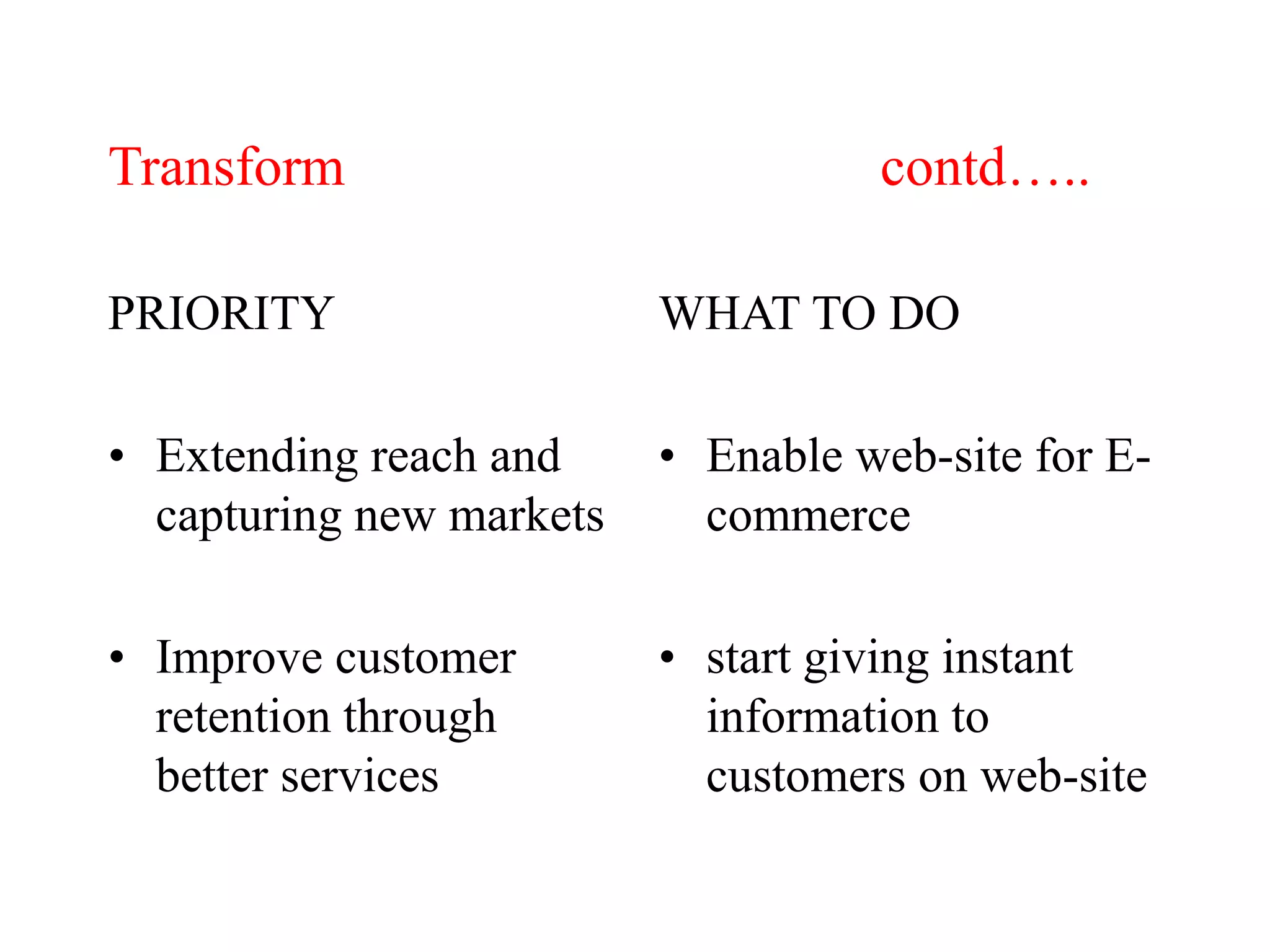
Transform contd…..
PRIORITY
• Extending reach and
capturing new markets
• Improve customer
retention through
better services
WHAT TO DO
• Enable web-site for E-
commerce
• start giving instant
information to
customers on web-site
Build
• Involves building the transform applications
• Fastest and effective way is simply to extend and
continue to modernize existing applications and
develop the new ones with the existing
information systems
Run
To run e-business successfully and optimally:
• offer reliability to ensure trust
• provide security that provides confidence
• manageability to ensure performance
• Since e-business solutions must grow quickly in
multiple dimensions, SCALABILITY is also
important
Leverage
Outside the Organization
• Becoming customer-centric means leverage
existing data for greater understanding of the
customer.
• What do customer buy, when and how do they
buy? -----------Use this information optimally
Leverage Contd...
Inside the Organization
• Leverage the experience and knowledge of
individuals within the organization -----
to make a complex process work
to roll out a new product
• Leverage existing knowledge and replicate best
processes across the organization to improve
innovation & responsiveness
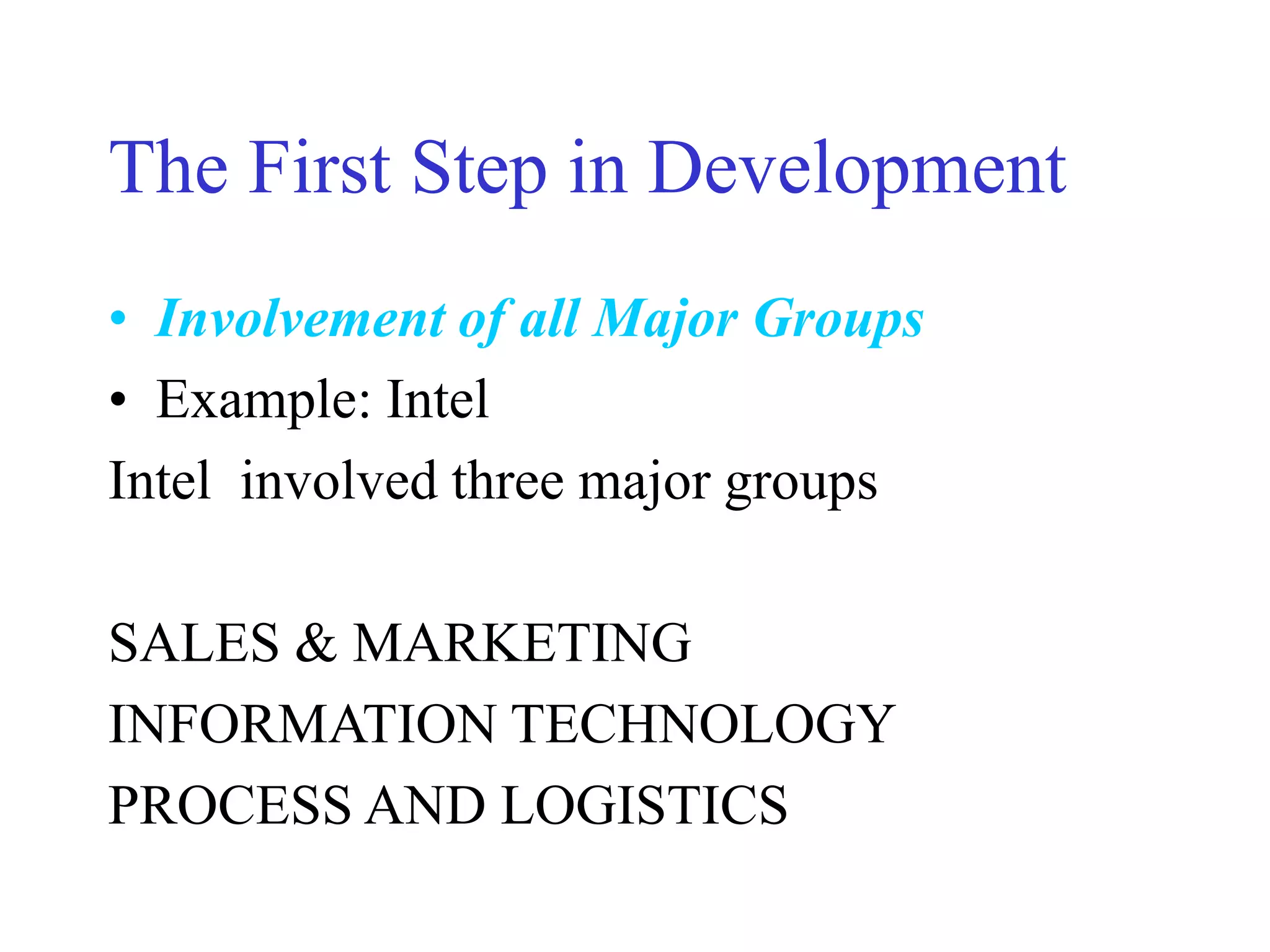
The First Step in Development
• Involvement of all Major Groups
• Example: Intel
Intel involved three major groups
SALES & MARKETING
INFORMATION TECHNOLOGY
PROCESS AND LOGISTICS
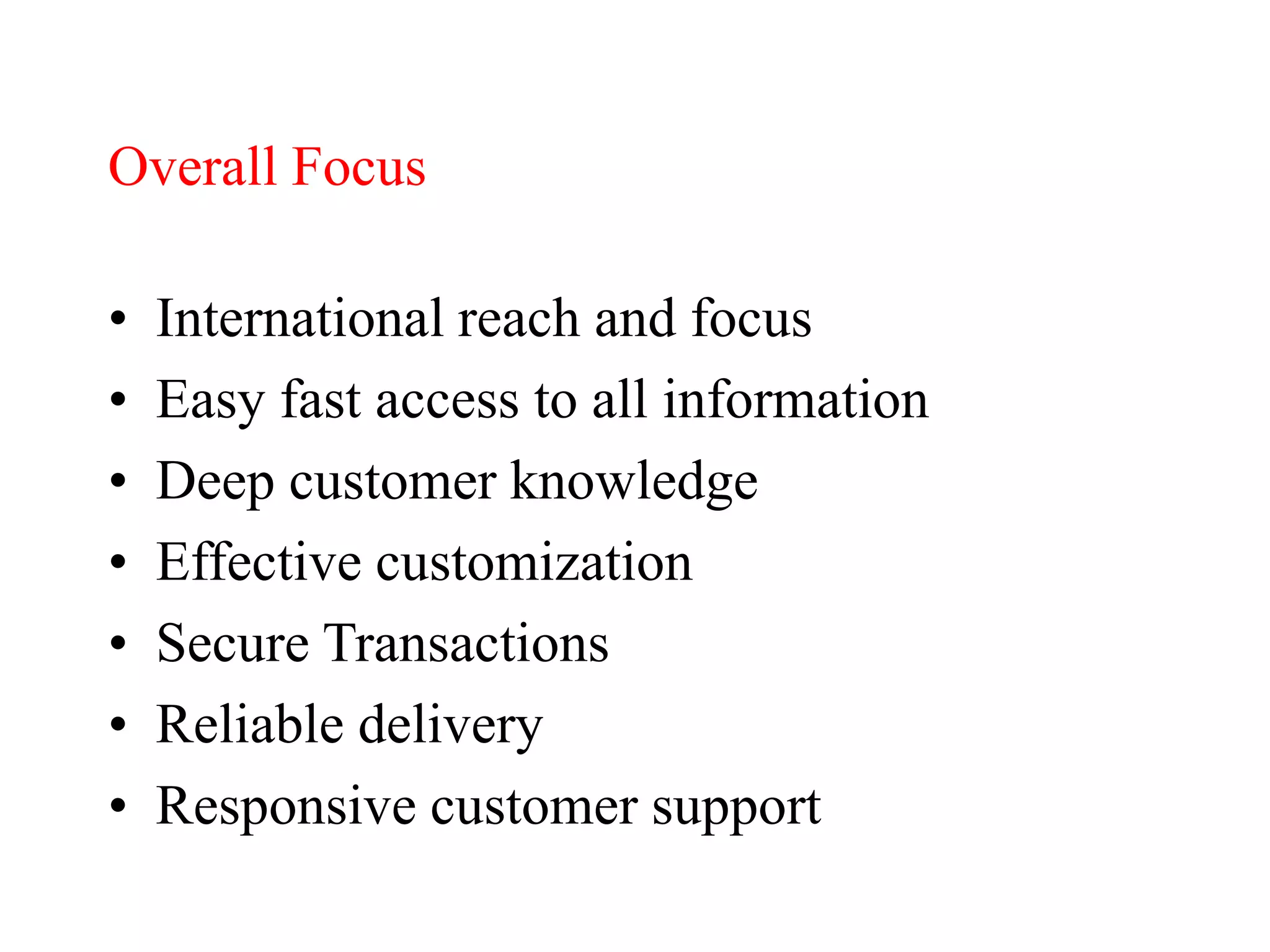
Overall Focus
• International reach and focus
• Easy fast access to all information
• Deep customer knowledge
• Effective customization
• Secure Transactions
• Reliable delivery
• Responsive customer support
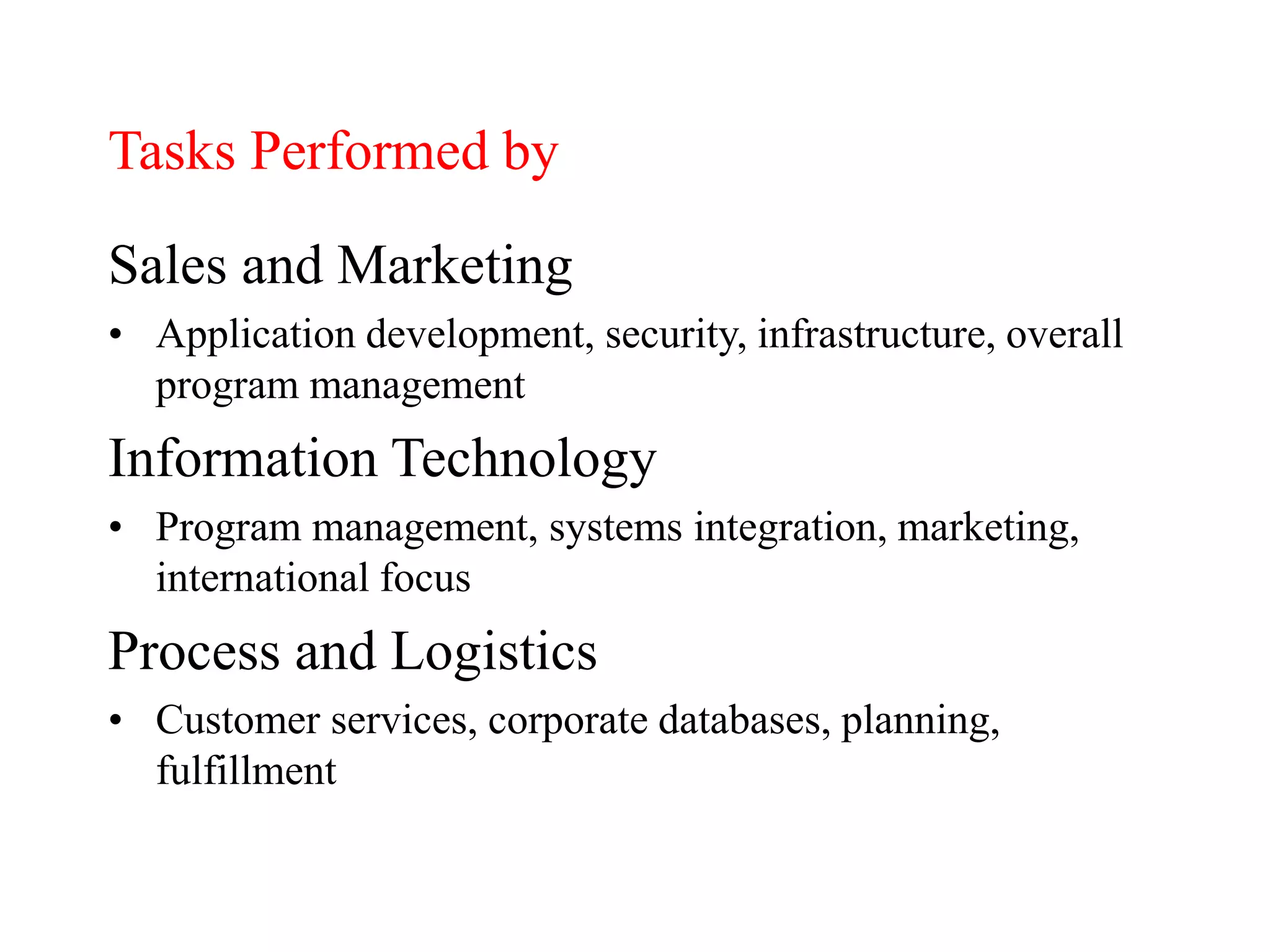
Tasks Performed by
Sales and Marketing
• Application development, security, infrastructure, overall
program management
Information Technology
• Program management, systems integration, marketing,
international focus
Process and Logistics
• Customer services, corporate databases, planning,
fulfillment
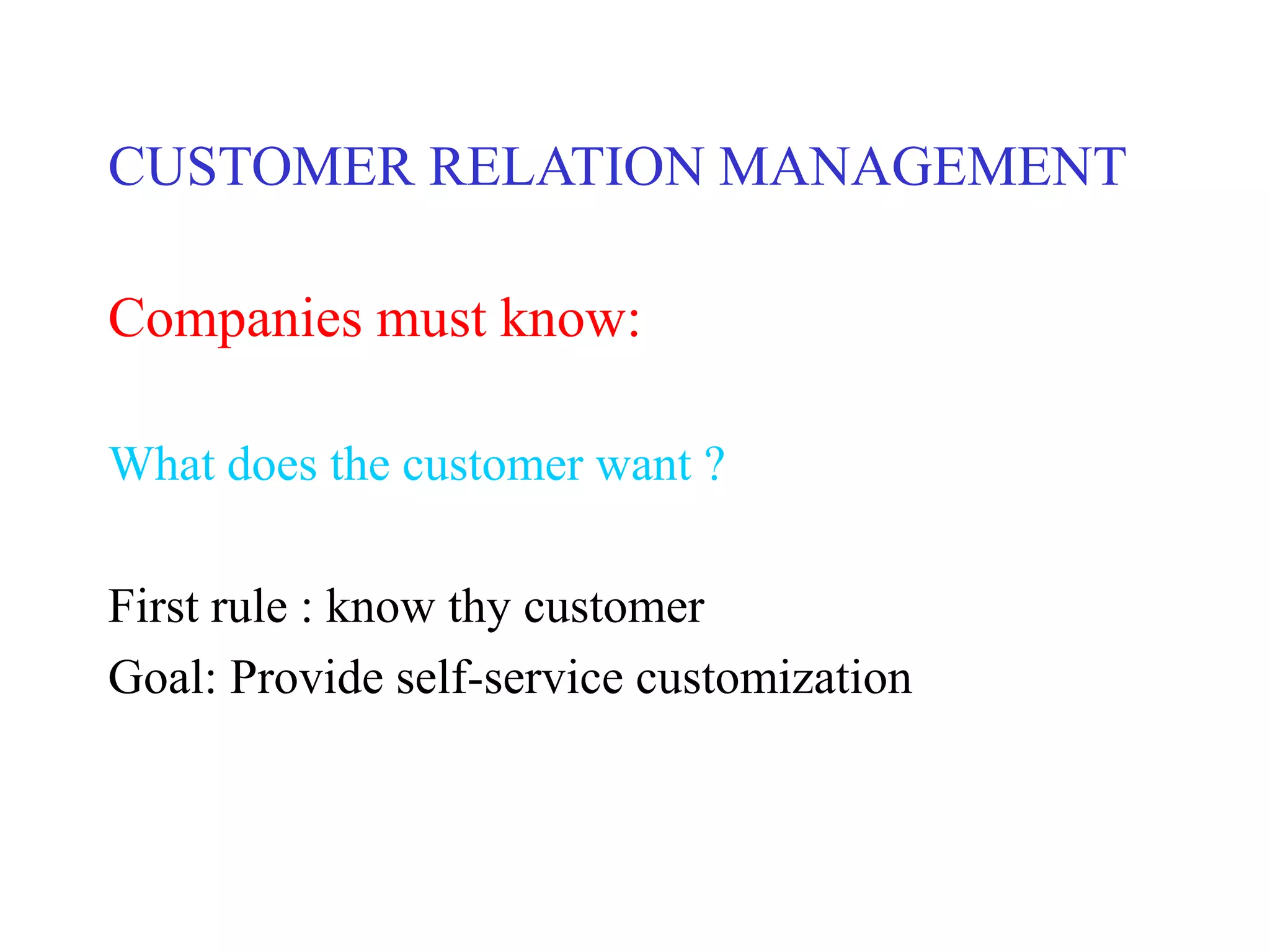
CUSTOMER RELATION MANAGEMENT
Companies must know:
What does the customer want ?
First rule : know thy customer
Goal: Provide self-service customization
Companies must know: Contd...
How does the customer want it ?
• HTML is not the only tool
• Deliver the data as the customer want
-Spreadsheet, XML, data, document
-Businesses need loosely-coupled architectures that let
systems interact without creating dependencies
Companies must know: Contd...
Where does the customer want it ?
• Customer could be using:
-workstation
-or cell phone
• Company’s delivery system must able to
intelligently deal with a range of platforms
and connections
Companies must know: Contd...
When does the customer want it ?
• E-business never sleeps
so information is always needed
• customer needs information as soon as it
becomes relevant
example: customer must know the price changes
Communicating with Customer
• To increase sales and profits, companies
must know:
Which customer to communicate to ?
When to communicate ?
E-Business must have insight into each customer
interaction and purchase information that
accumulates constantly
Prepare a Questionnaire
• How often does each customer respond to an e-mail
promotion or web-site banner ad ?
• What is the average length of time between each customer
transaction ?
• How quickly does the transaction value increase for each
customer ?
• What is the average number of interactions before each
customer buys ?
• What are the top 10 most viewed by each customer ?
Products they buy? Products they don’t buy ?
Total Insight
Combine product and transaction information
with all customer information like:
• Purchase History
• Non-purchase interaction
• Promotion History
• Individual Customer Preferences
• Demographics
• Psychographics
Superior Customer Understanding
Personalization
• be information intensive, helpful and
relevant
Reach customer
• reach customers wherever they want to be
reached

amit.ppt

  • 1.
    Seminar in E-Commerce CSE-712 On E-Business AmitBhri D E P A R T M E N T O F C O M P U T E R S C I E N C E A N D E N G I N E E R I N G
  • 2.
    E-BUSINESS E-Business is thepowerful business environment that is created when we connect critical business systems directly to customers, employees, vendors, and business partners using intranets, E-Commerce technologies, collaborative applications and the Web
  • 3.
    Developing E-Business Successfullymeans…... BUILDING RELIABLE AND SCALABLE SYSTEMS FOR… • security • collaboration • messaging • E-Commerce payments • supply-chain management • sales force • data warehousing • customer relations AND INTEGRATE ALL THE ABOVE WITH…….. • Back-end operations
  • 4.
    E-Business has….. • Increasedthe competition • made companies reconfigure their business • created a critical new market • exploded the distribution channels • imparted more power to customer
  • 5.
    Main Ideas ofE-Business • Start Simple but grow fast • Build on what you have
  • 6.
    Evolution of E-Business THREEGENERATIONS OF E-BUSINESS • Establishing static presence on the web • Lining front-ends with the back-ends • Benefits of automation and integration extended to the customer contd...
  • 7.
    Generation 1 • Developingweb-sites that served as the catalogs Generation 2 • Linking the Web front-ends with back-end order management and inventory control systems • Enabled customers to place and track orders directly from a company’s web site, thus giving customers more control over the order process • Vendor-centric : company’s ability to automate internal process and link them to the web for the customers contd...
  • 8.
    Generation 3 • Companiesextends the benefits of automation and integration to the customer • not only deliver information directly to the customer but also customize services and data delivery in order to enable rich interaction among systems • Companies conduct business programmatically • Customer-centric approach: employs automation, integration and data delivery techniques to provide maximum competitive value to external customers
  • 9.
    E-Business Models There arethree types of market places: • Controlled by Sellers • Controlled by Buyers • Neutral Marketplaces
  • 10.
    Seller Controlled Markets •Set up by single vendor seeking many buyers • Main aim to retain value and power in any transaction
  • 11.
    Buyer Controlled Markets •Set up by or for one or more buyers • Main aim to shift value and power in marketplace on the buyer’s side • Buyer intermediaries can also be there …act as agents
  • 12.
    Neutral Markets • Setup by third party intermediaries to match many buyers to many sellers • Matches buyers to sellers at an auction • Commission based
  • 13.
    Choosing a MarketplaceModel Choosing a marketplace depends on four factors: • Are there transactions or benefits to be realized ? • Is electronic market for product developing quickly ? • Does company have substantial market share or buying power ? • Would a neutral intermediary be beneficiary ?
  • 14.
    E-Business Cycle FOUR PROCESSES •Transform • Build • Run • Leverage
  • 15.
    Transform • Ability ofcompany to transform core business processes and leveraging the reach and pervasiveness of the internet • where to start? Key to success lies in making e-business priorities the priorities of business
  • 16.
    Transform contd….. PRIORITY • Extendingreach and capturing new markets • Improve customer retention through better services WHAT TO DO • Enable web-site for E- commerce • start giving instant information to customers on web-site
  • 17.
    Build • Involves buildingthe transform applications • Fastest and effective way is simply to extend and continue to modernize existing applications and develop the new ones with the existing information systems
  • 18.
    Run To run e-businesssuccessfully and optimally: • offer reliability to ensure trust • provide security that provides confidence • manageability to ensure performance • Since e-business solutions must grow quickly in multiple dimensions, SCALABILITY is also important
  • 19.
    Leverage Outside the Organization •Becoming customer-centric means leverage existing data for greater understanding of the customer. • What do customer buy, when and how do they buy? -----------Use this information optimally
  • 20.
    Leverage Contd... Inside theOrganization • Leverage the experience and knowledge of individuals within the organization ----- to make a complex process work to roll out a new product • Leverage existing knowledge and replicate best processes across the organization to improve innovation & responsiveness
  • 21.
    The First Stepin Development • Involvement of all Major Groups • Example: Intel Intel involved three major groups SALES & MARKETING INFORMATION TECHNOLOGY PROCESS AND LOGISTICS
  • 22.
    Overall Focus • Internationalreach and focus • Easy fast access to all information • Deep customer knowledge • Effective customization • Secure Transactions • Reliable delivery • Responsive customer support
  • 23.
    Tasks Performed by Salesand Marketing • Application development, security, infrastructure, overall program management Information Technology • Program management, systems integration, marketing, international focus Process and Logistics • Customer services, corporate databases, planning, fulfillment
  • 24.
    CUSTOMER RELATION MANAGEMENT Companiesmust know: What does the customer want ? First rule : know thy customer Goal: Provide self-service customization
  • 25.
    Companies must know:Contd... How does the customer want it ? • HTML is not the only tool • Deliver the data as the customer want -Spreadsheet, XML, data, document -Businesses need loosely-coupled architectures that let systems interact without creating dependencies
  • 26.
    Companies must know:Contd... Where does the customer want it ? • Customer could be using: -workstation -or cell phone • Company’s delivery system must able to intelligently deal with a range of platforms and connections
  • 27.
    Companies must know:Contd... When does the customer want it ? • E-business never sleeps so information is always needed • customer needs information as soon as it becomes relevant example: customer must know the price changes
  • 28.
    Communicating with Customer •To increase sales and profits, companies must know: Which customer to communicate to ? When to communicate ? E-Business must have insight into each customer interaction and purchase information that accumulates constantly
  • 29.
    Prepare a Questionnaire •How often does each customer respond to an e-mail promotion or web-site banner ad ? • What is the average length of time between each customer transaction ? • How quickly does the transaction value increase for each customer ? • What is the average number of interactions before each customer buys ? • What are the top 10 most viewed by each customer ? Products they buy? Products they don’t buy ?
  • 30.
    Total Insight Combine productand transaction information with all customer information like: • Purchase History • Non-purchase interaction • Promotion History • Individual Customer Preferences • Demographics • Psychographics
  • 31.
    Superior Customer Understanding Personalization •be information intensive, helpful and relevant Reach customer • reach customers wherever they want to be reached