Outlines
 Enterprise Functional Systems
 Enterprise E-business systems
 Knowledge management
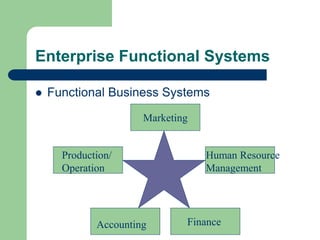
Enterprise Functional Systems
 Functional Business Systems
Marketing
Production/
Operation
Accounting Finance
Human Resource
Management
Marketing Systems
 Marketing Systems
– One-to-one marketing
– Interactive marketing
– Target marketing
– Sale force automation
– Advertisements
– Customer services
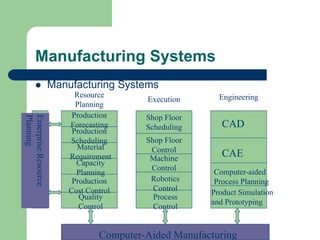
Manufacturing Systems
 Manufacturing Systems
Production
Forecasting
Production
Scheduling
Material
Requirement
Capacity
Planning
Production
Cost Control
Quality
Control
Shop Floor
Scheduling
Shop Floor
Control
Machine
Control
Robotics
Control
Process
Control
CAD
CAE
Computer-aided
Process Planning
Product Simulation
and Prototyping
Computer-Aided Manufacturing
Enterprise
Resource
Planning
Resource
Planning
Execution Engineering
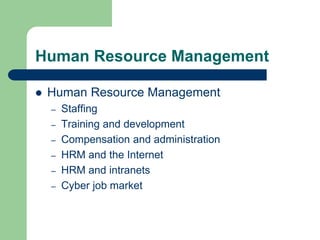
Human Resource Management
 Human Resource Management
– Staffing
– Training and development
– Compensation and administration
– HRM and the Internet
– HRM and intranets
– Cyber job market
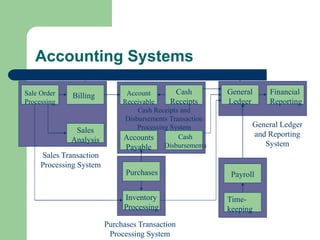
Accounting Systems
Sale Order
Processing
Billing
Sales
Analysis
Account
Receivable
Cash
Receipts
Accounts
Payable
Cash
Disbursements
Purchases
Inventory
Processing
Payroll
Time-
keeping
General
Ledger
Financial
Reporting
Sales Transaction
Processing System
Purchases Transaction
Processing System
General Ledger
and Reporting
System
Cash Receipts and
Disbursements Transaction
Processing System
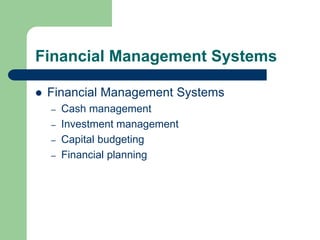
Financial Management Systems
 Financial Management Systems
– Cash management
– Investment management
– Capital budgeting
– Financial planning
Enterprise E-Business Systems
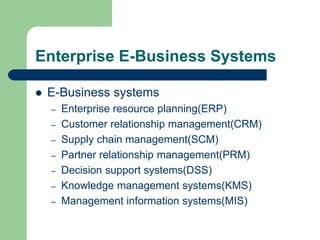
 E-Business systems
– Enterprise resource planning(ERP)
– Customer relationship management(CRM)
– Supply chain management(SCM)
– Partner relationship management(PRM)
– Decision support systems(DSS)
– Knowledge management systems(KMS)
– Management information systems(MIS)
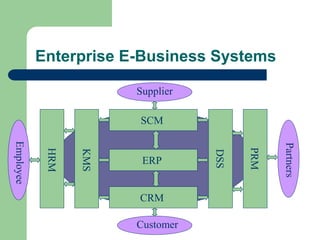
Enterprise E-Business Systems
SCM
CRM
ERP
Supplier
Customer
Employee
Partners
DSS
PRM
KMS
HRM
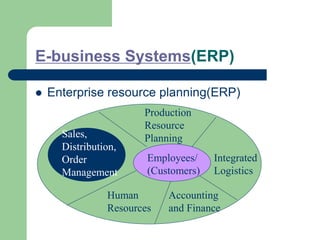
E-business Systems(ERP)
 Enterprise resource planning(ERP)
Employees/
(Customers)
Sales,
Distribution,
Order
Management
Production
Resource
Planning
Integrated
Logistics
Accounting
and Finance
Human
Resources
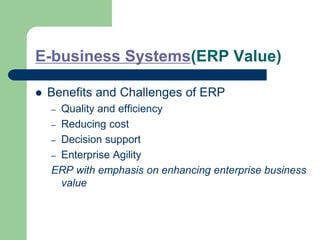
E-business Systems(ERP Value)
 Benefits and Challenges of ERP
– Quality and efficiency
– Reducing cost
– Decision support
– Enterprise Agility
ERP with emphasis on enhancing enterprise business
value
E-business Systems (ERP
Problems)
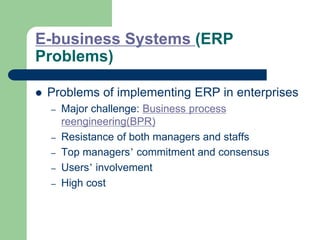
 Problems of implementing ERP in enterprises
– Major challenge: Business process
reengineering(BPR)
– Resistance of both managers and staffs
– Top managers’ commitment and consensus
– Users’ involvement
– High cost
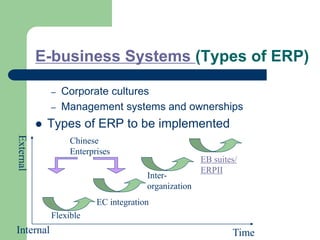
E-business Systems (Types of ERP)
– Corporate cultures
– Management systems and ownerships
 Types of ERP to be implemented
Flexible
EC integration
Inter-
organization
EB suites/
ERPII
Time
Internal
External
Chinese
Enterprises
E-business Systems(ERP Cost)
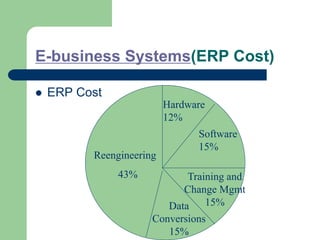
 ERP Cost
Reengineering
43%
Hardware
12%
Software
15%
Training and
Change Mgmt
15%
Data
Conversions
15%
E-business Systems(CRM)
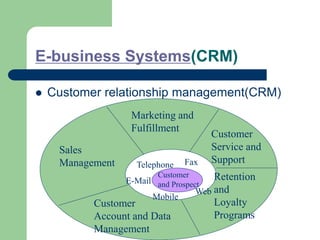
 Customer relationship management(CRM)
Marketing and
Fulfillment
Sales
Management
Customer
Account and Data
Management
Retention
and
Loyalty
Programs
Customer
Service and
Support
Customer
and Prospect
Fax
Telephone
E-Mail
Web
Mobile
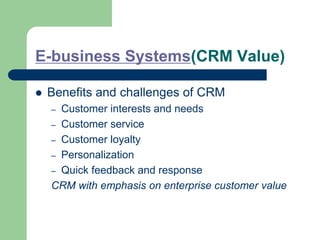
E-business Systems(CRM Value)
 Benefits and challenges of CRM
– Customer interests and needs
– Customer service
– Customer loyalty
– Personalization
– Quick feedback and response
CRM with emphasis on enterprise customer value
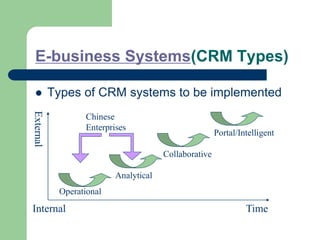
E-business Systems(CRM Types)
 Types of CRM systems to be implemented
Operational
Analytical
Collaborative
Portal/Intelligent
Internal
External
Chinese
Enterprises
Time
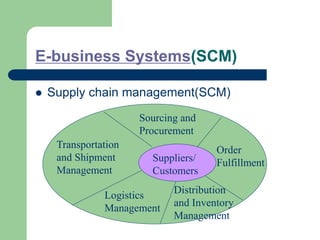
E-business Systems(SCM)
 Supply chain management(SCM)
Suppliers/
Customers
Transportation
and Shipment
Management
Sourcing and
Procurement
Order
Fulfillment
Distribution
and Inventory
Management
Logistics
Management
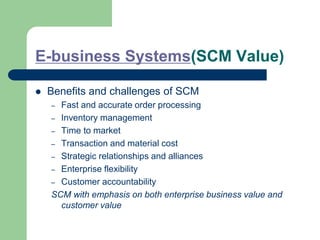
E-business Systems(SCM Value)
 Benefits and challenges of SCM
– Fast and accurate order processing
– Inventory management
– Time to market
– Transaction and material cost
– Strategic relationships and alliances
– Enterprise flexibility
– Customer accountability
SCM with emphasis on both enterprise business value and
customer value
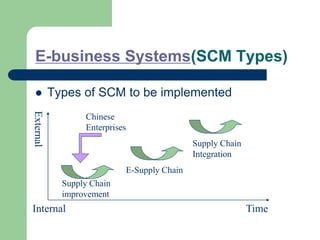
E-business Systems(SCM Types)
 Types of SCM to be implemented
Supply Chain
improvement
E-Supply Chain
Supply Chain
Integration
Internal
External
Chinese
Enterprises
Time
Knowledge Management
 Knowledge management Activities
– Knowledge creating/acquiring
– Knowledge presenting, storing and renewal
– Knowledge sharing and services
– Knowledge applying
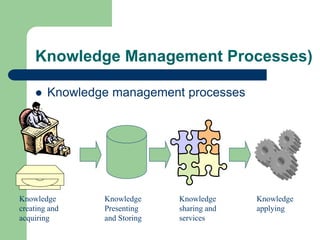
Knowledge Management Processes)
 Knowledge management processes
Knowledge
creating and
acquiring
Knowledge
Presenting
and Storing
Knowledge
sharing and
services
Knowledge
applying
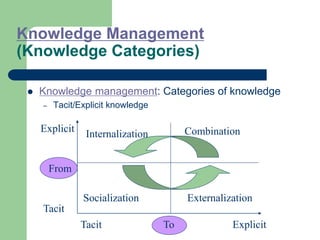
Knowledge Management
(Knowledge Categories)
 Knowledge management: Categories of knowledge
– Tacit/Explicit knowledge
Explicit
Tacit
Internalization
Socialization Externalization
Combination
Explicit
From
To
Tacit
Knowledge Management
(Intellectual Capitals)
 Sources of knowledge: Intellectual capital
– Human capital
– Structural capital
– Customer/partner capital
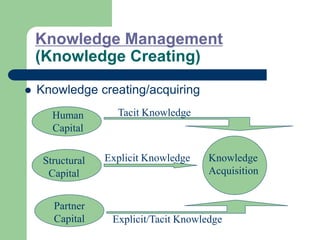
Knowledge Management
(Knowledge Creating)
 Knowledge creating/acquiring
Human
Capital
Structural
Capital
Partner
Capital
Knowledge
Acquisition
Tacit Knowledge
Explicit/Tacit Knowledge
Explicit Knowledge
Knowledge Management (Tacit
Knowledge Acquisition)
– Tacit knowledge acquisition
 Knowledge engineering
 Intelligent agents
 Management measures
 Cognitive science applications
 Natural language processing
Knowledge Management (Explicit
Knowledge Acquisition)
– Explicit knowledge acquisition
 Data mining
 Web mining
 Text mining
 Intelligent agents
Knowledge Management
(Knowledge Storing)
 Knowledge presenting, storing and renewal
– Knowledge modeling
– Data warehouse
– Knowledge base
– Ontology base
Knowledge Management
(Knowledge Sharing)
 Knowledge sharing and services
– Knowledge portal
– Application Ontology
– Knowledge query and visualization
Knowledge Management
(Knowledge Applying)
 Knowledge applications
– Decision support
– Business intelligence
– Innovation
– New business opportunities
– Enterprise adaptability
E-Business
E-business in Business
 E-business:Use of Internet technologies to
internetwork and empower business
processes,electronic commerce,and enterprise
communication and collaboration within a company
and with its customers,suppliers, and other business
stakeholders.
E-Commerce
 Concept
Describing the buying, selling, and exchanging
products, services, and information via
computer networks including mainly the
Internet
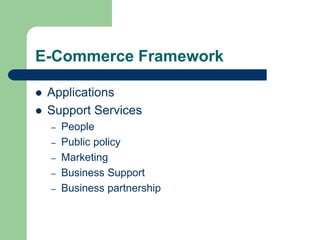
E-Commerce Framework
 Applications
 Support Services
– People
– Public policy
– Marketing
– Business Support
– Business partnership
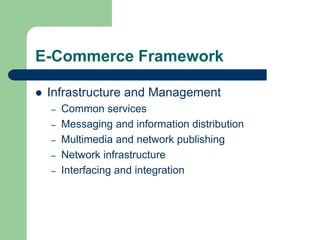
E-Commerce Framework
 Infrastructure and Management
– Common services
– Messaging and information distribution
– Multimedia and network publishing
– Network infrastructure
– Interfacing and integration
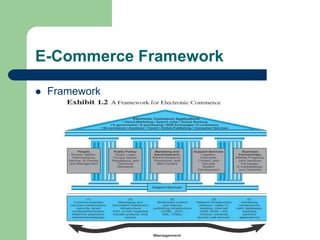
E-Commerce Framework
 Framework
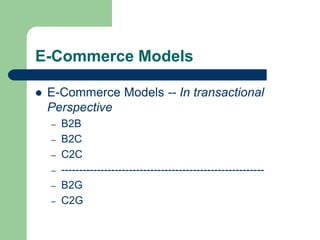
E-Commerce Models
 E-Commerce Models -- In transactional
Perspective
– B2B
– B2C
– C2C
– ---------------------------------------------------------
– B2G
– C2G
E-Commerce Models
 E-Commerce Models -- In
Cyberspace/Marketplace Perspective
– Buyer oriented marketplace
– Seller oriented marketplace
– Infomediary oriented marketplace
E-Commerce Models
 Pure and Partial EC—from Process Perspective
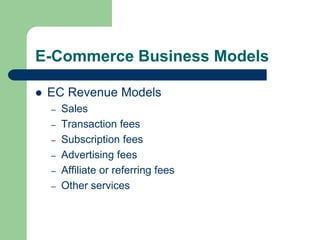
E-Commerce Business Models
 EC Revenue Models
– Sales
– Transaction fees
– Subscription fees
– Advertising fees
– Affiliate or referring fees
– Other services
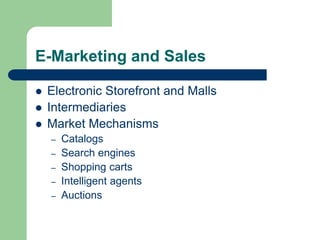
E-Marketing and Sales
 Electronic Storefront and Malls
 Intermediaries
 Market Mechanisms
– Catalogs
– Search engines
– Shopping carts
– Intelligent agents
– Auctions
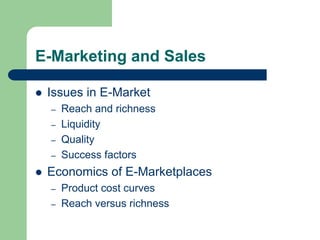
E-Marketing and Sales
 Issues in E-Market
– Reach and richness
– Liquidity
– Quality
– Success factors
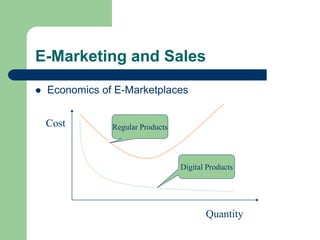
 Economics of E-Marketplaces
– Product cost curves
– Reach versus richness
E-Marketing and Sales
 Economics of E-Marketplaces
Regular Products
Digital Products
Cost
Quantity
Electronic Retailing
 E-Tailing
 Travel and Tourism
 Job Market
 Real Estate, Insurance, Stock Trading
 E-Banking
 E-Delivery
 Sales Channels
Electronic Retailing
 Clicks and Bricks Strategies
 Issues in E-Tailing
– Disintermediation and reintermediation
– Channel Conflicts
– Determining the right price
– Personalization
Online Advertisement
 Web Advertisement
– Advertising methods
– Advertising strategies
– Economics of Web advertising
– Issues of Web advertising
– Unsolicited electronic ads--spamming
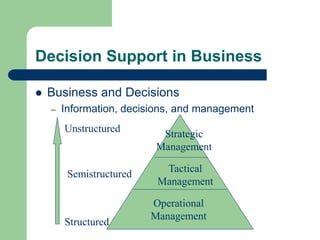
Decision Support in Business
 Business and Decisions
– Information, decisions, and management
Strategic
Management
Tactical
Management
Operational
Management
Unstructured
Structured
Semistructured
Management Information Systems
 MIS
– Producing information products that support many
of the day-to-day decision making needs of
managers and business professionals
 Management Reporting Alternatives
– Periodic scheduled reports
– Exception reports
– Demand reports and responses
– Push reporting
Online Analytical Processing
 Online Analytical Processing
– Consolidation
– Drill-Down
– Slicing and Dicing
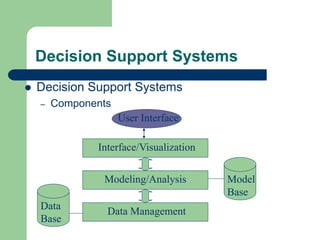
Decision Support Systems
 Decision Support Systems
– Components
Interface/Visualization
Modeling/Analysis
Data Management
Data
Base
Model
Base
User Interface
Decision Support Systems
 Geographic Information and Data Visualization
Systems
– GSS
– DVS
– VRML
Using Decision Support Systems
 Using DSS
– What-If Analysis
– Sensitivity analysis
– Goal-Seeking analysis
– Optimization analysis
Executive Information Systems
 EIS Features
– To the preferences of the managers
– GUI and visualization
– Data analysis
– Easy to use
Artificial Intelligence Technologies
in Business
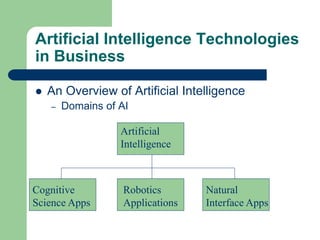
 An Overview of Artificial Intelligence
– Domains of AI
Artificial
Intelligence
Cognitive
Science Apps
Robotics
Applications
Natural
Interface Apps
Artificial Intelligence
 Attributes of Intelligent Behavior
– Think and reason
– Use reason to solve problems
– Learn or understand from experience
– Acquire and apply knowledge
– Exhibit creativity and imagination
– Deal with complex and perplexing situations
– Respond quickly and successfully to new situations
– Recognize the relative importance of elements in a situation
– Handle ambiguous,incomplete, and erroneous information
Artificial Intelligence
 Neural Networks
 Fuzzy Logic Systems
 Genetic algorithms
 Virtual Reality
 Intelligent Agents
 Expert Systems
Expert Systems
Components of an expert system
– User interface
– Inference engine
– Knowledge base
– Knowledge acquisition
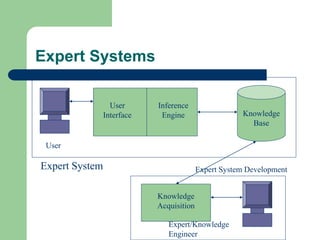
Expert Systems
User
Interface
Inference
Engine Knowledge
Base
Knowledge
Acquisition
Expert/Knowledge
Engineer
User
Expert System Development
Expert System
Expert Systems
 Suitability Criteria
– Domain: Relative small and limited to a well-defined problem
area
– Expertise: A body of knowledge,techniques,and intuition is
needed that only a few people possess
– Complexity: Solution of the problem is a complex task that
requires logical inference processing,which would not be
handled as well by conventional information processing
– Structure: The solution process must be able to cope with ill-
structured,uncertain,missing,and conflicting data, and a
problem situation that changes with the passage of time
Expert Systems
– Availability: An expert exists who is articulate and
cooperative,and who has the support of the
management and end users involved in the
development of the proposed system
 Benefits and Limitations

e-businesssystems.ppt

  • 1.
    Outlines  Enterprise FunctionalSystems  Enterprise E-business systems  Knowledge management
  • 2.
    Enterprise Functional Systems Functional Business Systems Marketing Production/ Operation Accounting Finance Human Resource Management
  • 3.
    Marketing Systems  MarketingSystems – One-to-one marketing – Interactive marketing – Target marketing – Sale force automation – Advertisements – Customer services
  • 4.
    Manufacturing Systems  ManufacturingSystems Production Forecasting Production Scheduling Material Requirement Capacity Planning Production Cost Control Quality Control Shop Floor Scheduling Shop Floor Control Machine Control Robotics Control Process Control CAD CAE Computer-aided Process Planning Product Simulation and Prototyping Computer-Aided Manufacturing Enterprise Resource Planning Resource Planning Execution Engineering
  • 5.
    Human Resource Management Human Resource Management – Staffing – Training and development – Compensation and administration – HRM and the Internet – HRM and intranets – Cyber job market
  • 6.
    Accounting Systems Sale Order Processing Billing Sales Analysis Account Receivable Cash Receipts Accounts Payable Cash Disbursements Purchases Inventory Processing Payroll Time- keeping General Ledger Financial Reporting SalesTransaction Processing System Purchases Transaction Processing System General Ledger and Reporting System Cash Receipts and Disbursements Transaction Processing System
  • 7.
    Financial Management Systems Financial Management Systems – Cash management – Investment management – Capital budgeting – Financial planning
  • 8.
    Enterprise E-Business Systems E-Business systems – Enterprise resource planning(ERP) – Customer relationship management(CRM) – Supply chain management(SCM) – Partner relationship management(PRM) – Decision support systems(DSS) – Knowledge management systems(KMS) – Management information systems(MIS)
  • 9.
  • 10.
    E-business Systems(ERP)  Enterpriseresource planning(ERP) Employees/ (Customers) Sales, Distribution, Order Management Production Resource Planning Integrated Logistics Accounting and Finance Human Resources
  • 11.
    E-business Systems(ERP Value) Benefits and Challenges of ERP – Quality and efficiency – Reducing cost – Decision support – Enterprise Agility ERP with emphasis on enhancing enterprise business value
  • 12.
    E-business Systems (ERP Problems) Problems of implementing ERP in enterprises – Major challenge: Business process reengineering(BPR) – Resistance of both managers and staffs – Top managers’ commitment and consensus – Users’ involvement – High cost
  • 13.
    E-business Systems (Typesof ERP) – Corporate cultures – Management systems and ownerships  Types of ERP to be implemented Flexible EC integration Inter- organization EB suites/ ERPII Time Internal External Chinese Enterprises
  • 14.
    E-business Systems(ERP Cost) ERP Cost Reengineering 43% Hardware 12% Software 15% Training and Change Mgmt 15% Data Conversions 15%
  • 15.
    E-business Systems(CRM)  Customerrelationship management(CRM) Marketing and Fulfillment Sales Management Customer Account and Data Management Retention and Loyalty Programs Customer Service and Support Customer and Prospect Fax Telephone E-Mail Web Mobile
  • 16.
    E-business Systems(CRM Value) Benefits and challenges of CRM – Customer interests and needs – Customer service – Customer loyalty – Personalization – Quick feedback and response CRM with emphasis on enterprise customer value
  • 17.
    E-business Systems(CRM Types) Types of CRM systems to be implemented Operational Analytical Collaborative Portal/Intelligent Internal External Chinese Enterprises Time
  • 18.
    E-business Systems(SCM)  Supplychain management(SCM) Suppliers/ Customers Transportation and Shipment Management Sourcing and Procurement Order Fulfillment Distribution and Inventory Management Logistics Management
  • 19.
    E-business Systems(SCM Value) Benefits and challenges of SCM – Fast and accurate order processing – Inventory management – Time to market – Transaction and material cost – Strategic relationships and alliances – Enterprise flexibility – Customer accountability SCM with emphasis on both enterprise business value and customer value
  • 20.
    E-business Systems(SCM Types) Types of SCM to be implemented Supply Chain improvement E-Supply Chain Supply Chain Integration Internal External Chinese Enterprises Time
  • 21.
    Knowledge Management  Knowledgemanagement Activities – Knowledge creating/acquiring – Knowledge presenting, storing and renewal – Knowledge sharing and services – Knowledge applying
  • 22.
    Knowledge Management Processes) Knowledge management processes Knowledge creating and acquiring Knowledge Presenting and Storing Knowledge sharing and services Knowledge applying
  • 23.
    Knowledge Management (Knowledge Categories) Knowledge management: Categories of knowledge – Tacit/Explicit knowledge Explicit Tacit Internalization Socialization Externalization Combination Explicit From To Tacit
  • 24.
    Knowledge Management (Intellectual Capitals) Sources of knowledge: Intellectual capital – Human capital – Structural capital – Customer/partner capital
  • 25.
    Knowledge Management (Knowledge Creating) Knowledge creating/acquiring Human Capital Structural Capital Partner Capital Knowledge Acquisition Tacit Knowledge Explicit/Tacit Knowledge Explicit Knowledge
  • 26.
    Knowledge Management (Tacit KnowledgeAcquisition) – Tacit knowledge acquisition  Knowledge engineering  Intelligent agents  Management measures  Cognitive science applications  Natural language processing
  • 27.
    Knowledge Management (Explicit KnowledgeAcquisition) – Explicit knowledge acquisition  Data mining  Web mining  Text mining  Intelligent agents
  • 28.
    Knowledge Management (Knowledge Storing) Knowledge presenting, storing and renewal – Knowledge modeling – Data warehouse – Knowledge base – Ontology base
  • 29.
    Knowledge Management (Knowledge Sharing) Knowledge sharing and services – Knowledge portal – Application Ontology – Knowledge query and visualization
  • 30.
    Knowledge Management (Knowledge Applying) Knowledge applications – Decision support – Business intelligence – Innovation – New business opportunities – Enterprise adaptability
  • 31.
    E-Business E-business in Business E-business:Use of Internet technologies to internetwork and empower business processes,electronic commerce,and enterprise communication and collaboration within a company and with its customers,suppliers, and other business stakeholders.
  • 32.
    E-Commerce  Concept Describing thebuying, selling, and exchanging products, services, and information via computer networks including mainly the Internet
  • 33.
    E-Commerce Framework  Applications Support Services – People – Public policy – Marketing – Business Support – Business partnership
  • 34.
    E-Commerce Framework  Infrastructureand Management – Common services – Messaging and information distribution – Multimedia and network publishing – Network infrastructure – Interfacing and integration
  • 35.
  • 36.
    E-Commerce Models  E-CommerceModels -- In transactional Perspective – B2B – B2C – C2C – --------------------------------------------------------- – B2G – C2G
  • 37.
    E-Commerce Models  E-CommerceModels -- In Cyberspace/Marketplace Perspective – Buyer oriented marketplace – Seller oriented marketplace – Infomediary oriented marketplace
  • 38.
    E-Commerce Models  Pureand Partial EC—from Process Perspective
  • 39.
    E-Commerce Business Models EC Revenue Models – Sales – Transaction fees – Subscription fees – Advertising fees – Affiliate or referring fees – Other services
  • 40.
    E-Marketing and Sales Electronic Storefront and Malls  Intermediaries  Market Mechanisms – Catalogs – Search engines – Shopping carts – Intelligent agents – Auctions
  • 41.
    E-Marketing and Sales Issues in E-Market – Reach and richness – Liquidity – Quality – Success factors  Economics of E-Marketplaces – Product cost curves – Reach versus richness
  • 42.
    E-Marketing and Sales Economics of E-Marketplaces Regular Products Digital Products Cost Quantity
  • 43.
    Electronic Retailing  E-Tailing Travel and Tourism  Job Market  Real Estate, Insurance, Stock Trading  E-Banking  E-Delivery  Sales Channels
  • 44.
    Electronic Retailing  Clicksand Bricks Strategies  Issues in E-Tailing – Disintermediation and reintermediation – Channel Conflicts – Determining the right price – Personalization
  • 45.
    Online Advertisement  WebAdvertisement – Advertising methods – Advertising strategies – Economics of Web advertising – Issues of Web advertising – Unsolicited electronic ads--spamming
  • 46.
    Decision Support inBusiness  Business and Decisions – Information, decisions, and management Strategic Management Tactical Management Operational Management Unstructured Structured Semistructured
  • 47.
    Management Information Systems MIS – Producing information products that support many of the day-to-day decision making needs of managers and business professionals  Management Reporting Alternatives – Periodic scheduled reports – Exception reports – Demand reports and responses – Push reporting
  • 48.
    Online Analytical Processing Online Analytical Processing – Consolidation – Drill-Down – Slicing and Dicing
  • 49.
    Decision Support Systems Decision Support Systems – Components Interface/Visualization Modeling/Analysis Data Management Data Base Model Base User Interface
  • 50.
    Decision Support Systems Geographic Information and Data Visualization Systems – GSS – DVS – VRML
  • 51.
    Using Decision SupportSystems  Using DSS – What-If Analysis – Sensitivity analysis – Goal-Seeking analysis – Optimization analysis
  • 52.
    Executive Information Systems EIS Features – To the preferences of the managers – GUI and visualization – Data analysis – Easy to use
  • 53.
    Artificial Intelligence Technologies inBusiness  An Overview of Artificial Intelligence – Domains of AI Artificial Intelligence Cognitive Science Apps Robotics Applications Natural Interface Apps
  • 54.
    Artificial Intelligence  Attributesof Intelligent Behavior – Think and reason – Use reason to solve problems – Learn or understand from experience – Acquire and apply knowledge – Exhibit creativity and imagination – Deal with complex and perplexing situations – Respond quickly and successfully to new situations – Recognize the relative importance of elements in a situation – Handle ambiguous,incomplete, and erroneous information
  • 55.
    Artificial Intelligence  NeuralNetworks  Fuzzy Logic Systems  Genetic algorithms  Virtual Reality  Intelligent Agents  Expert Systems
  • 56.
    Expert Systems Components ofan expert system – User interface – Inference engine – Knowledge base – Knowledge acquisition
  • 57.
  • 58.
    Expert Systems  SuitabilityCriteria – Domain: Relative small and limited to a well-defined problem area – Expertise: A body of knowledge,techniques,and intuition is needed that only a few people possess – Complexity: Solution of the problem is a complex task that requires logical inference processing,which would not be handled as well by conventional information processing – Structure: The solution process must be able to cope with ill- structured,uncertain,missing,and conflicting data, and a problem situation that changes with the passage of time
  • 59.
    Expert Systems – Availability:An expert exists who is articulate and cooperative,and who has the support of the management and end users involved in the development of the proposed system  Benefits and Limitations