SOA and M&A –  Breakthrough in Merger and Acquisition Practice? David Sprott Presentation made to  Enterprise Architecture Conference Europe London, June 2009
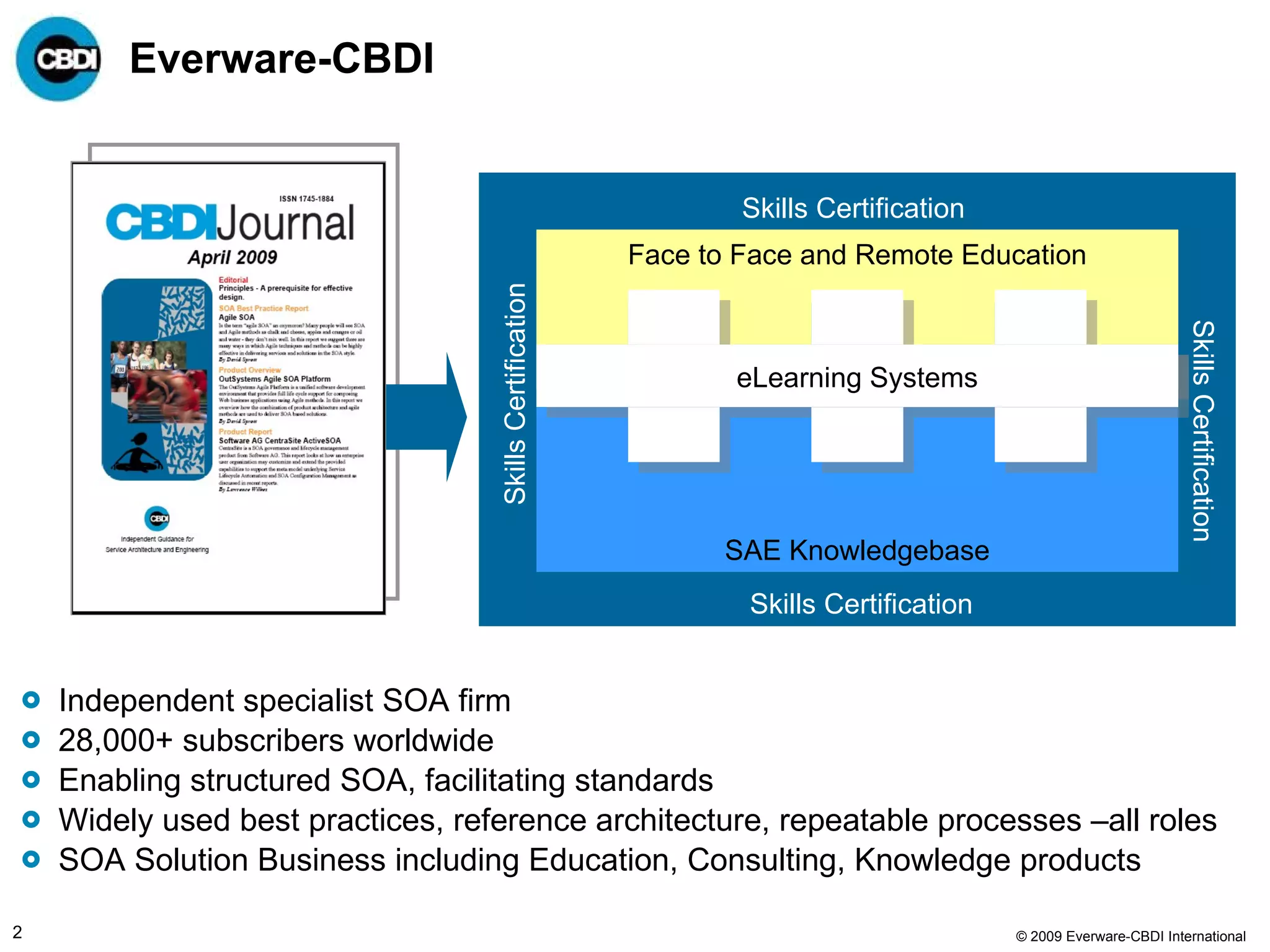
Everware-CBDI Independent specialist SOA firm 28,000+ subscribers worldwide Enabling structured SOA, facilitating standards Widely used best practices, reference architecture, repeatable processes –all roles SOA Solution Business including Education, Consulting, Knowledge products SAE Knowledgebase Face to Face and Remote Education Skills Certification Skills Certification Skills Certification eLearning Systems Skills Certification
a majority of merger and acquisitions fail to deliver planned shareholder value . . .  . . . . is there a better way?
“ Between 1992 and 2006 around  58.3 percent of all mergers and acquisitions not only failed to create shareholder value  but actually destroyed it, resulting in a net loss of 1.2 percent across all transactions” Boston Consulting Group “ Most elite,  world-beating companies are built through savvy, well-executed, M&A strategies . Regardless of sector, getting to the top involves an astute management of a portfolio of businesses” Deloitte & Touche “ More than  33 percent of companies did not expect to complete integration for more than two years or could not say when they would complete such integration.  Poor documentation of systems, a lack of metadata, diverse and uncontrolled data sources and poor data quality were also reported as significant problems by more than 50 percent of companies. Poor planning of the IT integration process was cited as a significant problem by 54 percent of respondents.” Boston Consulting Group
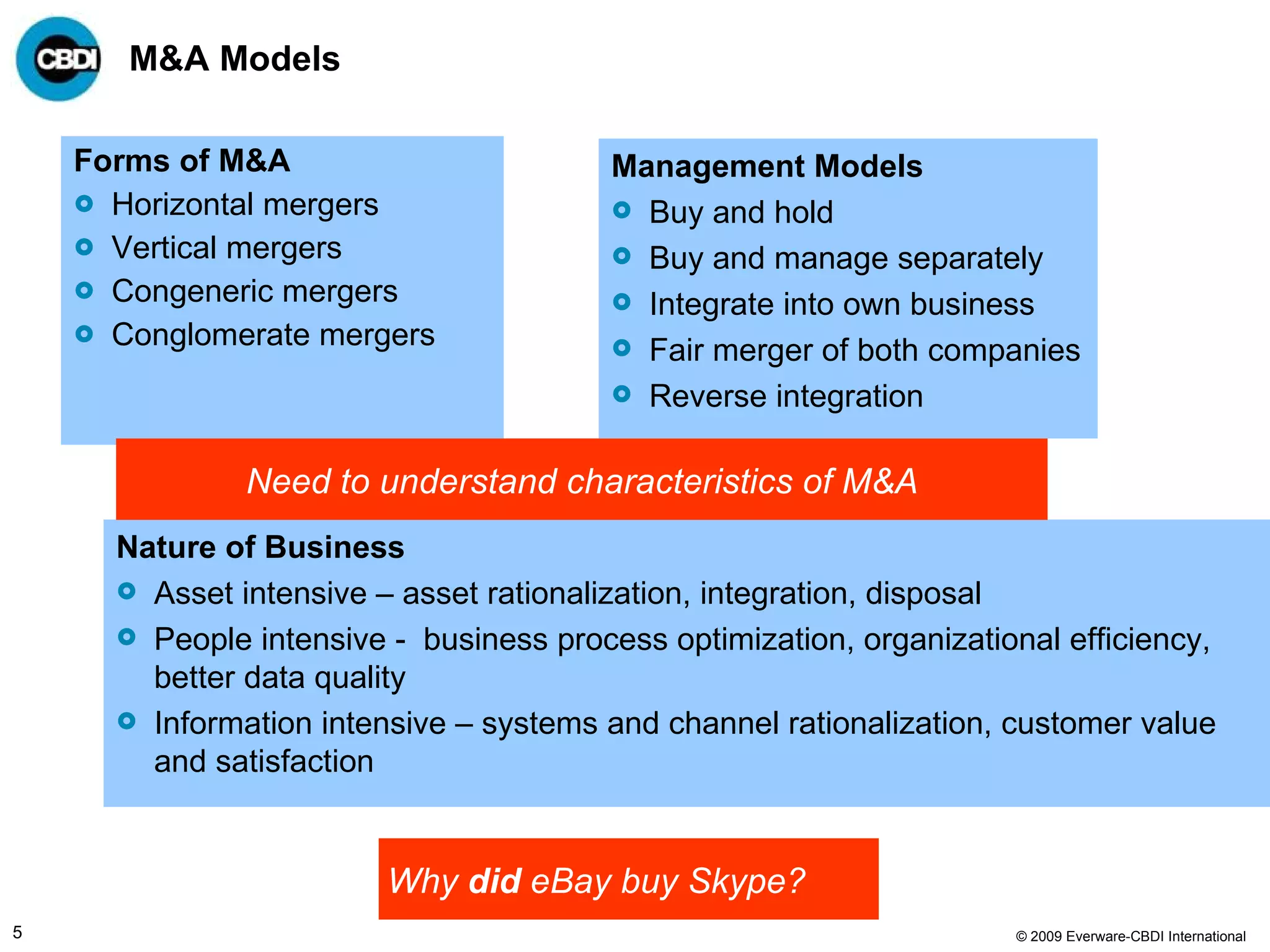
M&A Models Forms of M&A Horizontal mergers Vertical mergers Congeneric mergers Conglomerate mergers Management Models Buy and hold Buy and manage separately Integrate into own business Fair merger of both companies Reverse integration Need to understand characteristics of M&A Nature of Business Asset intensive – asset rationalization, integration, disposal People intensive -  business process optimization, organizational efficiency, better data quality Information intensive – systems and channel rationalization, customer value and satisfaction Why  did  eBay buy Skype?
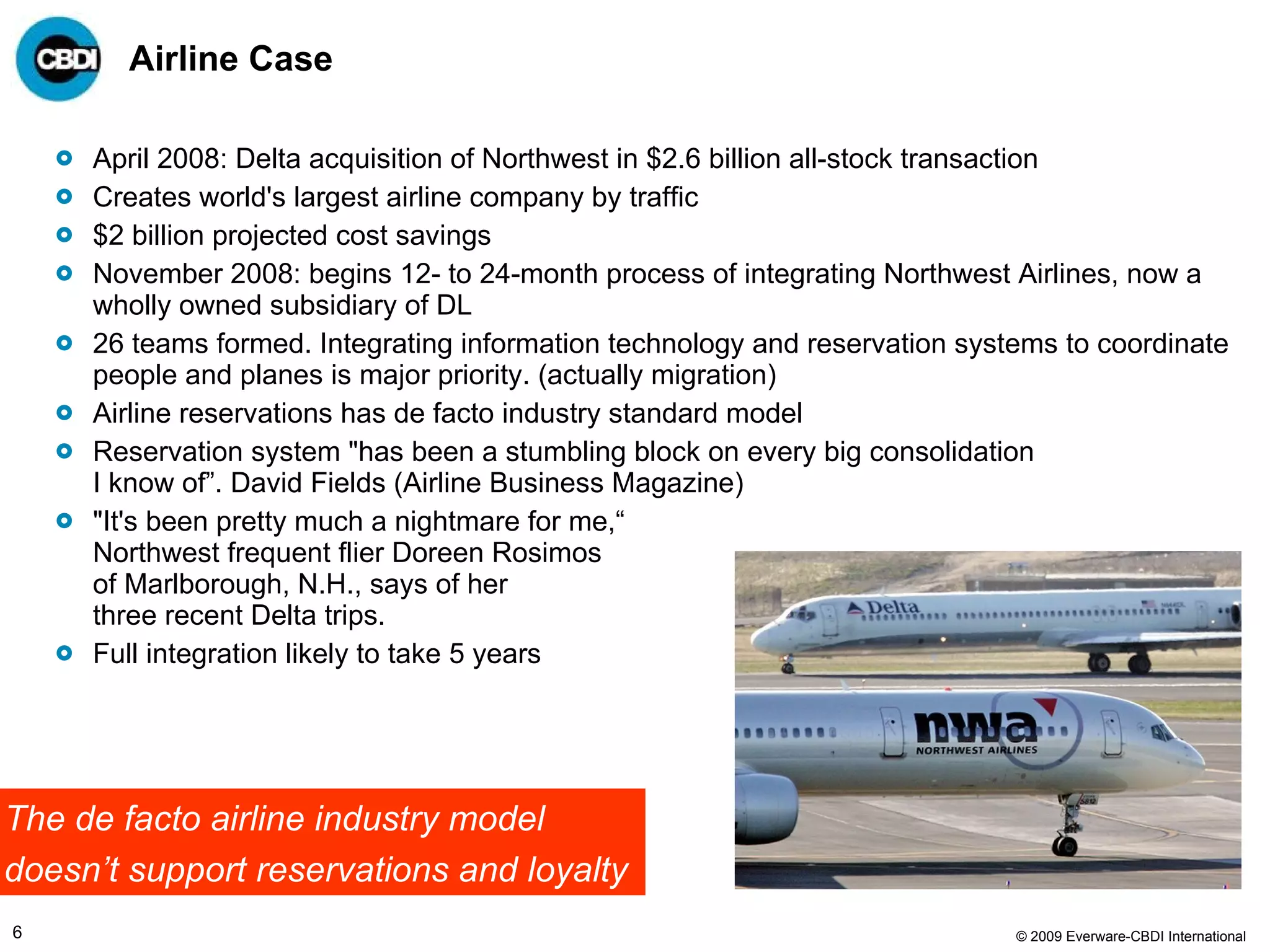
Airline Case April 2008: Delta acquisition of Northwest in $2.6 billion all-stock transaction Creates world's largest airline company by traffic $2 billion projected cost savings  November 2008: begins 12- to 24-month process of integrating Northwest Airlines, now a wholly owned subsidiary of DL 26 teams formed. Integrating information technology and reservation systems to coordinate people and planes is major priority. (actually migration) Airline reservations has de facto industry standard model Reservation system "has been a stumbling block on every big consolidation I know of”. David Fields (Airline Business Magazine) "It's been pretty much a nightmare for me,“ Northwest frequent flier Doreen Rosimos  of Marlborough, N.H., says of her  three recent Delta trips. Full integration likely to take 5 years The de facto airline industry model  doesn’t support reservations and loyalty
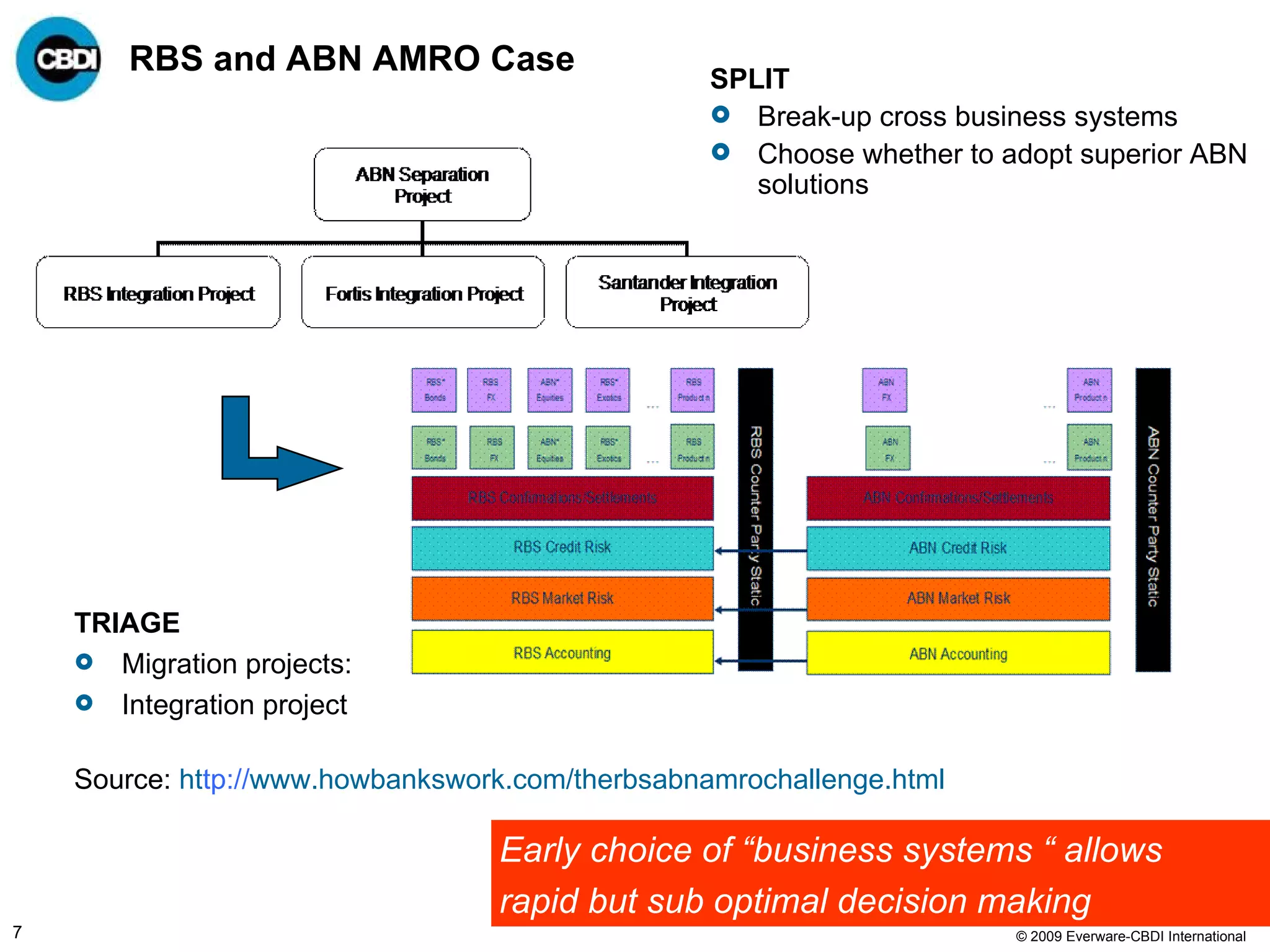
RBS and ABN AMRO Case SPLIT Break-up cross business systems Choose whether to adopt superior ABN solutions TRIAGE Migration projects:  Integration project Source:  ht tp:// www.howbankswork.com/therbsabnamrochallenge.html   Early choice of “business systems “ allows  rapid but sub optimal decision making
Why M&A often fails to deliver value (rapidly)? Insufficient focus on business systems in Due Diligence Numbers Organization (efficiency) Massive underestimation of systems complexity Use of M&A “experts” lacking modern enterprise architecture expertise  Lack of planning for Post Acquisition Integration Inadequate meta data for effective landscape analysis  Program and application level decision making Overwhelming need for immediate efficiencies drives tactical solutions and delays sensible architecture Default to message rather than service architecture SOA immaturity in one or more parties
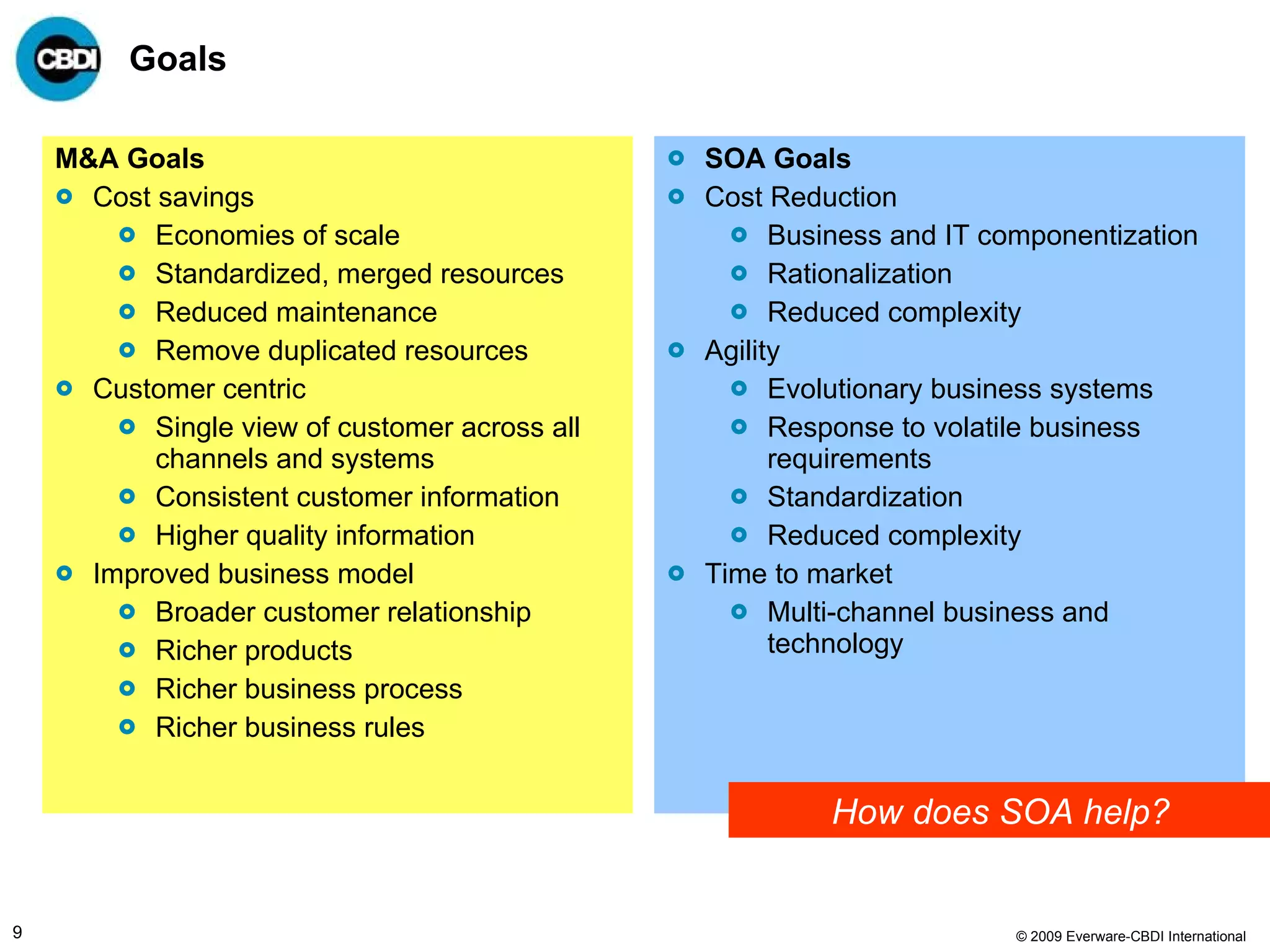
Goals M&A Goals Cost savings Economies of scale Standardized, merged resources Reduced maintenance Remove duplicated resources Customer centric Single view of customer across all channels and systems Consistent customer information Higher quality information Improved business model Broader customer relationship Richer products Richer business process Richer business rules SOA Goals Cost Reduction Business and IT componentization Rationalization Reduced complexity Agility Evolutionary business systems Response to volatile business requirements Standardization Reduced complexity Time to market Multi-channel business and technology How does SOA help?
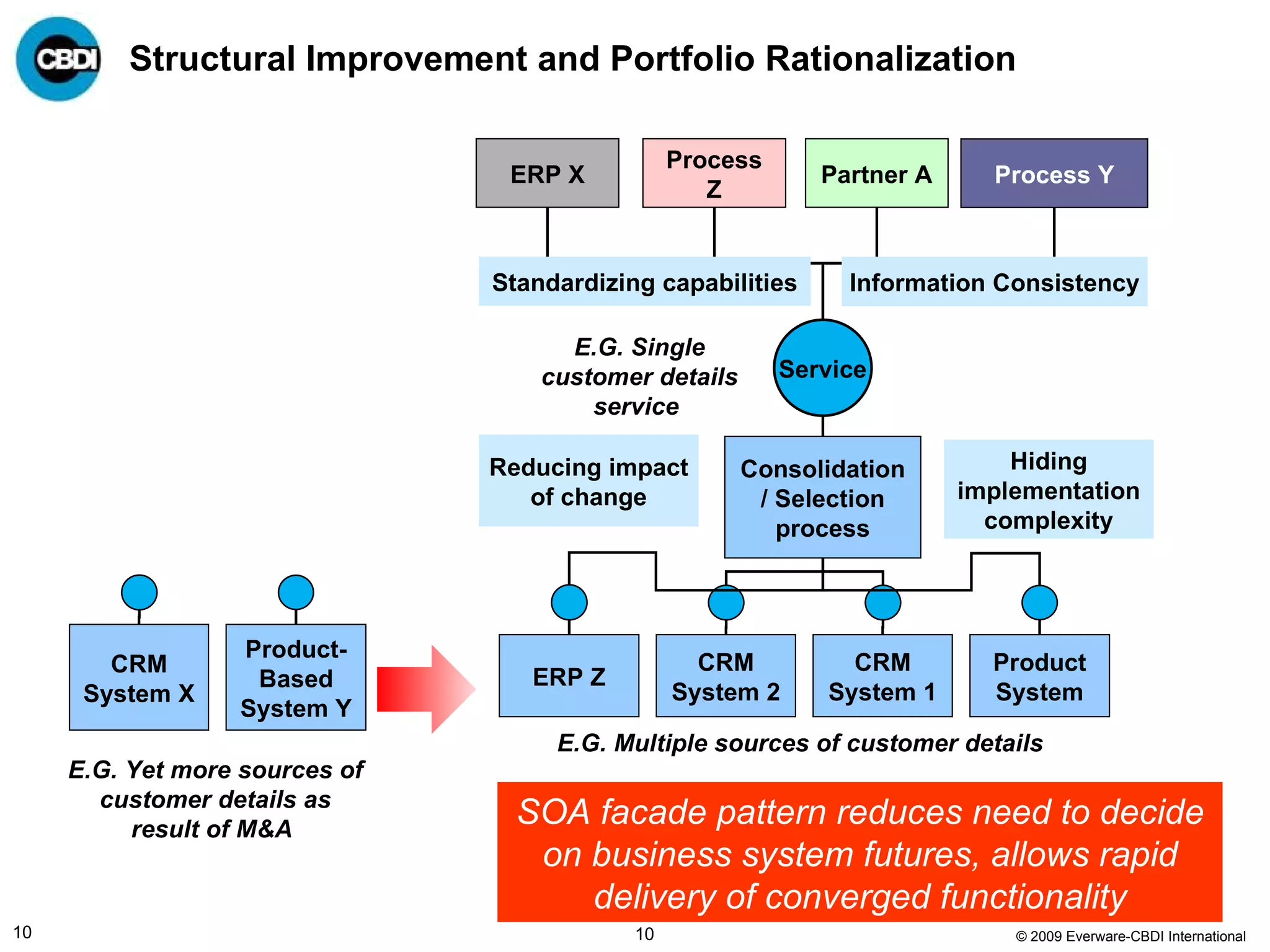
Structural Improvement and Portfolio Rationalization Product System ERP Z CRM System 1 CRM System 2 E.G. Multiple sources of customer details  SOA facade pattern reduces need to decide on business system futures, allows rapid delivery of converged functionality Product-Based System Y CRM System X E.G. Yet more sources of customer details as result of M&A  Consolidation/ Selection process E.G. Single customer details service  Hiding implementation complexity Reducing impact of change Service ERP X Process Z Partner A Process Y Standardizing capabilities Information Consistency
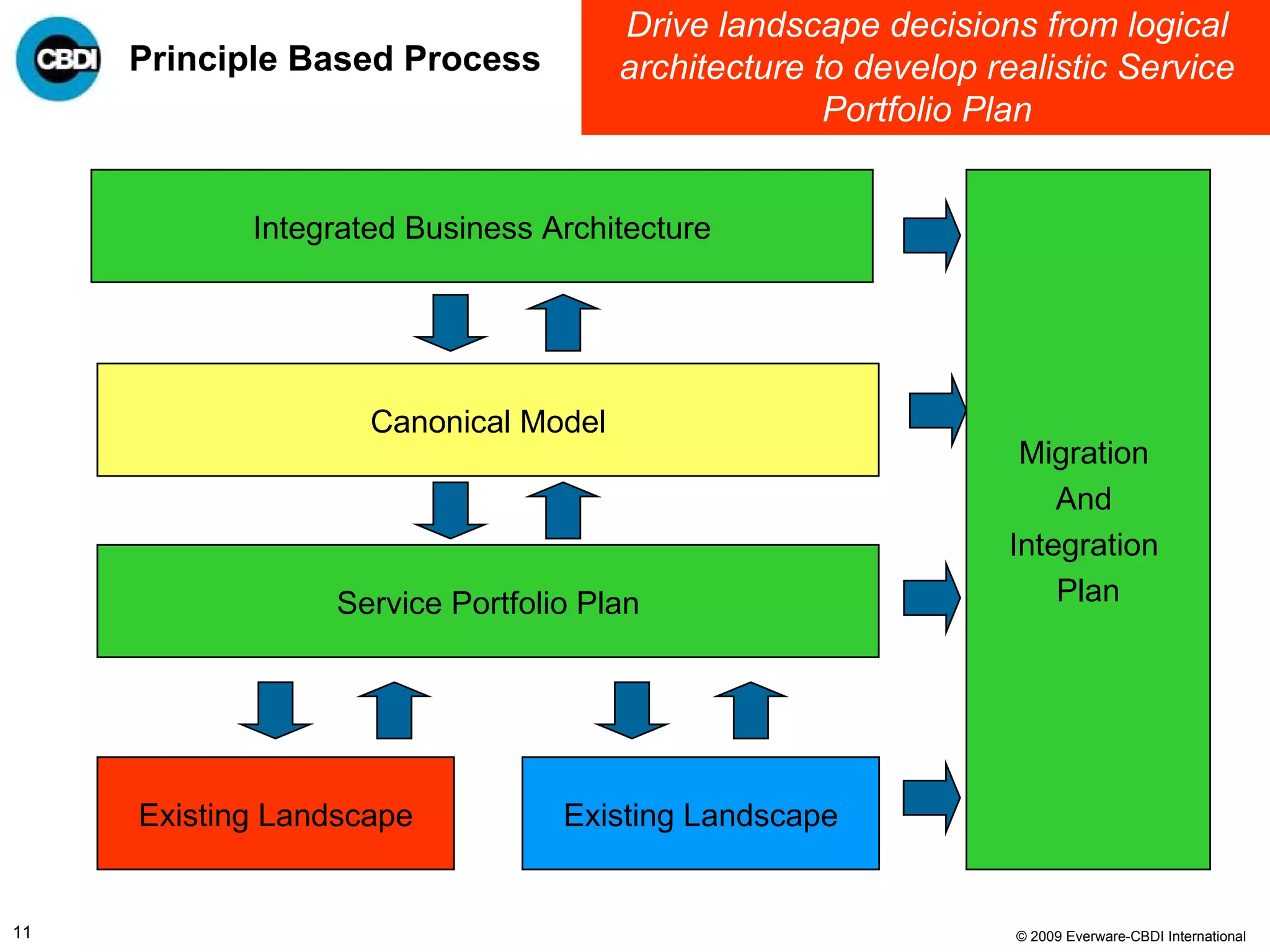
Principle Based Process Existing Landscape Existing Landscape Migration  And  Integration  Plan Integrated Business Architecture Drive landscape decisions from logical architecture to develop realistic Service Portfolio Plan Canonical Model Service Portfolio Plan
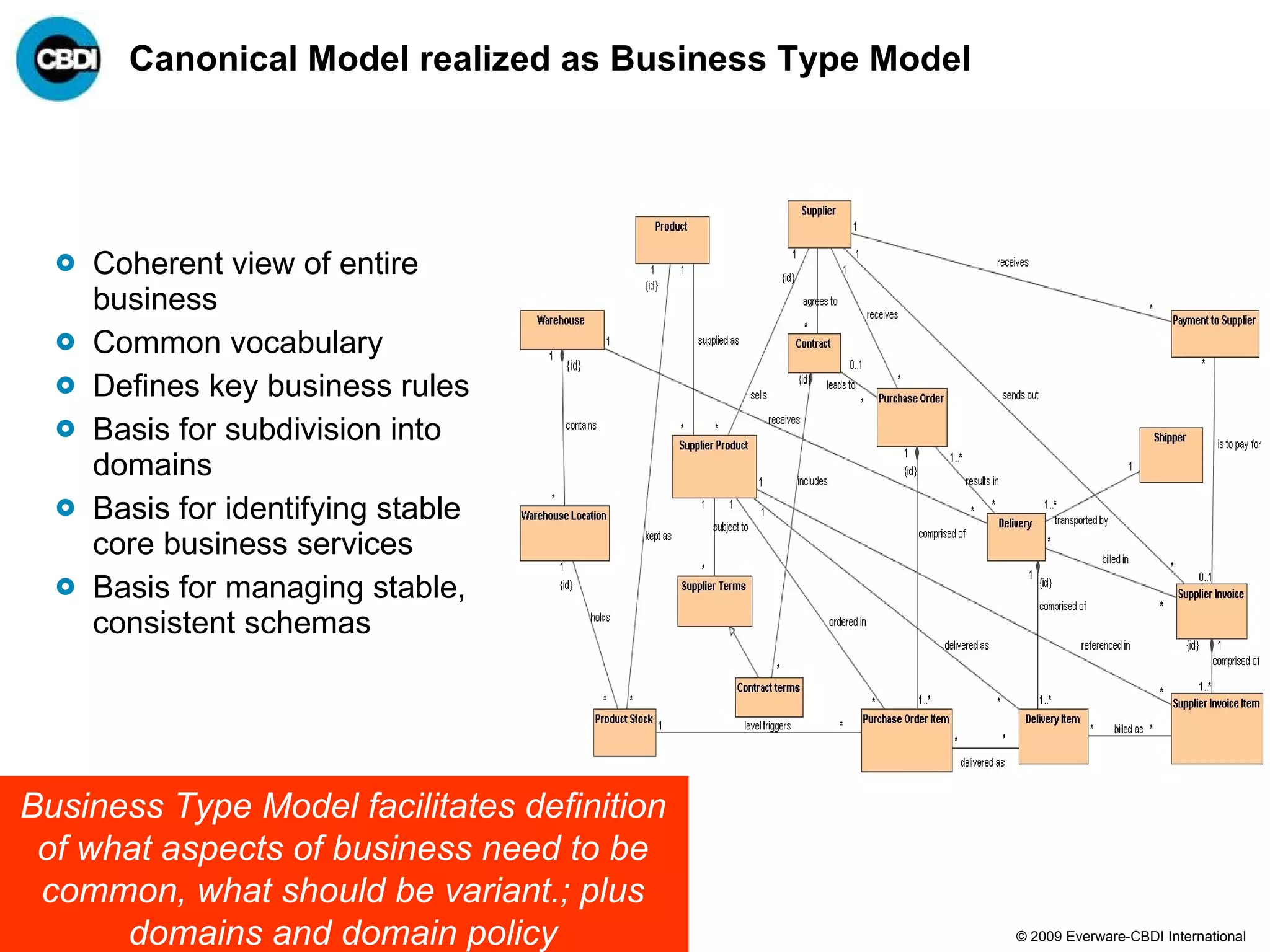
Canonical Model realized as Business Type Model Coherent view of entire business Common vocabulary Defines key business rules Basis for subdivision into domains Basis for identifying stable core business services Basis for managing stable, consistent schemas  Business Type Model facilitates definition of what aspects of business need to be common, what should be variant.; plus domains and domain policy
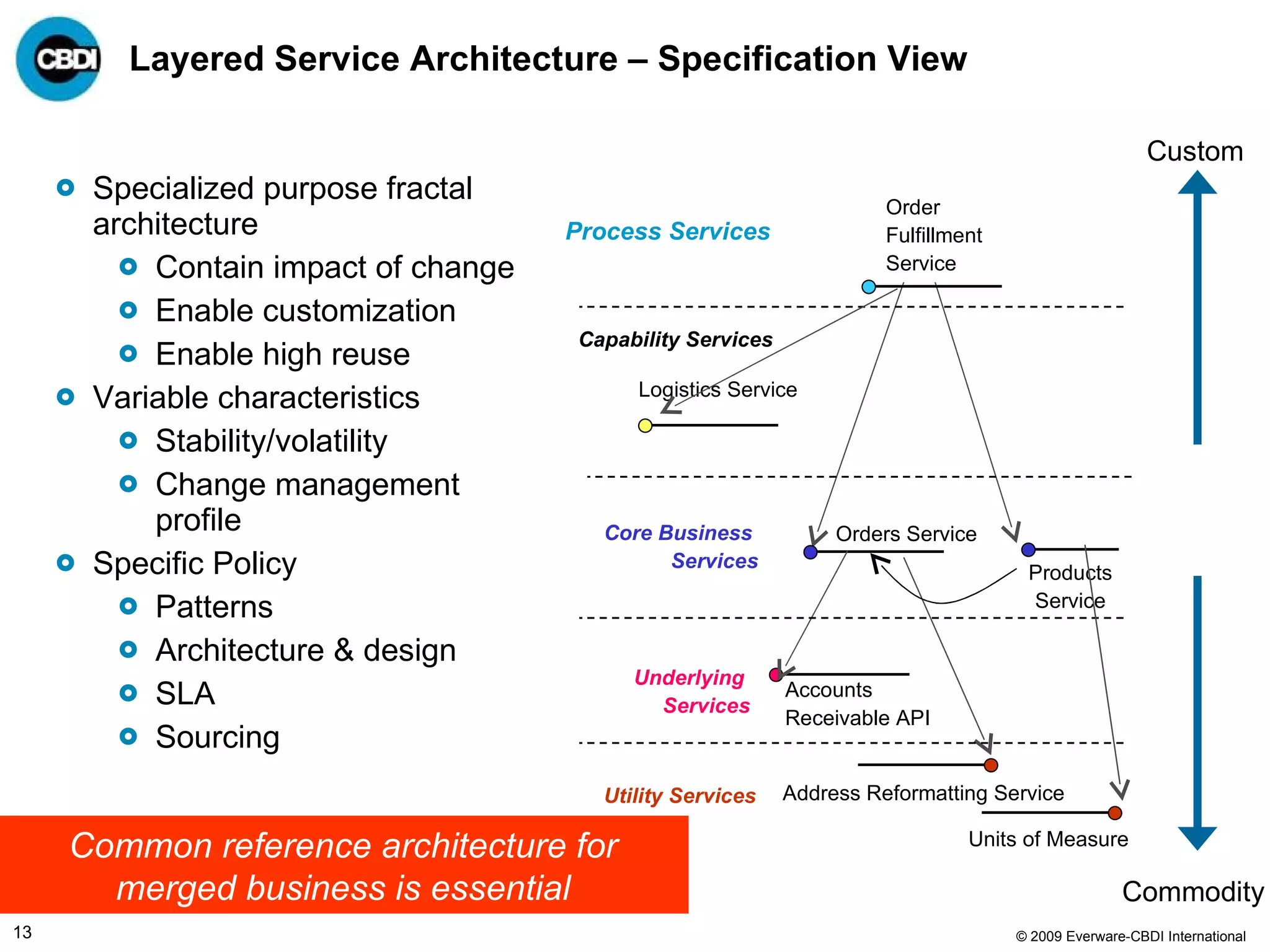
Layered Service Architecture – Specification View Specialized purpose fractal architecture Contain impact of change Enable customization Enable high reuse Variable characteristics Stability/volatility Change management profile Specific Policy Patterns Architecture & design SLA Sourcing  Order  Fulfillment Service Products Service Orders Service Process Services Core Business  Services Underlying  Services Utility Services Address Reformatting Service Accounts Receivable API Logistics Service Capability Services Units of Measure Commodity Custom Common reference architecture for merged business is essential
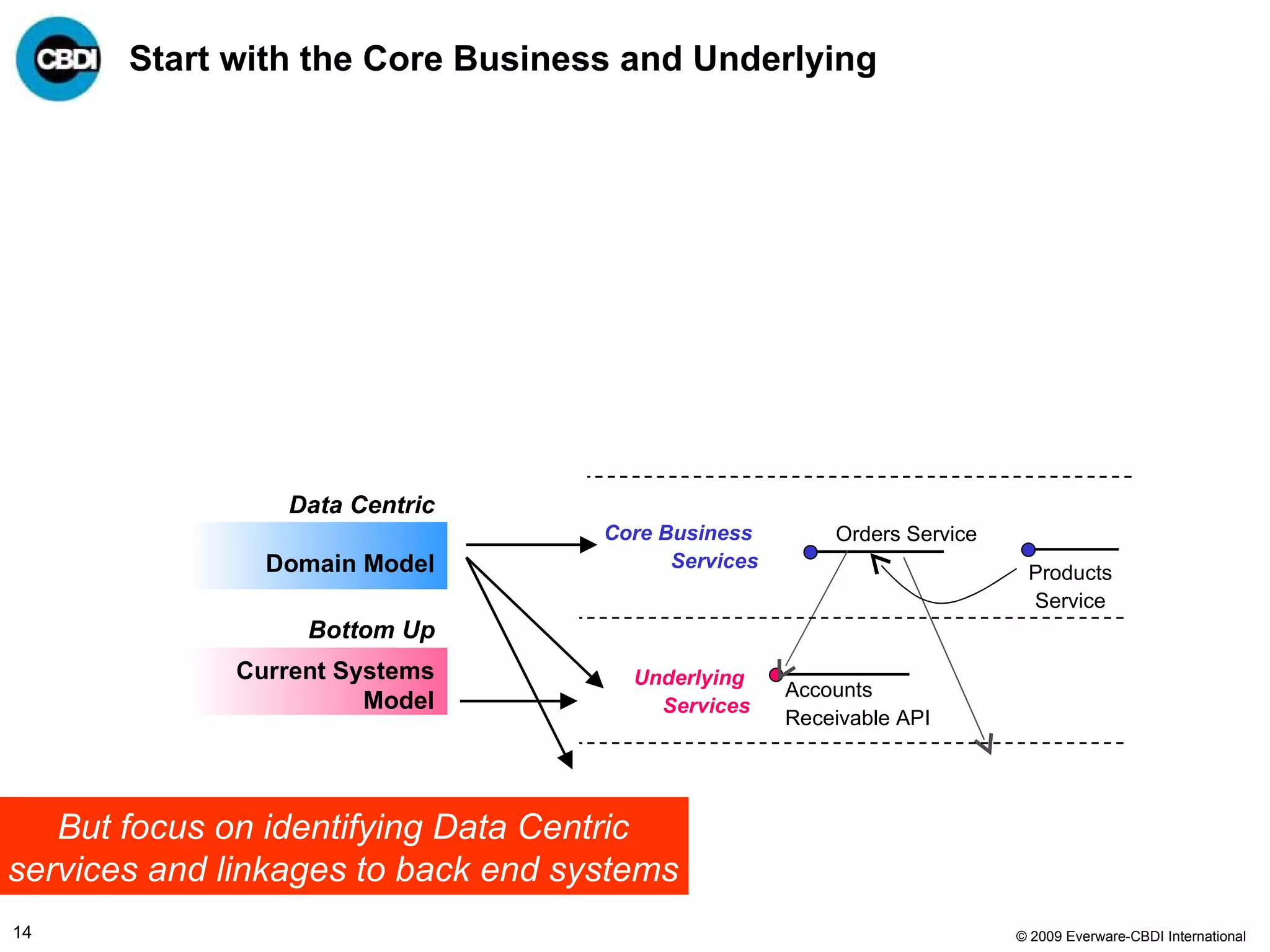
Start with the Core Business and Underlying Solution Model Domain Model Current Systems Model Process Driven Data Centric Bottom Up Order  Fulfillment Service Products Service Orders Service Process Services Core Business  Services Underlying  Services Accounts Receivable API Capability Model Function Driven Logistics Service Capability Services But focus on identifying Data Centric services and linkages to back end systems
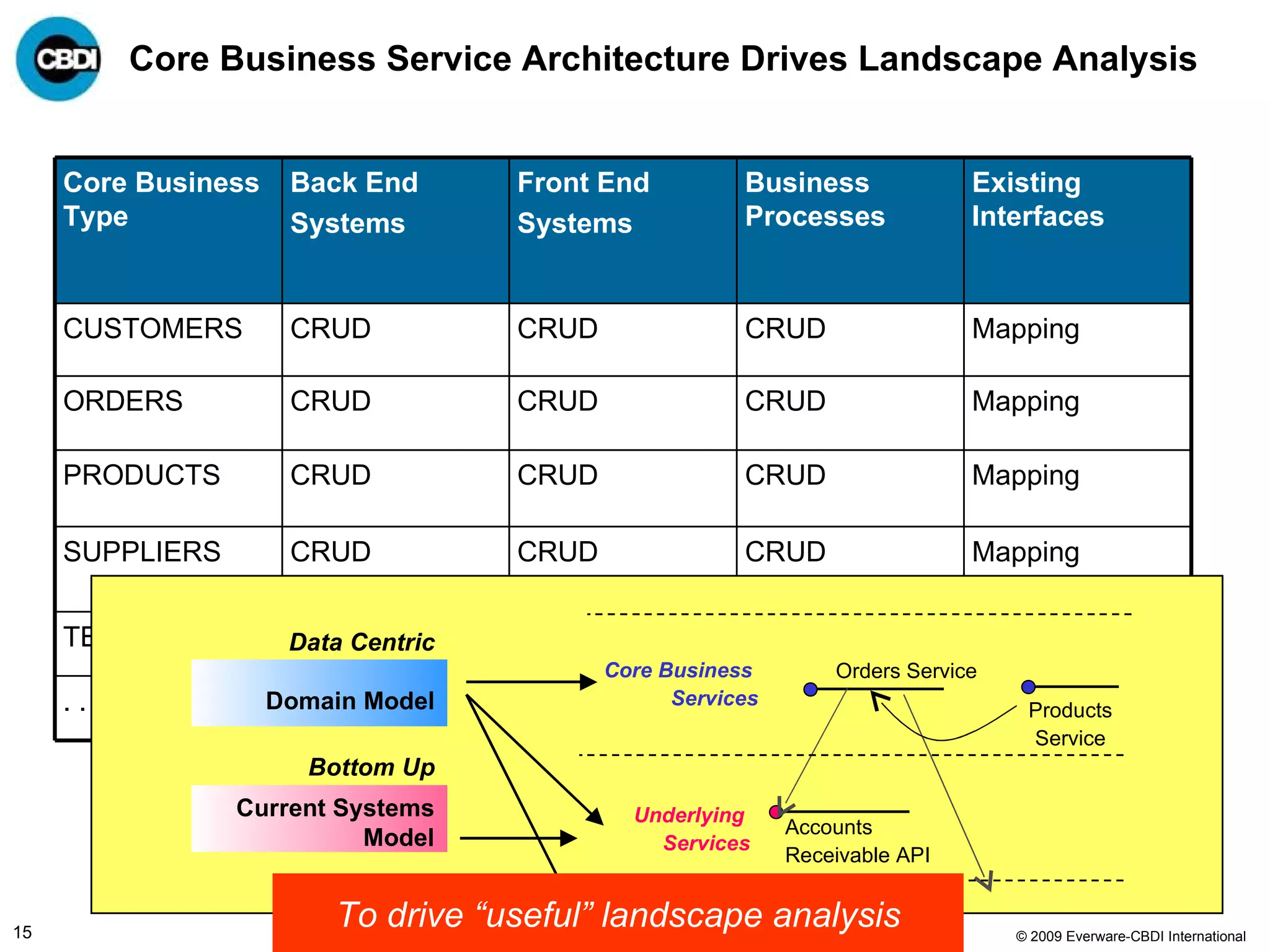
Core Business Service Architecture Drives Landscape Analysis Targeted landscape analysis Mapping logical, business perspective to potentially multiple existing environments Focus on identifying Underlying Services To drive “useful” landscape analysis Mapping CRUD CRUD CRUD . . .  Mapping CRUD CRUD CRUD TERMS Mapping CRUD CRUD CRUD SUPPLIERS Mapping CRUD CRUD CRUD PRODUCTS Mapping CRUD CRUD CRUD ORDERS Mapping CRUD CRUD CRUD CUSTOMERS Existing Interfaces Business Processes Front End Systems Back End Systems Core Business Type Domain Model Current Systems Model Data Centric Bottom Up Products Service Orders Service Core Business  Services Underlying  Services Accounts Receivable API
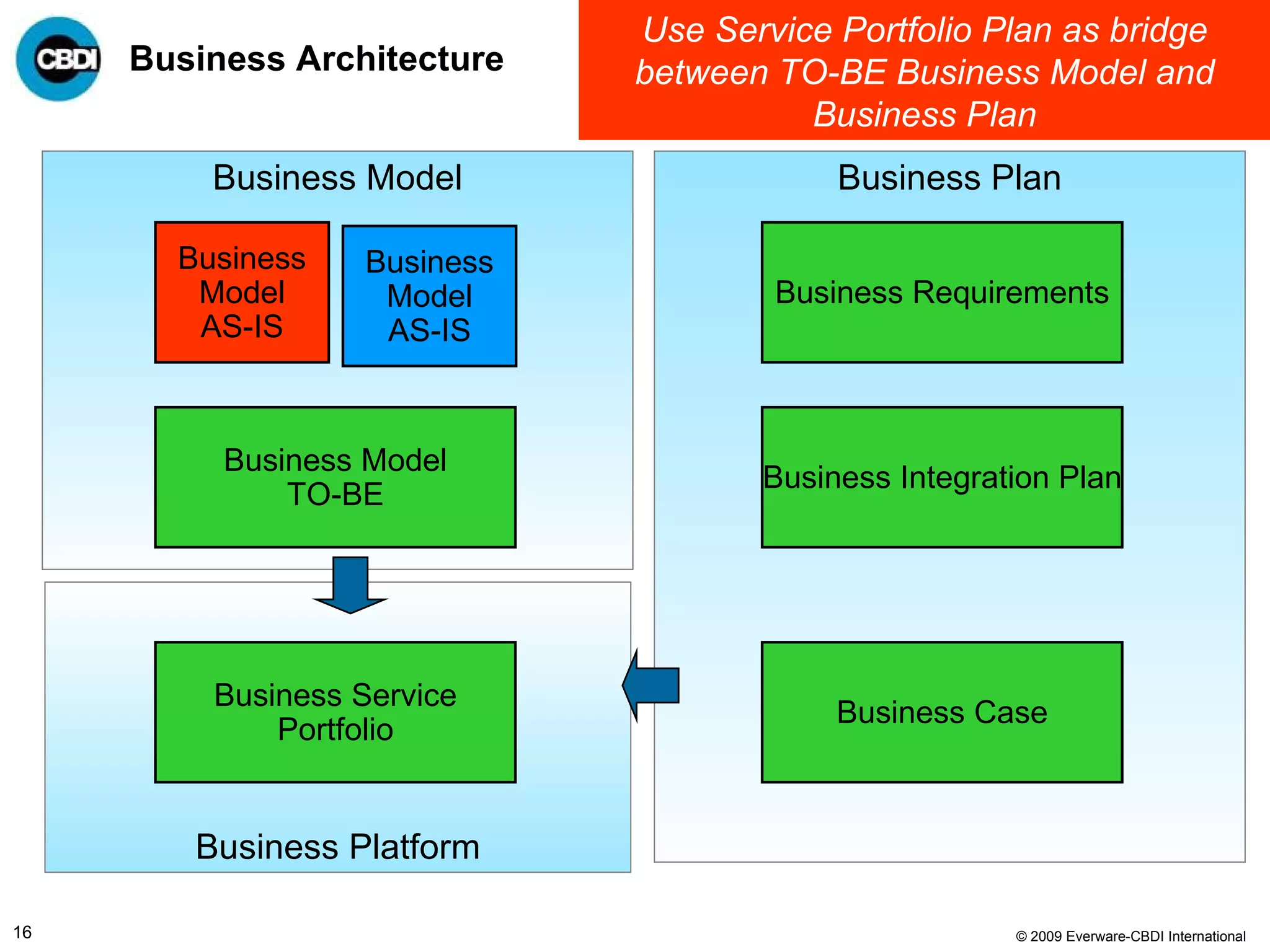
Business Architecture Business Model Business Plan Business Platform Business   Model AS-IS Business   Model TO-BE Business Requirements Business Integration Plan Business Case Business Service Portfolio Business   Model AS-IS Use Service Portfolio Plan as bridge between TO-BE Business Model and Business Plan
Perceived SOA Capability Issues Wide variations in capability (within and across enterprises) Wide divergence of service architectures (business and infrastructure) Cost, time and risk to establish minimum necessary capability Need for immediate cost and revenue returns Time to develop convergent business model Lack of understanding by M&A advisors and business management Enterprise architects not involved in M&A planning High quality business models do not exist  Short term numbers view of business plan Unwanted additional complexity There may be strong push back  against using SOA as a key tool
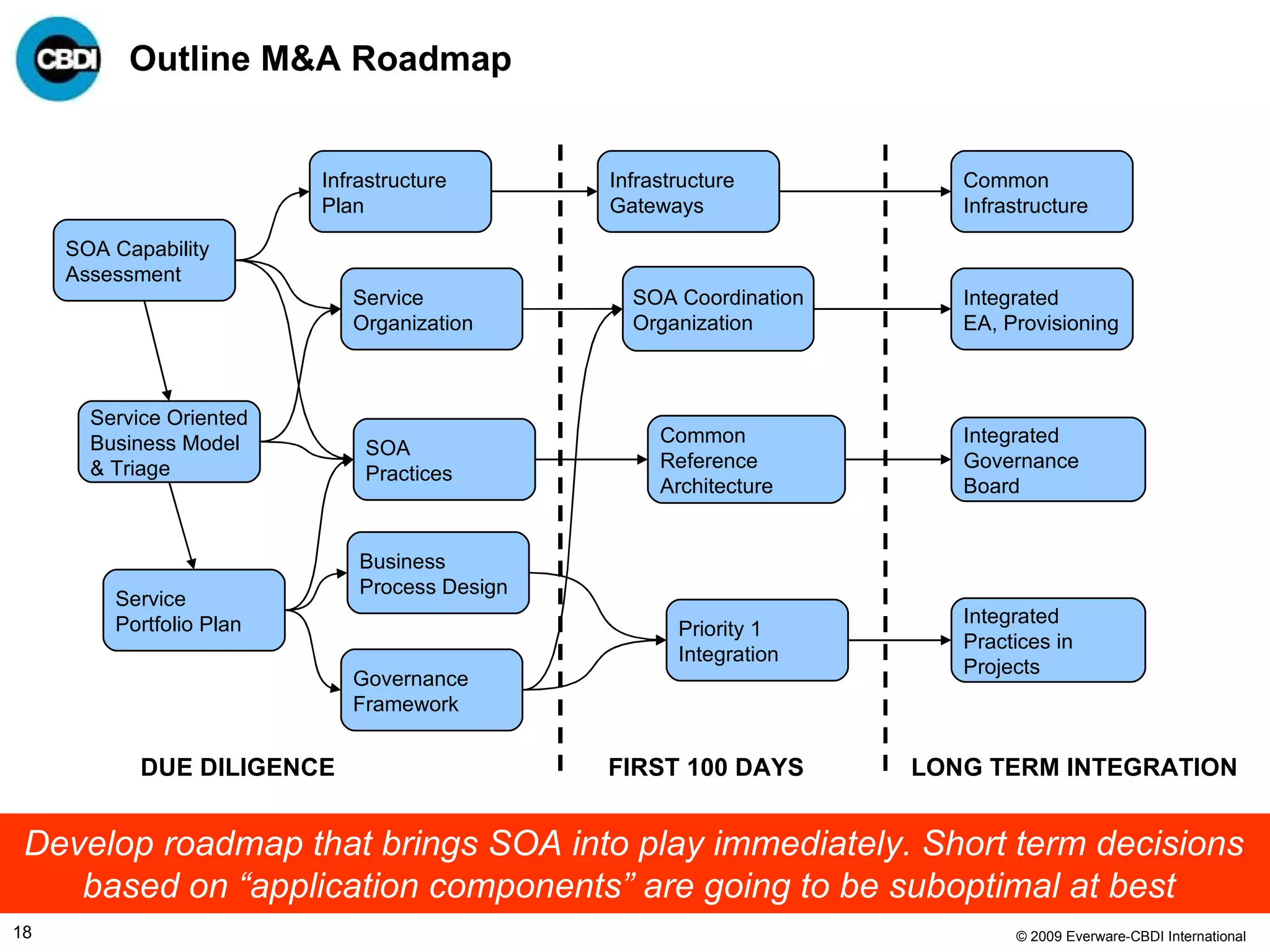
Outline M&A Roadmap DUE DILIGENCE FIRST 100 DAYS LONG TERM INTEGRATION SOA Capability  Assessment Service Oriented Business Model  & Triage Service  Portfolio Plan Infrastructure Plan Governance  Framework Service Organization SOA Practices Business  Process Design Develop roadmap that brings SOA into play immediately. Short term decisions based on “application components” are going to be suboptimal at best  Common Infrastructure Integrated  EA, Provisioning Integrated Governance  Board Integrated Practices in  Projects Infrastructure Gateways Priority 1 Integration Common  Reference  Architecture SOA Coordination Organization
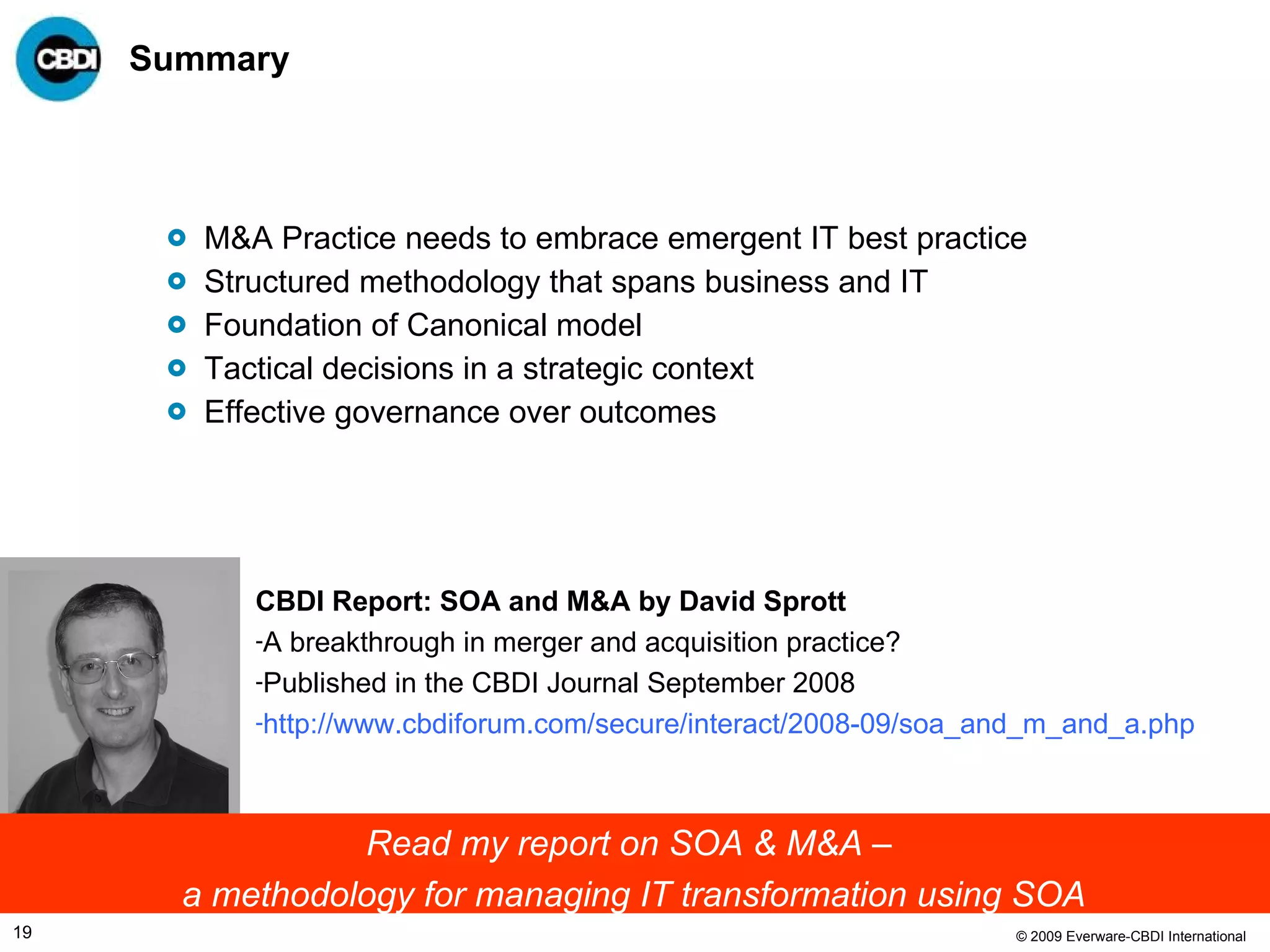
Summary M&A Practice needs to embrace emergent IT best practice Structured methodology that spans business and IT Foundation of Canonical model Tactical decisions in a strategic context Effective governance over outcomes  CBDI Report: SOA and M&A by David Sprott A breakthrough in merger and acquisition practice? Published in the CBDI Journal September 2008 http://www.cbdiforum.com/secure/interact/2008-09/soa_and_m_and_a.php   Read my report on SOA & M&A –  a methodology for managing IT transformation using SOA
Independent Guidance for Service Architecture and Engineering  www.cbdiforum.com www.everware-cbdi.com

SOA and M&A

  • 1.
    SOA and M&A– Breakthrough in Merger and Acquisition Practice? David Sprott Presentation made to Enterprise Architecture Conference Europe London, June 2009
  • 2.
    Everware-CBDI Independent specialistSOA firm 28,000+ subscribers worldwide Enabling structured SOA, facilitating standards Widely used best practices, reference architecture, repeatable processes –all roles SOA Solution Business including Education, Consulting, Knowledge products SAE Knowledgebase Face to Face and Remote Education Skills Certification Skills Certification Skills Certification eLearning Systems Skills Certification
  • 3.
    a majority ofmerger and acquisitions fail to deliver planned shareholder value . . . . . . . is there a better way?
  • 4.
    “ Between 1992and 2006 around 58.3 percent of all mergers and acquisitions not only failed to create shareholder value but actually destroyed it, resulting in a net loss of 1.2 percent across all transactions” Boston Consulting Group “ Most elite, world-beating companies are built through savvy, well-executed, M&A strategies . Regardless of sector, getting to the top involves an astute management of a portfolio of businesses” Deloitte & Touche “ More than 33 percent of companies did not expect to complete integration for more than two years or could not say when they would complete such integration. Poor documentation of systems, a lack of metadata, diverse and uncontrolled data sources and poor data quality were also reported as significant problems by more than 50 percent of companies. Poor planning of the IT integration process was cited as a significant problem by 54 percent of respondents.” Boston Consulting Group
  • 5.
    M&A Models Formsof M&A Horizontal mergers Vertical mergers Congeneric mergers Conglomerate mergers Management Models Buy and hold Buy and manage separately Integrate into own business Fair merger of both companies Reverse integration Need to understand characteristics of M&A Nature of Business Asset intensive – asset rationalization, integration, disposal People intensive - business process optimization, organizational efficiency, better data quality Information intensive – systems and channel rationalization, customer value and satisfaction Why did eBay buy Skype?
  • 6.
    Airline Case April2008: Delta acquisition of Northwest in $2.6 billion all-stock transaction Creates world's largest airline company by traffic $2 billion projected cost savings November 2008: begins 12- to 24-month process of integrating Northwest Airlines, now a wholly owned subsidiary of DL 26 teams formed. Integrating information technology and reservation systems to coordinate people and planes is major priority. (actually migration) Airline reservations has de facto industry standard model Reservation system "has been a stumbling block on every big consolidation I know of”. David Fields (Airline Business Magazine) "It's been pretty much a nightmare for me,“ Northwest frequent flier Doreen Rosimos of Marlborough, N.H., says of her three recent Delta trips. Full integration likely to take 5 years The de facto airline industry model doesn’t support reservations and loyalty
  • 7.
    RBS and ABNAMRO Case SPLIT Break-up cross business systems Choose whether to adopt superior ABN solutions TRIAGE Migration projects: Integration project Source: ht tp:// www.howbankswork.com/therbsabnamrochallenge.html Early choice of “business systems “ allows rapid but sub optimal decision making
  • 8.
    Why M&A oftenfails to deliver value (rapidly)? Insufficient focus on business systems in Due Diligence Numbers Organization (efficiency) Massive underestimation of systems complexity Use of M&A “experts” lacking modern enterprise architecture expertise Lack of planning for Post Acquisition Integration Inadequate meta data for effective landscape analysis Program and application level decision making Overwhelming need for immediate efficiencies drives tactical solutions and delays sensible architecture Default to message rather than service architecture SOA immaturity in one or more parties
  • 9.
    Goals M&A GoalsCost savings Economies of scale Standardized, merged resources Reduced maintenance Remove duplicated resources Customer centric Single view of customer across all channels and systems Consistent customer information Higher quality information Improved business model Broader customer relationship Richer products Richer business process Richer business rules SOA Goals Cost Reduction Business and IT componentization Rationalization Reduced complexity Agility Evolutionary business systems Response to volatile business requirements Standardization Reduced complexity Time to market Multi-channel business and technology How does SOA help?
  • 10.
    Structural Improvement andPortfolio Rationalization Product System ERP Z CRM System 1 CRM System 2 E.G. Multiple sources of customer details SOA facade pattern reduces need to decide on business system futures, allows rapid delivery of converged functionality Product-Based System Y CRM System X E.G. Yet more sources of customer details as result of M&A Consolidation/ Selection process E.G. Single customer details service Hiding implementation complexity Reducing impact of change Service ERP X Process Z Partner A Process Y Standardizing capabilities Information Consistency
  • 11.
    Principle Based ProcessExisting Landscape Existing Landscape Migration And Integration Plan Integrated Business Architecture Drive landscape decisions from logical architecture to develop realistic Service Portfolio Plan Canonical Model Service Portfolio Plan
  • 12.
    Canonical Model realizedas Business Type Model Coherent view of entire business Common vocabulary Defines key business rules Basis for subdivision into domains Basis for identifying stable core business services Basis for managing stable, consistent schemas Business Type Model facilitates definition of what aspects of business need to be common, what should be variant.; plus domains and domain policy
  • 13.
    Layered Service Architecture– Specification View Specialized purpose fractal architecture Contain impact of change Enable customization Enable high reuse Variable characteristics Stability/volatility Change management profile Specific Policy Patterns Architecture & design SLA Sourcing Order Fulfillment Service Products Service Orders Service Process Services Core Business Services Underlying Services Utility Services Address Reformatting Service Accounts Receivable API Logistics Service Capability Services Units of Measure Commodity Custom Common reference architecture for merged business is essential
  • 14.
    Start with theCore Business and Underlying Solution Model Domain Model Current Systems Model Process Driven Data Centric Bottom Up Order Fulfillment Service Products Service Orders Service Process Services Core Business Services Underlying Services Accounts Receivable API Capability Model Function Driven Logistics Service Capability Services But focus on identifying Data Centric services and linkages to back end systems
  • 15.
    Core Business ServiceArchitecture Drives Landscape Analysis Targeted landscape analysis Mapping logical, business perspective to potentially multiple existing environments Focus on identifying Underlying Services To drive “useful” landscape analysis Mapping CRUD CRUD CRUD . . . Mapping CRUD CRUD CRUD TERMS Mapping CRUD CRUD CRUD SUPPLIERS Mapping CRUD CRUD CRUD PRODUCTS Mapping CRUD CRUD CRUD ORDERS Mapping CRUD CRUD CRUD CUSTOMERS Existing Interfaces Business Processes Front End Systems Back End Systems Core Business Type Domain Model Current Systems Model Data Centric Bottom Up Products Service Orders Service Core Business Services Underlying Services Accounts Receivable API
  • 16.
    Business Architecture BusinessModel Business Plan Business Platform Business Model AS-IS Business Model TO-BE Business Requirements Business Integration Plan Business Case Business Service Portfolio Business Model AS-IS Use Service Portfolio Plan as bridge between TO-BE Business Model and Business Plan
  • 17.
    Perceived SOA CapabilityIssues Wide variations in capability (within and across enterprises) Wide divergence of service architectures (business and infrastructure) Cost, time and risk to establish minimum necessary capability Need for immediate cost and revenue returns Time to develop convergent business model Lack of understanding by M&A advisors and business management Enterprise architects not involved in M&A planning High quality business models do not exist Short term numbers view of business plan Unwanted additional complexity There may be strong push back against using SOA as a key tool
  • 18.
    Outline M&A RoadmapDUE DILIGENCE FIRST 100 DAYS LONG TERM INTEGRATION SOA Capability Assessment Service Oriented Business Model & Triage Service Portfolio Plan Infrastructure Plan Governance Framework Service Organization SOA Practices Business Process Design Develop roadmap that brings SOA into play immediately. Short term decisions based on “application components” are going to be suboptimal at best Common Infrastructure Integrated EA, Provisioning Integrated Governance Board Integrated Practices in Projects Infrastructure Gateways Priority 1 Integration Common Reference Architecture SOA Coordination Organization
  • 19.
    Summary M&A Practiceneeds to embrace emergent IT best practice Structured methodology that spans business and IT Foundation of Canonical model Tactical decisions in a strategic context Effective governance over outcomes CBDI Report: SOA and M&A by David Sprott A breakthrough in merger and acquisition practice? Published in the CBDI Journal September 2008 http://www.cbdiforum.com/secure/interact/2008-09/soa_and_m_and_a.php Read my report on SOA & M&A – a methodology for managing IT transformation using SOA
  • 20.
    Independent Guidance forService Architecture and Engineering www.cbdiforum.com www.everware-cbdi.com