
Introduction to E-Business
E-Commerce
The use of Internet and the web to transact
business.
More formally digitally enabled commercial
transactions between and among
organisations and individuals.
Digitally Enabled Transaction
Commercial Transaction
Unique Features of E-commerce
Technology
Ubiquity
Global reach
Universal standards
Information richness
Interactivity
Information density
Personalization/customization
Major Types of E-commerce
Business to Business. B2B
Business to Consumer. B2C
Business to Government. B2G
Consumer to Consumer. C2C
Customer to Business. C2C
Business to Employee. B2E
Business to Business. B2B
B2B is that model of e-commerce whereby a
company conducts its trading and other
commercial activity through the internet and
the customer is another business itself.
Business to Consumer. B2C
Visiting the Virtual Mall
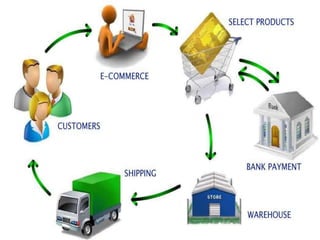
Customer Registers
Customer Buys Product
Merchant Processes the order
Credit/Debit card is processed
Operations Management
Shipment and Delivery
Customer Receives
After Sales Service
Business to Government. B2G
Professional affairs conducted between
companies and regional, municipal or federal
governing bodies.
Business to government typically
encompasses the determination and
evaluation of government agency needs,
the creation and submission of proposals and
the completion of the contracted work
Consumer to Consumer. C2C
Customer sells directly to other customers
via
online classified ads
auctions
selling personal services or expertise online.
Customer to Business. C2B
Consumer-to-business (C2B) is a business
model where an end user or consumer makes
a product or service that an organization
uses to complete a business process or gain
competitive advantage.
Business to Employee. B2E
Exchange of intra firm information with
employees over the internet or an intranet.
term of employment,
benefits,
policies,
operation manuals,
company newsletter
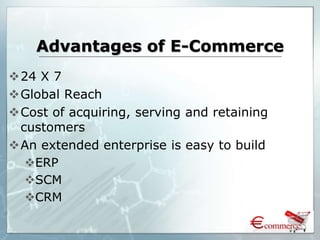
Advantages of E-Commerce
24 X 7
Global Reach
Cost of acquiring, serving and retaining
customers
An extended enterprise is easy to build
ERP
SCM
CRM
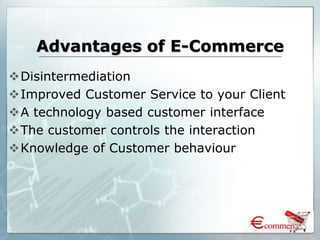
Advantages of E-Commerce
Disintermediation
Improved Customer Service to your Client
A technology based customer interface
The customer controls the interaction
Knowledge of Customer behaviour
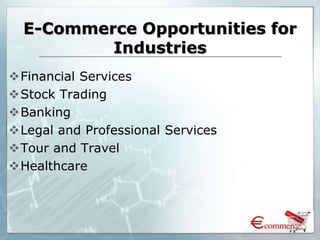
E-Commerce Opportunities for
Industries
Financial Services
Stock Trading
Banking
Legal and Professional Services
Tour and Travel
Healthcare
E-transitional Challenges for
Indian Corporate
Internal Resisting Issues
Bureaucratic Wrangles
Cultural Changes
Not Many Are Prepared
Lack of skills and Training
E-transitional Challenges for
Indian Corporate
External Driving Factors
Big Business
Global Market
Value for Money
No-entry barriers
IT Act 2000
 An Act to provide legal recognition for transactions
carried out by means of electronic data interchange
and other means of electronic communication,
commonly referred to as "electronic commerce",
which involve the use of alternatives to paper-based
methods of communication and storage of
information, to facilitate electronic filing of
documents with the Government agencies and
further to amend the Indian Penal Code, the Indian
Evidence Act, 1872, the Bankers' Books Evidence
Act, 1891 and the Reserve Bank of India Act, 1934
and for matters connected therewith or incidental
thereto.
Important Concepts of IT Act,
2000
Electronic Record
Secure electronic Record
Digital Signature
Secure Digital Signature
Certifying authority
Digital signature certificate
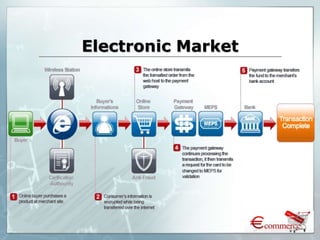
Electronic Market
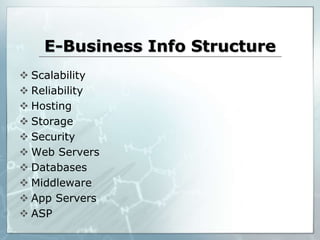
E-Business Info Structure
 Scalability
 Reliability
 Hosting
 Storage
 Security
 Web Servers
 Databases
 Middleware
 App Servers
 ASP
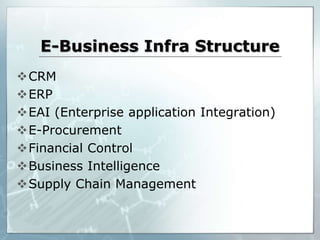
E-Business Infra Structure
CRM
ERP
EAI (Enterprise application Integration)
E-Procurement
Financial Control
Business Intelligence
Supply Chain Management
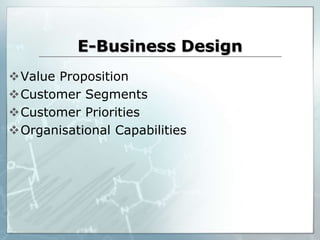
E-Business Design
Value Proposition
Customer Segments
Customer Priorities
Organisational Capabilities
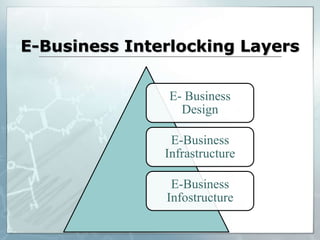
E-Business Interlocking Layers
E- Business
Design
E-Business
Infrastructure
E-Business
Infostructure
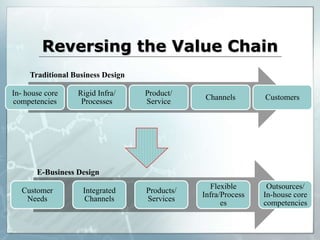
Reversing the Value Chain
In- house core
competencies
Rigid Infra/
Processes
Product/
Service
Channels Customers
Customer
Needs
Integrated
Channels
Products/
Services
Flexible
Infra/Process
es
Outsources/
In-house core
competencies
Traditional Business Design
E-Business Design
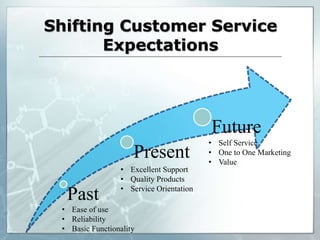
Shifting Customer Service
Expectations
Past
Present
Future
• Ease of use
• Reliability
• Basic Functionality
• Excellent Support
• Quality Products
• Service Orientation
• Self Service
• One to One Marketing
• Value
E Commerce
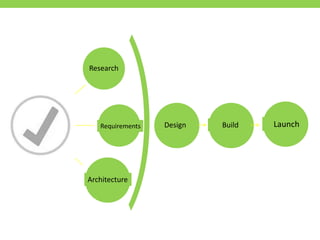
Website Development
Process
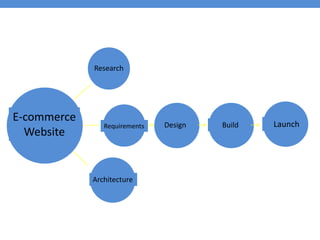
Research
Architecture
Design Build
E-commerce
Website
LaunchRequirements
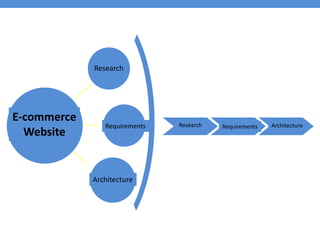
Research
Architecture
E-commerce
Website
ArchitectureRequirementsResearchRequirements
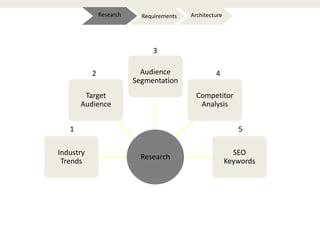
ArchitectureRequirementsResearch
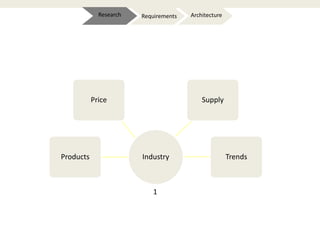
Industry
Trends
Target
Audience
Audience
Segmentation
Competitor
Analysis
SEO
Keywords
Research
1 5
2 4
3
IndustryProducts
Price Supply
Trends
ArchitectureRequirementsResearch
1
ArchitectureRequirementsResearch
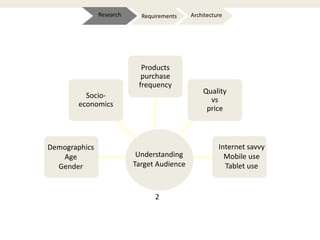
Socio-
economics
Products
purchase
frequency
Quality
vs
price
Understanding
Target Audience
Demographics
Age
Gender
Internet savvy
Mobile use
Tablet use
2
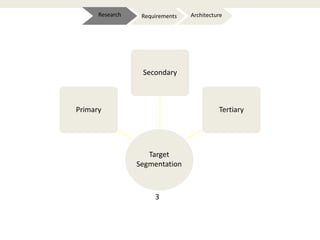
Primary
Secondary
Tertiary
Target
Segmentation
ArchitectureRequirementsResearch
3
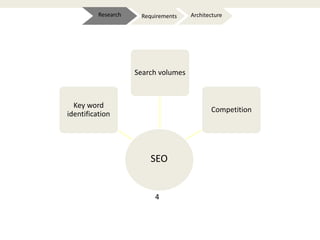
Key word
identification
Search volumes
Competition
SEO
ArchitectureRequirementsResearch
4
ArchitectureRequirementsResearch
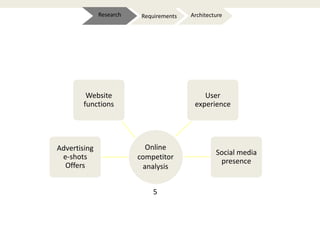
Advertising
e-shots
Offers
Website
functions
User
experience
Social media
presence
Online
competitor
analysis
5
ArchitectureRequirementsResearch
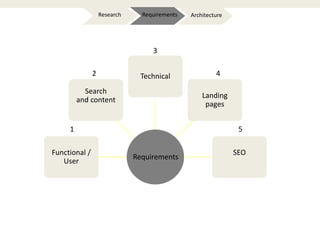
Functional /
User
Search
and content
Technical
Landing
pages
SEO
Requirements
1 5
2 4
3
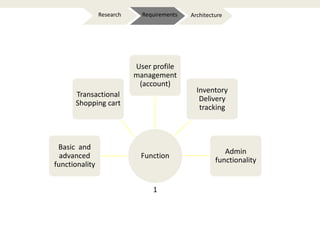
Function
Basic and
advanced
functionality
Transactional
Shopping cart
User profile
management
(account)
Inventory
Delivery
tracking
Admin
functionality
ArchitectureRequirementsResearch
1
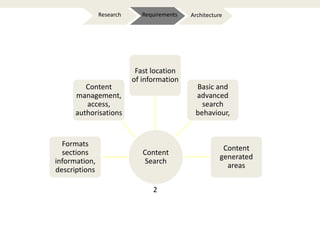
Content
Search
Formats
sections
information,
descriptions
Content
management,
access,
authorisations
Basic and
advanced
search
behaviour,
Content
generated
areas
ArchitectureRequirementsResearch
Fast location
of information
2
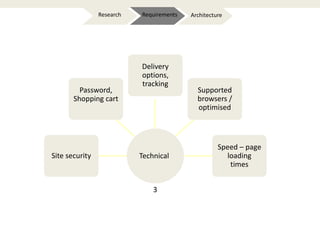
ArchitectureRequirementsResearch
Site security
Password,
Shopping cart
Delivery
options,
tracking
Supported
browsers /
optimised
Speed – page
loading
times
Technical
3
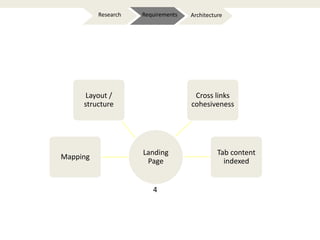
Landing
Page
Mapping
Layout /
structure
Cross links
cohesiveness
Tab content
indexed
ArchitectureRequirementsResearch
4
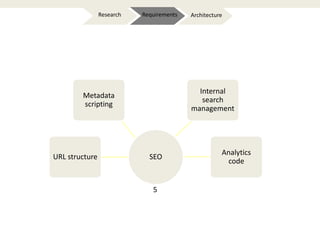
SEOURL structure
Metadata
scripting
Internal
search
management
Analytics
code
ArchitectureRequirementsResearch
5
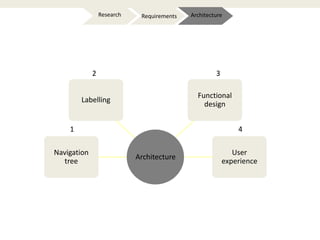
ArchitectureRequirementsResearch
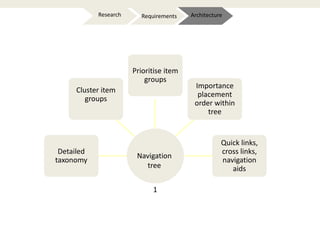
Navigation
tree
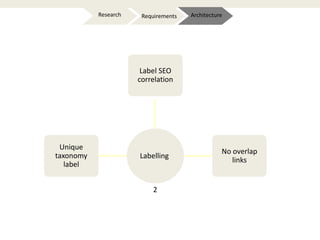
Labelling
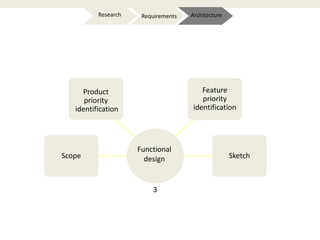
Functional
design
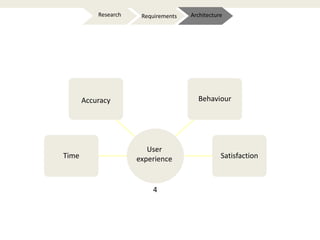
User
experience
Architecture
1 4
2 3
Detailed
taxonomy
Cluster item
groups
Prioritise item
groups
Importance
placement
order within
tree
Quick links,
cross links,
navigation
aids
Navigation
tree
ArchitectureRequirementsResearch
1
Unique
taxonomy
label
Label SEO
correlation
No overlap
links
Labelling
ArchitectureRequirementsResearch
2
Scope
Product
priority
identification
Feature
priority
identification
Sketch
Functional
design
ArchitectureRequirementsResearch
3
Time
Accuracy Behaviour
Satisfaction
User
experience
ArchitectureRequirementsResearch
4
Research
Architecture
Design Build LaunchRequirements
Presentation
Electronic Commerce & Internet
Marketing
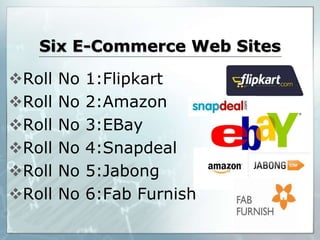
Six E-Commerce Web Sites
Roll No 1:Flipkart
Roll No 2:Amazon
Roll No 3:EBay
Roll No 4:Snapdeal
Roll No 5:Jabong
Roll No 6:Fab Furnish
Presentation
Presentation for 20 Min
Q & A for 10 Min
Presentation would be divided into 6 parts
1. E-commerce web site quality evaluation models
2. Business Strategy
3. Business Model
4. Market Position
5. Revenue Model
6. Technical Evaluation
Ease of use
Navigation
Security Assurance
Content
Design
Easy Search
Reliability
Image Created
Innovativeness
Contact Details
Update Frequency
Availability
Domain
E-commerce web site quality evaluation models
Need to Include
Login Functions
Banner Ads
Feedback Channel
Mission
Target Customers
Product
Infrastructure
E-Marketing
Solutions
Design Layout
CRM
2 yrs Income
2 yrs Expenditure
Online Catalogue
Online Ads
Technical Considerations for
Evaluating E-Commerce Platforms
Scalability
The product
Catalogue
Business User
Control
Search
Agility
Reporting and
Analytics
Standards
Integration
Interoperability
Synergy

Class 2