Outlines Enterprise Functional Systems Enterprise E-business systems Knowledge management
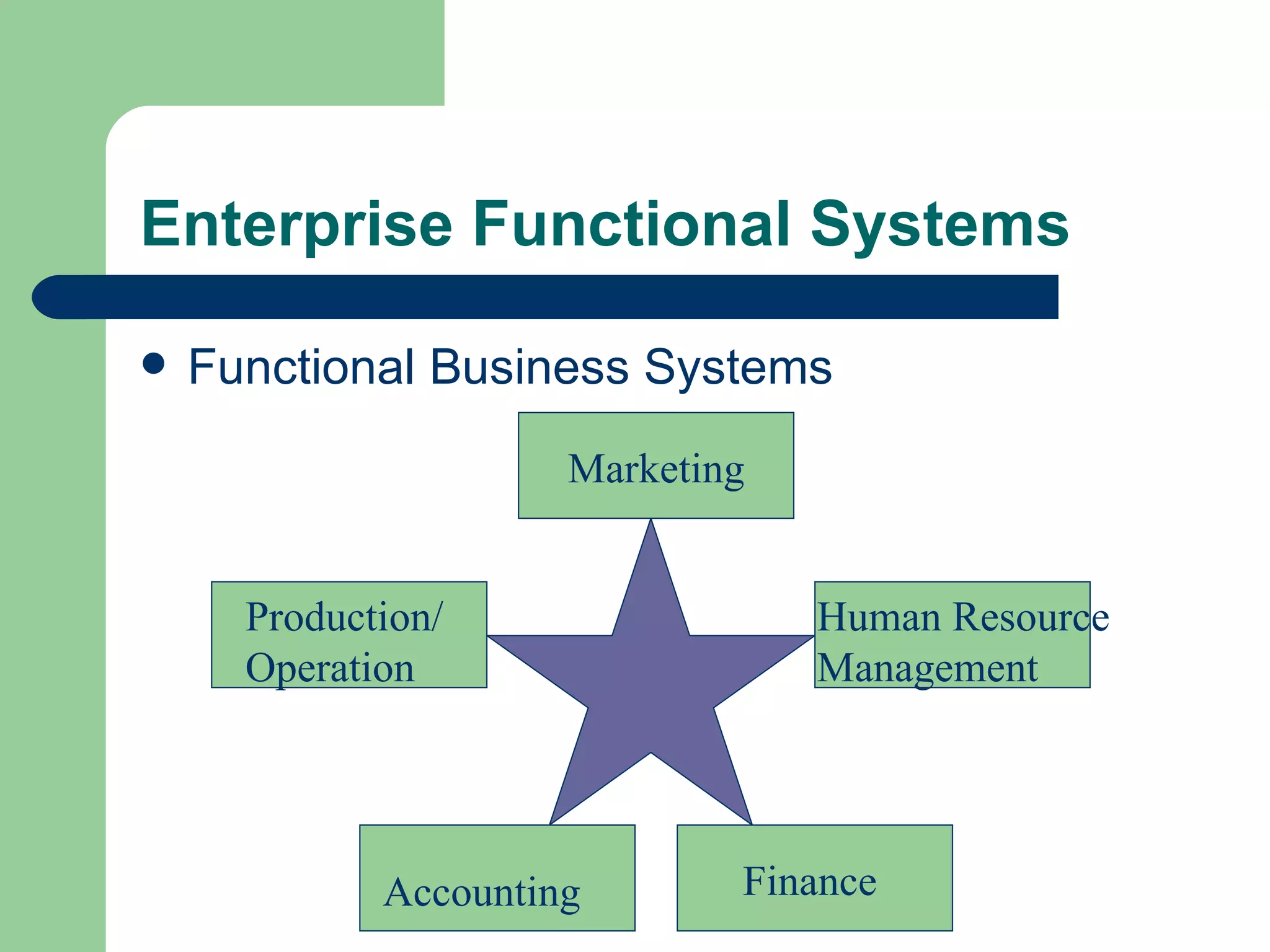
Enterprise Functional Systems Functional Business Systems Marketing Production/Operation Accounting Finance Human Resource Management
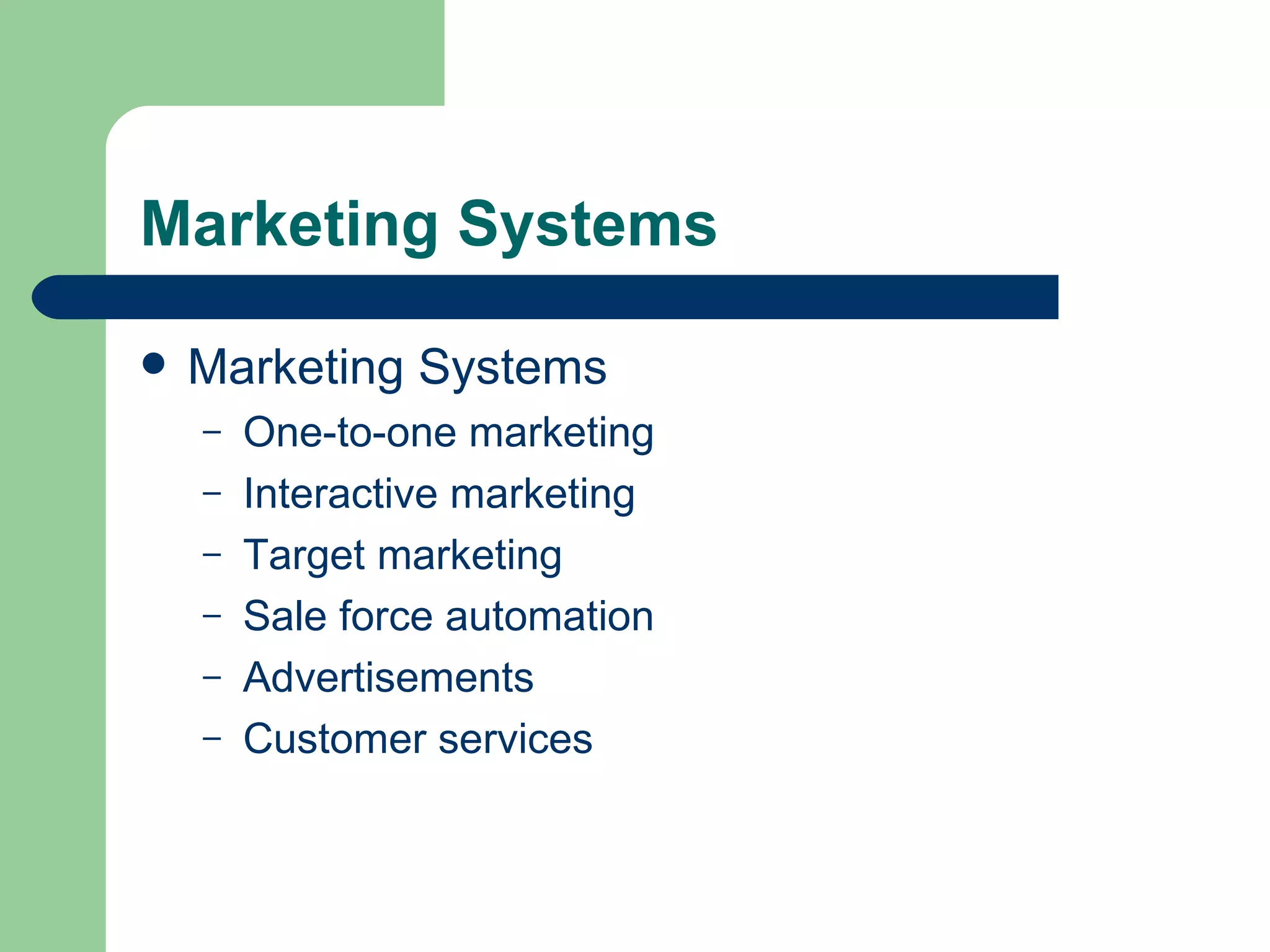
Marketing Systems Marketing Systems One-to-one marketing Interactive marketing Target marketing Sale force automation Advertisements Customer services
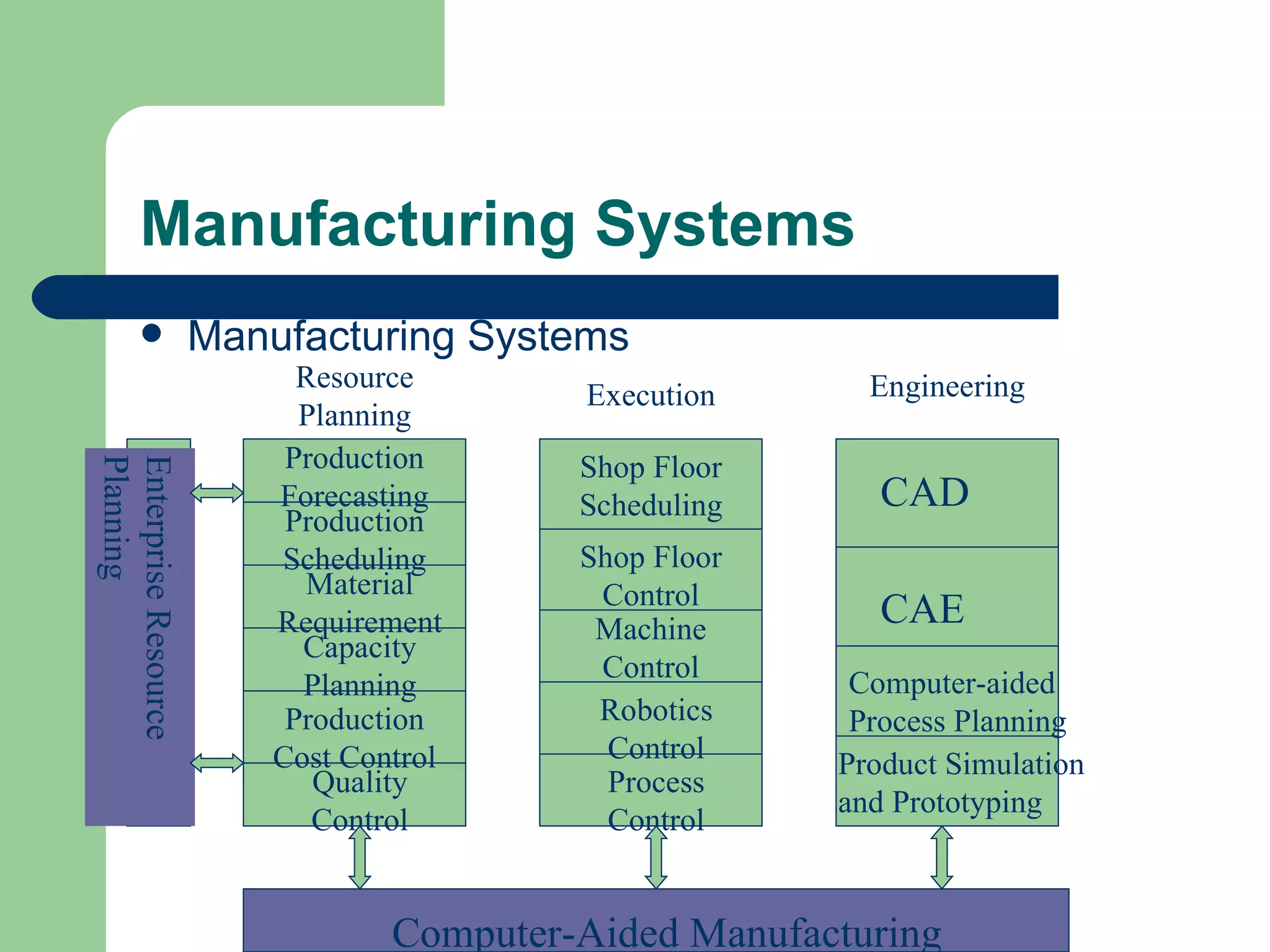
Manufacturing Systems Manufacturing Systems Production Forecasting Production Scheduling Material Requirement Capacity Planning Production Cost Control Quality Control Shop Floor Scheduling Shop Floor Control Machine Control Robotics Control Process Control CAD CAE Computer-aided Process Planning Product Simulation and Prototyping Computer-Aided Manufacturing Enterprise Resource Planning Resource Planning Execution Engineering
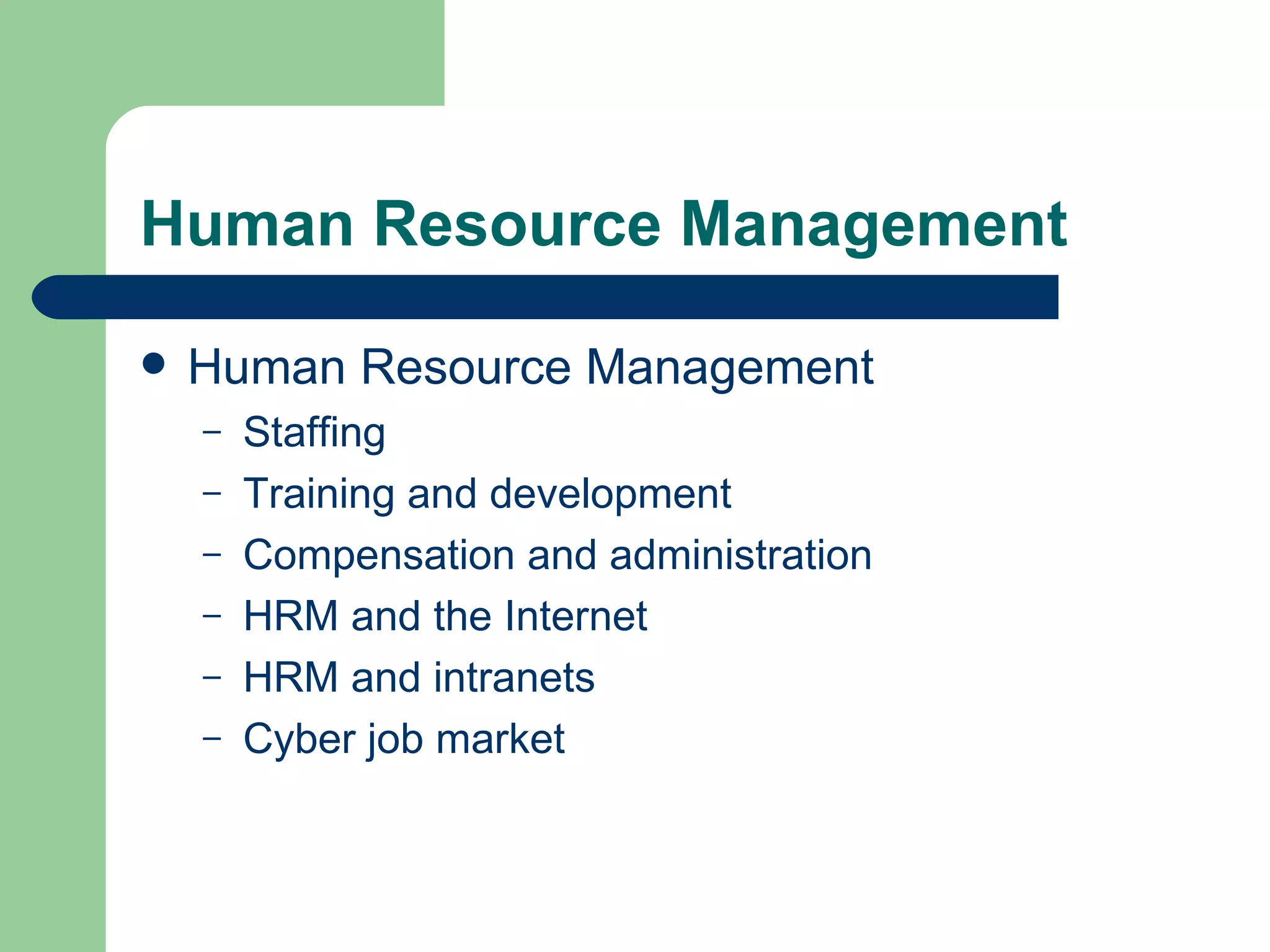
Human Resource Management Human Resource Management Staffing Training and development Compensation and administration HRM and the Internet HRM and intranets Cyber job market
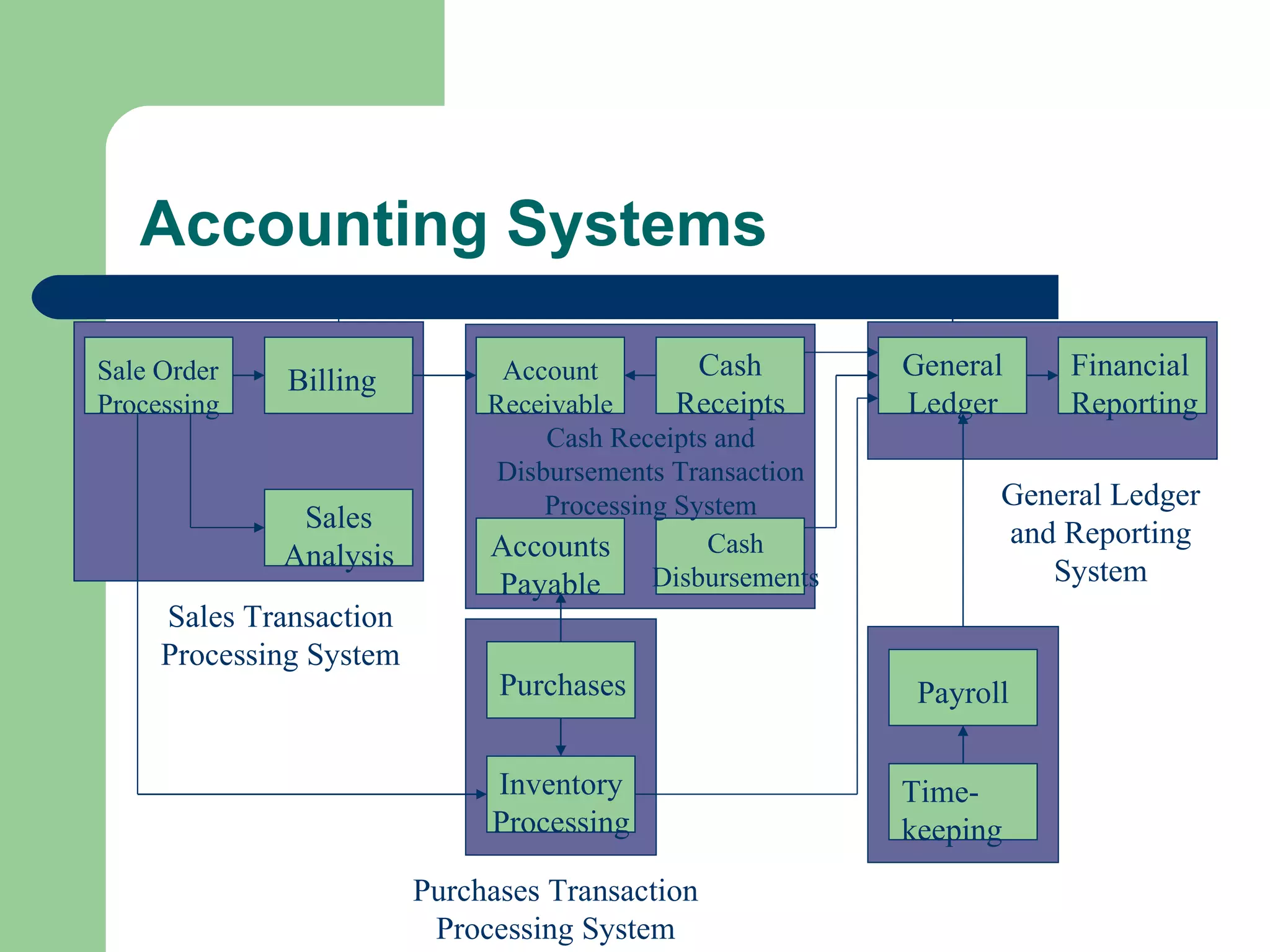
Accounting Systems Sale Order Processing Billing Sales Analysis Account Receivable Cash Receipts Accounts Payable Cash Disbursements Purchases Inventory Processing Payroll Time-keeping General Ledger Financial Reporting Sales Transaction Processing System Purchases Transaction Processing System General Ledger and Reporting System Cash Receipts and Disbursements Transaction Processing System
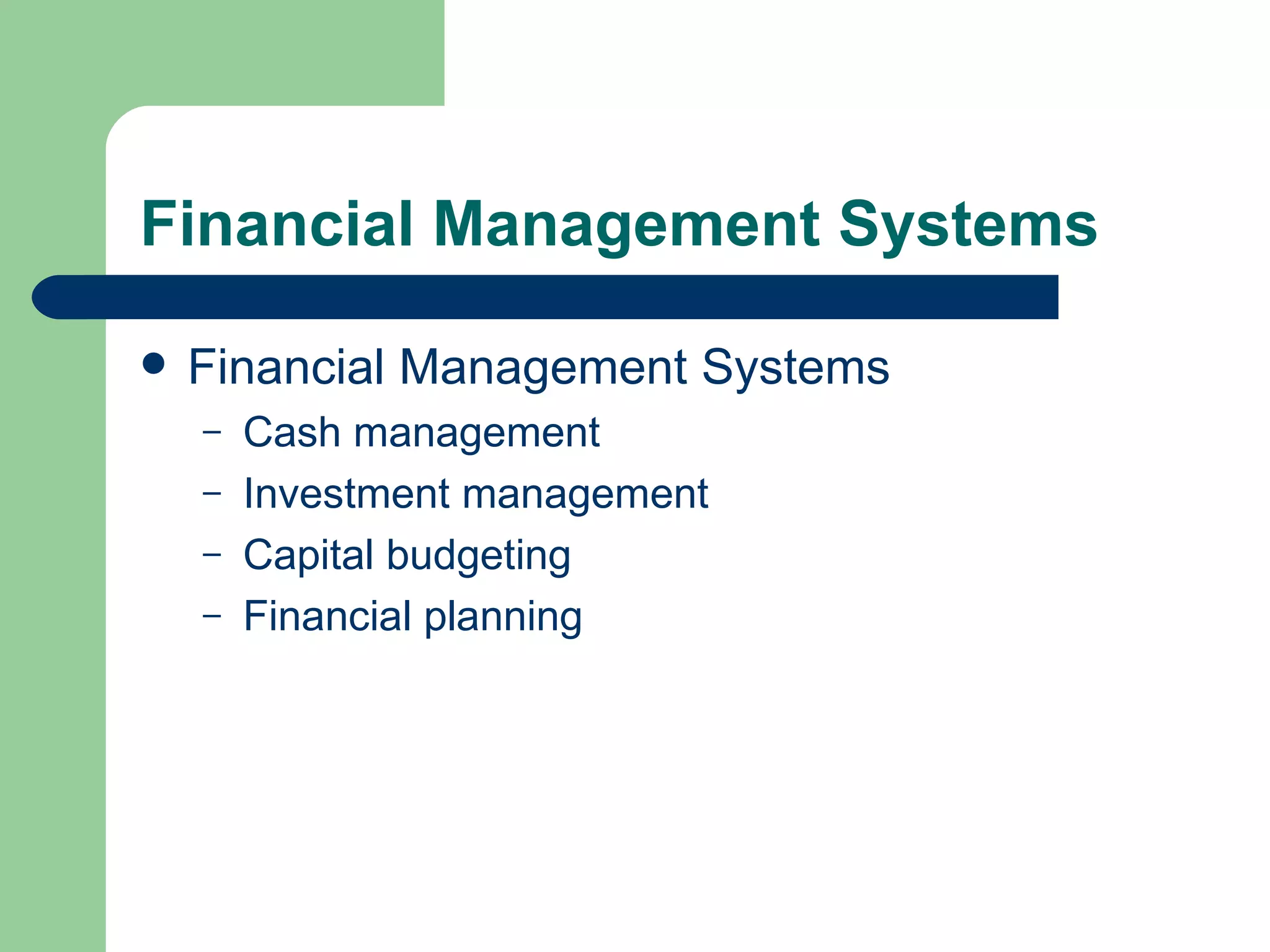
Financial Management Systems Financial Management Systems Cash management Investment management Capital budgeting Financial planning
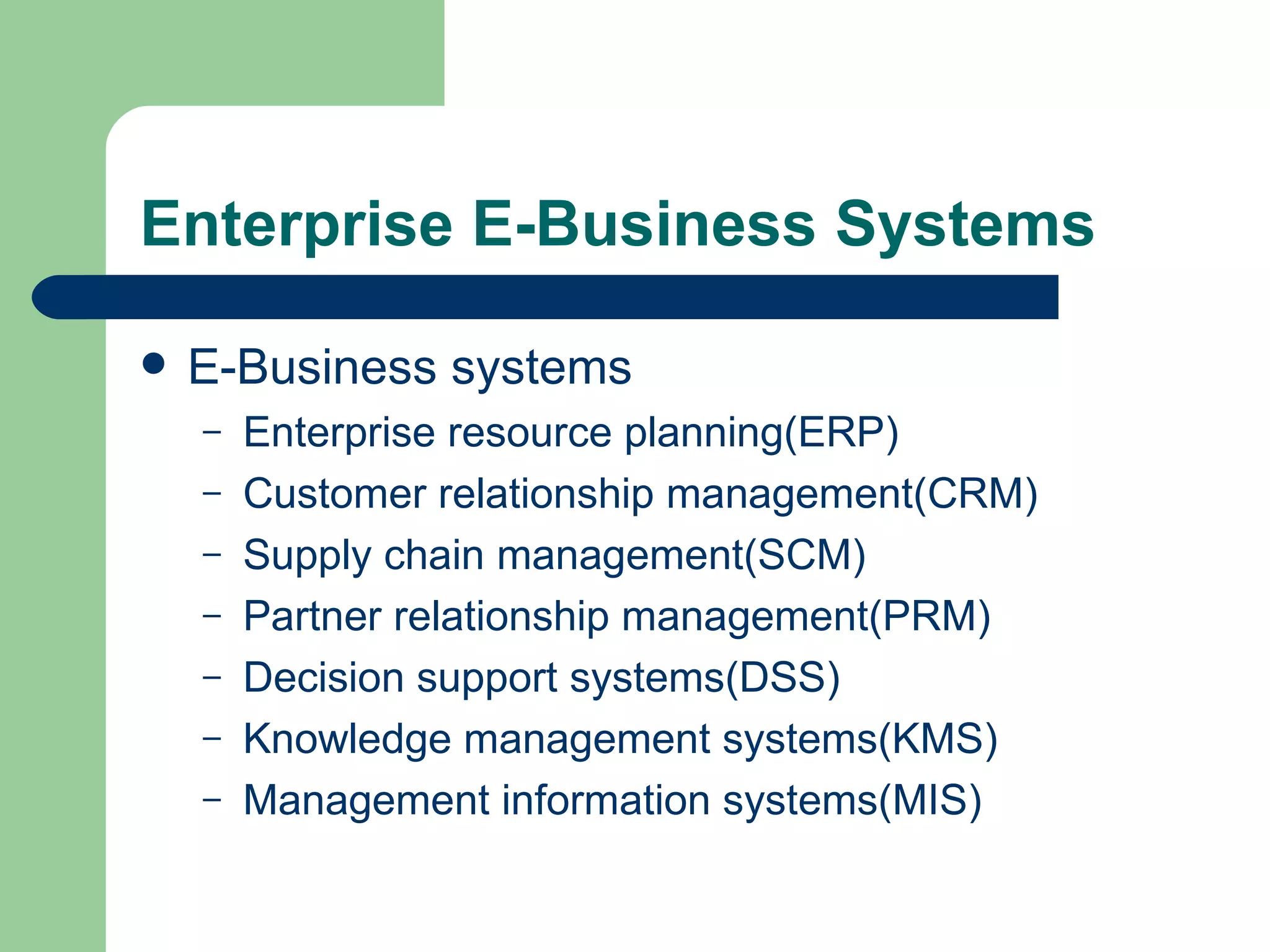
Enterprise E-Business Systems E-Business systems Enterprise resource planning(ERP) Customer relationship management(CRM) Supply chain management(SCM) Partner relationship management(PRM) Decision support systems(DSS) Knowledge management systems(KMS) Management information systems(MIS)
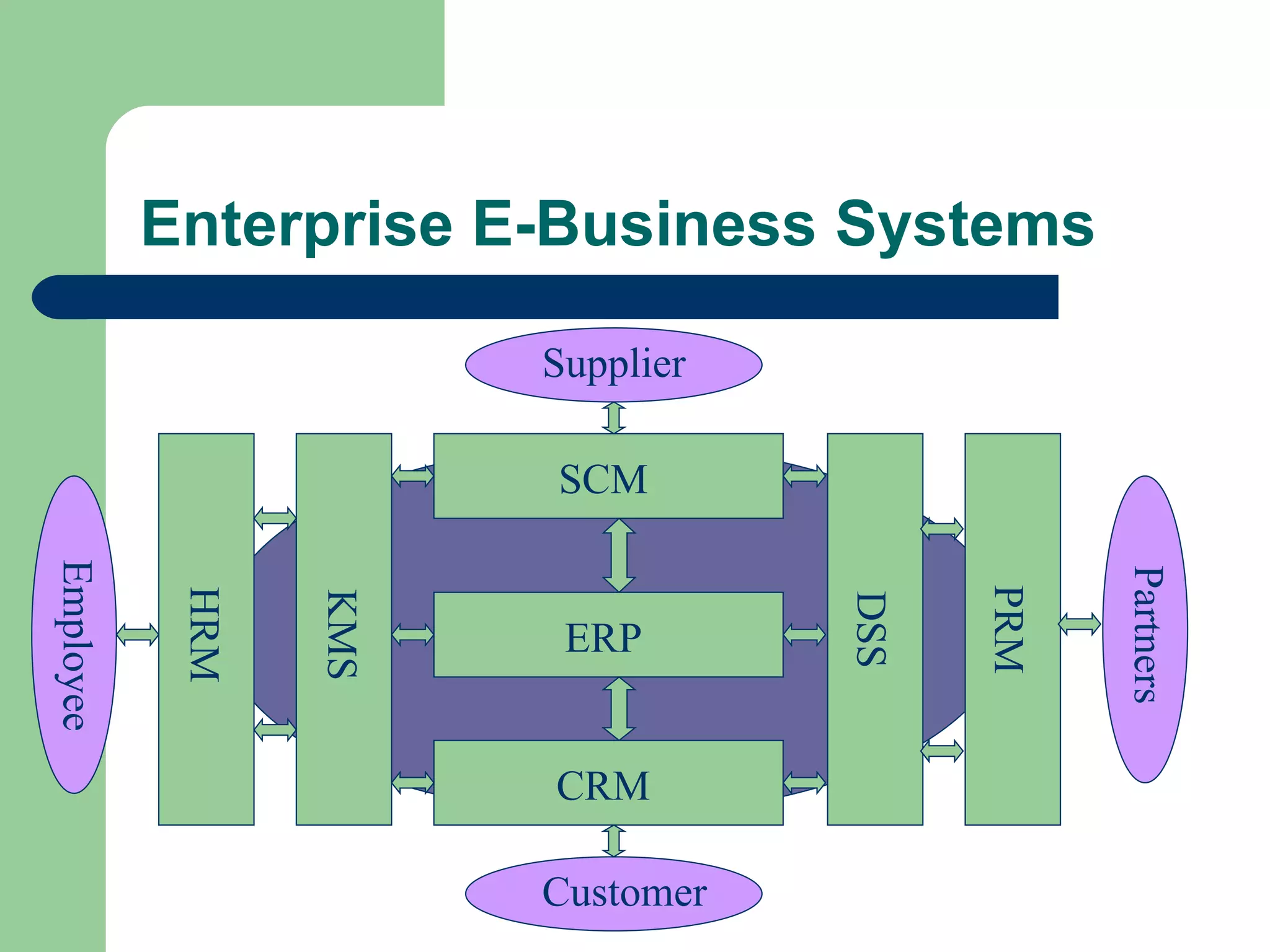
Enterprise E-Business Systems SCM CRM ERP Supplier Customer Employee Partners DSS PRM KMS HRM
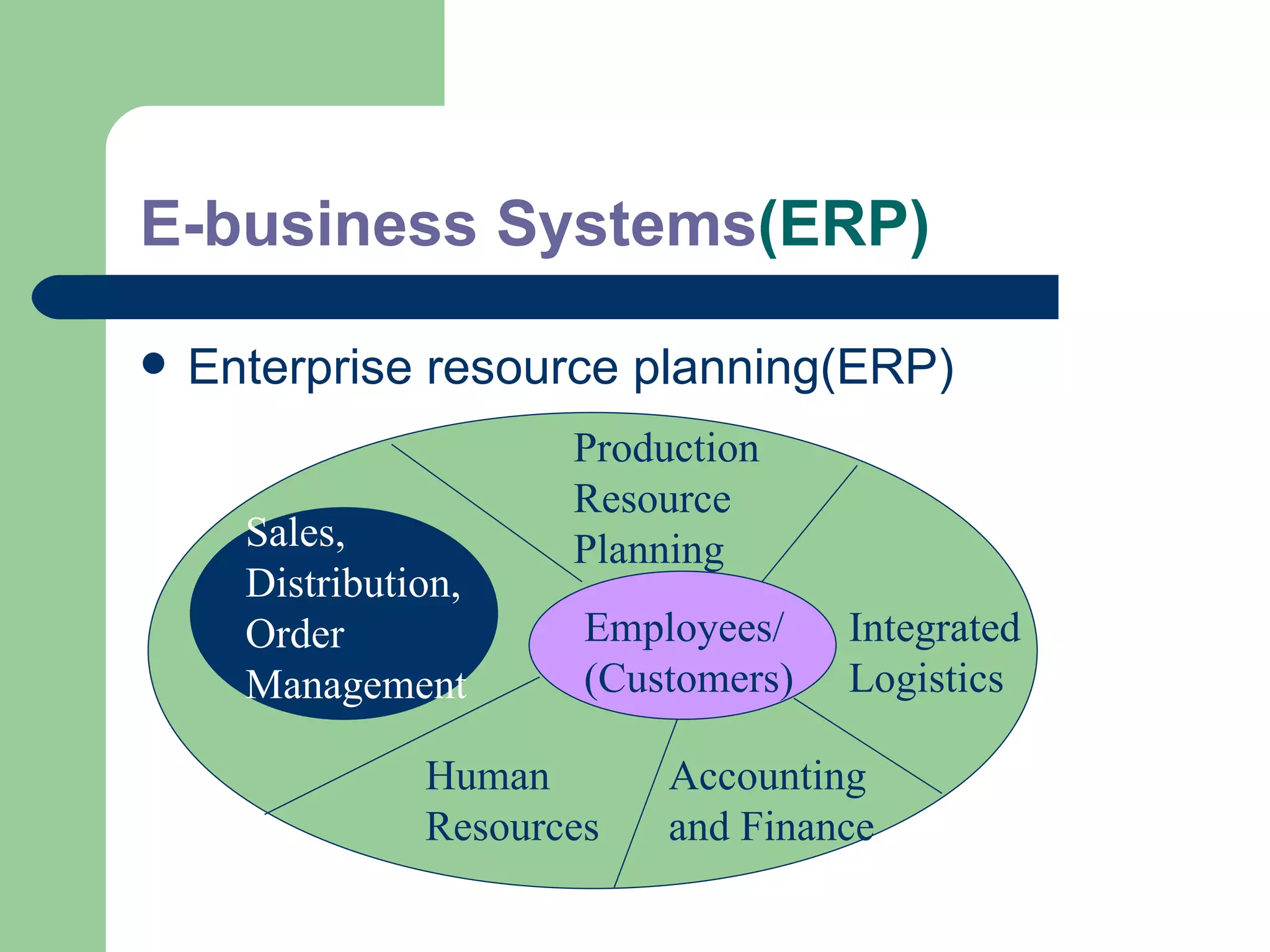
E-business Systems (ERP) Enterprise resource planning(ERP) Employees/ (Customers) Sales, Distribution, Order  Management Production Resource Planning Integrated Logistics Accounting and Finance Human Resources
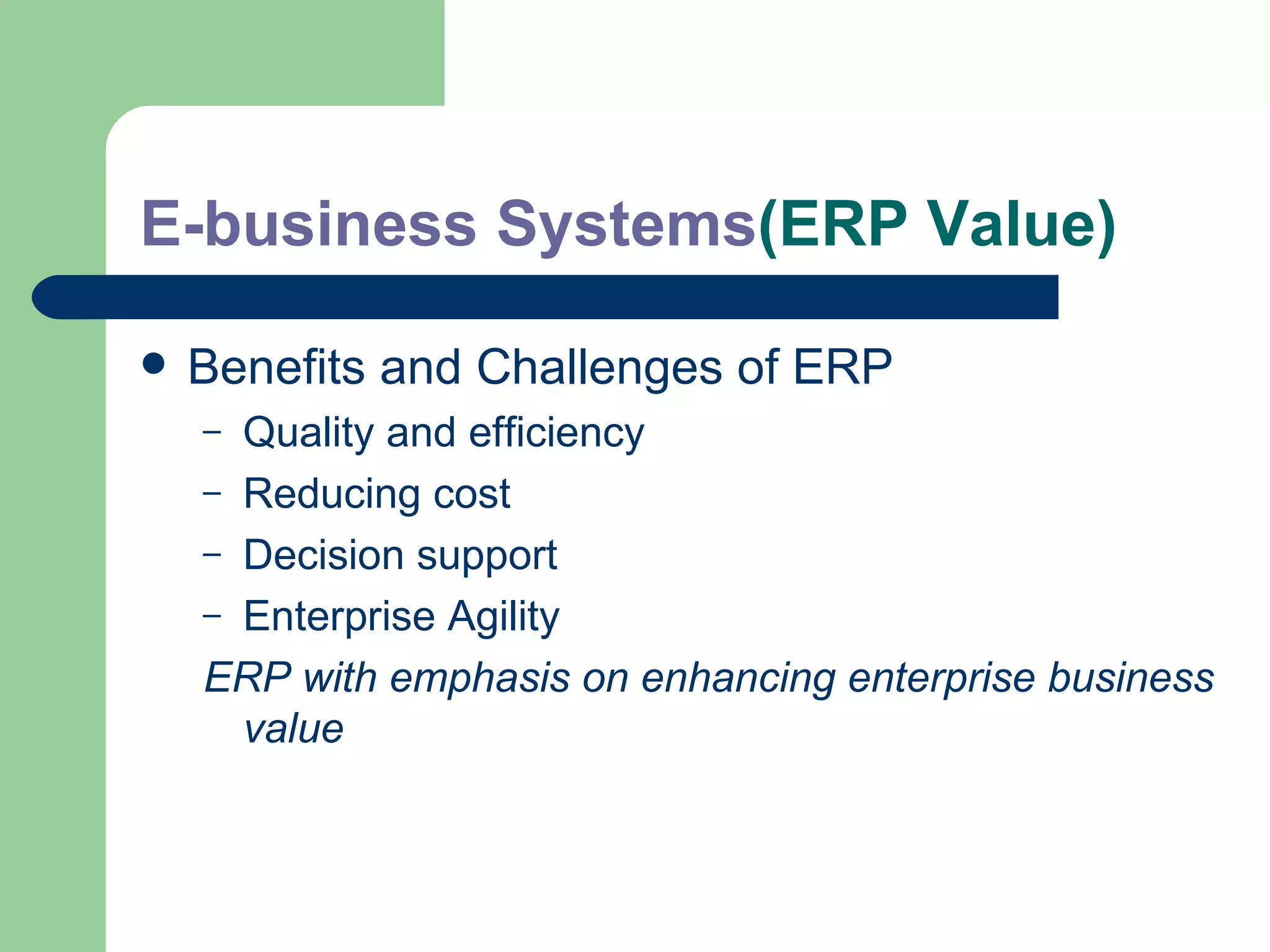
E-business Systems (ERP Value) Benefits and Challenges of ERP Quality and efficiency Reducing cost Decision support Enterprise Agility ERP with emphasis on enhancing enterprise business value
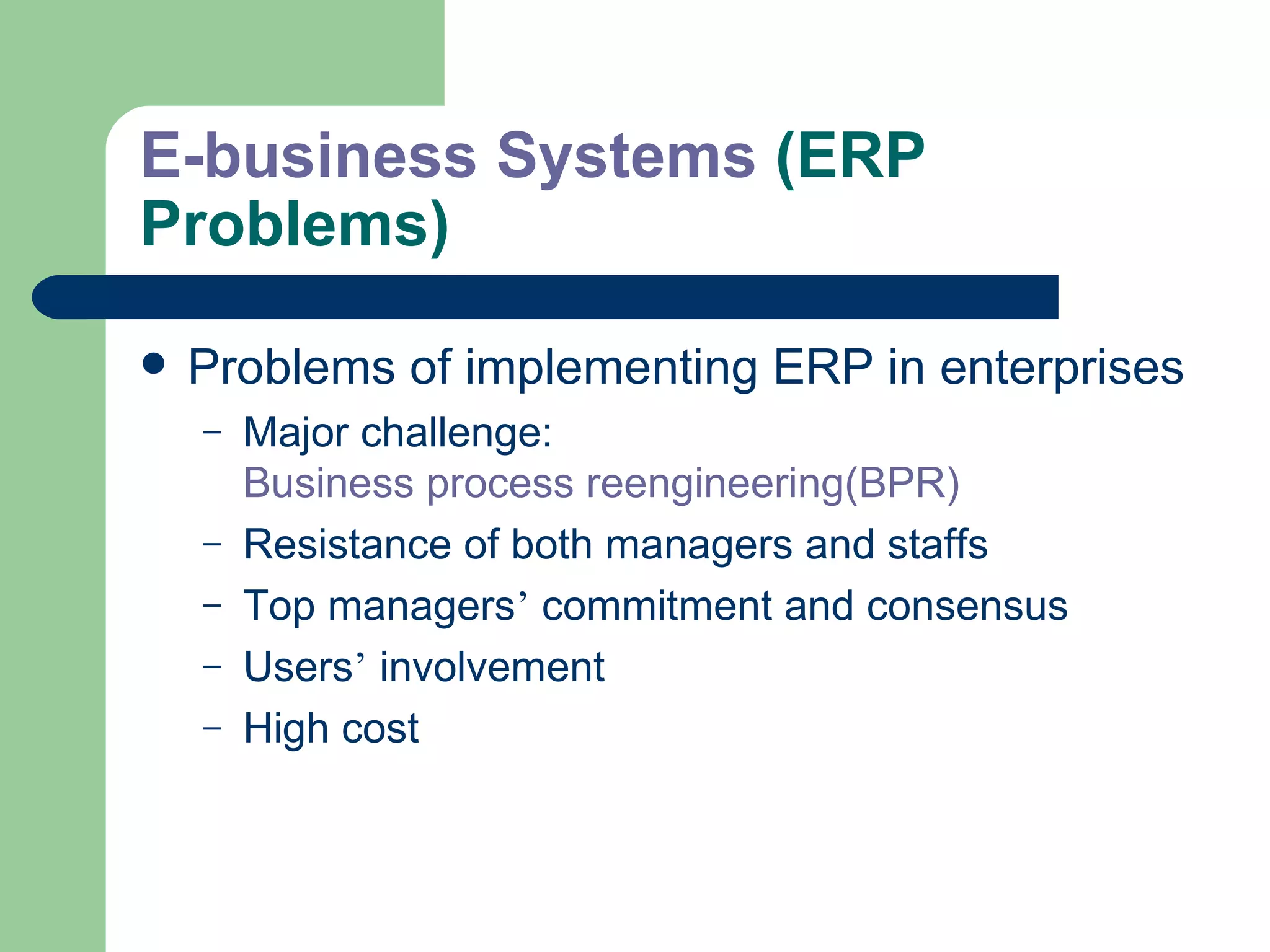
E-business Systems  (ERP Problems) Problems of implementing ERP in enterprises Major challenge:  Business process reengineering(BPR) Resistance of both managers and staffs  Top managers ’  commitment and consensus Users ’  involvement High cost
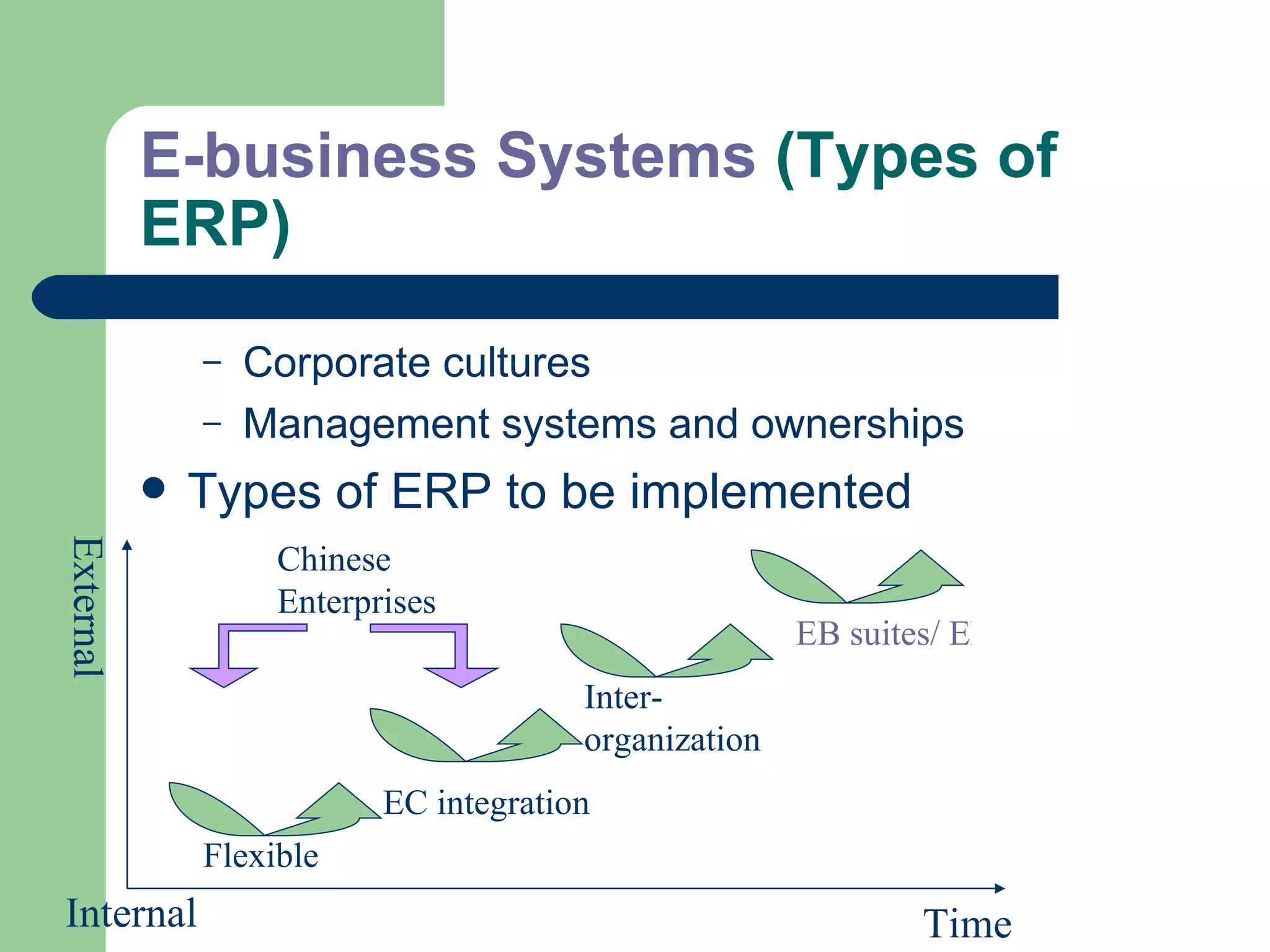
E-business Systems  (Types of ERP) Corporate cultures Management systems and ownerships Types of ERP to be implemented Flexible EC integration Inter-organization EB suites/ ERPII Time Internal External Chinese Enterprises
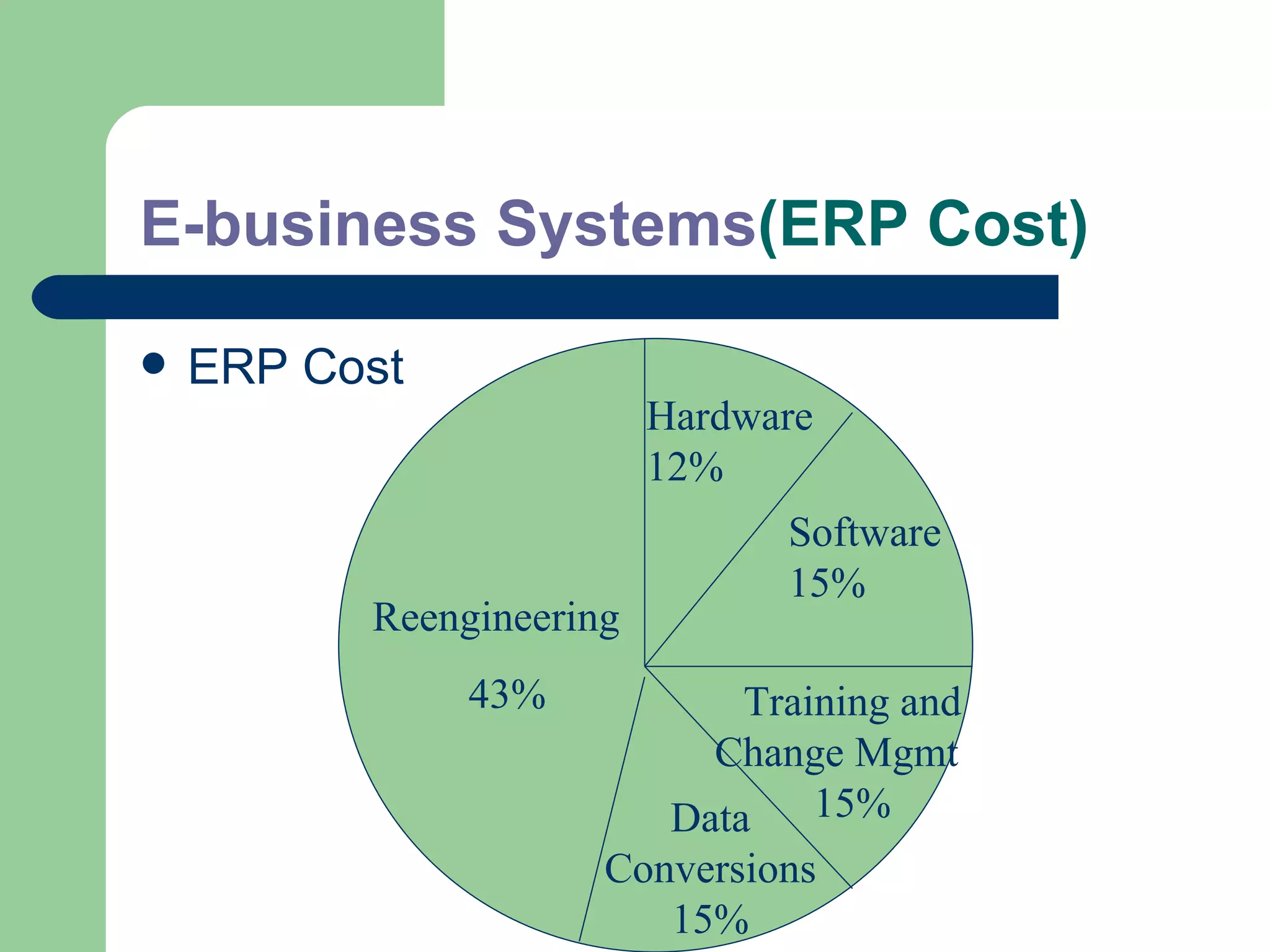
E-business Systems (ERP Cost) ERP Cost Reengineering 43% Hardware 12% Software 15% Training and Change Mgmt  15% Data Conversions 15%
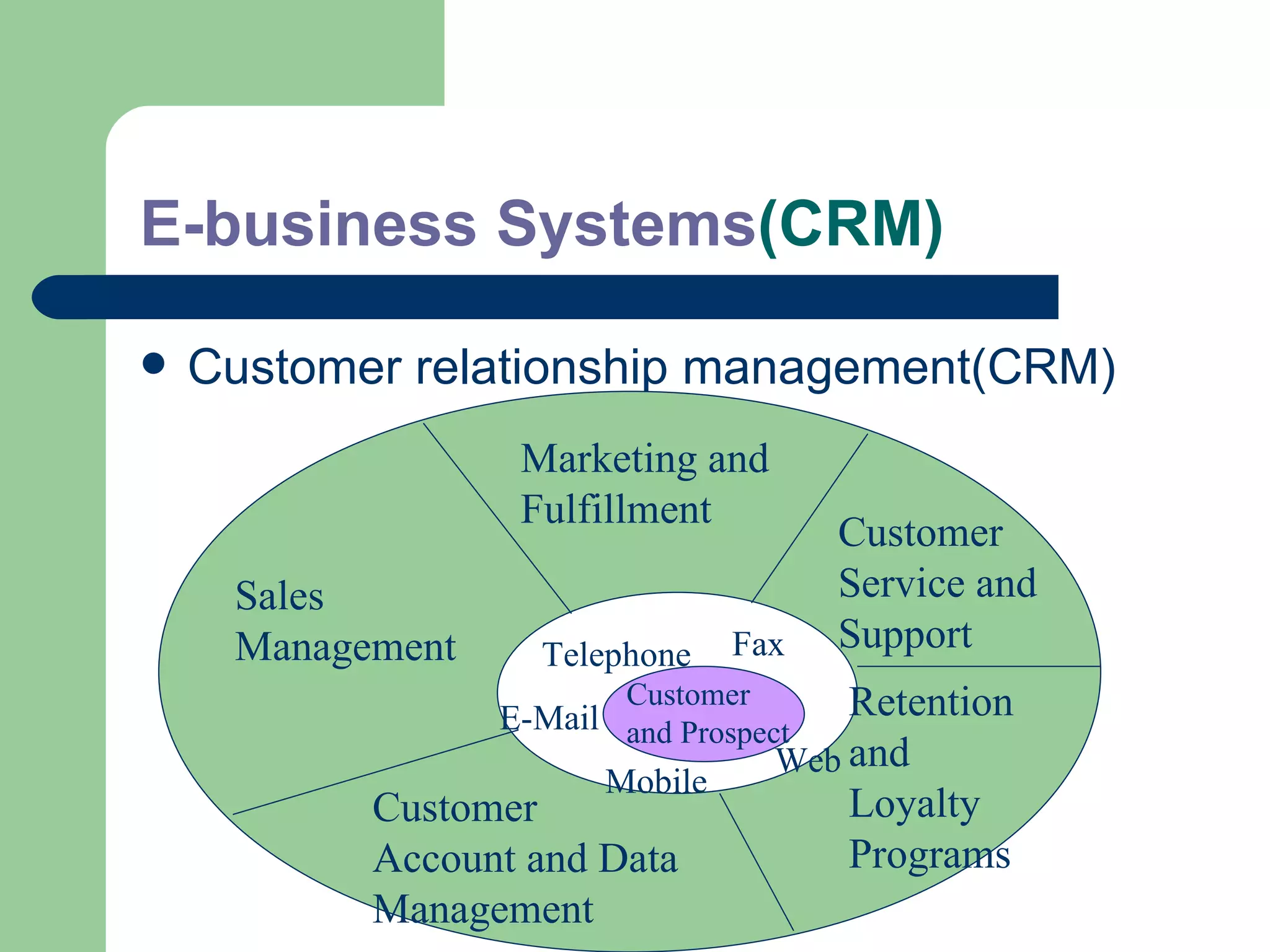
E-business Systems (CRM) Customer relationship management(CRM) Marketing and Fulfillment Sales Management Customer  Account and Data Management Retention and Loyalty Programs Customer Service and Support Customer and Prospect Fax Telephone E-Mail Web Mobile
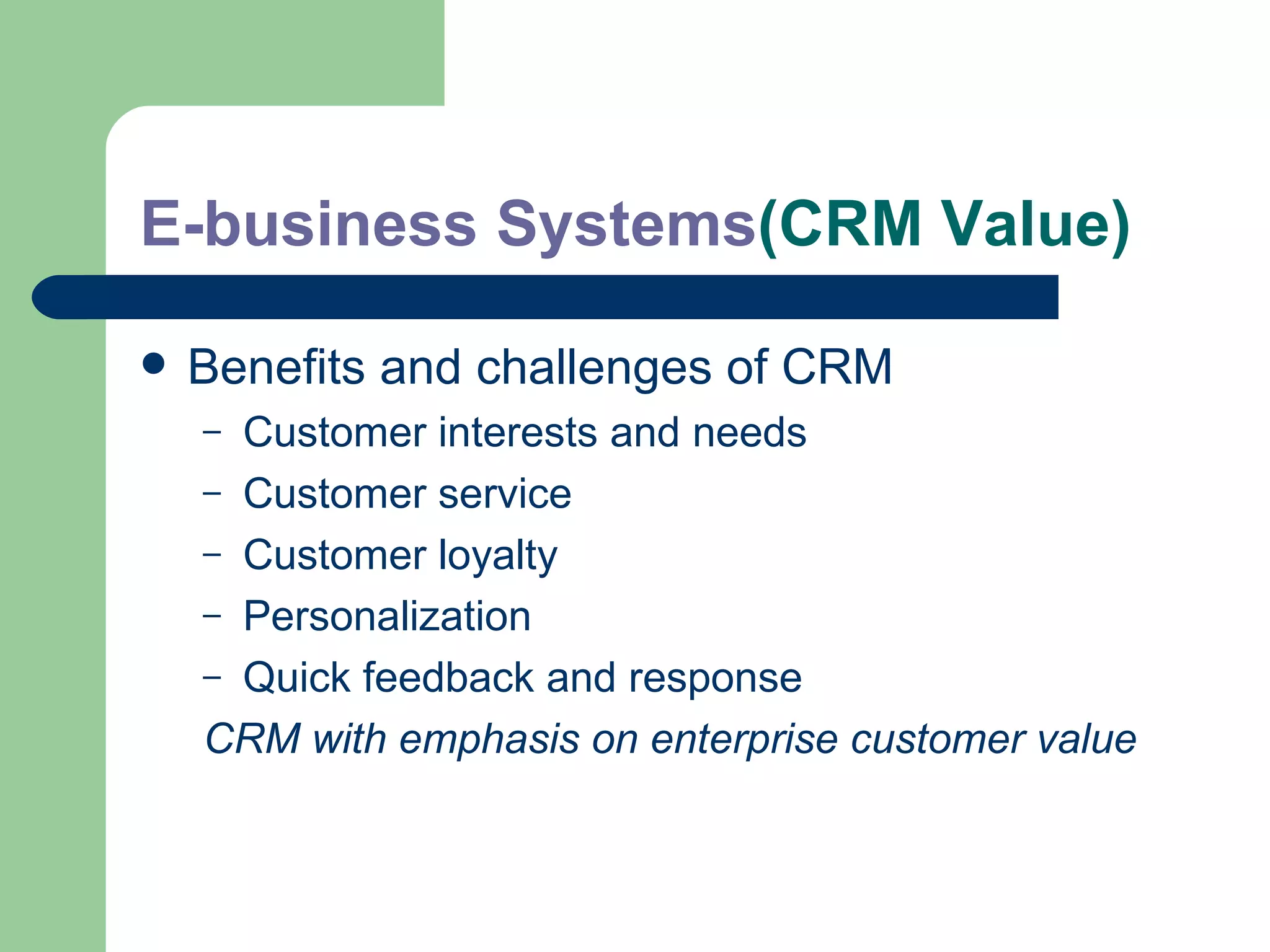
E-business Systems (CRM Value) Benefits and challenges of CRM Customer interests and needs Customer service Customer loyalty Personalization Quick feedback and response CRM with emphasis on enterprise customer value
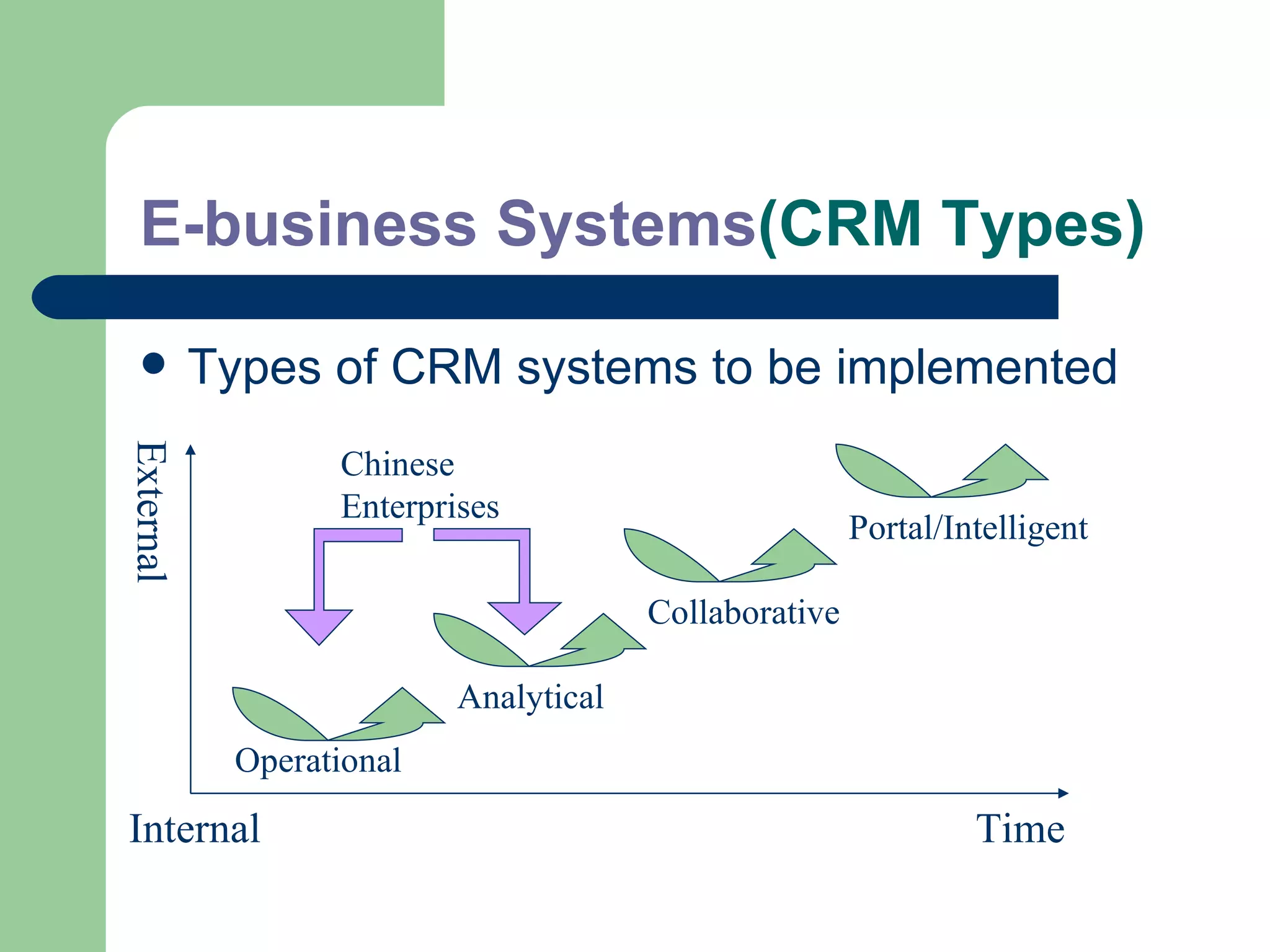
E-business Systems (CRM Types) Types of CRM systems to be implemented Operational Analytical Collaborative Portal/Intelligent  Internal External Chinese Enterprises Time
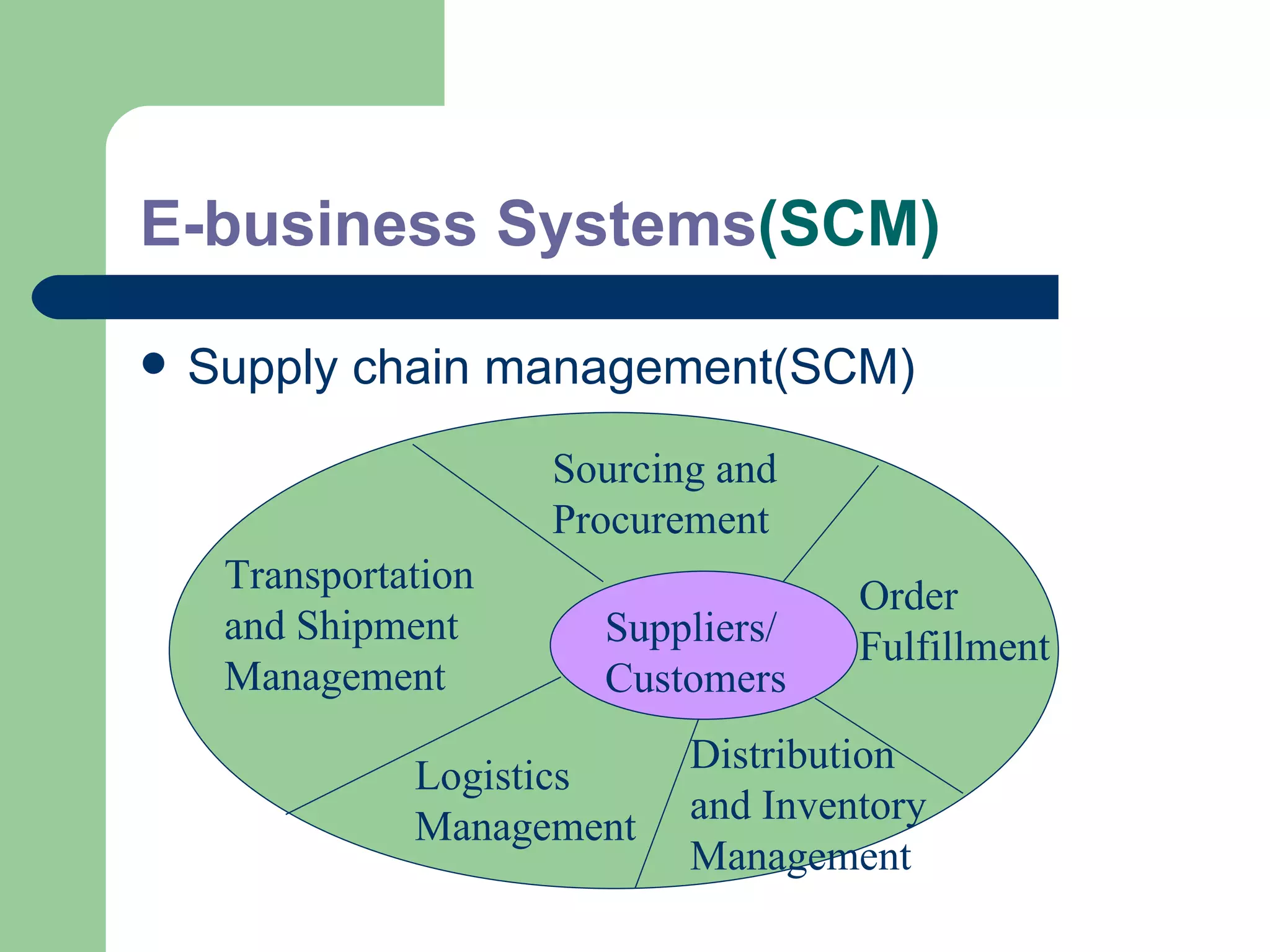
E-business Systems (SCM) Supply chain management(SCM) Suppliers/ Customers Transportation and Shipment Management Sourcing and Procurement Order Fulfillment Distribution and Inventory Management Logistics Management
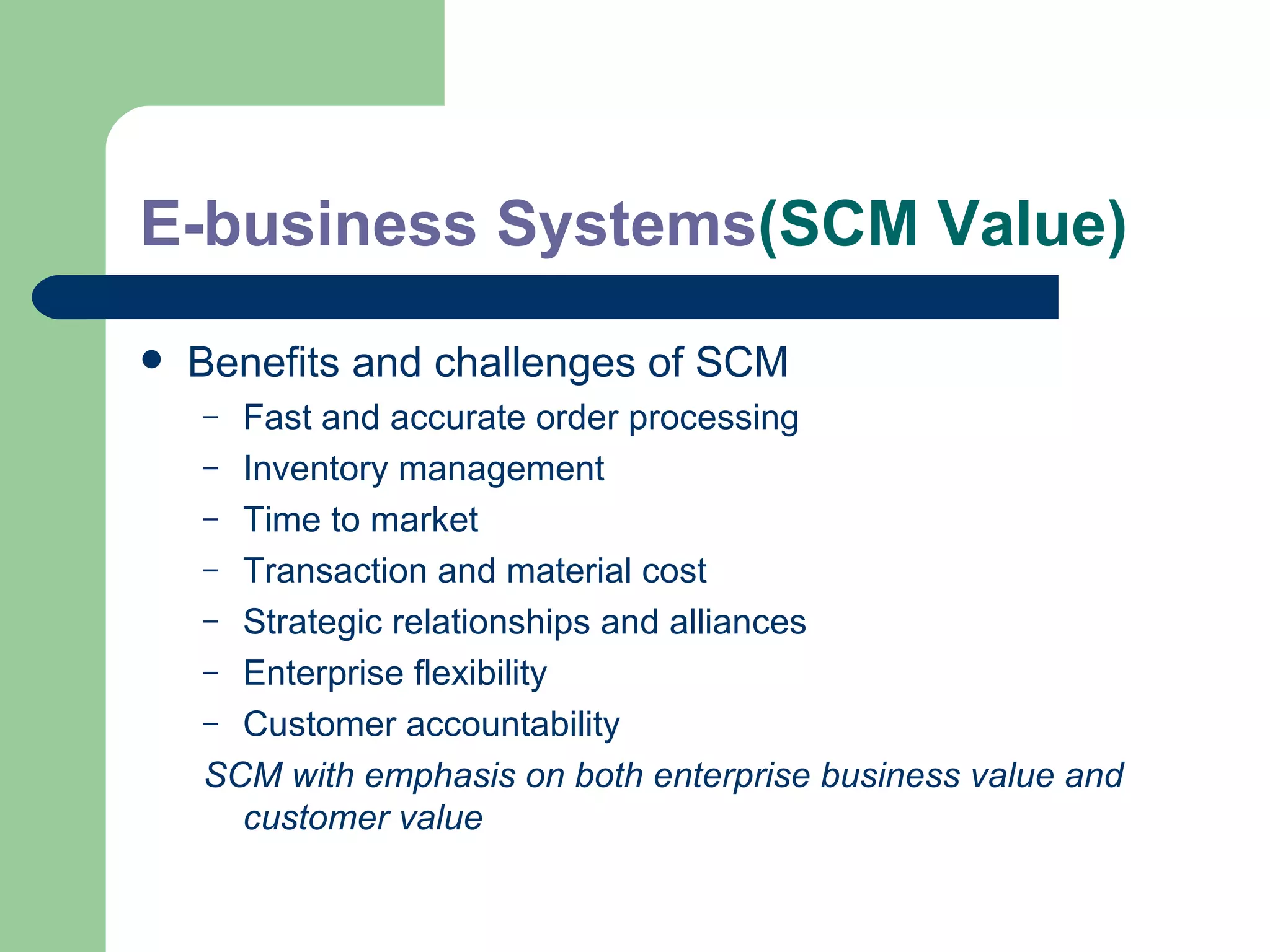
E-business Systems (SCM Value) Benefits and challenges of SCM Fast and accurate order processing Inventory management Time to market Transaction and material cost Strategic relationships and alliances Enterprise flexibility Customer accountability SCM with emphasis on both enterprise business value and customer value
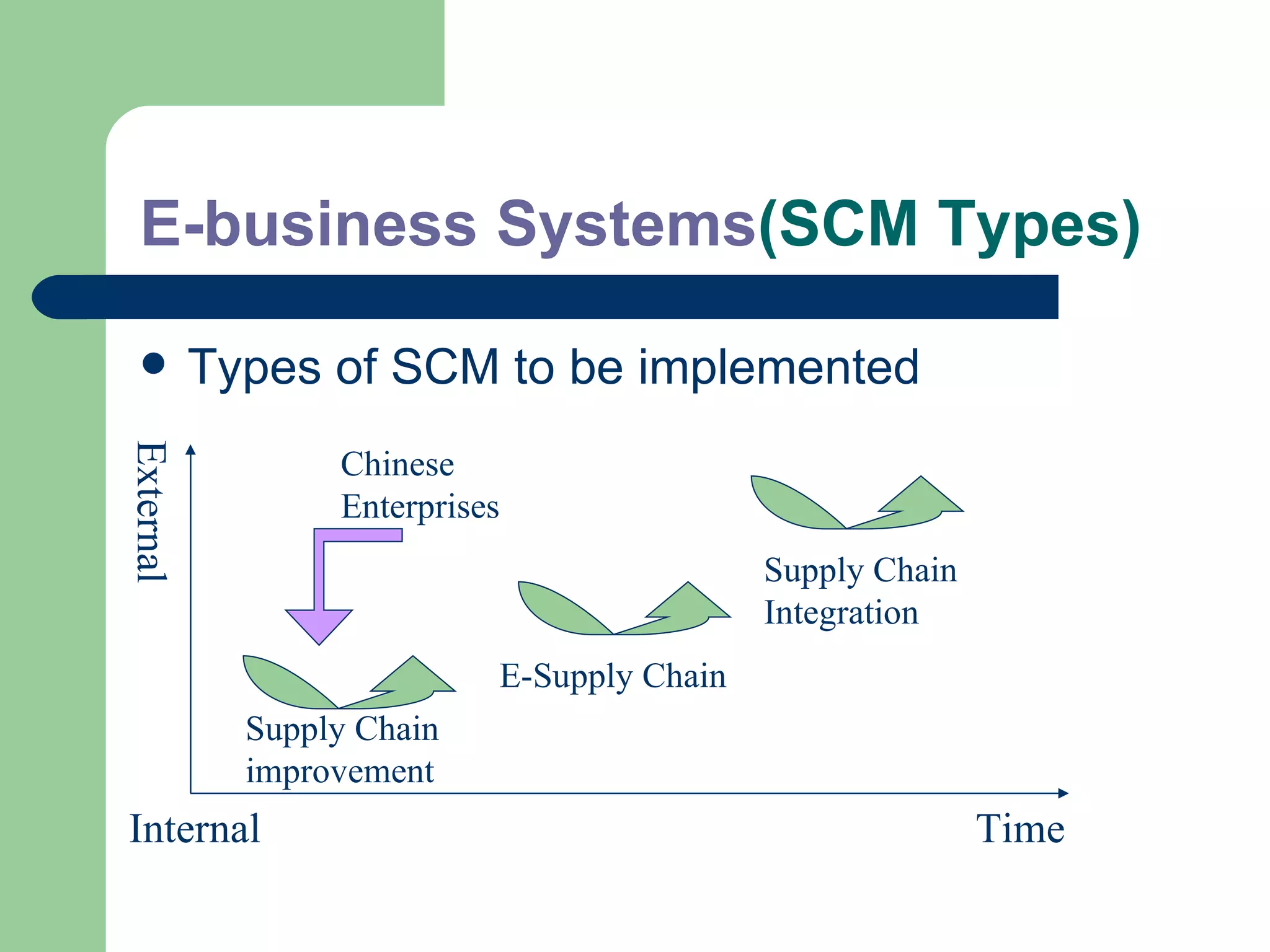
E-business Systems (SCM Types) Types of SCM to be implemented Supply Chain improvement E-Supply Chain Supply Chain Integration Internal External Chinese Enterprises Time
Knowledge Management Knowledge management  Activities Knowledge creating/acquiring Knowledge presenting, storing and renewal Knowledge sharing and services Knowledge applying
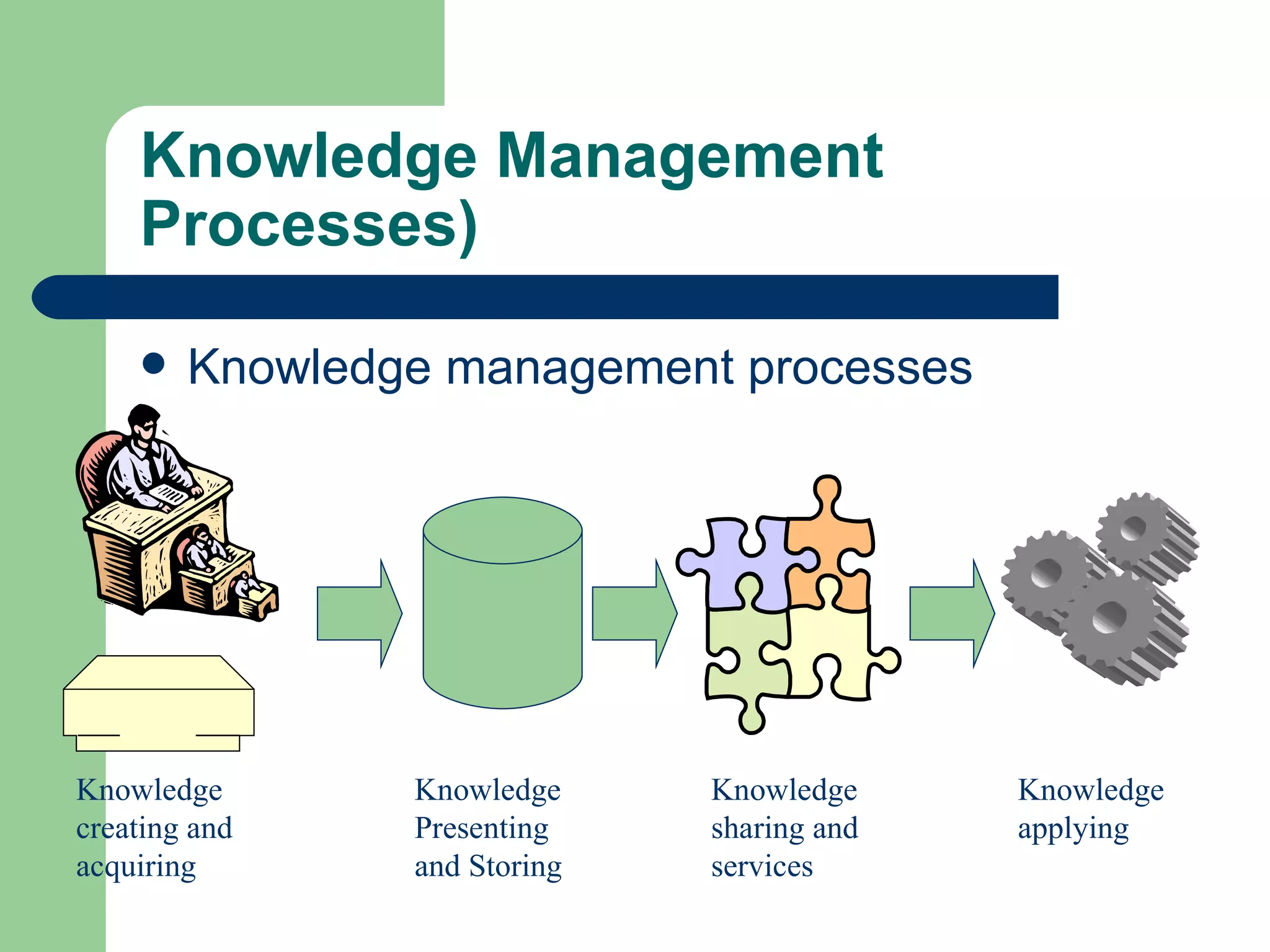
Knowledge Management Processes) Knowledge management processes Knowledge creating and acquiring Knowledge Presenting and Storing Knowledge sharing and services Knowledge applying
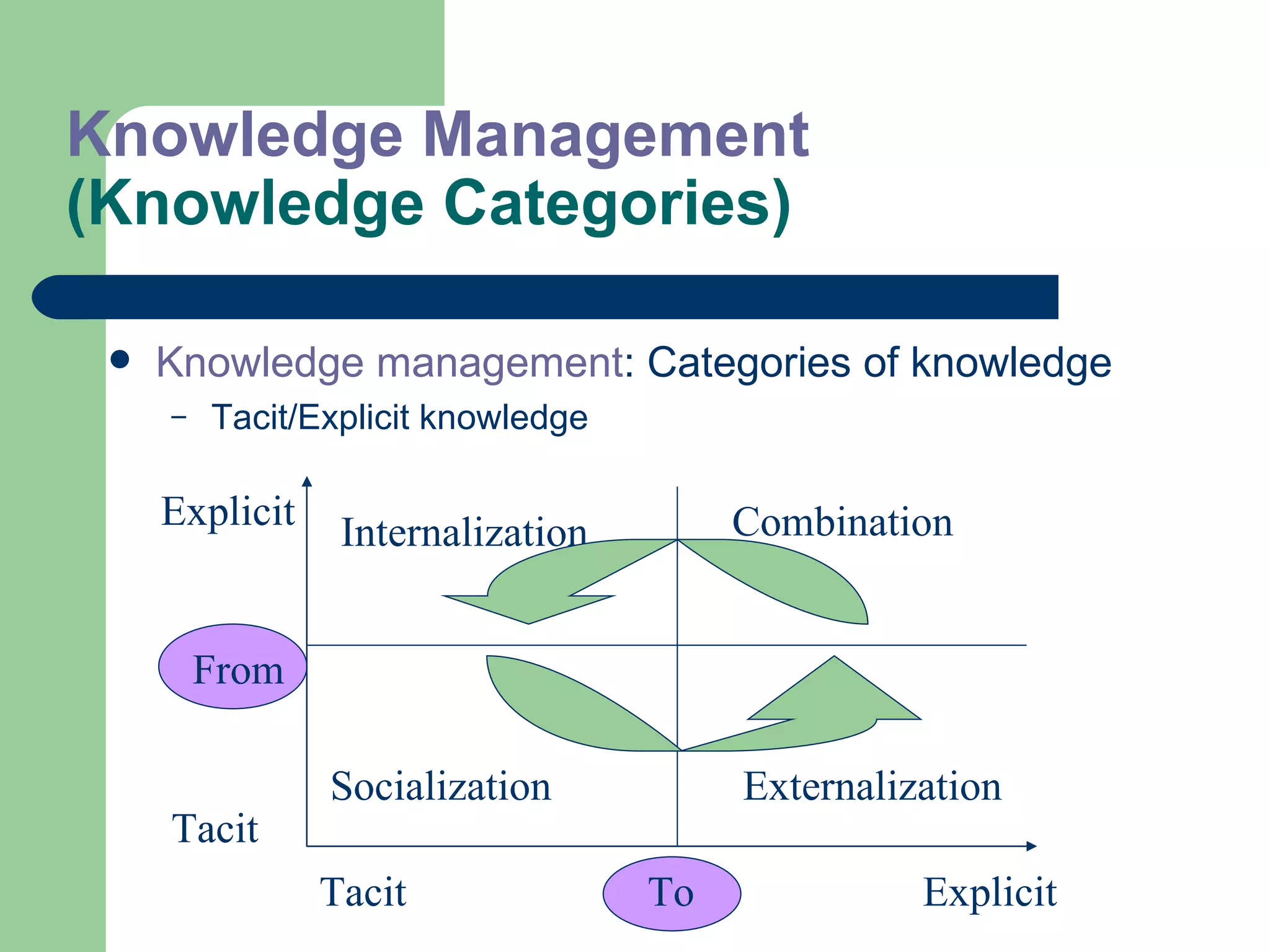
Knowledge Management  (Knowledge Categories) Knowledge management : Categories of knowledge Tacit/Explicit knowledge Explicit Tacit Internalization Socialization Externalization Combination Explicit From To Tacit
Knowledge Management  (Intellectual Capitals) Sources of knowledge: Intellectual capital Human capital Structural capital Customer/partner capital
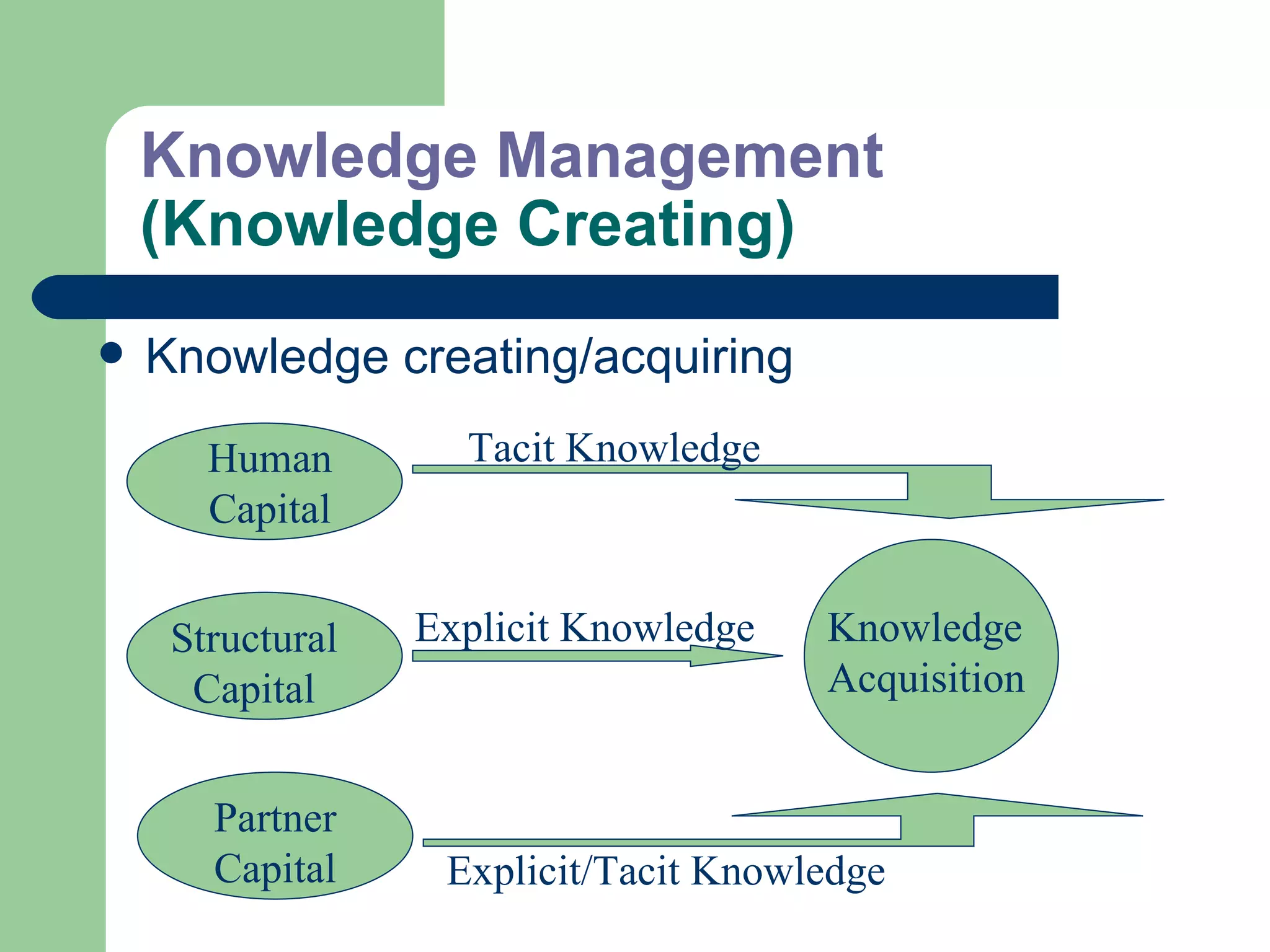
Knowledge Management  (Knowledge Creating) Knowledge creating/acquiring Human Capital Structural Capital Partner Capital Knowledge Acquisition Tacit Knowledge Explicit/Tacit Knowledge Explicit Knowledge
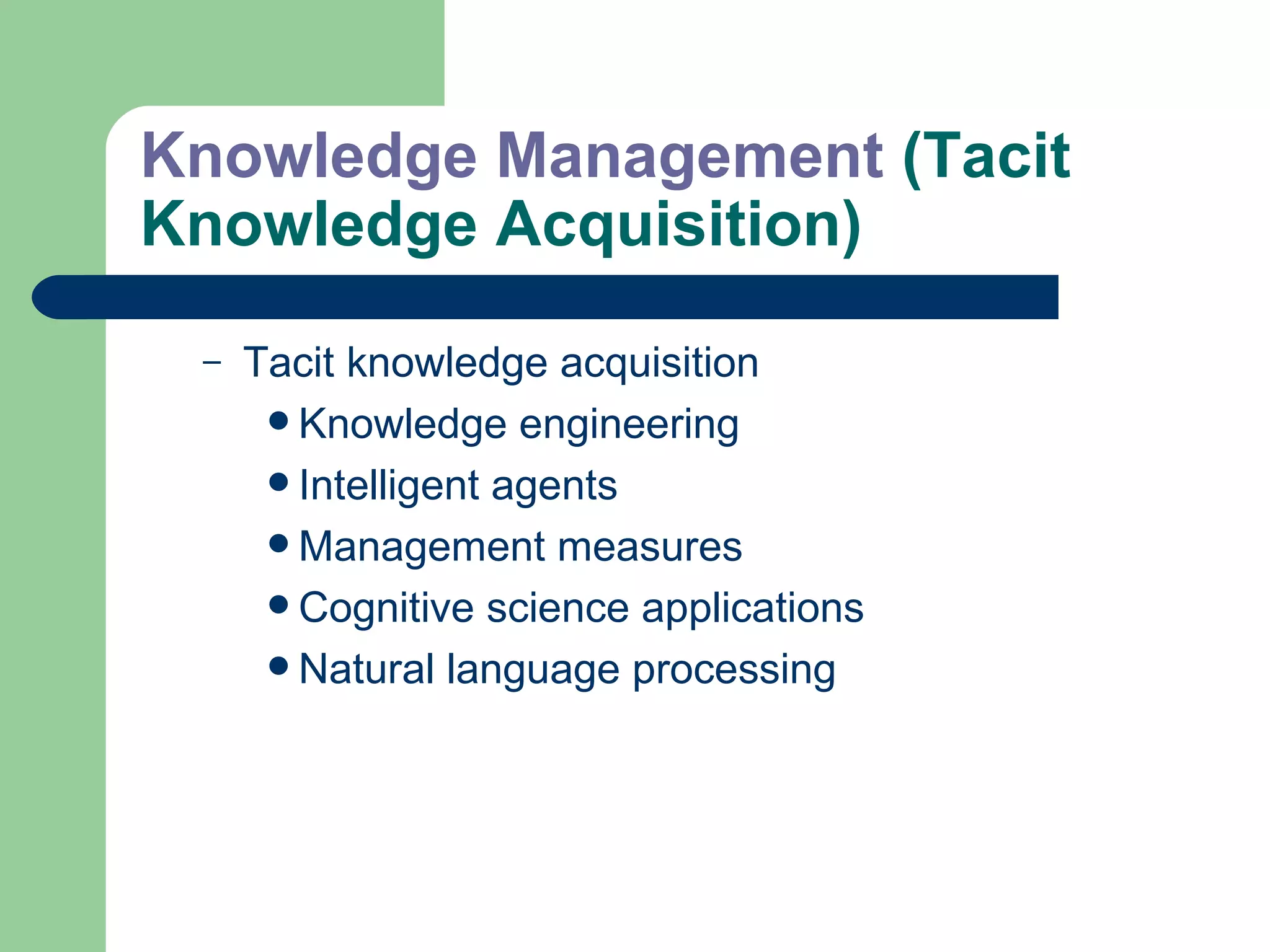
Knowledge Management  (Tacit Knowledge Acquisition) Tacit knowledge acquisition Knowledge engineering Intelligent agents Management measures Cognitive science applications Natural language processing
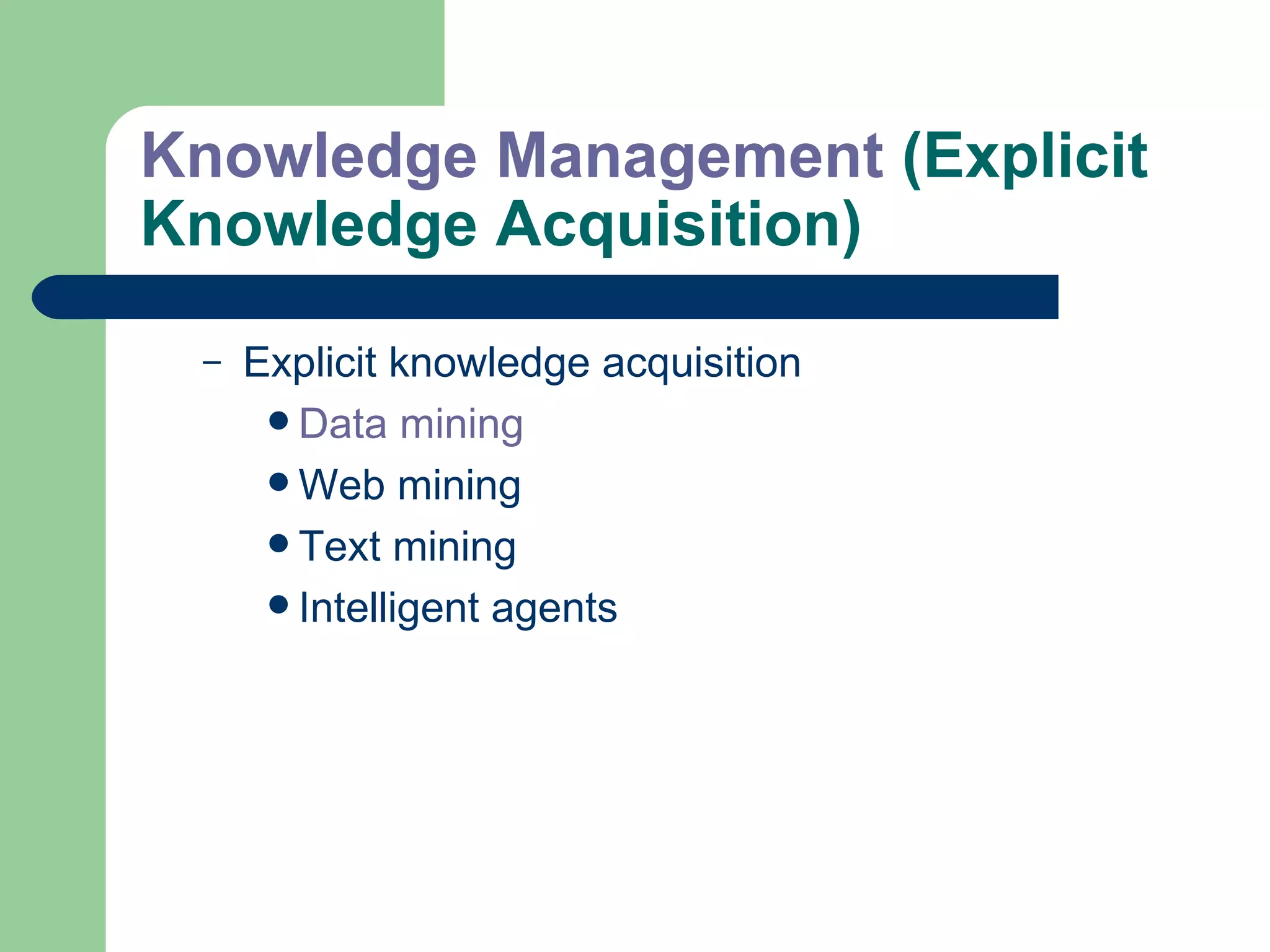
Knowledge Management  (Explicit Knowledge Acquisition) Explicit knowledge acquisition Data mining  Web mining Text mining Intelligent agents
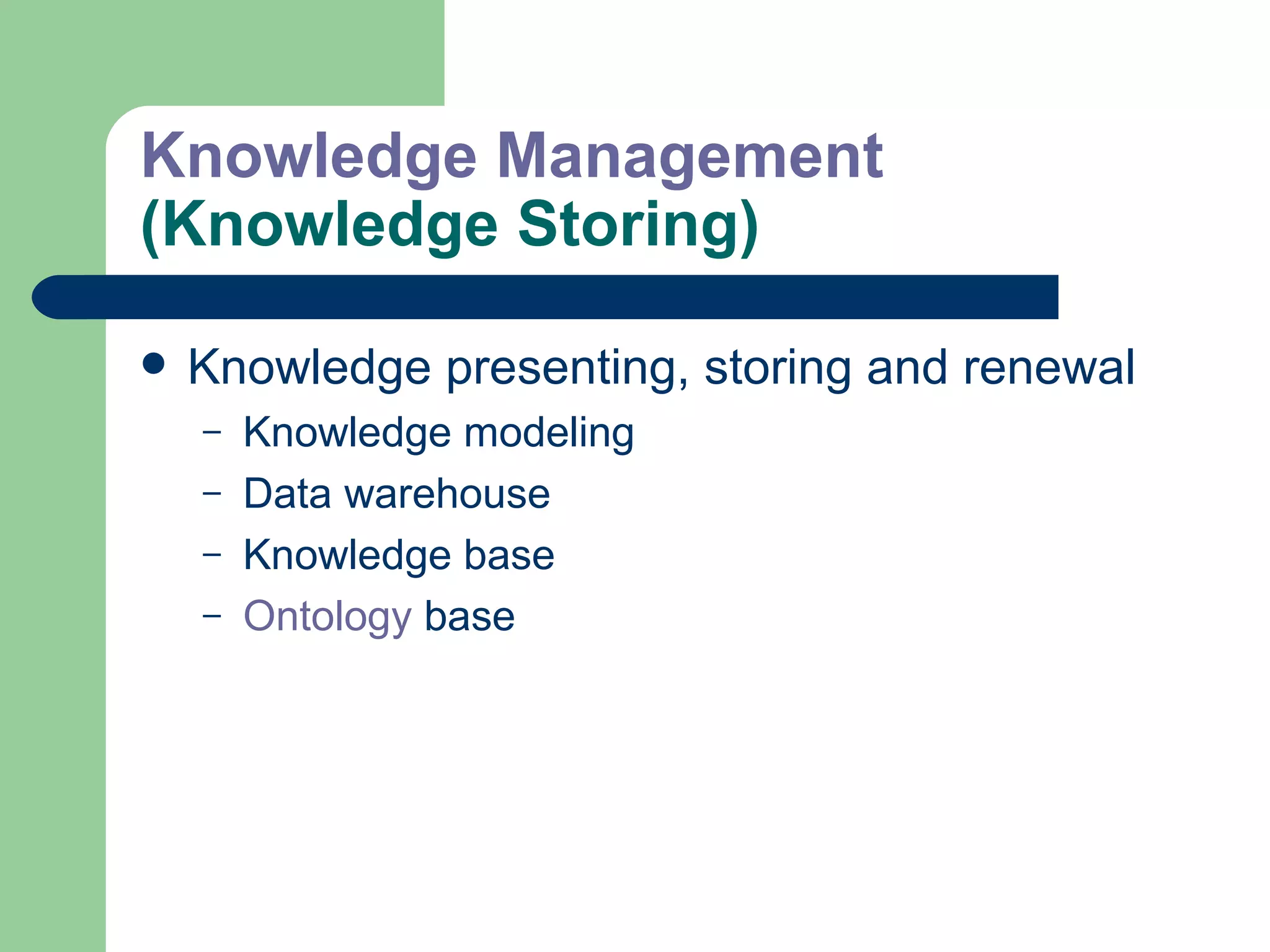
Knowledge Management  (Knowledge Storing) Knowledge presenting, storing and renewal Knowledge modeling Data warehouse Knowledge base Ontology  base
Knowledge Management  (Knowledge Sharing) Knowledge sharing and services Knowledge portal Application  Ontology Knowledge query and visualization
Knowledge Management  (Knowledge Applying) Knowledge applications Decision support Business intelligence Innovation New business opportunities Enterprise adaptability
E-Business E-business in Business E-business:Use of Internet technologies to internetwork and empower business processes,electronic commerce,and enterprise communication and collaboration within a company and with its customers,suppliers, and other business stakeholders.
E-Commerce Concept Describing the buying, selling, and exchanging products, services, and information via computer networks including mainly the Internet
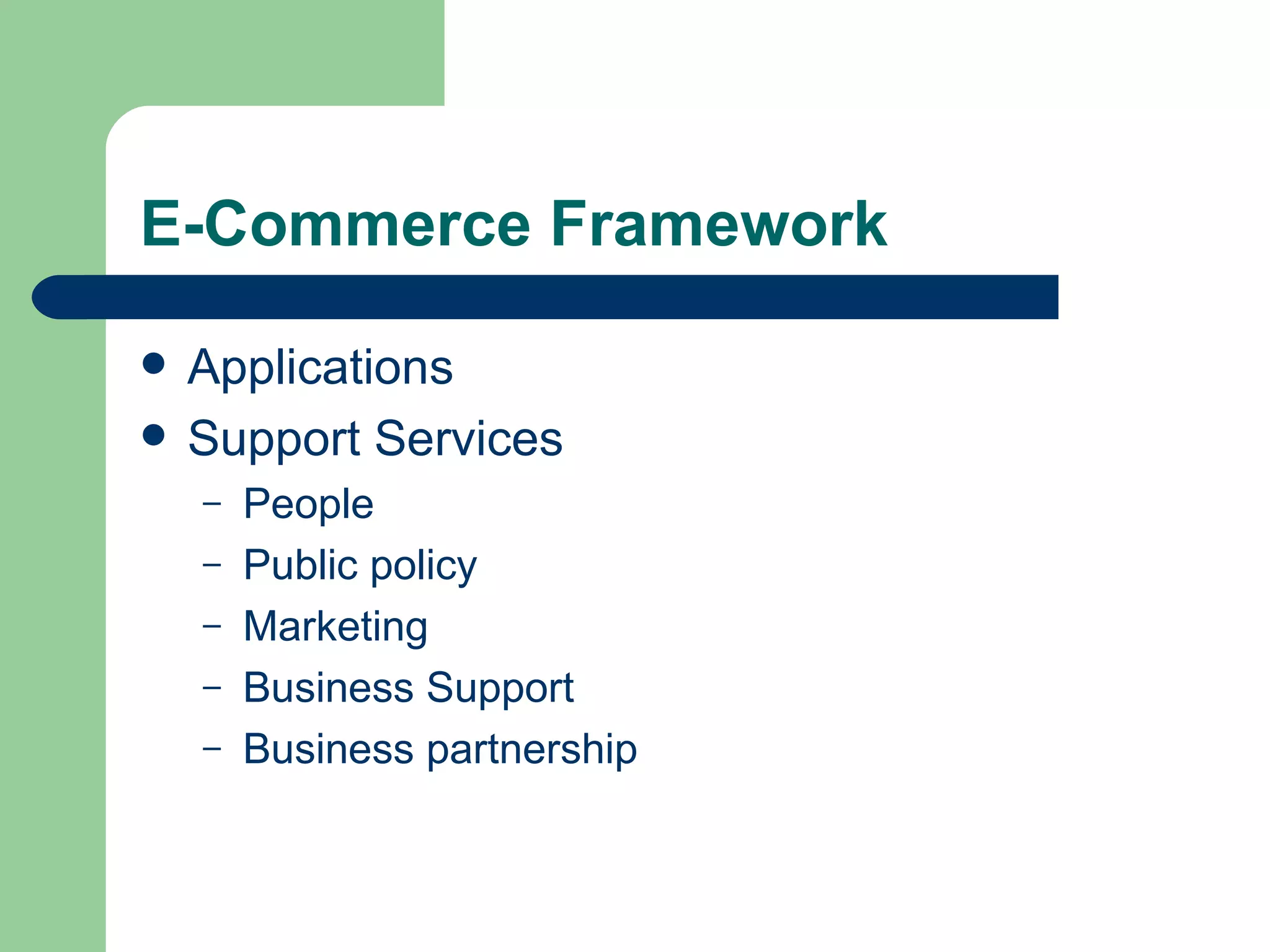
E-Commerce Framework Applications Support Services People Public policy Marketing Business Support Business partnership
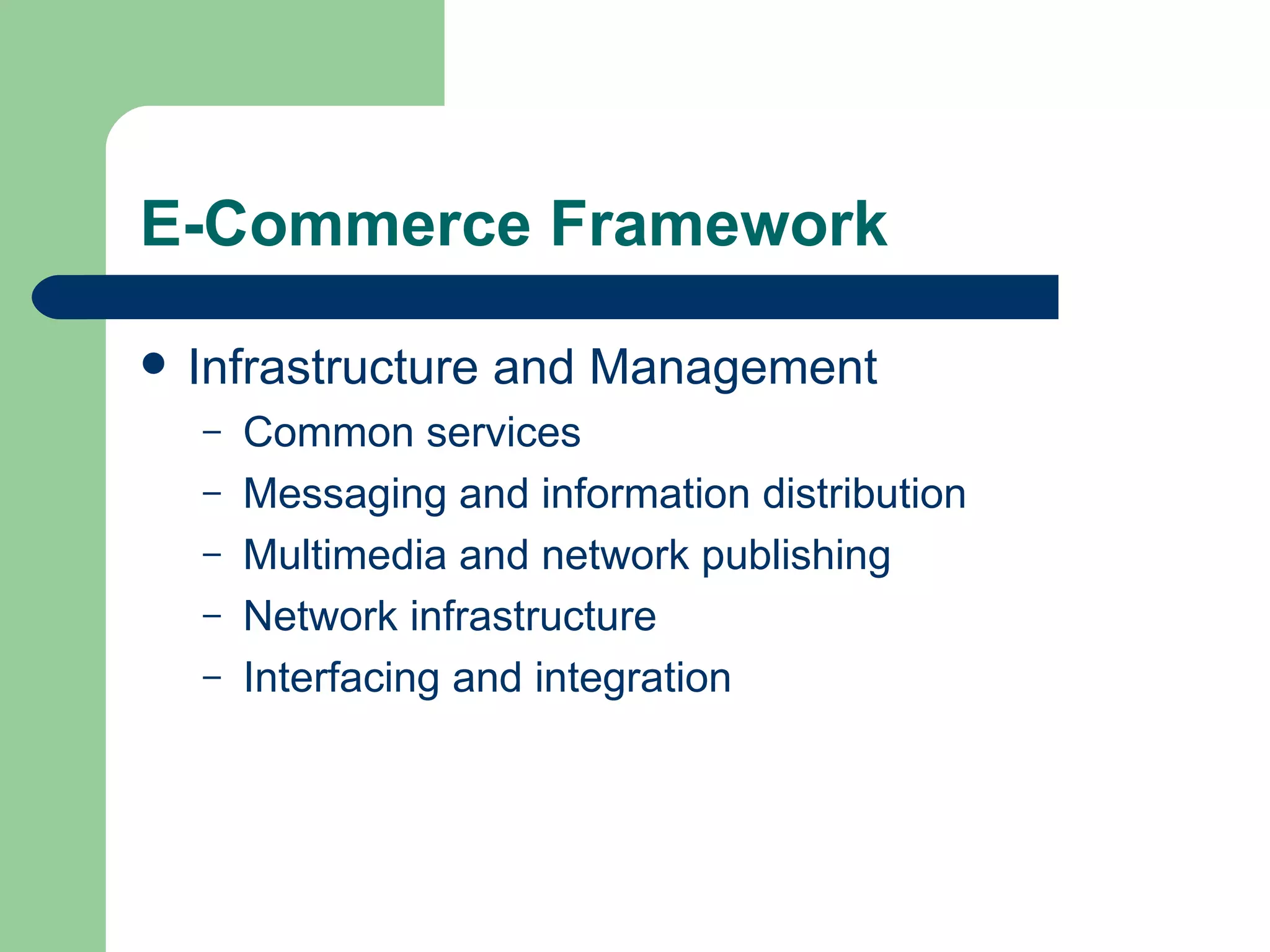
E-Commerce Framework Infrastructure and Management Common services Messaging and information distribution Multimedia and network publishing Network infrastructure Interfacing and integration
E-Commerce Framework Framework
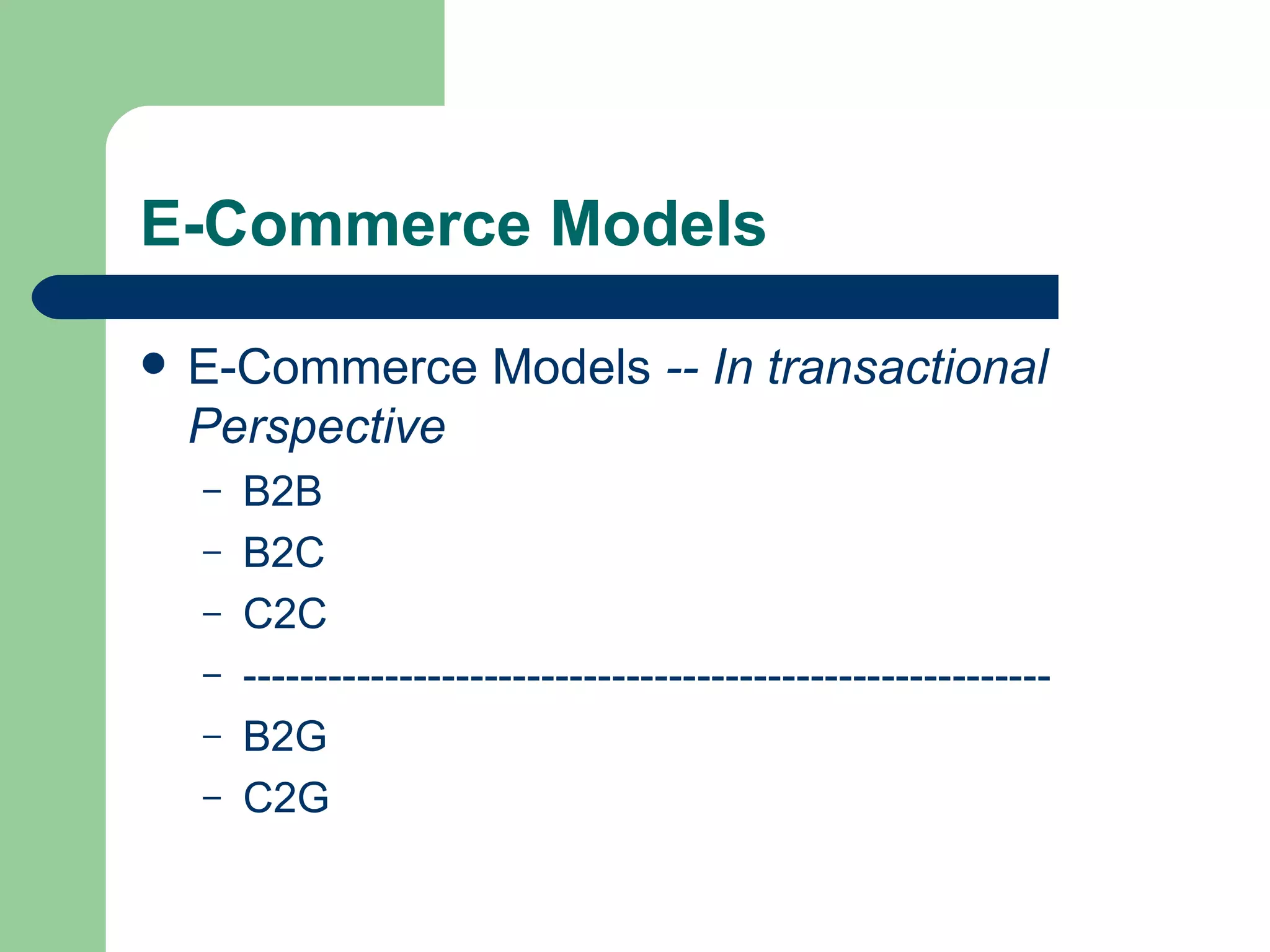
E-Commerce Models E-Commerce Models  -- In transactional Perspective B2B B2C C2C --------------------------------------------------------- B2G C2G
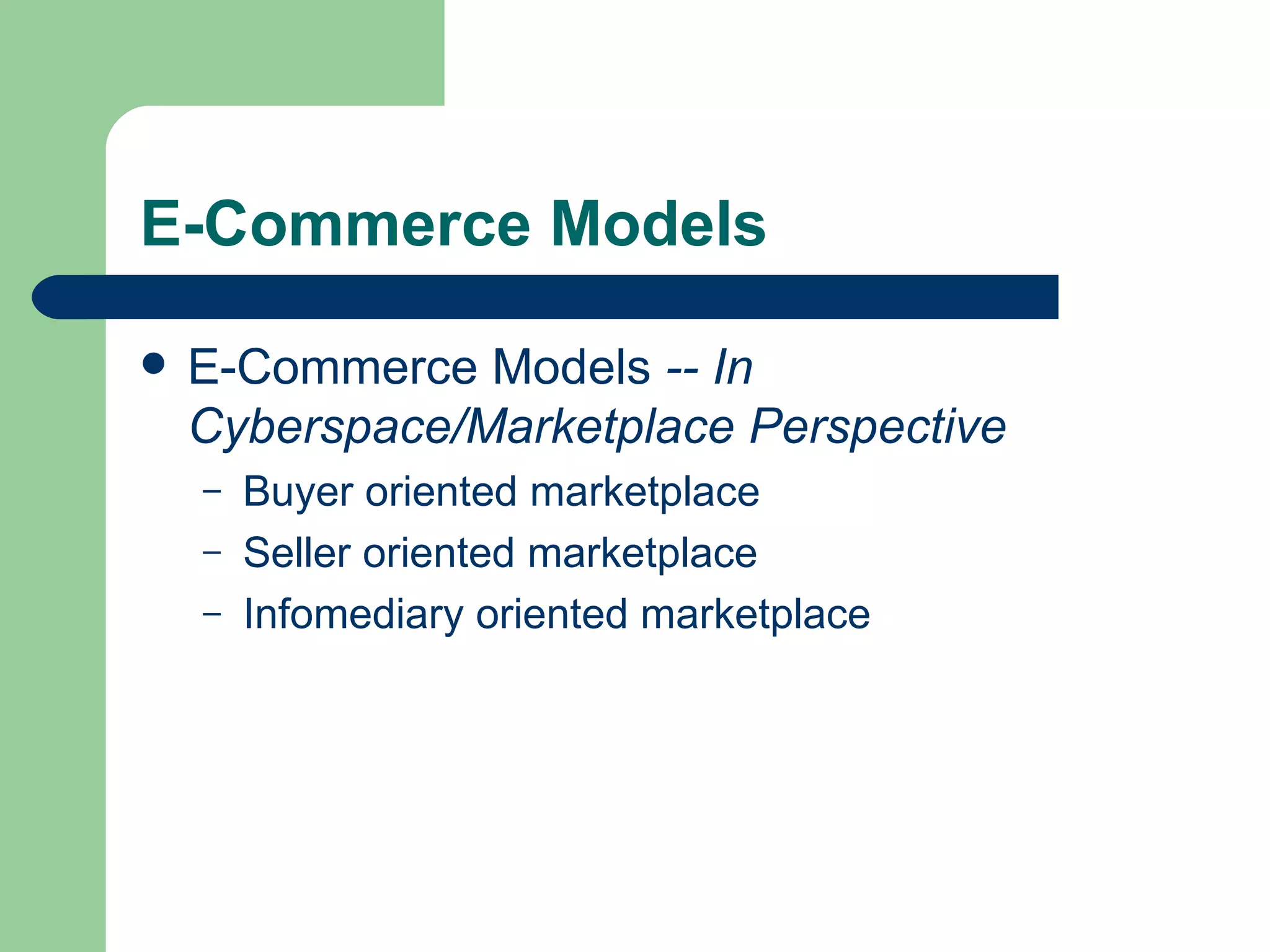
E-Commerce Models E-Commerce Models  -- In Cyberspace/Marketplace Perspective Buyer oriented marketplace Seller oriented marketplace Infomediary oriented marketplace
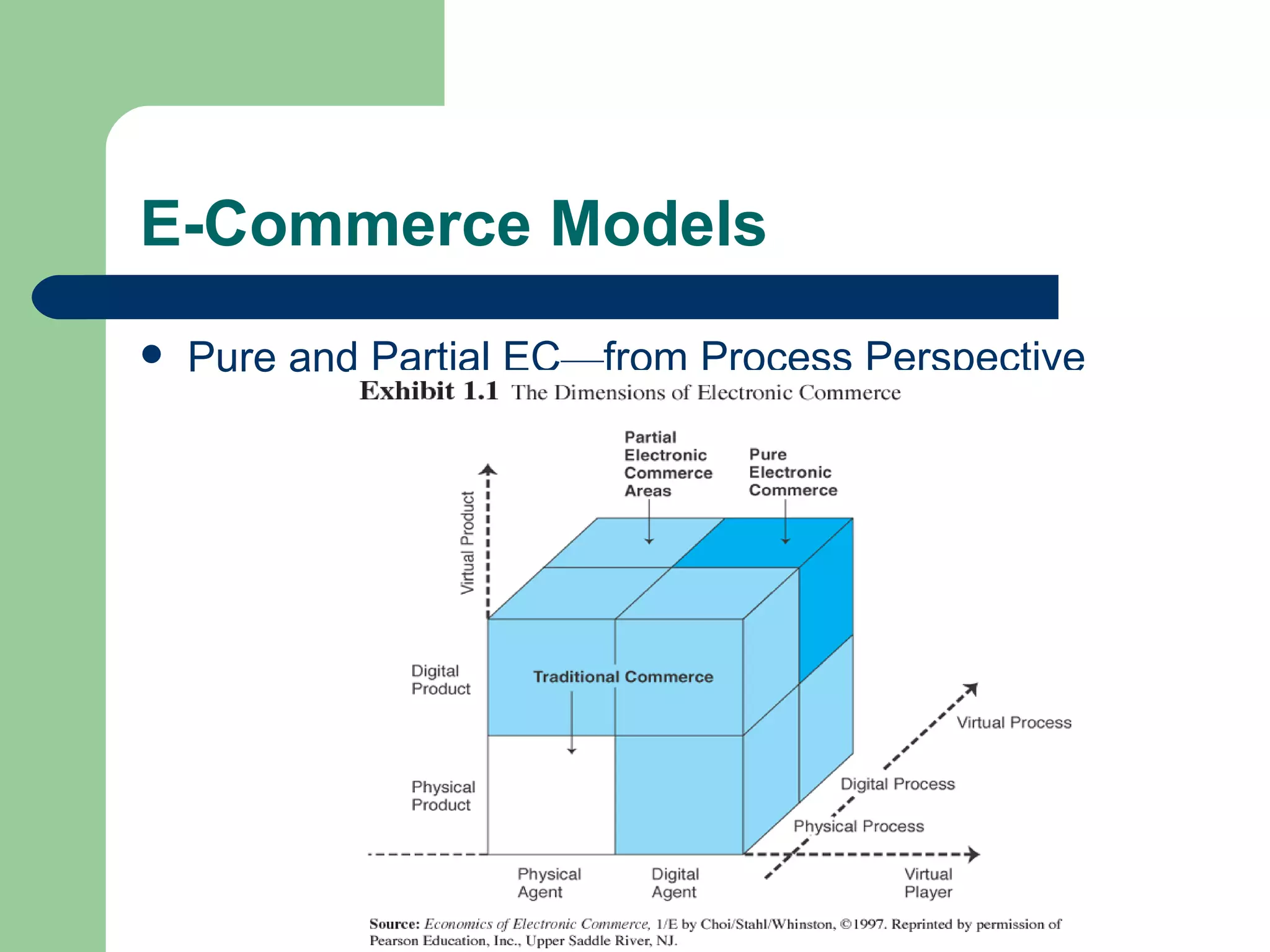
E-Commerce Models Pure and Partial EC — from Process Perspective
E-Commerce Business Models EC Revenue Models Sales Transaction fees Subscription fees Advertising fees Affiliate or referring fees Other services
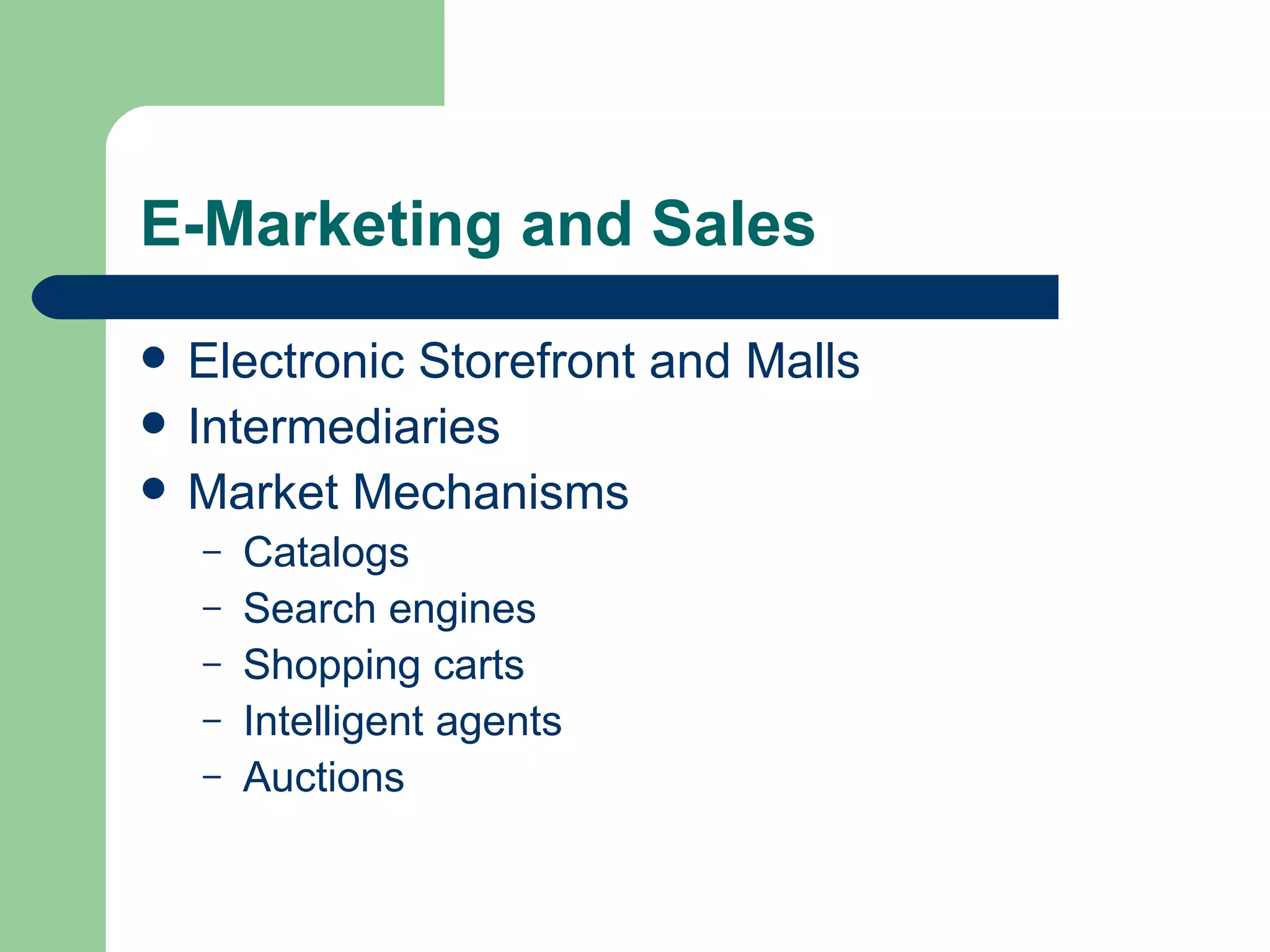
E-Marketing and Sales Electronic Storefront and Malls Intermediaries Market Mechanisms Catalogs Search engines Shopping carts Intelligent agents Auctions
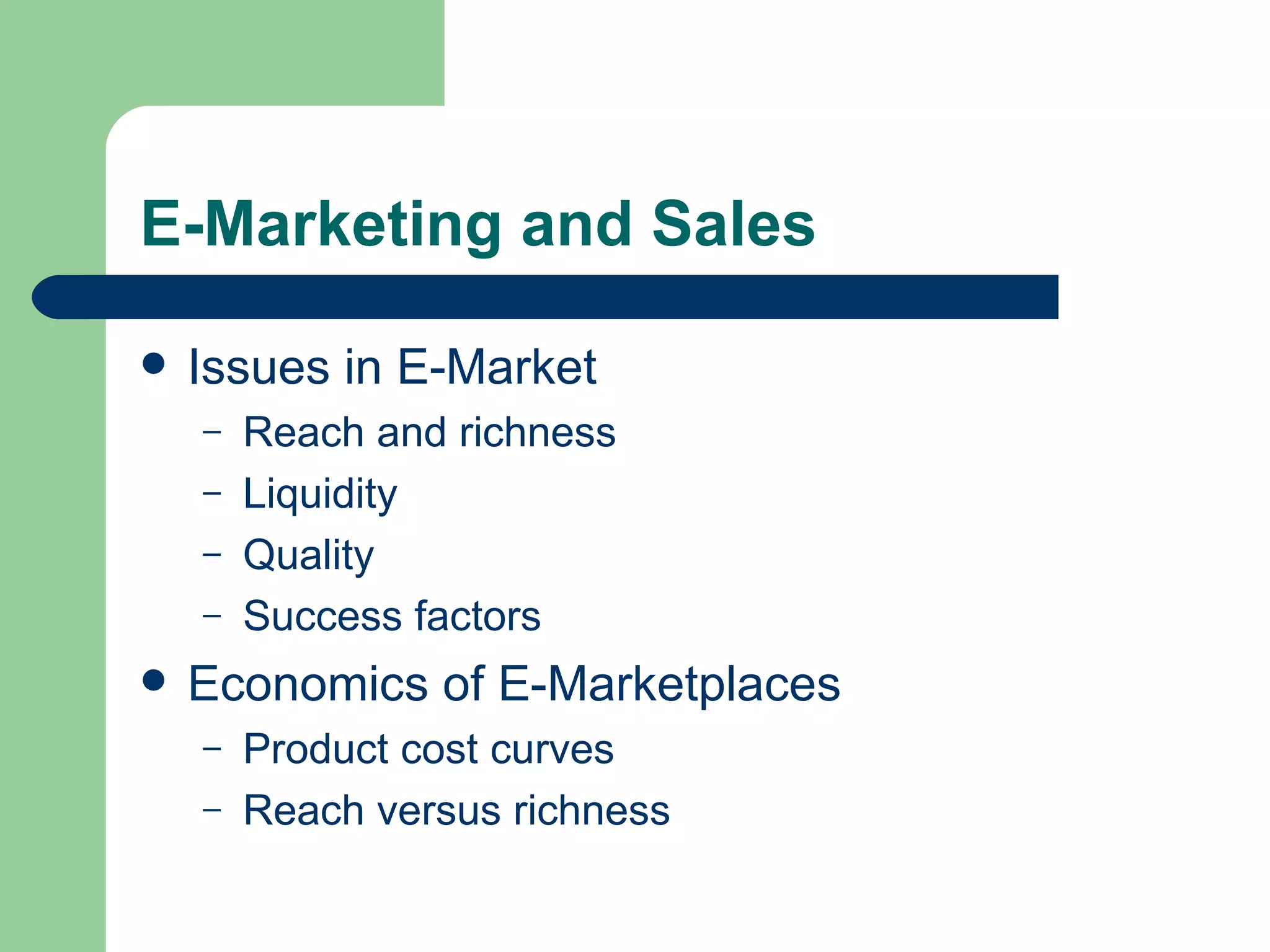
E-Marketing and Sales Issues in E-Market Reach and richness Liquidity Quality Success factors Economics of E-Marketplaces Product cost curves Reach versus richness
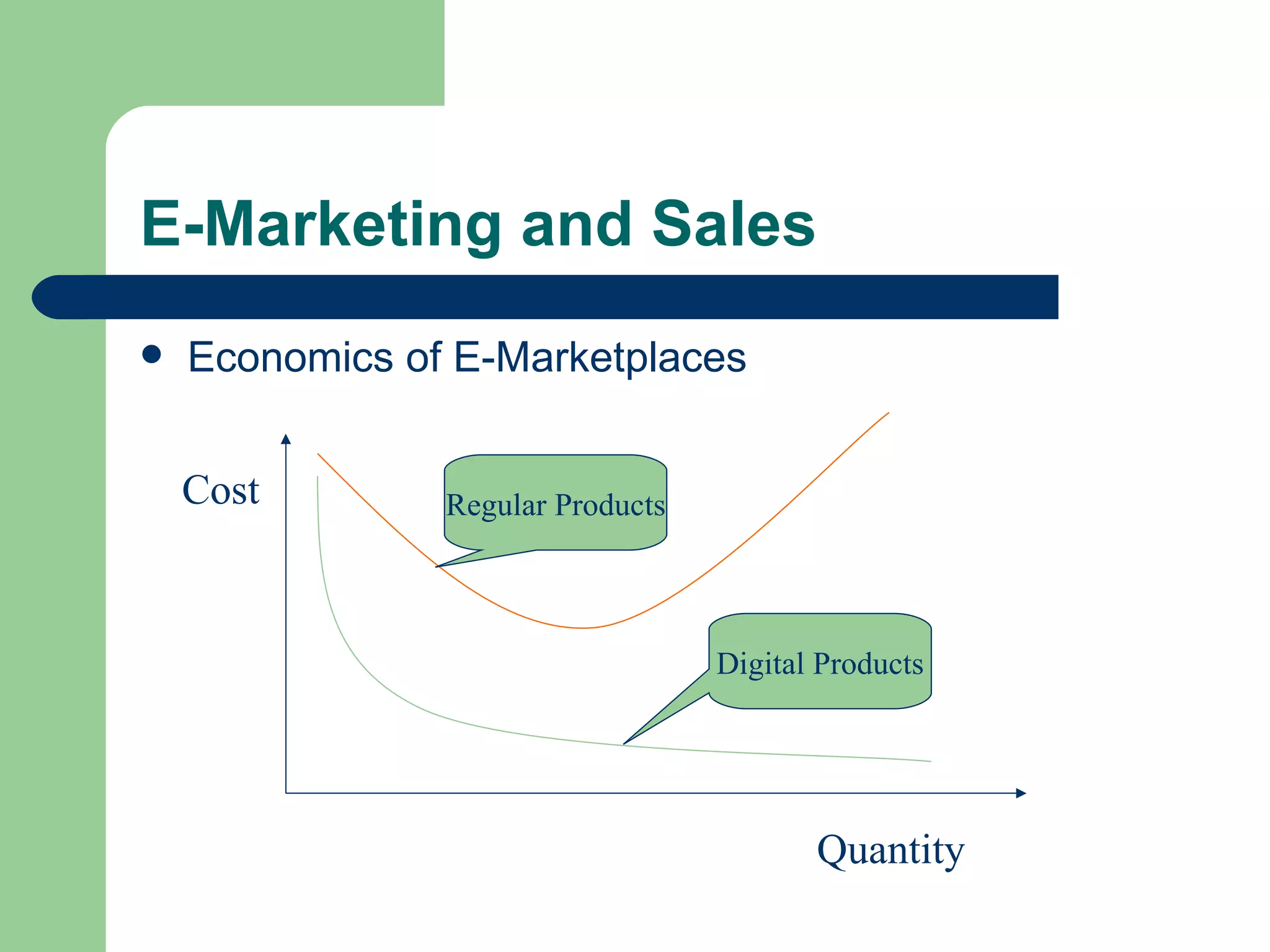
E-Marketing and Sales Economics of E-Marketplaces Regular Products Digital Products Cost Quantity
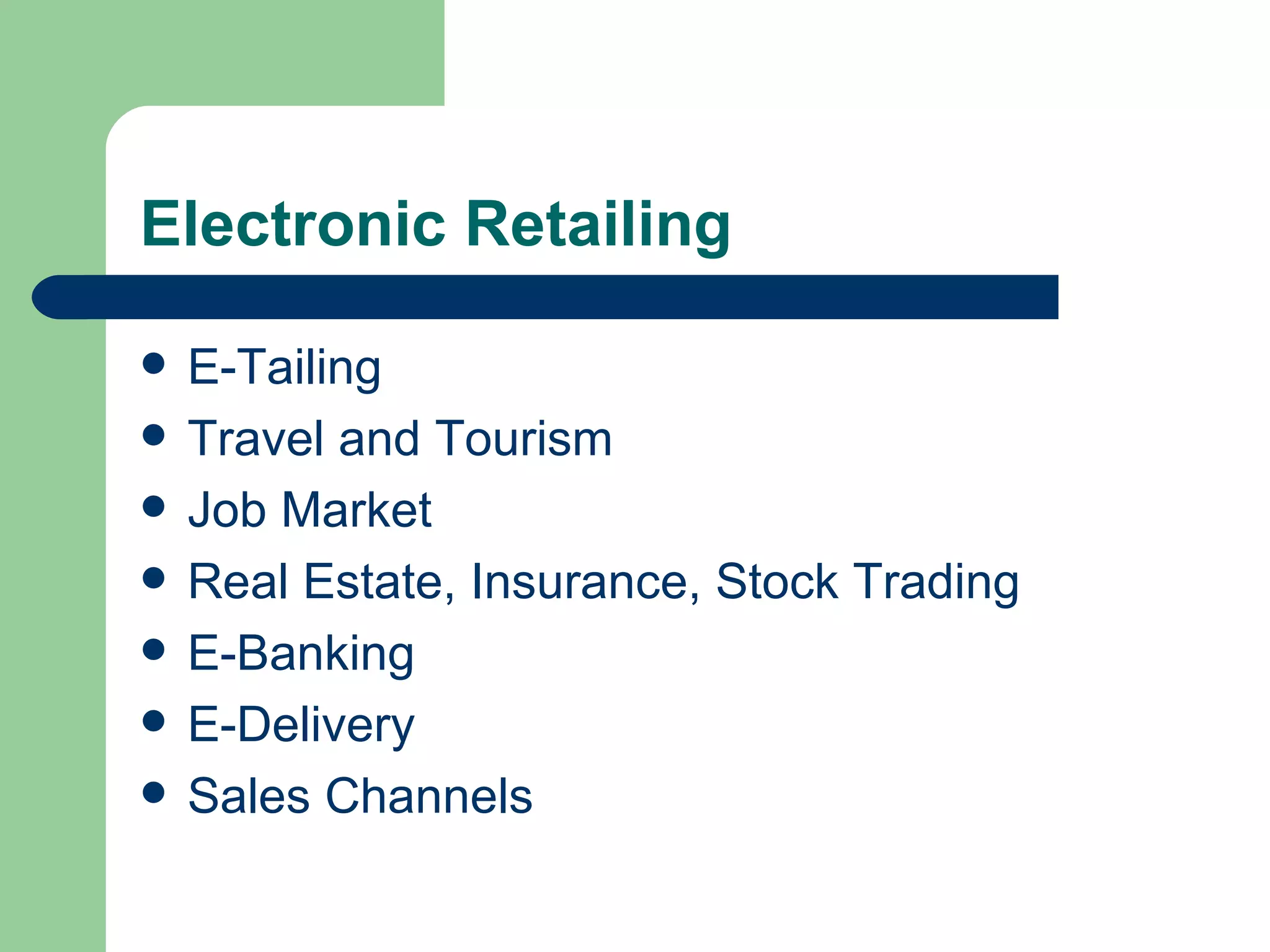
Electronic Retailing E-Tailing Travel and Tourism Job Market Real Estate, Insurance, Stock Trading E-Banking E-Delivery Sales Channels
Electronic Retailing Clicks and Bricks Strategies Issues in E-Tailing Disintermediation and reintermediation Channel Conflicts Determining the right price Personalization
Online Advertisement Web Advertisement Advertising methods Advertising strategies Economics of Web advertising Issues of Web advertising Unsolicited electronic ads--spamming
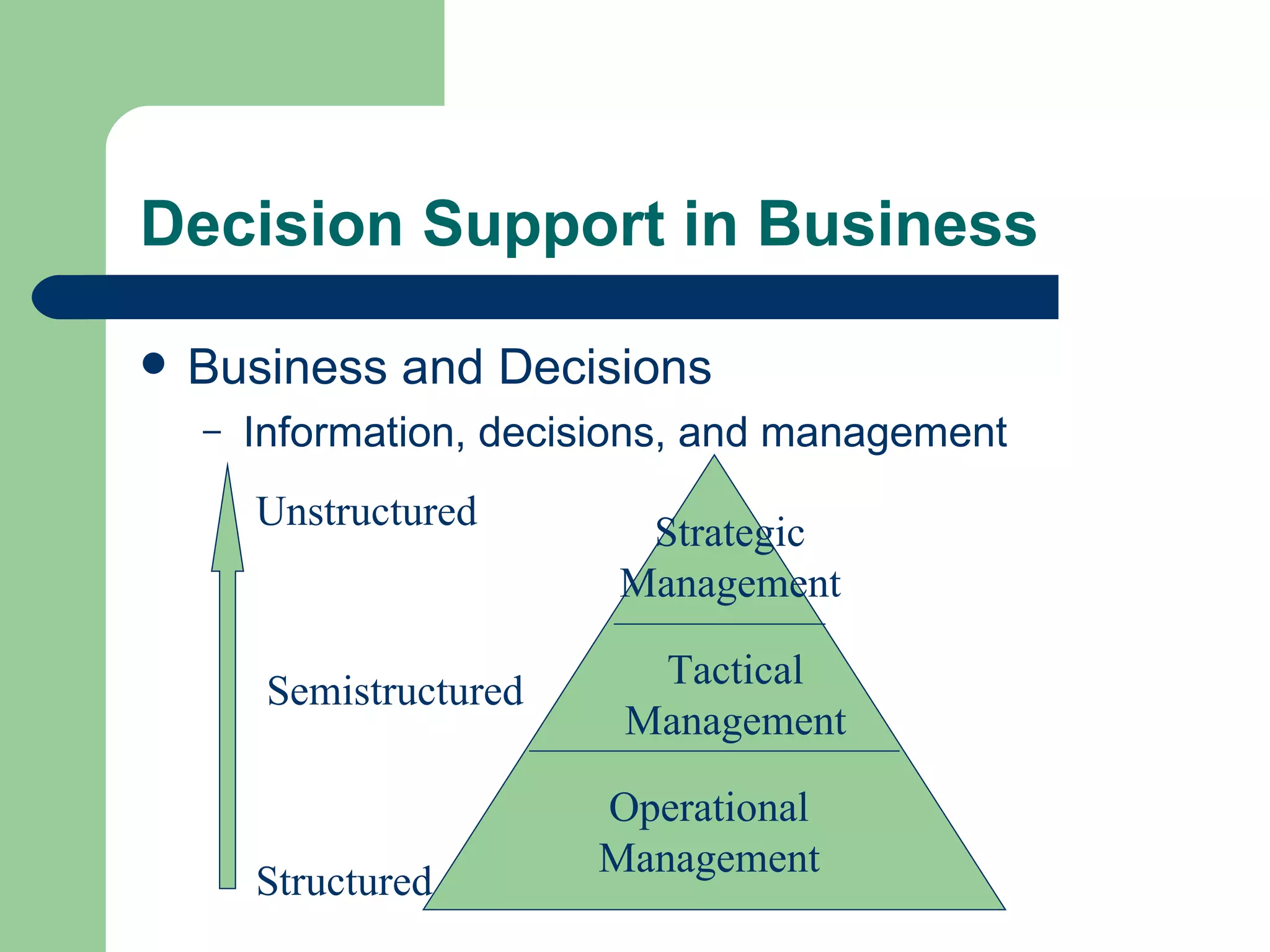
Decision Support in Business Business and Decisions Information, decisions, and management Strategic Management Tactical Management Operational Management Unstructured Structured Semistructured
Management Information Systems MIS Producing information products that support many of the day-to-day decision making needs of managers and business professionals Management Reporting Alternatives Periodic scheduled reports Exception reports Demand reports and responses Push reporting
Online Analytical Processing Online Analytical Processing Consolidation Drill-Down Slicing and Dicing
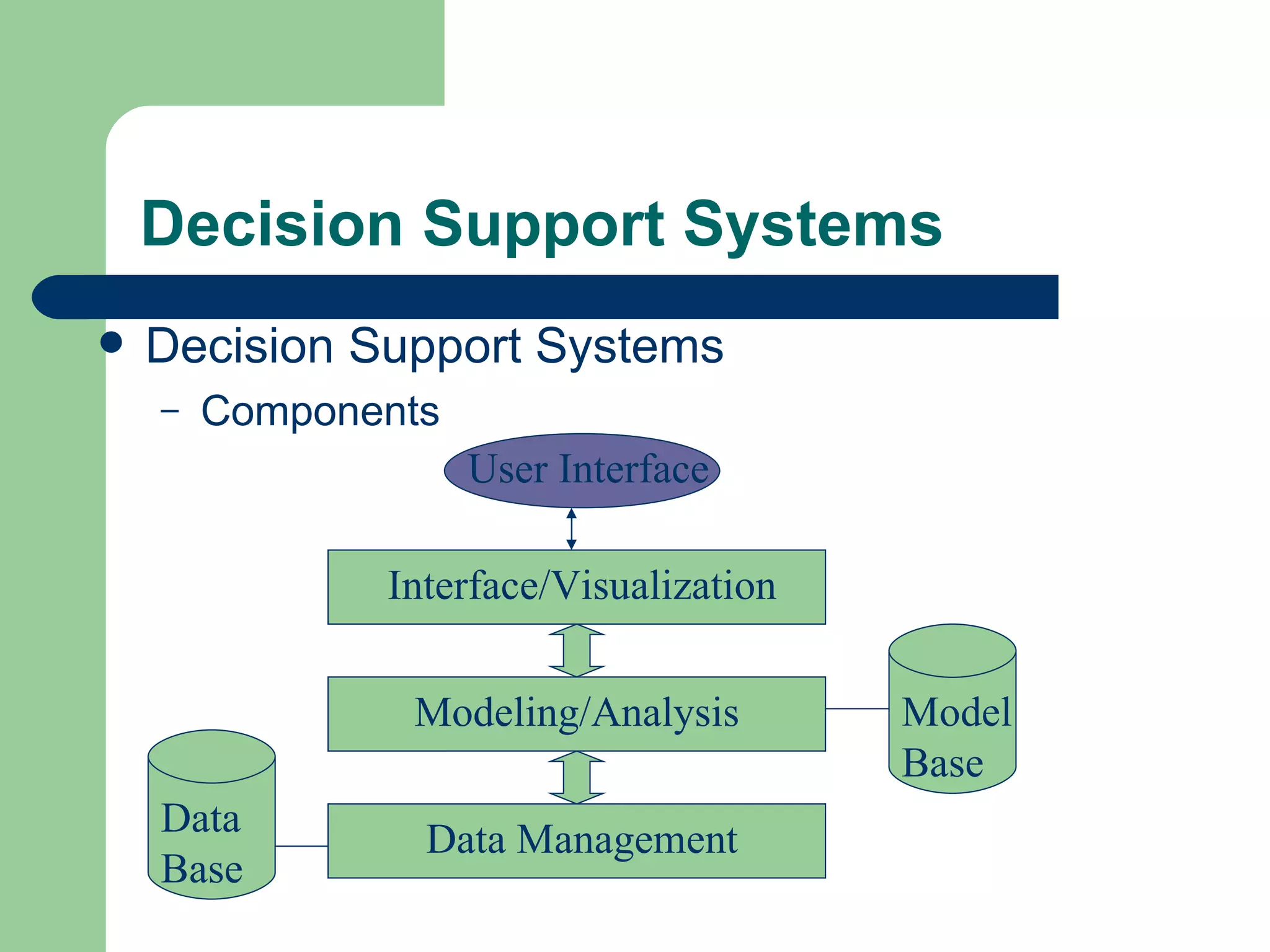
Decision Support Systems Decision Support Systems Components Interface/Visualization Modeling/Analysis Data Management Data Base Model Base User Interface
Decision Support Systems Geographic Information and Data Visualization Systems GSS DVS VRML
Using Decision Support Systems Using DSS What-If Analysis Sensitivity analysis Goal-Seeking analysis Optimization analysis
Executive Information Systems EIS Features To the preferences of the managers GUI and visualization Data analysis Easy to use
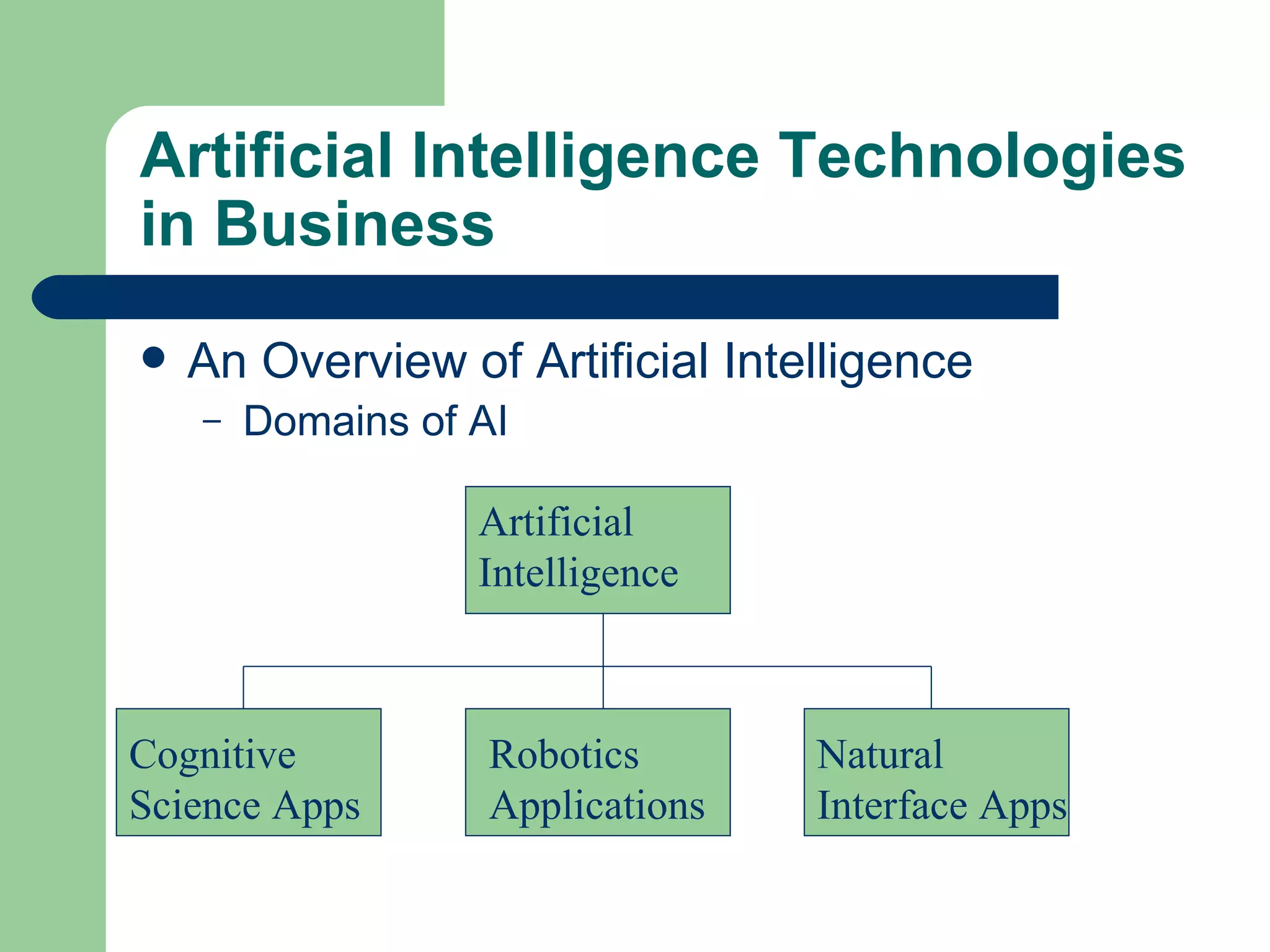
Artificial Intelligence Technologies in Business An Overview of Artificial Intelligence Domains of AI Artificial Intelligence Cognitive Science Apps Robotics Applications Natural Interface Apps
Artificial Intelligence Attributes of Intelligent Behavior Think and reason Use reason to solve problems Learn or understand from experience Acquire and apply knowledge Exhibit creativity and imagination Deal with complex and perplexing situations Respond quickly and successfully to new situations Recognize the relative importance of elements in a situation Handle ambiguous,incomplete, and erroneous information
Artificial Intelligence Neural Networks Fuzzy Logic Systems Genetic algorithms Virtual Reality Intelligent Agents Expert Systems
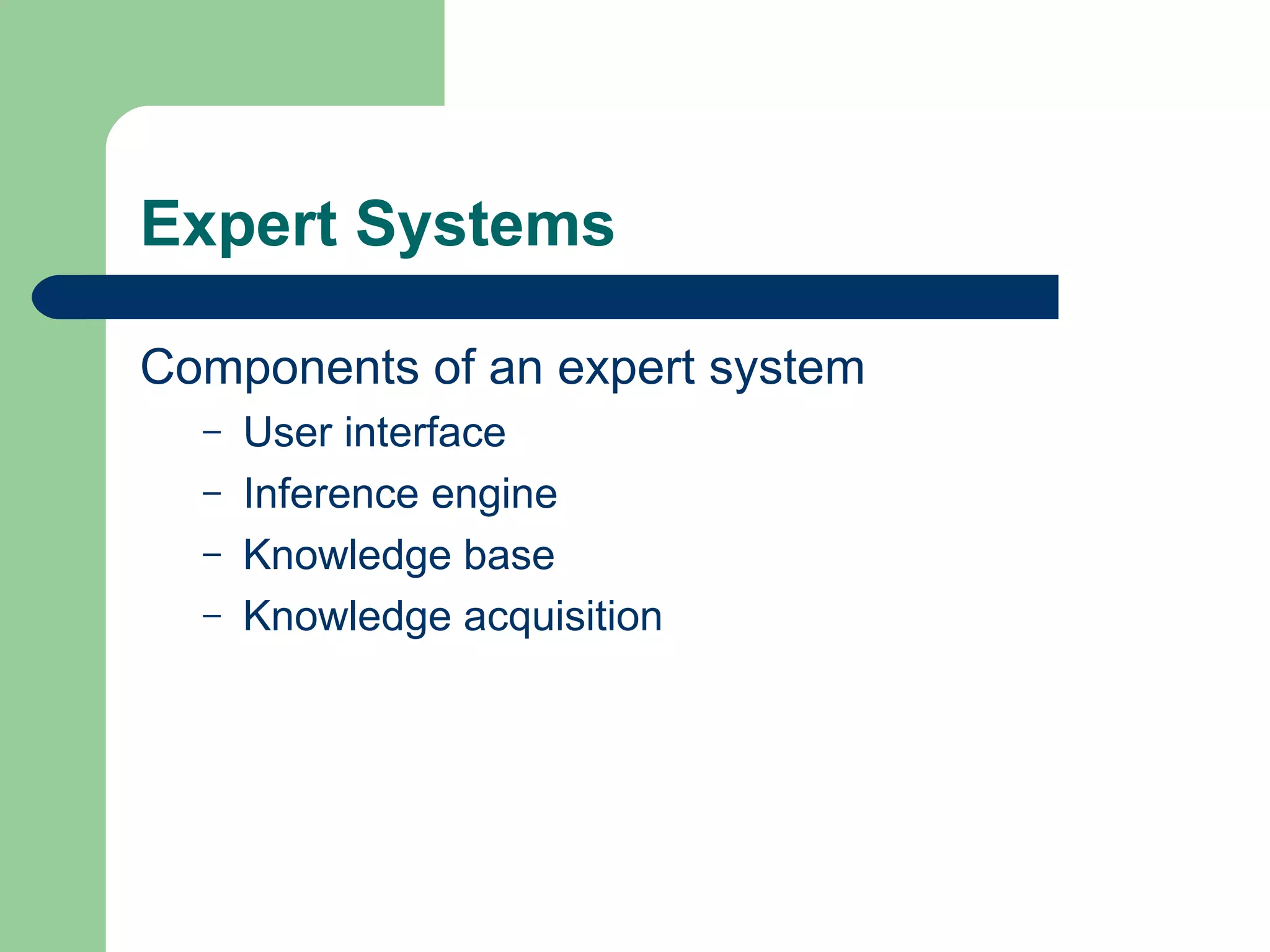
Expert Systems Components of an expert system User interface Inference engine Knowledge base Knowledge acquisition
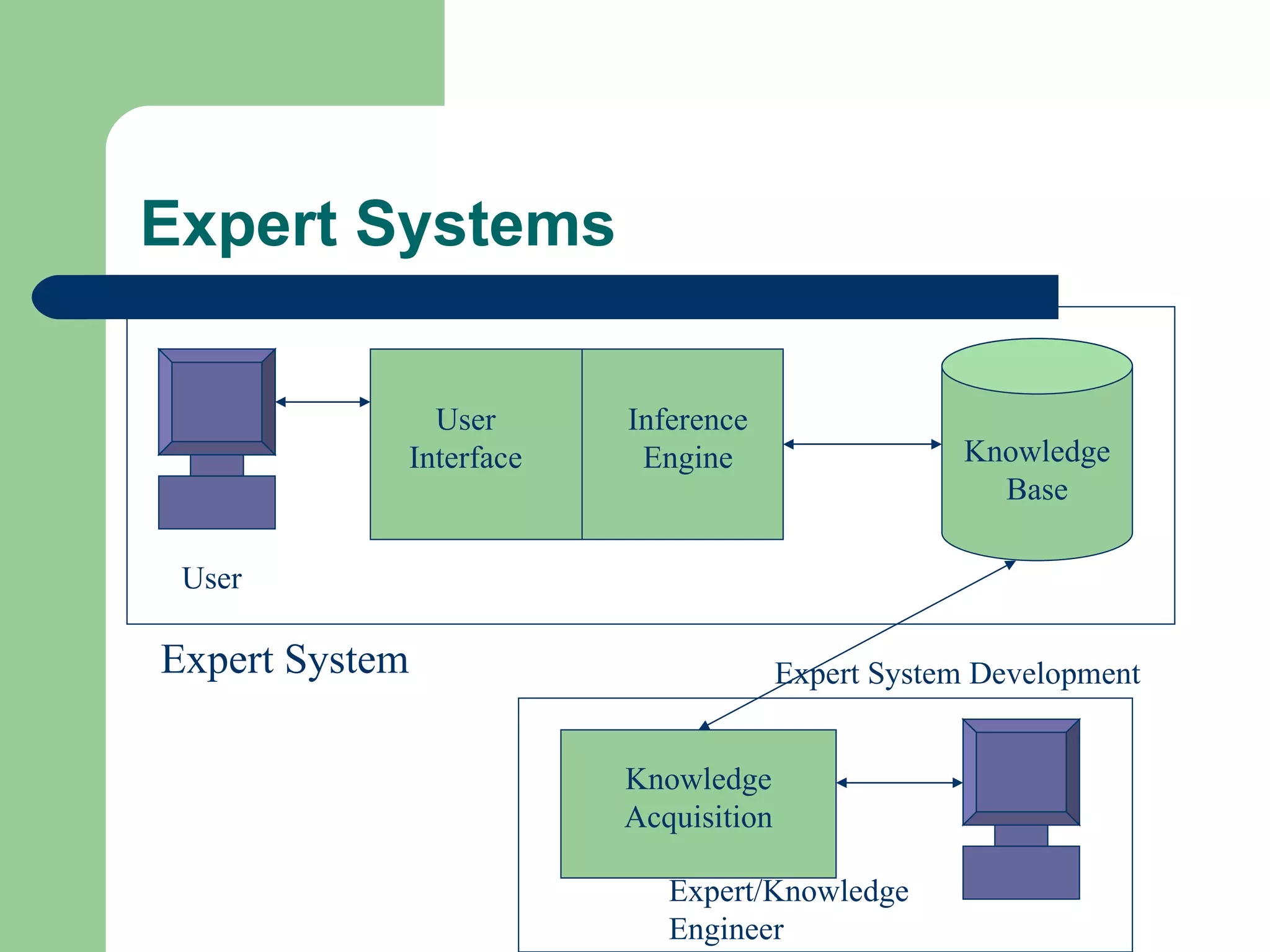
Expert Systems User Interface Inference Engine Knowledge Base Knowledge Acquisition Expert/Knowledge Engineer User Expert System Development Expert System
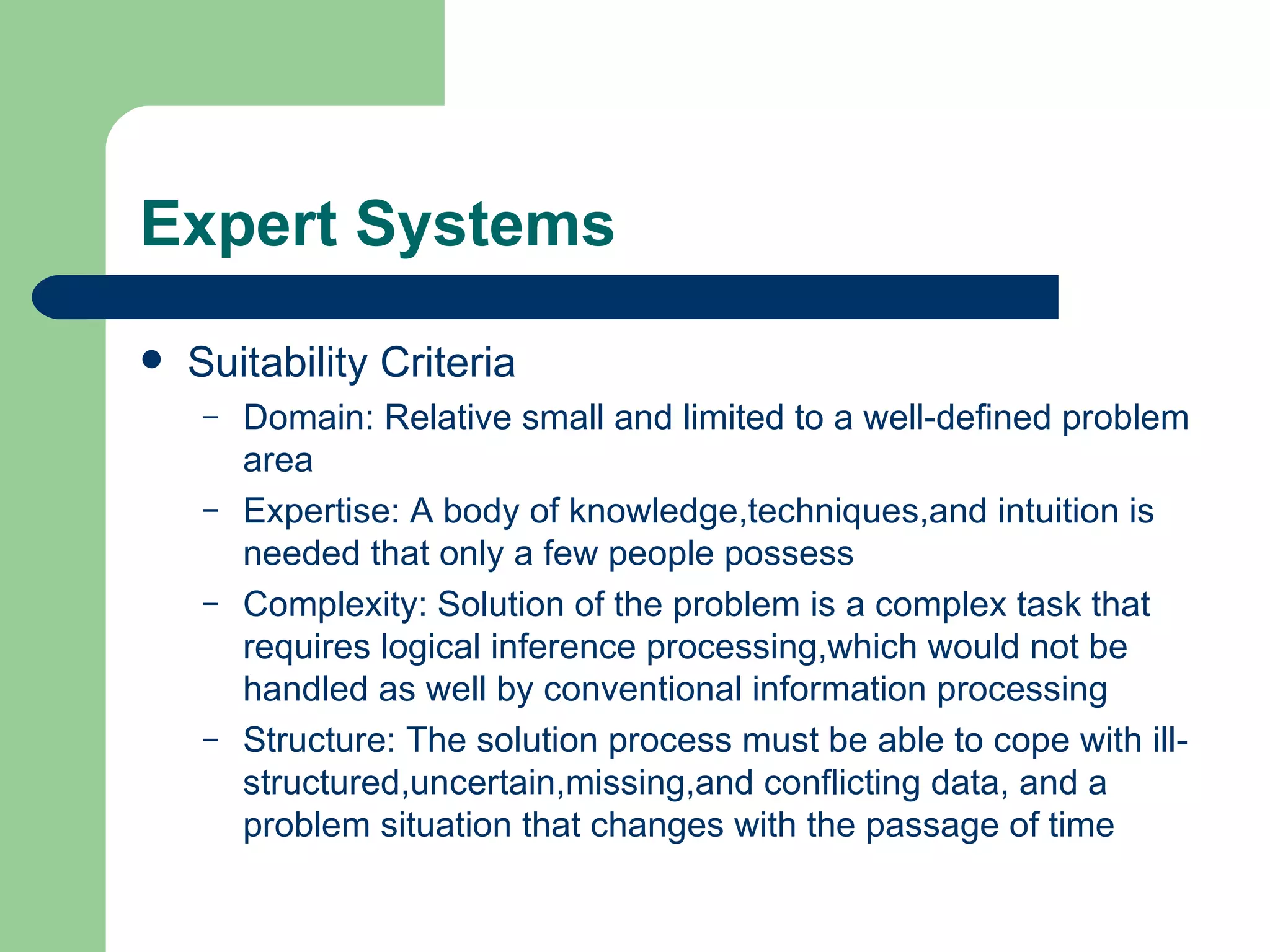
Expert Systems Suitability Criteria Domain: Relative small and limited to a well-defined problem area Expertise: A body of knowledge,techniques,and intuition is needed that only a few people possess Complexity: Solution of the problem is a complex task that requires logical inference processing,which would not be handled as well by conventional information processing Structure: The solution process must be able to cope with ill-structured,uncertain,missing,and conflicting data, and a problem situation that changes with the passage of time
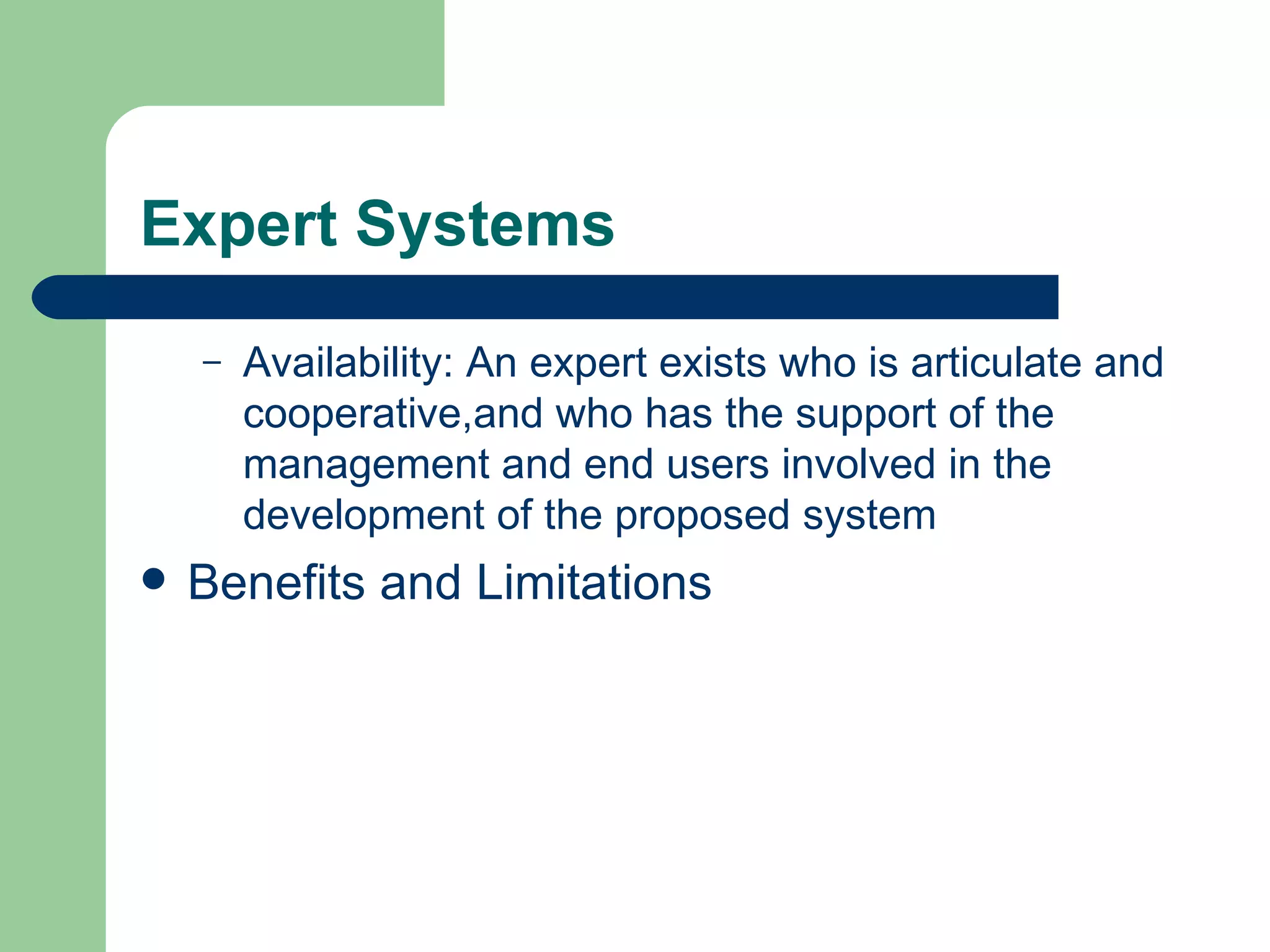
Expert Systems Availability: An expert exists who is articulate and cooperative,and who has the support of the management and end users involved in the development of the proposed system Benefits and Limitations

E Business Systems

  • 1.
    Outlines Enterprise FunctionalSystems Enterprise E-business systems Knowledge management
  • 2.
    Enterprise Functional SystemsFunctional Business Systems Marketing Production/Operation Accounting Finance Human Resource Management
  • 3.
    Marketing Systems MarketingSystems One-to-one marketing Interactive marketing Target marketing Sale force automation Advertisements Customer services
  • 4.
    Manufacturing Systems ManufacturingSystems Production Forecasting Production Scheduling Material Requirement Capacity Planning Production Cost Control Quality Control Shop Floor Scheduling Shop Floor Control Machine Control Robotics Control Process Control CAD CAE Computer-aided Process Planning Product Simulation and Prototyping Computer-Aided Manufacturing Enterprise Resource Planning Resource Planning Execution Engineering
  • 5.
    Human Resource ManagementHuman Resource Management Staffing Training and development Compensation and administration HRM and the Internet HRM and intranets Cyber job market
  • 6.
    Accounting Systems SaleOrder Processing Billing Sales Analysis Account Receivable Cash Receipts Accounts Payable Cash Disbursements Purchases Inventory Processing Payroll Time-keeping General Ledger Financial Reporting Sales Transaction Processing System Purchases Transaction Processing System General Ledger and Reporting System Cash Receipts and Disbursements Transaction Processing System
  • 7.
    Financial Management SystemsFinancial Management Systems Cash management Investment management Capital budgeting Financial planning
  • 8.
    Enterprise E-Business SystemsE-Business systems Enterprise resource planning(ERP) Customer relationship management(CRM) Supply chain management(SCM) Partner relationship management(PRM) Decision support systems(DSS) Knowledge management systems(KMS) Management information systems(MIS)
  • 9.
    Enterprise E-Business SystemsSCM CRM ERP Supplier Customer Employee Partners DSS PRM KMS HRM
  • 10.
    E-business Systems (ERP)Enterprise resource planning(ERP) Employees/ (Customers) Sales, Distribution, Order Management Production Resource Planning Integrated Logistics Accounting and Finance Human Resources
  • 11.
    E-business Systems (ERPValue) Benefits and Challenges of ERP Quality and efficiency Reducing cost Decision support Enterprise Agility ERP with emphasis on enhancing enterprise business value
  • 12.
    E-business Systems (ERP Problems) Problems of implementing ERP in enterprises Major challenge: Business process reengineering(BPR) Resistance of both managers and staffs Top managers ’ commitment and consensus Users ’ involvement High cost
  • 13.
    E-business Systems (Types of ERP) Corporate cultures Management systems and ownerships Types of ERP to be implemented Flexible EC integration Inter-organization EB suites/ ERPII Time Internal External Chinese Enterprises
  • 14.
    E-business Systems (ERPCost) ERP Cost Reengineering 43% Hardware 12% Software 15% Training and Change Mgmt 15% Data Conversions 15%
  • 15.
    E-business Systems (CRM)Customer relationship management(CRM) Marketing and Fulfillment Sales Management Customer Account and Data Management Retention and Loyalty Programs Customer Service and Support Customer and Prospect Fax Telephone E-Mail Web Mobile
  • 16.
    E-business Systems (CRMValue) Benefits and challenges of CRM Customer interests and needs Customer service Customer loyalty Personalization Quick feedback and response CRM with emphasis on enterprise customer value
  • 17.
    E-business Systems (CRMTypes) Types of CRM systems to be implemented Operational Analytical Collaborative Portal/Intelligent Internal External Chinese Enterprises Time
  • 18.
    E-business Systems (SCM)Supply chain management(SCM) Suppliers/ Customers Transportation and Shipment Management Sourcing and Procurement Order Fulfillment Distribution and Inventory Management Logistics Management
  • 19.
    E-business Systems (SCMValue) Benefits and challenges of SCM Fast and accurate order processing Inventory management Time to market Transaction and material cost Strategic relationships and alliances Enterprise flexibility Customer accountability SCM with emphasis on both enterprise business value and customer value
  • 20.
    E-business Systems (SCMTypes) Types of SCM to be implemented Supply Chain improvement E-Supply Chain Supply Chain Integration Internal External Chinese Enterprises Time
  • 21.
    Knowledge Management Knowledgemanagement Activities Knowledge creating/acquiring Knowledge presenting, storing and renewal Knowledge sharing and services Knowledge applying
  • 22.
    Knowledge Management Processes)Knowledge management processes Knowledge creating and acquiring Knowledge Presenting and Storing Knowledge sharing and services Knowledge applying
  • 23.
    Knowledge Management (Knowledge Categories) Knowledge management : Categories of knowledge Tacit/Explicit knowledge Explicit Tacit Internalization Socialization Externalization Combination Explicit From To Tacit
  • 24.
    Knowledge Management (Intellectual Capitals) Sources of knowledge: Intellectual capital Human capital Structural capital Customer/partner capital
  • 25.
    Knowledge Management (Knowledge Creating) Knowledge creating/acquiring Human Capital Structural Capital Partner Capital Knowledge Acquisition Tacit Knowledge Explicit/Tacit Knowledge Explicit Knowledge
  • 26.
    Knowledge Management (Tacit Knowledge Acquisition) Tacit knowledge acquisition Knowledge engineering Intelligent agents Management measures Cognitive science applications Natural language processing
  • 27.
    Knowledge Management (Explicit Knowledge Acquisition) Explicit knowledge acquisition Data mining Web mining Text mining Intelligent agents
  • 28.
    Knowledge Management (Knowledge Storing) Knowledge presenting, storing and renewal Knowledge modeling Data warehouse Knowledge base Ontology base
  • 29.
    Knowledge Management (Knowledge Sharing) Knowledge sharing and services Knowledge portal Application Ontology Knowledge query and visualization
  • 30.
    Knowledge Management (Knowledge Applying) Knowledge applications Decision support Business intelligence Innovation New business opportunities Enterprise adaptability
  • 31.
    E-Business E-business inBusiness E-business:Use of Internet technologies to internetwork and empower business processes,electronic commerce,and enterprise communication and collaboration within a company and with its customers,suppliers, and other business stakeholders.
  • 32.
    E-Commerce Concept Describingthe buying, selling, and exchanging products, services, and information via computer networks including mainly the Internet
  • 33.
    E-Commerce Framework ApplicationsSupport Services People Public policy Marketing Business Support Business partnership
  • 34.
    E-Commerce Framework Infrastructureand Management Common services Messaging and information distribution Multimedia and network publishing Network infrastructure Interfacing and integration
  • 35.
  • 36.
    E-Commerce Models E-CommerceModels -- In transactional Perspective B2B B2C C2C --------------------------------------------------------- B2G C2G
  • 37.
    E-Commerce Models E-CommerceModels -- In Cyberspace/Marketplace Perspective Buyer oriented marketplace Seller oriented marketplace Infomediary oriented marketplace
  • 38.
    E-Commerce Models Pureand Partial EC — from Process Perspective
  • 39.
    E-Commerce Business ModelsEC Revenue Models Sales Transaction fees Subscription fees Advertising fees Affiliate or referring fees Other services
  • 40.
    E-Marketing and SalesElectronic Storefront and Malls Intermediaries Market Mechanisms Catalogs Search engines Shopping carts Intelligent agents Auctions
  • 41.
    E-Marketing and SalesIssues in E-Market Reach and richness Liquidity Quality Success factors Economics of E-Marketplaces Product cost curves Reach versus richness
  • 42.
    E-Marketing and SalesEconomics of E-Marketplaces Regular Products Digital Products Cost Quantity
  • 43.
    Electronic Retailing E-TailingTravel and Tourism Job Market Real Estate, Insurance, Stock Trading E-Banking E-Delivery Sales Channels
  • 44.
    Electronic Retailing Clicksand Bricks Strategies Issues in E-Tailing Disintermediation and reintermediation Channel Conflicts Determining the right price Personalization
  • 45.
    Online Advertisement WebAdvertisement Advertising methods Advertising strategies Economics of Web advertising Issues of Web advertising Unsolicited electronic ads--spamming
  • 46.
    Decision Support inBusiness Business and Decisions Information, decisions, and management Strategic Management Tactical Management Operational Management Unstructured Structured Semistructured
  • 47.
    Management Information SystemsMIS Producing information products that support many of the day-to-day decision making needs of managers and business professionals Management Reporting Alternatives Periodic scheduled reports Exception reports Demand reports and responses Push reporting
  • 48.
    Online Analytical ProcessingOnline Analytical Processing Consolidation Drill-Down Slicing and Dicing
  • 49.
    Decision Support SystemsDecision Support Systems Components Interface/Visualization Modeling/Analysis Data Management Data Base Model Base User Interface
  • 50.
    Decision Support SystemsGeographic Information and Data Visualization Systems GSS DVS VRML
  • 51.
    Using Decision SupportSystems Using DSS What-If Analysis Sensitivity analysis Goal-Seeking analysis Optimization analysis
  • 52.
    Executive Information SystemsEIS Features To the preferences of the managers GUI and visualization Data analysis Easy to use
  • 53.
    Artificial Intelligence Technologiesin Business An Overview of Artificial Intelligence Domains of AI Artificial Intelligence Cognitive Science Apps Robotics Applications Natural Interface Apps
  • 54.
    Artificial Intelligence Attributesof Intelligent Behavior Think and reason Use reason to solve problems Learn or understand from experience Acquire and apply knowledge Exhibit creativity and imagination Deal with complex and perplexing situations Respond quickly and successfully to new situations Recognize the relative importance of elements in a situation Handle ambiguous,incomplete, and erroneous information
  • 55.
    Artificial Intelligence NeuralNetworks Fuzzy Logic Systems Genetic algorithms Virtual Reality Intelligent Agents Expert Systems
  • 56.
    Expert Systems Componentsof an expert system User interface Inference engine Knowledge base Knowledge acquisition
  • 57.
    Expert Systems UserInterface Inference Engine Knowledge Base Knowledge Acquisition Expert/Knowledge Engineer User Expert System Development Expert System
  • 58.
    Expert Systems SuitabilityCriteria Domain: Relative small and limited to a well-defined problem area Expertise: A body of knowledge,techniques,and intuition is needed that only a few people possess Complexity: Solution of the problem is a complex task that requires logical inference processing,which would not be handled as well by conventional information processing Structure: The solution process must be able to cope with ill-structured,uncertain,missing,and conflicting data, and a problem situation that changes with the passage of time
  • 59.
    Expert Systems Availability:An expert exists who is articulate and cooperative,and who has the support of the management and end users involved in the development of the proposed system Benefits and Limitations