IT Security
Deepak John, Assistant Lecturer
Department of Computing, Lyit
Topics to be covered
1. Introduction to IT security
2. malware, phishing, information theft
3. Protecting data on all devices
4. Search safely online and evaluate web content
Certificate in Digital Skills
IT Security
➢ It is a set of security strategies that prevents unauthorized access to the systems, networks,
and data.
➢ Types of IT security
1. Network security: used to prevent unauthorized or malicious users from getting inside your
network.
2. Internet security: involves the protection of information that is sent and received in
browsers.
3. Endpoint security: provides protection at the device level.
4. Cloud security: help secure the usage of software-as-a-service (SaaS) applications and the
public cloud.
5. Application security: applications are specifically coded at the time of their creation to be as
secure as possible, to ensure they are not vulnerable to attacks.
Certificate in Digital Skills
Malware, Phishing, Information Theft
1. Malware
➢ these are malicious computer program that are installed without the consent
of users and can cause a number of unpleasant effects
➢ Types of Malware
a) Viruses
b) Spyware
c) Adware
Certificate in Digital Skills
Viruses
➢ most commonly-known form of malware
➢ that replicates by copying itself to another program, computer boot
sector or document and changes how a computer works.
➢ potentially the most destructive.
Certificate in Digital Skills
Spyware
➢ Collects your personal information and passes it on to interested
third parties without your knowledge or consent.
➢ Secretly records your browsing habits, the websites you visit, and
your online purchases. Some types of spyware also record your
passwords, login credentials, and credit card details.
Certificate in Digital Skills
Adware
➢ Displays pop-up advertisements when you are online.
➢ Adware uses the browser to collect your web browsing history in
order to ’target’ advertisements that seem tailored to your interests.
Certificate in Digital Skills
 Signs of Malware in your system
1. Rapid Battery loss
2. Random reboots and shutdowns
3. Frequent crashes
4. Unusually slow computer performance
5. Strange emails and text messages
6. High data Traffic
7. Activity when the computer is not in use
8. Delayed shutdown
9. Unexpected popups with urgent messages
10.Unknown programs that start up when you turn on your computer.
Certificate in Digital Skills
Facts about Malware
➢ Malware is often bundled with other software and may be installed
without your knowledge.
➢ Malware is very difficult to remove.
➢ Malware threatens your privacy.
Certificate in Digital Skills
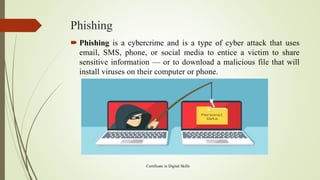
Phishing
 Phishing is a cybercrime and is a type of cyber attack that uses
email, SMS, phone, or social media to entice a victim to share
sensitive information — or to download a malicious file that will
install viruses on their computer or phone.
Certificate in Digital Skills
 Characteristics Of Phishing Messages
i. Asks for sensitive information:Legitimate businesses won’t request
ii. Uses a different domain:Check the domain by looking at the Sent
field.
iii. Contains links that don’t match the domain:Hover the cursor over
any links to make sure they will take you to the site you expect. Also
look for https:// at the start of the URL, and do not click on any link
that does not use HTTPS.
iv. Includes unsolicited attachments
v. Is not personalized
vi. Uses poor spelling and grammar
Certificate in Digital Skills
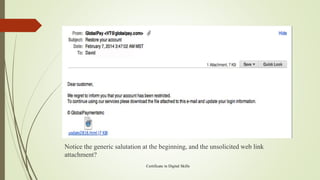
Notice the generic salutation at the beginning, and the unsolicited web link
attachment?
Certificate in Digital Skills
Phishing mail example
Certificate in Digital Skills
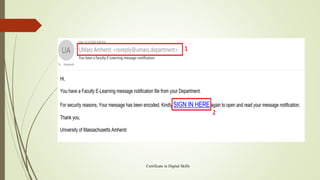
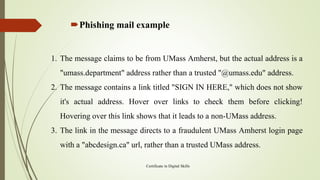
1. The message claims to be from UMass Amherst, but the actual address is a
"umass.department" address rather than a trusted "@umass.edu" address.
2. The message contains a link titled "SIGN IN HERE," which does not show
it's actual address. Hover over links to check them before clicking!
Hovering over this link shows that it leads to a non-UMass address.
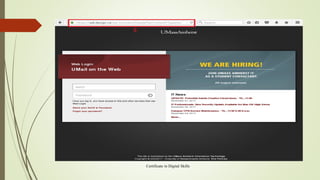
3. The link in the message directs to a fraudulent UMass Amherst login page
with a "abcdesign.ca" url, rather than a trusted UMass address.
Certificate in Digital Skills
 How to Protect Against Phishing Attacks
✓ Be cautious about all communications you receive, and remember
that although phishing may most commonly happen through email,
it can also occur through cell phone, SMS and social media.
✓ Before downloading an app, check the reviews for quantity and
quality, only connect to trusted devices.
Certificate in Digital Skills
Information Theft or Identity Theft
 Identity theft occurs when someone stolen your personal
information and used that to commit fraud or other crimes.
 Types
i. Financial identity theft
ii. Identity cloning
iii. Criminal identity theft
iv. Medical identity theft
Certificate in Digital Skills
 How to protect from information theft
i. Protect your personal information
ii. routinely monitoring your financial accounts and billing statements
for suspicious activities
iii. If you identify potential identity theft, take steps to stop further
damage.
Certificate in Digital Skills
Software Vulnerability
 A software vulnerability is a glitch, flaw, or weakness present in the
software or in an OS (Operating System).
 all systems include vulnerabilities. The thing is whether or not
they’re exploited to cause damage.
 Software vulnerabilities are explained by three ideal factors. These
are:
• Existence – The existence of a vulnerability in the software.
• Access – The possibility that hackers gain access to the
vulnerability.
• Exploit – The capability of the hacker to take advantage of that
vulnerability via tools or with certain techniques.
Certificate in Digital Skills
Protecting Data on Devices
1. Keep the Firewall On and update it regularly
2. Prevent unauthorized access to your data or computing devices
3. Use updated Antivirus
4. Only download software from trusted websites
5. Manage Your Operating System and Browser
6. Encrypt the data
7. Back up your Data
Certificate in Digital Skills
Use a firewall
➢ "Firewalls assist in blocking dangerous programs, viruses or
spyware before they infiltrate your system.
➢ Various software companies offer firewall protection, but hardware-
based firewalls, like those frequently built into network routers,
provide a better level of security,"
Certificate in Digital Skills
Prevent unauthorized access to your data or computing devices
➢ By using Passwords or Paraphrases
➢ By turn off the devices while unattended
Certificate in Digital Skills
Encrypt the data.
➢ encryption is the process of encoding information.
➢ Ensure data protection by using publicly available tools
Certificate in Digital Skills
Backup your data
➢ One of the most basic, yet often overlooked, data protection tips is
backing up your data.
➢ Basically, this creates a duplicate copy of your data so that if a
device is lost, stolen, or compromised, you don't also lose your
important information.
Certificate in Digital Skills
Manage Your Operating System ,software's and Browser
➢ Operating system updates are necessary, as these updates contain
critical security patches that will protect your computer from
recently discovered threats.
➢ It's best to set automatic updates for the operating system and other
software's.
Certificate in Digital Skills
Use Antivirus
➢ helps protect your computer against malware and cybercriminals.
➢ Antivirus looks at data — web pages, files, software, applications —
traveling over the network to your devices.
➢ It searches for known threats and monitors the behaviour of all
programs, flagging suspicious behaviour.
➢ It seeks to block or remove malware as quickly as possible.
Certificate in Digital Skills
Search Safely Online and Evaluate Web Content
Search Safely Online
➢ The risks associated with online search
• Exposure to material that may be offensive or illegal.
• Visibility to search engine providers of your search activity.
• Chances of Security Threats
Certificate in Digital Skills
 Pop-ups are small windows that ‘pop up’ over the top of web pages in
your internet browser.
 A plugin is a software add-on that is installed on a program, enhancing
its capabilities.
 Virtual proxy networks or VPNs help you maintain your privacy by
encrypting your data and internet requests before they ever hit the
internet.
Certificate in Digital Skills
 Cookies
✓ are text files with small pieces of data — like a username and password —
that are used to identify your computer.
✓ Data stored in a cookie is created by the server upon your connection. This
data is labeled with an ID unique to you and your computer.
✓ types of cookies
1. Magic Cookies :this would be used for a login to computer database
systems, such as a business internal network.
2. HTTP Cookies:or internet cookies, are built specifically for Internet web
browsers to track, personalize, and save information about each user’s
session. A “session” just refers to the time you spend on a site.
Certificate in Digital Skills
Things to remember for online search
1. Be picky about what Wi-Fi you’re using
2. Keep your browser and plugins updated
3. Block Pop-ups
4. Use an ad blocker
5. Enable “do not track” in your browser
6. Clear your web browser cache and cookies
7. Use a VPN
8. Ensure you have up-to-date antivirus and firewall protection
Certificate in Digital Skills
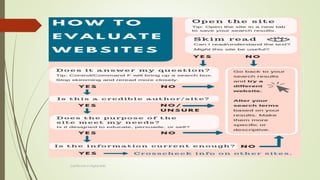
Evaluate Web Content
 consider these criteria for evaluating Web resources
1. Currency
2. Relevance
3. authority
4. Accuracy
5. purpose.
Certificate in Digital Skills
Thank You
Certificate in Digital Skills

It security,malware,phishing,information theft

  • 1.
    IT Security Deepak John,Assistant Lecturer Department of Computing, Lyit
  • 2.
    Topics to becovered 1. Introduction to IT security 2. malware, phishing, information theft 3. Protecting data on all devices 4. Search safely online and evaluate web content Certificate in Digital Skills
  • 3.
    IT Security ➢ Itis a set of security strategies that prevents unauthorized access to the systems, networks, and data. ➢ Types of IT security 1. Network security: used to prevent unauthorized or malicious users from getting inside your network. 2. Internet security: involves the protection of information that is sent and received in browsers. 3. Endpoint security: provides protection at the device level. 4. Cloud security: help secure the usage of software-as-a-service (SaaS) applications and the public cloud. 5. Application security: applications are specifically coded at the time of their creation to be as secure as possible, to ensure they are not vulnerable to attacks. Certificate in Digital Skills
  • 4.
    Malware, Phishing, InformationTheft 1. Malware ➢ these are malicious computer program that are installed without the consent of users and can cause a number of unpleasant effects ➢ Types of Malware a) Viruses b) Spyware c) Adware Certificate in Digital Skills
  • 5.
    Viruses ➢ most commonly-knownform of malware ➢ that replicates by copying itself to another program, computer boot sector or document and changes how a computer works. ➢ potentially the most destructive. Certificate in Digital Skills
  • 6.
    Spyware ➢ Collects yourpersonal information and passes it on to interested third parties without your knowledge or consent. ➢ Secretly records your browsing habits, the websites you visit, and your online purchases. Some types of spyware also record your passwords, login credentials, and credit card details. Certificate in Digital Skills
  • 7.
    Adware ➢ Displays pop-upadvertisements when you are online. ➢ Adware uses the browser to collect your web browsing history in order to ’target’ advertisements that seem tailored to your interests. Certificate in Digital Skills
  • 8.
     Signs ofMalware in your system 1. Rapid Battery loss 2. Random reboots and shutdowns 3. Frequent crashes 4. Unusually slow computer performance 5. Strange emails and text messages 6. High data Traffic 7. Activity when the computer is not in use 8. Delayed shutdown 9. Unexpected popups with urgent messages 10.Unknown programs that start up when you turn on your computer. Certificate in Digital Skills
  • 9.
    Facts about Malware ➢Malware is often bundled with other software and may be installed without your knowledge. ➢ Malware is very difficult to remove. ➢ Malware threatens your privacy. Certificate in Digital Skills
  • 10.
    Phishing  Phishing isa cybercrime and is a type of cyber attack that uses email, SMS, phone, or social media to entice a victim to share sensitive information — or to download a malicious file that will install viruses on their computer or phone. Certificate in Digital Skills
  • 11.
     Characteristics OfPhishing Messages i. Asks for sensitive information:Legitimate businesses won’t request ii. Uses a different domain:Check the domain by looking at the Sent field. iii. Contains links that don’t match the domain:Hover the cursor over any links to make sure they will take you to the site you expect. Also look for https:// at the start of the URL, and do not click on any link that does not use HTTPS. iv. Includes unsolicited attachments v. Is not personalized vi. Uses poor spelling and grammar Certificate in Digital Skills
  • 12.
    Certificate in DigitalSkills Notice the generic salutation at the beginning, and the unsolicited web link attachment?
  • 13.
  • 14.
    Phishing mail example Certificatein Digital Skills 1. The message claims to be from UMass Amherst, but the actual address is a "umass.department" address rather than a trusted "@umass.edu" address. 2. The message contains a link titled "SIGN IN HERE," which does not show it's actual address. Hover over links to check them before clicking! Hovering over this link shows that it leads to a non-UMass address. 3. The link in the message directs to a fraudulent UMass Amherst login page with a "abcdesign.ca" url, rather than a trusted UMass address.
  • 15.
  • 16.
     How toProtect Against Phishing Attacks ✓ Be cautious about all communications you receive, and remember that although phishing may most commonly happen through email, it can also occur through cell phone, SMS and social media. ✓ Before downloading an app, check the reviews for quantity and quality, only connect to trusted devices. Certificate in Digital Skills
  • 17.
    Information Theft orIdentity Theft  Identity theft occurs when someone stolen your personal information and used that to commit fraud or other crimes.  Types i. Financial identity theft ii. Identity cloning iii. Criminal identity theft iv. Medical identity theft Certificate in Digital Skills
  • 18.
     How toprotect from information theft i. Protect your personal information ii. routinely monitoring your financial accounts and billing statements for suspicious activities iii. If you identify potential identity theft, take steps to stop further damage. Certificate in Digital Skills
  • 19.
    Software Vulnerability  Asoftware vulnerability is a glitch, flaw, or weakness present in the software or in an OS (Operating System).  all systems include vulnerabilities. The thing is whether or not they’re exploited to cause damage.  Software vulnerabilities are explained by three ideal factors. These are: • Existence – The existence of a vulnerability in the software. • Access – The possibility that hackers gain access to the vulnerability. • Exploit – The capability of the hacker to take advantage of that vulnerability via tools or with certain techniques. Certificate in Digital Skills
  • 20.
    Protecting Data onDevices 1. Keep the Firewall On and update it regularly 2. Prevent unauthorized access to your data or computing devices 3. Use updated Antivirus 4. Only download software from trusted websites 5. Manage Your Operating System and Browser 6. Encrypt the data 7. Back up your Data Certificate in Digital Skills
  • 21.
    Use a firewall ➢"Firewalls assist in blocking dangerous programs, viruses or spyware before they infiltrate your system. ➢ Various software companies offer firewall protection, but hardware- based firewalls, like those frequently built into network routers, provide a better level of security," Certificate in Digital Skills
  • 22.
    Prevent unauthorized accessto your data or computing devices ➢ By using Passwords or Paraphrases ➢ By turn off the devices while unattended Certificate in Digital Skills
  • 23.
    Encrypt the data. ➢encryption is the process of encoding information. ➢ Ensure data protection by using publicly available tools Certificate in Digital Skills
  • 24.
    Backup your data ➢One of the most basic, yet often overlooked, data protection tips is backing up your data. ➢ Basically, this creates a duplicate copy of your data so that if a device is lost, stolen, or compromised, you don't also lose your important information. Certificate in Digital Skills
  • 25.
    Manage Your OperatingSystem ,software's and Browser ➢ Operating system updates are necessary, as these updates contain critical security patches that will protect your computer from recently discovered threats. ➢ It's best to set automatic updates for the operating system and other software's. Certificate in Digital Skills
  • 26.
    Use Antivirus ➢ helpsprotect your computer against malware and cybercriminals. ➢ Antivirus looks at data — web pages, files, software, applications — traveling over the network to your devices. ➢ It searches for known threats and monitors the behaviour of all programs, flagging suspicious behaviour. ➢ It seeks to block or remove malware as quickly as possible. Certificate in Digital Skills
  • 27.
    Search Safely Onlineand Evaluate Web Content Search Safely Online ➢ The risks associated with online search • Exposure to material that may be offensive or illegal. • Visibility to search engine providers of your search activity. • Chances of Security Threats Certificate in Digital Skills
  • 28.
     Pop-ups aresmall windows that ‘pop up’ over the top of web pages in your internet browser.  A plugin is a software add-on that is installed on a program, enhancing its capabilities.  Virtual proxy networks or VPNs help you maintain your privacy by encrypting your data and internet requests before they ever hit the internet. Certificate in Digital Skills
  • 29.
     Cookies ✓ aretext files with small pieces of data — like a username and password — that are used to identify your computer. ✓ Data stored in a cookie is created by the server upon your connection. This data is labeled with an ID unique to you and your computer. ✓ types of cookies 1. Magic Cookies :this would be used for a login to computer database systems, such as a business internal network. 2. HTTP Cookies:or internet cookies, are built specifically for Internet web browsers to track, personalize, and save information about each user’s session. A “session” just refers to the time you spend on a site. Certificate in Digital Skills
  • 30.
    Things to rememberfor online search 1. Be picky about what Wi-Fi you’re using 2. Keep your browser and plugins updated 3. Block Pop-ups 4. Use an ad blocker 5. Enable “do not track” in your browser 6. Clear your web browser cache and cookies 7. Use a VPN 8. Ensure you have up-to-date antivirus and firewall protection Certificate in Digital Skills
  • 31.
    Evaluate Web Content consider these criteria for evaluating Web resources 1. Currency 2. Relevance 3. authority 4. Accuracy 5. purpose. Certificate in Digital Skills
  • 32.
  • 33.