11
THE ART OF
CLOUD AUDITING
Eryk Budi Pratama
CSX Team
ISACA Indonesia Chapter
11 December 2019
About Me
❑CSX Team Member, ISACA ID
❑Cyber Security & IT Advisory Professional
❑Community Enthusiast
❑Blogger / Writer
❑Knowledge Hunter
❑Do some “magic”
❑https://medium.com/@proferyk
❑https://www.slideshare.net/proferyk
https://www.linkedin.com/in/erykbudipratama/
ISACA Indonesia Chapter (Join Us ☺)
http://www.isaca.or.id
The chapter was established in 1993. We have been and continue organizing various talks, seminars, conference,
forums and other activities to keep our members informed of the latest audit, security and control issues which
members can attend at concession rates.
Growing number of members of more than 700, with 400++ ISACA certified members from various industry
https://www.isaca.org
Setup the Context
Industry, Geography, Sector, Market, Regulatory Environment
Management, Funding, Staffing Levels & Competencies, Strategy & Initiatives
Procure to Pay, HR, Operations, Revenue & Receivables, SG&A, Marketing, Legal
SaaS, On-Premise (tied to lines of business and processes)
App Code, Databases, OS, Hypervisors, Compute, Networks (SAN, Backup, WAN/LAN)
Business Processes
Application
Infrastructure
Micro
Macro
Know how
each layer
impacts
the others
What should not go to the cloud? Why?
How does this broader context affect
your perspective of cloud services ?
Common IT focus
Cloud Risk & Security
Deployment Model
Service Model
Essential Characteristics
6
Cloud Computing – Know the Basic
Cloud computing is a very clearly defined computing model with essential characteristics
On-demand
self service
Broad access
network
Resource pooling Rapid elasticity Measured service
Infrastructure as a Service
(IaaS)
Platform as a Service
(PaaS)
Software as a Service
(SaaS)
Public Private Hybrid Community
7
Common Cloud Risk Questions
What do you believe to be the most common cloud risks?
Account lock-out /
resource hijacking
• Who has administrative control over the service or account?
Misconfiguration
leading to a breach
• How can we assess the security and appropriateness of
configurations?
Loss of control • How are we defining control in the context of the cloud?
Asymmetries between
the provider and
customer
• Who has greater power in negotiations (T&Cs / Pricing)?
Multi-tenancy • What are the impact of multi-tenancy?
Jurisdictional
• How does the location of services impact legal / compliance
requirements?
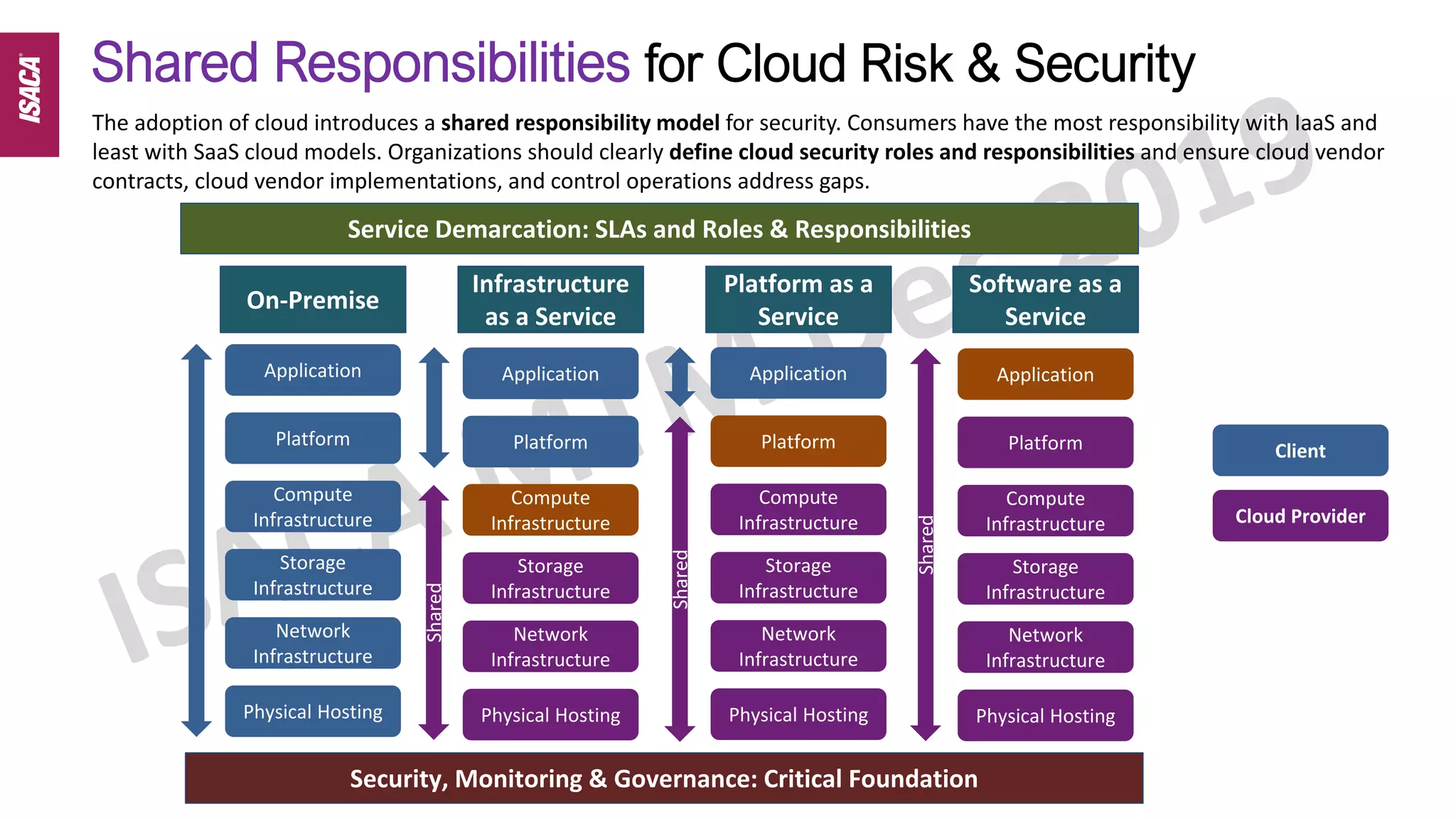
Shared Responsibilities for Cloud Risk & Security
The adoption of cloud introduces a shared responsibility model for security. Consumers have the most responsibility with IaaS and
least with SaaS cloud models. Organizations should clearly define cloud security roles and responsibilities and ensure cloud vendor
contracts, cloud vendor implementations, and control operations address gaps.
Infrastructure
as a Service
Physical Hosting
Network
Infrastructure
Storage
Infrastructure
Compute
Infrastructure
Platform
Application
Software as a
Service
Physical Hosting
Network
Infrastructure
Storage
Infrastructure
Compute
Infrastructure
Platform
Application
Shared
Shared
Shared
Platform as a
Service
Physical Hosting
Network
Infrastructure
Storage
Infrastructure
Compute
Infrastructure
Platform
Application
Physical Hosting
Network
Infrastructure
Storage
Infrastructure
Compute
Infrastructure
Platform
Application
On-Premise
Service Demarcation: SLAs and Roles & Responsibilities
Security, Monitoring & Governance: Critical Foundation
Client
Cloud Provider
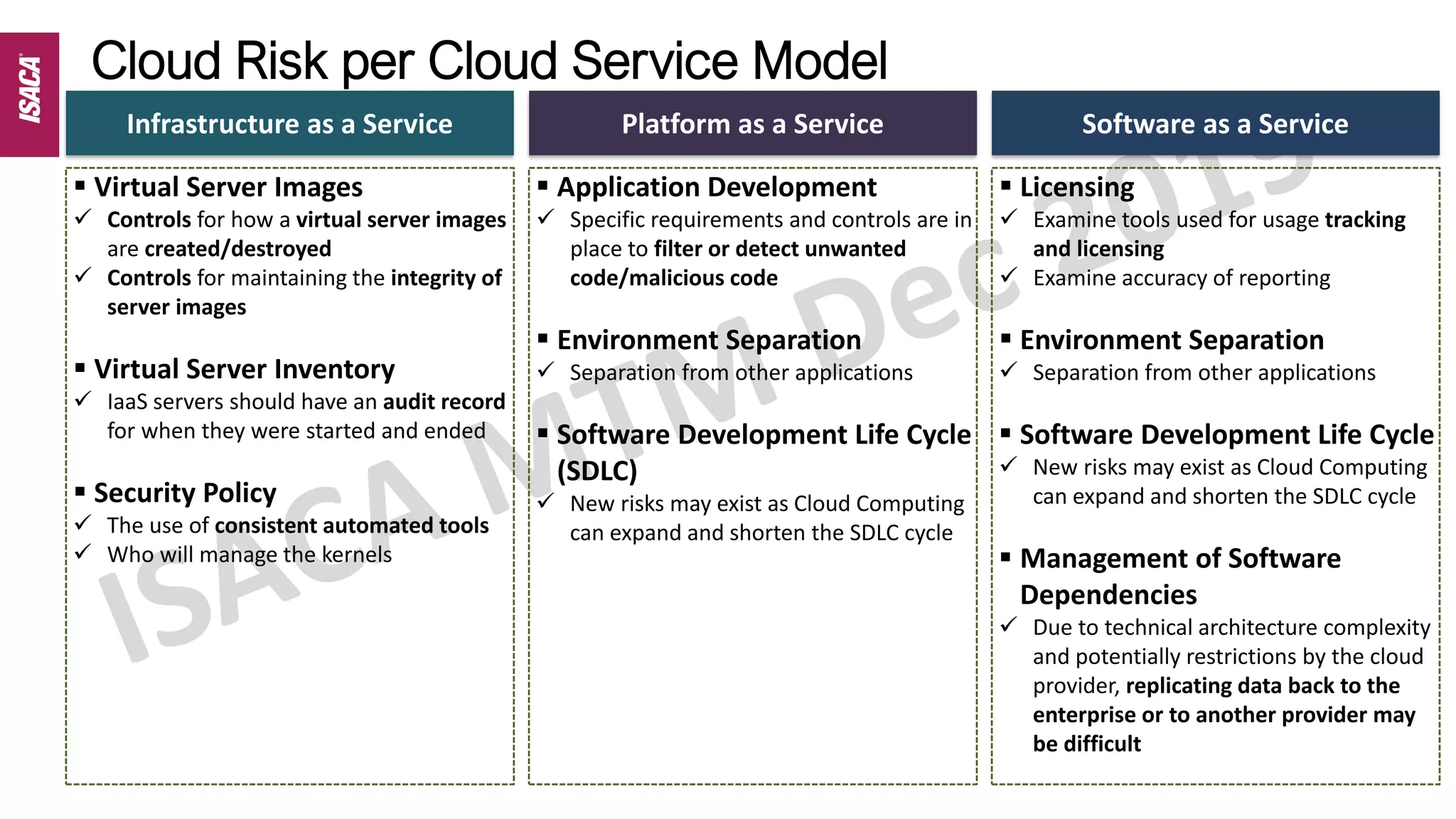
Cloud Risk per Cloud Service Model
Infrastructure as a Service Platform as a Service Software as a Service
▪ Virtual Server Images
✓ Controls for how a virtual server images
are created/destroyed
✓ Controls for maintaining the integrity of
server images
▪ Virtual Server Inventory
✓ IaaS servers should have an audit record
for when they were started and ended
▪ Security Policy
✓ The use of consistent automated tools
✓ Who will manage the kernels
▪ Application Development
✓ Specific requirements and controls are in
place to filter or detect unwanted
code/malicious code
▪ Environment Separation
✓ Separation from other applications
▪ Software Development Life Cycle
(SDLC)
✓ New risks may exist as Cloud Computing
can expand and shorten the SDLC cycle
▪ Licensing
✓ Examine tools used for usage tracking
and licensing
✓ Examine accuracy of reporting
▪ Environment Separation
✓ Separation from other applications
▪ Software Development Life Cycle
✓ New risks may exist as Cloud Computing
can expand and shorten the SDLC cycle
▪ Management of Software
Dependencies
✓ Due to technical architecture complexity
and potentially restrictions by the cloud
provider, replicating data back to the
enterprise or to another provider may
be difficult
10
Critical Areas of Focus in Cloud Computing
The domains are divided into two broad categories: Governance and Operations. The governance domains are broad and
address strategic and policy issues within a cloud computing environment, while the operational domains focus on more tactical
security concerns and implementation within the architecture.
Governance and
Enterprise Risk
Management
Legal Issues:
Contracts and
Electronic
Discovery
Compliance and
Audit
Management
Information
Governance
Management
Plane and Business
Continuity
Infrastructure
Security
Virtualization and
Containers
Incident Response,
Notification and
Remediation
Application
Security
Data Security and
Encryption
Identity,
Entitlement, and
Access
Management
Security as a
Service
Related
Technologies
11
Top Cloud Security Risks based on ENISA
Top Cloud
Risk
Loss of
Governance
Lock-In
Data
Protection
Compliance
Risk
Isolation
Failure
Management
Interface
Compromise
In using cloud infrastructures, the client necessarily hand over
control to the Cloud Provider (CP) on a number of issues which
may affect security. At the same time SLAs may not offer a
commitment to provide such services on the part of the cloud
provider, thus leaving a gap in security defenses
There is currently little on offer in the way of tools,
procedures or standard data formats or services
interfaces that could guarantee data, application
and service portability. This can make it difficult
for the customer to migrate from one provider to
another or migrate data and services back to an
in-house IT environment
Cloud computing poses several data protection
risks for cloud customers and providers. In some
cases, it may be difficult for the cloud customer
(in its role as data controller) to effectively check
the data handling practices of the cloud provider
and thus to be sure that the data is handled in a
lawful way.
investment in achieving certification (e.g., industry standard or
regulatory requirements) may be put at risk by migration to the
cloud: (1) IF the CP cannot provide evidence of their own
compliance with the relevant requirements or (2) IF the CP does
not permit audit by the cloud customer (CC)
This risk category covers the failure of
mechanisms separating storage,
memory, routing and even reputation
between different tenants (e.g., so-
called guest-hopping attacks).
Customer management interfaces of a
public cloud provider are accessible
through the Internet and mediate access
to larger sets of resources (than
traditional hosting providers) and
therefore pose an increased risk
Auditing the Cloud
13
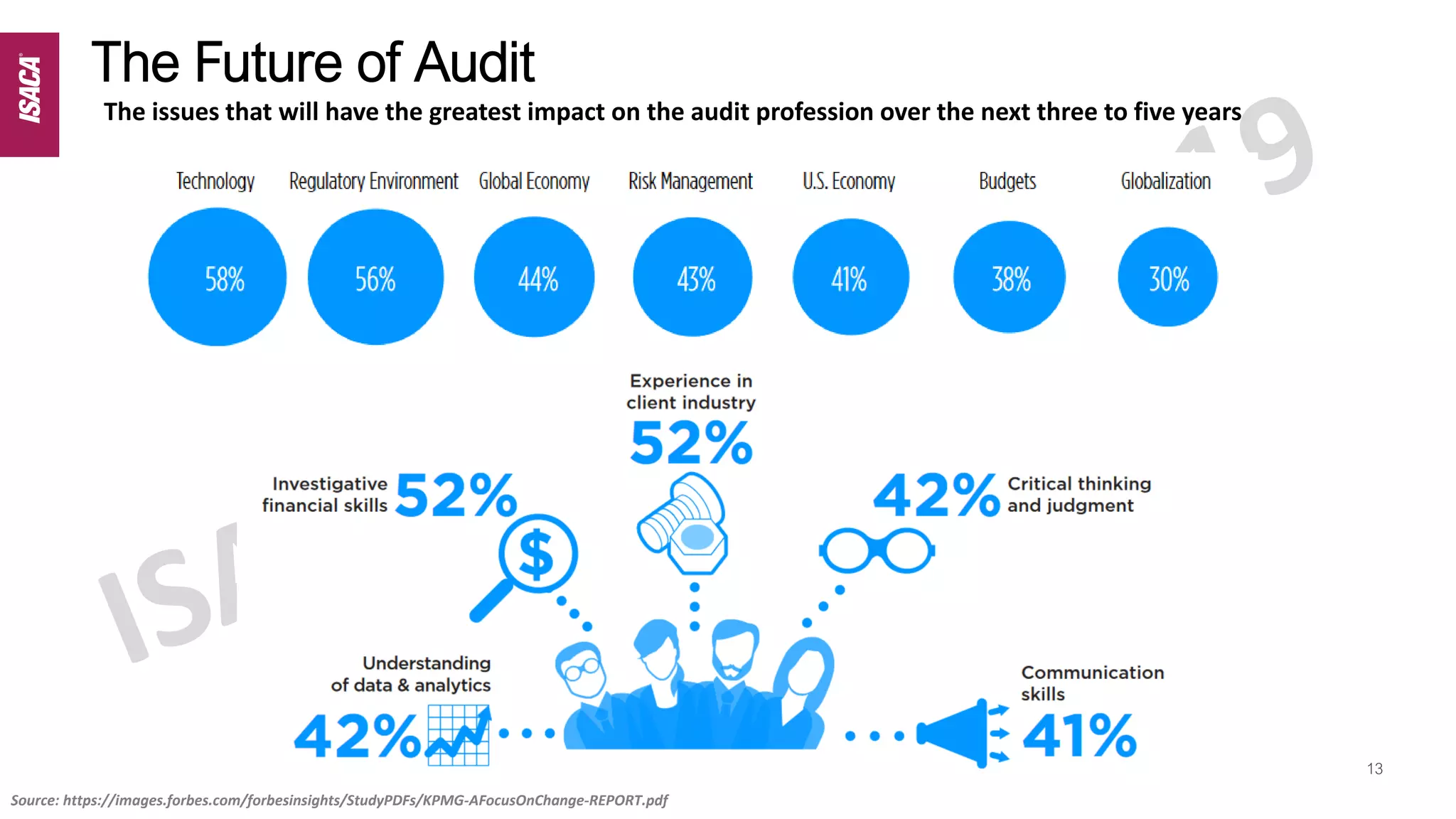
The Future of Audit
The issues that will have the greatest impact on the audit profession over the next three to five years
Source: https://images.forbes.com/forbesinsights/StudyPDFs/KPMG-AFocusOnChange-REPORT.pdf
14
Typical Audit Plan
▪ Internal Controls
▪ Regulatory Requirements
▪ Vendor Management Requirements
(Second/Third Party Audit)
▪ Policy Procedures
▪ Business Processes
▪ Functions
▪ Applications
▪ Infrastructure
▪ Vendors / Cloud Provider(s)
Some basic questions when building cloud audit
plan:Audit Objectives
Audit Scope
Cloud
Audit
Context
Is the service or application authorized to be in the
cloud?
What is the role of the application or service?
What type of information or data is used by
the application?
Do we have the right skills, competencies and
staff to operate in the cloud?
Have risks changed given the use of cloud services
be they SaaS or IaaS?
15
Auditing Challenges with Cloud Computing
A disruptive technology, like cloud computing, can impact “how” to audit
❑ Understanding the scope of the cloud computing environment
✓ Do you use the same matrix for public clouds as for private clouds? (internal vs external)
✓ The concept of a perimeter in a multi-tenant environment doesn’t make sense anymore
❑ Can your current risk assessment capture the risks correctly?
❑ Sample selection
✓ What is the universal population from which to pick a sample from?
✓ What would your sample selection methodology be in a highly dynamic environment?
✓ A snapshot in time may depend if it’s a high or low peak point in time
❑ Audit trails
✓ How do you “test” historical data if there was no audit trail?
❑ Other
✓ Educating the audit committee
✓ Overcoming internal barriers restricting the early involvement of internal audit as a ‘risk
advisor’ to the business and IT
16
Standards applicable to cloud security auditing
Standard Type Strength
Sponsoring
Organization
Service Organization
Control 2
Audit for outsourced
service
Technology neutral AICPA
ISO 27001 & 27002 Traditional security audit Technology neutral ISO
NIST SP800-53 rev 4 Federal Government
audit
Technology neutral NIST
Cloud Security Alliance Cloud-specific audit Dedicated to cloud
security auditing
CSA
PCI DSS PCI Qualified Security
Assessor cloud
supplement
Cloud specific and
provide guidance
PCI DSS
17
Auditing the Cloud
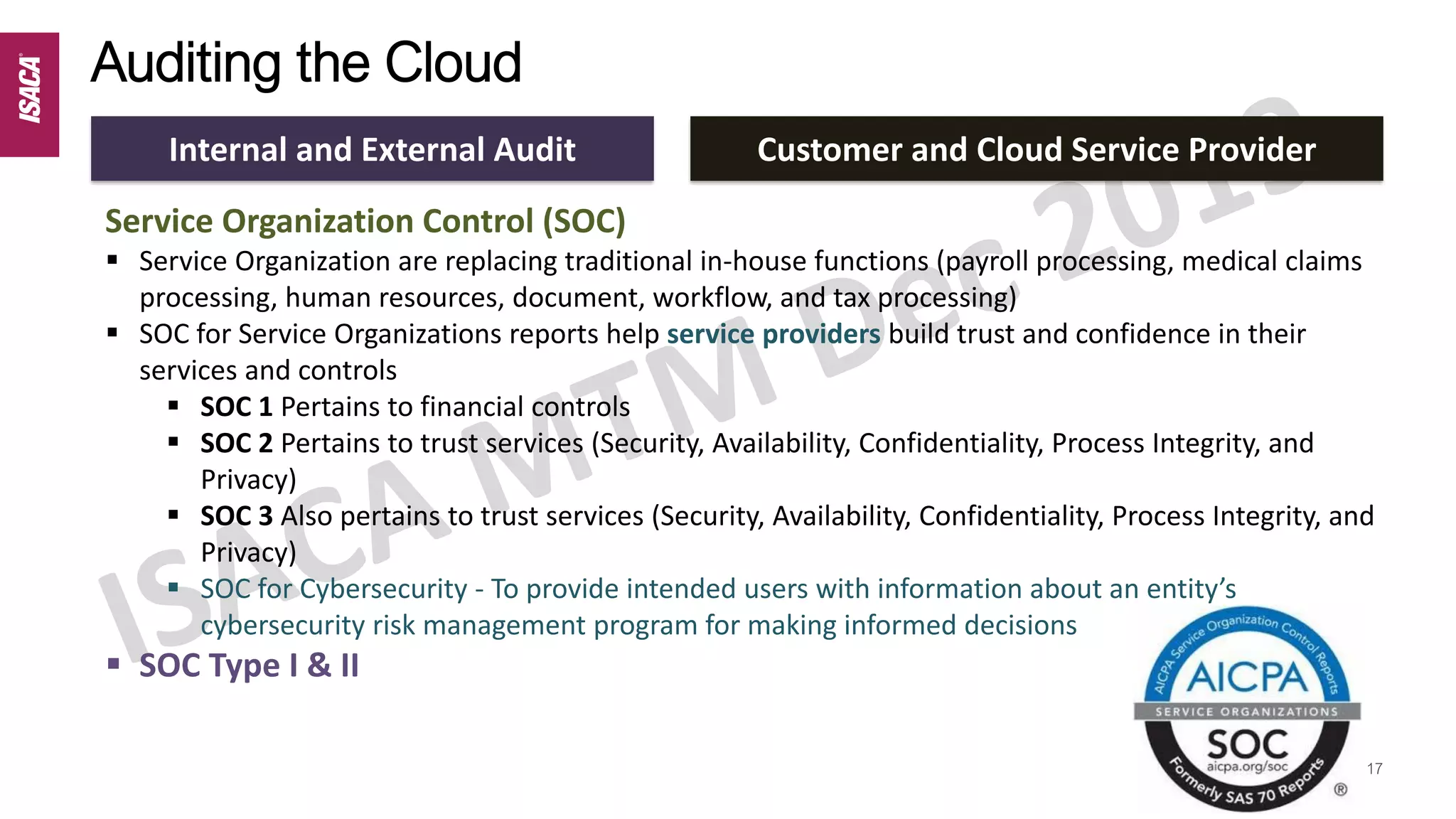
Service Organization Control (SOC)
▪ Service Organization are replacing traditional in-house functions (payroll processing, medical claims
processing, human resources, document, workflow, and tax processing)
▪ SOC for Service Organizations reports help service providers build trust and confidence in their
services and controls
▪ SOC 1 Pertains to financial controls
▪ SOC 2 Pertains to trust services (Security, Availability, Confidentiality, Process Integrity, and
Privacy)
▪ SOC 3 Also pertains to trust services (Security, Availability, Confidentiality, Process Integrity, and
Privacy)
▪ SOC for Cybersecurity - To provide intended users with information about an entity’s
cybersecurity risk management program for making informed decisions
▪ SOC Type I & II
Internal and External Audit Customer and Cloud Service Provider
18
SOC Comparison
SOC Type Who Uses the Audit Info Why
What the Audit Reports
On
SOC 1 Users’ controller’s office and
users’ auditors
Audits of financial
statements
Internal controls over
financial statements
SOC 2 Internal management,
regulators
▪ GRC programs
▪ Oversight
▪ Due Diligence
Security, availability,
processing integrity and
privacy controls
SOC 3 General public ▪ Marketing Purposes
▪ Detail not required
General customer
assurance, marketing
SOC Cybersecurity Senior management, board
of directors, analysts,
investors, business partners
To provide intended
users with information
about an entity’s
cybersecurity risk
management program
for making informed
decisions
Enterprise-wide
cybersecurity risk
management program
19
Service Organization Controls - SOC 2 and 3
AICPA guidance — Footnote 1 of TSP section 100, Trust
Services Principles, Criteria, and Illustrations for Security,
Availability, Processing Integrity, Confidentiality, and Privacy
(AICPA, Technical Practice Aids), contains the following
definition of a system:
▪ Infrastructure — The physical and hardware
components of a system (facilities, equipment, and
networks)
▪ Software — The programs and operating software of a
system (systems, applications, and utilities)
▪ People — The personnel involved in the operation and
use of a system (developers, operators, users, and
managers)
▪ Procedures — The automated and manual procedures
involved in the operation of a system
▪ Data — The information used and supported by a
system (transaction streams, files, databases, and
tables)
Criteria for evaluating and reporting on controls related
to security, availability, processing integrity,
confidentiality, and privacy:
▪ Security — The system is protected against
unauthorized access (both physical and logical).
▪ Availability — The system is available for operation
and use as committed or agreed.
▪ Processing integrity — System processing is
complete, accurate, timely, and authorized.
▪ Confidentiality — Information designated as
confidential is protected as committed or agreed.
▪ Privacy — Personal information is collected, used,
retained, disclosed, and destroyed in conformity with
the commitments in the entity’s privacy notice and
with criteria set forth in Generally Accepted Privacy
Principles (GAPP)
20
SOC 2 Applicability
Considerations of where SOC2 reports may be applicable for your organization, SOC 2 Reports are
applicable when an entity outsources the collection, processing, transmission, storing, organizing,
maintenance or disposal of the entity’s information.
Here are some examples where a SOC 2 report should be obtained:
Cloud Service
Providers
Fintech
Intellectual
Property
Protection
Sales Force
Automation
HealthCare
Providers and
Payers, HIPAA
Data Center
Hosting Service
Providers
21
Service Organization Controls - SOC 2/3
Security
▪ IT security policy
▪ Security awareness and
communication
▪ Risk assessment
▪ Physical access
▪ Environmental controls
▪ Security monitoring
(breaches)
▪ User authentication
▪ Incident management
▪ Asset classification and
management
▪ Systems development and
maintenance
▪ Logical access
▪ Configuration
management
Availability Confidentiality Processing Integrity Privacy
▪ Availability policy
▪ Backup and restoration
▪ Disaster recovery
▪ Confidentiality policy
▪ Confidentiality of inputs
▪ Confidentiality of data
processing
▪ Confidentiality of outputs
▪ Information disclosures
(including third parties)
▪ Confidentiality of
Information in systems
development
▪ System processing
integrity policies
▪ Completeness, accuracy,
timeliness, and
authorization of inputs,
system processing, and
outputs
▪ Information tracing from
source to disposition
▪ Notice
▪ Choice
▪ Access
▪ Security
▪ Data Integrity
▪ Training and Awareness
▪ Enforcement and
Compliance
22
Cloud Security Alliance - Cloud Controls Matrix
The Cloud Security Alliance (CSA) Cloud Controls Matrix (CCM) is specifically designed to provide
fundamental security principles to guide cloud vendors and to assist prospective cloud
customers in assessing the overall security risk of a cloud provider.
▪ It provides a controls framework is aligned to the
Cloud Security Alliance guidance in 16 domains.
▪ The foundations rest on its customized relationship
to other industry-accepted security standards,
regulations, and controls frameworks such as the
ISO 27001/27002, ISACA COBIT, PCI, NIST, Jericho
Forum and NERC CIP
▪ It will augment or provide internal
control direction for SOC attestations
provided by cloud providers.
23
Cloud Security Alliance - Cloud Controls Matrix
The Cloud Security Alliance (CSA) Cloud Controls Matrix (CCM) domains.
1. Application & Interface Security
2. Audit Assurance & Compliance
3. Business Continuity Management & Operational
Resilience
4. Change Control & Configuration Management
5. Data Security & Information Lifecycle Management
6. Datacenter Security
7. Encryption & Key Management
8. Governance and Risk Management
9. Human Resources
10. Identity & Access Management
11. Infrastructure & Virtualization Security
12. Interoperability & Portability
13. Mobile Security
14. Security Incident Management, E-Discovery & Cloud
Forensics
15. Supply Chain Management, Transparency and
Accountability
16. Threat and Vulnerability Management
24
CSA CCM Working Paper
Service Model Cloud Provider vs Customer
25
CSA CCM Working Paper
Mapping to AICPA Trust Service Criteria
Cloud Audit Implementation - Example
Disclaimer:
Because of time limitation to present the material, for example purpose, this section will cover the overview of Google
Cloud features which support audit function as the speaker experience is on GCP platform.
27
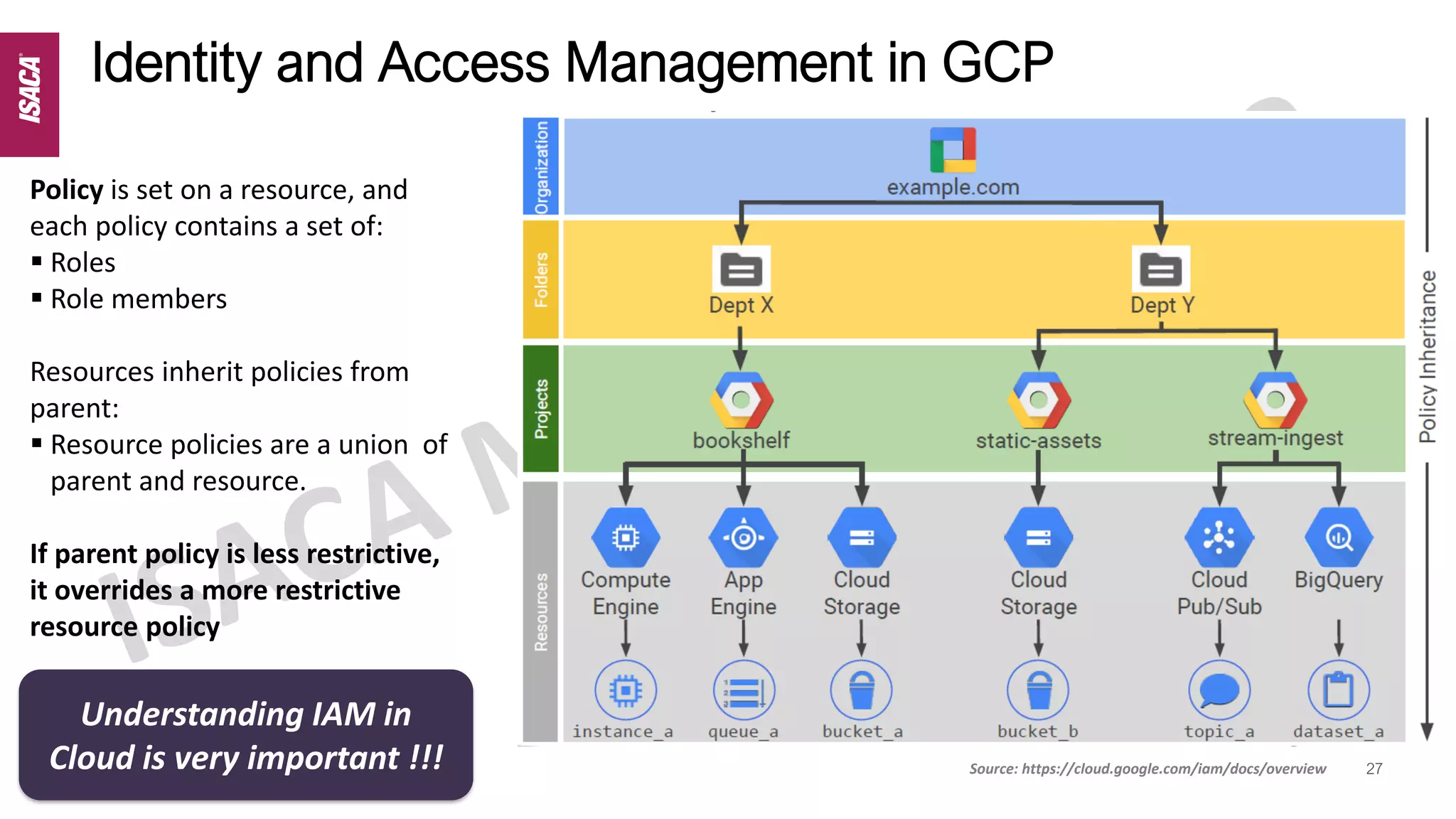
Identity and Access Management in GCP
Source: https://cloud.google.com/iam/docs/overview
Policy is set on a resource, and
each policy contains a set of:
▪ Roles
▪ Role members
Resources inherit policies from
parent:
▪ Resource policies are a union of
parent and resource.
If parent policy is less restrictive,
it overrides a more restrictive
resource policy
Understanding IAM in
Cloud is very important !!!
28
Permissions Management in GCP
Source: https://cloud.google.com/iam/docs/overview
29
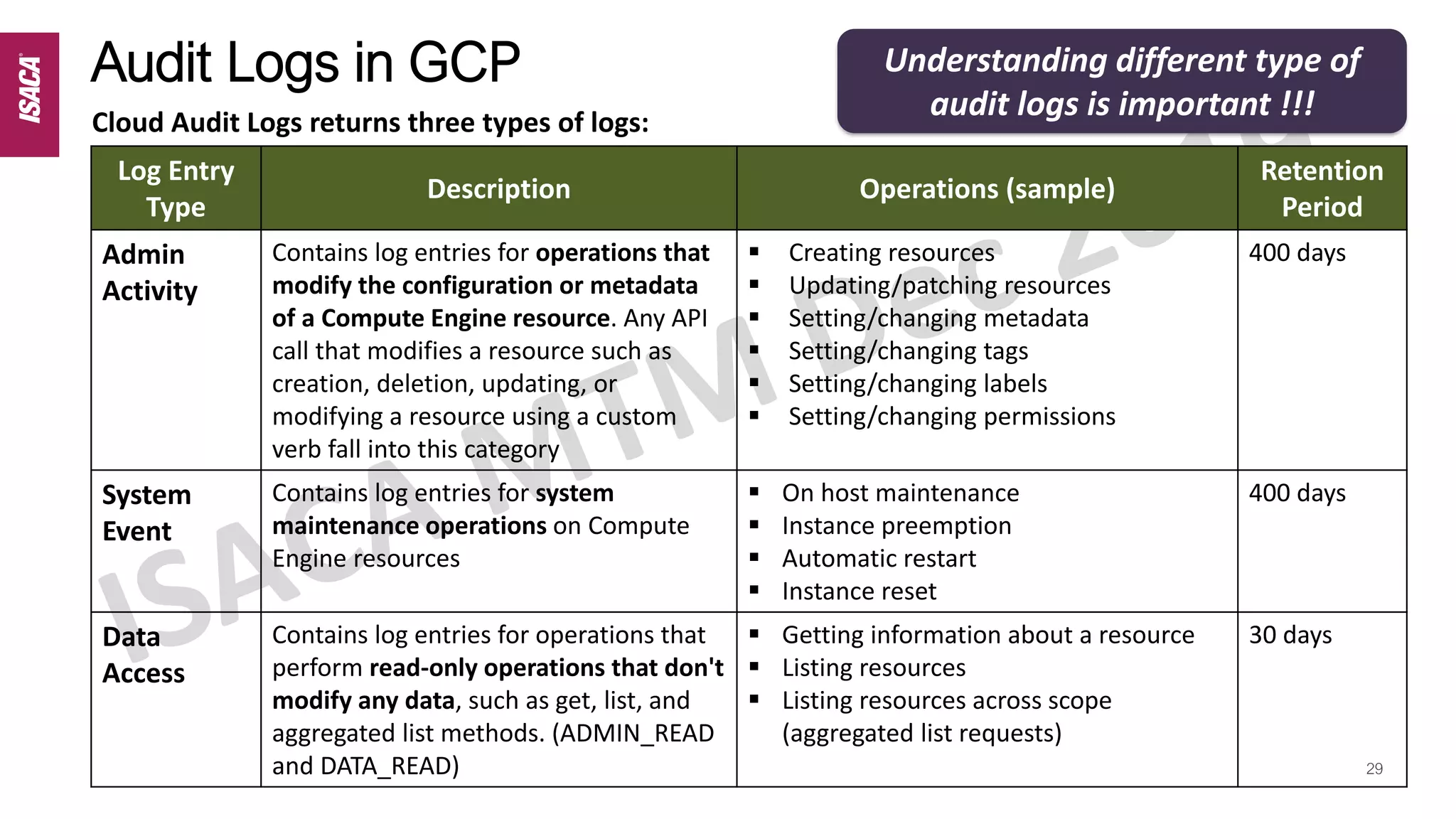
Audit Logs in GCP
Cloud Audit Logs returns three types of logs:
Log Entry
Type
Description Operations (sample)
Retention
Period
Admin
Activity
Contains log entries for operations that
modify the configuration or metadata
of a Compute Engine resource. Any API
call that modifies a resource such as
creation, deletion, updating, or
modifying a resource using a custom
verb fall into this category
▪ Creating resources
▪ Updating/patching resources
▪ Setting/changing metadata
▪ Setting/changing tags
▪ Setting/changing labels
▪ Setting/changing permissions
400 days
System
Event
Contains log entries for system
maintenance operations on Compute
Engine resources
▪ On host maintenance
▪ Instance preemption
▪ Automatic restart
▪ Instance reset
400 days
Data
Access
Contains log entries for operations that
perform read-only operations that don't
modify any data, such as get, list, and
aggregated list methods. (ADMIN_READ
and DATA_READ)
▪ Getting information about a resource
▪ Listing resources
▪ Listing resources across scope
(aggregated list requests)
30 days
Understanding different type of
audit logs is important !!!
30
Groups vs Label vs Tags
Source: https://cloud.google.com/blog/products/gcp/labelling-and-grouping-your-google-cloud-platform-resources
Labels -> billing / cost transparency
Tags -> manage network traffic
Security Marks -> resource grouping
31
Scenario - Monitoring and Logging for Cloud Functions
32
Scenario - Logging the Kubernetes Engine
33
Scenario - Logging with Kubernetes Engine
34
Cloud Audit Logs Best Practices
Cloud Audit Logs is a powerful tool that can help you manage and troubleshoot your GCP environment, as
well as demonstrate compliance. Here are some best practices to keep in mind:
❑ Use a test project to validate the configuration of your data-access audit collection
before propagating to developer and production projects
❑ Be sure you’ve applied appropriate IAM controls to restrict who can access the audit
logs
❑ Determine whether you need to export logs for longer-term retention
❑ Design aggregated exports on which your organization can filter and export the data
for future analysis
❑ Configure log sinks before you start receiving logs
❑ Follow the best practices for common logging export scenarios
❑ Make sure to use exclusion filters to exclude logging data that isn’t useful.
35
See the difference between
“IT Auditor” and “Engineer Auditor” ?
General Control Specific Controlvs
Surrounding environment Specific Resources
36
KEY TAKEAWAYS
Cloud customers have to understand the share responsibilities between customer
and cloud provider
Different cloud service model (IaaS, PaaS, SaaS) has different audit
methodology
Customer’s IT Auditor have to be trained to have the skills needed to audit
the cloud service
Understanding IAM in Cloud is very important. Each Cloud Service Provider
has different IAM mechanism
Understanding different type of audit logs in cloud platform is important for IT
Auditor
Case Studies
Notes:
Contact me directly for further discussion ☺
Thank You ☺

The Art of Cloud Auditing - ISACA ID

  • 1.
    11 THE ART OF CLOUDAUDITING Eryk Budi Pratama CSX Team ISACA Indonesia Chapter 11 December 2019
  • 2.
    About Me ❑CSX TeamMember, ISACA ID ❑Cyber Security & IT Advisory Professional ❑Community Enthusiast ❑Blogger / Writer ❑Knowledge Hunter ❑Do some “magic” ❑https://medium.com/@proferyk ❑https://www.slideshare.net/proferyk https://www.linkedin.com/in/erykbudipratama/
  • 3.
    ISACA Indonesia Chapter(Join Us ☺) http://www.isaca.or.id The chapter was established in 1993. We have been and continue organizing various talks, seminars, conference, forums and other activities to keep our members informed of the latest audit, security and control issues which members can attend at concession rates. Growing number of members of more than 700, with 400++ ISACA certified members from various industry https://www.isaca.org
  • 4.
    Setup the Context Industry,Geography, Sector, Market, Regulatory Environment Management, Funding, Staffing Levels & Competencies, Strategy & Initiatives Procure to Pay, HR, Operations, Revenue & Receivables, SG&A, Marketing, Legal SaaS, On-Premise (tied to lines of business and processes) App Code, Databases, OS, Hypervisors, Compute, Networks (SAN, Backup, WAN/LAN) Business Processes Application Infrastructure Micro Macro Know how each layer impacts the others What should not go to the cloud? Why? How does this broader context affect your perspective of cloud services ? Common IT focus
  • 5.
    Cloud Risk &Security
  • 6.
    Deployment Model Service Model EssentialCharacteristics 6 Cloud Computing – Know the Basic Cloud computing is a very clearly defined computing model with essential characteristics On-demand self service Broad access network Resource pooling Rapid elasticity Measured service Infrastructure as a Service (IaaS) Platform as a Service (PaaS) Software as a Service (SaaS) Public Private Hybrid Community
  • 7.
    7 Common Cloud RiskQuestions What do you believe to be the most common cloud risks? Account lock-out / resource hijacking • Who has administrative control over the service or account? Misconfiguration leading to a breach • How can we assess the security and appropriateness of configurations? Loss of control • How are we defining control in the context of the cloud? Asymmetries between the provider and customer • Who has greater power in negotiations (T&Cs / Pricing)? Multi-tenancy • What are the impact of multi-tenancy? Jurisdictional • How does the location of services impact legal / compliance requirements?
  • 8.
    Shared Responsibilities forCloud Risk & Security The adoption of cloud introduces a shared responsibility model for security. Consumers have the most responsibility with IaaS and least with SaaS cloud models. Organizations should clearly define cloud security roles and responsibilities and ensure cloud vendor contracts, cloud vendor implementations, and control operations address gaps. Infrastructure as a Service Physical Hosting Network Infrastructure Storage Infrastructure Compute Infrastructure Platform Application Software as a Service Physical Hosting Network Infrastructure Storage Infrastructure Compute Infrastructure Platform Application Shared Shared Shared Platform as a Service Physical Hosting Network Infrastructure Storage Infrastructure Compute Infrastructure Platform Application Physical Hosting Network Infrastructure Storage Infrastructure Compute Infrastructure Platform Application On-Premise Service Demarcation: SLAs and Roles & Responsibilities Security, Monitoring & Governance: Critical Foundation Client Cloud Provider
  • 9.
    Cloud Risk perCloud Service Model Infrastructure as a Service Platform as a Service Software as a Service ▪ Virtual Server Images ✓ Controls for how a virtual server images are created/destroyed ✓ Controls for maintaining the integrity of server images ▪ Virtual Server Inventory ✓ IaaS servers should have an audit record for when they were started and ended ▪ Security Policy ✓ The use of consistent automated tools ✓ Who will manage the kernels ▪ Application Development ✓ Specific requirements and controls are in place to filter or detect unwanted code/malicious code ▪ Environment Separation ✓ Separation from other applications ▪ Software Development Life Cycle (SDLC) ✓ New risks may exist as Cloud Computing can expand and shorten the SDLC cycle ▪ Licensing ✓ Examine tools used for usage tracking and licensing ✓ Examine accuracy of reporting ▪ Environment Separation ✓ Separation from other applications ▪ Software Development Life Cycle ✓ New risks may exist as Cloud Computing can expand and shorten the SDLC cycle ▪ Management of Software Dependencies ✓ Due to technical architecture complexity and potentially restrictions by the cloud provider, replicating data back to the enterprise or to another provider may be difficult
  • 10.
    10 Critical Areas ofFocus in Cloud Computing The domains are divided into two broad categories: Governance and Operations. The governance domains are broad and address strategic and policy issues within a cloud computing environment, while the operational domains focus on more tactical security concerns and implementation within the architecture. Governance and Enterprise Risk Management Legal Issues: Contracts and Electronic Discovery Compliance and Audit Management Information Governance Management Plane and Business Continuity Infrastructure Security Virtualization and Containers Incident Response, Notification and Remediation Application Security Data Security and Encryption Identity, Entitlement, and Access Management Security as a Service Related Technologies
  • 11.
    11 Top Cloud SecurityRisks based on ENISA Top Cloud Risk Loss of Governance Lock-In Data Protection Compliance Risk Isolation Failure Management Interface Compromise In using cloud infrastructures, the client necessarily hand over control to the Cloud Provider (CP) on a number of issues which may affect security. At the same time SLAs may not offer a commitment to provide such services on the part of the cloud provider, thus leaving a gap in security defenses There is currently little on offer in the way of tools, procedures or standard data formats or services interfaces that could guarantee data, application and service portability. This can make it difficult for the customer to migrate from one provider to another or migrate data and services back to an in-house IT environment Cloud computing poses several data protection risks for cloud customers and providers. In some cases, it may be difficult for the cloud customer (in its role as data controller) to effectively check the data handling practices of the cloud provider and thus to be sure that the data is handled in a lawful way. investment in achieving certification (e.g., industry standard or regulatory requirements) may be put at risk by migration to the cloud: (1) IF the CP cannot provide evidence of their own compliance with the relevant requirements or (2) IF the CP does not permit audit by the cloud customer (CC) This risk category covers the failure of mechanisms separating storage, memory, routing and even reputation between different tenants (e.g., so- called guest-hopping attacks). Customer management interfaces of a public cloud provider are accessible through the Internet and mediate access to larger sets of resources (than traditional hosting providers) and therefore pose an increased risk
  • 12.
  • 13.
    13 The Future ofAudit The issues that will have the greatest impact on the audit profession over the next three to five years Source: https://images.forbes.com/forbesinsights/StudyPDFs/KPMG-AFocusOnChange-REPORT.pdf
  • 14.
    14 Typical Audit Plan ▪Internal Controls ▪ Regulatory Requirements ▪ Vendor Management Requirements (Second/Third Party Audit) ▪ Policy Procedures ▪ Business Processes ▪ Functions ▪ Applications ▪ Infrastructure ▪ Vendors / Cloud Provider(s) Some basic questions when building cloud audit plan:Audit Objectives Audit Scope Cloud Audit Context Is the service or application authorized to be in the cloud? What is the role of the application or service? What type of information or data is used by the application? Do we have the right skills, competencies and staff to operate in the cloud? Have risks changed given the use of cloud services be they SaaS or IaaS?
  • 15.
    15 Auditing Challenges withCloud Computing A disruptive technology, like cloud computing, can impact “how” to audit ❑ Understanding the scope of the cloud computing environment ✓ Do you use the same matrix for public clouds as for private clouds? (internal vs external) ✓ The concept of a perimeter in a multi-tenant environment doesn’t make sense anymore ❑ Can your current risk assessment capture the risks correctly? ❑ Sample selection ✓ What is the universal population from which to pick a sample from? ✓ What would your sample selection methodology be in a highly dynamic environment? ✓ A snapshot in time may depend if it’s a high or low peak point in time ❑ Audit trails ✓ How do you “test” historical data if there was no audit trail? ❑ Other ✓ Educating the audit committee ✓ Overcoming internal barriers restricting the early involvement of internal audit as a ‘risk advisor’ to the business and IT
  • 16.
    16 Standards applicable tocloud security auditing Standard Type Strength Sponsoring Organization Service Organization Control 2 Audit for outsourced service Technology neutral AICPA ISO 27001 & 27002 Traditional security audit Technology neutral ISO NIST SP800-53 rev 4 Federal Government audit Technology neutral NIST Cloud Security Alliance Cloud-specific audit Dedicated to cloud security auditing CSA PCI DSS PCI Qualified Security Assessor cloud supplement Cloud specific and provide guidance PCI DSS
  • 17.
    17 Auditing the Cloud ServiceOrganization Control (SOC) ▪ Service Organization are replacing traditional in-house functions (payroll processing, medical claims processing, human resources, document, workflow, and tax processing) ▪ SOC for Service Organizations reports help service providers build trust and confidence in their services and controls ▪ SOC 1 Pertains to financial controls ▪ SOC 2 Pertains to trust services (Security, Availability, Confidentiality, Process Integrity, and Privacy) ▪ SOC 3 Also pertains to trust services (Security, Availability, Confidentiality, Process Integrity, and Privacy) ▪ SOC for Cybersecurity - To provide intended users with information about an entity’s cybersecurity risk management program for making informed decisions ▪ SOC Type I & II Internal and External Audit Customer and Cloud Service Provider
  • 18.
    18 SOC Comparison SOC TypeWho Uses the Audit Info Why What the Audit Reports On SOC 1 Users’ controller’s office and users’ auditors Audits of financial statements Internal controls over financial statements SOC 2 Internal management, regulators ▪ GRC programs ▪ Oversight ▪ Due Diligence Security, availability, processing integrity and privacy controls SOC 3 General public ▪ Marketing Purposes ▪ Detail not required General customer assurance, marketing SOC Cybersecurity Senior management, board of directors, analysts, investors, business partners To provide intended users with information about an entity’s cybersecurity risk management program for making informed decisions Enterprise-wide cybersecurity risk management program
  • 19.
    19 Service Organization Controls- SOC 2 and 3 AICPA guidance — Footnote 1 of TSP section 100, Trust Services Principles, Criteria, and Illustrations for Security, Availability, Processing Integrity, Confidentiality, and Privacy (AICPA, Technical Practice Aids), contains the following definition of a system: ▪ Infrastructure — The physical and hardware components of a system (facilities, equipment, and networks) ▪ Software — The programs and operating software of a system (systems, applications, and utilities) ▪ People — The personnel involved in the operation and use of a system (developers, operators, users, and managers) ▪ Procedures — The automated and manual procedures involved in the operation of a system ▪ Data — The information used and supported by a system (transaction streams, files, databases, and tables) Criteria for evaluating and reporting on controls related to security, availability, processing integrity, confidentiality, and privacy: ▪ Security — The system is protected against unauthorized access (both physical and logical). ▪ Availability — The system is available for operation and use as committed or agreed. ▪ Processing integrity — System processing is complete, accurate, timely, and authorized. ▪ Confidentiality — Information designated as confidential is protected as committed or agreed. ▪ Privacy — Personal information is collected, used, retained, disclosed, and destroyed in conformity with the commitments in the entity’s privacy notice and with criteria set forth in Generally Accepted Privacy Principles (GAPP)
  • 20.
    20 SOC 2 Applicability Considerationsof where SOC2 reports may be applicable for your organization, SOC 2 Reports are applicable when an entity outsources the collection, processing, transmission, storing, organizing, maintenance or disposal of the entity’s information. Here are some examples where a SOC 2 report should be obtained: Cloud Service Providers Fintech Intellectual Property Protection Sales Force Automation HealthCare Providers and Payers, HIPAA Data Center Hosting Service Providers
  • 21.
    21 Service Organization Controls- SOC 2/3 Security ▪ IT security policy ▪ Security awareness and communication ▪ Risk assessment ▪ Physical access ▪ Environmental controls ▪ Security monitoring (breaches) ▪ User authentication ▪ Incident management ▪ Asset classification and management ▪ Systems development and maintenance ▪ Logical access ▪ Configuration management Availability Confidentiality Processing Integrity Privacy ▪ Availability policy ▪ Backup and restoration ▪ Disaster recovery ▪ Confidentiality policy ▪ Confidentiality of inputs ▪ Confidentiality of data processing ▪ Confidentiality of outputs ▪ Information disclosures (including third parties) ▪ Confidentiality of Information in systems development ▪ System processing integrity policies ▪ Completeness, accuracy, timeliness, and authorization of inputs, system processing, and outputs ▪ Information tracing from source to disposition ▪ Notice ▪ Choice ▪ Access ▪ Security ▪ Data Integrity ▪ Training and Awareness ▪ Enforcement and Compliance
  • 22.
    22 Cloud Security Alliance- Cloud Controls Matrix The Cloud Security Alliance (CSA) Cloud Controls Matrix (CCM) is specifically designed to provide fundamental security principles to guide cloud vendors and to assist prospective cloud customers in assessing the overall security risk of a cloud provider. ▪ It provides a controls framework is aligned to the Cloud Security Alliance guidance in 16 domains. ▪ The foundations rest on its customized relationship to other industry-accepted security standards, regulations, and controls frameworks such as the ISO 27001/27002, ISACA COBIT, PCI, NIST, Jericho Forum and NERC CIP ▪ It will augment or provide internal control direction for SOC attestations provided by cloud providers.
  • 23.
    23 Cloud Security Alliance- Cloud Controls Matrix The Cloud Security Alliance (CSA) Cloud Controls Matrix (CCM) domains. 1. Application & Interface Security 2. Audit Assurance & Compliance 3. Business Continuity Management & Operational Resilience 4. Change Control & Configuration Management 5. Data Security & Information Lifecycle Management 6. Datacenter Security 7. Encryption & Key Management 8. Governance and Risk Management 9. Human Resources 10. Identity & Access Management 11. Infrastructure & Virtualization Security 12. Interoperability & Portability 13. Mobile Security 14. Security Incident Management, E-Discovery & Cloud Forensics 15. Supply Chain Management, Transparency and Accountability 16. Threat and Vulnerability Management
  • 24.
    24 CSA CCM WorkingPaper Service Model Cloud Provider vs Customer
  • 25.
    25 CSA CCM WorkingPaper Mapping to AICPA Trust Service Criteria
  • 26.
    Cloud Audit Implementation- Example Disclaimer: Because of time limitation to present the material, for example purpose, this section will cover the overview of Google Cloud features which support audit function as the speaker experience is on GCP platform.
  • 27.
    27 Identity and AccessManagement in GCP Source: https://cloud.google.com/iam/docs/overview Policy is set on a resource, and each policy contains a set of: ▪ Roles ▪ Role members Resources inherit policies from parent: ▪ Resource policies are a union of parent and resource. If parent policy is less restrictive, it overrides a more restrictive resource policy Understanding IAM in Cloud is very important !!!
  • 28.
    28 Permissions Management inGCP Source: https://cloud.google.com/iam/docs/overview
  • 29.
    29 Audit Logs inGCP Cloud Audit Logs returns three types of logs: Log Entry Type Description Operations (sample) Retention Period Admin Activity Contains log entries for operations that modify the configuration or metadata of a Compute Engine resource. Any API call that modifies a resource such as creation, deletion, updating, or modifying a resource using a custom verb fall into this category ▪ Creating resources ▪ Updating/patching resources ▪ Setting/changing metadata ▪ Setting/changing tags ▪ Setting/changing labels ▪ Setting/changing permissions 400 days System Event Contains log entries for system maintenance operations on Compute Engine resources ▪ On host maintenance ▪ Instance preemption ▪ Automatic restart ▪ Instance reset 400 days Data Access Contains log entries for operations that perform read-only operations that don't modify any data, such as get, list, and aggregated list methods. (ADMIN_READ and DATA_READ) ▪ Getting information about a resource ▪ Listing resources ▪ Listing resources across scope (aggregated list requests) 30 days Understanding different type of audit logs is important !!!
  • 30.
    30 Groups vs Labelvs Tags Source: https://cloud.google.com/blog/products/gcp/labelling-and-grouping-your-google-cloud-platform-resources Labels -> billing / cost transparency Tags -> manage network traffic Security Marks -> resource grouping
  • 31.
    31 Scenario - Monitoringand Logging for Cloud Functions
  • 32.
    32 Scenario - Loggingthe Kubernetes Engine
  • 33.
    33 Scenario - Loggingwith Kubernetes Engine
  • 34.
    34 Cloud Audit LogsBest Practices Cloud Audit Logs is a powerful tool that can help you manage and troubleshoot your GCP environment, as well as demonstrate compliance. Here are some best practices to keep in mind: ❑ Use a test project to validate the configuration of your data-access audit collection before propagating to developer and production projects ❑ Be sure you’ve applied appropriate IAM controls to restrict who can access the audit logs ❑ Determine whether you need to export logs for longer-term retention ❑ Design aggregated exports on which your organization can filter and export the data for future analysis ❑ Configure log sinks before you start receiving logs ❑ Follow the best practices for common logging export scenarios ❑ Make sure to use exclusion filters to exclude logging data that isn’t useful.
  • 35.
    35 See the differencebetween “IT Auditor” and “Engineer Auditor” ? General Control Specific Controlvs Surrounding environment Specific Resources
  • 36.
    36 KEY TAKEAWAYS Cloud customershave to understand the share responsibilities between customer and cloud provider Different cloud service model (IaaS, PaaS, SaaS) has different audit methodology Customer’s IT Auditor have to be trained to have the skills needed to audit the cloud service Understanding IAM in Cloud is very important. Each Cloud Service Provider has different IAM mechanism Understanding different type of audit logs in cloud platform is important for IT Auditor
  • 37.
    Case Studies Notes: Contact medirectly for further discussion ☺
  • 38.