Nicole Wieberneit
CRM Roadmap
Methodology
3
1. Objectives
2. Approach
3. Work Plan and Framework
Agenda
Objectives
5
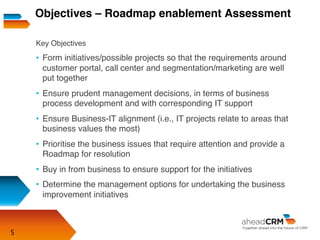
Key Objectives
•  Form initiatives/possible projects so that the requirements around
customer portal, call center and segmentation/marketing are well
put together
•  Ensure prudent management decisions, in terms of business
process development and with corresponding IT support
•  Ensure Business-IT alignment (i.e., IT projects relate to areas that
business values the most)
•  Prioritise the business issues that require attention and provide a
Roadmap for resolution
•  Buy in from business to ensure support for the initiatives
•  Determine the management options for undertaking the business
improvement initiatives
Objectives – Roadmap enablement Assessment
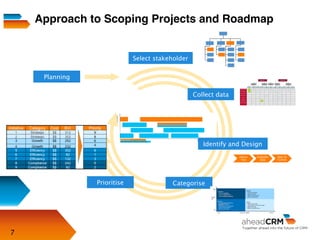
Approach
7
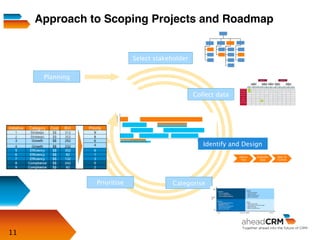
Collect data
CategorisePrioritise
Identify and Design
Define
Opp
Evaluate
Opp
Opp to
Funnel
Approach to Scoping Projects and Roadmap
Select stakeholder
Planning
8
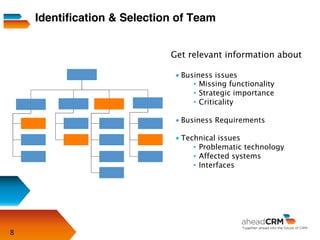
Identification & Selection of Team
• Business issues
•  Missing functionality
•  Strategic importance
•  Criticality
• Business Requirements
• Technical issues
•  Problematic technology
•  Affected systems
•  Interfaces
Get relevant information about
9
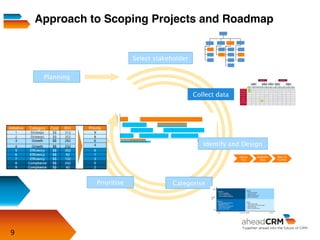
Collect data
CategorisePrioritise
Identify and Design
Define
Opp
Evaluate
Opp
Opp to
Funnel
Approach to Scoping Projects and Roadmap
Select stakeholder
Planning
10
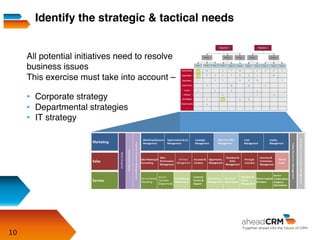
All potential initiatives need to resolve
business issues
This exercise must take into account –
•  Corporate strategy
•  Departmental strategies
•  IT strategy
Identify the strategic & tactical needs
11
Collect data
CategorisePrioritise
Identify and Design
Define
Opp
Evaluate
Opp
Opp to
Funnel
Approach to Scoping Projects and Roadmap
Select stakeholder
Planning
12
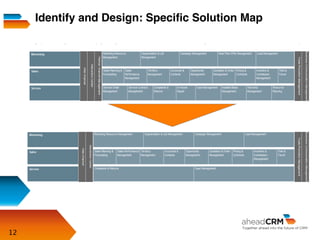
Identify and Design: Specific Solution Map
13
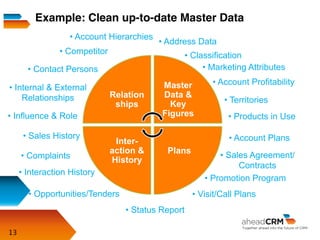
Example: Clean up-to-date Master Data
Relation
ships
Master
Data &
Key
Figures
Plans
Inter-
action &
History
• Account Plans
• Sales Agreement/
Contracts
• Visit/Call Plans
• Promotion Program
• Address Data
• Marketing Attributes
• Account Profitability
• Competitor
• Contact Persons
• Account Hierarchies
• Internal & External
Relationships
• Interaction History
• Sales History
• Opportunities/Tenders
• Classification
• Influence & Role
• Territories
• Products in Use
• Complaints
• Status Report
14
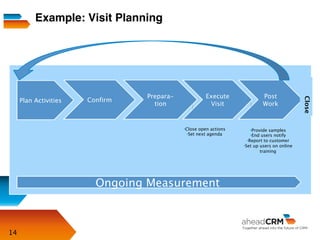
Example: Visit Planning
• Close open actions
• Set next agenda
• Provide samples
• End users notify
• Report to customer
• Set up users on online
training
Plan Activities
Post
Work
Confirm
Prepara-
tion
Execute
Visit
Close
Ongoing Measurement
15
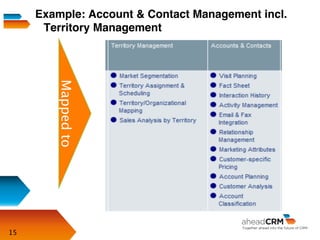
Example: Account & Contact Management incl.
Territory Management
Mappedto
16
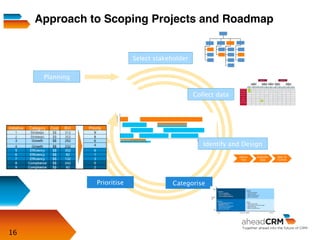
Collect data
CategorisePrioritise
Identify and Design
Define
Opp
Evaluate
Opp
Opp to
Funnel
Approach to Scoping Projects and Roadmap
Select stakeholder
Planning
17
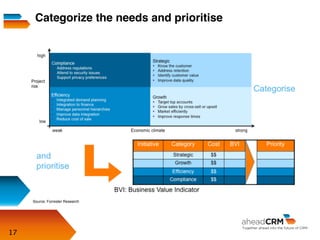
Categorize the needs and prioritise
Source: Forrester Research
18
• Each project carries a collective business
value metrics based on e.g.:
o Business Value – 14 parameters
o IT Efficiency – 11 parameters
o (Financial view – 5 parameters)
• Portfolio mix: agile, cost-based or balanced
• Reports risk and probability for success
Business Value Indicators allow Project
Prioritization by Business Value
19
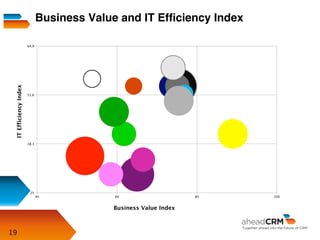
Business Value and IT Efficiency Index
25
38.3
51.6
64.9
40 60 80 100
ITEfficiencyIndex
Business Value Index
20
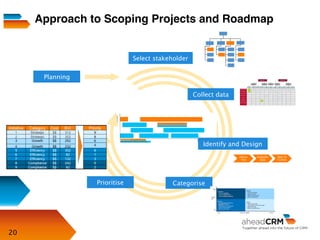
Collect data
CategorisePrioritise
Identify and Design
Define
Opp
Evaluate
Opp
Opp to
Funnel
Approach to Scoping Projects and Roadmap
Select stakeholder
Planning
21
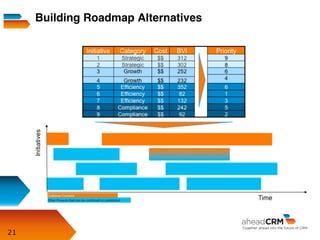
Building Roadmap Alternatives
22
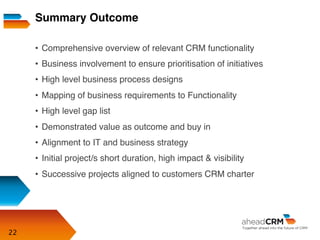
•  Comprehensive overview of relevant CRM functionality
•  Business involvement to ensure prioritisation of initiatives
•  High level business process designs
•  Mapping of business requirements to Functionality
•  High level gap list
•  Demonstrated value as outcome and buy in
•  Alignment to IT and business strategy
•  Initial project/s short duration, high impact & visibility
•  Successive projects aligned to customers CRM charter
Summary Outcome
Work Plan and
Framework
24
Functional Business workshops – { Business Streams }
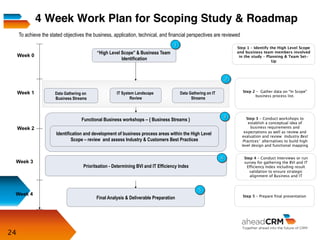
4 Week Work Plan for Scoping Study & Roadmap
Final Analysis & Deliverable Preparation
“High Level Scope” & Business Team
Identification
Identification and development of business process areas within the High Level
Scope – review and assess Industry & Customers Best Practices
IT System Landscape
Review
Data Gathering on
Business Streams
Step 2 – Gather data on “In Scope”
business process list.
Step 5 – Prepare final presentation
Step 3 – Conduct workshops to
establish a conceptual idea of
business requirements and
expectations as well as review and
evaluation and review Industry Best
Practices’ alternatives to build high
level design and functional mapping
Week 4
Week 1
Week 0
Week 2
Step 1 – Identify the High Level Scope
and business team members involved
in the study – Planning & Team Set-
Up
1
2
4
3
To achieve the stated objectives the business, application, technical, and financial perspectives are reviewed
Data Gathering on IT
Streams
Prioritsation - Determining BVI and IT Efficiency Index
Week 3
Step 4 – Conduct Interviews or run
survey for gathering the BVI and IT
Efficiency Index including result
validation to ensure strategic
alignment of Business and IT
4
5
25
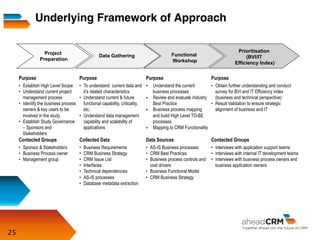
Underlying Framework of Approach
Purpose Purpose Purpose Purpose
•  Establish High Level Scope
•  Understand current project
management process
•  Identify the business process
owners & key users to be
involved in the study
•  Establish Study Governance
– Sponsors and
Stakeholders
•  To understand current data and
it’s related characteristics
•  Understand current & future
functional capability, criticality,
etc.
•  Understand data management
capability and scalability of
applications
•  Understand the current
business processes
§  Review and evaluate Industry
Best Practice
§  Business process mapping
and build High Level TO-BE
processes
§  Mapping to CRM Functionality
•  Obtain further understanding and conduct
survey for BVI and IT Efficiency index
(business and technical perspective)
•  Result Validation to ensure strategic
alignment of business and IT
Contacted Groups Collected Data Data Sources Contacted Groups
•  Sponsor & Stakeholders
•  Business Process owner
•  Management group
•  Business Requirements
•  CRM Business Strategy
•  CRM Issue List
•  Interfaces
•  Technical dependencies
•  AS-IS processes
•  Database metadata extraction
•  AS-IS Business processes
•  CRM Best Practices
•  Business process controls and
cost drivers
•  Business Functional Model
•  CRM Business Strategy
•  interviews with application support teams
•  interviews with internal IT development teams
•  interviews with business process owners and
business application owners
Data Gathering Functional
Workshop
Prioritisation
(BVI/IT
Efficiency Index)
Project
Preparation
Nicole Wieberneit, PhD
Director//Solution Architect

aheadCRM PO Box 5057, Christchurch 8542
Phone +64 21 281 7701
Email nicole.wieberneit@aheadcrm.co.nz
Thank you!

Roadmap methodology

  • 1.
  • 2.
  • 3.
  • 4.
    5 Key Objectives •  Forminitiatives/possible projects so that the requirements around customer portal, call center and segmentation/marketing are well put together •  Ensure prudent management decisions, in terms of business process development and with corresponding IT support •  Ensure Business-IT alignment (i.e., IT projects relate to areas that business values the most) •  Prioritise the business issues that require attention and provide a Roadmap for resolution •  Buy in from business to ensure support for the initiatives •  Determine the management options for undertaking the business improvement initiatives Objectives – Roadmap enablement Assessment
  • 5.
  • 6.
    7 Collect data CategorisePrioritise Identify andDesign Define Opp Evaluate Opp Opp to Funnel Approach to Scoping Projects and Roadmap Select stakeholder Planning
  • 7.
    8 Identification & Selectionof Team • Business issues •  Missing functionality •  Strategic importance •  Criticality • Business Requirements • Technical issues •  Problematic technology •  Affected systems •  Interfaces Get relevant information about
  • 8.
    9 Collect data CategorisePrioritise Identify andDesign Define Opp Evaluate Opp Opp to Funnel Approach to Scoping Projects and Roadmap Select stakeholder Planning
  • 9.
    10 All potential initiativesneed to resolve business issues This exercise must take into account – •  Corporate strategy •  Departmental strategies •  IT strategy Identify the strategic & tactical needs
  • 10.
    11 Collect data CategorisePrioritise Identify andDesign Define Opp Evaluate Opp Opp to Funnel Approach to Scoping Projects and Roadmap Select stakeholder Planning
  • 11.
    12 Identify and Design:Specific Solution Map
  • 12.
    13 Example: Clean up-to-dateMaster Data Relation ships Master Data & Key Figures Plans Inter- action & History • Account Plans • Sales Agreement/ Contracts • Visit/Call Plans • Promotion Program • Address Data • Marketing Attributes • Account Profitability • Competitor • Contact Persons • Account Hierarchies • Internal & External Relationships • Interaction History • Sales History • Opportunities/Tenders • Classification • Influence & Role • Territories • Products in Use • Complaints • Status Report
  • 13.
    14 Example: Visit Planning • Closeopen actions • Set next agenda • Provide samples • End users notify • Report to customer • Set up users on online training Plan Activities Post Work Confirm Prepara- tion Execute Visit Close Ongoing Measurement
  • 14.
    15 Example: Account &Contact Management incl. Territory Management Mappedto
  • 15.
    16 Collect data CategorisePrioritise Identify andDesign Define Opp Evaluate Opp Opp to Funnel Approach to Scoping Projects and Roadmap Select stakeholder Planning
  • 16.
    17 Categorize the needsand prioritise Source: Forrester Research
  • 17.
    18 • Each project carriesa collective business value metrics based on e.g.: o Business Value – 14 parameters o IT Efficiency – 11 parameters o (Financial view – 5 parameters) • Portfolio mix: agile, cost-based or balanced • Reports risk and probability for success Business Value Indicators allow Project Prioritization by Business Value
  • 18.
    19 Business Value andIT Efficiency Index 25 38.3 51.6 64.9 40 60 80 100 ITEfficiencyIndex Business Value Index
  • 19.
    20 Collect data CategorisePrioritise Identify andDesign Define Opp Evaluate Opp Opp to Funnel Approach to Scoping Projects and Roadmap Select stakeholder Planning
  • 20.
  • 21.
    22 •  Comprehensive overviewof relevant CRM functionality •  Business involvement to ensure prioritisation of initiatives •  High level business process designs •  Mapping of business requirements to Functionality •  High level gap list •  Demonstrated value as outcome and buy in •  Alignment to IT and business strategy •  Initial project/s short duration, high impact & visibility •  Successive projects aligned to customers CRM charter Summary Outcome
  • 22.
  • 23.
    24 Functional Business workshops– { Business Streams } 4 Week Work Plan for Scoping Study & Roadmap Final Analysis & Deliverable Preparation “High Level Scope” & Business Team Identification Identification and development of business process areas within the High Level Scope – review and assess Industry & Customers Best Practices IT System Landscape Review Data Gathering on Business Streams Step 2 – Gather data on “In Scope” business process list. Step 5 – Prepare final presentation Step 3 – Conduct workshops to establish a conceptual idea of business requirements and expectations as well as review and evaluation and review Industry Best Practices’ alternatives to build high level design and functional mapping Week 4 Week 1 Week 0 Week 2 Step 1 – Identify the High Level Scope and business team members involved in the study – Planning & Team Set- Up 1 2 4 3 To achieve the stated objectives the business, application, technical, and financial perspectives are reviewed Data Gathering on IT Streams Prioritsation - Determining BVI and IT Efficiency Index Week 3 Step 4 – Conduct Interviews or run survey for gathering the BVI and IT Efficiency Index including result validation to ensure strategic alignment of Business and IT 4 5
  • 24.
    25 Underlying Framework ofApproach Purpose Purpose Purpose Purpose •  Establish High Level Scope •  Understand current project management process •  Identify the business process owners & key users to be involved in the study •  Establish Study Governance – Sponsors and Stakeholders •  To understand current data and it’s related characteristics •  Understand current & future functional capability, criticality, etc. •  Understand data management capability and scalability of applications •  Understand the current business processes §  Review and evaluate Industry Best Practice §  Business process mapping and build High Level TO-BE processes §  Mapping to CRM Functionality •  Obtain further understanding and conduct survey for BVI and IT Efficiency index (business and technical perspective) •  Result Validation to ensure strategic alignment of business and IT Contacted Groups Collected Data Data Sources Contacted Groups •  Sponsor & Stakeholders •  Business Process owner •  Management group •  Business Requirements •  CRM Business Strategy •  CRM Issue List •  Interfaces •  Technical dependencies •  AS-IS processes •  Database metadata extraction •  AS-IS Business processes •  CRM Best Practices •  Business process controls and cost drivers •  Business Functional Model •  CRM Business Strategy •  interviews with application support teams •  interviews with internal IT development teams •  interviews with business process owners and business application owners Data Gathering Functional Workshop Prioritisation (BVI/IT Efficiency Index) Project Preparation
  • 25.
    Nicole Wieberneit, PhD Director//SolutionArchitect
 aheadCRM PO Box 5057, Christchurch 8542 Phone +64 21 281 7701 Email nicole.wieberneit@aheadcrm.co.nz Thank you!