Lesson 2:
The Characteristics,
Processes, and
Ethics of Research
Here starts the
lesson!
At the end of the lesson the
students were able to:
1.
2.
3.
Share knowledge and experiences about research
Describe the characteristics, processes and ethics
of research
Provide examples of research in areas of interest
Objective
s:
1. Empirical - Research is based on
direct experience or observation by the
researcher.
2. Logical - Research is based on valid
procedures and principles.
3. Cyclical - Research is a cyclical
process because it starts with a
problem and ends with a problem.
4. Analytical - Research utilizes proven
analytical procedures in gathering the
data, whether historical, descriptive,
and experimental and case study.
Characteristic of
Research
5. Critical - Research exhibits careful and
precise judgment.
6. Methodical - Research is conducted in
a methodical manner without bias
using systematic method and
procedures.
7. Replicability - The research design
and procedures are replicated or
repeated to enable the researcher to
arrive at valid and conclusive results
Characteristic of
Research
The Seven Steps of
the Research
Process
STEP
1:
Define and develop your topic (Research
Problem). Factors to Consider in Selecting
a Research Problem
Research Problem
1. Researcher‘s area of interest
2. Availability of funds
3. Investigator‘s ability and training
STEP
2:
Find background information about your
chosen topic (Review of Related
Literature).
STEP
3:
Plan your research design including your
sample (Methodology).
STEP
4:
Gather necessary data using open ended
questions (for qualitative research) and
closed-ended questionnaire or paper pencil
test questionnaire (for quantitative
research) (Data Gathering Activities).
The Seven Steps of
the Research
Process
STEP
5:
Process and analyze data using thematic
analysis (for qualitative research) and
statistical tools (for quantitative research).
STEP
6:
Formulate new insights gained (for
qualitative research) conclusions (for
quantitative research) and
recommendations.
STEP
7:
Define new problem.
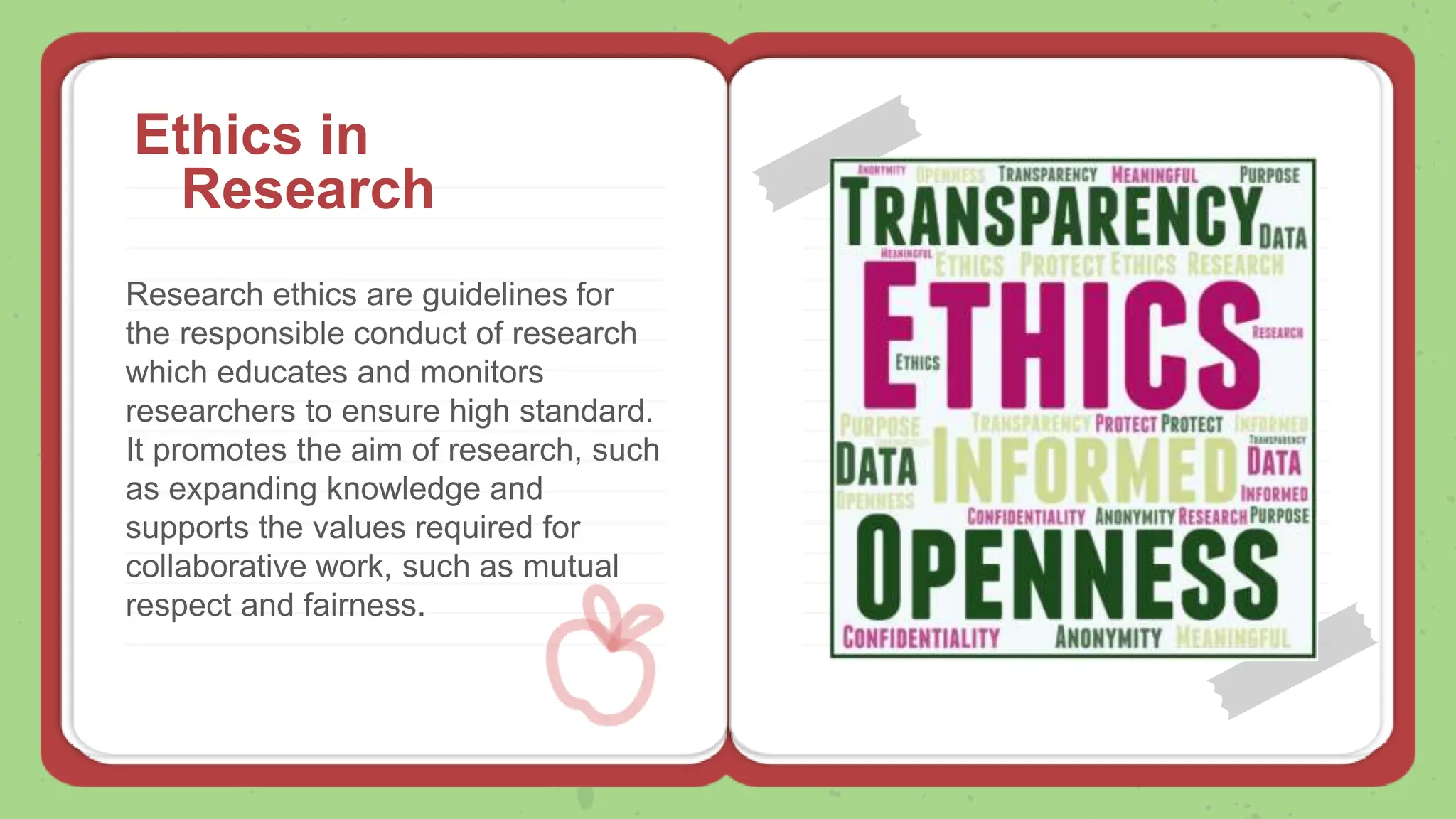
Research ethics are guidelines for
the responsible conduct of research
which educates and monitors
researchers to ensure high standard.
It promotes the aim of research, such
as expanding knowledge and
supports the values required for
collaborative work, such as mutual
respect and fairness.
Ethics in
Research
1. Objectivity and integrity
2. Respect of the research subjects
‘right to privacy and dignity and
protection of subjects from personal
harm
3. Presentation of research findings
4. Misuse of research role
5. Acknowledgement of research
collaboration and assistance
6. Distortions of findings by sponsor
ETHICAL
CONSIDERATIONS
IN CONDUCTING
RESEARCH
What are these ethics in
research?
1. Informed Consent. This is required to secure in order protect the rights of the
participants in your study. Inform your participants about the criteria set for choosing
them as informants and the schedule of one-on one interview at the convenient time
they are available. Participation to the study will be completely voluntary.
2. Honesty. It reports data, results, methods and procedures, and publication status. Do
not fabricate, falsify and misrepresent the data.
3. Objectivity. Avoid bias in experimental design, data analysis, data interpretation peer
review, personnel decisions, grant writing, expert testimony, and other aspects of
research.
4. Integrity. Keep your promises and agreements; act with sincerity; strive for
consistency of thought and action.
5. Carefulness. Avoid careless errors and negligence; carefully and critically examine
your work and the work of peers. Keep good records of research activities.
6. Openness. Share data, results, ideas, tools and resources. Be open to criticism and
new ideas.
What are these ethics in
research?
7. Respect for Intellectual Property. Honor patents, copyrights, trademarks, trade
secrets and other forms of intellectual property. Do not use published or unpublished
data, methods, or results without permission. Give credit where credit is due. Never
plagiarize, fabricate and falsify.
8. Confidentiality. Protect confidential communications, such as papers or grants
submitted for publication, personnel records, trade or military secrets, and patient
records.
9. Responsible Mentoring. Help to educate, mentor, and advise others. Promote their
welfare and allow them to make their own decisions.
10. Responsible Publication. Publish in order to advance research and scholarship, not
to advance your own career. Avoid wasteful and duplicative publication.
11. Respect for Colleagues. Respect your colleagues’ opinion, treat them fairly and do
not outsmart others.
12. Social responsibility. Strive to promote social acceptance and prevent or mitigate
social harms through research, public education, and advocacy.
What are these ethics in
research?
13. Non-discrimination. Avoid discrimination against colleagues or students on the
basis of sex, race, ethnicity, or other factors that are not related to their scientific
competence and integrity.
14. Competence. Maintain and improve your own professional competence and
expertise through lifelong education and learning; take steps to promote competence
in science as a whole.
15. Legality. Know and obey relevant laws and institutional and government policies.
16. Animal Care. Show proper respect and care for animals when using them in
research. Do not conduct unnecessary or poorly designed animal experiments.
17. Human Subjects protection. When conducting a research on human subjects,
minimize harms and risks and maximize benefits; respect human dignity, privacy, and
anonymity.
Data Privacy Act of
2012
• Republic Act No. 10173, also known as
Data Privacy Act of 2012
• This law protect individual personal
information and communication
systems in the government and private
sector.
• An independent body known as
National Privacy Commission was
created to administer and implement
the provisions of this act and to
monitor and ensure compliance of the
country to the international standards
set for data protection.
RIGHTS OF
RESEARCH
PARTICIPANT
S
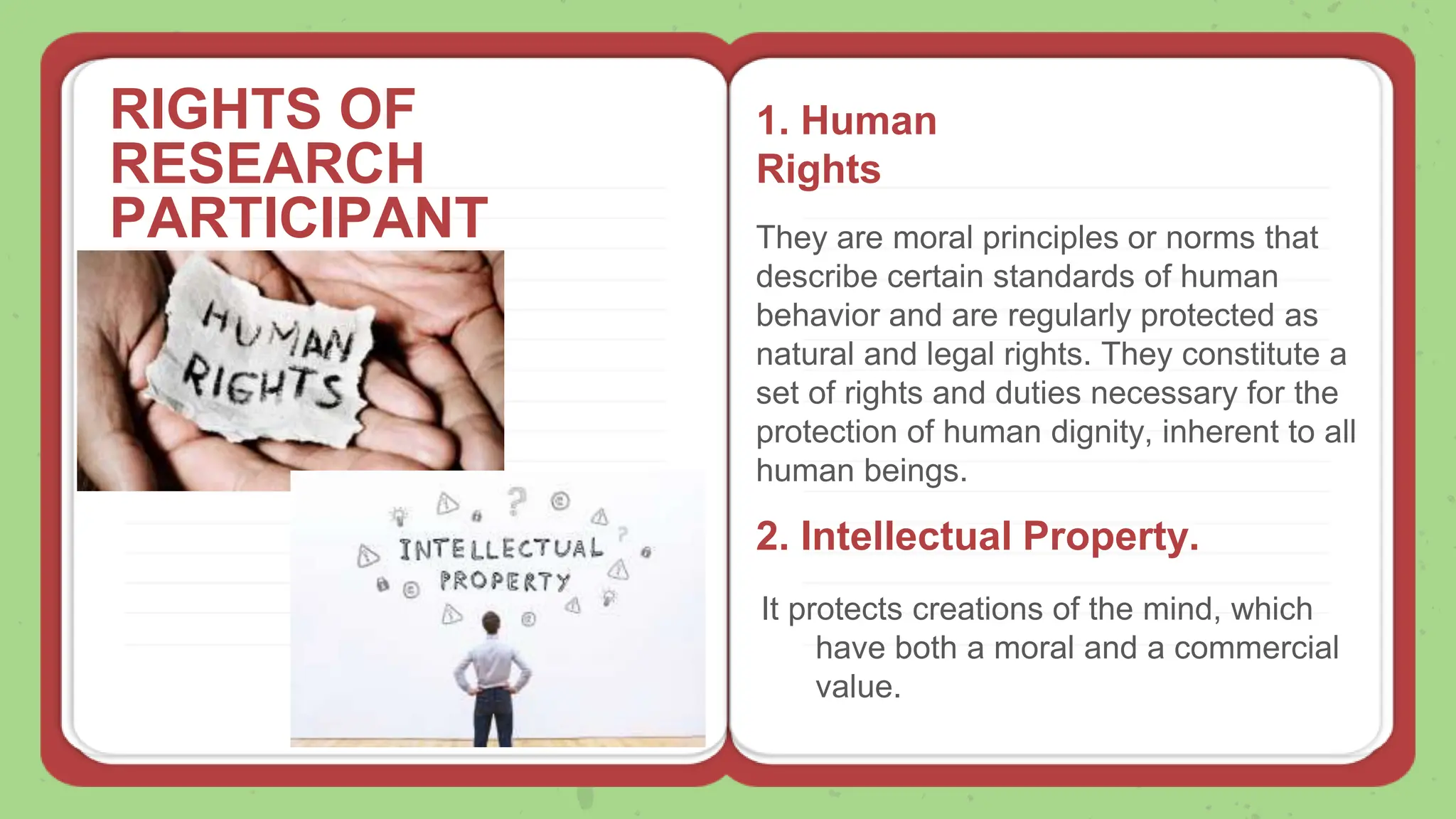
1. Human
Rights
They are moral principles or norms that
describe certain standards of human
behavior and are regularly protected as
natural and legal rights. They constitute a
set of rights and duties necessary for the
protection of human dignity, inherent to all
human beings.
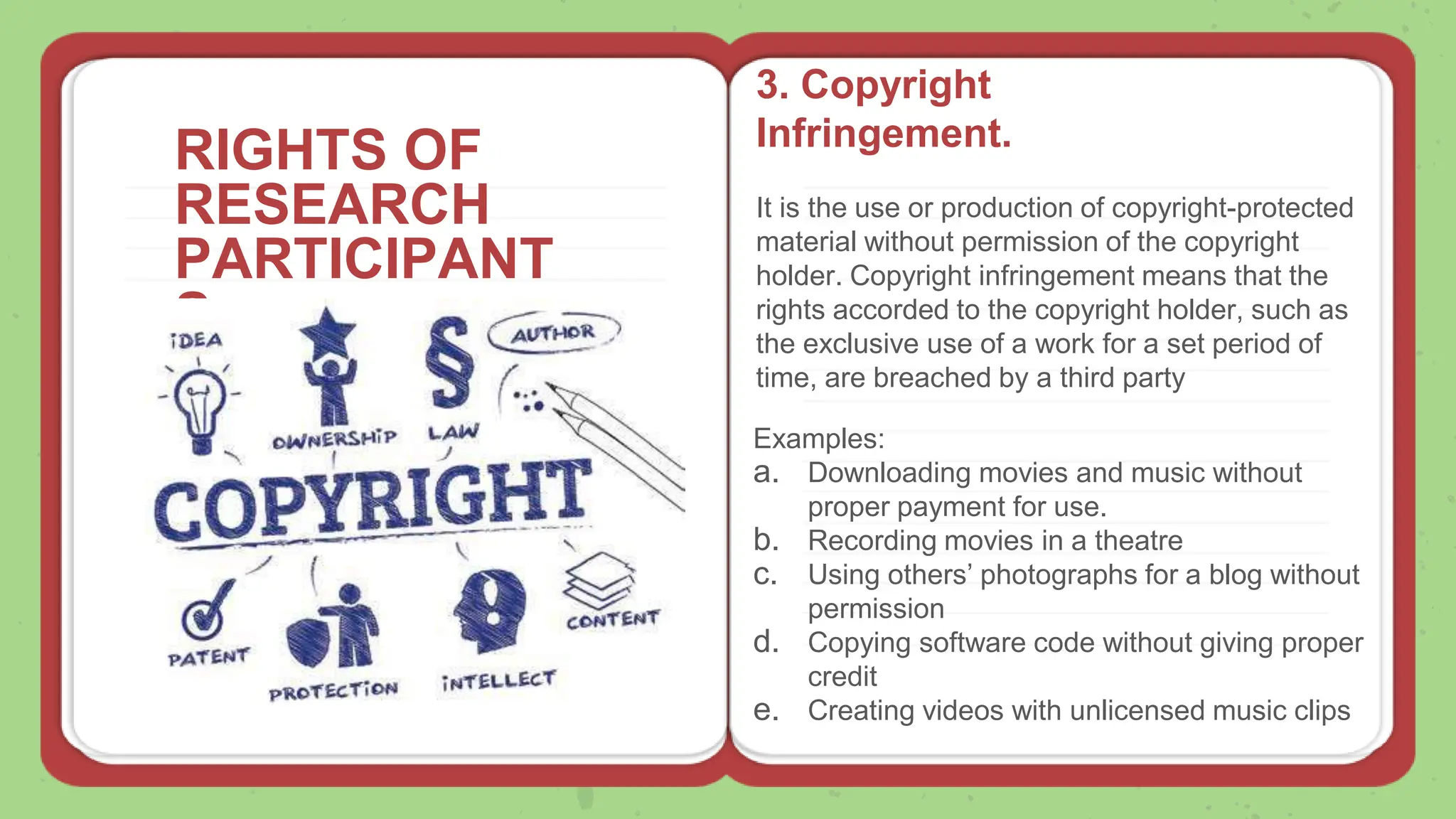
2. Intellectual Property.
It protects creations of the mind, which
have both a moral and a commercial
value.
RIGHTS OF
RESEARCH
PARTICIPANT
S
3. Copyright
Infringement.
It is the use or production of copyright-protected
material without permission of the copyright
holder. Copyright infringement means that the
rights accorded to the copyright holder, such as
the exclusive use of a work for a set period of
time, are breached by a third party
Examples:
a. Downloading movies and music without
proper payment for use.
b. Recording movies in a theatre
c. Using others’ photographs for a blog without
permission
d. Copying software code without giving proper
credit
e. Creating videos with unlicensed music clips
RIGHTS OF
RESEARCH
PARTICIPANT
S
4. Voluntary
Participation.
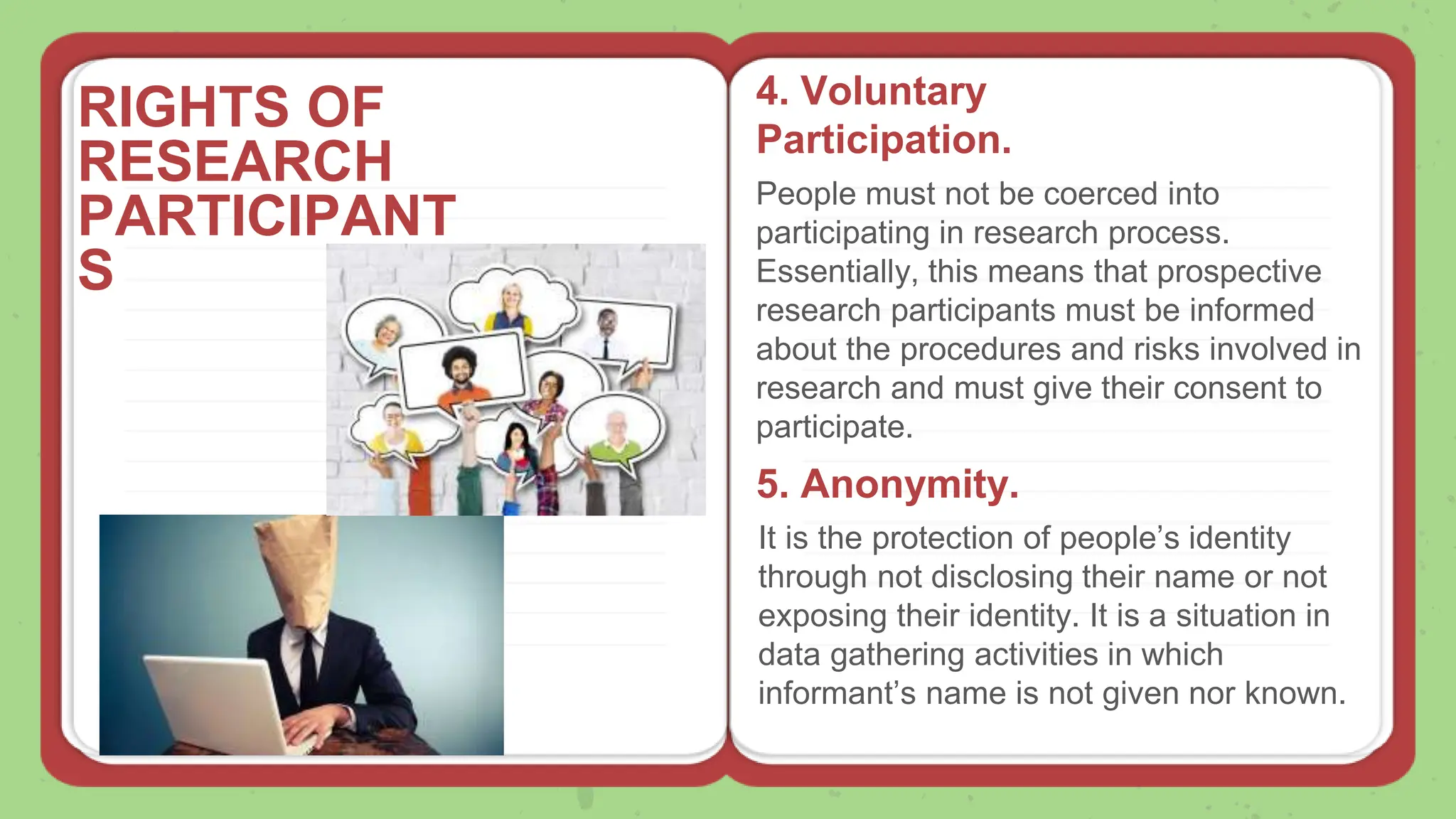
People must not be coerced into
participating in research process.
Essentially, this means that prospective
research participants must be informed
about the procedures and risks involved in
research and must give their consent to
participate.
5. Anonymity.
It is the protection of people’s identity
through not disclosing their name or not
exposing their identity. It is a situation in
data gathering activities in which
informant’s name is not given nor known.
RIGHTS OF
RESEARCH
PARTICIPANT
S
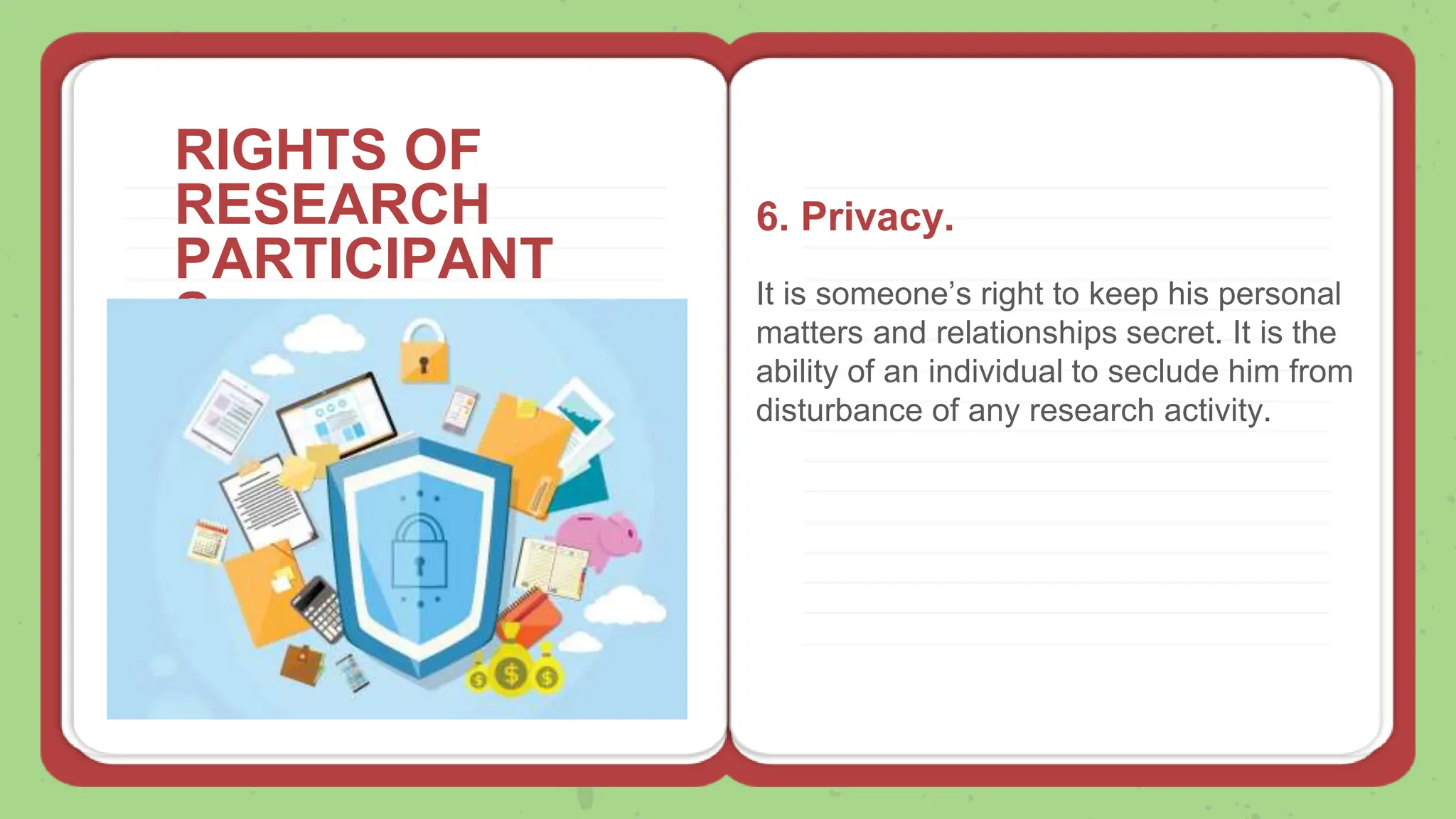
6. Privacy.
It is someone’s right to keep his personal
matters and relationships secret. It is the
ability of an individual to seclude him from
disturbance of any research activity.
ETHICAL
STANDARDS IN
RESEARCH
WRITING
Research Misconduct includes
fabrication, falsification, or plagiarism.
It doesn’t include honest error of
differences of opinion. It can erode
trust between researchers and funding
agencies, which make it more difficult
for colleagues at the same institution to
receive grants.
PLAGIARISM
Plagiarism refers to the act of using
another person’s ideas, works,
processes, and results without giving
due credit. It should not be tolerated as
the unauthorized use of original works,
a violation of intellectual property
rights.
Three different acts are considered
plagiarism:
1. Failure to cite quotations and
borrowed ideas,
2. Failure to enclose borrowed
language in quotation marks, and.
3. Failure to put summaries and
paraphrases in your own words.
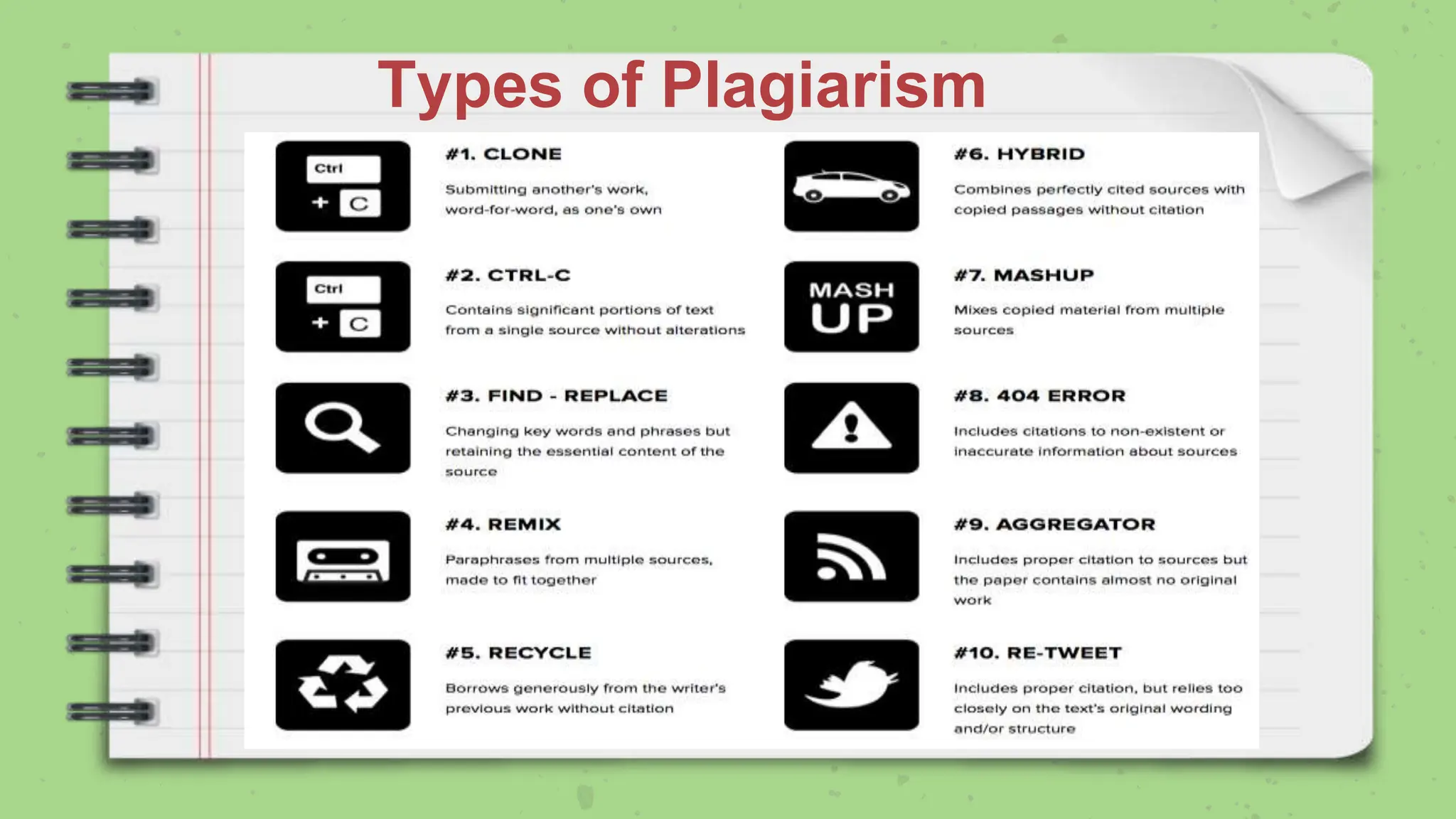
Types of Plagiarism
Thanks
for
Listening!

Lesson 2 The Characteristics, Processes, and Ethics of Research.pptx

  • 1.
    Lesson 2: The Characteristics, Processes,and Ethics of Research Here starts the lesson!
  • 2.
    At the endof the lesson the students were able to: 1. 2. 3. Share knowledge and experiences about research Describe the characteristics, processes and ethics of research Provide examples of research in areas of interest Objective s:
  • 3.
    1. Empirical -Research is based on direct experience or observation by the researcher. 2. Logical - Research is based on valid procedures and principles. 3. Cyclical - Research is a cyclical process because it starts with a problem and ends with a problem. 4. Analytical - Research utilizes proven analytical procedures in gathering the data, whether historical, descriptive, and experimental and case study. Characteristic of Research
  • 4.
    5. Critical -Research exhibits careful and precise judgment. 6. Methodical - Research is conducted in a methodical manner without bias using systematic method and procedures. 7. Replicability - The research design and procedures are replicated or repeated to enable the researcher to arrive at valid and conclusive results Characteristic of Research
  • 5.
    The Seven Stepsof the Research Process STEP 1: Define and develop your topic (Research Problem). Factors to Consider in Selecting a Research Problem Research Problem 1. Researcher‘s area of interest 2. Availability of funds 3. Investigator‘s ability and training STEP 2: Find background information about your chosen topic (Review of Related Literature). STEP 3: Plan your research design including your sample (Methodology). STEP 4: Gather necessary data using open ended questions (for qualitative research) and closed-ended questionnaire or paper pencil test questionnaire (for quantitative research) (Data Gathering Activities).
  • 6.
    The Seven Stepsof the Research Process STEP 5: Process and analyze data using thematic analysis (for qualitative research) and statistical tools (for quantitative research). STEP 6: Formulate new insights gained (for qualitative research) conclusions (for quantitative research) and recommendations. STEP 7: Define new problem.
  • 7.
    Research ethics areguidelines for the responsible conduct of research which educates and monitors researchers to ensure high standard. It promotes the aim of research, such as expanding knowledge and supports the values required for collaborative work, such as mutual respect and fairness. Ethics in Research
  • 8.
    1. Objectivity andintegrity 2. Respect of the research subjects ‘right to privacy and dignity and protection of subjects from personal harm 3. Presentation of research findings 4. Misuse of research role 5. Acknowledgement of research collaboration and assistance 6. Distortions of findings by sponsor ETHICAL CONSIDERATIONS IN CONDUCTING RESEARCH
  • 9.
    What are theseethics in research? 1. Informed Consent. This is required to secure in order protect the rights of the participants in your study. Inform your participants about the criteria set for choosing them as informants and the schedule of one-on one interview at the convenient time they are available. Participation to the study will be completely voluntary. 2. Honesty. It reports data, results, methods and procedures, and publication status. Do not fabricate, falsify and misrepresent the data. 3. Objectivity. Avoid bias in experimental design, data analysis, data interpretation peer review, personnel decisions, grant writing, expert testimony, and other aspects of research. 4. Integrity. Keep your promises and agreements; act with sincerity; strive for consistency of thought and action. 5. Carefulness. Avoid careless errors and negligence; carefully and critically examine your work and the work of peers. Keep good records of research activities. 6. Openness. Share data, results, ideas, tools and resources. Be open to criticism and new ideas.
  • 10.
    What are theseethics in research? 7. Respect for Intellectual Property. Honor patents, copyrights, trademarks, trade secrets and other forms of intellectual property. Do not use published or unpublished data, methods, or results without permission. Give credit where credit is due. Never plagiarize, fabricate and falsify. 8. Confidentiality. Protect confidential communications, such as papers or grants submitted for publication, personnel records, trade or military secrets, and patient records. 9. Responsible Mentoring. Help to educate, mentor, and advise others. Promote their welfare and allow them to make their own decisions. 10. Responsible Publication. Publish in order to advance research and scholarship, not to advance your own career. Avoid wasteful and duplicative publication. 11. Respect for Colleagues. Respect your colleagues’ opinion, treat them fairly and do not outsmart others. 12. Social responsibility. Strive to promote social acceptance and prevent or mitigate social harms through research, public education, and advocacy.
  • 11.
    What are theseethics in research? 13. Non-discrimination. Avoid discrimination against colleagues or students on the basis of sex, race, ethnicity, or other factors that are not related to their scientific competence and integrity. 14. Competence. Maintain and improve your own professional competence and expertise through lifelong education and learning; take steps to promote competence in science as a whole. 15. Legality. Know and obey relevant laws and institutional and government policies. 16. Animal Care. Show proper respect and care for animals when using them in research. Do not conduct unnecessary or poorly designed animal experiments. 17. Human Subjects protection. When conducting a research on human subjects, minimize harms and risks and maximize benefits; respect human dignity, privacy, and anonymity.
  • 12.
    Data Privacy Actof 2012 • Republic Act No. 10173, also known as Data Privacy Act of 2012 • This law protect individual personal information and communication systems in the government and private sector. • An independent body known as National Privacy Commission was created to administer and implement the provisions of this act and to monitor and ensure compliance of the country to the international standards set for data protection.
  • 13.
    RIGHTS OF RESEARCH PARTICIPANT S 1. Human Rights Theyare moral principles or norms that describe certain standards of human behavior and are regularly protected as natural and legal rights. They constitute a set of rights and duties necessary for the protection of human dignity, inherent to all human beings. 2. Intellectual Property. It protects creations of the mind, which have both a moral and a commercial value.
  • 14.
    RIGHTS OF RESEARCH PARTICIPANT S 3. Copyright Infringement. Itis the use or production of copyright-protected material without permission of the copyright holder. Copyright infringement means that the rights accorded to the copyright holder, such as the exclusive use of a work for a set period of time, are breached by a third party Examples: a. Downloading movies and music without proper payment for use. b. Recording movies in a theatre c. Using others’ photographs for a blog without permission d. Copying software code without giving proper credit e. Creating videos with unlicensed music clips
  • 15.
    RIGHTS OF RESEARCH PARTICIPANT S 4. Voluntary Participation. Peoplemust not be coerced into participating in research process. Essentially, this means that prospective research participants must be informed about the procedures and risks involved in research and must give their consent to participate. 5. Anonymity. It is the protection of people’s identity through not disclosing their name or not exposing their identity. It is a situation in data gathering activities in which informant’s name is not given nor known.
  • 16.
    RIGHTS OF RESEARCH PARTICIPANT S 6. Privacy. Itis someone’s right to keep his personal matters and relationships secret. It is the ability of an individual to seclude him from disturbance of any research activity.
  • 17.
    ETHICAL STANDARDS IN RESEARCH WRITING Research Misconductincludes fabrication, falsification, or plagiarism. It doesn’t include honest error of differences of opinion. It can erode trust between researchers and funding agencies, which make it more difficult for colleagues at the same institution to receive grants.
  • 18.
    PLAGIARISM Plagiarism refers tothe act of using another person’s ideas, works, processes, and results without giving due credit. It should not be tolerated as the unauthorized use of original works, a violation of intellectual property rights. Three different acts are considered plagiarism: 1. Failure to cite quotations and borrowed ideas, 2. Failure to enclose borrowed language in quotation marks, and. 3. Failure to put summaries and paraphrases in your own words.
  • 19.
  • 20.