Research Publication & Ethics contains a chapter on Intellectual Honesty and Research Integrity.
Different case studies of intellectual dishonesty and integrity were discussed.
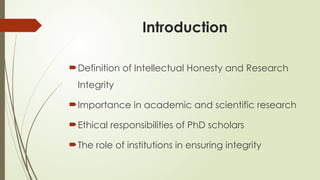
Introduction
Definition of IntellectualHonesty and Research
Integrity
Importance in academic and scientific research
Ethical responsibilities of PhD scholars
The role of institutions in ensuring integrity
3.
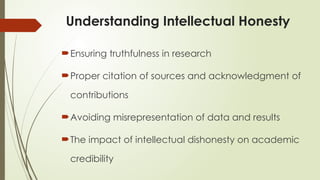
Understanding Intellectual Honesty
Ensuringtruthfulness in research
Proper citation of sources and acknowledgment of
contributions
Avoiding misrepresentation of data and results
The impact of intellectual dishonesty on academic
credibility
4.
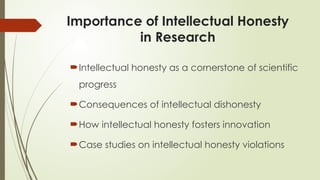
Importance of IntellectualHonesty
in Research
Intellectual honesty as a cornerstone of scientific
progress
Consequences of intellectual dishonesty
How intellectual honesty fosters innovation
Case studies on intellectual honesty violations
5.
Consequences of Intellectual
Dishonesty:
Retraction of research papers and academic penalties
Loss of funding and research opportunities
Damage to professional reputation and career
setbacks
Misinformation harming public trust and scientific
progress
6.
Examples of CaseStudies:
Hwang Woo-suk’s Fabricated Stem Cell Research (2004-2005): A
South Korean scientist falsely claimed to have successfully
cloned human stem cells, leading to retraction of his papers and
loss of credibility.
Andrew Wakefield’s Fraudulent Vaccine-Autism Study (1998):
Published false claims linking vaccines to autism, causing
widespread vaccine hesitancy and his eventual medical license
revocation.
7.
How Intellectual HonestyFosters
Innovation:
Encourages collaboration and trust among researchers
Leads to genuine scientific breakthroughs with real-
world applications
Helps in refining theories and improving research
methodologies
Ensures long-term credibility and integrity of scientific
discoveries
8.
Principles of IntellectualHonesty
Transparency: Open and honest reporting of research
Acknowledgment: Giving proper credit to others' work
Accuracy: Representing data and findings truthfully
Fairness: Avoiding bias and ensuring objective
interpretations
Accountability: Taking responsibility for one's research
9.
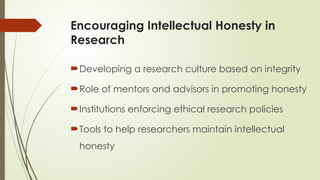
Encouraging Intellectual Honestyin
Research
Developing a research culture based on integrity
Role of mentors and advisors in promoting honesty
Institutions enforcing ethical research policies
Tools to help researchers maintain intellectual
honesty
10.
Importance of ResearchIntegrity
Ensuring reliability and reproducibility of research
Promoting trust in scientific discoveries
Avoiding negative consequences such as
retractions
Encouraging ethical conduct in academic
communities
11.
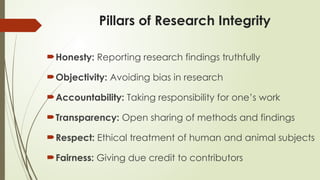
Pillars of ResearchIntegrity
Honesty: Reporting research findings truthfully
Objectivity: Avoiding bias in research
Accountability: Taking responsibility for one’s work
Transparency: Open sharing of methods and findings
Respect: Ethical treatment of human and animal subjects
Fairness: Giving due credit to contributors
12.
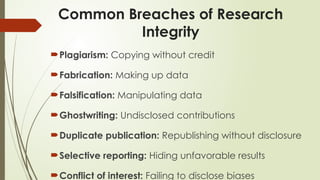
Common Breaches ofResearch
Integrity
Plagiarism: Copying without credit
Fabrication: Making up data
Falsification: Manipulating data
Ghostwriting: Undisclosed contributions
Duplicate publication: Republishing without disclosure
Selective reporting: Hiding unfavorable results
Conflict of interest: Failing to disclose biases
13.
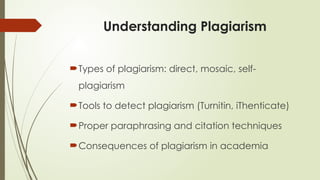
Understanding Plagiarism
Types ofplagiarism: direct, mosaic, self-
plagiarism
Tools to detect plagiarism (Turnitin, iThenticate)
Proper paraphrasing and citation techniques
Consequences of plagiarism in academia
14.
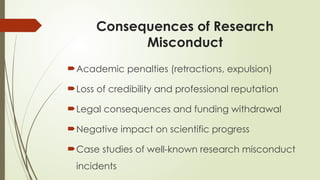
Consequences of Research
Misconduct
Academicpenalties (retractions, expulsion)
Loss of credibility and professional reputation
Legal consequences and funding withdrawal
Negative impact on scientific progress
Case studies of well-known research misconduct
incidents
15.
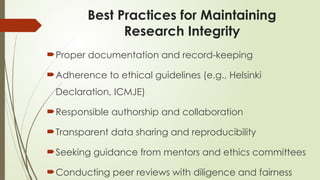
Best Practices forMaintaining
Research Integrity
Proper documentation and record-keeping
Adherence to ethical guidelines (e.g., Helsinki
Declaration, ICMJE)
Responsible authorship and collaboration
Transparent data sharing and reproducibility
Seeking guidance from mentors and ethics committees
Conducting peer reviews with diligence and fairness
16.
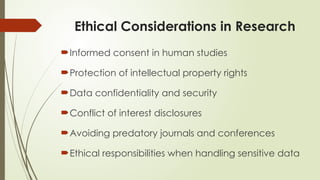
Ethical Considerations inResearch
Informed consent in human studies
Protection of intellectual property rights
Data confidentiality and security
Conflict of interest disclosures
Avoiding predatory journals and conferences
Ethical responsibilities when handling sensitive data
17.
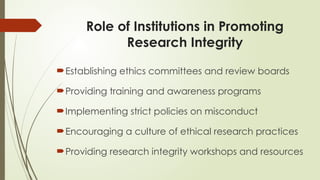
Role of Institutionsin Promoting
Research Integrity
Establishing ethics committees and review boards
Providing training and awareness programs
Implementing strict policies on misconduct
Encouraging a culture of ethical research practices
Providing research integrity workshops and resources
18.
Role of Researchersin Upholding
Integrity
Self-awareness and accountability in research
Engaging in ethical collaborations
Reporting any observed misconduct
Continuously educating oneself on research
ethics
19.
Case Studies onResearch Integrity
Example 1: Plagiarism in high-impact research
Example 2: Data falsification in clinical trials
Example 3: Ethical violations in human trials
Lessons learned from past research misconduct
cases
20.
Example 1: StanfordPrison Experiment (1971): Ethical
concerns over psychological harm to participants
raised awareness about research ethics and led to
stricter ethical guidelines.
Example 2: The Tuskegee Syphilis Study (1932-1972):
U.S. Public Health Service’s failure to obtain informed
consent led to severe consequences and the
establishment of ethical regulations such as the
Belmont Report.
21.
Example 3: Retractionof Papers by Dr. Yoshitaka Fujii
(2012): The highest number of retracted papers (over
180) due to falsified data, demonstrating the need for
rigorous peer review and data verification.
Example 4: Jennifer Doudna and Emmanuelle
Charpentier’s CRISPR Discovery (2020): A prime example
of maintaining research integrity, where transparency
and collaboration led to a groundbreaking scientific
breakthrough, earning them a Nobel Prize.
22.
Lessons learned frompast research
misconduct cases:
Importance of ethical oversight
Need for transparency in data collection and
reporting
Consequences of ignoring ethical considerations
Role of institutions in maintaining research integrity
23.
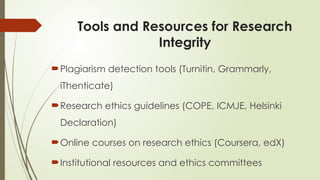
Tools and Resourcesfor Research
Integrity
Plagiarism detection tools (Turnitin, Grammarly,
iThenticate)
Research ethics guidelines (COPE, ICMJE, Helsinki
Declaration)
Online courses on research ethics (Coursera, edX)
Institutional resources and ethics committees
24.
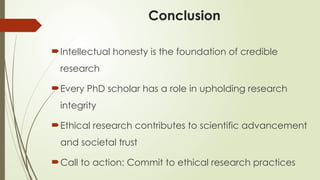
Conclusion
Intellectual honesty isthe foundation of credible
research
Every PhD scholar has a role in upholding research
integrity
Ethical research contributes to scientific advancement
and societal trust
Call to action: Commit to ethical research practices
Editor's Notes
#6 Hwang Woo-suk’s Fabricated Stem Cell Research (2004-2005)
A South Korean scientist, Hwang Woo-suk, published groundbreaking research claiming to have successfully cloned human stem cells.
Investigations revealed that much of his data had been fabricated and that his work was based on unethical practices, including coercion of junior researchers to donate eggs.
His research was retracted, and he faced criminal charges, leading to the loss of credibility and a major setback in the field of stem cell research.
This case emphasized the ethical concerns surrounding biomedical research, data integrity, and responsible authorship.
Andrew Wakefield’s Fraudulent Vaccine-Autism Study (1998)
Dr. Andrew Wakefield, a former British physician, published a paper in The Lancet in 1998, claiming a link between the measles, mumps, and rubella (MMR) vaccine and autism in children. This study had profound consequences, causing widespread fear, vaccine hesitancy, and a decline in vaccination rates.
Key Issues in the Study
Small and Biased Sample Size – The study was based on only 12 children, which is far too small to draw any generalizable conclusions.
Conflict of Interest – Wakefield had received funding from lawyers seeking to sue vaccine manufacturers, a fact he did not disclose.
Ethical Violations – The study involved invasive medical procedures on children without proper ethical approval.
Data Manipulation – Investigations revealed that Wakefield had altered patient records and misrepresented the timing of symptoms to fit his hypothesis.
Consequences of Intellectual Dishonesty
The study was widely publicized, leading to a sharp decline in MMR vaccination rates in the UK and the U.S.
This decline contributed to measles outbreaks and unnecessary illness and death.
In 2010, The Lancet fully retracted the paper, acknowledging its fraudulent nature.
Wakefield lost his medical license due to professional misconduct.
#20 Stanford Prison Experiment (1971)
Conducted by psychologist Philip Zimbardo at Stanford University, this experiment aimed to study the psychological effects of perceived power by assigning participants roles of prisoners and guards in a simulated prison environment.
The study quickly spiraled out of control, with guards exhibiting extreme cruelty and prisoners suffering severe emotional distress.
Ethical concerns included a lack of informed consent, inadequate protection from harm, and the researcher's failure to intervene when participants were in distress.
This case highlighted the necessity of ethical oversight in psychological research, leading to stricter guidelines on participant welfare and informed consent.
The Tuskegee Syphilis Study (1932-1972)
Conducted by the U.S. Public Health Service, this study observed the progression of untreated syphilis in African American men in Alabama.
Participants were not informed they had syphilis and were denied effective treatment, even after penicillin was discovered as a cure in the 1940s.
The study continued for 40 years, causing unnecessary suffering and death, and was only exposed after media reports in the early 1970s.
This unethical research led to widespread distrust in medical research among African Americans and prompted the creation of ethical regulations such as the Belmont Report and Institutional Review Boards (IRBs).
#21 Retraction of Papers by Dr. Yoshitaka Fujii (2012)
A Japanese anesthesiologist, Dr. Fujii, was found guilty of fabricating data in over 180 scientific papers, making it one of the largest known cases of research fraud.
His studies on post-operative nausea and vomiting were widely cited but later found to contain manipulated and falsified data.
His fraudulent research misled the medical community for years, potentially affecting clinical decisions and patient care.
This case underscored the importance of peer review, data transparency, and accountability in scientific publishing.
Jennifer Doudna and Emmanuelle Charpentier’s CRISPR Discovery (2020)
Jennifer Doudna and Emmanuelle Charpentier revolutionized genetic engineering with their discovery of CRISPR-Cas9, a genome-editing technology, earning them the 2020 Nobel Prize in Chemistry. This discovery demonstrated high research integrity and a commitment to intellectual honesty, ultimately transforming medicine, agriculture, and biological sciences.
Background of the Discovery
CRISPR-Cas9 is a molecular tool that allows precise editing of DNA in living organisms.
Charpentier identified a bacterial RNA molecule (tracrRNA) that plays a role in the immune defense system of bacteria.
Collaborating with Doudna, they reprogrammed this system into a simplified, programmable gene-editing tool.
Commitment to Research Integrity
Rigorous Peer-Reviewed Research – Their findings were published in Science in 2012, ensuring transparency and replicability.
Collaborative Effort – They openly shared their knowledge, allowing other scientists to refine and apply CRISPR technology.
Acknowledgment of Contributions – Doudna and Charpentier credited past discoveries (e.g., Francisco Mojica’s earlier work on CRISPR in bacteria).
Ethical Considerations – They have actively advocated for responsible gene-editing practices, warning against unethical uses like human germline editing.
Impact on Science and Society
Medical Breakthroughs – CRISPR is being explored for treating genetic disorders like sickle cell disease and cancer.
Agricultural Innovations – Gene-editing crops to improve yield, disease resistance, and nutritional value.
Ethical Challenges – Their discovery sparked debates on the potential misuse of gene-editing, especially in human embryos.
This case highlights how intellectual honesty and ethical research practices lead to groundbreaking innovations that benefit humanity.




![RESEARCH_INTEGRITY_3[1] [Autosaved].pptx](https://cdn.slidesharecdn.com/ss_thumbnails/researchintegrity31autosaved-250823160831-2ec43fd7-thumbnail.jpg?width=640&height=640&fit=bounds)


