In this we will observe
• What is space exploration.
• Why we need to explore the space.
• The history and future of space.
• India’s work in space.
• Why space exploration is more
important.
• Space exploration contributions.
• Conclusion.
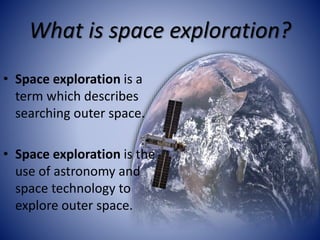
What is space exploration?
• Space exploration is a
term which describes
searching outer space.
• Space exploration is the
use of astronomy and
space technology to
explore outer space.
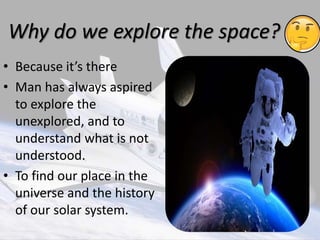
Why do we explore the space?
• Because it’s there
• Man has always aspired
to explore the
unexplored, and to
understand what is not
understood.
• To find our place in the
universe and the history
of our solar system.
History of space exploration.
• The first rocket that was able to
fly high enough to be considered
‘in space’ was the V-2 missile.
• This was a weapon developed by
German scientists in the Second
World War.
• The technology was used for
rockets in early space
exploration.
History of space exploration.
• In October of 1957, the Soviet
Union launched the first
satellite, SPUTNIK-I, into low
Earth orbit. It was the start of
the “Space Age.”
• In response, the United States
launched its first satellite,
EXPLORER-I, on January 31,
1958. This started the Space
Race.
First life in space.
• Just a few weeks after the
successful launch of
Sputnik 1, the Soviet Union
launched another satellite,
SPUTNIK-II.
• Sputnik 2 had a
passenger for its
journey; a dog named
LAIKA.
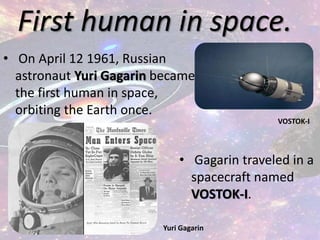
First human in space.
• On April 12 1961, Russian
astronaut Yuri Gagarin became
the first human in space,
orbiting the Earth once.
• Gagarin traveled in a
spacecraft named
VOSTOK-I.
Yuri Gagarin
VOSTOK-I
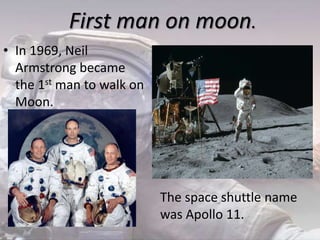
First man on moon.
• In 1969, Neil
Armstrong became
the 1st man to walk on
Moon.
The space shuttle name
was Apollo 11.
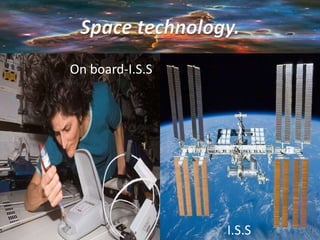
I.S.S
On board-I.S.S
Curiosity (rover)
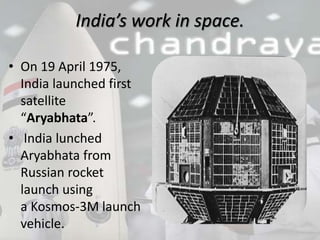
India’s work in space.
• On 19 April 1975,
India launched first
satellite
“Aryabhata”.
• India lunched
Aryabhata from
Russian rocket
launch using
a Kosmos-3M launch
vehicle.
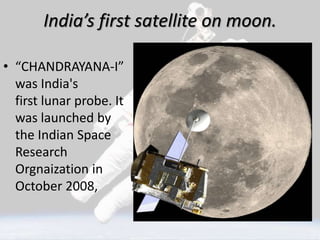
India’s first satellite on moon.
• “CHANDRAYANA-I”
was India's
first lunar probe. It
was launched by
the Indian Space
Research
Orgnaization in
October 2008,
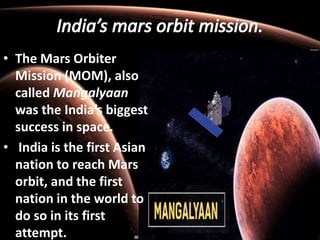
• The Mars Orbiter
Mission (MOM), also
called Mangalyaan
was the India’s biggest
success in space.
• India is the first Asian
nation to reach Mars
orbit, and the first
nation in the world to
do so in its first
attempt.
• We have lot of other
issues to solve on earth.
• Space exploration is a
always big investment
program.
• Money should be used
for development of
nations
No, because
In 1990s us spent about
$100 billions on the
Apollo Moon Program.
This money could
provide.
a year of health care
for 1,65,000 people
(or)
Electricity for 8,30,000
homes (or)
Build 2200 housing
units
• Enhanced
communications
• Television channels,
internet service
• Connected all parts of
countries together
But..
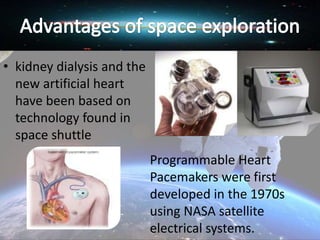
• kidney dialysis and the
new artificial heart
have been based on
technology found in
space shuttle
Programmable Heart
Pacemakers were first
developed in the 1970s
using NASA satellite
electrical systems.
Image processing used in CAT scanners
and MRI technology in hospitals
worldwide came from technology
developed to computer improved
pictures of the moon for the Apollo
programs.
Joystick evolved from Apollo Lunar
Rover Used for Computer Games,
Cranes, Mining Trucks, Underwater
unmanned vehicles
• pharmaceuticals produced in
space with zero gravity have
purities far higher than any
produced on Earth.
• that micro gravity semiconductor
materials can produce chips as much
as a thousand times more powerful
than anything now available.
There is an element known as Helium 3 that is found
on the moon and could power the world for at least
1,000 years when we are able to use it.
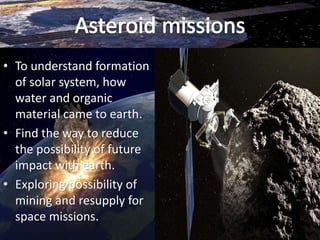
• To understand formation
of solar system, how
water and organic
material came to earth.
• Find the way to reduce
the possibility of future
impact with earth.
• Exploring possibility of
mining and resupply for
space missions.
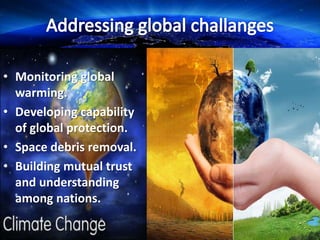
• Monitoring global
warming.
• Developing capability
of global protection.
• Space debris removal.
• Building mutual trust
and understanding
among nations.
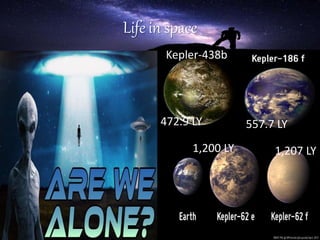
Life in space
557.7 LY
Kepler-438b
472.9 LY
1,207 LY1,200 LY
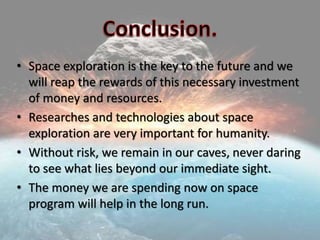
• Space exploration is the key to the future and we
will reap the rewards of this necessary investment
of money and resources.
• Researches and technologies about space
exploration are very important for humanity.
• Without risk, we remain in our caves, never daring
to see what lies beyond our immediate sight.
• The money we are spending now on space
program will help in the long run.
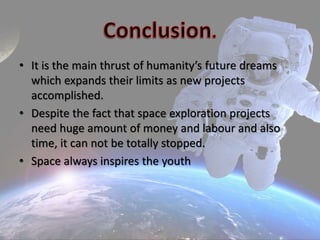
• It is the main thrust of humanity’s future dreams
which expands their limits as new projects
accomplished.
• Despite the fact that space exploration projects
need huge amount of money and labour and also
time, it can not be totally stopped.
• Space always inspires the youth
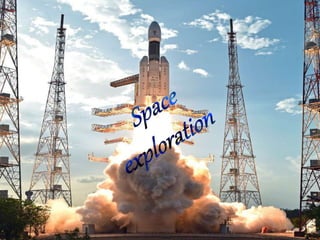
Space exploration (seminar)

Space exploration (seminar)

  • 2.
    In this wewill observe • What is space exploration. • Why we need to explore the space. • The history and future of space. • India’s work in space. • Why space exploration is more important. • Space exploration contributions. • Conclusion.
  • 3.
    What is spaceexploration? • Space exploration is a term which describes searching outer space. • Space exploration is the use of astronomy and space technology to explore outer space.
  • 4.
    Why do weexplore the space? • Because it’s there • Man has always aspired to explore the unexplored, and to understand what is not understood. • To find our place in the universe and the history of our solar system.
  • 5.
    History of spaceexploration. • The first rocket that was able to fly high enough to be considered ‘in space’ was the V-2 missile. • This was a weapon developed by German scientists in the Second World War. • The technology was used for rockets in early space exploration.
  • 6.
    History of spaceexploration. • In October of 1957, the Soviet Union launched the first satellite, SPUTNIK-I, into low Earth orbit. It was the start of the “Space Age.” • In response, the United States launched its first satellite, EXPLORER-I, on January 31, 1958. This started the Space Race.
  • 7.
    First life inspace. • Just a few weeks after the successful launch of Sputnik 1, the Soviet Union launched another satellite, SPUTNIK-II. • Sputnik 2 had a passenger for its journey; a dog named LAIKA.
  • 8.
    First human inspace. • On April 12 1961, Russian astronaut Yuri Gagarin became the first human in space, orbiting the Earth once. • Gagarin traveled in a spacecraft named VOSTOK-I. Yuri Gagarin VOSTOK-I
  • 9.
    First man onmoon. • In 1969, Neil Armstrong became the 1st man to walk on Moon. The space shuttle name was Apollo 11.
  • 11.
  • 12.
  • 13.
    India’s work inspace. • On 19 April 1975, India launched first satellite “Aryabhata”. • India lunched Aryabhata from Russian rocket launch using a Kosmos-3M launch vehicle.
  • 14.
    India’s first satelliteon moon. • “CHANDRAYANA-I” was India's first lunar probe. It was launched by the Indian Space Research Orgnaization in October 2008,
  • 15.
    • The MarsOrbiter Mission (MOM), also called Mangalyaan was the India’s biggest success in space. • India is the first Asian nation to reach Mars orbit, and the first nation in the world to do so in its first attempt.
  • 16.
    • We havelot of other issues to solve on earth. • Space exploration is a always big investment program. • Money should be used for development of nations No, because In 1990s us spent about $100 billions on the Apollo Moon Program. This money could provide. a year of health care for 1,65,000 people (or) Electricity for 8,30,000 homes (or) Build 2200 housing units
  • 17.
    • Enhanced communications • Televisionchannels, internet service • Connected all parts of countries together But..
  • 18.
    • kidney dialysisand the new artificial heart have been based on technology found in space shuttle Programmable Heart Pacemakers were first developed in the 1970s using NASA satellite electrical systems.
  • 19.
    Image processing usedin CAT scanners and MRI technology in hospitals worldwide came from technology developed to computer improved pictures of the moon for the Apollo programs. Joystick evolved from Apollo Lunar Rover Used for Computer Games, Cranes, Mining Trucks, Underwater unmanned vehicles
  • 20.
    • pharmaceuticals producedin space with zero gravity have purities far higher than any produced on Earth. • that micro gravity semiconductor materials can produce chips as much as a thousand times more powerful than anything now available. There is an element known as Helium 3 that is found on the moon and could power the world for at least 1,000 years when we are able to use it.
  • 21.
    • To understandformation of solar system, how water and organic material came to earth. • Find the way to reduce the possibility of future impact with earth. • Exploring possibility of mining and resupply for space missions.
  • 22.
    • Monitoring global warming. •Developing capability of global protection. • Space debris removal. • Building mutual trust and understanding among nations.
  • 23.
    Life in space 557.7LY Kepler-438b 472.9 LY 1,207 LY1,200 LY
  • 24.
    • Space explorationis the key to the future and we will reap the rewards of this necessary investment of money and resources. • Researches and technologies about space exploration are very important for humanity. • Without risk, we remain in our caves, never daring to see what lies beyond our immediate sight. • The money we are spending now on space program will help in the long run.
  • 25.
    • It isthe main thrust of humanity’s future dreams which expands their limits as new projects accomplished. • Despite the fact that space exploration projects need huge amount of money and labour and also time, it can not be totally stopped. • Space always inspires the youth