HISTORY ON
INDIA’S
CHANDRAYAAN
MADE BY: PRANJEET
MARANDI
CHANDRAYAAN
-2 WOULDN’T HAVE BEEN
POSSIBLE WITHOUT IT’S
PREDECESSOR
CHANDRAYA
AN-1
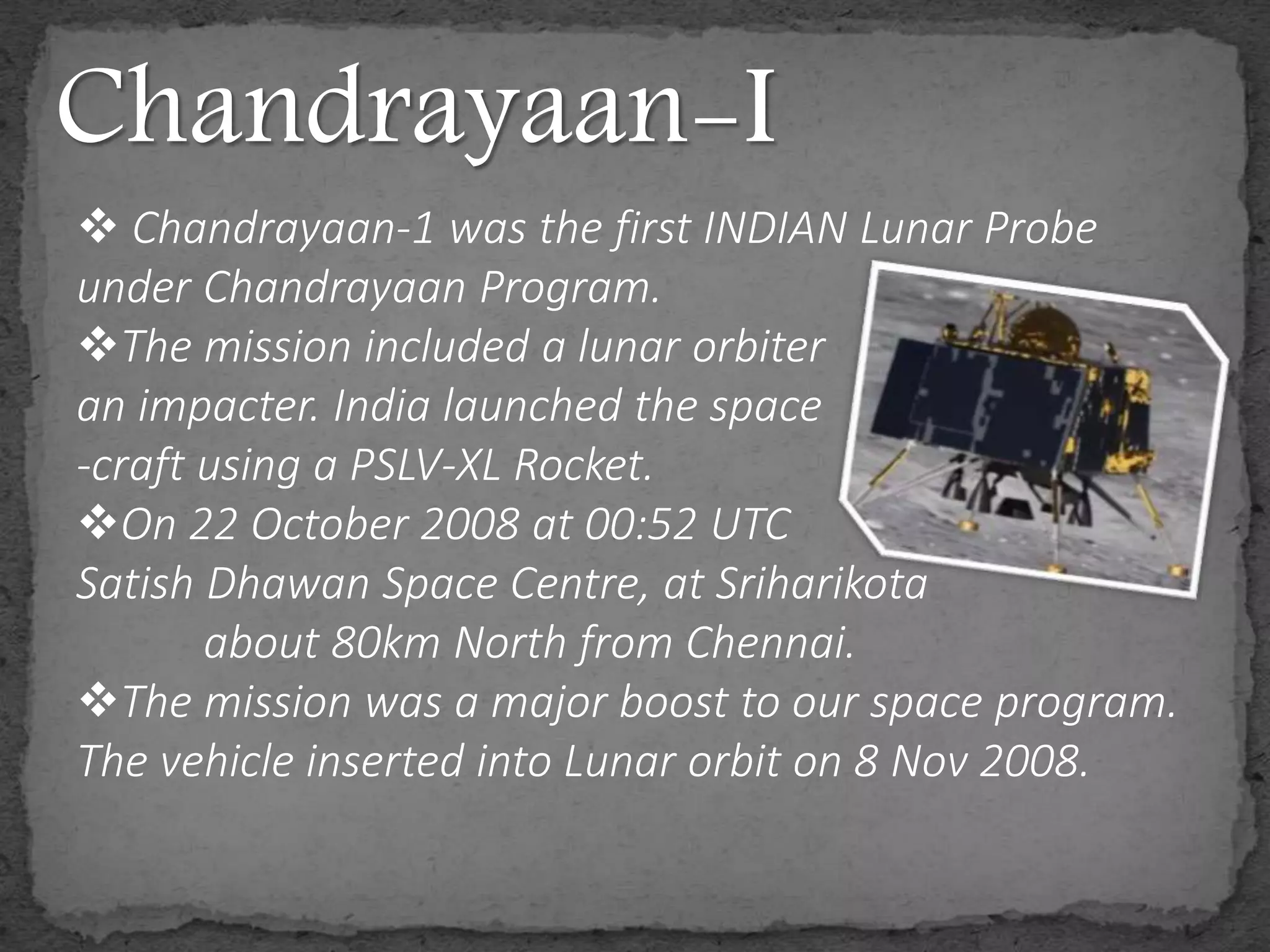
Chandrayaan-I
 Chandrayaan-1 was the first INDIAN Lunar Probe
under Chandrayaan Program.
The mission included a lunar orbiter and
an impacter. India launched the space -----
-craft using a PSLV-XL Rocket.
On 22 October 2008 at 00:52 UTC from
Satish Dhawan Space Centre, at Sriharikota
about 80km North from Chennai.
The mission was a major boost to our space program.
The vehicle inserted into Lunar orbit on 8 Nov 2008.
High resolution mineralogical and chemical imaging of the
permanently shadowed regions of our Moon.
Searching for surface or sub-surface lunar water-ice,
especially in the lunar poles.
Identification of chemicals in highlands rocks.
Chemicals stratigraphy of the lunar crust by remote
sensing of the central uplands of large lunar craters, and the
South Pole Aitken Region(SPAR), an expected site for internal
material.
Mapping the height variation of the Lunar Surface.
After
CHANDRAYAAN-
1,
ISRO didn’t stop…
Here came the hot topic of
recent news
CHANDRAYAA
N-2
Chandrayaan-II
It is the second LunarExploration mission developed by
the Indian Space and Reasearch
Organisation (ISRO), after Chandrayaan-I. It consists
of a lunar orbiter, the Vikram lander, and the Pragyan
Lunar rover, all of which were developed in India. The
main scientific objective is to map the location and
abundance of lunar water via Pragyan, and ongoing
analysis from the orbiter circling at a lunar polar orbit
of 100 × 100 km.
The primary objectives of the Chandrayaan-2 lander were to
demonstrate the ability to soft land on the Lunar surface and
operate a robotic rover on the surface. Scientific goals include
orbital studies of Lunar Topography, Minerology, Elemetatal
Deposition, the Lunar Exoshpere, and signatures of Hydroxyl and
Water Ice.] The orbiter will map the lunar surface and help to
prepare 3D maps of it. The onboard radar will also map the
surface while studying the Water Ice in the South Polar
region and thickness of the Lunar Regolith on the surface.
Aim of
Chandrayaan-2
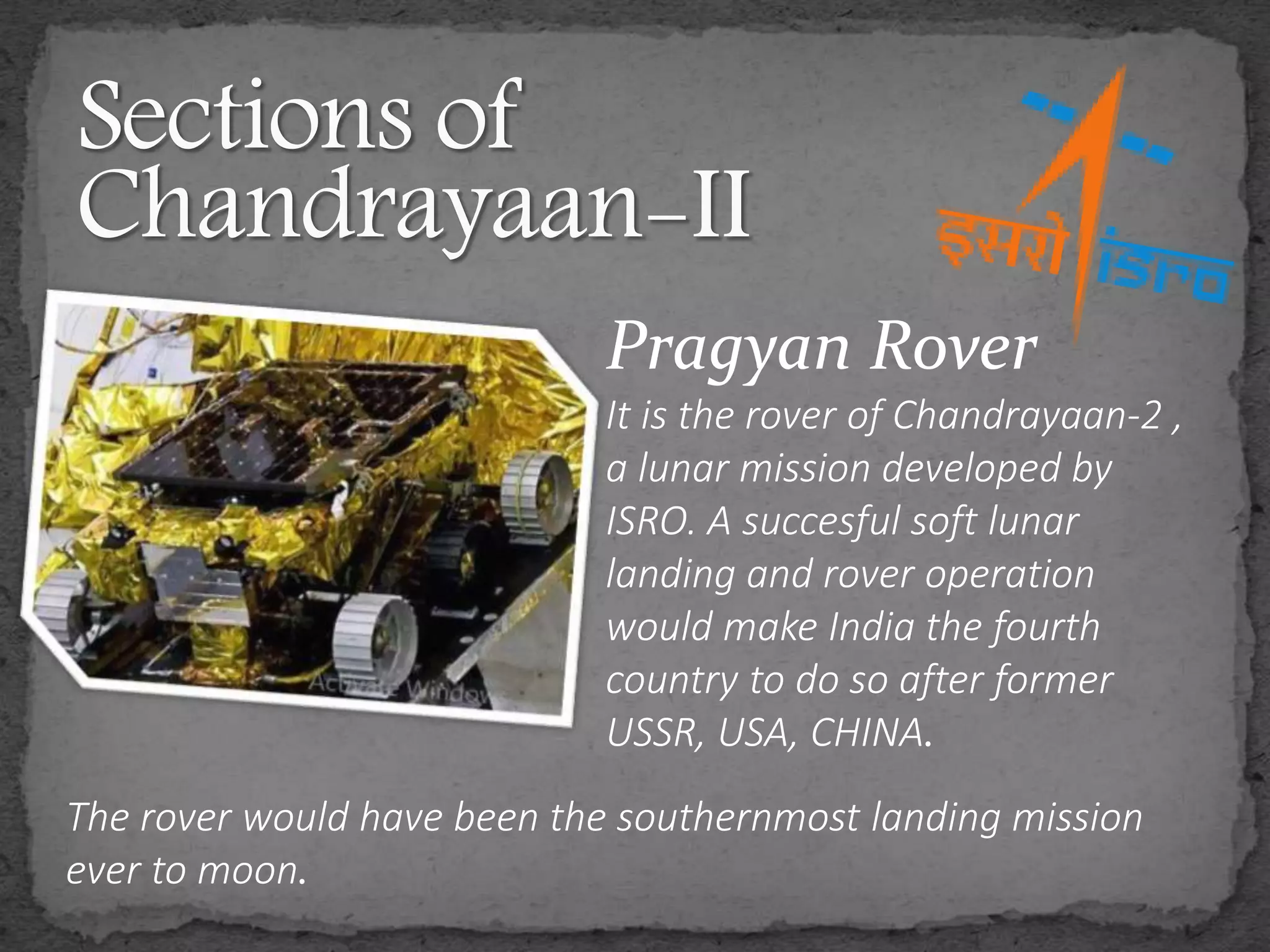
Pragyan Rover
It is the rover of Chandrayaan-2 ,
a lunar mission developed by
ISRO. A succesful soft lunar
landing and rover operation
would make India the fourth
country to do so after former
USSR, USA, CHINA.
The rover would have been the southernmost landing mission
ever to moon.
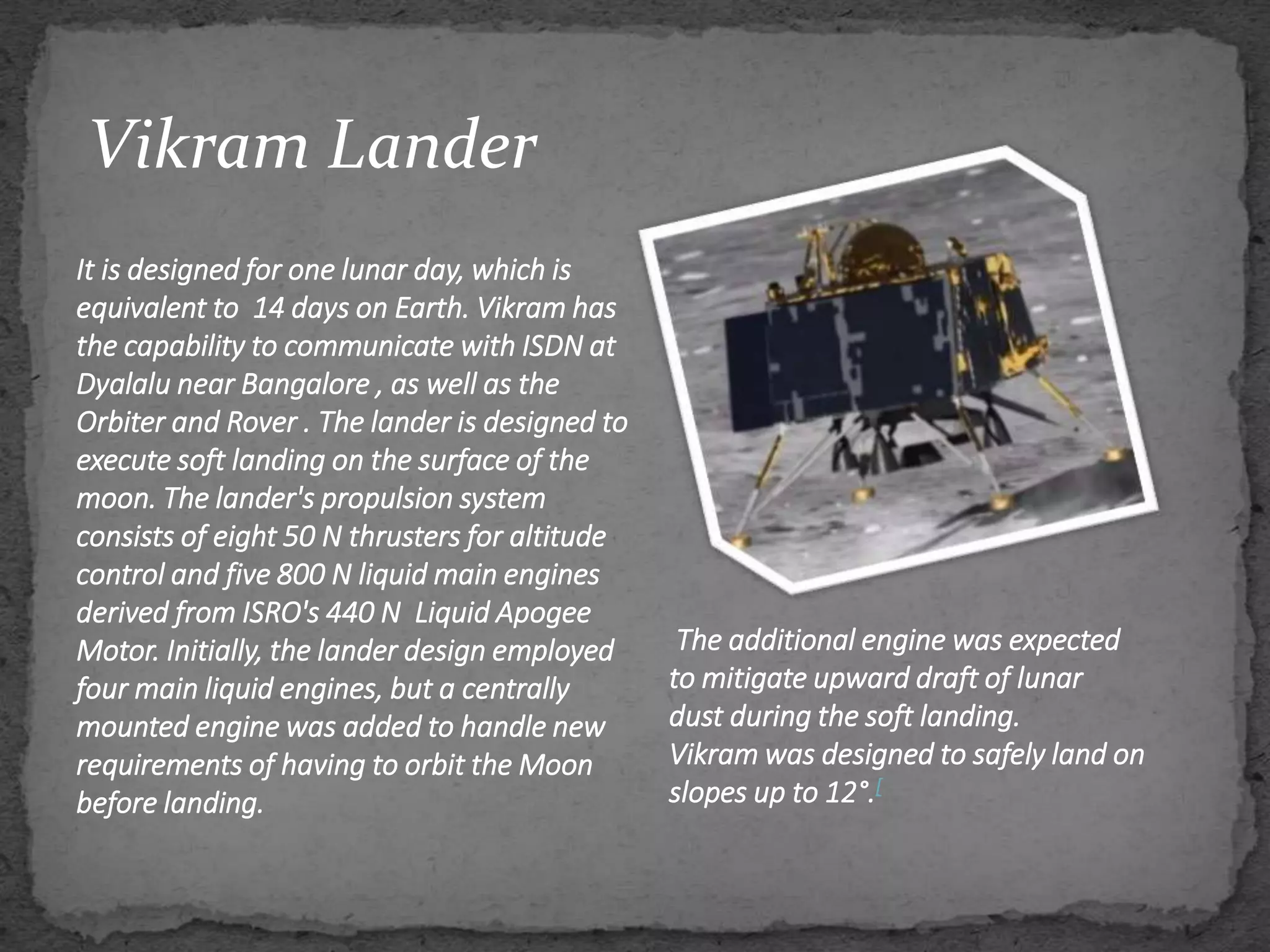
Vikram Lander
It is designed for one lunar day, which is
equivalent to 14 days on Earth. Vikram has
the capability to communicate with ISDN at
Dyalalu near Bangalore , as well as the
Orbiter and Rover . The lander is designed to
execute soft landing on the surface of the
moon. The lander's propulsion system
consists of eight 50 N thrusters for altitude
control and five 800 N liquid main engines
derived from ISRO's 440 N Liquid Apogee
Motor. Initially, the lander design employed
four main liquid engines, but a centrally
mounted engine was added to handle new
requirements of having to orbit the Moon
before landing.
The additional engine was expected
to mitigate upward draft of lunar
dust during the soft landing.
Vikram was designed to safely land on
slopes up to 12°.[
Orbiter
As of September 2019, orbiter is
orbiting the Moon on a polar
orbit at an altitude of 100 km.
The orbiter carries eight
scientific instruments; two of
them are improved versions of
those flown onChandrayaan-1.
The approximate launch mass
was 2,379 kg. The Orbiter High
Resolution Camera (OHRC) will
conduct high-resolution
observations of the landing site
prior to separation of the lander
from the orbiter.
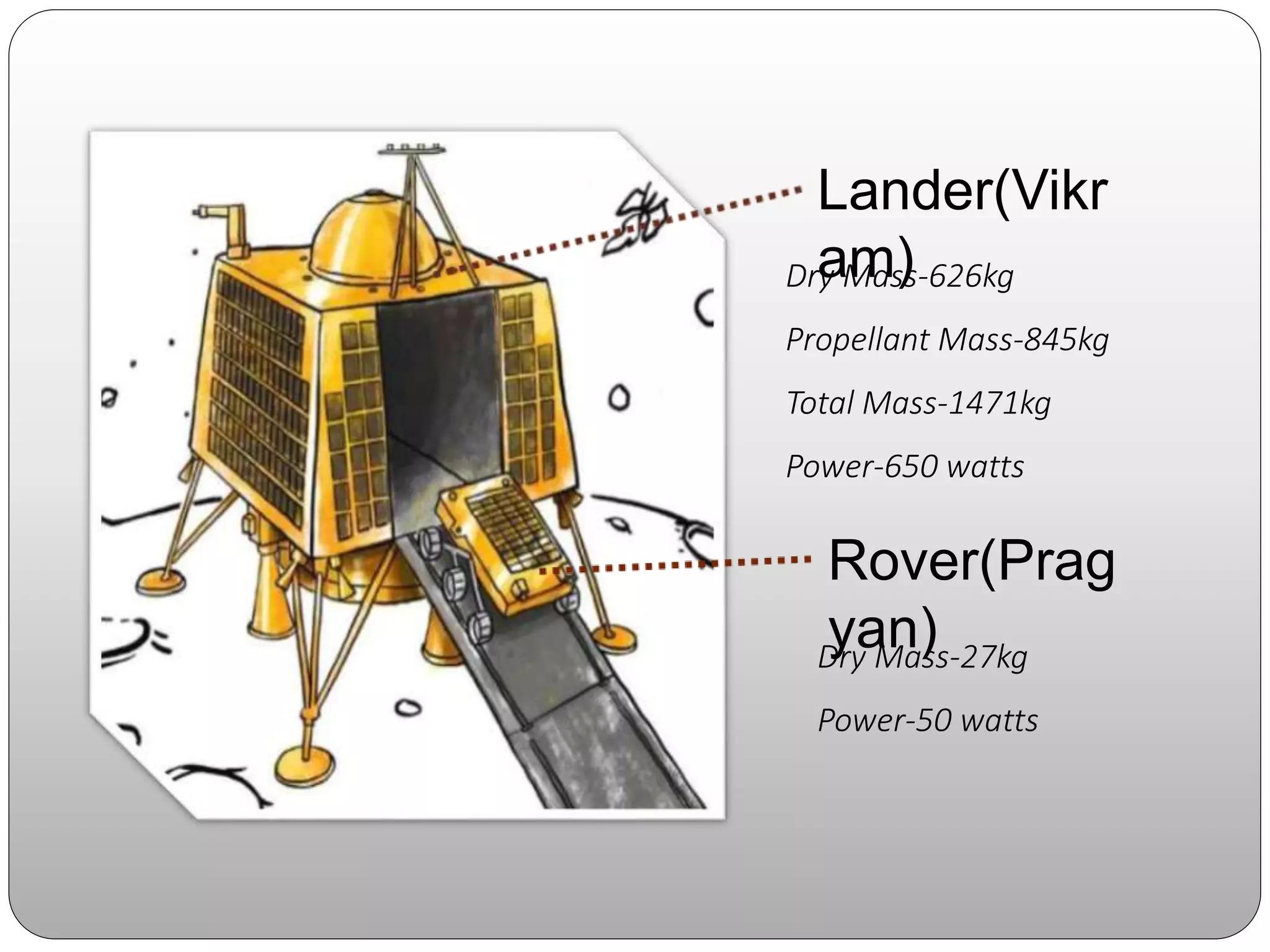
Lander(Vikr
am)Dry Mass-626kg
Propellant Mass-845kg
Total Mass-1471kg
Power-650 watts
Rover(Prag
yan)Dry Mass-27kg
Power-50 watts
Chandrayaan-2 has
gone a long a up the
sky to reach what
nobody has touched
before…
Here’s a An
Animated Video to
show the jaunt of
Current news
Vikram separated from Chandrayaan-2 on 7 September 2019 and was scheduled to
land on the Moon at around 1:50 a.m. IST. The initial descent was considered within
mission parameters, passing critical braking procedures as expected. The descent and
soft-landing were to be done by the on-board computers on Vikram, with mission
control unable to make corrections.
The lander's trajectory began to deviate at about 2.1 kilometres (1.3 mi; 6,900 ft) above
the surface.The final telemetry readings during ISRO's live-stream show
that Vikram's final vertical velocity was 58 m/s (210 km/h) from 330 meters above the
surface which, according to the MIT Technology Review, is "quite fast for a lunar
landing."Initial reports suggesting a crash,have been confirmed by ISRO chairman K.
Sivan, stating that the lander location had been found, and "it must have been a hard
landing". K. Sivan has tasked senior scientist P. S. Goel to head the Failure Analysis
Committee to look into the causes of the failure. As of 10 September 2019, ongoing
efforts are being made by ISRO in hopes to restore communications with Vikram. The
orbiter part of the mission, with eight scientific instruments, remains operational and
will continue its seven-year mission to study the Moon.
As of 10 September 2019,
ongoing efforts are being made
by ISRO in hopes to restore
communications with Vikram. The
orbiter part of the mission, with
eight scientific instruments,
remains operational and will
continue its seven-year mission
to study the Moon.
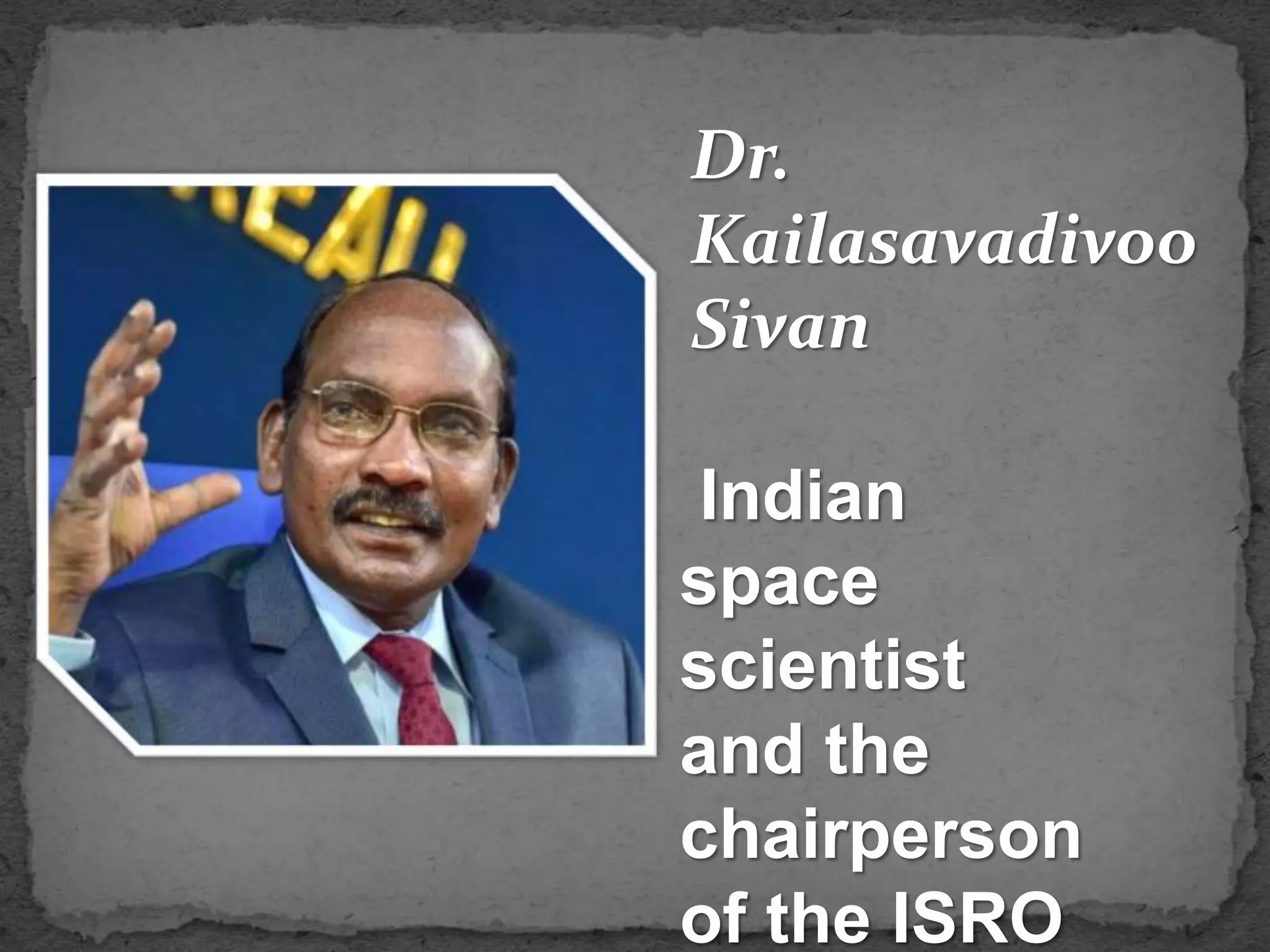
Dr.
Kailasavadivoo
Sivan
Indian
space
scientist
and the
chairperson
of the ISRO
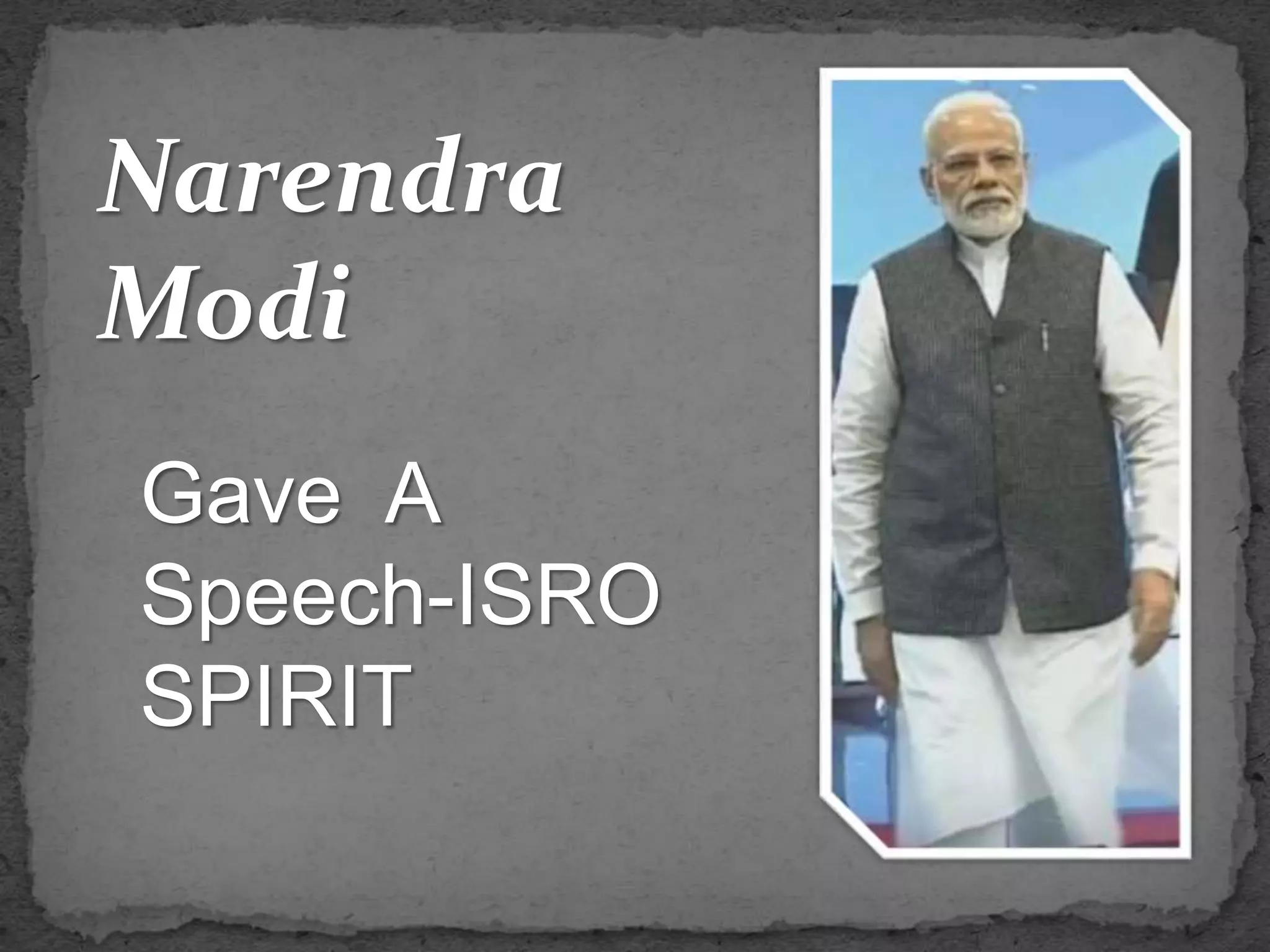
Narendra
Modi
Gave A
Speech-ISRO
SPIRIT
Conclusion
ISRO Confirmed that the Vikram Lander
has safely landed on the lunar surface.
But the connection’s still not made with
the Vikram Lander.
But there’s HOPE…
AND THAT TOO OF
130 CRORE INDIANS!!!
And that’s the
END TO Our
Presenation
Hope you liked
it
And its time to
Adieu
Thank you for watching the Presentation

CHANDRAYAAN 1 AND 2

  • 1.
  • 2.
    CHANDRAYAAN -2 WOULDN’T HAVEBEEN POSSIBLE WITHOUT IT’S PREDECESSOR CHANDRAYA AN-1
  • 3.
    Chandrayaan-I  Chandrayaan-1 wasthe first INDIAN Lunar Probe under Chandrayaan Program. The mission included a lunar orbiter and an impacter. India launched the space ----- -craft using a PSLV-XL Rocket. On 22 October 2008 at 00:52 UTC from Satish Dhawan Space Centre, at Sriharikota about 80km North from Chennai. The mission was a major boost to our space program. The vehicle inserted into Lunar orbit on 8 Nov 2008.
  • 4.
    High resolution mineralogicaland chemical imaging of the permanently shadowed regions of our Moon. Searching for surface or sub-surface lunar water-ice, especially in the lunar poles. Identification of chemicals in highlands rocks. Chemicals stratigraphy of the lunar crust by remote sensing of the central uplands of large lunar craters, and the South Pole Aitken Region(SPAR), an expected site for internal material. Mapping the height variation of the Lunar Surface.
  • 5.
    After CHANDRAYAAN- 1, ISRO didn’t stop… Herecame the hot topic of recent news CHANDRAYAA N-2
  • 6.
    Chandrayaan-II It is thesecond LunarExploration mission developed by the Indian Space and Reasearch Organisation (ISRO), after Chandrayaan-I. It consists of a lunar orbiter, the Vikram lander, and the Pragyan Lunar rover, all of which were developed in India. The main scientific objective is to map the location and abundance of lunar water via Pragyan, and ongoing analysis from the orbiter circling at a lunar polar orbit of 100 × 100 km.
  • 7.
    The primary objectivesof the Chandrayaan-2 lander were to demonstrate the ability to soft land on the Lunar surface and operate a robotic rover on the surface. Scientific goals include orbital studies of Lunar Topography, Minerology, Elemetatal Deposition, the Lunar Exoshpere, and signatures of Hydroxyl and Water Ice.] The orbiter will map the lunar surface and help to prepare 3D maps of it. The onboard radar will also map the surface while studying the Water Ice in the South Polar region and thickness of the Lunar Regolith on the surface. Aim of Chandrayaan-2
  • 8.
    Pragyan Rover It isthe rover of Chandrayaan-2 , a lunar mission developed by ISRO. A succesful soft lunar landing and rover operation would make India the fourth country to do so after former USSR, USA, CHINA. The rover would have been the southernmost landing mission ever to moon.
  • 9.
    Vikram Lander It isdesigned for one lunar day, which is equivalent to 14 days on Earth. Vikram has the capability to communicate with ISDN at Dyalalu near Bangalore , as well as the Orbiter and Rover . The lander is designed to execute soft landing on the surface of the moon. The lander's propulsion system consists of eight 50 N thrusters for altitude control and five 800 N liquid main engines derived from ISRO's 440 N Liquid Apogee Motor. Initially, the lander design employed four main liquid engines, but a centrally mounted engine was added to handle new requirements of having to orbit the Moon before landing. The additional engine was expected to mitigate upward draft of lunar dust during the soft landing. Vikram was designed to safely land on slopes up to 12°.[
  • 10.
    Orbiter As of September2019, orbiter is orbiting the Moon on a polar orbit at an altitude of 100 km. The orbiter carries eight scientific instruments; two of them are improved versions of those flown onChandrayaan-1. The approximate launch mass was 2,379 kg. The Orbiter High Resolution Camera (OHRC) will conduct high-resolution observations of the landing site prior to separation of the lander from the orbiter.
  • 11.
    Lander(Vikr am)Dry Mass-626kg Propellant Mass-845kg TotalMass-1471kg Power-650 watts Rover(Prag yan)Dry Mass-27kg Power-50 watts
  • 12.
    Chandrayaan-2 has gone along a up the sky to reach what nobody has touched before… Here’s a An Animated Video to show the jaunt of
  • 13.
    Current news Vikram separatedfrom Chandrayaan-2 on 7 September 2019 and was scheduled to land on the Moon at around 1:50 a.m. IST. The initial descent was considered within mission parameters, passing critical braking procedures as expected. The descent and soft-landing were to be done by the on-board computers on Vikram, with mission control unable to make corrections. The lander's trajectory began to deviate at about 2.1 kilometres (1.3 mi; 6,900 ft) above the surface.The final telemetry readings during ISRO's live-stream show that Vikram's final vertical velocity was 58 m/s (210 km/h) from 330 meters above the surface which, according to the MIT Technology Review, is "quite fast for a lunar landing."Initial reports suggesting a crash,have been confirmed by ISRO chairman K. Sivan, stating that the lander location had been found, and "it must have been a hard landing". K. Sivan has tasked senior scientist P. S. Goel to head the Failure Analysis Committee to look into the causes of the failure. As of 10 September 2019, ongoing efforts are being made by ISRO in hopes to restore communications with Vikram. The orbiter part of the mission, with eight scientific instruments, remains operational and will continue its seven-year mission to study the Moon.
  • 14.
    As of 10September 2019, ongoing efforts are being made by ISRO in hopes to restore communications with Vikram. The orbiter part of the mission, with eight scientific instruments, remains operational and will continue its seven-year mission to study the Moon.
  • 15.
  • 16.
  • 17.
    Conclusion ISRO Confirmed thatthe Vikram Lander has safely landed on the lunar surface. But the connection’s still not made with the Vikram Lander. But there’s HOPE… AND THAT TOO OF 130 CRORE INDIANS!!!
  • 18.
    And that’s the ENDTO Our Presenation Hope you liked it And its time to
  • 19.
    Adieu Thank you forwatching the Presentation