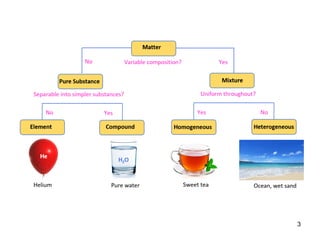
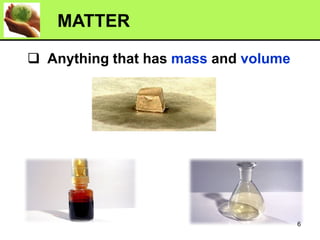
a) Matter
b) Mixture
c)Homogeneous mixture
d) Heterogeneous mixture
e) Substance
f) Compound
g) Element
The study of chemistry
reveals the world we
observe as the result of a
hidden, atomic reality 2
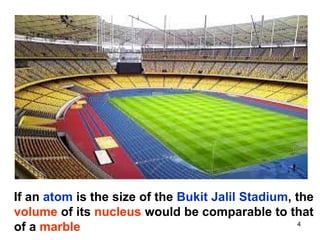
If an atomis the size of the Bukit Jalil Stadium, the
volume of its nucleus would be comparable to that
of a marble 4
5.
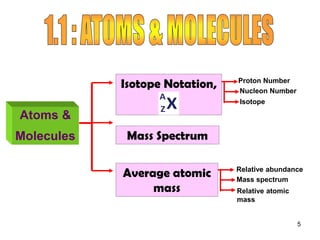
Atoms &
Molecules
Isotope Notation,
MassSpectrum
Average atomic
mass
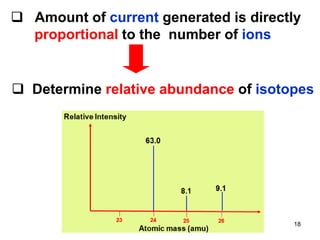
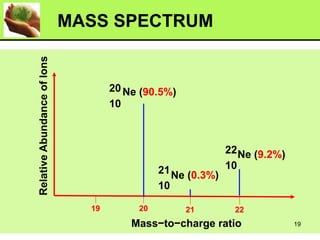
Relative abundance
Mass spectrum
Relative atomic
mass
Proton Number
Nucleon Number
Isotope
5
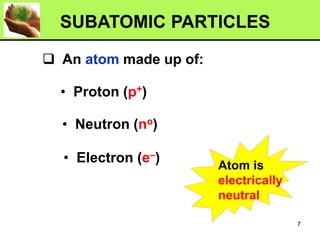
❑ An atommade up of:
• Neutron (no)
• Proton (p+)
• Electron (e–)
SUBATOMIC PARTICLES
Atom is
electrically
neutral
7
8.
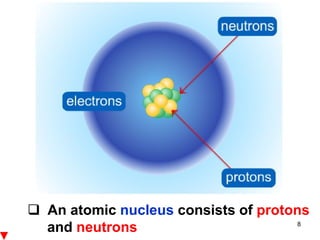
❑ An atomicnucleus consists of protons
and neutrons 8
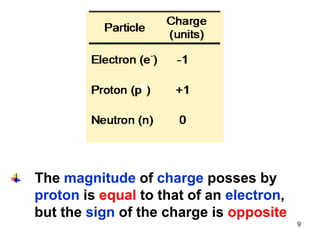
9.
The magnitude ofcharge posses by
proton is equal to that of an electron,
but the sign of the charge is opposite
9
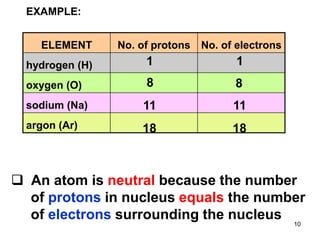
10.
ELEMENT No. ofprotons No. of electrons
hydrogen (H)
oxygen (O)
sodium (Na)
argon (Ar)
1
8
11
18
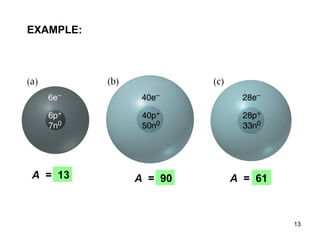
EXAMPLE:
1
8
11
18
❑ An atom is neutral because the number
of protons in nucleus equals the number
of electrons surrounding the nucleus
10
11.
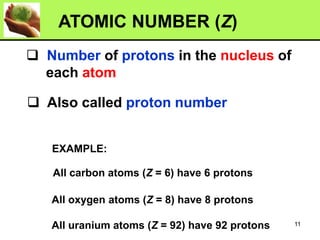
❑ Number ofprotons in the nucleus of
each atom
❑ Also called proton number
ATOMIC NUMBER (Z)
All carbon atoms (Z = 6) have 6 protons
All oxygen atoms (Z = 8) have 8 protons
All uranium atoms (Z = 92) have 92 protons
EXAMPLE:
11
12.
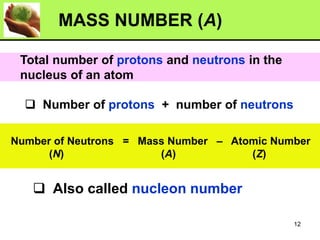
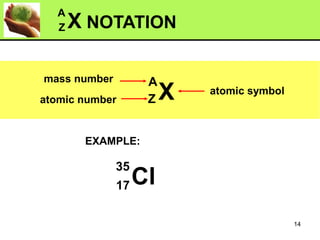
❑ Number ofprotons + number of neutrons
Number of Neutrons = Mass Number – Atomic Number
(N) (A) (Z)
MASS NUMBER (A)
❑ Also called nucleon number
Total number of protons and neutrons in the
nucleus of an atom
12
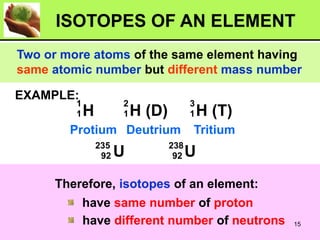
Two or moreatoms of the same element having
same atomic number but different mass number
H
1
1 H (D)
2
1 H (T)
3
1
U
235
92 U
238
92
Therefore, isotopes of an element:
have different number of neutrons
have same number of proton
EXAMPLE:
1.1-20
Protium Deutrium Tritium
ISOTOPES OF AN ELEMENT
15
16.
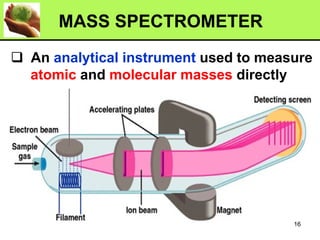
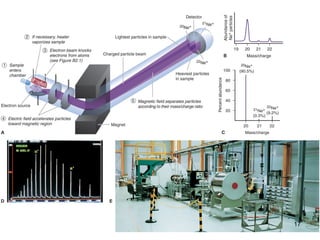
❑ An analyticalinstrument used to measure
atomic and molecular masses directly
MASS SPECTROMETER
16
LET’S TRY –02
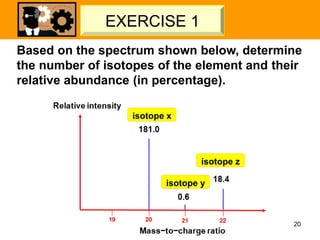
Based on the spectrum shown below, determine
the number of isotopes of the element and their
relative abundance (in percentage).
isotope x
isotope y
isotope z
EXERCISE 1
20
21.
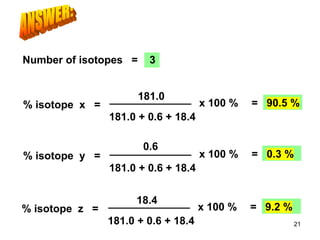
% isotope x=
181.0
181.0 + 0.6 + 18.4
x 100 % = 90.5 %
Number of isotopes = 3
% isotope y =
0.6
181.0 + 0.6 + 18.4
x 100 % = 0.3 %
% isotope z =
18.4
181.0 + 0.6 + 18.4
x 100 % = 9.2 %
21
22.
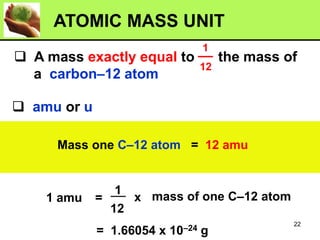
❑ amu oru
Mass one C–12 atom = 12 amu
1 amu
1
12
x
= mass of one C–12 atom
= 1.66054 x 10⁻²⁴ g
❑ A mass exactly equal to the mass of
a carbon–12 atom
12
1
ATOMIC MASS UNIT
22
23.
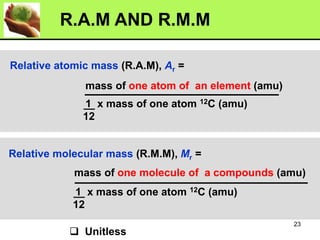
Relative atomic mass(R.A.M), Ar =
mass of one atom of an element (amu)
1 x mass of one atom 12C (amu)
12
Relative molecular mass (R.M.M), Mr =
mass of one molecule of a compounds (amu)
1 x mass of one atom 12C (amu)
12
❑ Unitless
R.A.M AND R.M.M
23
24.
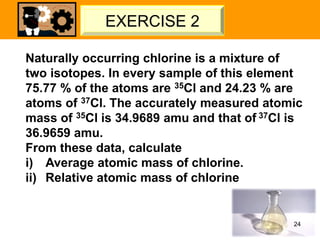
Naturally occurring chlorineis a mixture of
two isotopes. In every sample of this element
75.77 % of the atoms are 35Cl and 24.23 % are
atoms of 37Cl. The accurately measured atomic
mass of 35Cl is 34.9689 amu and that of 37Cl is
36.9659 amu.
From these data, calculate
i) Average atomic mass of chlorine.
ii) Relative atomic mass of chlorine
24
LET’S TRY – 02
EXERCISE 2
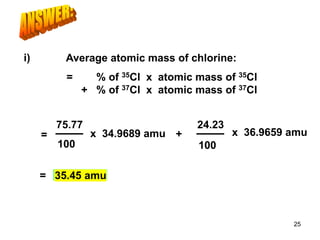
25.
= 35.45 amu
Averageatomic mass of chlorine:
75.77
100
x 34.9689 amu +
24.23
100
x 36.9659 amu
= % of 35Cl x atomic mass of 35Cl
+ % of 37Cl x atomic mass of 37Cl
=
i)
25
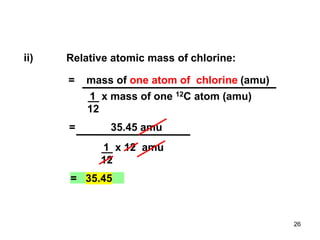
26.
= 35.45
Relative atomicmass of chlorine:
ii)
= mass of one atom of chlorine (amu)
1 x mass of one 12C atom (amu)
12
= 35.45 amu
1 x 12 amu
12
26
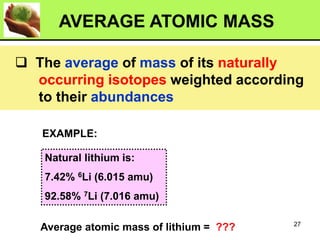
27.
Natural lithium is:
7.42%6Li (6.015 amu)
92.58% 7Li (7.016 amu)
Average atomic mass of lithium = ???
EXAMPLE:
❑ The average of mass of its naturally
occurring isotopes weighted according
to their abundances
AVERAGE ATOMIC MASS
27
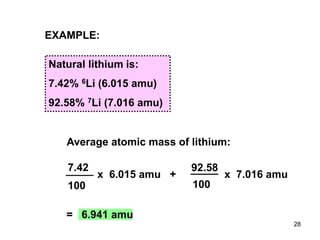
28.
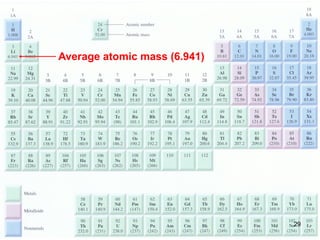
= 6.941 amu
Averageatomic mass of lithium:
Natural lithium is:
7.42% 6Li (6.015 amu)
92.58% 7Li (7.016 amu)
EXAMPLE:
7.42
100
x 6.015 amu +
92.58
100
x 7.016 amu
28
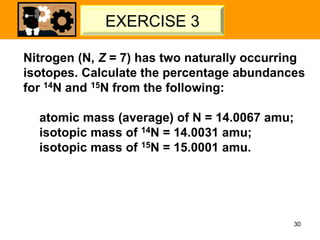
Nitrogen (N, Z= 7) has two naturally occurring
isotopes. Calculate the percentage abundances
for 14N and 15N from the following:
atomic mass (average) of N = 14.0067 amu;
isotopic mass of 14N = 14.0031 amu;
isotopic mass of 15N = 15.0001 amu.
30
LET’S TRY – 02
EXERCISE 3
31.
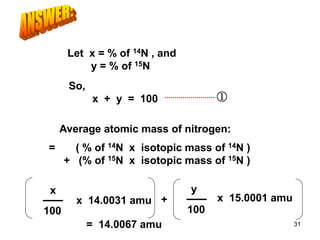
Average atomic massof nitrogen:
= ( % of 14N x isotopic mass of 14N )
+ (% of 15N x isotopic mass of 15N )
Let x = % of 14N , and
y = % of 15N
So,
x + y = 100 ①
x
100
x 14.0031 amu + x 15.0001 amu
= 14.0067 amu
y
100
31
32.
SIL, 3 ed,p.5
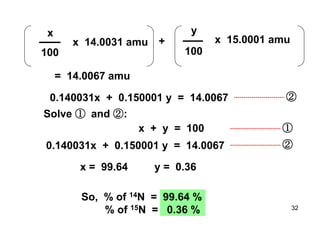
x
100
x 14.0031 amu + x 15.0001 amu
= 14.0067 amu
y
100
0.140031x + 0.150001 y = 14.0067 ②
Solve ① and ②:
x + y = 100 ①
x = 99.64 y = 0.36
So, % of 14N = 99.64 %
% of 15N = 0.36 %
0.140031x + 0.150001 y = 14.0067 ②
32
33.
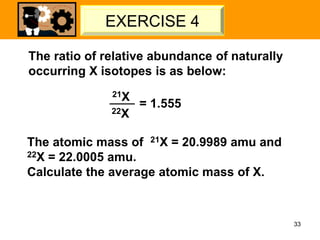
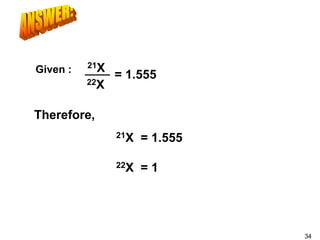
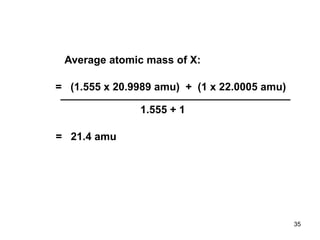
The ratio ofrelative abundance of naturally
occurring X isotopes is as below:
21X
22X
= 1.555
The atomic mass of 21X = 20.9989 amu and
22X = 22.0005 amu.
Calculate the average atomic mass of X.
33
LET’S TRY – 02
EXERCISE 4