1
Partial Orderings
Based on Slides by Chuck Allison from
http://uvsc.freshsources.com/Courses/CS_2300/Slides/slides.html
Rosen, Chapter 8.6
Modified by Longin Jan Latecki
2
Introduction
 An equivalence relation is a relation that is
reflexive, symmetric, and transitive
 A partial ordering (or partial order) is a relation that
is reflexive, antisymmetric, and transitive
• Recall that antisymmetric means that if (a,b)  R, then
(b,a) R unless b = a
• Thus, (a,a) is allowed to be in R
• But since it’s reflexive, all possible (a,a) must be in R
3
Partially Ordered Set (POSET)
A relation R on a set S is called a partial
ordering or partial order if it is reflexive,
antisymmetric, and transitive. A set S together
with a partial ordering R is called a partially
ordered set, or poset, and is denoted by (S, R)
4
Example (1)
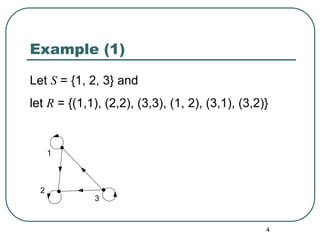
Let S = {1, 2, 3} and
let R = {(1,1), (2,2), (3,3), (1, 2), (3,1), (3,2)}
1
2
3
5
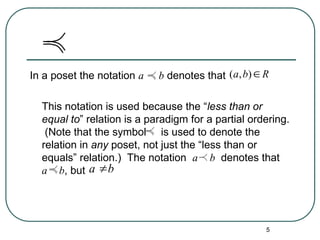
In a poset the notation a b denotes that
This notation is used because the “less than or
equal to” relation is a paradigm for a partial ordering.
(Note that the symbol is used to denote the
relation in any poset, not just the “less than or
equals” relation.) The notation a b denotes that
a b, but
( , )
a b R

a b

6
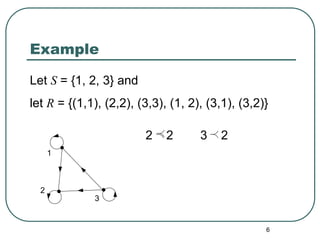
Example
Let S = {1, 2, 3} and
let R = {(1,1), (2,2), (3,3), (1, 2), (3,1), (3,2)}
1
2
3
2 2 3 2
7
Example (2)
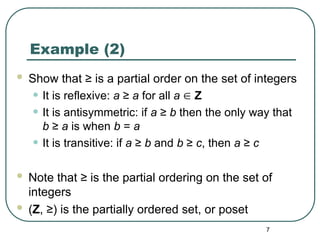
 Show that ≥ is a partial order on the set of integers
• It is reflexive: a ≥ a for all a  Z
• It is antisymmetric: if a ≥ b then the only way that
b ≥ a is when b = a
• It is transitive: if a ≥ b and b ≥ c, then a ≥ c
 Note that ≥ is the partial ordering on the set of
integers
 (Z, ≥) is the partially ordered set, or poset
8
Example (3)
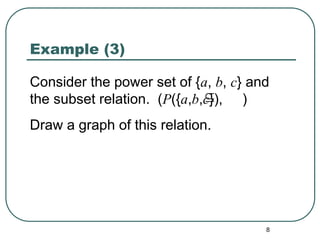
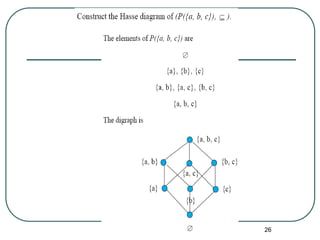
Consider the power set of {a, b, c} and
the subset relation. (P({a,b,c}), )
Draw a graph of this relation.

9
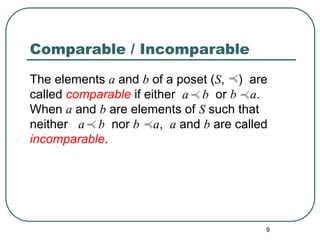
Comparable / Incomparable
The elements a and b of a poset (S, ) are
called comparable if either a b or b a.
When a and b are elements of S such that
neither a b nor b a, a and b are called
incomparable.
10
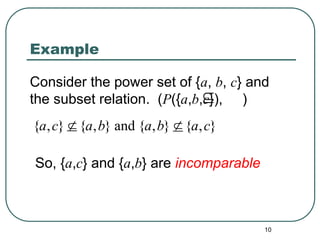
Example

Consider the power set of {a, b, c} and
the subset relation. (P({a,b,c}), )
{ , } { , } and { , } { , }
a c a b a b a c
 
So, {a,c} and {a,b} are incomparable
11
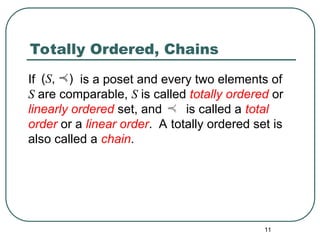
(S, )
If is a poset and every two elements of
S are comparable, S is called totally ordered or
linearly ordered set, and is called a total
order or a linear order. A totally ordered set is
also called a chain.
Totally Ordered, Chains
12
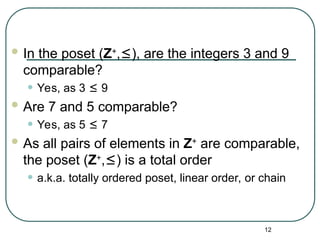
 In the poset (Z+
,≤), are the integers 3 and 9
comparable?
• Yes, as 3 ≤ 9
 Are 7 and 5 comparable?
• Yes, as 5 ≤ 7
 As all pairs of elements in Z+
are comparable,
the poset (Z+
,≤) is a total order
• a.k.a. totally ordered poset, linear order, or chain
13
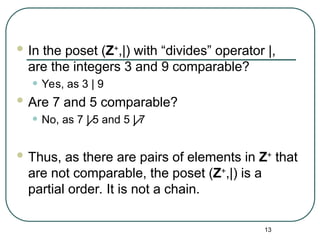
 In the poset (Z+
,|) with “divides” operator |,
are the integers 3 and 9 comparable?
• Yes, as 3 | 9
 Are 7 and 5 comparable?
• No, as 7 | 5 and 5 | 7
 Thus, as there are pairs of elements in Z+
that
are not comparable, the poset (Z+
,|) is a
partial order. It is not a chain.
14
15
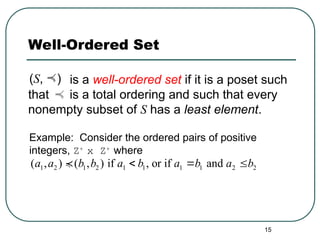
(S, ) is a well-ordered set if it is a poset such
that is a total ordering and such that every
nonempty subset of S has a least element.
Well-Ordered Set
Example: Consider the ordered pairs of positive
integers, Z+
x Z+
where
1 2 1 2 1 1 1 1 2 2
( , ) ( , ) if , or if and
a a b b a b a b a b
  

16
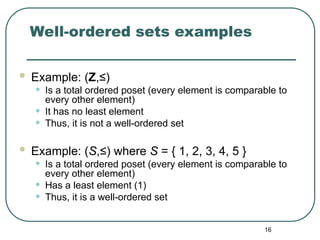
Well-ordered sets examples
 Example: (Z,≤)
• Is a total ordered poset (every element is comparable to
every other element)
• It has no least element
• Thus, it is not a well-ordered set
 Example: (S,≤) where S = { 1, 2, 3, 4, 5 }
• Is a total ordered poset (every element is comparable to
every other element)
• Has a least element (1)
• Thus, it is a well-ordered set
17
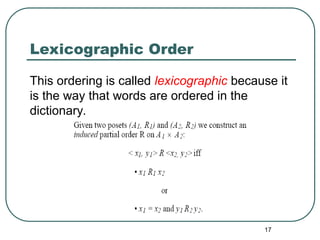
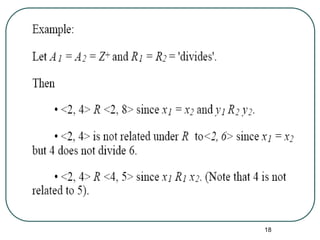
Lexicographic Order
This ordering is called lexicographic because it
is the way that words are ordered in the
dictionary.
18
19
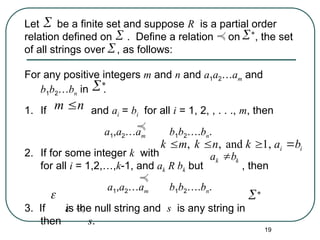
For any positive integers m and n and a1a2…am and
b1b2…bn in .
1. If and ai = bi for all i = 1, 2, , . . ., m, then
a1,a2…am b1b2….bn.
2. If for some integer k with
for all i = 1,2,…,k-1, and ak R bk but , then
a1,a2…am b1b2….bn.
3. If is the null string and s is any string in
then s.
m n

*

Let be a finite set and suppose R is a partial order
relation defined on . Define a relation on , the set
of all strings over , as follows:

*



, , and 1, i i
k m k n k a b
   
k k
a b



*

20
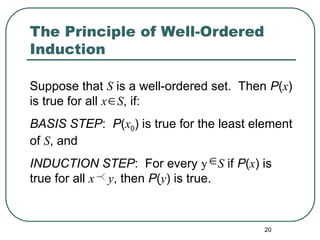
The Principle of Well-Ordered
Induction
Suppose that S is a well-ordered set. Then P(x)
is true for all x S, if:
BASIS STEP: P(x0) is true for the least element
of S, and
INDUCTION STEP: For every y S if P(x) is
true for all x y, then P(y) is true.


21
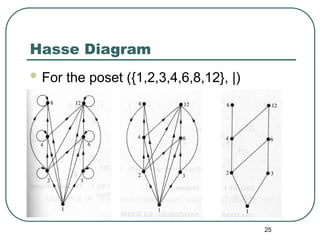
Hasse Diagrams
Given any partial order relation defined on a
finite set, it is possible to draw the directed
graph so that all of these properties are
satisfied.
This makes it possible to associate a
somewhat simpler graph, called a Hasse
diagram, with a partial order relation defined
on a finite set.
22
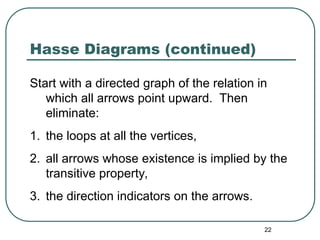
Hasse Diagrams (continued)
Start with a directed graph of the relation in
which all arrows point upward. Then
eliminate:
1. the loops at all the vertices,
2. all arrows whose existence is implied by the
transitive property,
3. the direction indicators on the arrows.
23
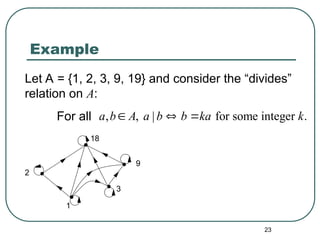
Example
Let A = {1, 2, 3, 9, 19} and consider the “divides”
relation on A:
For all , , | for some integer .
a b A a b b ka k
  
1
2
3
9
18
24
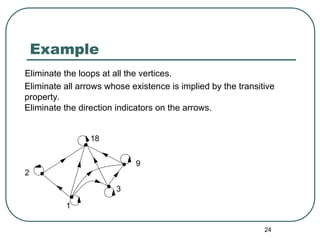
Example
Eliminate the loops at all the vertices.
1
2
3
9
18
Eliminate all arrows whose existence is implied by the transitive
property.
Eliminate the direction indicators on the arrows.
25
Hasse Diagram
 For the poset ({1,2,3,4,6,8,12}, |)
26
27
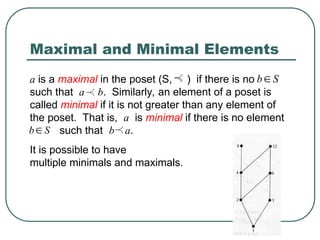
a is a maximal in the poset (S, ) if there is no
such that a b. Similarly, an element of a poset is
called minimal if it is not greater than any element of
the poset. That is, a is minimal if there is no element
such that b a.
It is possible to have
multiple minimals and maximals.
Maximal and Minimal Elements
b S

b S

28
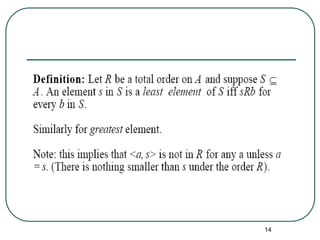
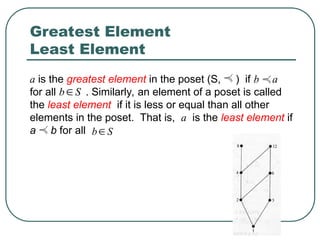
a is the greatest element in the poset (S, ) if b a
for all . Similarly, an element of a poset is called
the least element if it is less or equal than all other
elements in the poset. That is, a is the least element if
a b for all
Greatest Element
Least Element
b S

b S

29
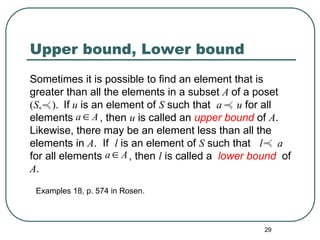
Upper bound, Lower bound
Sometimes it is possible to find an element that is
greater than all the elements in a subset A of a poset
(S, ). If u is an element of S such that a u for all
elements , then u is called an upper bound of A.
Likewise, there may be an element less than all the
elements in A. If l is an element of S such that l a
for all elements , then l is called a lower bound of
A.
a A

a A

Examples 18, p. 574 in Rosen.
30
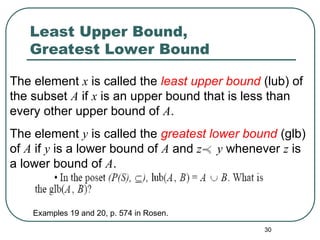
Least Upper Bound,
Greatest Lower Bound
The element x is called the least upper bound (lub) of
the subset A if x is an upper bound that is less than
every other upper bound of A.
The element y is called the greatest lower bound (glb)
of A if y is a lower bound of A and z y whenever z is
a lower bound of A.
Examples 19 and 20, p. 574 in Rosen.
31
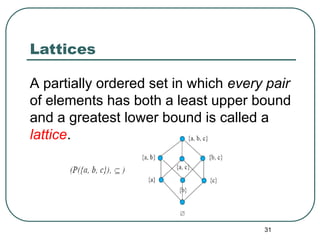
Lattices
A partially ordered set in which every pair
of elements has both a least upper bound
and a greatest lower bound is called a
lattice.
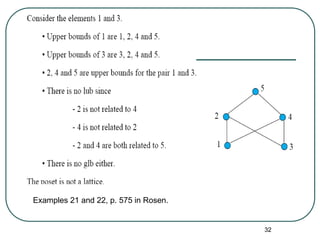
32
Examples 21 and 22, p. 575 in Rosen.
33
Lattice Model
(LinuxSecurity.com)
(I) A security model for flow control in a system, based on the
lattice that is formed by the finite security levels in a system and
their partial ordering. [Denn] (See: flow control, security level,
security model.) (C) The model describes the semantic structure
formed by a finite set of security levels, such as those used in
military organizations. (C) A lattice is a finite set together with a
partial ordering on its elements such that for every pair of
elements there is a least upper bound and a greatest lower bound.
For example, a lattice is formed by a finite set S of security levels
-- i.e., a set S of all ordered pairs (x, c), where x is one of a finite
set X of hierarchically ordered classification levels (X1, ..., Xm),
and c is a (possibly empty) subset of a finite set C of non-
hierarchical categories (C1, ..., Cn) -- together with the "dominate"
relation. (See: dominate.)
34
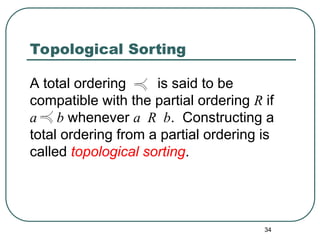
Topological Sorting
A total ordering is said to be
compatible with the partial ordering R if
a b whenever a R b. Constructing a
total ordering from a partial ordering is
called topological sorting.
35
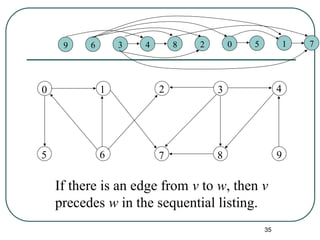
0 1 2 3 4
5 6 7 8 9
If there is an edge from v to w, then v
precedes w in the sequential listing.
9 6 3 4 8 2 0 5 1 7
36
Example
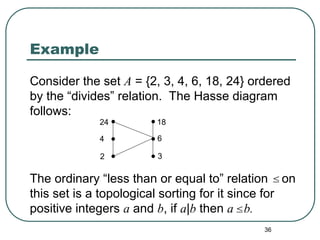
Consider the set A = {2, 3, 4, 6, 18, 24} ordered
by the “divides” relation. The Hasse diagram
follows:
The ordinary “less than or equal to” relation on
this set is a topological sorting for it since for
positive integers a and b, if a|b then a b.


24
4
2
18
6
3
37
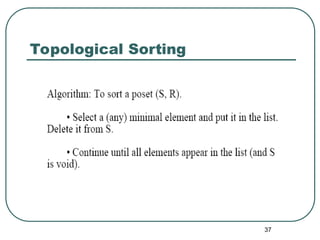
Topological Sorting
38
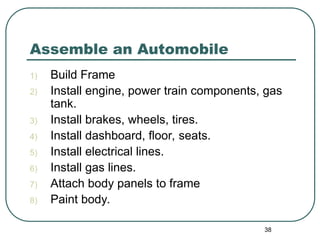
Assemble an Automobile
1) Build Frame
2) Install engine, power train components, gas
tank.
3) Install brakes, wheels, tires.
4) Install dashboard, floor, seats.
5) Install electrical lines.
6) Install gas lines.
7) Attach body panels to frame
8) Paint body.
39
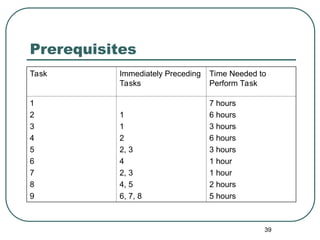
Prerequisites
Task Immediately Preceding
Tasks
Time Needed to
Perform Task
1
2
3
4
5
6
7
8
9
1
1
2
2, 3
4
2, 3
4, 5
6, 7, 8
7 hours
6 hours
3 hours
6 hours
3 hours
1 hour
1 hour
2 hours
5 hours
40
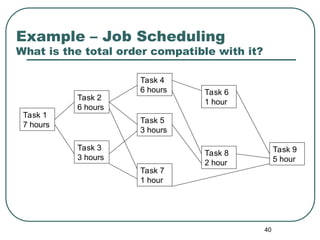
Example – Job Scheduling
What is the total order compatible with it?
Task 1
7 hours
Task 2
6 hours
Task 3
3 hours
Task 4
6 hours
Task 5
3 hours
Task 7
1 hour
Task 6
1 hour
Task 8
2 hour
Task 9
5 hour
41
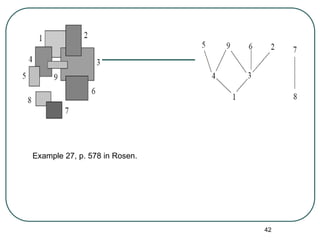
42
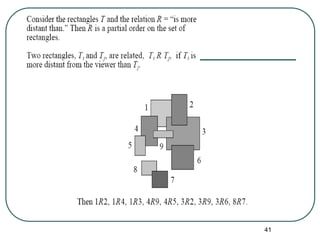
Example 27, p. 578 in Rosen.

Partial Orderings by Rosen Mathematics Discrete

  • 1.
    1 Partial Orderings Based onSlides by Chuck Allison from http://uvsc.freshsources.com/Courses/CS_2300/Slides/slides.html Rosen, Chapter 8.6 Modified by Longin Jan Latecki
  • 2.
    2 Introduction  An equivalencerelation is a relation that is reflexive, symmetric, and transitive  A partial ordering (or partial order) is a relation that is reflexive, antisymmetric, and transitive • Recall that antisymmetric means that if (a,b)  R, then (b,a) R unless b = a • Thus, (a,a) is allowed to be in R • But since it’s reflexive, all possible (a,a) must be in R
  • 3.
    3 Partially Ordered Set(POSET) A relation R on a set S is called a partial ordering or partial order if it is reflexive, antisymmetric, and transitive. A set S together with a partial ordering R is called a partially ordered set, or poset, and is denoted by (S, R)
  • 4.
    4 Example (1) Let S= {1, 2, 3} and let R = {(1,1), (2,2), (3,3), (1, 2), (3,1), (3,2)} 1 2 3
  • 5.
    5 In a posetthe notation a b denotes that This notation is used because the “less than or equal to” relation is a paradigm for a partial ordering. (Note that the symbol is used to denote the relation in any poset, not just the “less than or equals” relation.) The notation a b denotes that a b, but ( , ) a b R  a b 
  • 6.
    6 Example Let S ={1, 2, 3} and let R = {(1,1), (2,2), (3,3), (1, 2), (3,1), (3,2)} 1 2 3 2 2 3 2
  • 7.
    7 Example (2)  Showthat ≥ is a partial order on the set of integers • It is reflexive: a ≥ a for all a  Z • It is antisymmetric: if a ≥ b then the only way that b ≥ a is when b = a • It is transitive: if a ≥ b and b ≥ c, then a ≥ c  Note that ≥ is the partial ordering on the set of integers  (Z, ≥) is the partially ordered set, or poset
  • 8.
    8 Example (3) Consider thepower set of {a, b, c} and the subset relation. (P({a,b,c}), ) Draw a graph of this relation. 
  • 9.
    9 Comparable / Incomparable Theelements a and b of a poset (S, ) are called comparable if either a b or b a. When a and b are elements of S such that neither a b nor b a, a and b are called incomparable.
  • 10.
    10 Example  Consider the powerset of {a, b, c} and the subset relation. (P({a,b,c}), ) { , } { , } and { , } { , } a c a b a b a c   So, {a,c} and {a,b} are incomparable
  • 11.
    11 (S, ) If isa poset and every two elements of S are comparable, S is called totally ordered or linearly ordered set, and is called a total order or a linear order. A totally ordered set is also called a chain. Totally Ordered, Chains
  • 12.
    12  In theposet (Z+ ,≤), are the integers 3 and 9 comparable? • Yes, as 3 ≤ 9  Are 7 and 5 comparable? • Yes, as 5 ≤ 7  As all pairs of elements in Z+ are comparable, the poset (Z+ ,≤) is a total order • a.k.a. totally ordered poset, linear order, or chain
  • 13.
    13  In theposet (Z+ ,|) with “divides” operator |, are the integers 3 and 9 comparable? • Yes, as 3 | 9  Are 7 and 5 comparable? • No, as 7 | 5 and 5 | 7  Thus, as there are pairs of elements in Z+ that are not comparable, the poset (Z+ ,|) is a partial order. It is not a chain.
  • 14.
  • 15.
    15 (S, ) isa well-ordered set if it is a poset such that is a total ordering and such that every nonempty subset of S has a least element. Well-Ordered Set Example: Consider the ordered pairs of positive integers, Z+ x Z+ where 1 2 1 2 1 1 1 1 2 2 ( , ) ( , ) if , or if and a a b b a b a b a b    
  • 16.
    16 Well-ordered sets examples Example: (Z,≤) • Is a total ordered poset (every element is comparable to every other element) • It has no least element • Thus, it is not a well-ordered set  Example: (S,≤) where S = { 1, 2, 3, 4, 5 } • Is a total ordered poset (every element is comparable to every other element) • Has a least element (1) • Thus, it is a well-ordered set
  • 17.
    17 Lexicographic Order This orderingis called lexicographic because it is the way that words are ordered in the dictionary.
  • 18.
  • 19.
    19 For any positiveintegers m and n and a1a2…am and b1b2…bn in . 1. If and ai = bi for all i = 1, 2, , . . ., m, then a1,a2…am b1b2….bn. 2. If for some integer k with for all i = 1,2,…,k-1, and ak R bk but , then a1,a2…am b1b2….bn. 3. If is the null string and s is any string in then s. m n  *  Let be a finite set and suppose R is a partial order relation defined on . Define a relation on , the set of all strings over , as follows:  *    , , and 1, i i k m k n k a b     k k a b    * 
  • 20.
    20 The Principle ofWell-Ordered Induction Suppose that S is a well-ordered set. Then P(x) is true for all x S, if: BASIS STEP: P(x0) is true for the least element of S, and INDUCTION STEP: For every y S if P(x) is true for all x y, then P(y) is true.  
  • 21.
    21 Hasse Diagrams Given anypartial order relation defined on a finite set, it is possible to draw the directed graph so that all of these properties are satisfied. This makes it possible to associate a somewhat simpler graph, called a Hasse diagram, with a partial order relation defined on a finite set.
  • 22.
    22 Hasse Diagrams (continued) Startwith a directed graph of the relation in which all arrows point upward. Then eliminate: 1. the loops at all the vertices, 2. all arrows whose existence is implied by the transitive property, 3. the direction indicators on the arrows.
  • 23.
    23 Example Let A ={1, 2, 3, 9, 19} and consider the “divides” relation on A: For all , , | for some integer . a b A a b b ka k    1 2 3 9 18
  • 24.
    24 Example Eliminate the loopsat all the vertices. 1 2 3 9 18 Eliminate all arrows whose existence is implied by the transitive property. Eliminate the direction indicators on the arrows.
  • 25.
    25 Hasse Diagram  Forthe poset ({1,2,3,4,6,8,12}, |)
  • 26.
  • 27.
    27 a is amaximal in the poset (S, ) if there is no such that a b. Similarly, an element of a poset is called minimal if it is not greater than any element of the poset. That is, a is minimal if there is no element such that b a. It is possible to have multiple minimals and maximals. Maximal and Minimal Elements b S  b S 
  • 28.
    28 a is thegreatest element in the poset (S, ) if b a for all . Similarly, an element of a poset is called the least element if it is less or equal than all other elements in the poset. That is, a is the least element if a b for all Greatest Element Least Element b S  b S 
  • 29.
    29 Upper bound, Lowerbound Sometimes it is possible to find an element that is greater than all the elements in a subset A of a poset (S, ). If u is an element of S such that a u for all elements , then u is called an upper bound of A. Likewise, there may be an element less than all the elements in A. If l is an element of S such that l a for all elements , then l is called a lower bound of A. a A  a A  Examples 18, p. 574 in Rosen.
  • 30.
    30 Least Upper Bound, GreatestLower Bound The element x is called the least upper bound (lub) of the subset A if x is an upper bound that is less than every other upper bound of A. The element y is called the greatest lower bound (glb) of A if y is a lower bound of A and z y whenever z is a lower bound of A. Examples 19 and 20, p. 574 in Rosen.
  • 31.
    31 Lattices A partially orderedset in which every pair of elements has both a least upper bound and a greatest lower bound is called a lattice.
  • 32.
    32 Examples 21 and22, p. 575 in Rosen.
  • 33.
    33 Lattice Model (LinuxSecurity.com) (I) Asecurity model for flow control in a system, based on the lattice that is formed by the finite security levels in a system and their partial ordering. [Denn] (See: flow control, security level, security model.) (C) The model describes the semantic structure formed by a finite set of security levels, such as those used in military organizations. (C) A lattice is a finite set together with a partial ordering on its elements such that for every pair of elements there is a least upper bound and a greatest lower bound. For example, a lattice is formed by a finite set S of security levels -- i.e., a set S of all ordered pairs (x, c), where x is one of a finite set X of hierarchically ordered classification levels (X1, ..., Xm), and c is a (possibly empty) subset of a finite set C of non- hierarchical categories (C1, ..., Cn) -- together with the "dominate" relation. (See: dominate.)
  • 34.
    34 Topological Sorting A totalordering is said to be compatible with the partial ordering R if a b whenever a R b. Constructing a total ordering from a partial ordering is called topological sorting.
  • 35.
    35 0 1 23 4 5 6 7 8 9 If there is an edge from v to w, then v precedes w in the sequential listing. 9 6 3 4 8 2 0 5 1 7
  • 36.
    36 Example Consider the setA = {2, 3, 4, 6, 18, 24} ordered by the “divides” relation. The Hasse diagram follows: The ordinary “less than or equal to” relation on this set is a topological sorting for it since for positive integers a and b, if a|b then a b.   24 4 2 18 6 3
  • 37.
  • 38.
    38 Assemble an Automobile 1)Build Frame 2) Install engine, power train components, gas tank. 3) Install brakes, wheels, tires. 4) Install dashboard, floor, seats. 5) Install electrical lines. 6) Install gas lines. 7) Attach body panels to frame 8) Paint body.
  • 39.
    39 Prerequisites Task Immediately Preceding Tasks TimeNeeded to Perform Task 1 2 3 4 5 6 7 8 9 1 1 2 2, 3 4 2, 3 4, 5 6, 7, 8 7 hours 6 hours 3 hours 6 hours 3 hours 1 hour 1 hour 2 hours 5 hours
  • 40.
    40 Example – JobScheduling What is the total order compatible with it? Task 1 7 hours Task 2 6 hours Task 3 3 hours Task 4 6 hours Task 5 3 hours Task 7 1 hour Task 6 1 hour Task 8 2 hour Task 9 5 hour
  • 41.
  • 42.
    42 Example 27, p.578 in Rosen.