Predicates
Predicative logic
Free and bound variables
Rules of Inference
Consistency
Proof of Contradiction
Automatic Theorem proving
Quantifiers and Predicates
Universal quantifier : The quantifier ‘ all ’ is called the Universal
quantifier, and we shall denote it by x (or (x) ), which is an inverted
A followed by the variable x.
x : for all x ( for every x (or) for each x )
Existential quantifier : The quantifier ‘some’ is called the Existential
quantifier, and we shall denote it by x, which is a reversed E followed
by the variable x.
x : for some x ( There exists an x such that or There is at least one
x such that )
Consider the statement, ‘John is a Politician’
Here, ‘John’ is the subject and ‘is a Politician’ is the predicate
Denote the predicate, ‘is a Politician’ symbolically by the predicate
letter P, and the subject ‘John’ by j .
Predicates (Contd.,)
The statement ‘John is a Politician’ can be written as P(j)
P(j) : John is a Politician
If x is any person, then
P(x) : x is a politician
In general, any statement of the type “ x is Q ” is denoted by Q(x).
Let S(x) : x is a scientist. ( Here, S denote the predicate ‘is a scientist’).
P(x) : x is not a politician
P(x)  S(x) : x is a politician and x is a scientist.
P(x)  S(x) : Either x is a politician or x is a scientist.
P(x) S(y) : If x is a politician then y is a scientist.
x {P(x)} : All are politicians
Predicates (Contd.,)
x {P(x)  S(x)} : Some politicians are scientists.
x {P(x) S(x)} : All politicians are scientists.
x {P(x)  S(x)} : Every body is either a politician or a scientist
Sentence Abbreviated Meaning
(x) P(x) all true
(x) P(x) at least one true
 {(x) P(x)} none true
(x) {P(x)} all false
(x) {P(x)} at least one false
{(x) P(x)} none false
{(x) P(x)} not all true
{(x) P(x)} not all false
Free and Bound variables
Given a formula containing a part of the form (x) P(x) or (x) P(x),
such a part is called an x-bound part of the formula. Further P(x) is the
scope of the quantifier in both the formulas.
Any occurrence of x, in an x-bound part of the formula is called a
bound occurrence of x, while any variable that is not a bound
occurrence is called a free occurrence
Ex: consider, (x) P(x,y)
Here, the scope of the universal quantifier is P(x,y), x is a bound
variable and y is a free variable.
Ex: Consider the formula, (x) (P(x) Q(x))
Here, Scope of the quantifier is P(x) Q(x).
Both the occurrences of x are bound.
Free and Bound variables (Contd.,)
Ex: (x) {P(x)  (y) R(x,y)}
Here, the scope of x is P(x)  (y) R(x,y)
and the scope of y is R(x,y)
All occurrences of x and y are bound occurrences.
In the bound occurrence of a variable, the letter which is used to
represent the variable is a dummy variable.
The formula (x) {P(x)} is same as (y) {P(y)}
The formula, (y) R(x,y) is same as (z) R(x,z) .
Generally speaking, in order to draw conclusions from quantified
premises, we need to remove quantifiers properly, argue with the
resulting propositions, and then properly prefix the correct quantifiers.
Some Equivalences and Negations
(x) P(x)  {(x) P(x)}
(x) {P(x)}   {( x) P(x)}
 {(x) P(x)}  {(x)P(x)}
 {(x) ~P(x)}  (x) P(x)
Statement Negation
(x) P(x) (x) [P(x)]
(x) [~P(x)] (x) P(x)
(x) [P(x)] (x) P(x)
(x) P(x) (x) [P(x)]
To form the negation of a statement involving one quantifier,we need
only change the quantifier from universal to existential, or from
existential to Universal, and negate the statement it quantifies.
Rules of Inference for Quantified Propositions
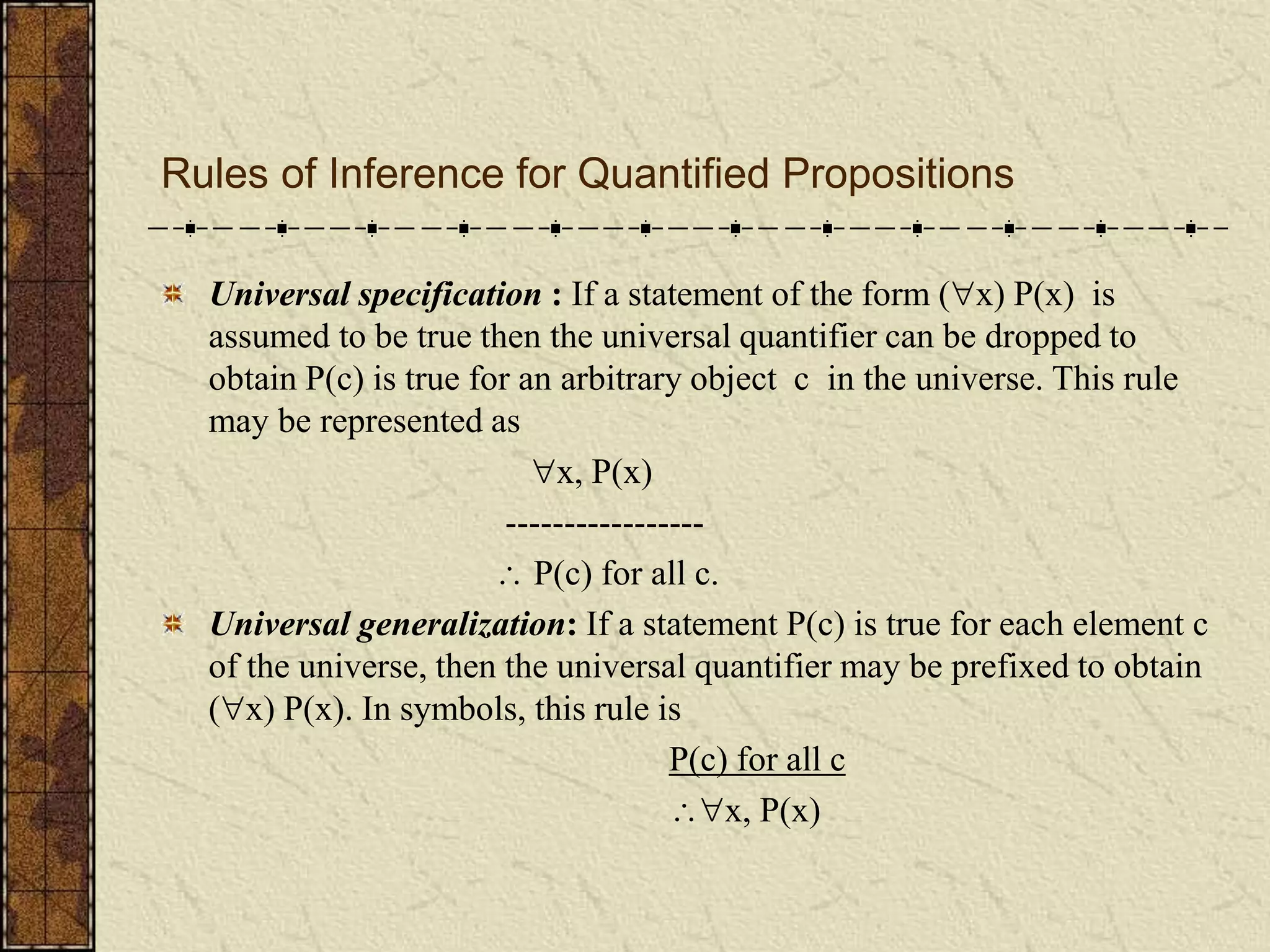
Universal specification : If a statement of the form (x) P(x) is
assumed to be true then the universal quantifier can be dropped to
obtain P(c) is true for an arbitrary object c in the universe. This rule
may be represented as
x, P(x)
-----------------
 P(c) for all c.
Universal generalization: If a statement P(c) is true for each element c
of the universe, then the universal quantifier may be prefixed to obtain
(x) P(x). In symbols, this rule is
P(c) for all c
x, P(x)
Rules of Inference for Quantified Propositions (Contd.,)
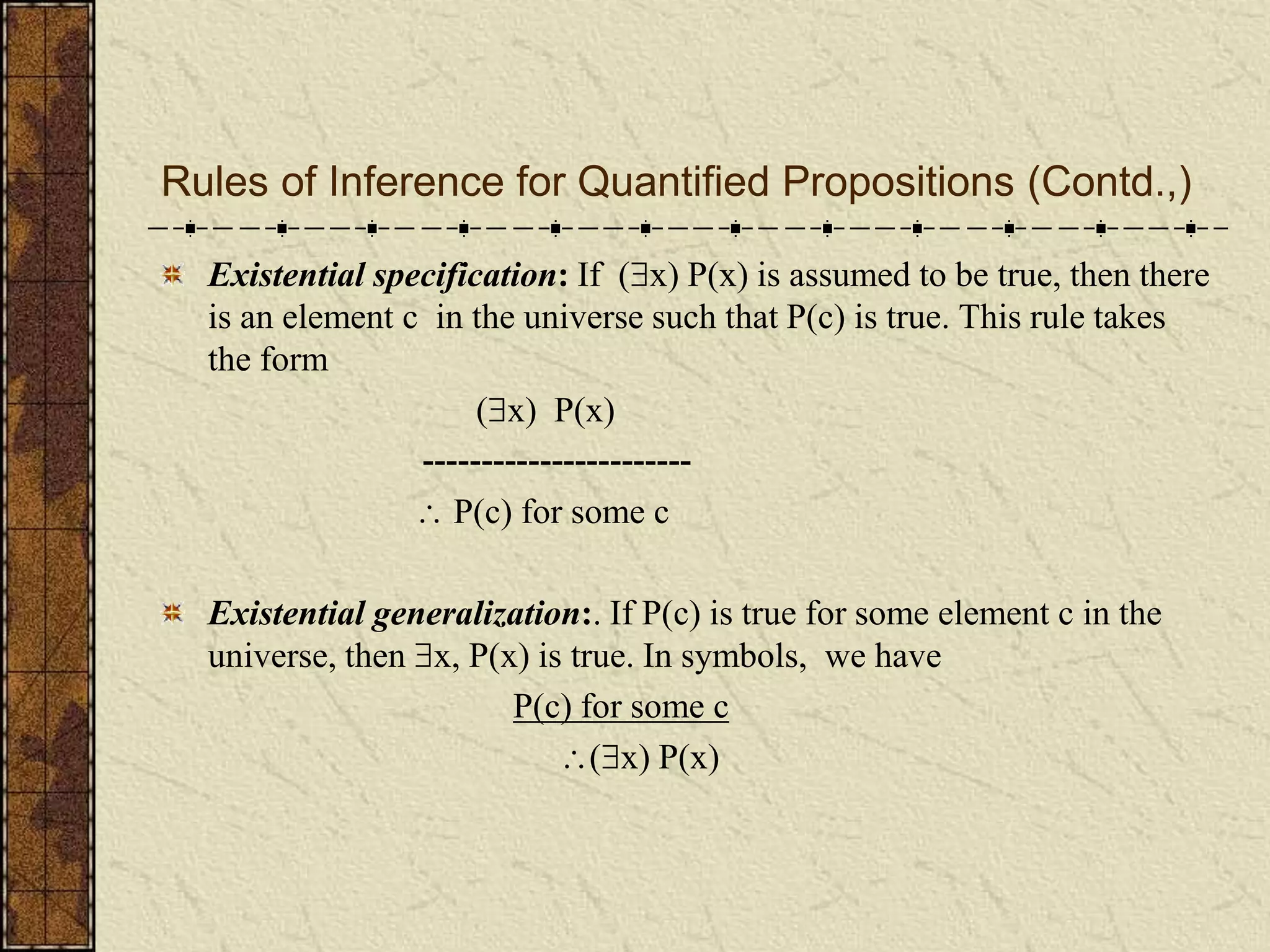
Existential specification: If (x) P(x) is assumed to be true, then there
is an element c in the universe such that P(c) is true. This rule takes
the form
(x) P(x)
-----------------------
 P(c) for some c
Existential generalization:. If P(c) is true for some element c in the
universe, then x, P(x) is true. In symbols, we have
P(c) for some c
(x) P(x)
Examples
Ex: Let P(x) : x is a person
F(x,y) : x is the father of y
M(x,y) : x is the mother of y
Write the predicate “ x is the father of the mother of y ” in symbolic
form.
Solution: In order to symbolize the predicate,
let us assume a person called z as the mother of y.
Now, x is the father of z and z is the mother of y .
We symbolize the predicate as
(z) { P(z)  F(x , z)  M(z , y) }
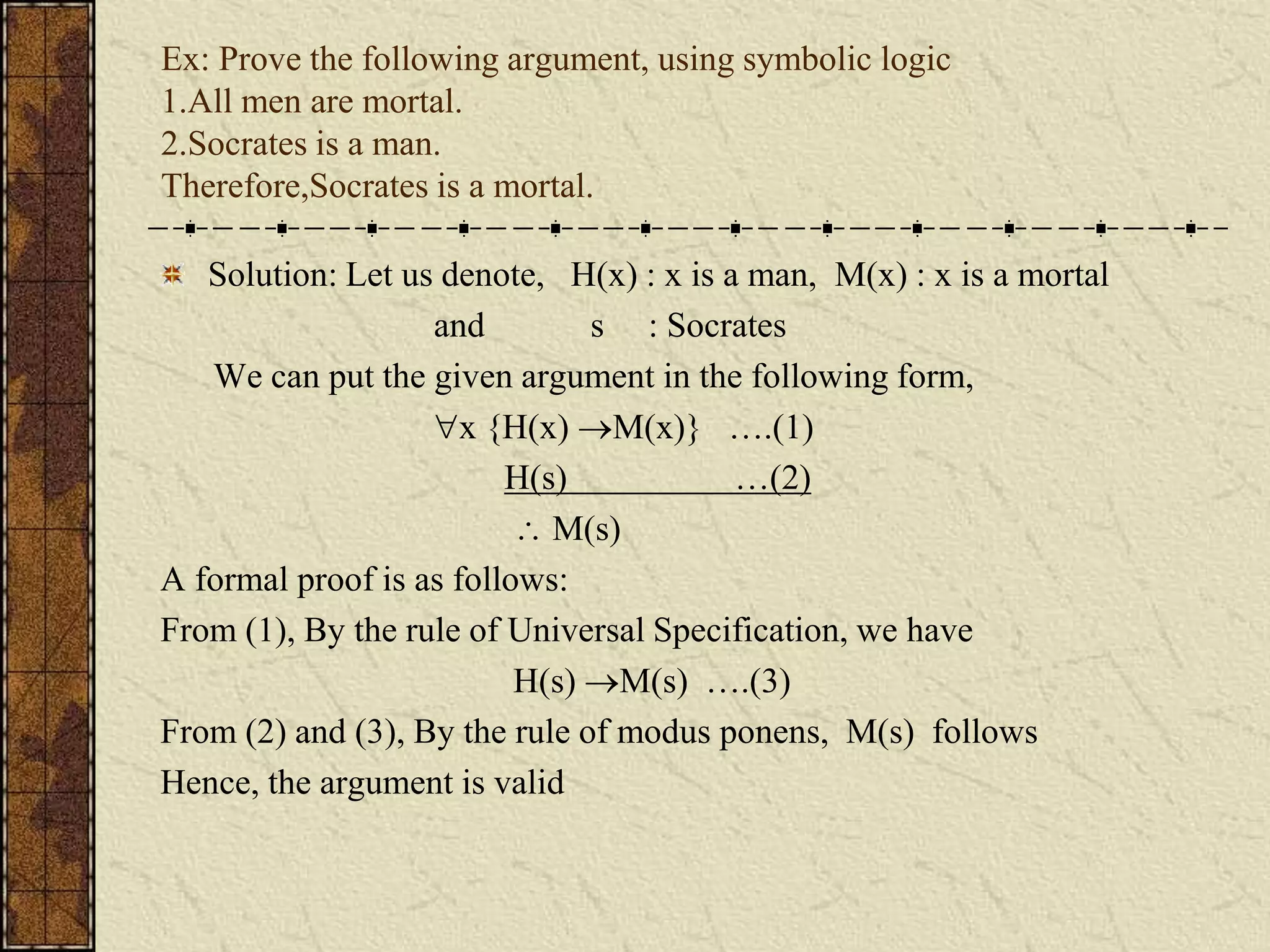
Ex: Prove the following argument, using symbolic logic
1.All men are mortal.
2.Socrates is a man.
Therefore,Socrates is a mortal.
Solution: Let us denote, H(x) : x is a man, M(x) : x is a mortal
and s : Socrates
We can put the given argument in the following form,
x {H(x) M(x)} ….(1)
H(s) …(2)
 M(s)
A formal proof is as follows:
From (1), By the rule of Universal Specification, we have
H(s) M(s) ….(3)
From (2) and (3), By the rule of modus ponens, M(s) follows
Hence, the argument is valid
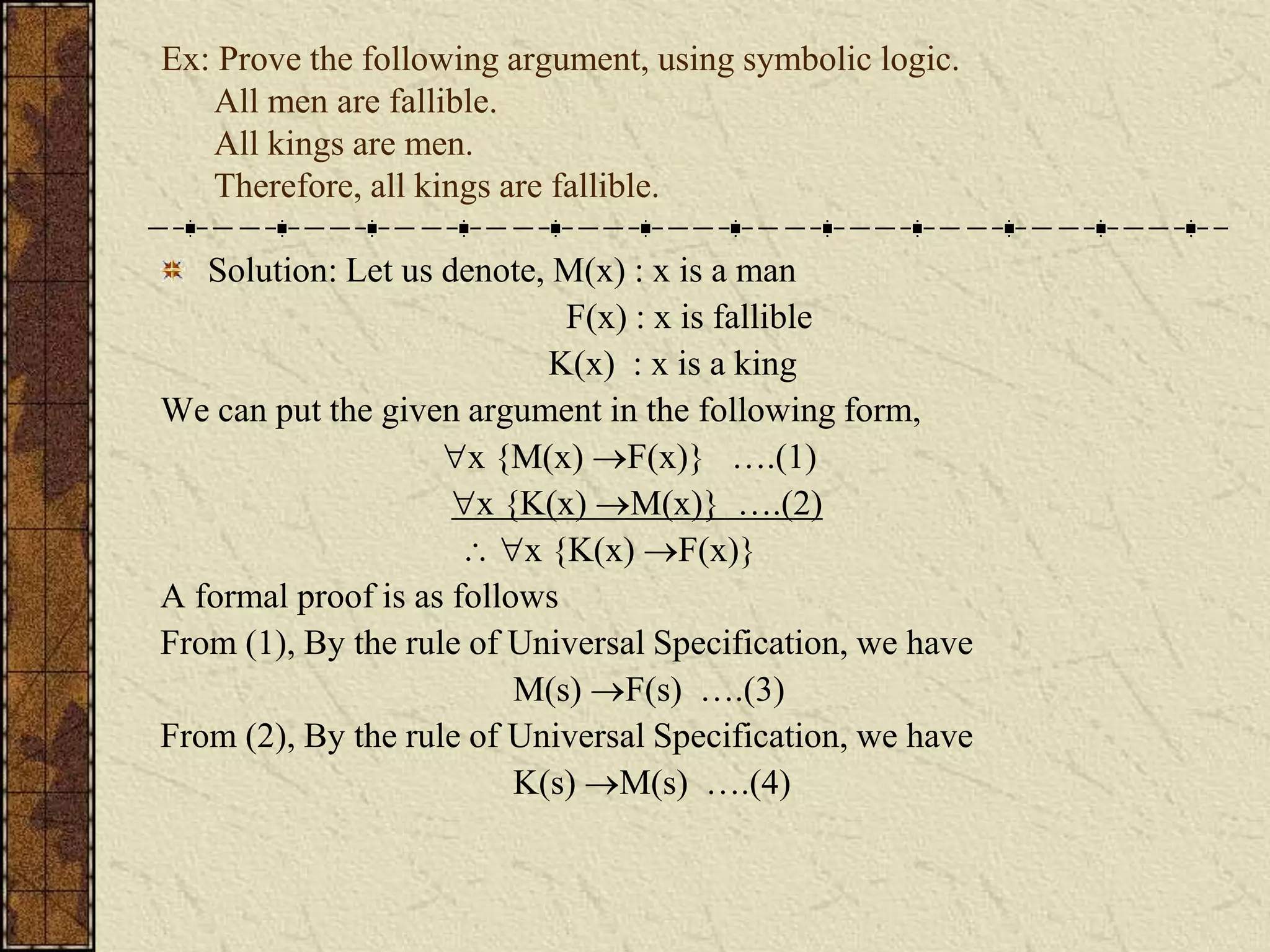
Ex: Prove the following argument, using symbolic logic.
All men are fallible.
All kings are men.
Therefore, all kings are fallible.
Solution: Let us denote, M(x) : x is a man
F(x) : x is fallible
K(x) : x is a king
We can put the given argument in the following form,
x {M(x) F(x)} ….(1)
x {K(x) M(x)} ….(2)
 x {K(x) F(x)}
A formal proof is as follows
From (1), By the rule of Universal Specification, we have
M(s) F(s) ….(3)
From (2), By the rule of Universal Specification, we have
K(s) M(s) ….(4)
Contd.,
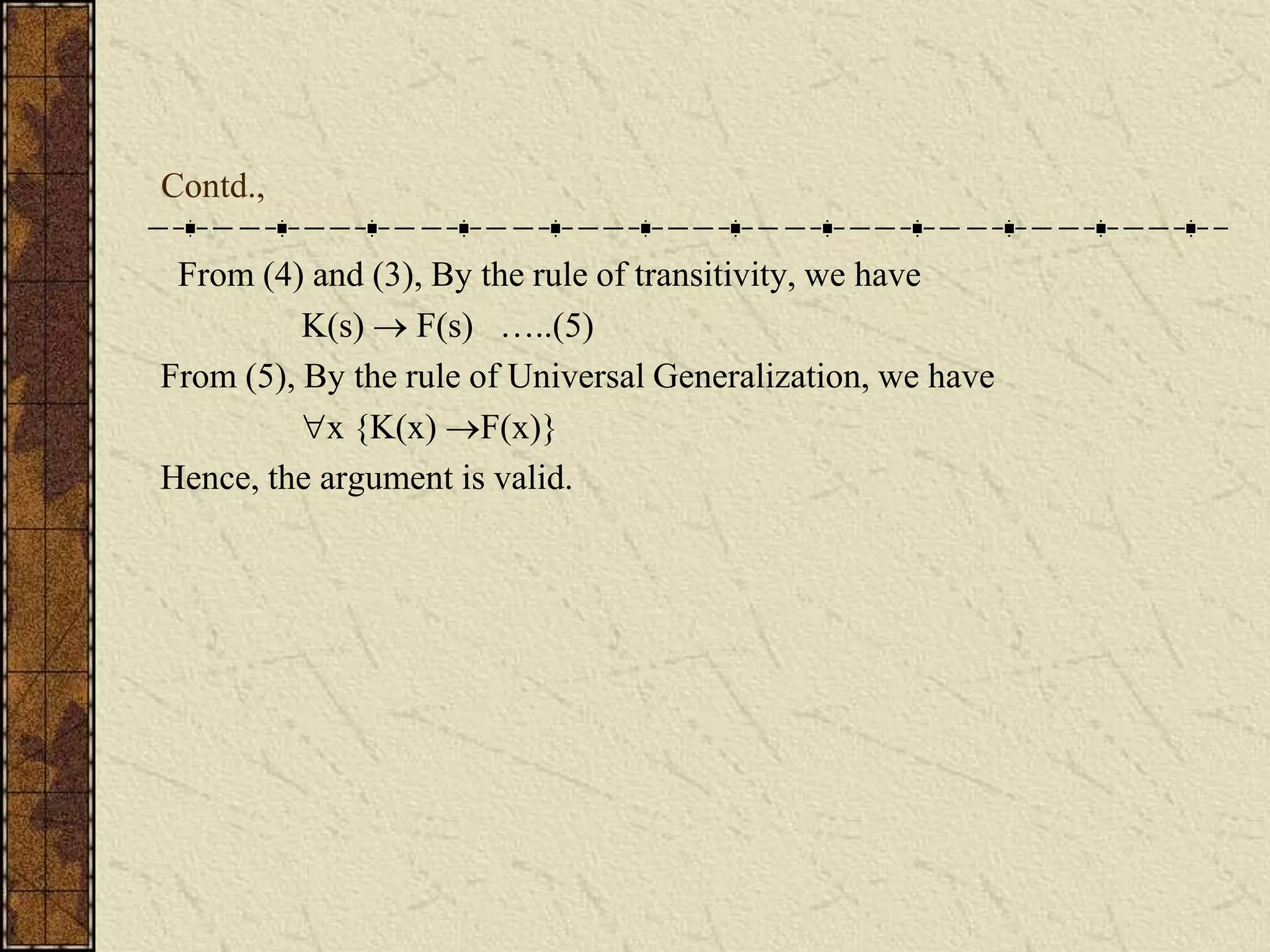
From (4) and (3), By the rule of transitivity, we have
K(s)  F(s) …..(5)
From (5), By the rule of Universal Generalization, we have
x {K(x) F(x)}
Hence, the argument is valid.
Ex: Symbolize the following argument and check for its validity:
All lions are dangerous animals
There are lions
Therefore, there are dangerous animals.
Solution: Let L(x) : x is a lion and
D(x) : x is dangerous.
Then the argument takes the form
(x) {L(x) D(x)} ….(1)
(x) L(x) …..(2)
 (x) D(x)
A formal proof is as follows:
From (2), By the rule of Existential specification, we have
L(a) ……. (3)
From (1), By the rule of Universal Specification, we have
L(a) D(a) ….(4)
Contd.,
From (3) and (4), By the rule of modus ponens,
D(a) …(5)
From(5), By the rule of Existential Generalization, we have
(x) D(x)
Hence, the argument is valid
Ex: Symbolize the following argument and check for its validity:
Every living thing is a plant or animal.
David’s dog is alive and it is not a plant.
All animals have Hearts. Hence, David’s dog has a heart
Solution: Let the universe consists of all living things, and let
P(x) : x is a plant
A(x) : x is an animal
H(x) : x has a heart
a : David’s dog
Then the argument takes the form
(x) {P(x)  A(x)} ….(1)
P(a) ….(2)
x) {A(x) H(x)} ….(3)
 H(a)
The formal proof is given below:
From (1), By the rule of Universal Specification, we have P(a)  A(a)
Contd.,
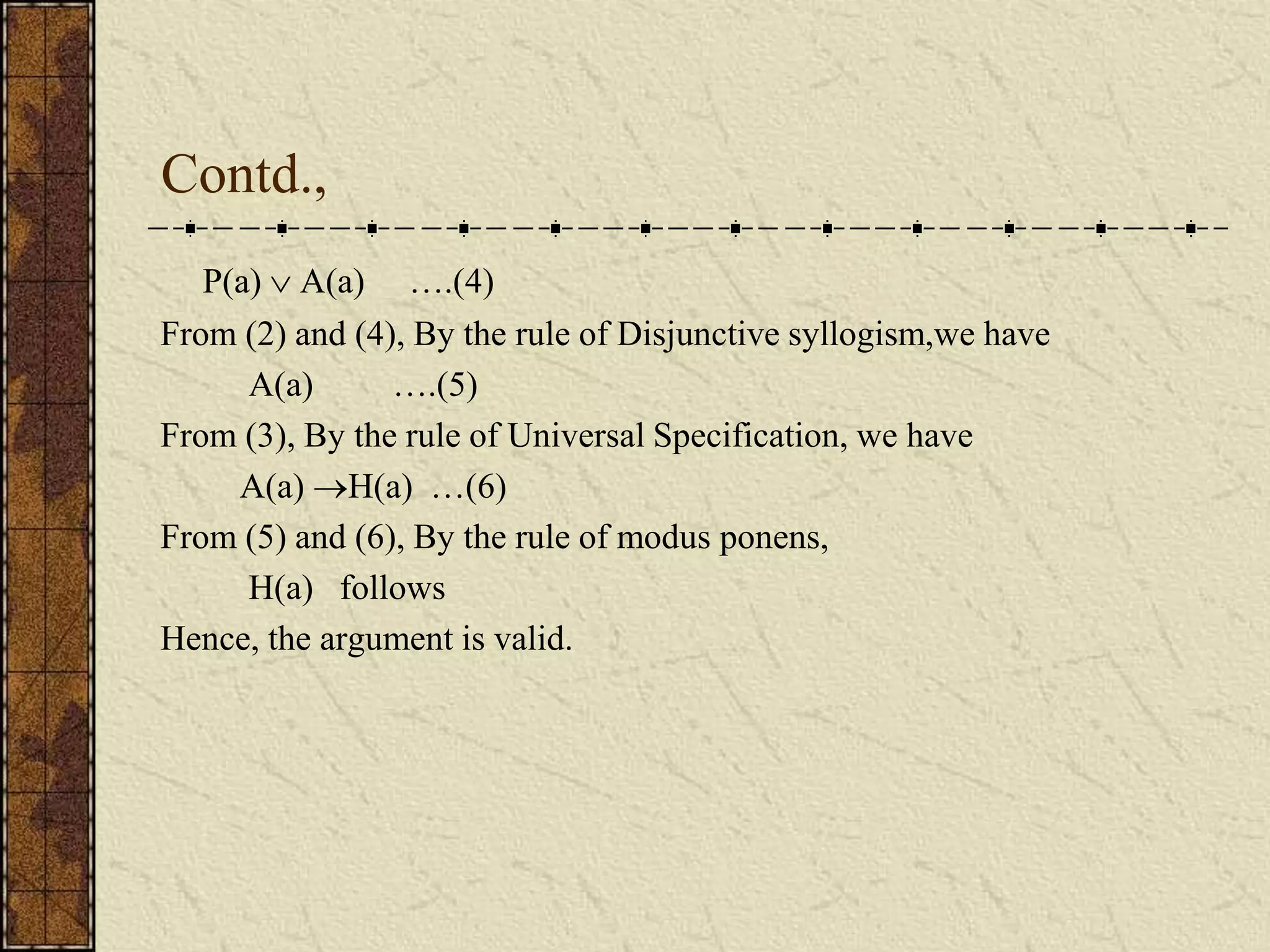
P(a)  A(a) ….(4)
From (2) and (4), By the rule of Disjunctive syllogism,we have
A(a) ….(5)
From (3), By the rule of Universal Specification, we have
A(a) H(a) …(6)
From (5) and (6), By the rule of modus ponens,
H(a) follows
Hence, the argument is valid.
Ex: Prove that (x){P(x)  Q(x)}  (x)P(x)  (x)Q(x)
Is the converse true? . Justify your answer.
Proof: L.H.S. = (x){P(x)  Q(x)}
By the rule of ES,we have
P(y)  Q(y) …(1), y fixed
P(y) …(2) , from (1)
Q(y) …(3), from (1)
From(2), By EG, we have
(x) P(x) ….(4)
From(3), By EG, we have
(x) Q(x) ….(5)
From (4) and (5), we have
(x) P(x)  (x) Q(x) = R.H.S
Contd.,
Now, let us show that the converse of the above result is not true
Consider, R.H.S. = (x) P(x)  (x) Q(x) …(1)
From (1), we have, (x) P(x) …..(2)
Again from (1), we have, (x) Q(x) …(3)
From (2), By ES,we have P(a) ….(4)
From (3), By ES,we have Q(b) ….(5)
Note that in step (4), a is fixed, and it is no longer possible to use that
variable again in step(5).
From (4) and (5), the L.H.S. (x) {P(x)  Q(x)} does not follows
Hence, the converse of the result does not hold.
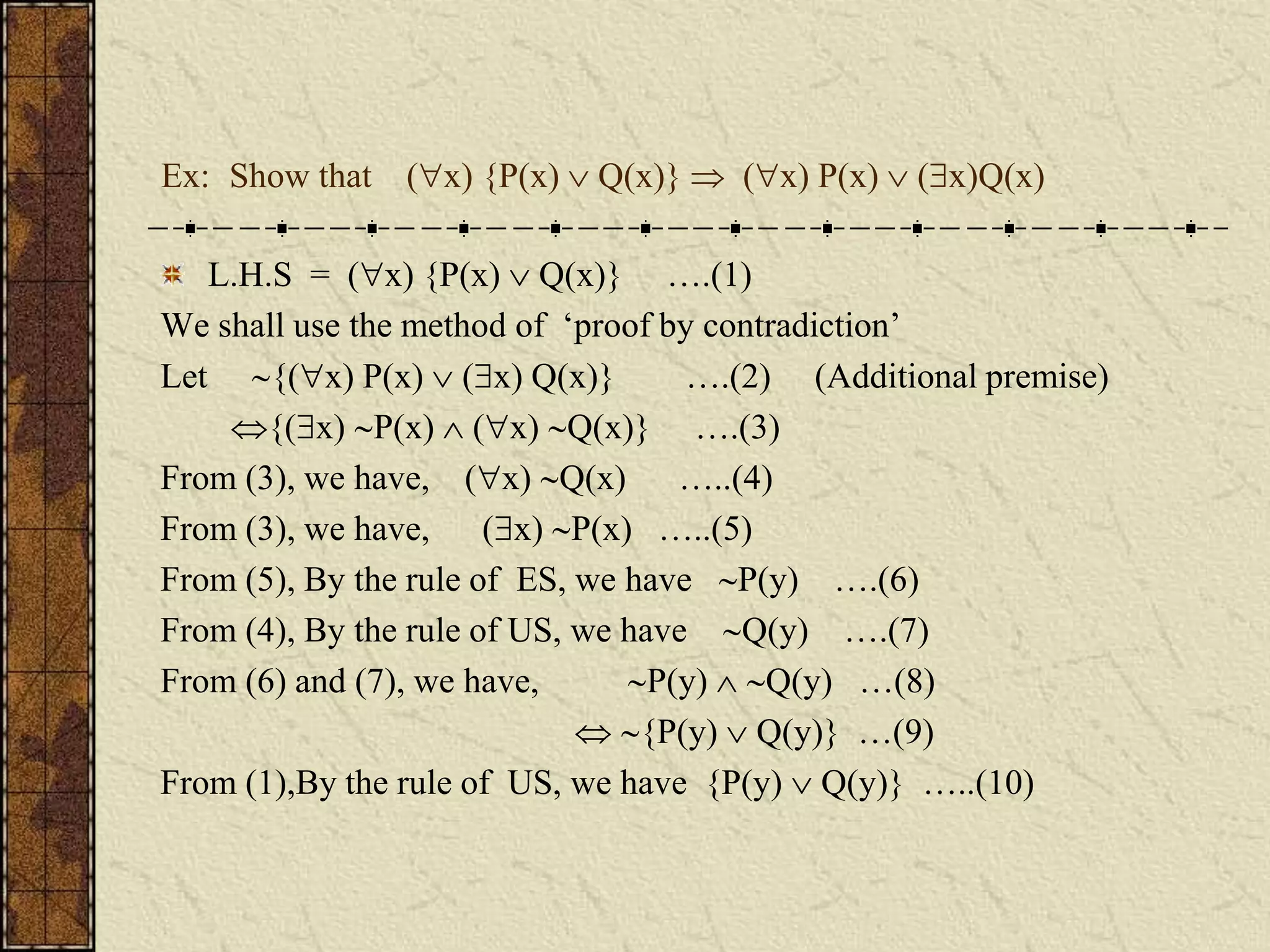
Ex: Show that (x) {P(x)  Q(x)}  (x) P(x)  (x)Q(x)
L.H.S = (x) {P(x)  Q(x)} ….(1)
We shall use the method of ‘proof by contradiction’
Let {(x) P(x)  (x) Q(x)} ….(2) (Additional premise)
{(x) P(x)  (x) Q(x)} ….(3)
From (3), we have, (x) Q(x) …..(4)
From (3), we have, (x) P(x) …..(5)
From (5), By the rule of ES, we have P(y) ….(6)
From (4), By the rule of US, we have Q(y) ….(7)
From (6) and (7), we have, P(y)  Q(y) …(8)
 {P(y)  Q(y)} …(9)
From (1),By the rule of US, we have {P(y)  Q(y)} …..(10)
Contd.,
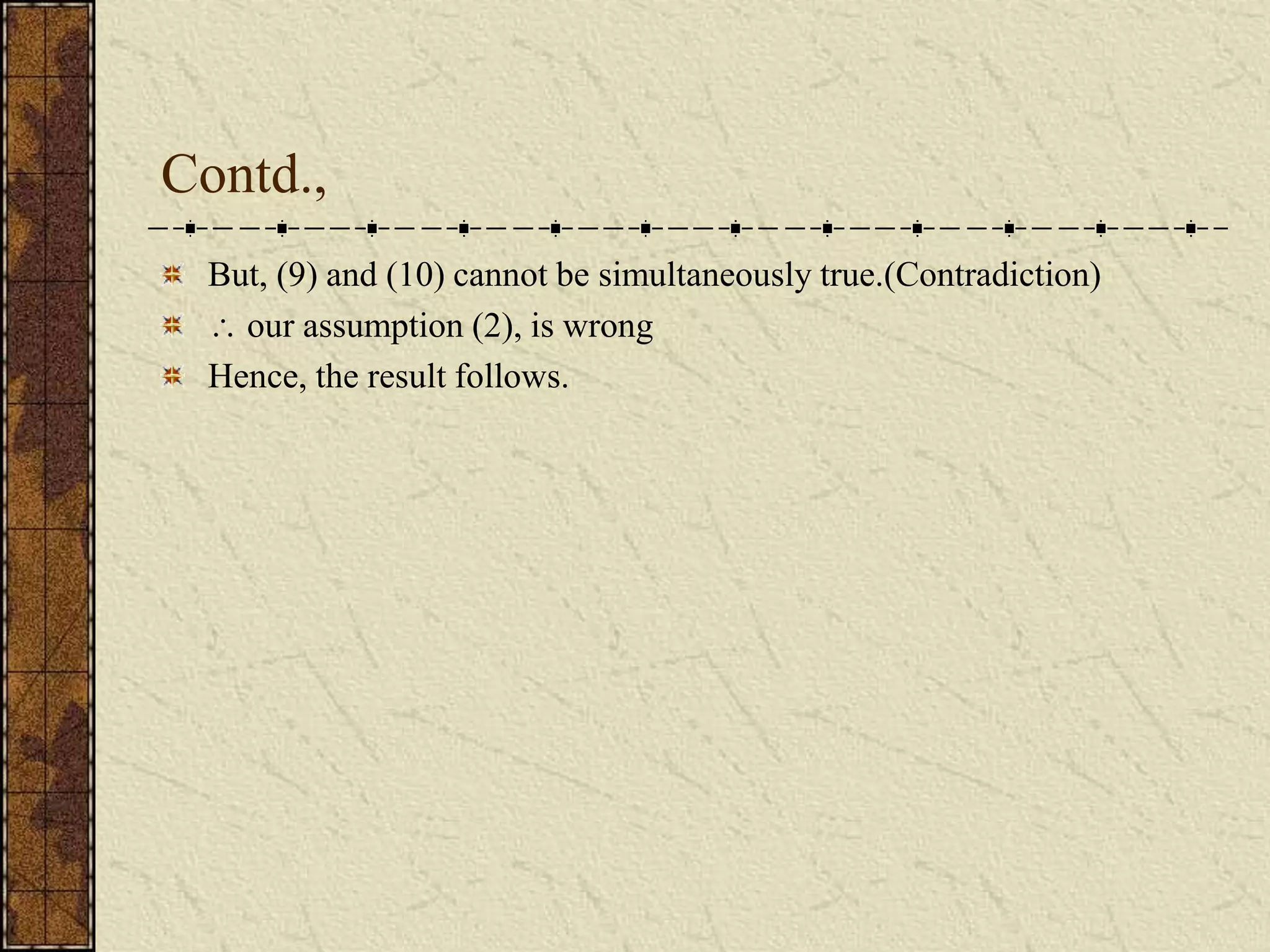
But, (9) and (10) cannot be simultaneously true.(Contradiction)
 our assumption (2), is wrong
Hence, the result follows.
Ex: Show that from
(a) (x) {F(x) S(x)}  (y){M(y)  W(y)}
(b) (y) {M(y )  W(y)}
the conclusion, (x) {F(x)  S(x)} follows
Proof: Given premises are
(x) {F(x) S(x)}  (y){M(y)  W(y)} ……(1)
(y) {M(y )  W(y)} …..(2)
(2)  [(y) {M(y )  W(y)}] …(3)
 [(y) {M(y ) W(y)}] …(4)
From (1) and (4), By Modus tollens, we have
[(x) {F(x)  S(x)}] ….(5)
 [(x) {F(x) )  S(x)}] ….(6)
 [(x) {F(x))  S(x)}] ….(7)
The conclusion logically follows from the premises.
Ex: Show that P(a,b) follows logically from the premises
(x) (y) { P(x,y) W(x,y)} and
W(a,b)
Solution: Given premises are
(x) (y) { P(x,y) W(x,y)} …(1)
W(a,b) …..(2)
From (1), By the rule of US, we have
(y) { P(a,y) W(a,y)} …..(3)
From (3), By the rule of US, we have
{ P(a,b) W(a,b)} …..(4)
From (2)and (4), By the rule of Modus ponens,
P(a,b) follows.
Ex: Consider the statement ‘Given any positive integer, there is a greater
positive integer’. Symbolize the statement with and without using the set
of positive integers as the universe of discourse.
Case1: Let x and y are are restricted to set of positive integers.
The above statement can be written as
‘For all x, there exists a ‘y’ such that y is greater than x’
If G(x,y) is ‘x greater than y’
Then the given statement in symbolic form is (x) (y) G(y,x)
Case 2: If we do not impose the restriction on the universe of discourse
and if we write I(x) : x is an integer,
then we can symbolize the given statement as
(x) [ I(x) (y) { I(y)  G(y , x)} ]
Ex: prove the following argument
(1) (x) {P(x)  Q(x)}
(2) (x) [{P(x)  Q(x)}R(x)]
 (x) {R(x) P(x)}
Proof: From (1), By the rule of US, we have
P(c)  Q(c) ….(3)
From (2), By the rule of US, we have
{P(c)  Q(c)}  R(c) ..…(4)
From (4), By contra positive equivalence, we have
R(c)  {P(c)  Q(c)} ……(5)
Let R(c) ……………(6) (Additional premise)
From (5) and (6), By the rule of modus ponens, we have
P(c)  Q(c) ……………(7)
From (3) and (7), we have
{P(c)  Q( c )}  {P(c)  Q(c)}
Contd.,
 P(c)  {Q( c )  Q(c)}
 P(c)  F
 P(c)
Now, By CP rule,
R(c) P(c) ….(8) follows
From (8), By the rule of UG, we have
(x) {R(x) P(x)}
Hence, the given argument is valid.
Example:
Ex: Let L(x,y) denote the statement ‘x likes y’, where the
universe of discourse for both x and y is the set of all
people in the world.
Consider the statement
“ There is somebody whom no one likes”
Write the Statement in symbolic form.
Solution:
(y) (x) [ ~L(x , y)} ]
Ex: Show that the negation of the sentence
(x) [{C(x)  B(x)}  A(x)}] is
(x) {C(x)  B(x)  A(x)}
Consider, {(x) [{C(x)  B(x)}  A(x)}] }
 {(x) [{C(x)  B(x)}  A(x)}] }
( Since P Q  P Q)
 {(x) [C(x)   B(x)  A(x)] }
(By demorgan’s law)
 (x) {C(x)  B(x)  A(x)}
(By demorgan’s law)
Ex: Show that the negation of the sentence
(x) (y) [{F(x,y)  G(x,y)}  H(x,y)]
is (x) (y) { F(x,y)  G(x,y)  H(x,y)}
Consider {(x) (y) [{F(x,y)  G(x,y)}  H(x,y)] }
 {(x) (y) [{F(x,y)  G(x,y)}  H(x,y)] }
( Since, P Q  P Q )
 (x) (y) {F(x,y)  G(x,y)  H(x,y)}
(By demorgan’s law)
Ex: Show that
(x) {B(x)  I(x)}  [(x){B(x)  I(x)}]
Proof: L.H.S.  [(x) {B(x)  I(x)}]
(Since, P  P)
 [(x) {B(x)  I(x)}]
( Since, P Q  P Q )
 [(x){B(x)  I(x)}]
(By demorgan’s law)
Ex: Show that
(x) {N(x)  R(x)}  [(x) {N(x)  R(x)}]
Proof: L.H.S.   [(x) {N(x)  R(x)} ]
(Since, P  P)
  [(x) {N(x)  R(x)}]
(By demorgan’s law)
  [(x) {N(x)  R(x)}]
( Since, P Q  P Q )
Some more Equivalences & Implications
Let A(x) : x is an ambitious person.
Let B(x) : x is a brave person.
(x){A(x)  B(x)}  {(x)A(x)}  {(x)B(x)}
{(x)A(x)  (x)B(x)}  (x){A(x)  B(x)}
(x) {A(x)  B(x)}  {(x)A(x)}  {(x)B(x)}
(x){A(x)B(x)}  {(x)A(x)  (x)B(x)}
{(x)A(x)  B}  (x){A(x) B}
{(x)A(x)  B }  (x){A(x) B}
Sentences with Multiple quantifiers
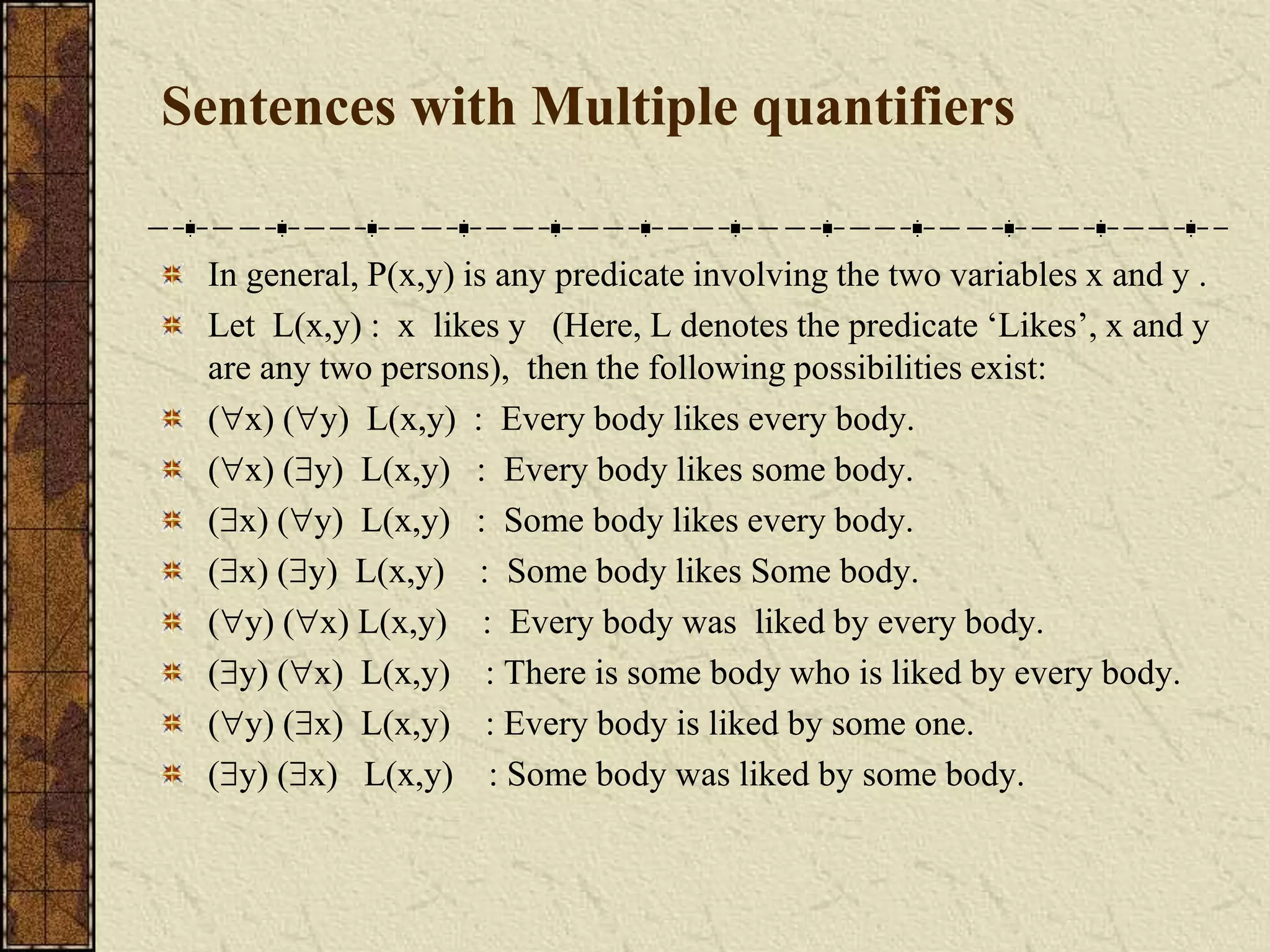
In general, P(x,y) is any predicate involving the two variables x and y .
Let L(x,y) : x likes y (Here, L denotes the predicate ‘Likes’, x and y
are any two persons), then the following possibilities exist:
(x) (y) L(x,y) : Every body likes every body.
(x) (y) L(x,y) : Every body likes some body.
(x) (y) L(x,y) : Some body likes every body.
(x) (y) L(x,y) : Some body likes Some body.
(y) (x) L(x,y) : Every body was liked by every body.
(y) (x) L(x,y) : There is some body who is liked by every body.
(y) (x) L(x,y) : Every body is liked by some one.
(y) (x) L(x,y) : Some body was liked by some body.
Relationship diagram
(x) (y) (y) (x)
(y) (x) (x) (y)
(x) (y)
(y) (x)
(x) (y)
(y) (x)
L(x,y)
Automatic Theorem proving
String of Formulas: A string of formulas is defined as follows.
A) Any formula is a string of formulas
B) If  and  are strings of formulas, then
 ,  and ,  are strings of formulas.
C) Only those strings which are obtained by steps (A) and (B) are
strings of formulas, with the exception of empty string which is also a
string of formulas.
Sequents : If  and  are strings of formulas, then    is called a
sequent in which  is called antecedent and  is called consequent.
s
Sequents (Contd.,)
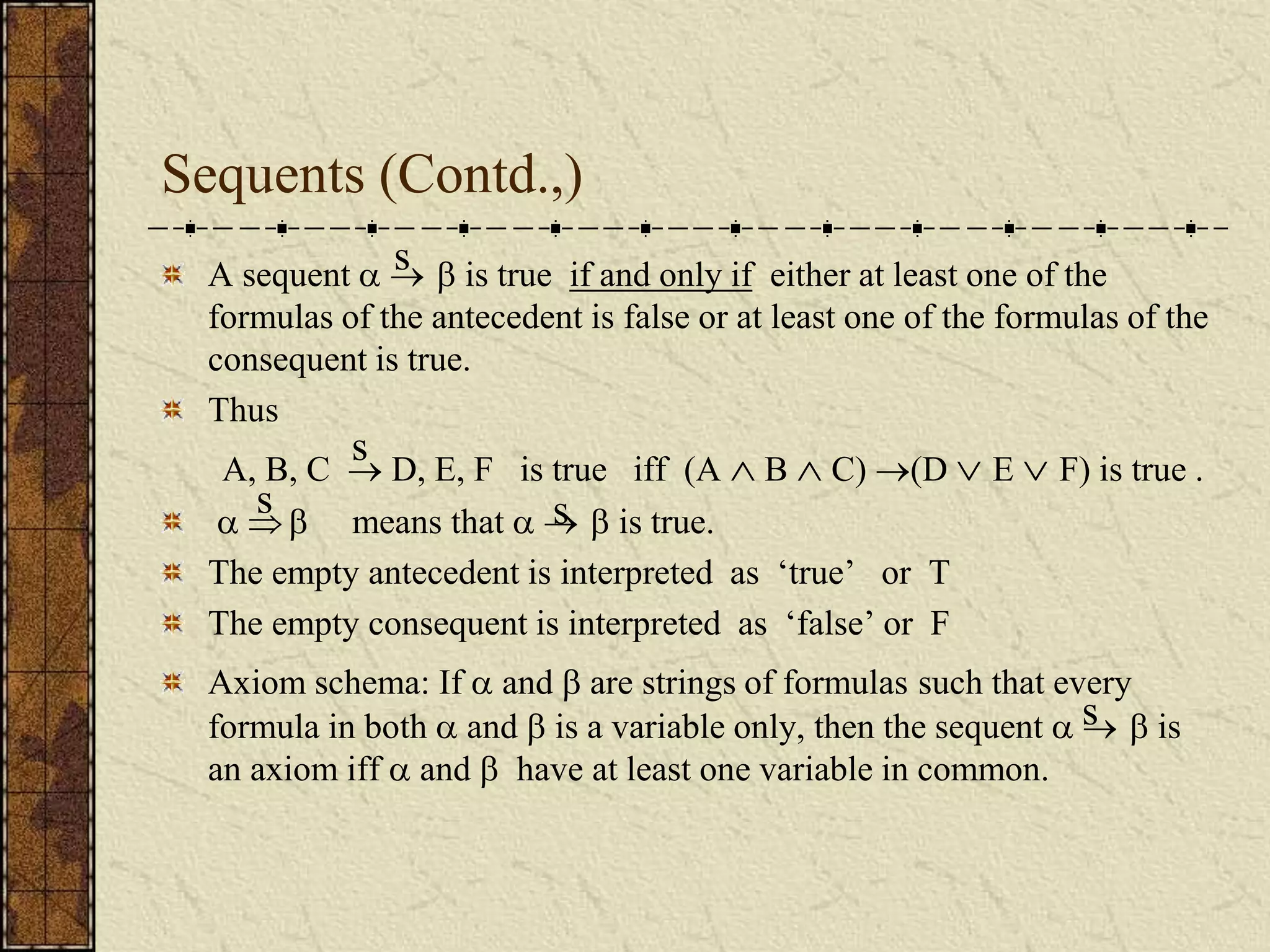
A sequent    is true if and only if either at least one of the
formulas of the antecedent is false or at least one of the formulas of the
consequent is true.
Thus
A, B, C  D, E, F is true iff (A  B  C) (D  E  F) is true .
   means that    is true.
The empty antecedent is interpreted as ‘true’ or T
The empty consequent is interpreted as ‘false’ or F
Axiom schema: If  and  are strings of formulas such that every
formula in both  and  is a variable only, then the sequent    is
an axiom iff  and  have at least one variable in common.
s
s
s s
s
Axioms –theorems -Rules
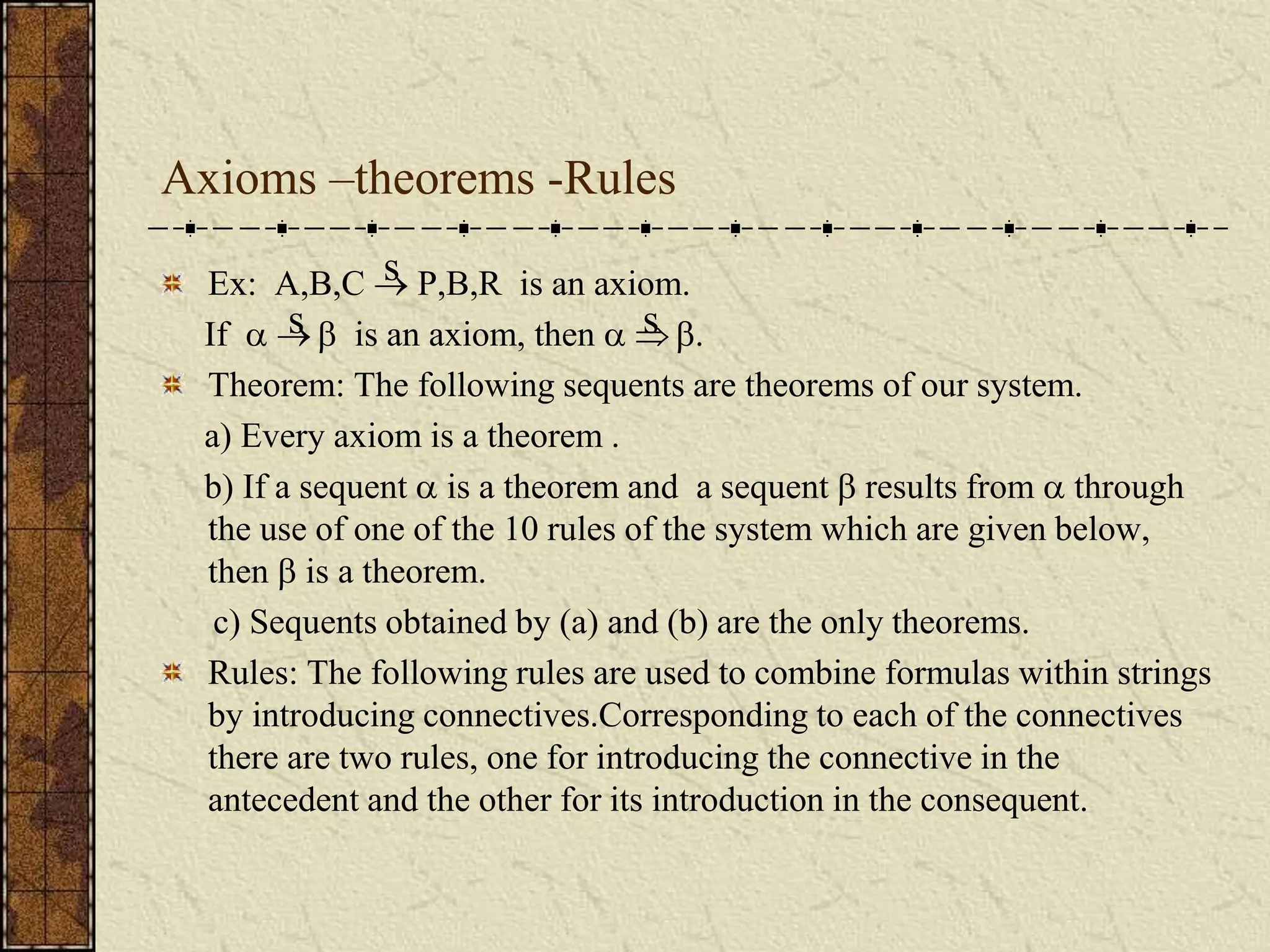
Ex: A,B,C  P,B,R is an axiom.
If    is an axiom, then   .
Theorem: The following sequents are theorems of our system.
a) Every axiom is a theorem .
b) If a sequent  is a theorem and a sequent  results from  through
the use of one of the 10 rules of the system which are given below,
then  is a theorem.
c) Sequents obtained by (a) and (b) are the only theorems.
Rules: The following rules are used to combine formulas within strings
by introducing connectives.Corresponding to each of the connectives
there are two rules, one for introducing the connective in the
antecedent and the other for its introduction in the consequent.
s s
s
Rules for Automatic Theorem proving
Antecedent rules:
Rule   : If  ,   X ,  then  , X ,   
Rule   : If X, Y,  ,    then  , X Y ,   
Rule   : If X,  ,    and Y,  ,    ,
then  , X  Y,   
Rule  : If Y,  ,    and  ,   X , 
then  , X  Y,   
Rule   : If X,Y, ,    and  ,   X, Y,
then , XY,   
s s
s s
s s
s
s` s
s
s s
s
Rules for Automatic Theorem proving (contd.,)
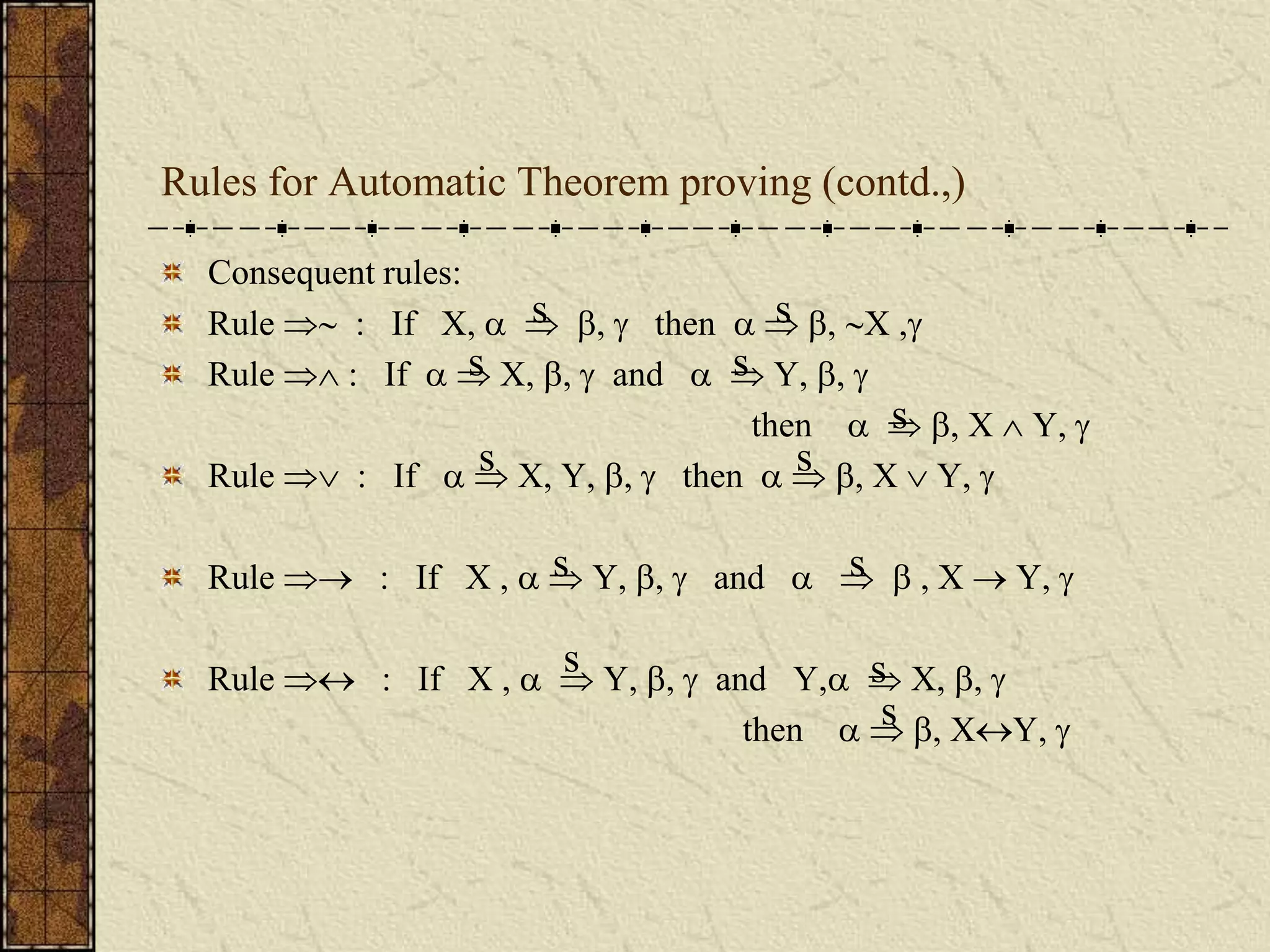
Consequent rules:
Rule  : If X,   ,  then   , X ,
Rule  : If   X, ,  and   Y, , 
then   , X  Y, 
Rule  : If   X, Y, ,  then   , X  Y, 
Rule  : If X ,   Y, ,  and    , X  Y, 
Rule  : If X ,   Y, ,  and Y,  X, , 
then   , XY, 
s s
s s
s s
s
s s
s s
s
Examples
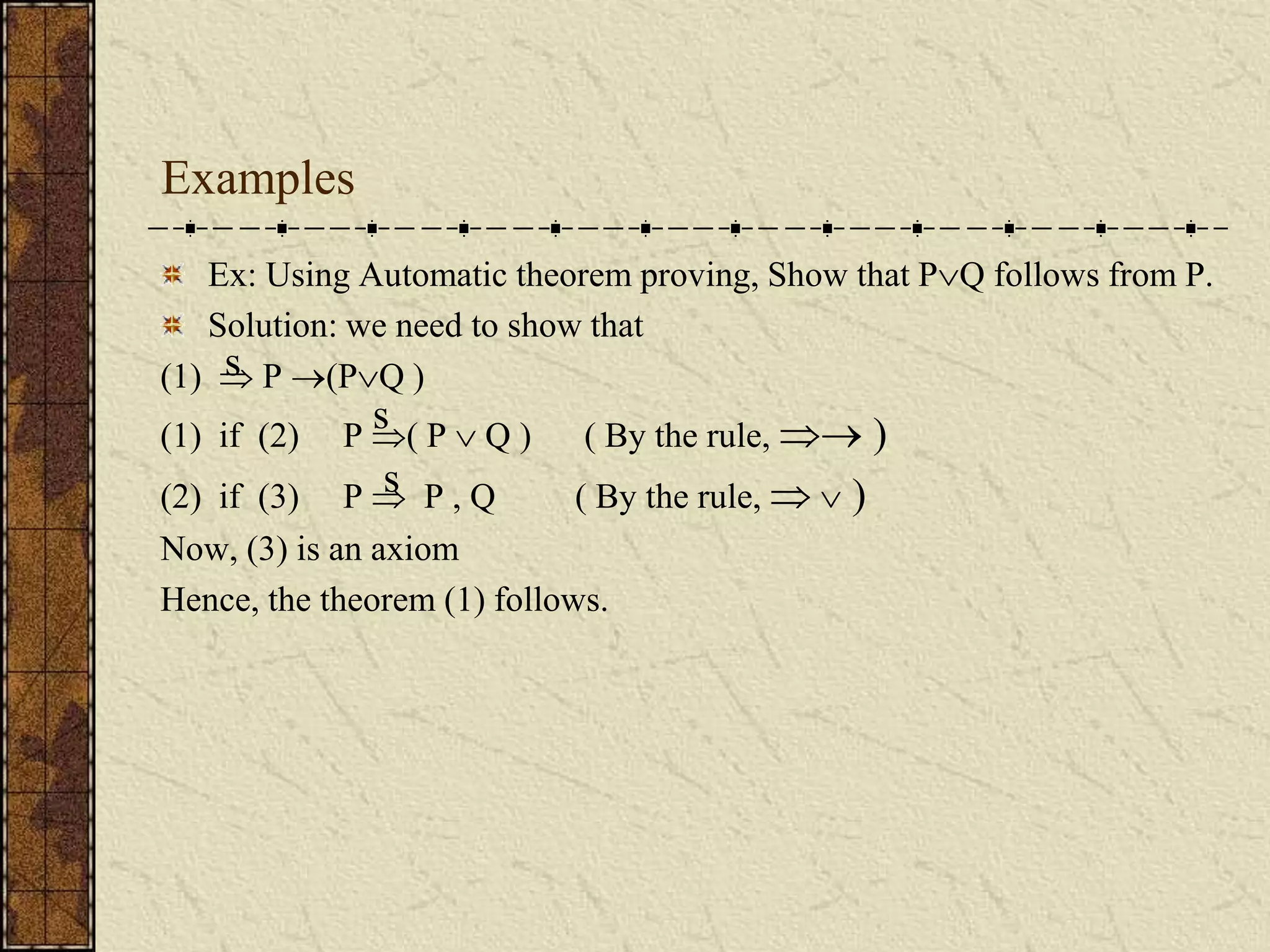
Ex: Using Automatic theorem proving, Show that PQ follows from P.
Solution: we need to show that
(1)  P (PQ )
(1) if (2) P ( P  Q ) ( By the rule,  )
(2) if (3) P  P , Q ( By the rule,   )
Now, (3) is an axiom
Hence, the theorem (1) follows.
s
s
s
Ex: Using Automatic theorem proving,
Show that P does not follow from PQ.
Solution: Assume
(1)  (PQ ) P
(1) if (2) ( P  Q ) P ( By the rule,  )
(2) if (3) P  P and (4) Q P ( By the rule,   )
Note that (3)is an axiom, but (4) is not.
Hence, P does not follow from PQ.
s
s
s s
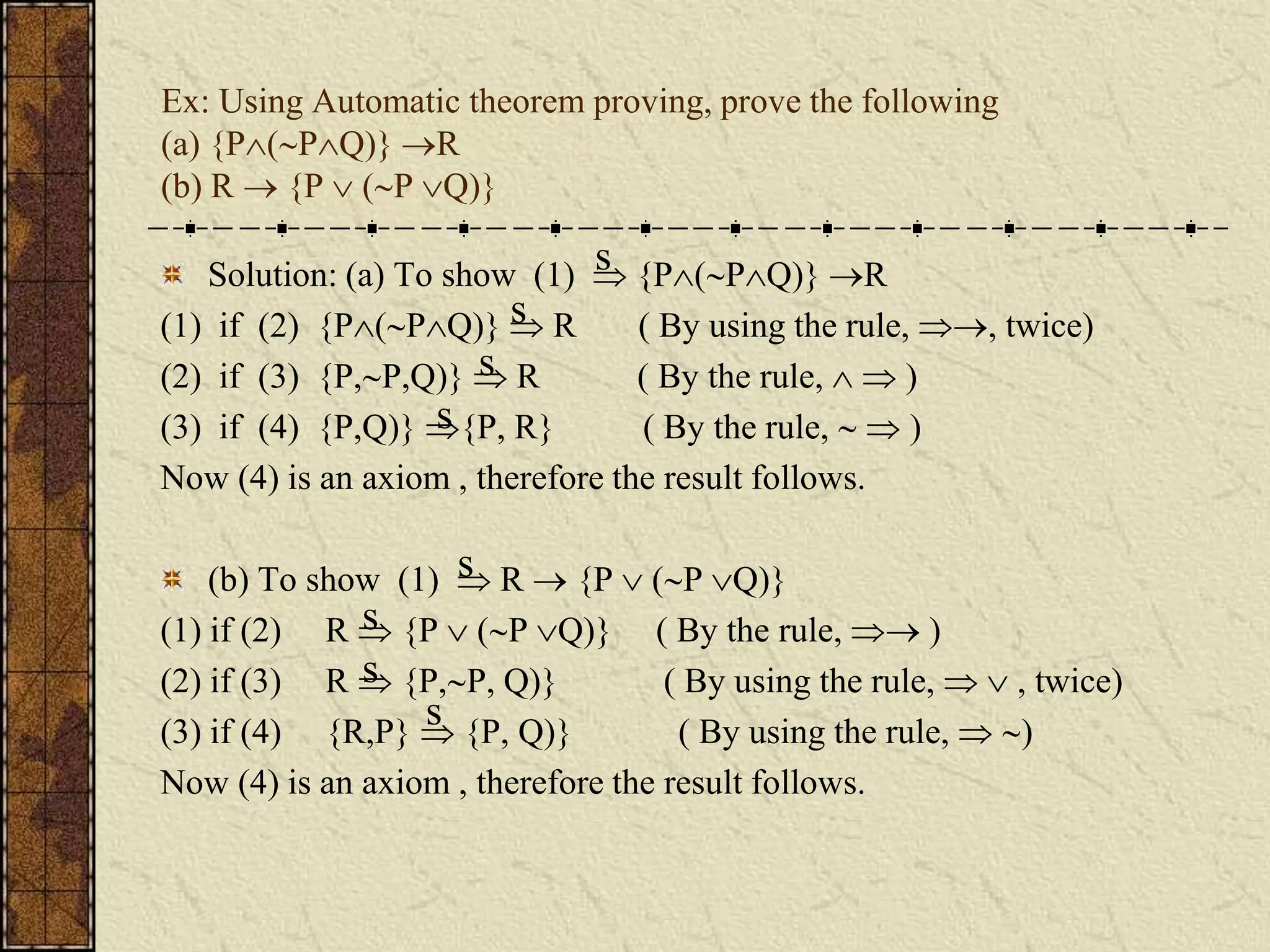
Ex: Using Automatic theorem proving, prove the following
(a) {P(PQ)} R
(b) R  {P  (P Q)}
Solution: (a) To show (1)  {P(PQ)} R
(1) if (2) {P(PQ)}  R ( By using the rule, , twice)
(2) if (3) {P,P,Q)}  R ( By the rule,   )
(3) if (4) {P,Q)} {P, R} ( By the rule,   )
Now (4) is an axiom , therefore the result follows.
(b) To show (1)  R  {P  (P Q)}
(1) if (2) R  {P  (P Q)} ( By the rule,  )
(2) if (3) R  {P,P, Q)} ( By using the rule,   , twice)
(3) if (4) {R,P}  {P, Q)} ( By using the rule,  )
Now (4) is an axiom , therefore the result follows.
s
s
s
s
s
s
s
s
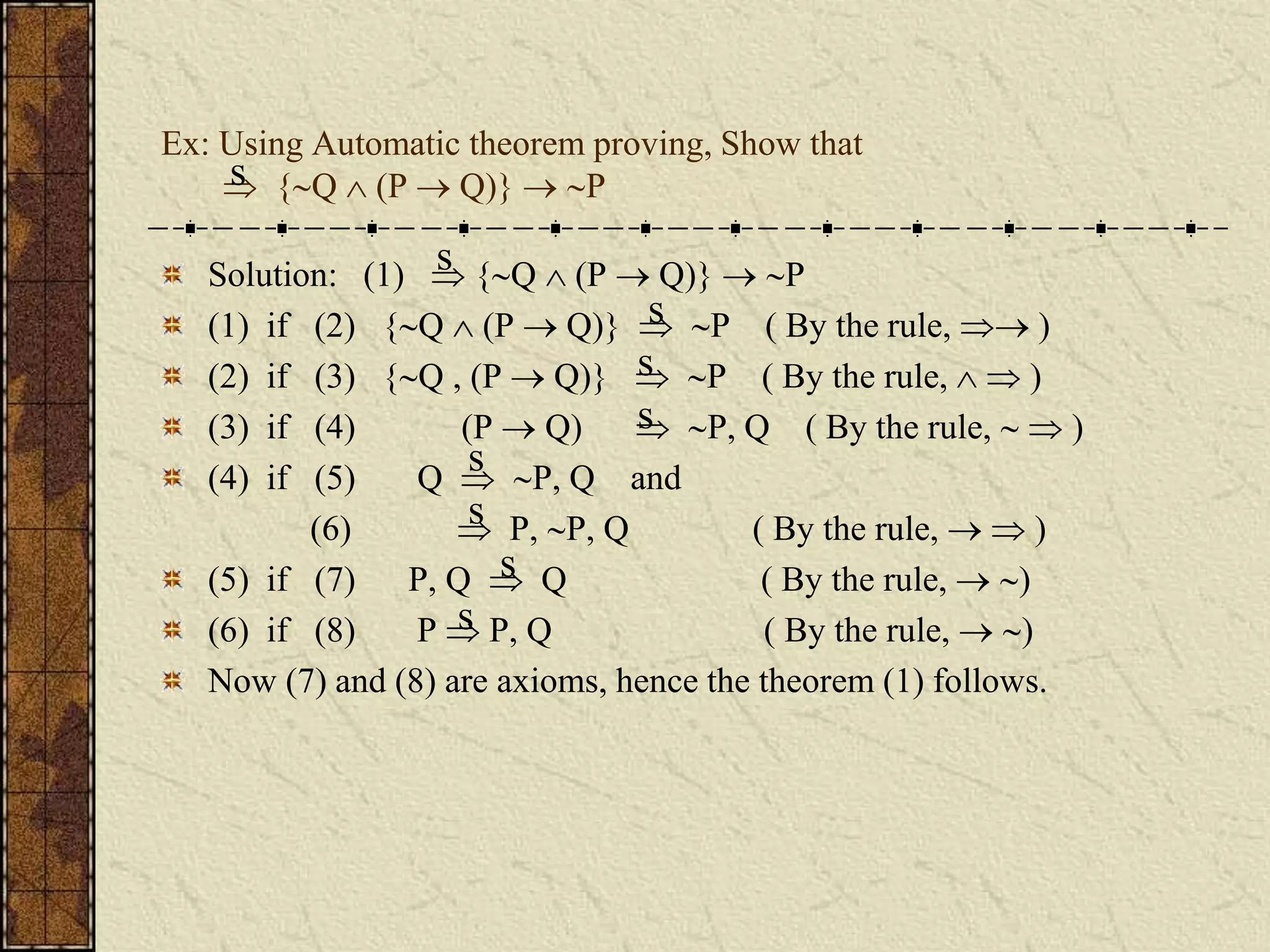
Ex: Using Automatic theorem proving, Show that
 {Q  (P  Q)}  P
Solution: (1)  {Q  (P  Q)}  P
(1) if (2) {Q  (P  Q)}  P ( By the rule,  )
(2) if (3) {Q , (P  Q)}  P ( By the rule,   )
(3) if (4) (P  Q)  P, Q ( By the rule,   )
(4) if (5) Q  P, Q and
(6)  P, P, Q ( By the rule,   )
(5) if (7) P, Q  Q ( By the rule,  )
(6) if (8) P  P, Q ( By the rule,  )
Now (7) and (8) are axioms, hence the theorem (1) follows.
s
s
s
s
s
s
s
s
s
Ex: With reference to automatic theorem proving, Show that SR is
tautologically implied by (PQ)(PR) (QS).
Solution: (1)  {(PQ)(PR) (QS)} (SR)
(1) if (2) {(PQ)(PR) (QS)} (SR) (By the rule, )
(2) if (3) {(PQ)(PR) (QS)}  S,R (By the rule,  )
(3) if (4) {(PQ),(PR),(QS)}  S,R (By the rule,  )
(4) if (5) {P,(PR),(QS)}  S,R
and (6) {Q, (PR),(QS)}  S,R (By the rule,  )
(5) if (7) {P,R,(QS)}  S,R and (8) {P,(QS)} P,S,R
(By the rule )
(7) if (9) P,R,S  S,R and (10) P,R S,R,Q (By the rule )
(8) if (11) P,S P, S,R and (12) PP,S,R,Q (By the rule )
s
s
s
s
s
s
s s
s
s
s s
Contd.,
(6) if (13) {Q, R,(QS)}  S,R and (14) {Q,(QS)}  S,R,P
(By the rule )
(13) if (15) Q,R,S  S,R and (16) Q, R  S,R,Q
(By the rule )
(14) if (17) Q,S  S,R,P and (18) Q  S,R,P,Q
(By the rule )
Now (9) to (12) and (15) to (18) are all axioms
Hence, the result follows.
s s
s s
s s

Predicates

  • 1.
    Predicates Predicative logic Free andbound variables Rules of Inference Consistency Proof of Contradiction Automatic Theorem proving
  • 2.
    Quantifiers and Predicates Universalquantifier : The quantifier ‘ all ’ is called the Universal quantifier, and we shall denote it by x (or (x) ), which is an inverted A followed by the variable x. x : for all x ( for every x (or) for each x ) Existential quantifier : The quantifier ‘some’ is called the Existential quantifier, and we shall denote it by x, which is a reversed E followed by the variable x. x : for some x ( There exists an x such that or There is at least one x such that ) Consider the statement, ‘John is a Politician’ Here, ‘John’ is the subject and ‘is a Politician’ is the predicate Denote the predicate, ‘is a Politician’ symbolically by the predicate letter P, and the subject ‘John’ by j .
  • 3.
    Predicates (Contd.,) The statement‘John is a Politician’ can be written as P(j) P(j) : John is a Politician If x is any person, then P(x) : x is a politician In general, any statement of the type “ x is Q ” is denoted by Q(x). Let S(x) : x is a scientist. ( Here, S denote the predicate ‘is a scientist’). P(x) : x is not a politician P(x)  S(x) : x is a politician and x is a scientist. P(x)  S(x) : Either x is a politician or x is a scientist. P(x) S(y) : If x is a politician then y is a scientist. x {P(x)} : All are politicians
  • 4.
    Predicates (Contd.,) x {P(x) S(x)} : Some politicians are scientists. x {P(x) S(x)} : All politicians are scientists. x {P(x)  S(x)} : Every body is either a politician or a scientist Sentence Abbreviated Meaning (x) P(x) all true (x) P(x) at least one true  {(x) P(x)} none true (x) {P(x)} all false (x) {P(x)} at least one false {(x) P(x)} none false {(x) P(x)} not all true {(x) P(x)} not all false
  • 5.
    Free and Boundvariables Given a formula containing a part of the form (x) P(x) or (x) P(x), such a part is called an x-bound part of the formula. Further P(x) is the scope of the quantifier in both the formulas. Any occurrence of x, in an x-bound part of the formula is called a bound occurrence of x, while any variable that is not a bound occurrence is called a free occurrence Ex: consider, (x) P(x,y) Here, the scope of the universal quantifier is P(x,y), x is a bound variable and y is a free variable. Ex: Consider the formula, (x) (P(x) Q(x)) Here, Scope of the quantifier is P(x) Q(x). Both the occurrences of x are bound.
  • 6.
    Free and Boundvariables (Contd.,) Ex: (x) {P(x)  (y) R(x,y)} Here, the scope of x is P(x)  (y) R(x,y) and the scope of y is R(x,y) All occurrences of x and y are bound occurrences. In the bound occurrence of a variable, the letter which is used to represent the variable is a dummy variable. The formula (x) {P(x)} is same as (y) {P(y)} The formula, (y) R(x,y) is same as (z) R(x,z) . Generally speaking, in order to draw conclusions from quantified premises, we need to remove quantifiers properly, argue with the resulting propositions, and then properly prefix the correct quantifiers.
  • 7.
    Some Equivalences andNegations (x) P(x)  {(x) P(x)} (x) {P(x)}   {( x) P(x)}  {(x) P(x)}  {(x)P(x)}  {(x) ~P(x)}  (x) P(x) Statement Negation (x) P(x) (x) [P(x)] (x) [~P(x)] (x) P(x) (x) [P(x)] (x) P(x) (x) P(x) (x) [P(x)] To form the negation of a statement involving one quantifier,we need only change the quantifier from universal to existential, or from existential to Universal, and negate the statement it quantifies.
  • 8.
    Rules of Inferencefor Quantified Propositions Universal specification : If a statement of the form (x) P(x) is assumed to be true then the universal quantifier can be dropped to obtain P(c) is true for an arbitrary object c in the universe. This rule may be represented as x, P(x) -----------------  P(c) for all c. Universal generalization: If a statement P(c) is true for each element c of the universe, then the universal quantifier may be prefixed to obtain (x) P(x). In symbols, this rule is P(c) for all c x, P(x)
  • 9.
    Rules of Inferencefor Quantified Propositions (Contd.,) Existential specification: If (x) P(x) is assumed to be true, then there is an element c in the universe such that P(c) is true. This rule takes the form (x) P(x) -----------------------  P(c) for some c Existential generalization:. If P(c) is true for some element c in the universe, then x, P(x) is true. In symbols, we have P(c) for some c (x) P(x)
  • 10.
    Examples Ex: Let P(x): x is a person F(x,y) : x is the father of y M(x,y) : x is the mother of y Write the predicate “ x is the father of the mother of y ” in symbolic form. Solution: In order to symbolize the predicate, let us assume a person called z as the mother of y. Now, x is the father of z and z is the mother of y . We symbolize the predicate as (z) { P(z)  F(x , z)  M(z , y) }
  • 11.
    Ex: Prove thefollowing argument, using symbolic logic 1.All men are mortal. 2.Socrates is a man. Therefore,Socrates is a mortal. Solution: Let us denote, H(x) : x is a man, M(x) : x is a mortal and s : Socrates We can put the given argument in the following form, x {H(x) M(x)} ….(1) H(s) …(2)  M(s) A formal proof is as follows: From (1), By the rule of Universal Specification, we have H(s) M(s) ….(3) From (2) and (3), By the rule of modus ponens, M(s) follows Hence, the argument is valid
  • 12.
    Ex: Prove thefollowing argument, using symbolic logic. All men are fallible. All kings are men. Therefore, all kings are fallible. Solution: Let us denote, M(x) : x is a man F(x) : x is fallible K(x) : x is a king We can put the given argument in the following form, x {M(x) F(x)} ….(1) x {K(x) M(x)} ….(2)  x {K(x) F(x)} A formal proof is as follows From (1), By the rule of Universal Specification, we have M(s) F(s) ….(3) From (2), By the rule of Universal Specification, we have K(s) M(s) ….(4)
  • 13.
    Contd., From (4) and(3), By the rule of transitivity, we have K(s)  F(s) …..(5) From (5), By the rule of Universal Generalization, we have x {K(x) F(x)} Hence, the argument is valid.
  • 14.
    Ex: Symbolize thefollowing argument and check for its validity: All lions are dangerous animals There are lions Therefore, there are dangerous animals. Solution: Let L(x) : x is a lion and D(x) : x is dangerous. Then the argument takes the form (x) {L(x) D(x)} ….(1) (x) L(x) …..(2)  (x) D(x) A formal proof is as follows: From (2), By the rule of Existential specification, we have L(a) ……. (3) From (1), By the rule of Universal Specification, we have L(a) D(a) ….(4)
  • 15.
    Contd., From (3) and(4), By the rule of modus ponens, D(a) …(5) From(5), By the rule of Existential Generalization, we have (x) D(x) Hence, the argument is valid
  • 16.
    Ex: Symbolize thefollowing argument and check for its validity: Every living thing is a plant or animal. David’s dog is alive and it is not a plant. All animals have Hearts. Hence, David’s dog has a heart Solution: Let the universe consists of all living things, and let P(x) : x is a plant A(x) : x is an animal H(x) : x has a heart a : David’s dog Then the argument takes the form (x) {P(x)  A(x)} ….(1) P(a) ….(2) x) {A(x) H(x)} ….(3)  H(a) The formal proof is given below: From (1), By the rule of Universal Specification, we have P(a)  A(a)
  • 17.
    Contd., P(a)  A(a)….(4) From (2) and (4), By the rule of Disjunctive syllogism,we have A(a) ….(5) From (3), By the rule of Universal Specification, we have A(a) H(a) …(6) From (5) and (6), By the rule of modus ponens, H(a) follows Hence, the argument is valid.
  • 18.
    Ex: Prove that(x){P(x)  Q(x)}  (x)P(x)  (x)Q(x) Is the converse true? . Justify your answer. Proof: L.H.S. = (x){P(x)  Q(x)} By the rule of ES,we have P(y)  Q(y) …(1), y fixed P(y) …(2) , from (1) Q(y) …(3), from (1) From(2), By EG, we have (x) P(x) ….(4) From(3), By EG, we have (x) Q(x) ….(5) From (4) and (5), we have (x) P(x)  (x) Q(x) = R.H.S
  • 19.
    Contd., Now, let usshow that the converse of the above result is not true Consider, R.H.S. = (x) P(x)  (x) Q(x) …(1) From (1), we have, (x) P(x) …..(2) Again from (1), we have, (x) Q(x) …(3) From (2), By ES,we have P(a) ….(4) From (3), By ES,we have Q(b) ….(5) Note that in step (4), a is fixed, and it is no longer possible to use that variable again in step(5). From (4) and (5), the L.H.S. (x) {P(x)  Q(x)} does not follows Hence, the converse of the result does not hold.
  • 20.
    Ex: Show that(x) {P(x)  Q(x)}  (x) P(x)  (x)Q(x) L.H.S = (x) {P(x)  Q(x)} ….(1) We shall use the method of ‘proof by contradiction’ Let {(x) P(x)  (x) Q(x)} ….(2) (Additional premise) {(x) P(x)  (x) Q(x)} ….(3) From (3), we have, (x) Q(x) …..(4) From (3), we have, (x) P(x) …..(5) From (5), By the rule of ES, we have P(y) ….(6) From (4), By the rule of US, we have Q(y) ….(7) From (6) and (7), we have, P(y)  Q(y) …(8)  {P(y)  Q(y)} …(9) From (1),By the rule of US, we have {P(y)  Q(y)} …..(10)
  • 21.
    Contd., But, (9) and(10) cannot be simultaneously true.(Contradiction)  our assumption (2), is wrong Hence, the result follows.
  • 22.
    Ex: Show thatfrom (a) (x) {F(x) S(x)}  (y){M(y)  W(y)} (b) (y) {M(y )  W(y)} the conclusion, (x) {F(x)  S(x)} follows Proof: Given premises are (x) {F(x) S(x)}  (y){M(y)  W(y)} ……(1) (y) {M(y )  W(y)} …..(2) (2)  [(y) {M(y )  W(y)}] …(3)  [(y) {M(y ) W(y)}] …(4) From (1) and (4), By Modus tollens, we have [(x) {F(x)  S(x)}] ….(5)  [(x) {F(x) )  S(x)}] ….(6)  [(x) {F(x))  S(x)}] ….(7) The conclusion logically follows from the premises.
  • 23.
    Ex: Show thatP(a,b) follows logically from the premises (x) (y) { P(x,y) W(x,y)} and W(a,b) Solution: Given premises are (x) (y) { P(x,y) W(x,y)} …(1) W(a,b) …..(2) From (1), By the rule of US, we have (y) { P(a,y) W(a,y)} …..(3) From (3), By the rule of US, we have { P(a,b) W(a,b)} …..(4) From (2)and (4), By the rule of Modus ponens, P(a,b) follows.
  • 24.
    Ex: Consider thestatement ‘Given any positive integer, there is a greater positive integer’. Symbolize the statement with and without using the set of positive integers as the universe of discourse. Case1: Let x and y are are restricted to set of positive integers. The above statement can be written as ‘For all x, there exists a ‘y’ such that y is greater than x’ If G(x,y) is ‘x greater than y’ Then the given statement in symbolic form is (x) (y) G(y,x) Case 2: If we do not impose the restriction on the universe of discourse and if we write I(x) : x is an integer, then we can symbolize the given statement as (x) [ I(x) (y) { I(y)  G(y , x)} ]
  • 25.
    Ex: prove thefollowing argument (1) (x) {P(x)  Q(x)} (2) (x) [{P(x)  Q(x)}R(x)]  (x) {R(x) P(x)} Proof: From (1), By the rule of US, we have P(c)  Q(c) ….(3) From (2), By the rule of US, we have {P(c)  Q(c)}  R(c) ..…(4) From (4), By contra positive equivalence, we have R(c)  {P(c)  Q(c)} ……(5) Let R(c) ……………(6) (Additional premise) From (5) and (6), By the rule of modus ponens, we have P(c)  Q(c) ……………(7) From (3) and (7), we have {P(c)  Q( c )}  {P(c)  Q(c)}
  • 26.
    Contd.,  P(c) {Q( c )  Q(c)}  P(c)  F  P(c) Now, By CP rule, R(c) P(c) ….(8) follows From (8), By the rule of UG, we have (x) {R(x) P(x)} Hence, the given argument is valid.
  • 27.
    Example: Ex: Let L(x,y)denote the statement ‘x likes y’, where the universe of discourse for both x and y is the set of all people in the world. Consider the statement “ There is somebody whom no one likes” Write the Statement in symbolic form. Solution: (y) (x) [ ~L(x , y)} ]
  • 28.
    Ex: Show thatthe negation of the sentence (x) [{C(x)  B(x)}  A(x)}] is (x) {C(x)  B(x)  A(x)} Consider, {(x) [{C(x)  B(x)}  A(x)}] }  {(x) [{C(x)  B(x)}  A(x)}] } ( Since P Q  P Q)  {(x) [C(x)   B(x)  A(x)] } (By demorgan’s law)  (x) {C(x)  B(x)  A(x)} (By demorgan’s law)
  • 29.
    Ex: Show thatthe negation of the sentence (x) (y) [{F(x,y)  G(x,y)}  H(x,y)] is (x) (y) { F(x,y)  G(x,y)  H(x,y)} Consider {(x) (y) [{F(x,y)  G(x,y)}  H(x,y)] }  {(x) (y) [{F(x,y)  G(x,y)}  H(x,y)] } ( Since, P Q  P Q )  (x) (y) {F(x,y)  G(x,y)  H(x,y)} (By demorgan’s law)
  • 30.
    Ex: Show that (x){B(x)  I(x)}  [(x){B(x)  I(x)}] Proof: L.H.S.  [(x) {B(x)  I(x)}] (Since, P  P)  [(x) {B(x)  I(x)}] ( Since, P Q  P Q )  [(x){B(x)  I(x)}] (By demorgan’s law)
  • 31.
    Ex: Show that (x){N(x)  R(x)}  [(x) {N(x)  R(x)}] Proof: L.H.S.   [(x) {N(x)  R(x)} ] (Since, P  P)   [(x) {N(x)  R(x)}] (By demorgan’s law)   [(x) {N(x)  R(x)}] ( Since, P Q  P Q )
  • 32.
    Some more Equivalences& Implications Let A(x) : x is an ambitious person. Let B(x) : x is a brave person. (x){A(x)  B(x)}  {(x)A(x)}  {(x)B(x)} {(x)A(x)  (x)B(x)}  (x){A(x)  B(x)} (x) {A(x)  B(x)}  {(x)A(x)}  {(x)B(x)} (x){A(x)B(x)}  {(x)A(x)  (x)B(x)} {(x)A(x)  B}  (x){A(x) B} {(x)A(x)  B }  (x){A(x) B}
  • 33.
    Sentences with Multiplequantifiers In general, P(x,y) is any predicate involving the two variables x and y . Let L(x,y) : x likes y (Here, L denotes the predicate ‘Likes’, x and y are any two persons), then the following possibilities exist: (x) (y) L(x,y) : Every body likes every body. (x) (y) L(x,y) : Every body likes some body. (x) (y) L(x,y) : Some body likes every body. (x) (y) L(x,y) : Some body likes Some body. (y) (x) L(x,y) : Every body was liked by every body. (y) (x) L(x,y) : There is some body who is liked by every body. (y) (x) L(x,y) : Every body is liked by some one. (y) (x) L(x,y) : Some body was liked by some body.
  • 34.
    Relationship diagram (x) (y)(y) (x) (y) (x) (x) (y) (x) (y) (y) (x) (x) (y) (y) (x) L(x,y)
  • 35.
    Automatic Theorem proving Stringof Formulas: A string of formulas is defined as follows. A) Any formula is a string of formulas B) If  and  are strings of formulas, then  ,  and ,  are strings of formulas. C) Only those strings which are obtained by steps (A) and (B) are strings of formulas, with the exception of empty string which is also a string of formulas. Sequents : If  and  are strings of formulas, then    is called a sequent in which  is called antecedent and  is called consequent. s
  • 36.
    Sequents (Contd.,) A sequent   is true if and only if either at least one of the formulas of the antecedent is false or at least one of the formulas of the consequent is true. Thus A, B, C  D, E, F is true iff (A  B  C) (D  E  F) is true .    means that    is true. The empty antecedent is interpreted as ‘true’ or T The empty consequent is interpreted as ‘false’ or F Axiom schema: If  and  are strings of formulas such that every formula in both  and  is a variable only, then the sequent    is an axiom iff  and  have at least one variable in common. s s s s s
  • 37.
    Axioms –theorems -Rules Ex:A,B,C  P,B,R is an axiom. If    is an axiom, then   . Theorem: The following sequents are theorems of our system. a) Every axiom is a theorem . b) If a sequent  is a theorem and a sequent  results from  through the use of one of the 10 rules of the system which are given below, then  is a theorem. c) Sequents obtained by (a) and (b) are the only theorems. Rules: The following rules are used to combine formulas within strings by introducing connectives.Corresponding to each of the connectives there are two rules, one for introducing the connective in the antecedent and the other for its introduction in the consequent. s s s
  • 38.
    Rules for AutomaticTheorem proving Antecedent rules: Rule   : If  ,   X ,  then  , X ,    Rule   : If X, Y,  ,    then  , X Y ,    Rule   : If X,  ,    and Y,  ,    , then  , X  Y,    Rule  : If Y,  ,    and  ,   X ,  then  , X  Y,    Rule   : If X,Y, ,    and  ,   X, Y, then , XY,    s s s s s s s s` s s s s s
  • 39.
    Rules for AutomaticTheorem proving (contd.,) Consequent rules: Rule  : If X,   ,  then   , X , Rule  : If   X, ,  and   Y, ,  then   , X  Y,  Rule  : If   X, Y, ,  then   , X  Y,  Rule  : If X ,   Y, ,  and    , X  Y,  Rule  : If X ,   Y, ,  and Y,  X, ,  then   , XY,  s s s s s s s s s s s s
  • 40.
    Examples Ex: Using Automatictheorem proving, Show that PQ follows from P. Solution: we need to show that (1)  P (PQ ) (1) if (2) P ( P  Q ) ( By the rule,  ) (2) if (3) P  P , Q ( By the rule,   ) Now, (3) is an axiom Hence, the theorem (1) follows. s s s
  • 41.
    Ex: Using Automatictheorem proving, Show that P does not follow from PQ. Solution: Assume (1)  (PQ ) P (1) if (2) ( P  Q ) P ( By the rule,  ) (2) if (3) P  P and (4) Q P ( By the rule,   ) Note that (3)is an axiom, but (4) is not. Hence, P does not follow from PQ. s s s s
  • 42.
    Ex: Using Automatictheorem proving, prove the following (a) {P(PQ)} R (b) R  {P  (P Q)} Solution: (a) To show (1)  {P(PQ)} R (1) if (2) {P(PQ)}  R ( By using the rule, , twice) (2) if (3) {P,P,Q)}  R ( By the rule,   ) (3) if (4) {P,Q)} {P, R} ( By the rule,   ) Now (4) is an axiom , therefore the result follows. (b) To show (1)  R  {P  (P Q)} (1) if (2) R  {P  (P Q)} ( By the rule,  ) (2) if (3) R  {P,P, Q)} ( By using the rule,   , twice) (3) if (4) {R,P}  {P, Q)} ( By using the rule,  ) Now (4) is an axiom , therefore the result follows. s s s s s s s s
  • 43.
    Ex: Using Automatictheorem proving, Show that  {Q  (P  Q)}  P Solution: (1)  {Q  (P  Q)}  P (1) if (2) {Q  (P  Q)}  P ( By the rule,  ) (2) if (3) {Q , (P  Q)}  P ( By the rule,   ) (3) if (4) (P  Q)  P, Q ( By the rule,   ) (4) if (5) Q  P, Q and (6)  P, P, Q ( By the rule,   ) (5) if (7) P, Q  Q ( By the rule,  ) (6) if (8) P  P, Q ( By the rule,  ) Now (7) and (8) are axioms, hence the theorem (1) follows. s s s s s s s s s
  • 44.
    Ex: With referenceto automatic theorem proving, Show that SR is tautologically implied by (PQ)(PR) (QS). Solution: (1)  {(PQ)(PR) (QS)} (SR) (1) if (2) {(PQ)(PR) (QS)} (SR) (By the rule, ) (2) if (3) {(PQ)(PR) (QS)}  S,R (By the rule,  ) (3) if (4) {(PQ),(PR),(QS)}  S,R (By the rule,  ) (4) if (5) {P,(PR),(QS)}  S,R and (6) {Q, (PR),(QS)}  S,R (By the rule,  ) (5) if (7) {P,R,(QS)}  S,R and (8) {P,(QS)} P,S,R (By the rule ) (7) if (9) P,R,S  S,R and (10) P,R S,R,Q (By the rule ) (8) if (11) P,S P, S,R and (12) PP,S,R,Q (By the rule ) s s s s s s s s s s s s
  • 45.
    Contd., (6) if (13){Q, R,(QS)}  S,R and (14) {Q,(QS)}  S,R,P (By the rule ) (13) if (15) Q,R,S  S,R and (16) Q, R  S,R,Q (By the rule ) (14) if (17) Q,S  S,R,P and (18) Q  S,R,P,Q (By the rule ) Now (9) to (12) and (15) to (18) are all axioms Hence, the result follows. s s s s s s