Relations and Functions notes for presentation.pdf
This presentation will enable a student understand calculus very well as it is simplified and brief but with meaning covering ares like relations and functions,sets and many others to mention but a few
Kind of relations
⚫Thereare three kinds of relations
Equivalence relations,
Order relations,
Functions.
3.
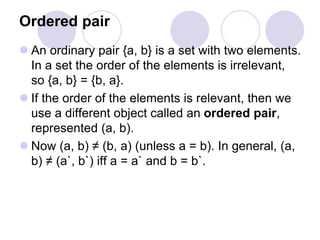
Ordered pair
⚫ Anordinary pair {a, b} is a set with two elements.
In a set the order of the elements is irrelevant,
so {a, b} = {b, a}.
⚫ If the order of the elements is relevant, then we
use a different object called an ordered pair,
represented (a, b).
⚫ Now (a, b) ≠ (b, a) (unless a = b). In general, (a,
b) ≠ (a`, b`) iff a = a` and b = b`.
4.
Ordered pairs andsets
⚫Let A be a given set.
⚫An ordered pair (a, b) of elements in A is
defined to be the set {a, {a, b}}. The
element a is called the first component.
Cartesian product
⚫ Giventwo sets A, B, their Cartesian product A×B
is the set of all ordered pairs (a, b) such that a ∈
A and b ∈ B:
⚫ A × B = {(a, b) | (a ∈ A) ∧ (b ∈ B)} .
⚫ An example of a Cartesian product is the real
plane i.e the cartesian plane, where is the
set of real numbers ( is sometimes called the
real line).
8.
Examples
⚫ Example 1
⚫a. Show that if A is a set with m elements and B is a set of n
elements then A x B is a set of mn elements.
⚫ b. Show that if A x B = Ø then A = Ø or B = Ø.
⚫ Soln.
⚫ a. Consider an ordered pair (a, b). There are m possibilities for
a. For each fixed a, there are n possibilities for b. Thus, there
are m x n ordered pairs (a, b). That is, |A x B| = mn.
⚫ b. We use the proof by contrapositive. Suppose that A ≠ Ø and
B ≠ Ø. Then there is at least an a ∈ A and an element b ∈ B.
That is, (a, b) ∈ A x B and this shows that A x B ≠ Ø. A
negation of the assumption that A x B = Ø.
Examples
Example 1
Let A= {2, 3, 4} and B = {3, 4, 5, 6, 7}.
Define the relation R by aRb if and only if
a divides b. Find, R,Dom(R),Range(R).
Solution.
R = {(2, 4), (2, 6), (3, 3), (3, 6), (4,
4)},Dom(R) = {2, 3, 4}, and Range(R) = {3,
4, 6}.
11.
Examples
Example 2
Let A= {1, 2, 3, 4}. Define the relation R by aRb
if and only if a b. Find, R, Dom (R), Range(R).
Soln.
R = {(1, 1), (1, 2), (1, 3), (1, 4), (2, 2), (2, 3), (2,
4), (3, 3), (3, 4), (4, 4)},Dom(R) = A,
Range (R) = A.
12.
Digraph (Directed Graph)
loop.
a
simply
is
edge
directed
thenthe
R
a)
(a,
if
Finally,
b.
to
a
from
edge
directed
a)
(called
arrow
an
draw
we
R
b)
(a,
if
Next,
A.
of
elements
the
represent
to
s
or vertice
dots
draw
first
we
A,
set
a
on
relation
a
of
digraph
a
draw
To
digraph.
its
draw
to
is
set
a
on
relation
a
picture
way to
e
informativ
An
13.
Example
⚫ Let A= {1, 2, 3, 4}. Define the relation R by aRb if
and only if a b. Draw the directed graph of the
relation
14.
The Inverse ofa Relation ( )
1
−
R
R}.
b)
(a,
:
A
B
a)
{(b,
R
such that
Dom(R)
to
Range(R)
from
R
relation
the
is
R
of
inverse
The
B.
set
a
A to
set
a
from
relation
a
be
R
Let
1
-
1
-
=
15.
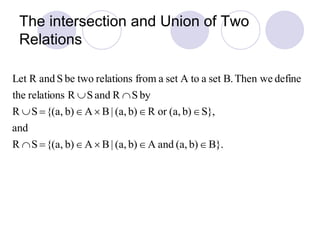
The intersection andUnion of Two
Relations
B}.
b)
(a,
and
A
b)
(a,
|
B
A
b)
{(a,
S
R
and
S},
b)
(a,
or
R
b)
(a,
|
B
A
b)
{(a,
S
R
by
S
R
and
S
R
relations
the
define
Then we
B.
set
a
A to
set
a
from
relations
two
be
S
and
R
Let
=
=
Soln
⚫ a) Sinceeach vertex has a loop the relation is
reflexive.
⚫ b) A relation R on a set is reflexive if every
element is related to itself. For the relation
defined by aRb if a<b, it is not reflexive because
no element a in R can satisfy the condition a<a.
i.e. a number cannot be less than itself: it is
equal to itself.
Explanation for solution(a)
Given the set A={a,b,c,d} and the relation
R={(a,a),(b,c),(c,b),(d,d)}, to prove that R is symmetric, we
must check that for every ordered pair (x,y) in R, the
reverse ordered pair (y,x) also exists in R.
From R, we can see:
⚫ The pair (a,a) is symmetric to itself since a=a.
⚫ The pair (b,c) has its reverse (c,b) in R.
⚫ The pair (c,b) has its reverse (b,c) in R.
⚫ The pair (d,d) is symmetric to itself since d=d.
Because each element paired with another in R has a
corresponding pair that flips the two, the relation R is
symmetric.
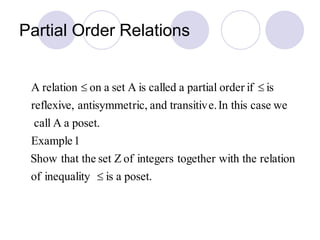
Partial Order Relations
poset.
a
is
inequality
of
relation
withthe
together
integers
of
set Z
that the
Show
1
Example
poset.
a
A
call
we
case
In this
e.
transitiv
and
ric,
antisymmet
reflexive,
is
if
order
partial
a
called
is
A
set
a
on
relation
A
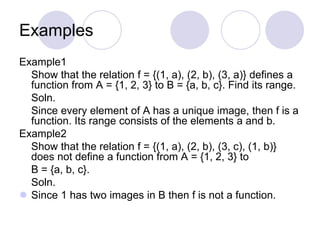
Examples
Example1
Show that therelation f = {(1, a), (2, b), (3, a)} defines a
function from A = {1, 2, 3} to B = {a, b, c}. Find its range.
Soln.
Since every element of A has a unique image, then f is a
function. Its range consists of the elements a and b.
Example2
Show that the relation f = {(1, a), (2, b), (3, c), (1, b)}
does not define a function from A = {1, 2, 3} to
B = {a, b, c}.
Soln.
⚫ Since 1 has two images in B then f is not a function.
41.
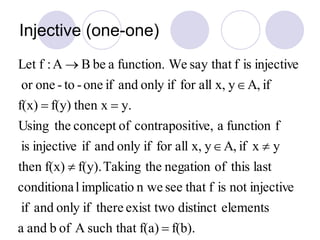
Injective (one-one)
f(b).
f(a)
such that
A
of
b
and
a
elements
distinct
existtwo
there
if
only
and
if
injective
not
is
f
that
see
n we
implicatio
l
conditiona
last
this
of
negation
the
Taking
f(y).
f(x)
then
y
x
if
A,
y
x,
all
for
if
only
and
if
injective
is
f
function
a
tive,
contraposi
of
concept
the
Using
y.
then x
f(y)
f(x)
if
A,
y
x,
all
for
if
only
and
if
one
-
to
-
one
or
injective
is
f
say that
We
function.
a
be
B
A
:
f
Let
=
=
=
→