ISOLATION OF THE OPERATIVE
FIELD
DR ASHWINI M PATIL
Reader
Navodaya dental college
Raichur
The goals of operative field
isolation are
Moisture control
Retraction
Harm prevention
Following components of oral environment
need to be controlled during operative procedure









Saliva
Tongue
Mandible
Lips & cheek
Gingival tissue
Buccal & lingual vestibule
Floor of the mouth
Adjacent teeth and restoration
Respiratory moisture
Advantages
Patient related:
A. Provides comfort to the
patient
B. Protect patients from
swallowing or aspirating
foreign bodies
C. Protect patients soft
tissues by retracting them.
Operator related:
A. A dry clean operative field
B. Infection control
C. Increased accessibility to
operative site
D. Improved properties of
dental materials
E. Improved visibility & less
fogging of mirror
F. Prevents contamination of
tooth preparation.
Materials can be used
1. Rubber Dam
2. Cotton rolls & cellulose wafers
3. Throat shields
4. High volume evacuators & saliva ejector
5. Mirror & evacuator tip retractor
6. Mouth props
7. Air Water syringe
8. Cheek retractor
9. Drugs
Rubber Dam Isolation
In 1864, S.C.Barnum, a NY city dentist
introduced the rubber dam.
It is a flat thin sheet of latex/non-latex that is
held by a clamp and a frame, that is preferred
to allow the tooth/teeth to protrude through
the perforations, while all other teeth are
covered.
Rubber Dam Isolation
A.
B.
G.
Advantage
Act as a raincoat for the tooth.
Complete,long term moisture
control.
C. Maximizes access and visibility.
D. Clean dry field while working.
E. Protect lips,cheeks & tongue by
keeping them aside.
F. Reduces risk of cross contamination
esp. to root canal system
Prevents accidental swallowing or
aspiration of foreign bodies.
Improves the properties of dental
materials
Disadvantage
A. Takes time to be applied.
B. Communication with the patient
can be difficult.
C. Incorrect use may damage
porcelain crowns/gingival
tissues.
D. Insecure clamps can be
swallowed or aspirated.
H.
Contraindication:
 Asthmatic patients.
 Epilepsy and other motor disabilities.
 Allergic to latex
 Mouth breathers
 Presence of some fixed ortho app.
 A recently erupted tooth that does not retain
a clamp
 Extremely malpositioned teeth
 Third molar (in some cases)
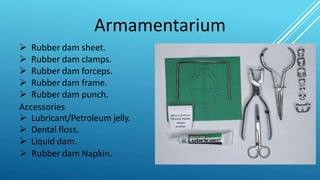
Armamentarium
 Rubber dam sheet.
 Rubber dam clamps.
 Rubber dam forceps.
 Rubber dam frame.
 Rubber dam punch.
Accessories
 Lubricant/Petroleum jelly.
 Dental floss.
 Liquid dam.
 Rubber dam Napkin.
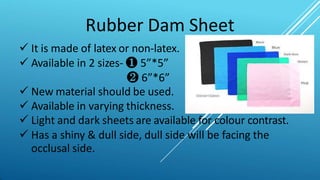
Rubber Dam Sheet
 It is made of latex or non-latex.
 Available in 2 sizes- ❶ 5”*5”
❷ 6”*6”
 New material should be used.
 Available in varying thickness.
 Light and dark sheets are available for colour contrast.
 Has a shiny & dull side, dull side will be facing the
occlusal side.
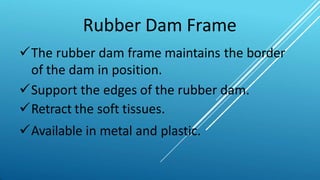
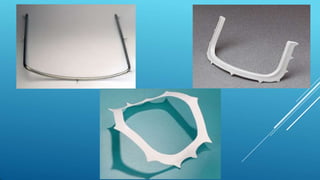
Rubber Dam Frame
The rubber dam frame maintains the border
of the dam in position.
Support the edges of the rubber dam.
Retract the soft tissues.
Available in metal and plastic.
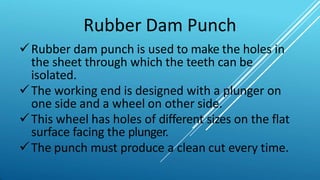
Rubber Dam Punch
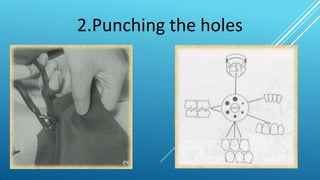
Rubber dam punch is used to make the holes in
the sheet through which the teeth can be
isolated.
The working end is designed with a plunger on
one side and a wheel on other side.
This wheel has holes of different sizes on the flat
surface facing the plunger.
The punch must produce a clean cut every time.
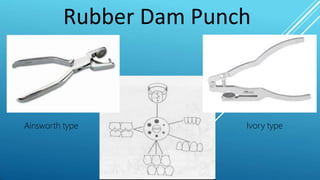
Rubber Dam Punch
Ainsworth type Ivory type
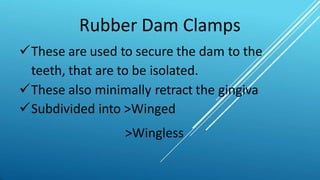
Rubber Dam Clamps
These are used to secure the dam to the
teeth, that are to be isolated.
These also minimally retract the gingiva
Subdivided into >Winged
>Wingless
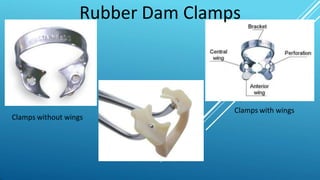
Rubber Dam Clamps
Clamps without wings
Clamps with wings
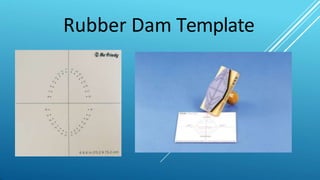
Rubber Dam Template
It is an inked rubber stamp which helps in
marking the dots on the sheet according to
position of the tooth.
Holes should be punched according to arch
and missing teeth.
Rubber Dam Template
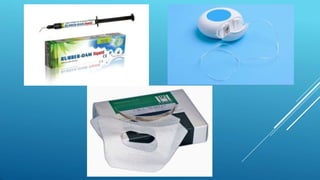
Accessories
• Dental Floss: It is used as flossing agent for
rubber dam in tight contact areas.
• Rubber Dam napkin: This is a sheet of absorbent
material placed between the rubber dam and
skin.
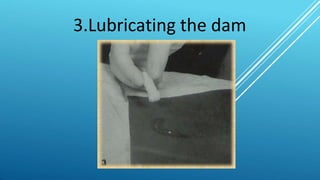
• Lubricant: A lubricant is applied in the area of
punch holes facilitates the passing of dam septa
through proximal contacts.
Application of Rubber Dam
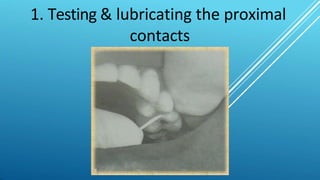
1. Testing & lubricating the proximal
contacts
2.Punching the holes
3.Lubricating the dam
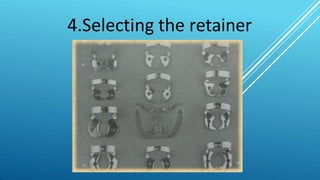
4.Selecting the retainer
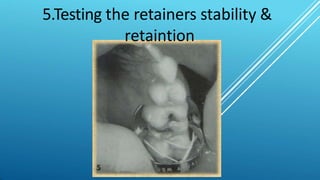
5.Testing the retainers stability &
retaintion
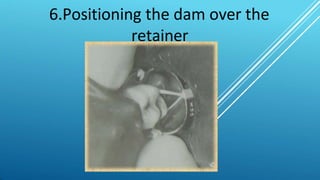
6.Positioning the dam over the
retainer
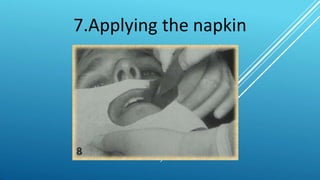
7.Applying the napkin
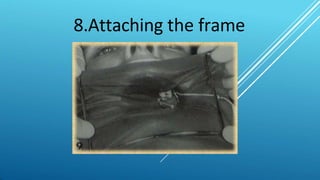
8.Attaching the frame
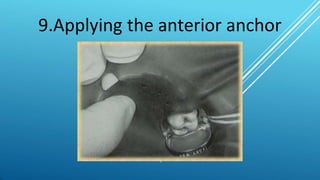
9.Applying the anterior anchor
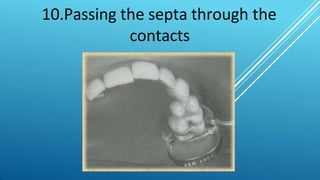
10.Passing the septa through the
contacts
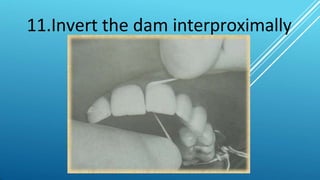
11.Invert the dam interproximally
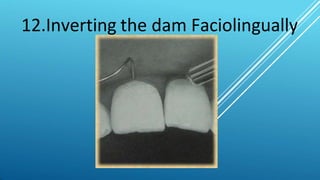
12.Inverting the dam Faciolingually
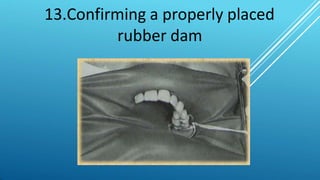
13.Confirming a properly placed
rubber dam
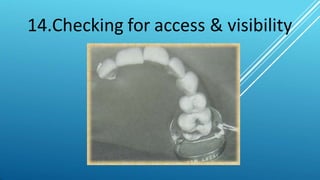
14.Checking for access & visibility
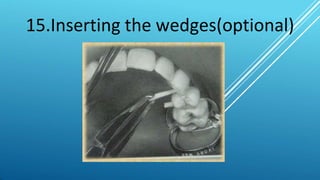
15.Inserting the wedges(optional)
RUBBER DAM APPLICATION TECHNIQUES.
⯈Clamp first technique.
⯈Wing technique
⯈Rubber first technique
⯈Bracket technique
CLAMP FIRST TECHNIQUE
Advantages:
⯈ It is two handed procedureore
⯈ It can be implemented with molar and premolar(single bracket), winged or wingless clamp
⯈ Excellent operative field visibility during placement
Disadvantages:
⯈ Inserting the clamp into the mouth before the dam is dangerous since it might be displaced (fasten
it with ligature)
⯈ The clamp is severely strained during placement
⯈ It cannot be used with double bracket clamps
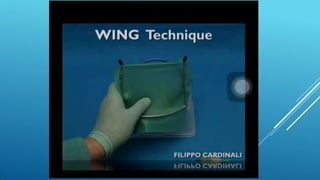
WING TECHNIQUE
Advantage:
⯈ It is two handed procedure
⯈ It is safe procedure for the clamp engaged within the sheet hole; if it gets disengaged from the
plier there is no risk of falling into the oral cavity (swallowing or inhaling)
⯈ It is minimally invasive technique ; the patient does not feel the dentist’s hands in his/her mouth
Disadvantages:
⯈ It can be implemented with winged clamps only
⯈ Limited visibility on the target tooth
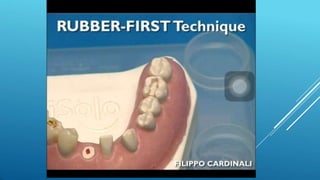
RUBBER FIRST TECHNIQUE
Advantages:
⯈ It is a clamp safe procedure when oral cavity is protected by the rubber sheet(no risk of
swallowing or inhaling)
⯈ Suitable for every clamp type
Disadvantages:
⯈ Invasive for the patient especially in posterior region
⯈ Limited visibility of the tooth to be clamped
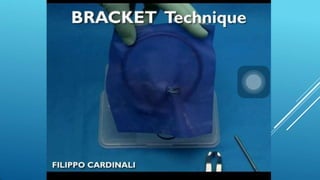
BRACKET TECHNIQUE
Advantages:
⯈ It is two handed procedure
⯈ it is safe; the clamp is engaged within the sheet hole and it won’t fall into oral cavity should it
unfasten from the plier(swallowing or inhaling)
⯈Compatible with winged or wingless (wingless is better) premolar and molar (single bracket
clamp)
⯈ Excellent field visibility during clamping
Disadvantages:
⯈ Not compatible with anterior clamps(double bracket).
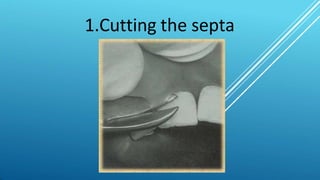
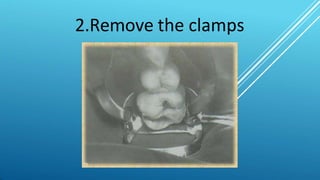
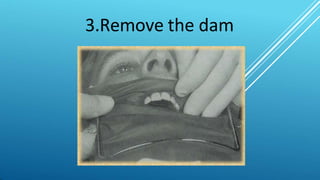
Removal of Rubber Dam
1.Cutting the septa
2.Remove the clamps
3.Remove the dam
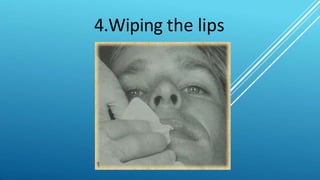
4.Wiping the lips
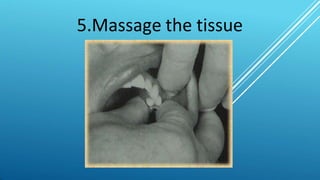
5.Massage the tissue
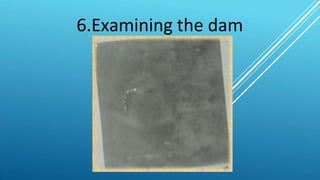
6.Examining the dam
Cotton rolls
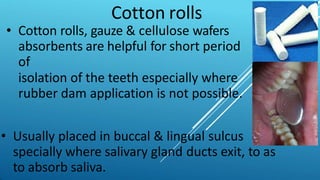
• Cotton rolls, gauze & cellulose wafers
absorbents are helpful for short period
of
isolation of the teeth especially where
rubber dam application is not possible.
• Usually placed in buccal & lingual sulcus
specially where salivary gland ducts exit, to as
to absorb saliva.
Throat Shield
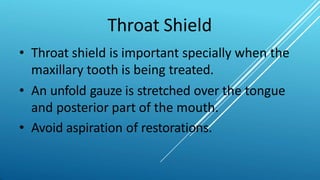
• Throat shield is important specially when the
maxillary tooth is being treated.
• An unfold gauze is stretched over the tongue
and posterior part of the mouth.
• Avoid aspiration of restorations.
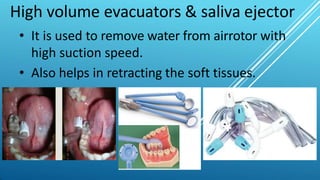
High volume evacuators & saliva ejector
• It is used to remove water from airrotor with
high suction speed.
• Also helps in retracting the soft tissues.
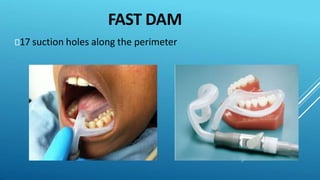
FAST DAM
⯈17 suction holes along the perimeter
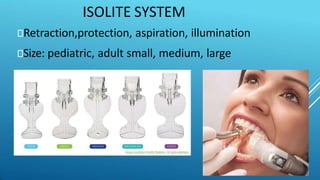
ISOLITE SYSTEM
⯈Retraction,protection, aspiration, illumination
⯈Size: pediatric, adult small, medium, large
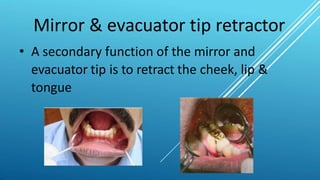
Mirror & evacuator tip retractor
• A secondary function of the mirror and
evacuator tip is to retract the cheek, lip &
tongue
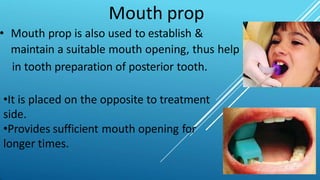
Mouth prop
• Mouth prop is also used to establish &
maintain a suitable mouth opening, thus help
in tooth preparation of posterior tooth.
•It is placed on the opposite to treatment
side.
•Provides sufficient mouth opening for
longer times.
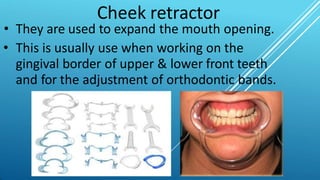
Cheek retractor
• They are used to expand the mouth opening.
• This is usually use when working on the
gingival border of upper & lower front teeth
and for the adjustment of orthodontic bands.
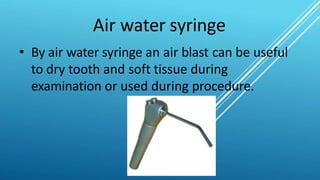
Air water syringe
• By air water syringe an air blast can be useful
to dry tooth and soft tissue during
examination or used during procedure.
Drugs
• The use of drugs to control salivation is rarely
indicated in restorative therapy, and is
generally limited to atropine.
• Contraindicated for nursing mothers, and
patients with glaucoma.

isolationoftheoperative.pptx

  • 1.
    ISOLATION OF THEOPERATIVE FIELD DR ASHWINI M PATIL Reader Navodaya dental college Raichur
  • 2.
    The goals ofoperative field isolation are Moisture control Retraction Harm prevention
  • 3.
    Following components oforal environment need to be controlled during operative procedure          Saliva Tongue Mandible Lips & cheek Gingival tissue Buccal & lingual vestibule Floor of the mouth Adjacent teeth and restoration Respiratory moisture
  • 4.
    Advantages Patient related: A. Providescomfort to the patient B. Protect patients from swallowing or aspirating foreign bodies C. Protect patients soft tissues by retracting them. Operator related: A. A dry clean operative field B. Infection control C. Increased accessibility to operative site D. Improved properties of dental materials E. Improved visibility & less fogging of mirror F. Prevents contamination of tooth preparation.
  • 5.
    Materials can beused 1. Rubber Dam 2. Cotton rolls & cellulose wafers 3. Throat shields 4. High volume evacuators & saliva ejector 5. Mirror & evacuator tip retractor 6. Mouth props 7. Air Water syringe 8. Cheek retractor 9. Drugs
  • 6.
    Rubber Dam Isolation In1864, S.C.Barnum, a NY city dentist introduced the rubber dam. It is a flat thin sheet of latex/non-latex that is held by a clamp and a frame, that is preferred to allow the tooth/teeth to protrude through the perforations, while all other teeth are covered.
  • 7.
    Rubber Dam Isolation A. B. G. Advantage Actas a raincoat for the tooth. Complete,long term moisture control. C. Maximizes access and visibility. D. Clean dry field while working. E. Protect lips,cheeks & tongue by keeping them aside. F. Reduces risk of cross contamination esp. to root canal system Prevents accidental swallowing or aspiration of foreign bodies. Improves the properties of dental materials Disadvantage A. Takes time to be applied. B. Communication with the patient can be difficult. C. Incorrect use may damage porcelain crowns/gingival tissues. D. Insecure clamps can be swallowed or aspirated. H.
  • 8.
    Contraindication:  Asthmatic patients. Epilepsy and other motor disabilities.  Allergic to latex  Mouth breathers  Presence of some fixed ortho app.  A recently erupted tooth that does not retain a clamp  Extremely malpositioned teeth  Third molar (in some cases)
  • 9.
    Armamentarium  Rubber damsheet.  Rubber dam clamps.  Rubber dam forceps.  Rubber dam frame.  Rubber dam punch. Accessories  Lubricant/Petroleum jelly.  Dental floss.  Liquid dam.  Rubber dam Napkin.
  • 10.
    Rubber Dam Sheet It is made of latex or non-latex.  Available in 2 sizes- ❶ 5”*5” ❷ 6”*6”  New material should be used.  Available in varying thickness.  Light and dark sheets are available for colour contrast.  Has a shiny & dull side, dull side will be facing the occlusal side.
  • 11.
    Rubber Dam Frame Therubber dam frame maintains the border of the dam in position. Support the edges of the rubber dam. Retract the soft tissues. Available in metal and plastic.
  • 13.
    Rubber Dam Punch Rubberdam punch is used to make the holes in the sheet through which the teeth can be isolated. The working end is designed with a plunger on one side and a wheel on other side. This wheel has holes of different sizes on the flat surface facing the plunger. The punch must produce a clean cut every time.
  • 14.
  • 15.
    Rubber Dam Clamps Theseare used to secure the dam to the teeth, that are to be isolated. These also minimally retract the gingiva Subdivided into >Winged >Wingless
  • 16.
    Rubber Dam Clamps Clampswithout wings Clamps with wings
  • 17.
    Rubber Dam Template Itis an inked rubber stamp which helps in marking the dots on the sheet according to position of the tooth. Holes should be punched according to arch and missing teeth.
  • 18.
  • 19.
    Accessories • Dental Floss:It is used as flossing agent for rubber dam in tight contact areas. • Rubber Dam napkin: This is a sheet of absorbent material placed between the rubber dam and skin. • Lubricant: A lubricant is applied in the area of punch holes facilitates the passing of dam septa through proximal contacts.
  • 21.
  • 22.
    1. Testing &lubricating the proximal contacts
  • 23.
  • 24.
  • 25.
  • 26.
    5.Testing the retainersstability & retaintion
  • 27.
    6.Positioning the damover the retainer
  • 28.
  • 29.
  • 30.
  • 31.
    10.Passing the septathrough the contacts
  • 32.
    11.Invert the daminterproximally
  • 33.
    12.Inverting the damFaciolingually
  • 34.
    13.Confirming a properlyplaced rubber dam
  • 35.
  • 36.
  • 37.
    RUBBER DAM APPLICATIONTECHNIQUES. ⯈Clamp first technique. ⯈Wing technique ⯈Rubber first technique ⯈Bracket technique
  • 38.
    CLAMP FIRST TECHNIQUE Advantages: ⯈It is two handed procedureore ⯈ It can be implemented with molar and premolar(single bracket), winged or wingless clamp ⯈ Excellent operative field visibility during placement Disadvantages: ⯈ Inserting the clamp into the mouth before the dam is dangerous since it might be displaced (fasten it with ligature) ⯈ The clamp is severely strained during placement ⯈ It cannot be used with double bracket clamps
  • 40.
    WING TECHNIQUE Advantage: ⯈ Itis two handed procedure ⯈ It is safe procedure for the clamp engaged within the sheet hole; if it gets disengaged from the plier there is no risk of falling into the oral cavity (swallowing or inhaling) ⯈ It is minimally invasive technique ; the patient does not feel the dentist’s hands in his/her mouth Disadvantages: ⯈ It can be implemented with winged clamps only ⯈ Limited visibility on the target tooth
  • 42.
    RUBBER FIRST TECHNIQUE Advantages: ⯈It is a clamp safe procedure when oral cavity is protected by the rubber sheet(no risk of swallowing or inhaling) ⯈ Suitable for every clamp type Disadvantages: ⯈ Invasive for the patient especially in posterior region ⯈ Limited visibility of the tooth to be clamped
  • 44.
    BRACKET TECHNIQUE Advantages: ⯈ Itis two handed procedure ⯈ it is safe; the clamp is engaged within the sheet hole and it won’t fall into oral cavity should it unfasten from the plier(swallowing or inhaling) ⯈Compatible with winged or wingless (wingless is better) premolar and molar (single bracket clamp) ⯈ Excellent field visibility during clamping Disadvantages: ⯈ Not compatible with anterior clamps(double bracket).
  • 46.
  • 47.
  • 48.
  • 49.
  • 50.
  • 51.
  • 52.
  • 53.
    Cotton rolls • Cottonrolls, gauze & cellulose wafers absorbents are helpful for short period of isolation of the teeth especially where rubber dam application is not possible. • Usually placed in buccal & lingual sulcus specially where salivary gland ducts exit, to as to absorb saliva.
  • 54.
    Throat Shield • Throatshield is important specially when the maxillary tooth is being treated. • An unfold gauze is stretched over the tongue and posterior part of the mouth. • Avoid aspiration of restorations.
  • 55.
    High volume evacuators& saliva ejector • It is used to remove water from airrotor with high suction speed. • Also helps in retracting the soft tissues.
  • 56.
    FAST DAM ⯈17 suctionholes along the perimeter
  • 57.
    ISOLITE SYSTEM ⯈Retraction,protection, aspiration,illumination ⯈Size: pediatric, adult small, medium, large
  • 58.
    Mirror & evacuatortip retractor • A secondary function of the mirror and evacuator tip is to retract the cheek, lip & tongue
  • 59.
    Mouth prop • Mouthprop is also used to establish & maintain a suitable mouth opening, thus help in tooth preparation of posterior tooth. •It is placed on the opposite to treatment side. •Provides sufficient mouth opening for longer times.
  • 60.
    Cheek retractor • Theyare used to expand the mouth opening. • This is usually use when working on the gingival border of upper & lower front teeth and for the adjustment of orthodontic bands.
  • 61.
    Air water syringe •By air water syringe an air blast can be useful to dry tooth and soft tissue during examination or used during procedure.
  • 62.
    Drugs • The useof drugs to control salivation is rarely indicated in restorative therapy, and is generally limited to atropine. • Contraindicated for nursing mothers, and patients with glaucoma.