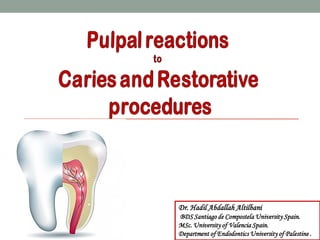
Dr. Hadil Abdallah Altilbani
BDS Santiago de Compostela University Spain.
MSc. University of Valencia Spain.
Department of Endodontics University of Palestine .
Introduction
Embryologically and physiologically Dentin
and pulp are so intimately related that
dentin can be considered as the peripheral
calcified portion of the dental pulp.
However This intimate relation extends
beyond embryological and physiologic
considerations.
It has important clinical implications.
It means that pulp would react
when dentin is injured whether the
injury is caused by caries, attrition,
abrasion, erosion or operative procedures.
Dynamic Dental Pulp
Responds to external stimuli in a variety of ways
A variety of stimuli have been demonstrated to have an effect on the
pulp. The reactions of the dental pulp to respective irritants are largely
dictated by the character and duration of a stimulus.
Ability to form dentin throughout life
Potential for regeneration and repair diminishes with age
Very sensitive to thermal stimuli
Encased in a low compliance environment
Scarcity of collateral circulation
Why pulp is unique?
MODES OF IRRITATION TO PULP
• 1. DIRECT-
• Direct irritation to the pulp-
Dentin organ- Carious/
iatrogenic pulp exposure
• Allows direct access for the oral
flora and other irritating
ingredients
• 2. INDIRECT-
• Irritating toxins/chemicals enter
through the dentinal tubules
1. Bacterial irritants:
Most common cause for pulpal
irritation are bacteria or their
products which may enter pulp
through a break in dentin either
from:
 – Caries
 – Accidental exposure
 – Fracture
 – Percolation around a restoration
 – Extension of infection from
gingival sulcus
 – Periodontal pocket and abscess
 – Anachoresis (Process by which
microorganisms get carried by the
bloodstream from another source
localize on inflamed tissue).
PULPAL IRRITANTS
2. Iatrogenic:
– Thermal changes.
– Orthodontic movement
– Periodontal curettage
– Periapical curettage
– Use of chemicals like temporary and permanent
fillings.
3. Idiopathic
– Aging
– Resorption—internal or external.
4. Traumatic
Acute trauma like fracture
Chronic trauma including parafunctional
Pulpal Reactions
1.Caries
2. Local Anesthetics
3. Restorative Procedures
4. Dental Materials
5. Vital Bleaching
6. Periodontal Procedures
7. Orthodontic Movement
Dental caries - Facts
• Dental caries is the most common route for
causing irritation to the pulp.
• Dental caries is localized, progressive, decay of the teeth
characterized by demineralization of the tooth surface
by organic acids, produced by microorganisms .
• From the carious lesion, acids and other toxic substances
penetrate through the dentinal tubules to reach the
pulp.
• Destroys dentin at a rate of 1mm/six months
Pulpal Reaction to caries
Three basic reactions protecting pulp
1. Decrease in dentin permeability
2. Tertiary dentin formation
3. Inflammatory & Immune reactions
Dentin permeability -
Importance
• Channels of diffusion – Dentinal tubules
• More no of tubules per unit area
towards pulpal side as compared to
peripheral dentin
• Clinical importance – Dentin
beneath a deep cavity
preparation is more permeable
than dentin underlying a shallow
cavity
Decrease in dentin permeability
• First defense to caries
– SCLEROTIC DENTIN
Combination of
• An increased deposition of intratubular dentin
• Direct deposition of mineral crystals (Whitlokite) into narrowed
dentinal tubules
Whitlockite crystals
• 2) - Tertiary dentin formation:
PULPAL REACTION TO CARIES
3. Pulpal Immune Response
• The bacterial toxins, enzymes, organic acids and the products of tissue
destruction show inflammatory response in the pulp.
• The degree of pulpal inflammation beneath a carious lesion depends on
closeness of carious lesions with pulp and permeability of underlying
dentin.
• Early response is characterised by focal accumulation of
chronic inflammatory cells
• Dental caries stimulates the accumulation of pulpal dendritic cells in
and around odontoblastic layer
Progressive inflammation
Pulpal Reactions
1. Caries
2.Local Anesthetics
3. Restorative Procedures
4. Dental Materials
5. Vital Bleaching
6. Periodontal Procedures
7. Orthodontic Movement
EFFECT ON PULP
•Intact pulpal blood flow is critical
•Dental pulp is enclosed in a rigid chamber and
cannot benefit from collateral circulation
•Reduction of blood flow – Reduction in clearance
of large molecular weight toxins or waste
products •
•Reduction in blood flow during a restorative
procedure could lead to an increase in
concentration of irritants accumulating within
the pulp.
•Vasoconstrictor of local anesthetic (LA)
potentiates and prolongs anesthetic effect by
reducing blood flow in the area.
• Local Anaesthetic delivered through an intra osseous
route or periodontal ligament route The supplemental
anesthetic techniques can compromise the inflamed pulp’s
ability to heal by reducing the blood flow
•Fortunately, the rate of oxygen consumption in the
healthy pulp is relatively low, and if necessary, pulp cells
can produce energy anaerobically through the pentose
phosphate pathway of carbohydrate metabolism.
Pulpal Reactions
1. Caries
2. Local Anesthetics
3.Restorative Procedures
4. Dental Materials
5. Vital Bleaching
6. Periodontal Procedures
7. Orthodontic Movement
1. Tooth Preparation (Restorations/ Crown)
2. Acid Etching
3. Chemicals from restorative materials
(Cements/ Bases)
3. Restorative procedures causing pulp injury
One key requirement of a successful restorative
procedure maintaining the pulp vitality is to cause
minimal additional irritation of the pulp so as not to
interfere with normal pulpal healing.
• This involves the avoidance of thermal stimuli
caused by operative procedures, toxicity of
restorative materials and bacteria penetration.
Factors affecting response of pulp to tooth preparation
1. • Pressure
2. • Heat
3. • Vibration
4. • Remaining dentin thickness
5. • Thermal and mechanical injury
6. • Speed
7. • Nature of cutting instruments.Heat
3-PULPAL REACTION TO RESTORATIVE
PROCEDURE
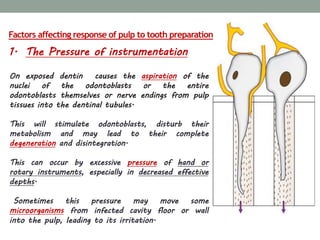
1. The Pressure of instrumentation
On exposed dentin causes the aspiration of the
nuclei of the odontoblasts or the entire
odontoblasts themselves or nerve endings from pulp
tissues into the dentinal tubules.
This will stimulate odontoblasts, disturb their
metabolism and may lead to their complete
degeneration and disintegration.
This can occur by excessive pressure of hand or
rotary instruments, especially in decreased effective
depths.
Sometimes this pressure may move some
microorganisms from infected cavity floor or wall
into the pulp, leading to its irritation.
Factors affecting response of pulp to tooth preparation
CR- Cell rich zone
Aspirated odontoblasts
Cutting of dentin with always produces some amount of
heat which is determined by several factors such as:
Mech.Energy >>>> Cut + Heat
Based on that equation several factors influence the
quantity of the heat produced;
i. Size and shape of the cutting instrument.
ii. Speed of rotation.
iii. Length of time, the instrument is in contact with dentin.
iv. Amount of pressure exerted.
Factors affecting response of pulp to tooth preparation
• Heat
2. Heat production
Is the second most
damaging factor.
Any restorative procedures leads
to increase in pulpal temperatures
Irreversible pulp pathosis → pulp
abscess formation
If the cavity floor ≤ 0.5 mm from
the pulp, areas of coagulation
necrosis could be detected.
That “heat” is a function of:
a. RPM (apeed), i.e. more the RPM more is the heat production.
b. Pressure is directly proportional to heat generation.
c. Surface area of contact, which is related to the size and shape of the
revolving tool.
The more the contact between the tooth structures and revolving tool, the more is the
heat generation.
Heat creates destruction in the pulp tissues, coagulate protoplasm, and burn dentin if
the temperature is amply elevated.
d. Desiccation, if occurring in vital dentin such that water in the protoplasm of
Tome’s fibers is eliminated, can cause aspiration of the odontoblasts into the tubules .
The subsequent disturbances in their metabolism may lead to the complete
degeneration of odontoblasts.
Desiccation increases the permeability of the vital dentin to irritants like
microorganisms or restorative materials.
Blushing of teeth during or after cavity or crown
preparation has been seen in teeth after cutting.
After dentin is cut, the coronal dentin develops pinkish hue and this hue
is due to vascular stasis and hemorrhage in the sub-odontoblastic layer.
• First principle to
eliminate sources of
pulp injury is
NEVER
CUT DRY
Coolant sprays should be used even in
nonvital or devitalized tooth structures,
since the heat will burn the tooth
structures, and these burnt areas will be
sequestrated later leaving a space
around the restoration where failures
can occur.
Use of Coolants
In deep cavities air blast should
not be used to dry the cavity,
instead cotton pellets should be
used. Or use short blasts of air.
Air blast can cause desiccation of
dentin which can damage the
odontoblasts.
Water spray is considered as the
ideal coolant.
Coolants are most effective method
to reduce the thermal damage.
3. Vibrations
The higher the amplitude, the more destructive may be the response of the
pulp.
The reaction is termed as the rebound response which is due to
the effect of the ultrasonic energy induced.
It is characterized by:
1. Disruption of the odontoblasts
2. Edema
3. Fibrosis of pulp tissues proper.
4. Changes in ground substance.
In addition to affecting the pulp tissues, vibration can create
microcracks in enamel and dentin.
These cracks may transmit and coalesce, directly joining the oral
environment with pulp and periodontal tissues.
Vibrations also increase the permeability of the dentin and enamel.
Vibratory phenomenon.
 Shock waves produced by vibration are
particularly pronounced when:
 The cutting speed is reduced.
 Distorted bur.
 Loose bur clutch.
 Eccentric rotation looseness of handpiece tip.
Physical irritation from a procedure
Factors affecting response of pulp to tooth preparation
1) • Pressure
2) • Heat
3) • Vibration
4) • Remaining dentin thickness
5) • Mechanical injury
6) • Speed
7) • Nature of cutting instruments.Heat
The depth of the cavity
is the most disadvantageous
exasperating factor to the pulp.
Most important is the thickness of
the dentin bridge between the
floor of the cavity and the roof of
the pulp chamber, also termed as
the effective depth.
Lesser is the effective depth,
more destructive the pulpal
response will be.
DENTIN THICKNESS
. REMAINING
4
• Most critical factor in determining the intensity of pulp reaction is RDT
• 2mm of RDT provides adequate protection
• So it is advocated that if RDT < 2mm
• USE OF A PROTECTIVE BASE IS MANDATORY
Importance of remaining dentin thickness
0.5mm
1 mm
2 mm
Remaining
dentin
thickness
25%
10%
Minimal
or nil
Effect of
toxic
substances
Physical irritation from a procedure
Factors affecting response of pulp to tooth preparation
1) • Pressure
2) • Heat
3) • Vibration
4) • Remaining dentin thickness
5) • Mechanical injury
6) • Speed
7) • Nature of cutting instruments.Heat
6. Speed
Speed of Rotation
Ultra high speed should be used for removal of enamel and
superficial dentin.
It should be kept in mind that without the use of
coolant there is no safe speed.
High speed without coolant can produce burning of dentin,
which in turn affects the integrity of the pulp.
7. Nature of Cutting Instrument
 Thermal damage to the pulp was greater with steel burs than
with carbide burs, because of greater heat produced by steel
burs.
 Uncooled carbide burs and diamond instruments produce
severe damage to the dental pulp.
 Diamond burs cause most damage to pulp due to its abrasive
action and need for increased pressure.
 Larger size burs cause greater damage due to increased heat
generation, cutting of larger area and reduced effectiveness of
the coolants.
 Improper use of handpiece, use of old, broken down and
damaged handpiece can cause pulpal damage from eccentric
bur rotation and heavy cutting force necessitated by poor
torque characteristic.
Effect of Rotary instruments
• Rotary abrasive instruments (stones)
are not recommended for cutting in
vital dentin, as their abrasive action
will elevate the temperature of
surrounding dentin.
• It may crush vital dentin
• It should be confined to enamel
• Rotary cutting instruments (burs) are
biologically acceptable if used over
RDT of 2mm or more
• Carbides provides more cool cutting
1. Tooth Preparation (Restorations/ Crown)
2. Acid Etching
3. Chemicals from restorative materials (Cements/ Bases)
Effects of Caries, Microleakage, Restorative procedures
and materials is Cumulative
Restorative procedures causing pulp injury
Acid Etchants
• Acid etching is an important step
in the placement of composite
restorations.
• Commonly used acid etchant is 37
percent phosphoric acid.
• It has been shown that acid etching
does not cause pulpal injury if used
with the recommended time.
• Etching results in the Dissolution
the smear layer opens the dentinal
• tubules and increasing the
permeability of dentin
• On the contrary acid etching also
enhances bacterial penetration of
dentinal tubules
1. Tooth Preparation (Restorations/ Crown) Mechanical and Thermal effect.
2. Acid Etching
3. Chemicals from restorative materials (Cements/ Bases)
Effects of Caries, Microleakage, Restorative procedures
and materials is Cumulative
restorative procedures causing pulp injury
EFFECT OF CHEMICAL IRRITANTS ON PULP
 Various filling materials produce some irritation ranging from
mild to severe, as do various medicaments used for
desensitization or dehydration of the dentin.
Restorative Materials on Pulp
1. Acidity
2. Absorption of water from dentin during setting
3. Heat generated during setting
4. Poor marginal adaptation leads to bacterial penetration
5. Cytotoxicity of material
Cavity Varnishes, Liners, and
Bases
The use of cavity liner is advocated
under restorative material to reduce the
sensitivity of freshly cut dentin and to
protect pulp.
All liners and bases reduce dentin
permeability but to different extents.
Bases provide the largest reduction,
varnishes the least.
PULPAL REACTION TO
RESTORATIVE MATERIALS
Zinc Oxide Eugenol
Zinc oxide eugenol is temporary filling material that is also used
for provisional and permanent cementation of crowns, bridges, inlays
and as liner and base.
Of all the filling materials, it has always been considered the safest from
biological aspect.
• Anesthetic properties:
Zincoxide eugenol has been used as an anodyne for pulpal pain.
The sedative effects are apparently because of ability of eugenol to block
or reduce nerve impulse activity.
This effect is obtained only when a reasonably thin mix of ZOE is used
Eugenol, is toxic when placed in direct contact with tissue. .
Another advantage of ZOE is that there is no heat rise during setting.
• Antiseptic properties:
It inhibits bacterial growth on cavity walls.
• Sealing ability:
It has good adaptation to dentin.
 Zinc Phosphate
 Zinc phosphate cement can cause severe pulpal damage because of
its irritating properties.
 Toxicity is more pronounced when the cement is placed in deep
cavity preparations.
 In deep cavities, zinc phosphate cement should not be used
without an intervening liner of zinc oxide eugenol or calcium
hydroxide.
 Effect of zinc phosphate on pulp are due to:
1. • Components of zinc phosphate
2. • Acidic nature
3. • Heat produced during setting
4. • Marginal leakage.
Zinc Polycarboxylate Cements
Zinc polycarboxylate cement contains modified zinc oxide powder
and an aqueous solution of polyacrylic acid.
It chemically bonds to enamel and dentin and has antibacterial
properties.
Polycarboxylate cement is well tolerated by the pulp, being
roughly equivalent to zinc oxide eugenol cements in this respect.
Used as cavity liner or luting cement.
Glass Ionomer Cement
Calcium Hydroxide
Amalgam
 Amalgam has been used in dentistry since ages.
 It is considered one of the safest filling materials
with least irritating properties.
 Even if varnish is not employed, within a period of a
few weeks, marginal seal develops between the
tooth and the restoration due to its corrosion
products.
 It has been shown to produce discomfort due to its
high thermal conductivity.
 So liners or bases are necessary to provide thermal
insulation.
Effects of Amalgam on Pulp
• Mild to moderate inflammation in deep caries
• Harmful effects due to corrosion products
• Inhibition of reparative dentin formation due to damage
to odontoblasts
• Copper in high copper alloy is toxic
• High mercury content exerts cytotoxic effects on pulp
• Postoperative thermal sensitivity due to high thermal
conductivity.
RESTORATIVE RESINS
 Despite having several advantages, they are not considered best
materials because of their high coefficient of thermal expansion
and polymerization shrinkage, which results in marginal
leakage, subsequently the recurrent caries and ultimately the
pulp damage.
 Monomer present in composite resins also acts as an irritant to
the pulp.
Prevention of Pulpal Damage due to Operative Procedure
• To preserve the integrity of the pulp, the dentist should observe
certain precautions while rendering treatment.
• Excessive force should not be applied during insertion of
restoration.
• Restorative materials should be selected carefully, considering
the physical and biological properties of the material.
• Excessive heat production should be avoided while polishing
procedures.
• Avoid applying irritating chemicals to freshly cut dentin.
• Use varnish or base before insertion of restoration.
• Patient should be called on recall basis for periodic evaluation
of status of the pulp.
Science is a mystery that we won’t ever stop trying to reveal its
secrets so what’s the next material we’ll discover?
pulp protection.pdf

pulp protection.pdf

  • 1.
    Dr. Hadil AbdallahAltilbani BDS Santiago de Compostela University Spain. MSc. University of Valencia Spain. Department of Endodontics University of Palestine .
  • 4.
    Introduction Embryologically and physiologicallyDentin and pulp are so intimately related that dentin can be considered as the peripheral calcified portion of the dental pulp. However This intimate relation extends beyond embryological and physiologic considerations. It has important clinical implications. It means that pulp would react when dentin is injured whether the injury is caused by caries, attrition, abrasion, erosion or operative procedures.
  • 7.
    Dynamic Dental Pulp Respondsto external stimuli in a variety of ways A variety of stimuli have been demonstrated to have an effect on the pulp. The reactions of the dental pulp to respective irritants are largely dictated by the character and duration of a stimulus. Ability to form dentin throughout life Potential for regeneration and repair diminishes with age Very sensitive to thermal stimuli Encased in a low compliance environment Scarcity of collateral circulation Why pulp is unique?
  • 8.
    MODES OF IRRITATIONTO PULP • 1. DIRECT- • Direct irritation to the pulp- Dentin organ- Carious/ iatrogenic pulp exposure • Allows direct access for the oral flora and other irritating ingredients • 2. INDIRECT- • Irritating toxins/chemicals enter through the dentinal tubules
  • 9.
    1. Bacterial irritants: Mostcommon cause for pulpal irritation are bacteria or their products which may enter pulp through a break in dentin either from:  – Caries  – Accidental exposure  – Fracture  – Percolation around a restoration  – Extension of infection from gingival sulcus  – Periodontal pocket and abscess  – Anachoresis (Process by which microorganisms get carried by the bloodstream from another source localize on inflamed tissue). PULPAL IRRITANTS
  • 10.
    2. Iatrogenic: – Thermalchanges. – Orthodontic movement – Periodontal curettage – Periapical curettage – Use of chemicals like temporary and permanent fillings. 3. Idiopathic – Aging – Resorption—internal or external. 4. Traumatic Acute trauma like fracture Chronic trauma including parafunctional
  • 11.
    Pulpal Reactions 1.Caries 2. LocalAnesthetics 3. Restorative Procedures 4. Dental Materials 5. Vital Bleaching 6. Periodontal Procedures 7. Orthodontic Movement
  • 12.
    Dental caries -Facts • Dental caries is the most common route for causing irritation to the pulp. • Dental caries is localized, progressive, decay of the teeth characterized by demineralization of the tooth surface by organic acids, produced by microorganisms . • From the carious lesion, acids and other toxic substances penetrate through the dentinal tubules to reach the pulp. • Destroys dentin at a rate of 1mm/six months
  • 13.
    Pulpal Reaction tocaries Three basic reactions protecting pulp 1. Decrease in dentin permeability 2. Tertiary dentin formation 3. Inflammatory & Immune reactions
  • 14.
    Dentin permeability - Importance •Channels of diffusion – Dentinal tubules • More no of tubules per unit area towards pulpal side as compared to peripheral dentin • Clinical importance – Dentin beneath a deep cavity preparation is more permeable than dentin underlying a shallow cavity
  • 15.
    Decrease in dentinpermeability • First defense to caries – SCLEROTIC DENTIN Combination of • An increased deposition of intratubular dentin • Direct deposition of mineral crystals (Whitlokite) into narrowed dentinal tubules
  • 16.
  • 17.
    • 2) -Tertiary dentin formation: PULPAL REACTION TO CARIES
  • 18.
    3. Pulpal ImmuneResponse • The bacterial toxins, enzymes, organic acids and the products of tissue destruction show inflammatory response in the pulp. • The degree of pulpal inflammation beneath a carious lesion depends on closeness of carious lesions with pulp and permeability of underlying dentin. • Early response is characterised by focal accumulation of chronic inflammatory cells • Dental caries stimulates the accumulation of pulpal dendritic cells in and around odontoblastic layer Progressive inflammation
  • 20.
    Pulpal Reactions 1. Caries 2.LocalAnesthetics 3. Restorative Procedures 4. Dental Materials 5. Vital Bleaching 6. Periodontal Procedures 7. Orthodontic Movement
  • 21.
    EFFECT ON PULP •Intactpulpal blood flow is critical •Dental pulp is enclosed in a rigid chamber and cannot benefit from collateral circulation •Reduction of blood flow – Reduction in clearance of large molecular weight toxins or waste products • •Reduction in blood flow during a restorative procedure could lead to an increase in concentration of irritants accumulating within the pulp. •Vasoconstrictor of local anesthetic (LA) potentiates and prolongs anesthetic effect by reducing blood flow in the area.
  • 22.
    • Local Anaestheticdelivered through an intra osseous route or periodontal ligament route The supplemental anesthetic techniques can compromise the inflamed pulp’s ability to heal by reducing the blood flow •Fortunately, the rate of oxygen consumption in the healthy pulp is relatively low, and if necessary, pulp cells can produce energy anaerobically through the pentose phosphate pathway of carbohydrate metabolism.
  • 24.
    Pulpal Reactions 1. Caries 2.Local Anesthetics 3.Restorative Procedures 4. Dental Materials 5. Vital Bleaching 6. Periodontal Procedures 7. Orthodontic Movement
  • 25.
    1. Tooth Preparation(Restorations/ Crown) 2. Acid Etching 3. Chemicals from restorative materials (Cements/ Bases) 3. Restorative procedures causing pulp injury
  • 26.
    One key requirementof a successful restorative procedure maintaining the pulp vitality is to cause minimal additional irritation of the pulp so as not to interfere with normal pulpal healing. • This involves the avoidance of thermal stimuli caused by operative procedures, toxicity of restorative materials and bacteria penetration.
  • 27.
    Factors affecting responseof pulp to tooth preparation 1. • Pressure 2. • Heat 3. • Vibration 4. • Remaining dentin thickness 5. • Thermal and mechanical injury 6. • Speed 7. • Nature of cutting instruments.Heat 3-PULPAL REACTION TO RESTORATIVE PROCEDURE
  • 28.
    1. The Pressureof instrumentation On exposed dentin causes the aspiration of the nuclei of the odontoblasts or the entire odontoblasts themselves or nerve endings from pulp tissues into the dentinal tubules. This will stimulate odontoblasts, disturb their metabolism and may lead to their complete degeneration and disintegration. This can occur by excessive pressure of hand or rotary instruments, especially in decreased effective depths. Sometimes this pressure may move some microorganisms from infected cavity floor or wall into the pulp, leading to its irritation. Factors affecting response of pulp to tooth preparation
  • 31.
    CR- Cell richzone Aspirated odontoblasts
  • 32.
    Cutting of dentinwith always produces some amount of heat which is determined by several factors such as: Mech.Energy >>>> Cut + Heat Based on that equation several factors influence the quantity of the heat produced; i. Size and shape of the cutting instrument. ii. Speed of rotation. iii. Length of time, the instrument is in contact with dentin. iv. Amount of pressure exerted. Factors affecting response of pulp to tooth preparation • Heat
  • 33.
    2. Heat production Isthe second most damaging factor. Any restorative procedures leads to increase in pulpal temperatures Irreversible pulp pathosis → pulp abscess formation If the cavity floor ≤ 0.5 mm from the pulp, areas of coagulation necrosis could be detected.
  • 34.
    That “heat” isa function of: a. RPM (apeed), i.e. more the RPM more is the heat production. b. Pressure is directly proportional to heat generation. c. Surface area of contact, which is related to the size and shape of the revolving tool. The more the contact between the tooth structures and revolving tool, the more is the heat generation. Heat creates destruction in the pulp tissues, coagulate protoplasm, and burn dentin if the temperature is amply elevated. d. Desiccation, if occurring in vital dentin such that water in the protoplasm of Tome’s fibers is eliminated, can cause aspiration of the odontoblasts into the tubules . The subsequent disturbances in their metabolism may lead to the complete degeneration of odontoblasts. Desiccation increases the permeability of the vital dentin to irritants like microorganisms or restorative materials.
  • 36.
    Blushing of teethduring or after cavity or crown preparation has been seen in teeth after cutting. After dentin is cut, the coronal dentin develops pinkish hue and this hue is due to vascular stasis and hemorrhage in the sub-odontoblastic layer.
  • 38.
    • First principleto eliminate sources of pulp injury is NEVER CUT DRY Coolant sprays should be used even in nonvital or devitalized tooth structures, since the heat will burn the tooth structures, and these burnt areas will be sequestrated later leaving a space around the restoration where failures can occur.
  • 39.
    Use of Coolants Indeep cavities air blast should not be used to dry the cavity, instead cotton pellets should be used. Or use short blasts of air. Air blast can cause desiccation of dentin which can damage the odontoblasts. Water spray is considered as the ideal coolant. Coolants are most effective method to reduce the thermal damage.
  • 40.
    3. Vibrations The higherthe amplitude, the more destructive may be the response of the pulp. The reaction is termed as the rebound response which is due to the effect of the ultrasonic energy induced. It is characterized by: 1. Disruption of the odontoblasts 2. Edema 3. Fibrosis of pulp tissues proper. 4. Changes in ground substance. In addition to affecting the pulp tissues, vibration can create microcracks in enamel and dentin. These cracks may transmit and coalesce, directly joining the oral environment with pulp and periodontal tissues. Vibrations also increase the permeability of the dentin and enamel.
  • 42.
    Vibratory phenomenon.  Shockwaves produced by vibration are particularly pronounced when:  The cutting speed is reduced.  Distorted bur.  Loose bur clutch.  Eccentric rotation looseness of handpiece tip.
  • 43.
    Physical irritation froma procedure Factors affecting response of pulp to tooth preparation 1) • Pressure 2) • Heat 3) • Vibration 4) • Remaining dentin thickness 5) • Mechanical injury 6) • Speed 7) • Nature of cutting instruments.Heat
  • 44.
    The depth ofthe cavity is the most disadvantageous exasperating factor to the pulp. Most important is the thickness of the dentin bridge between the floor of the cavity and the roof of the pulp chamber, also termed as the effective depth. Lesser is the effective depth, more destructive the pulpal response will be. DENTIN THICKNESS . REMAINING 4
  • 45.
    • Most criticalfactor in determining the intensity of pulp reaction is RDT • 2mm of RDT provides adequate protection • So it is advocated that if RDT < 2mm • USE OF A PROTECTIVE BASE IS MANDATORY
  • 46.
    Importance of remainingdentin thickness 0.5mm 1 mm 2 mm Remaining dentin thickness 25% 10% Minimal or nil Effect of toxic substances
  • 47.
    Physical irritation froma procedure Factors affecting response of pulp to tooth preparation 1) • Pressure 2) • Heat 3) • Vibration 4) • Remaining dentin thickness 5) • Mechanical injury 6) • Speed 7) • Nature of cutting instruments.Heat
  • 48.
    6. Speed Speed ofRotation Ultra high speed should be used for removal of enamel and superficial dentin. It should be kept in mind that without the use of coolant there is no safe speed. High speed without coolant can produce burning of dentin, which in turn affects the integrity of the pulp.
  • 49.
    7. Nature ofCutting Instrument  Thermal damage to the pulp was greater with steel burs than with carbide burs, because of greater heat produced by steel burs.  Uncooled carbide burs and diamond instruments produce severe damage to the dental pulp.  Diamond burs cause most damage to pulp due to its abrasive action and need for increased pressure.  Larger size burs cause greater damage due to increased heat generation, cutting of larger area and reduced effectiveness of the coolants.  Improper use of handpiece, use of old, broken down and damaged handpiece can cause pulpal damage from eccentric bur rotation and heavy cutting force necessitated by poor torque characteristic.
  • 50.
    Effect of Rotaryinstruments • Rotary abrasive instruments (stones) are not recommended for cutting in vital dentin, as their abrasive action will elevate the temperature of surrounding dentin. • It may crush vital dentin • It should be confined to enamel • Rotary cutting instruments (burs) are biologically acceptable if used over RDT of 2mm or more • Carbides provides more cool cutting
  • 51.
    1. Tooth Preparation(Restorations/ Crown) 2. Acid Etching 3. Chemicals from restorative materials (Cements/ Bases) Effects of Caries, Microleakage, Restorative procedures and materials is Cumulative Restorative procedures causing pulp injury
  • 52.
    Acid Etchants • Acidetching is an important step in the placement of composite restorations. • Commonly used acid etchant is 37 percent phosphoric acid. • It has been shown that acid etching does not cause pulpal injury if used with the recommended time. • Etching results in the Dissolution the smear layer opens the dentinal • tubules and increasing the permeability of dentin • On the contrary acid etching also enhances bacterial penetration of dentinal tubules
  • 53.
    1. Tooth Preparation(Restorations/ Crown) Mechanical and Thermal effect. 2. Acid Etching 3. Chemicals from restorative materials (Cements/ Bases) Effects of Caries, Microleakage, Restorative procedures and materials is Cumulative restorative procedures causing pulp injury
  • 54.
    EFFECT OF CHEMICALIRRITANTS ON PULP  Various filling materials produce some irritation ranging from mild to severe, as do various medicaments used for desensitization or dehydration of the dentin. Restorative Materials on Pulp 1. Acidity 2. Absorption of water from dentin during setting 3. Heat generated during setting 4. Poor marginal adaptation leads to bacterial penetration 5. Cytotoxicity of material
  • 55.
    Cavity Varnishes, Liners,and Bases The use of cavity liner is advocated under restorative material to reduce the sensitivity of freshly cut dentin and to protect pulp. All liners and bases reduce dentin permeability but to different extents. Bases provide the largest reduction, varnishes the least.
  • 56.
  • 60.
    Zinc Oxide Eugenol Zincoxide eugenol is temporary filling material that is also used for provisional and permanent cementation of crowns, bridges, inlays and as liner and base. Of all the filling materials, it has always been considered the safest from biological aspect. • Anesthetic properties: Zincoxide eugenol has been used as an anodyne for pulpal pain. The sedative effects are apparently because of ability of eugenol to block or reduce nerve impulse activity. This effect is obtained only when a reasonably thin mix of ZOE is used Eugenol, is toxic when placed in direct contact with tissue. . Another advantage of ZOE is that there is no heat rise during setting. • Antiseptic properties: It inhibits bacterial growth on cavity walls. • Sealing ability: It has good adaptation to dentin.
  • 63.
     Zinc Phosphate Zinc phosphate cement can cause severe pulpal damage because of its irritating properties.  Toxicity is more pronounced when the cement is placed in deep cavity preparations.  In deep cavities, zinc phosphate cement should not be used without an intervening liner of zinc oxide eugenol or calcium hydroxide.  Effect of zinc phosphate on pulp are due to: 1. • Components of zinc phosphate 2. • Acidic nature 3. • Heat produced during setting 4. • Marginal leakage.
  • 64.
    Zinc Polycarboxylate Cements Zincpolycarboxylate cement contains modified zinc oxide powder and an aqueous solution of polyacrylic acid. It chemically bonds to enamel and dentin and has antibacterial properties. Polycarboxylate cement is well tolerated by the pulp, being roughly equivalent to zinc oxide eugenol cements in this respect. Used as cavity liner or luting cement.
  • 65.
  • 66.
  • 68.
    Amalgam  Amalgam hasbeen used in dentistry since ages.  It is considered one of the safest filling materials with least irritating properties.  Even if varnish is not employed, within a period of a few weeks, marginal seal develops between the tooth and the restoration due to its corrosion products.  It has been shown to produce discomfort due to its high thermal conductivity.  So liners or bases are necessary to provide thermal insulation.
  • 69.
    Effects of Amalgamon Pulp • Mild to moderate inflammation in deep caries • Harmful effects due to corrosion products • Inhibition of reparative dentin formation due to damage to odontoblasts • Copper in high copper alloy is toxic • High mercury content exerts cytotoxic effects on pulp • Postoperative thermal sensitivity due to high thermal conductivity.
  • 70.
    RESTORATIVE RESINS  Despitehaving several advantages, they are not considered best materials because of their high coefficient of thermal expansion and polymerization shrinkage, which results in marginal leakage, subsequently the recurrent caries and ultimately the pulp damage.  Monomer present in composite resins also acts as an irritant to the pulp.
  • 71.
    Prevention of PulpalDamage due to Operative Procedure • To preserve the integrity of the pulp, the dentist should observe certain precautions while rendering treatment. • Excessive force should not be applied during insertion of restoration. • Restorative materials should be selected carefully, considering the physical and biological properties of the material. • Excessive heat production should be avoided while polishing procedures. • Avoid applying irritating chemicals to freshly cut dentin. • Use varnish or base before insertion of restoration. • Patient should be called on recall basis for periodic evaluation of status of the pulp.
  • 72.
    Science is amystery that we won’t ever stop trying to reveal its secrets so what’s the next material we’ll discover?