ISOLATION OF THE
OPERATING FIELD
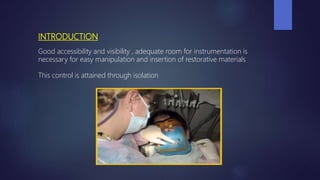
INTRODUCTION
Good accessibility and visibility , adequate room for instrumentation is
necessary for easy manipulation and insertion of restorative materials
This control is attained through isolation
GOALS OF ISOLATION
 Moisture control
 Retraction and access
 Protects soft tissues from damage
 Safe and aseptic operating field
 Prevent accidental swallowing of restorative materials and
instruments
METHODS OF ISOLATION
Direct method :
 Rubber dam
 Cotton rolls & cellulose wafers
 Saliva ejectors
 High volume evacuation
 Throat shields
 Gingival retraction cords
 Mouth props
 Mouth mirror
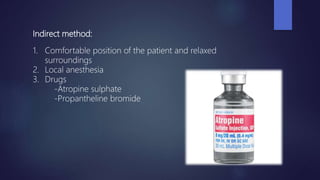
Indirect method:
1. Comfortable position of the patient and relaxed
surroundings
2. Local anesthesia
3. Drugs
-Atropine sulphate
-Propantheline bromide
RUBBER DAM
Use of rubber dam ensures absolute moisture control in the mouth
Introduced by S.C BARNUM in 1864
Advantages
Increases visibility & accessibility
Provides a dry field
Effectively retracts tongue, cheeks away from the field
of operation
Saves time
Improved properties of dental materials
Reduces the chances of injury to soft tissues
Produces calming effect in children
Protection of dentist- from infection like hepatitis B
Prevents any aspiration or ingestion of dental
instruments
Disadvantages
Takes time to apply and remove
Communication with the patient can be difficult
Some patient may object to the use of rubber dam due to
psychological reasons
Incorrect use may damage porcelain
crowns/gingival tissues
Insecure clamps can be swallowed or aspirated
Indications
1. Endodontic procedures
2. Excavation of deep caries
3. Adhesive restorations
4. Bleaching
5. Subgingival restorations
6. High risk patients
Contraindications
 child with upper respiratory tract infection,
 congestion of nasal passage or nasal obstruction
 Presence of some fixed orthodontic appliances
 recently erupted tooth
 Patients with allergy to latex
 Grossly carious teeth
 Extremely malpositioned teeth
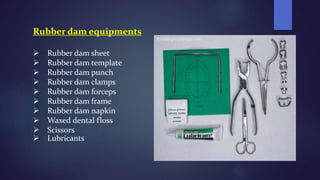
Rubber dam equipments
 Rubber dam sheet
 Rubber dam template
 Rubber dam punch
 Rubber dam clamps
 Rubber dam forceps
 Rubber dam frame
 Rubber dam napkin
 Waxed dental floss
 Scissors
 Lubricants
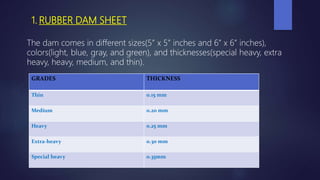
1. RUBBER DAM SHEET
The dam comes in different sizes(5” x 5” inches and 6” x 6” inches),
colors(light, blue, gray, and green), and thicknesses(special heavy, extra
heavy, heavy, medium, and thin).
GRADES THICKNESS
Thin 0.15 mm
Medium 0.20 mm
Heavy 0.25 mm
Extra-heavy 0.30 mm
Special heavy 0.35mm
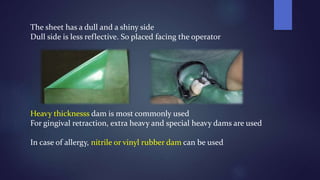
The sheet has a dull and a shiny side
Dull side is less reflective. So placed facing the operator
Heavy thicknesss dam is most commonly used
For gingival retraction, extra heavy and special heavy dams are used
In case of allergy, nitrile or vinyl rubber dam can be used
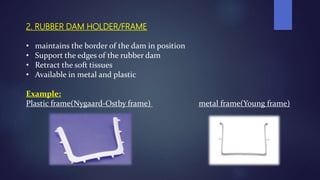
2. RUBBER DAM HOLDER/FRAME
• maintains the border of the dam in position
• Support the edges of the rubber dam
• Retract the soft tissues
• Available in metal and plastic
Example:
Plastic frame(Nygaard-Ostby frame) metal frame(Young frame)
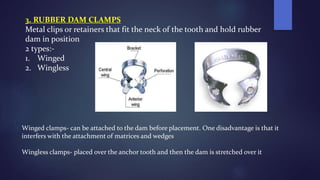
3. RUBBER DAM CLAMPS
Metal clips or retainers that fit the neck of the tooth and hold rubber
dam in position
2 types:-
1. Winged
2. Wingless
Winged clamps- can be attached to the dam before placement. One disadvantage is that it
interfers with the attachment of matrices and wedges
Wingless clamps- placed over the anchor tooth and then the dam is stretched over it
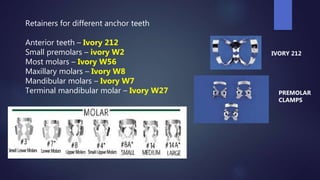
Retainers for different anchor teeth
Anterior teeth – Ivory 212
Small premolars – ivory W2
Most molars – Ivory W56
Maxillary molars – Ivory W8
Mandibular molars – Ivory W7
Terminal mandibular molar – Ivory W27
IVORY 212
PREMOLAR
CLAMPS
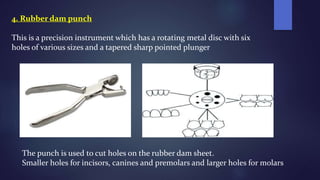
4. Rubber dam punch
This is a precision instrument which has a rotating metal disc with six
holes of various sizes and a tapered sharp pointed plunger
The punch is used to cut holes on the rubber dam sheet.
Smaller holes for incisors, canines and premolars and larger holes for molars
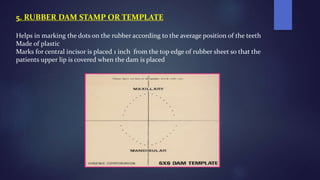
5. RUBBER DAM STAMP OR TEMPLATE
Helps in marking the dots on the rubber according to the average position of the teeth
Made of plastic
Marks for central incisor is placed 1 inch from the top edge of rubber sheet so that the
patients upper lip is covered when the dam is placed
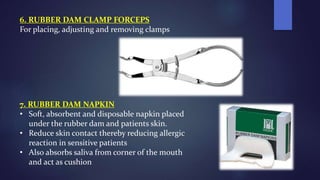
6. RUBBER DAM CLAMP FORCEPS
For placing, adjusting and removing clamps
7. RUBBER DAM NAPKIN
• Soft, absorbent and disposable napkin placed
under the rubber dam and patients skin.
• Reduce skin contact thereby reducing allergic
reaction in sensitive patients
• Also absorbs saliva from corner of the mouth
and act as cushion
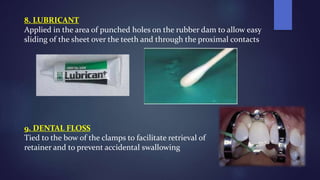
8. LUBRICANT
Applied in the area of punched holes on the rubber dam to allow easy
sliding of the sheet over the teeth and through the proximal contacts
9. DENTAL FLOSS
Tied to the bow of the clamps to facilitate retrieval of
retainer and to prevent accidental swallowing
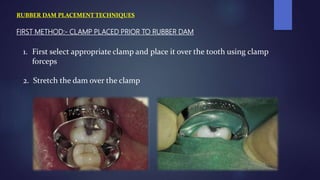
RUBBER DAM PLACEMENT TECHNIQUES
FIRST METHOD:- CLAMP PLACED PRIOR TO RUBBER DAM
1. First select appropriate clamp and place it over the tooth using clamp
forceps
2. Stretch the dam over the clamp
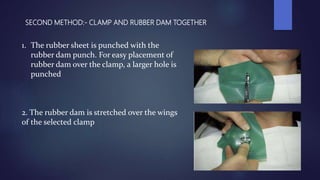
SECOND METHOD:- CLAMP AND RUBBER DAM TOGETHER
1. The rubber sheet is punched with the
rubber dam punch. For easy placement of
rubber dam over the clamp, a larger hole is
punched
2. The rubber dam is stretched over the wings
of the selected clamp
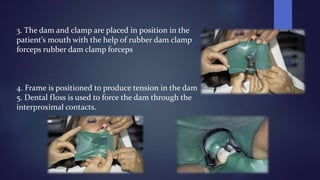
3. The dam and clamp are placed in position in the
patient’s mouth with the help of rubber dam clamp
forceps rubber dam clamp forceps
4. Frame is positioned to produce tension in the dam
5. Dental floss is used to force the dam through the
interproximal contacts.
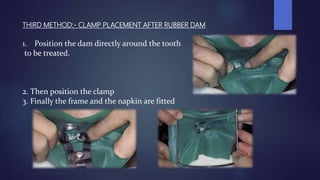
THIRD METHOD:- CLAMP PLACEMENT AFTER RUBBER DAM
1. Position the dam directly around the tooth
to be treated.
2. Then position the clamp
3. Finally the frame and the napkin are fitted
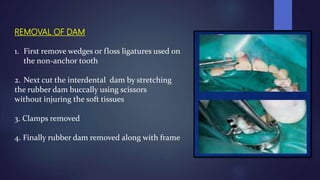
REMOVAL OF DAM
1. First remove wedges or floss ligatures used on
the non-anchor tooth
2. Next cut the interdental dam by stretching
the rubber dam buccally using scissors
without injuring the soft tissues
3. Clamps removed
4. Finally rubber dam removed along with frame
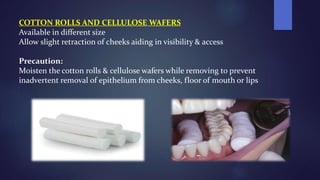
COTTON ROLLS AND CELLULOSE WAFERS
Available in different size
Allow slight retraction of cheeks aiding in visibility & access
Precaution:
Moisten the cotton rolls & cellulose wafers while removing to prevent
inadvertent removal of epithelium from cheeks, floor of mouth or lips
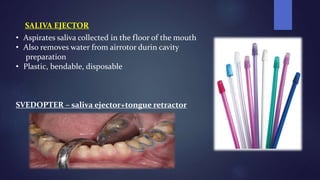
SALIVA EJECTOR
• Aspirates saliva collected in the floor of the mouth
• Also removes water from airrotor durin cavity
preparation
• Plastic, bendable, disposable
SVEDOPTER – saliva ejector+tongue retractor
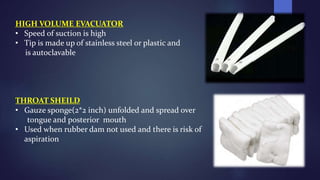
HIGH VOLUME EVACUATOR
• Speed of suction is high
• Tip is made up of stainless steel or plastic and
is autoclavable
THROAT SHEILD
• Gauze sponge(2*2 inch) unfolded and spread over
tongue and posterior mouth
• Used when rubber dam not used and there is risk of
aspiration
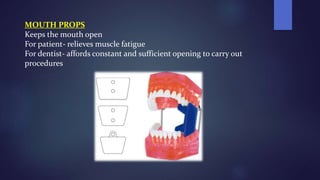
MOUTH PROPS
Keeps the mouth open
For patient- relieves muscle fatigue
For dentist- affords constant and sufficient opening to carry out
procedures
Isolation in restorative dentistry

Isolation in restorative dentistry

  • 1.
  • 2.
    INTRODUCTION Good accessibility andvisibility , adequate room for instrumentation is necessary for easy manipulation and insertion of restorative materials This control is attained through isolation
  • 3.
    GOALS OF ISOLATION Moisture control  Retraction and access  Protects soft tissues from damage  Safe and aseptic operating field  Prevent accidental swallowing of restorative materials and instruments
  • 4.
    METHODS OF ISOLATION Directmethod :  Rubber dam  Cotton rolls & cellulose wafers  Saliva ejectors  High volume evacuation  Throat shields  Gingival retraction cords  Mouth props  Mouth mirror
  • 5.
    Indirect method: 1. Comfortableposition of the patient and relaxed surroundings 2. Local anesthesia 3. Drugs -Atropine sulphate -Propantheline bromide
  • 6.
    RUBBER DAM Use ofrubber dam ensures absolute moisture control in the mouth Introduced by S.C BARNUM in 1864
  • 7.
    Advantages Increases visibility &accessibility Provides a dry field Effectively retracts tongue, cheeks away from the field of operation Saves time Improved properties of dental materials Reduces the chances of injury to soft tissues Produces calming effect in children Protection of dentist- from infection like hepatitis B Prevents any aspiration or ingestion of dental instruments
  • 8.
    Disadvantages Takes time toapply and remove Communication with the patient can be difficult Some patient may object to the use of rubber dam due to psychological reasons Incorrect use may damage porcelain crowns/gingival tissues Insecure clamps can be swallowed or aspirated
  • 9.
    Indications 1. Endodontic procedures 2.Excavation of deep caries 3. Adhesive restorations 4. Bleaching 5. Subgingival restorations 6. High risk patients
  • 10.
    Contraindications  child withupper respiratory tract infection,  congestion of nasal passage or nasal obstruction  Presence of some fixed orthodontic appliances  recently erupted tooth  Patients with allergy to latex  Grossly carious teeth  Extremely malpositioned teeth
  • 11.
    Rubber dam equipments Rubber dam sheet  Rubber dam template  Rubber dam punch  Rubber dam clamps  Rubber dam forceps  Rubber dam frame  Rubber dam napkin  Waxed dental floss  Scissors  Lubricants
  • 12.
    1. RUBBER DAMSHEET The dam comes in different sizes(5” x 5” inches and 6” x 6” inches), colors(light, blue, gray, and green), and thicknesses(special heavy, extra heavy, heavy, medium, and thin). GRADES THICKNESS Thin 0.15 mm Medium 0.20 mm Heavy 0.25 mm Extra-heavy 0.30 mm Special heavy 0.35mm
  • 13.
    The sheet hasa dull and a shiny side Dull side is less reflective. So placed facing the operator Heavy thicknesss dam is most commonly used For gingival retraction, extra heavy and special heavy dams are used In case of allergy, nitrile or vinyl rubber dam can be used
  • 14.
    2. RUBBER DAMHOLDER/FRAME • maintains the border of the dam in position • Support the edges of the rubber dam • Retract the soft tissues • Available in metal and plastic Example: Plastic frame(Nygaard-Ostby frame) metal frame(Young frame)
  • 15.
    3. RUBBER DAMCLAMPS Metal clips or retainers that fit the neck of the tooth and hold rubber dam in position 2 types:- 1. Winged 2. Wingless Winged clamps- can be attached to the dam before placement. One disadvantage is that it interfers with the attachment of matrices and wedges Wingless clamps- placed over the anchor tooth and then the dam is stretched over it
  • 16.
    Retainers for differentanchor teeth Anterior teeth – Ivory 212 Small premolars – ivory W2 Most molars – Ivory W56 Maxillary molars – Ivory W8 Mandibular molars – Ivory W7 Terminal mandibular molar – Ivory W27 IVORY 212 PREMOLAR CLAMPS
  • 17.
    4. Rubber dampunch This is a precision instrument which has a rotating metal disc with six holes of various sizes and a tapered sharp pointed plunger The punch is used to cut holes on the rubber dam sheet. Smaller holes for incisors, canines and premolars and larger holes for molars
  • 18.
    5. RUBBER DAMSTAMP OR TEMPLATE Helps in marking the dots on the rubber according to the average position of the teeth Made of plastic Marks for central incisor is placed 1 inch from the top edge of rubber sheet so that the patients upper lip is covered when the dam is placed
  • 19.
    6. RUBBER DAMCLAMP FORCEPS For placing, adjusting and removing clamps 7. RUBBER DAM NAPKIN • Soft, absorbent and disposable napkin placed under the rubber dam and patients skin. • Reduce skin contact thereby reducing allergic reaction in sensitive patients • Also absorbs saliva from corner of the mouth and act as cushion
  • 20.
    8. LUBRICANT Applied inthe area of punched holes on the rubber dam to allow easy sliding of the sheet over the teeth and through the proximal contacts 9. DENTAL FLOSS Tied to the bow of the clamps to facilitate retrieval of retainer and to prevent accidental swallowing
  • 21.
    RUBBER DAM PLACEMENTTECHNIQUES FIRST METHOD:- CLAMP PLACED PRIOR TO RUBBER DAM 1. First select appropriate clamp and place it over the tooth using clamp forceps 2. Stretch the dam over the clamp
  • 22.
    SECOND METHOD:- CLAMPAND RUBBER DAM TOGETHER 1. The rubber sheet is punched with the rubber dam punch. For easy placement of rubber dam over the clamp, a larger hole is punched 2. The rubber dam is stretched over the wings of the selected clamp
  • 23.
    3. The damand clamp are placed in position in the patient’s mouth with the help of rubber dam clamp forceps rubber dam clamp forceps 4. Frame is positioned to produce tension in the dam 5. Dental floss is used to force the dam through the interproximal contacts.
  • 24.
    THIRD METHOD:- CLAMPPLACEMENT AFTER RUBBER DAM 1. Position the dam directly around the tooth to be treated. 2. Then position the clamp 3. Finally the frame and the napkin are fitted
  • 25.
    REMOVAL OF DAM 1.First remove wedges or floss ligatures used on the non-anchor tooth 2. Next cut the interdental dam by stretching the rubber dam buccally using scissors without injuring the soft tissues 3. Clamps removed 4. Finally rubber dam removed along with frame
  • 26.
    COTTON ROLLS ANDCELLULOSE WAFERS Available in different size Allow slight retraction of cheeks aiding in visibility & access Precaution: Moisten the cotton rolls & cellulose wafers while removing to prevent inadvertent removal of epithelium from cheeks, floor of mouth or lips
  • 27.
    SALIVA EJECTOR • Aspiratessaliva collected in the floor of the mouth • Also removes water from airrotor durin cavity preparation • Plastic, bendable, disposable SVEDOPTER – saliva ejector+tongue retractor
  • 28.
    HIGH VOLUME EVACUATOR •Speed of suction is high • Tip is made up of stainless steel or plastic and is autoclavable THROAT SHEILD • Gauze sponge(2*2 inch) unfolded and spread over tongue and posterior mouth • Used when rubber dam not used and there is risk of aspiration
  • 29.
    MOUTH PROPS Keeps themouth open For patient- relieves muscle fatigue For dentist- affords constant and sufficient opening to carry out procedures