WELCOME TO OUR
PRESENTATION
Name Id
Ferdous Jannatul 12-20587-1
Ahmed Foysal 12-20841-1
ISO 9000 CERTIFICATION
 ISO is an international standards development body,
including among its membership national standards bodies
from 127 of the worlds leading industrial nations.
ISO officially began operations on 23 February 1947 in
Geneva, Switzerland.
ISO is a non-governmental organization that forms a bridge
between the public and private sectors.
WHAT IS ISO?
 ISO 9000 are among ISO’s most well known standards ever.
It implemented by more than a million organizations in some
175 countries.
ISO 9000 helps organizations to implement quality
management.
ISO 9000 IN BRIEF
 ISO 9000 is for quality management.
Quality management means what the organization does to
ensure that
its products satisfy the customer’s quality requirements and
company with any regulations applicable to those products or
services.
QUALITY MANAGEMENT
 ISO 8402- QA and Quality management vocabulary
 ISO 9000-2- Generic guidelines for applying ISO 9001, 9002
and 9003.
 ISO 9000-3- Guidelines for applying ISO 9001 to the
development supply and maintenance of software.
 ISO 9000-4- Application for dependability management.
 ISO 9000-2- Guidelines for services
 ISO 9000-3- Guidelines for processed material.
STANDARDS OF ISO 9000 FAMILY
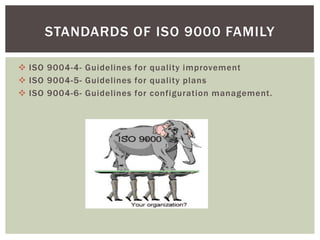
 ISO 9004-4- Guidelines for quality improvement
 ISO 9004-5- Guidelines for quality plans
 ISO 9004-6- Guidelines for configuration management.
STANDARDS OF ISO 9000 FAMILY
 Management Responsibility
 Quality System
 Contract Review
 Design Control
 Document & Data Control
 Purchasing
 Customer Supplied Product
ELEMENTS OF ISO 9000 CERTIFICATION
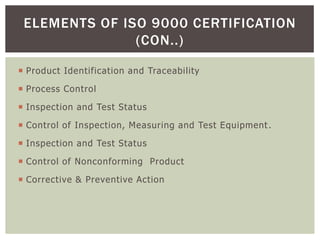
 Product Identification and Traceability
 Process Control
 Inspection and Test Status
 Control of Inspection, Measuring and Test Equipment.
 Inspection and Test Status
 Control of Nonconforming Product
 Corrective & Preventive Action
ELEMENTS OF ISO 9000 CERTIFICATION
(CON..)
 Handling , Storage, Packaging, Preservation and Delivery
 Control of Quality Records
 Quality Audits
 Training
 Servicing
 Statistical Techniques
ELEMENTS OF ISO 9000 CERTIFICATION
(CON..)
STAGES
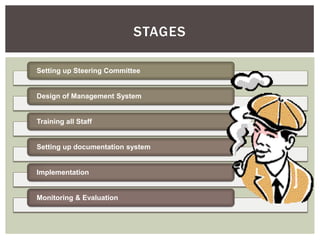
Setting up Steering Committee
Design of Management System
Training all Staff
Setting up documentation system
Implementation
Monitoring & Evaluation
STAGES (CON..)
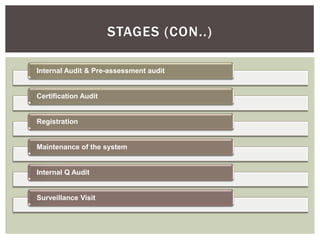
Internal Audit & Pre-assessment audit
Certification Audit
Registration
Maintenance of the system
Internal Q Audit
Surveillance Visit
 Increased marketability
 Reduced operational expenses
 better management control
 Increased customer satisfaction
 improved internal communication
 Improved customer service
 Attractiveness to investors
ADVANTAGES OF ISO 9000
 Owners and managers do not have an adequate
understanding of the ISO 9000 certification process or of the
quality standards themselves.
 Taxing on resources ( economic)
 over certification
 Hinders creativity and innovation
 Continuous improvement may suffer
DISADVANTAGES OF ISO 9000
 ISO 9001 are generic standards.
 Generic means that the same standards can be applied to
any organization, large or small, whatever its product or
service, in any sector of activity, and whether it is a business
enterprise, a business administration, or a government
department.
4 GENERIC PRODUCT CATEGORIES
 HARDWARE
 SOFTWARE
 PROCESSED MATERIALS
 SERVICE
GENERIC STANDARDS
 ISO 9001 concern the way an organization goes about its
work.
 Its not product standards.
 Its not service standards.
 Its process standards.
 Process affect final products or services.
 ISO 9001 gives the requirements for what the organization
must do to manage process affecting quality of its products
and services.
PROCESS, NOT PRODUCT
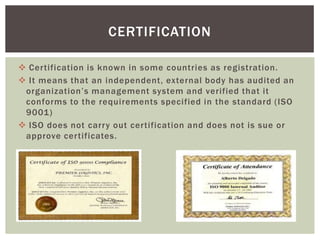
 Certification is known in some countries as registration.
 It means that an independent, external body has audited an
organization’s management system and verified that it
conforms to the requirements specified in the standard (ISO
9001)
 ISO does not carry out certification and does not is sue or
approve certificates.
CERTIFICATION
 ISO does not carry out 9001 certification.
 ISO does not issue certificates.
 ISO does not accredit, approve or control the certification
bodies.
 ISO develops standards and guides to encourage good
practice in accreditation and certification.
ISO DOES NOT CERTIFY
Iso 9000
Iso 9000
Iso 9000
Iso 9000

Iso 9000

  • 1.
  • 2.
    Name Id Ferdous Jannatul12-20587-1 Ahmed Foysal 12-20841-1 ISO 9000 CERTIFICATION
  • 3.
     ISO isan international standards development body, including among its membership national standards bodies from 127 of the worlds leading industrial nations. ISO officially began operations on 23 February 1947 in Geneva, Switzerland. ISO is a non-governmental organization that forms a bridge between the public and private sectors. WHAT IS ISO?
  • 4.
     ISO 9000are among ISO’s most well known standards ever. It implemented by more than a million organizations in some 175 countries. ISO 9000 helps organizations to implement quality management. ISO 9000 IN BRIEF
  • 5.
     ISO 9000is for quality management. Quality management means what the organization does to ensure that its products satisfy the customer’s quality requirements and company with any regulations applicable to those products or services. QUALITY MANAGEMENT
  • 6.
     ISO 8402-QA and Quality management vocabulary  ISO 9000-2- Generic guidelines for applying ISO 9001, 9002 and 9003.  ISO 9000-3- Guidelines for applying ISO 9001 to the development supply and maintenance of software.  ISO 9000-4- Application for dependability management.  ISO 9000-2- Guidelines for services  ISO 9000-3- Guidelines for processed material. STANDARDS OF ISO 9000 FAMILY
  • 7.
     ISO 9004-4-Guidelines for quality improvement  ISO 9004-5- Guidelines for quality plans  ISO 9004-6- Guidelines for configuration management. STANDARDS OF ISO 9000 FAMILY
  • 8.
     Management Responsibility Quality System  Contract Review  Design Control  Document & Data Control  Purchasing  Customer Supplied Product ELEMENTS OF ISO 9000 CERTIFICATION
  • 9.
     Product Identificationand Traceability  Process Control  Inspection and Test Status  Control of Inspection, Measuring and Test Equipment.  Inspection and Test Status  Control of Nonconforming Product  Corrective & Preventive Action ELEMENTS OF ISO 9000 CERTIFICATION (CON..)
  • 10.
     Handling ,Storage, Packaging, Preservation and Delivery  Control of Quality Records  Quality Audits  Training  Servicing  Statistical Techniques ELEMENTS OF ISO 9000 CERTIFICATION (CON..)
  • 11.
    STAGES Setting up SteeringCommittee Design of Management System Training all Staff Setting up documentation system Implementation Monitoring & Evaluation
  • 12.
    STAGES (CON..) Internal Audit& Pre-assessment audit Certification Audit Registration Maintenance of the system Internal Q Audit Surveillance Visit
  • 13.
     Increased marketability Reduced operational expenses  better management control  Increased customer satisfaction  improved internal communication  Improved customer service  Attractiveness to investors ADVANTAGES OF ISO 9000
  • 14.
     Owners andmanagers do not have an adequate understanding of the ISO 9000 certification process or of the quality standards themselves.  Taxing on resources ( economic)  over certification  Hinders creativity and innovation  Continuous improvement may suffer DISADVANTAGES OF ISO 9000
  • 15.
     ISO 9001are generic standards.  Generic means that the same standards can be applied to any organization, large or small, whatever its product or service, in any sector of activity, and whether it is a business enterprise, a business administration, or a government department. 4 GENERIC PRODUCT CATEGORIES  HARDWARE  SOFTWARE  PROCESSED MATERIALS  SERVICE GENERIC STANDARDS
  • 16.
     ISO 9001concern the way an organization goes about its work.  Its not product standards.  Its not service standards.  Its process standards.  Process affect final products or services.  ISO 9001 gives the requirements for what the organization must do to manage process affecting quality of its products and services. PROCESS, NOT PRODUCT
  • 17.
     Certification isknown in some countries as registration.  It means that an independent, external body has audited an organization’s management system and verified that it conforms to the requirements specified in the standard (ISO 9001)  ISO does not carry out certification and does not is sue or approve certificates. CERTIFICATION
  • 18.
     ISO doesnot carry out 9001 certification.  ISO does not issue certificates.  ISO does not accredit, approve or control the certification bodies.  ISO develops standards and guides to encourage good practice in accreditation and certification. ISO DOES NOT CERTIFY