ISCF Smart Sustainable
Packaging: Feasibility and
Demonstrators
Briefing Webinar – 02 December 2019
Scope
Nick Cliffe
Innovation Lead
Background to SSPP
Background to SSPP
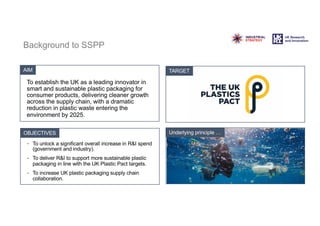
AIM
OBJECTIVES
To establish the UK as a leading innovator in
smart and sustainable plastic packaging for
consumer products, delivering cleaner growth
across the supply chain, with a dramatic
reduction in plastic waste entering the
environment by 2025.
- To unlock a significant overall increase in R&I spend
(government and industry).
- To deliver R&I to support more sustainable plastic
packaging in line with the UK Plastic Pact targets.
- To increase UK plastic packaging supply chain
collaboration.
TARGET
Underlying principle …
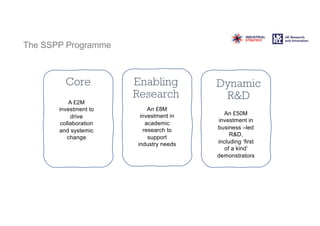
The SSPP Programme
Dynamic
R&D
Core Enabling
Research
A £2M
investment to
drive
collaboration
and systemic
change
An £8M
investment in
academic
research to
support
industry needs
An £50M
investment in
business –led
R&D,
including ‘first
of a kind’
demonstrators
The SSPP Programme - Core
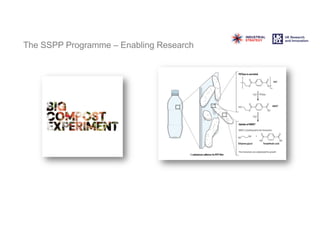
The SSPP Programme – Enabling Research
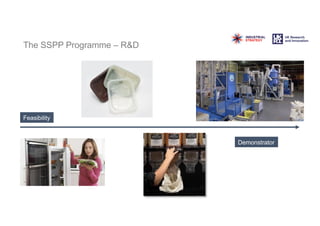
The SSPP Programme – R&D
Feasibility
Demonstrator
Scope
15
Image: Artstation, Paul Chamber
INVESTMENT OPPORTUNITITES
Scope
Your project must aim to:
• help make the plastics packaging supply chain more circular
• deliver the targets of the UK Plastics Pact
• improve on current state-of-the-art plastic packaging, while still demonstrating
practical and close-to-market solutions
• For Proposals – develop a future Demonstrator project
Your proposal must:
• show how your project supports the objectives of the Pact and delivers systemic
change
• clearly explain how you would reduce the UK plastic packaging system’s overall
environmental impact
Pact Targets
• 100% of plastic packaging to be
reusable, recyclable or
compostable.
• 70% of plastic packaging
effectively recycled or
composted.
• 30% average recycled content
across all plastic packaging.
• Take actions to eliminate
problematic or unnecessary
single-use packaging items
through redesign, innovation or
alternative (reuse) delivery
models.
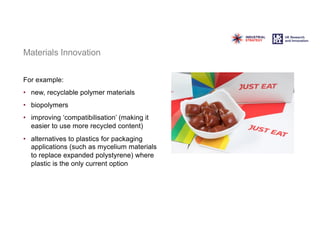
Materials Innovation
For example:
• new, recyclable polymer materials
• biopolymers
• improving ‘compatibilisation’ (making it
easier to use more recycled content)
• alternatives to plastics for packaging
applications (such as mycelium materials
to replace expanded polystyrene) where
plastic is the only current option
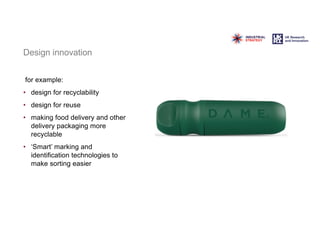
Design innovation
for example:
• design for recyclability
• design for reuse
• making food delivery and other
delivery packaging more
recyclable
• ‘Smart’ marking and
identification technologies to
make sorting easier
Technology Innovation
For example:
• reuse processes such as cleaning
• collection
• sorting and separation
• mechanical recycling
• chemical recycling
• anaerobic digestion or composting
of compostable packaging
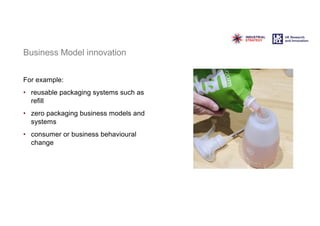
Business Model innovation
For example:
• reusable packaging systems such as
refill
• zero packaging business models and
systems
• consumer or business behavioural
change
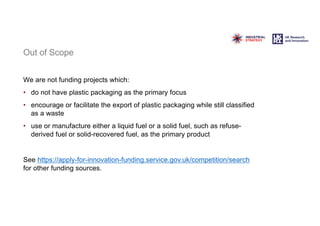
Out of Scope
We are not funding projects which:
• do not have plastic packaging as the primary focus
• encourage or facilitate the export of plastic packaging while still classified
as a waste
• use or manufacture either a liquid fuel or a solid fuel, such as refuse-
derived fuel or solid-recovered fuel, as the primary product
See https://apply-for-innovation-funding.service.gov.uk/competition/search
for other funding sources.
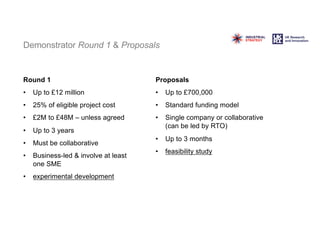
Demonstrator Round 1 & Proposals
Round 1
• Up to £12 million
• 25% of eligible project cost
• £2M to £48M – unless agreed
• Up to 3 years
• Must be collaborative
• Business-led & involve at least
one SME
• experimental development
Proposals
• Up to £700,000
• Standard funding model
• Single company or collaborative
(can be led by RTO)
• Up to 3 months
• feasibility study
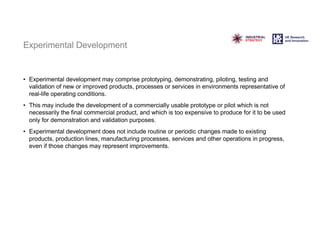
Experimental Development
• Experimental development may comprise prototyping, demonstrating, piloting, testing and
validation of new or improved products, processes or services in environments representative of
real-life operating conditions.
• This may include the development of a commercially usable prototype or pilot which is not
necessarily the final commercial product, and which is too expensive to produce for it to be used
only for demonstration and validation purposes.
• Experimental development does not include routine or periodic changes made to existing
products, production lines, manufacturing processes, services and other operations in progress,
even if those changes may represent improvements.
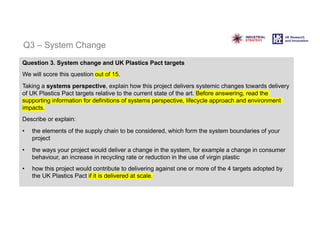
Q3 – System Change
Question 3. System change and UK Plastics Pact targets
We will score this question out of 15.
Taking a systems perspective, explain how this project delivers systemic changes towards delivery
of UK Plastics Pact targets relative to the current state of the art. Before answering, read the
supporting information for definitions of systems perspective, lifecycle approach and environment
impacts.
Describe or explain:
• the elements of the supply chain to be considered, which form the system boundaries of your
project
• the ways your project would deliver a change in the system, for example a change in consumer
behaviour, an increase in recycling rate or reduction in the use of virgin plastic
• how this project would contribute to delivering against one or more of the 4 targets adopted by
the UK Plastics Pact if it is delivered at scale.
Q4 Environmental Impact
Question 4. Environmental benefits
We will score this question out of 15.
Taking a systems perspective explain how your project will change the environmental impact
(positive or negative) of the component or components of the plastic packaging system your project
is intended to replace.
Are there any trade-offs in terms of environmental benefits and impacts?
You must take a lifecycle approach and consider any additives and other chemicals (such as glues
or inks) and/or materials that are used in the manufacture of a finished product, as well as process
wastes.
Consider the following areas in your answer:
• how your project will prevent or reduce plastic packaging escaping into the environment, such as
by increasing collection rates
• the direct and indirect carbon footprint impacts of your project compared to the current state of the
art, including both logistics and the production of carbon dioxide by biodegradation if applicable
Q4 Environmental Impact - continued
• the likely consequences of human exposure to any plastics your project could release to the
environment
• the likely consequences other species (such as fish, marine mammals or birds) in the natural
environment being exposed to any plastics your project could release to the environment
• other environmental impacts not covered by the above categories
If your material is of biological origin describe the impact on land use (for example, displacement of
food crops).
If a life cycle analysis (LCA) is available, you can submit it as a PDF appendix no larger than 10MB
and up to 4 A4 pages long to support your answer. The font must be legible at 100% zoom.
Note from EA
Definition of Waste Service
• The mechanism by which companies can seek the view of the Environment Agency
about whether their waste derived material has achieved end of waste status.
• It’s entirely voluntary, it is pay-to-use and the outcome is a national opinion
applicable across England about whether the material is waste or not.
• Costs and time scales are open ended.
• The company provides a ‘submission’ of evidence via the IsItWaste tool.
• Any Questions?? dowservices@environment-agency.gov.uk
Note from EA
Making a good submission
You must ensure your submission includes robust information that:
1. Completes the DoW checklist (see the IsItWaste tool).
2. Provides proper data (e.g. sample data, comparator reports) and evidence.
3. Tells a clear ‘story’ about your waste derived material.
4. Identifies the non-waste material it replaces (the comparator).
5. Satisfies the three limbs of the End of Waste test
I. Distinct and marketable,
II. used in the same way, and with
III. no worse environmental and human heath impact than the non waste it replaces.
Eligibility criteria
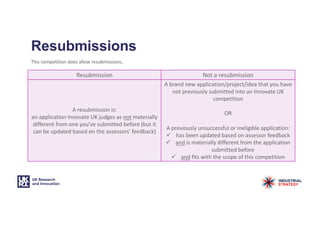
Resubmissions
This competition does allow resubmissions.
Resubmission Not a resubmission
A resubmission is:
an application Innovate UK judges as not materially
different from one you've submitted before (but it
can be updated based on the assessors' feedback)
A brand new application/project/idea that you have
not previously submitted into an Innovate UK
competition
OR
A previously unsuccessful or ineligible application:
ü has been updated based on assessor feedback
ü and is materially different from the application
submitted before
ü and fits with the scope of this competition
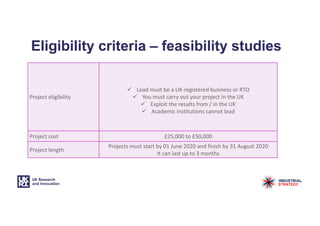
Eligibility criteria – feasibility studies
Project eligibility
ü Lead must be a UK-registered business or RTO
ü You must carry out your project in the UK
ü Exploit the results from / in the UK
ü Academic institutions cannot lead
Project cost £25,000 to £50,000
Project length
Projects must start by 01 June 2020 and finish by 31 August 2020
It can last up to 3 months
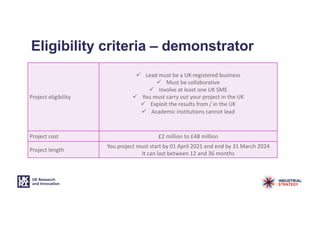
Eligibility criteria – demonstrator
Project eligibility
ü Lead must be a UK-registered business
ü Must be collaborative
ü Involve at least one UK SME
ü You must carry out your project in the UK
ü Exploit the results from / in the UK
ü Academic institutions cannot lead
Project cost £2 million to £48 million
Project length
You project must start by 01 April 2021 and end by 31 March 2024
It can last between 12 and 36 months
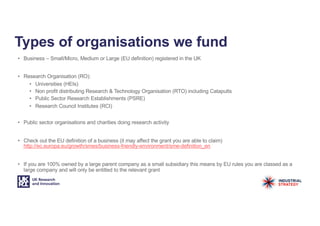
Types of organisations we fund
• Business – Small/Micro, Medium or Large (EU definition) registered in the UK
• Research Organisation (RO):
• Universities (HEIs)
• Non profit distributing Research & Technology Organisation (RTO) including Catapults
• Public Sector Research Establishments (PSRE)
• Research Council Institutes (RCI)
• Public sector organisations and charities doing research activity
• Check out the EU definition of a business (it may affect the grant you are able to claim)
http://ec.europa.eu/growth/smes/business-friendly-environment/sme-definition_en
• If you are 100% owned by a large parent company as a small subsidiary this means by EU rules you are classed as a
large company and will only be entitled to the relevant grant
Eligibility for State Aid
• Innovate UK is offering funding for this competition under the General Block Exemption Regulation. This is
available to eligible UK businesses.
• We are unable to grant funding to limited liability companies meeting the condition known as ‘undertakings in
difficulty’.
• This is where more than half of a company’s subscribed share capital has disappeared as a result of
accumulated losses.
• This test only applies to companies that are more than 3 years old.
• If you have a parent company the test can be performed on your parent or holding company.
• When submitting an application you must certify that you are eligible for state aid. If you are unsure, please
take legal advice before applying.
• Should you be successful, we will apply this test as part of our viability checks before confirming the grant
offer.
• Further information is available on our website in the general guidance under state aid
State Aid – Article 25
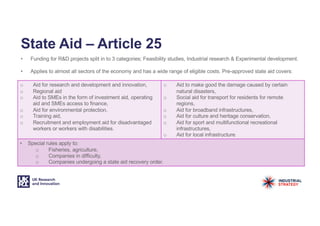
• Funding for R&D projects split in to 3 categories; Feasibility studies, Industrial research & Experimental development.
• Applies to almost all sectors of the economy and has a wide range of eligible costs. Pre-approved state aid covers:
o Aid for research and development and innovation,
o Regional aid
o Aid to SMEs in the form of investment aid, operating
aid and SMEs access to finance,
o Aid for environmental protection,
o Training aid,
o Recruitment and employment aid for disadvantaged
workers or workers with disabilities.
o Aid to make good the damage caused by certain
natural disasters,
o Social aid for transport for residents for remote
regions,
o Aid for broadband infrastructures,
o Aid for culture and heritage conservation,
o Aid for sport and multifunctional recreational
infrastructures,
o Aid for local infrastructure.
• Special rules apply to:
o Fisheries, agriculture,
o Companies in difficulty,
o Companies undergoing a state aid recovery order.
Participation Rules
• The aim of our State Aid scheme is to:
• optimise the level of funding to business and
• recognise the importance of research base to project
• At least 70% of total eligible project costs must be incurred by business
• The maximum level (30% of project costs) is shared by all research organisations in the
project
What is collaboration?
In all collaborative projects there must be:
• at least two organisations claiming grant within the application (including the lead)
• a business or RTO-led consortium, which may involve both business and the research
base and
• evidence of effective collaboration
• we would expect to see the structure and rationale of the collaboration described in the
application.
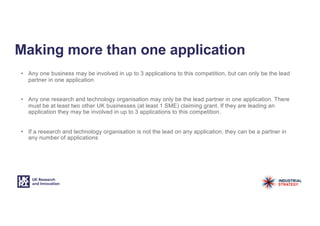
Making more than one application
• Any one business may be involved in up to 3 applications to this competition, but can only be the lead
partner in one application
• Any one research and technology organisation may only be the lead partner in one application. There
must be at least two other UK businesses (at least 1 SME) claiming grant. If they are leading an
application they may be involved in up to 3 applications to this competition.
• If a research and technology organisation is not the lead on any application, they can be a partner in
any number of applications
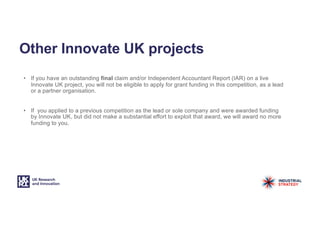
Other Innovate UK projects
• If you have an outstanding final claim and/or Independent Accountant Report (IAR) on a live
Innovate UK project, you will not be eligible to apply for grant funding in this competition, as a lead
or a partner organisation.
• If you applied to a previous competition as the lead or sole company and were awarded funding
by Innovate UK, but did not make a substantial effort to exploit that award, we will award no more
funding to you.
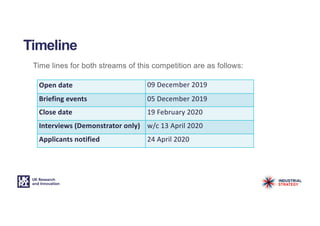
Timeline
Open date 09 December 2019
Briefing events 05 December 2019
Close date 19 February 2020
Interviews (Demonstrator only) w/c 13 April 2020
Applicants notified 24 April 2020
Time lines for both streams of this competition are as follows:
Innovation Funding
Service (IFS)
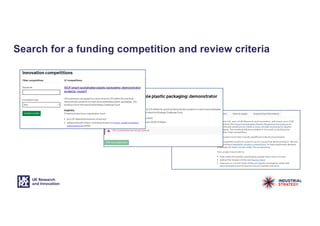
Search for a funding competition and review criteria
Applicant: create an account
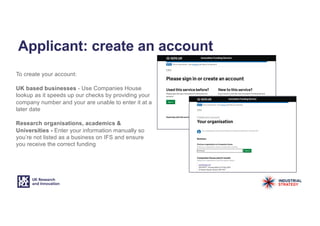
To create your account:
UK based businesses - Use Companies House
lookup as it speeds up our checks by providing your
company number and your are unable to enter it at a
later date
Research organisations, academics &
Universities - Enter your information manually so
you’re not listed as a business on IFS and ensure
you receive the correct funding
Project Details
• Application Team
- Collaborators: Invite organisations who you are working with on the project
- Contributors: Invite colleagues from your own organisation to help you complete your application
• Application Details
- Title, Timescales, Research Category, Innovation Area & Resubmission (y/n)
• Project Summary
- Short summary and objectives of the project including what is innovative about it
• Public Description
- Description of your project which will be published if you are successful
• Scope - How does your project align with the scope of this competition?
- If your project is not in scope, it will be ineligible for funding
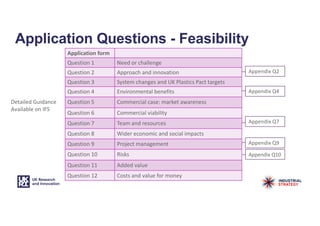
Application Questions - Feasibility
Application form
Question 1 Need or challenge
Question 2 Approach and innovation
Question 3 System changes and UK Plastics Pact targets
Question 4 Environmental benefits
Question 5 Commercial case: market awareness
Question 6 Commercial viability
Question 7 Team and resources
Question 8 Wider economic and social impacts
Question 9 Project management
Question 10 Risks
Question 11 Added value
Question 12 Costs and value for money
Detailed Guidance
Available on IFS
Appendix Q2
Appendix Q4
Appendix Q7
Appendix Q9
Appendix Q10
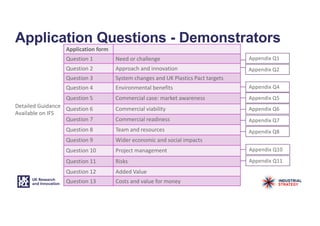
Application Questions - Demonstrators
Detailed Guidance
Available on IFS
Application form
Question 1 Need or challenge
Question 2 Approach and innovation
Question 3 System changes and UK Plastics Pact targets
Question 4 Environmental benefits
Question 5 Commercial case: market awareness
Question 6 Commercial viability
Question 7 Commercial readiness
Question 8 Team and resources
Question 9 Wider economic and social impacts
Question 10 Project management
Question 11 Risks
Question 12 Added Value
Question 13 Costs and value for money
Appendix Q1
Appendix Q2
Appendix Q4
Appendix Q5
Appendix Q6
Appendix Q7
Appendix Q8
Appendix Q10
Appendix Q11
Application finances
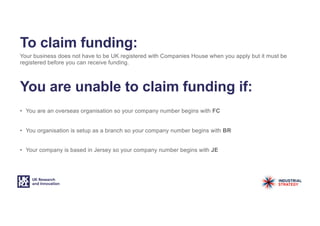
To claim funding:
Your business does not have to be UK registered with Companies House when you apply but it must be
registered before you can receive funding.
You are unable to claim funding if:
• You are an overseas organisation so your company number begins with FC
• You organisation is setup as a branch so your company number begins with BR
• Your company is based in Jersey so your company number begins with JE
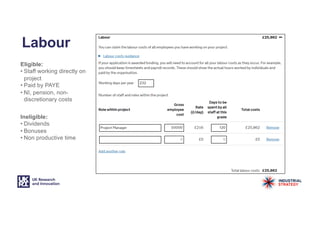
Ineligible:
• Dividends
• Bonuses
• Non productive time
Eligible:
• Staff working directly on
project
• Paid by PAYE
• NI, pension, non-
discretionary costs
Labour
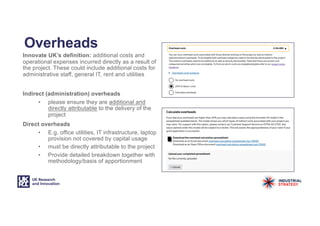
Overheads
Innovate UK’s definition: additional costs and
operational expenses incurred directly as a result of
the project. These could include additional costs for
administrative staff, general IT, rent and utilities
Indirect (administration) overheads
• please ensure they are additional and
directly attributable to the delivery of the
project
Direct overheads
• E.g. office utilities, IT infrastructure, laptop
provision not covered by capital usage
• must be directly attributable to the project
• Provide detailed breakdown together with
methodology/basis of apportionment
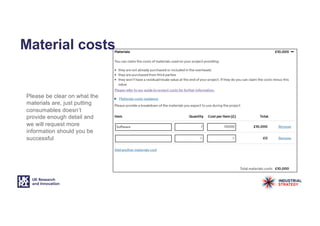
Material costs
Please be clear on what the
materials are, just putting
consumables doesn’t
provide enough detail and
we will request more
information should you be
successful
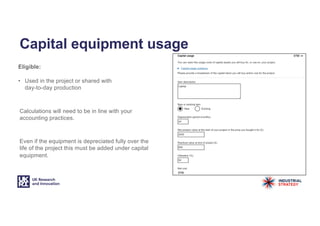
Capital equipment usage
Eligible:
• Used in the project or shared with
day-to-day production
Calculations will need to be in line with your
accounting practices.
Even if the equipment is depreciated fully over the
life of the project this must be added under capital
equipment.
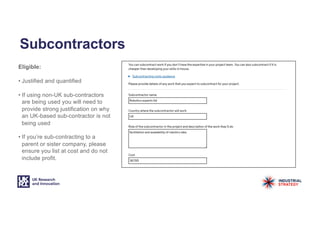
Subcontractors
Eligible:
• Justified and quantified
• If using non-UK sub-contractors
are being used you will need to
provide strong justification on why
an UK-based sub-contractor is not
being used
• If you’re sub-contracting to a
parent or sister company, please
ensure you list at cost and do not
include profit.
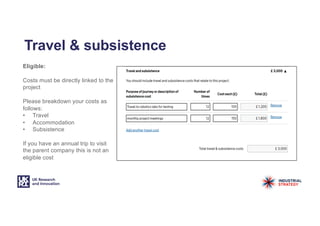
Travel & subsistence
Eligible:
Costs must be directly linked to the
project
Please breakdown your costs as
follows:
• Travel
• Accommodation
• Subsistence
If you have an annual trip to visit
the parent company this is not an
eligible cost
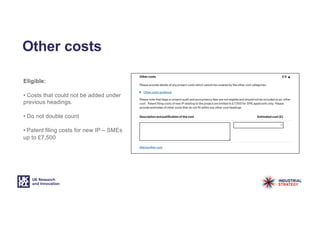
Other costs
Eligible:
• Costs that could not be added under
previous headings.
• Do not double count
• Patent filing costs for new IP – SMEs
up to £7,500
• Funding rules
• The level of funding awarded will depend upon the type of organisation and the type of
research being undertaken in the project
• Funding is calculated by project participant
• IFS will advise the maximum grant % you can request based upon your answers to:
• Type (and size) of organisation
• Research category defined by the lead applicant in the Application Details section of the
application
Funding
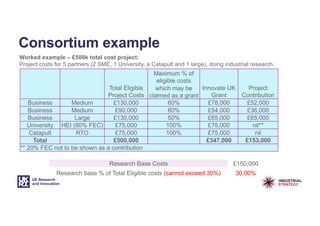
Research Base Costs £150,000
Research base % of Total Eligible costs (cannot exceed 30%) 30.00%
Total Eligible
Project Costs
Maximum % of
eligible costs
which may be
claimed as a grant
Innovate UK
Grant
Project
Contribution
Business Medium £130,000 60% £78,000 £52,000
Business Medium £90,000 60% £54,000 £36,000
Business Large £130,000 50% £65,000 £65,000
University HEI (80% FEC) £75,000 100% £75,000 nil**
Catapult RTO £75,000 100% £75,000 nil
Total £500,000 £347,000 £153,000
** 20% FEC not to be shown as a contribution
Worked example – £500k total cost project:
Project costs for 5 partners (2 SME, 1 University, a Catapult and 1 large), doing industrial research.
Consortium example
Academic partners
Why Je-S?
• We use the Research Councils’ Joint Electronic Submission System (Je-S) to collect academic
finances
• The Je-S system automates the collection of Full Economic Costs (FEC) based costs from academic
partners and tells them exactly what numbers should be used in the application form for their costs
• Also to collect project finance details from non-HEIs (e.g. RTOs) that are claiming they are carrying
out academic quality work and want to be funded on an FEC basis
• Using Je-S means that Innovate UK follows standard Research Council guidelines on funding
universities and enables Research Councils to easily co-fund Innovate UK projects
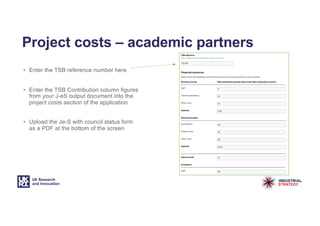
• Enter the TSB reference number here
• Enter the TSB Contribution column figures
from your J-eS output document into the
project costs section of the application
• Upload the Je-S with council status form
as a PDF at the bottom of the screen
Project costs – academic partners
Je-S application elements
Not just the financials
• E.g. Justification of resources
• E.g Pathways to impact
Full details on the Je-S system
Queries about Je-S via the Je-S Helpdesk
• JeSHelp@rcuk.ac.uk
• 01793 444164
Submitting your
application
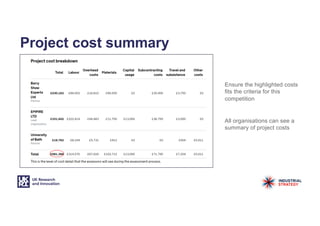
Project cost summary
All organisations can see a
summary of project costs
Ensure the highlighted costs
fits the criteria for this
competition
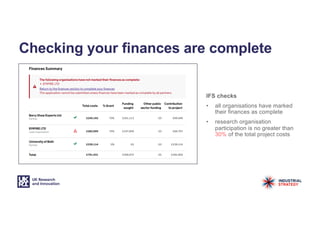
Checking your finances are complete
IFS checks
• all organisations have marked
their finances as complete
• research organisation
participation is no greater than
30% of the total project costs
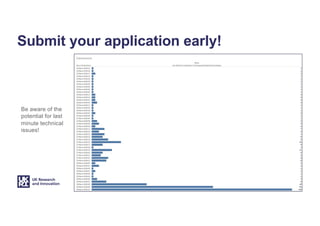
Submit your application early!
Be aware of the
potential for last
minute technical
issues!
Assessment
Application assessment
All applications are assessed by independent assessors drawn from industry and academia
What do they look for?
• Clear and concise answers
• The right amount of information
• not too much detail
• no assumptions
• Quantification and justification
• A proposal that presents a viable opportunity for growth, a level of innovation that
necessitates public sector investment and has the right team and approach to be successful
Keep your assessors engaged
and interested in your proposal.
You want them to be fascinated
and excited by your idea!
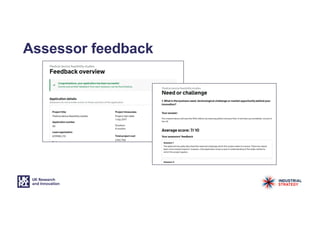
Note on feedback
• The feedback is compiled using the written comments of the independent assessors who review
and assess the applications.
• It is intended to be constructive in nature and to highlight both the strong as well as the weak
areas of your application.
• Please bear in mind that because applications are assessed by a number of assessors, you may
receive information which appears to be conflicting. This may reflect their different interpretations
of the proposal that you submitted.
• It must also be noted that some proposals may appear to have been favourably assessed based
on their comments, in such instances it could be that your proposal simply fell below the funding
threshold, with others achieving a higher merit score overall.
Scoring
We review scores and feedback to check assessors are adhering to our guidelines and scoring fairly.
In some cases, where we feel a score is unjust and not supported by feedback, we may remove that
score as an outlier and update the total score for the application.
Please be aware that both low and high outliers may be removed and as a result scores may
increase or decrease.
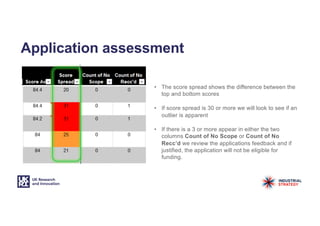
Application assessment
• The score spread shows the difference between the
top and bottom scores
• If score spread is 30 or more we will look to see if an
outlier is apparent
• If there is a 3 or more appear in either the two
columns Count of No Scope or Count of No
Recc’d we review the applications feedback and if
justified, the application will not be eligible for
funding.
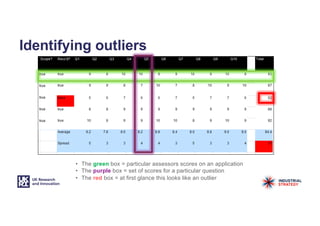
• The green box = particular assessors scores on an application
• The purple box = set of scores for a particular question
• The red box = at first glance this looks like an outlier
Identifying outliers
Assessor feedback
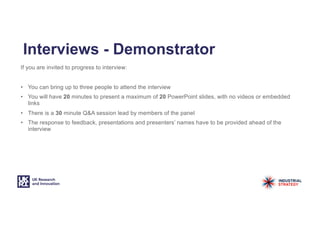
Interviews - Demonstrator
If you are invited to progress to interview:
• You can bring up to three people to attend the interview
• You will have 20 minutes to present a maximum of 20 PowerPoint slides, with no videos or embedded
links
• There is a 30 minute Q&A session lead by members of the panel
• The response to feedback, presentations and presenters’ names have to be provided ahead of the
interview
Project setup for
successful applicants
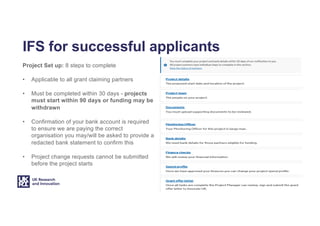
IFS for successful applicants
Project Set up: 8 steps to complete
• Applicable to all grant claiming partners
• Must be completed within 30 days - projects
must start within 90 days or funding may be
withdrawn
• Confirmation of your bank account is required
to ensure we are paying the correct
organisation you may/will be asked to provide a
redacted bank statement to confirm this
• Project change requests cannot be submitted
before the project starts
Project set up
All grant claiming project partners will be required to complete project set up. To avoid delays you
should consider:
• Who will be the project manager?
• Who will be the finance contact for each consortium member?
• How will your consortium be set up? (if applicable)
Collaboration agreement
Original agreement signed by all participants
Key Features:
• Who is in the consortium?
• What are the aims, and how is the work divided up?
• Ownership of IPR
• Management of consortium
Negotiating a Collaboration Agreement can be complex and time consuming. Start work on
this at an early stage in the process.
Grant claims and payments
• All grants are claimable quarterly in arrears
• Claims can only be made for costs incurred and paid between the project start and end dates
• Claims may be subject to an independent audit (including all academic partners) according to grant size
• Claims are only paid once quarterly reporting and necessary audits are complete
• Projects over 6 months are monitored on a quarterly basis including a visit from the appointed
Monitoring Officer. Anything outside of this will be discussed on a case by case basis.
• The monitoring will be carried out against a detailed project plan and financial forecast
Customer Support Services:
0300 321 4357 (Mon-Fri, 9am-5:30pm)
support@innovateuk.ukri.org
Knowledge Transfer Network:
www.ktn-uk.co.uk
Innovate UK:
https://www.gov.uk/government/organisations/innovate-uk
Q&A
@UKRI_news UK Research and Innovation UK Research and Innovation

ISCF: Smart Sustainable Plastic Packaging (SSPP) Challenge Workshop

  • 2.
    ISCF Smart Sustainable Packaging:Feasibility and Demonstrators Briefing Webinar – 02 December 2019
  • 3.
  • 8.
  • 9.
    Background to SSPP AIM OBJECTIVES Toestablish the UK as a leading innovator in smart and sustainable plastic packaging for consumer products, delivering cleaner growth across the supply chain, with a dramatic reduction in plastic waste entering the environment by 2025. - To unlock a significant overall increase in R&I spend (government and industry). - To deliver R&I to support more sustainable plastic packaging in line with the UK Plastic Pact targets. - To increase UK plastic packaging supply chain collaboration. TARGET Underlying principle …
  • 10.
    The SSPP Programme Dynamic R&D CoreEnabling Research A £2M investment to drive collaboration and systemic change An £8M investment in academic research to support industry needs An £50M investment in business –led R&D, including ‘first of a kind’ demonstrators
  • 11.
  • 12.
    The SSPP Programme– Enabling Research
  • 13.
    The SSPP Programme– R&D Feasibility Demonstrator
  • 14.
  • 15.
    15 Image: Artstation, PaulChamber INVESTMENT OPPORTUNITITES
  • 16.
    Scope Your project mustaim to: • help make the plastics packaging supply chain more circular • deliver the targets of the UK Plastics Pact • improve on current state-of-the-art plastic packaging, while still demonstrating practical and close-to-market solutions • For Proposals – develop a future Demonstrator project Your proposal must: • show how your project supports the objectives of the Pact and delivers systemic change • clearly explain how you would reduce the UK plastic packaging system’s overall environmental impact
  • 17.
    Pact Targets • 100%of plastic packaging to be reusable, recyclable or compostable. • 70% of plastic packaging effectively recycled or composted. • 30% average recycled content across all plastic packaging. • Take actions to eliminate problematic or unnecessary single-use packaging items through redesign, innovation or alternative (reuse) delivery models.
  • 18.
    Materials Innovation For example: •new, recyclable polymer materials • biopolymers • improving ‘compatibilisation’ (making it easier to use more recycled content) • alternatives to plastics for packaging applications (such as mycelium materials to replace expanded polystyrene) where plastic is the only current option
  • 19.
    Design innovation for example: •design for recyclability • design for reuse • making food delivery and other delivery packaging more recyclable • ‘Smart’ marking and identification technologies to make sorting easier
  • 20.
    Technology Innovation For example: •reuse processes such as cleaning • collection • sorting and separation • mechanical recycling • chemical recycling • anaerobic digestion or composting of compostable packaging
  • 21.
    Business Model innovation Forexample: • reusable packaging systems such as refill • zero packaging business models and systems • consumer or business behavioural change
  • 22.
    Out of Scope Weare not funding projects which: • do not have plastic packaging as the primary focus • encourage or facilitate the export of plastic packaging while still classified as a waste • use or manufacture either a liquid fuel or a solid fuel, such as refuse- derived fuel or solid-recovered fuel, as the primary product See https://apply-for-innovation-funding.service.gov.uk/competition/search for other funding sources.
  • 23.
    Demonstrator Round 1& Proposals Round 1 • Up to £12 million • 25% of eligible project cost • £2M to £48M – unless agreed • Up to 3 years • Must be collaborative • Business-led & involve at least one SME • experimental development Proposals • Up to £700,000 • Standard funding model • Single company or collaborative (can be led by RTO) • Up to 3 months • feasibility study
  • 24.
    Experimental Development • Experimentaldevelopment may comprise prototyping, demonstrating, piloting, testing and validation of new or improved products, processes or services in environments representative of real-life operating conditions. • This may include the development of a commercially usable prototype or pilot which is not necessarily the final commercial product, and which is too expensive to produce for it to be used only for demonstration and validation purposes. • Experimental development does not include routine or periodic changes made to existing products, production lines, manufacturing processes, services and other operations in progress, even if those changes may represent improvements.
  • 25.
    Q3 – SystemChange Question 3. System change and UK Plastics Pact targets We will score this question out of 15. Taking a systems perspective, explain how this project delivers systemic changes towards delivery of UK Plastics Pact targets relative to the current state of the art. Before answering, read the supporting information for definitions of systems perspective, lifecycle approach and environment impacts. Describe or explain: • the elements of the supply chain to be considered, which form the system boundaries of your project • the ways your project would deliver a change in the system, for example a change in consumer behaviour, an increase in recycling rate or reduction in the use of virgin plastic • how this project would contribute to delivering against one or more of the 4 targets adopted by the UK Plastics Pact if it is delivered at scale.
  • 26.
    Q4 Environmental Impact Question4. Environmental benefits We will score this question out of 15. Taking a systems perspective explain how your project will change the environmental impact (positive or negative) of the component or components of the plastic packaging system your project is intended to replace. Are there any trade-offs in terms of environmental benefits and impacts? You must take a lifecycle approach and consider any additives and other chemicals (such as glues or inks) and/or materials that are used in the manufacture of a finished product, as well as process wastes. Consider the following areas in your answer: • how your project will prevent or reduce plastic packaging escaping into the environment, such as by increasing collection rates • the direct and indirect carbon footprint impacts of your project compared to the current state of the art, including both logistics and the production of carbon dioxide by biodegradation if applicable
  • 27.
    Q4 Environmental Impact- continued • the likely consequences of human exposure to any plastics your project could release to the environment • the likely consequences other species (such as fish, marine mammals or birds) in the natural environment being exposed to any plastics your project could release to the environment • other environmental impacts not covered by the above categories If your material is of biological origin describe the impact on land use (for example, displacement of food crops). If a life cycle analysis (LCA) is available, you can submit it as a PDF appendix no larger than 10MB and up to 4 A4 pages long to support your answer. The font must be legible at 100% zoom.
  • 28.
    Note from EA Definitionof Waste Service • The mechanism by which companies can seek the view of the Environment Agency about whether their waste derived material has achieved end of waste status. • It’s entirely voluntary, it is pay-to-use and the outcome is a national opinion applicable across England about whether the material is waste or not. • Costs and time scales are open ended. • The company provides a ‘submission’ of evidence via the IsItWaste tool. • Any Questions?? dowservices@environment-agency.gov.uk
  • 29.
    Note from EA Makinga good submission You must ensure your submission includes robust information that: 1. Completes the DoW checklist (see the IsItWaste tool). 2. Provides proper data (e.g. sample data, comparator reports) and evidence. 3. Tells a clear ‘story’ about your waste derived material. 4. Identifies the non-waste material it replaces (the comparator). 5. Satisfies the three limbs of the End of Waste test I. Distinct and marketable, II. used in the same way, and with III. no worse environmental and human heath impact than the non waste it replaces.
  • 30.
  • 31.
    Resubmissions This competition doesallow resubmissions. Resubmission Not a resubmission A resubmission is: an application Innovate UK judges as not materially different from one you've submitted before (but it can be updated based on the assessors' feedback) A brand new application/project/idea that you have not previously submitted into an Innovate UK competition OR A previously unsuccessful or ineligible application: ü has been updated based on assessor feedback ü and is materially different from the application submitted before ü and fits with the scope of this competition
  • 32.
    Eligibility criteria –feasibility studies Project eligibility ü Lead must be a UK-registered business or RTO ü You must carry out your project in the UK ü Exploit the results from / in the UK ü Academic institutions cannot lead Project cost £25,000 to £50,000 Project length Projects must start by 01 June 2020 and finish by 31 August 2020 It can last up to 3 months
  • 33.
    Eligibility criteria –demonstrator Project eligibility ü Lead must be a UK-registered business ü Must be collaborative ü Involve at least one UK SME ü You must carry out your project in the UK ü Exploit the results from / in the UK ü Academic institutions cannot lead Project cost £2 million to £48 million Project length You project must start by 01 April 2021 and end by 31 March 2024 It can last between 12 and 36 months
  • 34.
    Types of organisationswe fund • Business – Small/Micro, Medium or Large (EU definition) registered in the UK • Research Organisation (RO): • Universities (HEIs) • Non profit distributing Research & Technology Organisation (RTO) including Catapults • Public Sector Research Establishments (PSRE) • Research Council Institutes (RCI) • Public sector organisations and charities doing research activity • Check out the EU definition of a business (it may affect the grant you are able to claim) http://ec.europa.eu/growth/smes/business-friendly-environment/sme-definition_en • If you are 100% owned by a large parent company as a small subsidiary this means by EU rules you are classed as a large company and will only be entitled to the relevant grant
  • 35.
    Eligibility for StateAid • Innovate UK is offering funding for this competition under the General Block Exemption Regulation. This is available to eligible UK businesses. • We are unable to grant funding to limited liability companies meeting the condition known as ‘undertakings in difficulty’. • This is where more than half of a company’s subscribed share capital has disappeared as a result of accumulated losses. • This test only applies to companies that are more than 3 years old. • If you have a parent company the test can be performed on your parent or holding company. • When submitting an application you must certify that you are eligible for state aid. If you are unsure, please take legal advice before applying. • Should you be successful, we will apply this test as part of our viability checks before confirming the grant offer. • Further information is available on our website in the general guidance under state aid
  • 36.
    State Aid –Article 25 • Funding for R&D projects split in to 3 categories; Feasibility studies, Industrial research & Experimental development. • Applies to almost all sectors of the economy and has a wide range of eligible costs. Pre-approved state aid covers: o Aid for research and development and innovation, o Regional aid o Aid to SMEs in the form of investment aid, operating aid and SMEs access to finance, o Aid for environmental protection, o Training aid, o Recruitment and employment aid for disadvantaged workers or workers with disabilities. o Aid to make good the damage caused by certain natural disasters, o Social aid for transport for residents for remote regions, o Aid for broadband infrastructures, o Aid for culture and heritage conservation, o Aid for sport and multifunctional recreational infrastructures, o Aid for local infrastructure. • Special rules apply to: o Fisheries, agriculture, o Companies in difficulty, o Companies undergoing a state aid recovery order.
  • 37.
    Participation Rules • Theaim of our State Aid scheme is to: • optimise the level of funding to business and • recognise the importance of research base to project • At least 70% of total eligible project costs must be incurred by business • The maximum level (30% of project costs) is shared by all research organisations in the project
  • 38.
    What is collaboration? Inall collaborative projects there must be: • at least two organisations claiming grant within the application (including the lead) • a business or RTO-led consortium, which may involve both business and the research base and • evidence of effective collaboration • we would expect to see the structure and rationale of the collaboration described in the application.
  • 39.
    Making more thanone application • Any one business may be involved in up to 3 applications to this competition, but can only be the lead partner in one application • Any one research and technology organisation may only be the lead partner in one application. There must be at least two other UK businesses (at least 1 SME) claiming grant. If they are leading an application they may be involved in up to 3 applications to this competition. • If a research and technology organisation is not the lead on any application, they can be a partner in any number of applications
  • 40.
    Other Innovate UKprojects • If you have an outstanding final claim and/or Independent Accountant Report (IAR) on a live Innovate UK project, you will not be eligible to apply for grant funding in this competition, as a lead or a partner organisation. • If you applied to a previous competition as the lead or sole company and were awarded funding by Innovate UK, but did not make a substantial effort to exploit that award, we will award no more funding to you.
  • 41.
    Timeline Open date 09December 2019 Briefing events 05 December 2019 Close date 19 February 2020 Interviews (Demonstrator only) w/c 13 April 2020 Applicants notified 24 April 2020 Time lines for both streams of this competition are as follows:
  • 42.
  • 43.
    Search for afunding competition and review criteria
  • 44.
    Applicant: create anaccount To create your account: UK based businesses - Use Companies House lookup as it speeds up our checks by providing your company number and your are unable to enter it at a later date Research organisations, academics & Universities - Enter your information manually so you’re not listed as a business on IFS and ensure you receive the correct funding
  • 45.
    Project Details • ApplicationTeam - Collaborators: Invite organisations who you are working with on the project - Contributors: Invite colleagues from your own organisation to help you complete your application • Application Details - Title, Timescales, Research Category, Innovation Area & Resubmission (y/n) • Project Summary - Short summary and objectives of the project including what is innovative about it • Public Description - Description of your project which will be published if you are successful • Scope - How does your project align with the scope of this competition? - If your project is not in scope, it will be ineligible for funding
  • 46.
    Application Questions -Feasibility Application form Question 1 Need or challenge Question 2 Approach and innovation Question 3 System changes and UK Plastics Pact targets Question 4 Environmental benefits Question 5 Commercial case: market awareness Question 6 Commercial viability Question 7 Team and resources Question 8 Wider economic and social impacts Question 9 Project management Question 10 Risks Question 11 Added value Question 12 Costs and value for money Detailed Guidance Available on IFS Appendix Q2 Appendix Q4 Appendix Q7 Appendix Q9 Appendix Q10
  • 47.
    Application Questions -Demonstrators Detailed Guidance Available on IFS Application form Question 1 Need or challenge Question 2 Approach and innovation Question 3 System changes and UK Plastics Pact targets Question 4 Environmental benefits Question 5 Commercial case: market awareness Question 6 Commercial viability Question 7 Commercial readiness Question 8 Team and resources Question 9 Wider economic and social impacts Question 10 Project management Question 11 Risks Question 12 Added Value Question 13 Costs and value for money Appendix Q1 Appendix Q2 Appendix Q4 Appendix Q5 Appendix Q6 Appendix Q7 Appendix Q8 Appendix Q10 Appendix Q11
  • 48.
  • 49.
    To claim funding: Yourbusiness does not have to be UK registered with Companies House when you apply but it must be registered before you can receive funding. You are unable to claim funding if: • You are an overseas organisation so your company number begins with FC • You organisation is setup as a branch so your company number begins with BR • Your company is based in Jersey so your company number begins with JE
  • 50.
    Ineligible: • Dividends • Bonuses •Non productive time Eligible: • Staff working directly on project • Paid by PAYE • NI, pension, non- discretionary costs Labour
  • 51.
    Overheads Innovate UK’s definition:additional costs and operational expenses incurred directly as a result of the project. These could include additional costs for administrative staff, general IT, rent and utilities Indirect (administration) overheads • please ensure they are additional and directly attributable to the delivery of the project Direct overheads • E.g. office utilities, IT infrastructure, laptop provision not covered by capital usage • must be directly attributable to the project • Provide detailed breakdown together with methodology/basis of apportionment
  • 52.
    Material costs Please beclear on what the materials are, just putting consumables doesn’t provide enough detail and we will request more information should you be successful
  • 53.
    Capital equipment usage Eligible: •Used in the project or shared with day-to-day production Calculations will need to be in line with your accounting practices. Even if the equipment is depreciated fully over the life of the project this must be added under capital equipment.
  • 54.
    Subcontractors Eligible: • Justified andquantified • If using non-UK sub-contractors are being used you will need to provide strong justification on why an UK-based sub-contractor is not being used • If you’re sub-contracting to a parent or sister company, please ensure you list at cost and do not include profit.
  • 55.
    Travel & subsistence Eligible: Costsmust be directly linked to the project Please breakdown your costs as follows: • Travel • Accommodation • Subsistence If you have an annual trip to visit the parent company this is not an eligible cost
  • 56.
    Other costs Eligible: • Coststhat could not be added under previous headings. • Do not double count • Patent filing costs for new IP – SMEs up to £7,500
  • 57.
    • Funding rules •The level of funding awarded will depend upon the type of organisation and the type of research being undertaken in the project • Funding is calculated by project participant • IFS will advise the maximum grant % you can request based upon your answers to: • Type (and size) of organisation • Research category defined by the lead applicant in the Application Details section of the application Funding
  • 58.
    Research Base Costs£150,000 Research base % of Total Eligible costs (cannot exceed 30%) 30.00% Total Eligible Project Costs Maximum % of eligible costs which may be claimed as a grant Innovate UK Grant Project Contribution Business Medium £130,000 60% £78,000 £52,000 Business Medium £90,000 60% £54,000 £36,000 Business Large £130,000 50% £65,000 £65,000 University HEI (80% FEC) £75,000 100% £75,000 nil** Catapult RTO £75,000 100% £75,000 nil Total £500,000 £347,000 £153,000 ** 20% FEC not to be shown as a contribution Worked example – £500k total cost project: Project costs for 5 partners (2 SME, 1 University, a Catapult and 1 large), doing industrial research. Consortium example
  • 59.
  • 60.
    Why Je-S? • Weuse the Research Councils’ Joint Electronic Submission System (Je-S) to collect academic finances • The Je-S system automates the collection of Full Economic Costs (FEC) based costs from academic partners and tells them exactly what numbers should be used in the application form for their costs • Also to collect project finance details from non-HEIs (e.g. RTOs) that are claiming they are carrying out academic quality work and want to be funded on an FEC basis • Using Je-S means that Innovate UK follows standard Research Council guidelines on funding universities and enables Research Councils to easily co-fund Innovate UK projects
  • 61.
    • Enter theTSB reference number here • Enter the TSB Contribution column figures from your J-eS output document into the project costs section of the application • Upload the Je-S with council status form as a PDF at the bottom of the screen Project costs – academic partners
  • 62.
    Je-S application elements Notjust the financials • E.g. Justification of resources • E.g Pathways to impact Full details on the Je-S system Queries about Je-S via the Je-S Helpdesk • JeSHelp@rcuk.ac.uk • 01793 444164
  • 63.
  • 64.
    Project cost summary Allorganisations can see a summary of project costs Ensure the highlighted costs fits the criteria for this competition
  • 65.
    Checking your financesare complete IFS checks • all organisations have marked their finances as complete • research organisation participation is no greater than 30% of the total project costs
  • 66.
    Submit your applicationearly! Be aware of the potential for last minute technical issues!
  • 67.
  • 68.
    Application assessment All applicationsare assessed by independent assessors drawn from industry and academia What do they look for? • Clear and concise answers • The right amount of information • not too much detail • no assumptions • Quantification and justification • A proposal that presents a viable opportunity for growth, a level of innovation that necessitates public sector investment and has the right team and approach to be successful Keep your assessors engaged and interested in your proposal. You want them to be fascinated and excited by your idea!
  • 69.
    Note on feedback •The feedback is compiled using the written comments of the independent assessors who review and assess the applications. • It is intended to be constructive in nature and to highlight both the strong as well as the weak areas of your application. • Please bear in mind that because applications are assessed by a number of assessors, you may receive information which appears to be conflicting. This may reflect their different interpretations of the proposal that you submitted. • It must also be noted that some proposals may appear to have been favourably assessed based on their comments, in such instances it could be that your proposal simply fell below the funding threshold, with others achieving a higher merit score overall.
  • 70.
    Scoring We review scoresand feedback to check assessors are adhering to our guidelines and scoring fairly. In some cases, where we feel a score is unjust and not supported by feedback, we may remove that score as an outlier and update the total score for the application. Please be aware that both low and high outliers may be removed and as a result scores may increase or decrease.
  • 71.
    Application assessment • Thescore spread shows the difference between the top and bottom scores • If score spread is 30 or more we will look to see if an outlier is apparent • If there is a 3 or more appear in either the two columns Count of No Scope or Count of No Recc’d we review the applications feedback and if justified, the application will not be eligible for funding.
  • 72.
    • The greenbox = particular assessors scores on an application • The purple box = set of scores for a particular question • The red box = at first glance this looks like an outlier Identifying outliers
  • 73.
  • 74.
    Interviews - Demonstrator Ifyou are invited to progress to interview: • You can bring up to three people to attend the interview • You will have 20 minutes to present a maximum of 20 PowerPoint slides, with no videos or embedded links • There is a 30 minute Q&A session lead by members of the panel • The response to feedback, presentations and presenters’ names have to be provided ahead of the interview
  • 75.
  • 76.
    IFS for successfulapplicants Project Set up: 8 steps to complete • Applicable to all grant claiming partners • Must be completed within 30 days - projects must start within 90 days or funding may be withdrawn • Confirmation of your bank account is required to ensure we are paying the correct organisation you may/will be asked to provide a redacted bank statement to confirm this • Project change requests cannot be submitted before the project starts
  • 77.
    Project set up Allgrant claiming project partners will be required to complete project set up. To avoid delays you should consider: • Who will be the project manager? • Who will be the finance contact for each consortium member? • How will your consortium be set up? (if applicable)
  • 78.
    Collaboration agreement Original agreementsigned by all participants Key Features: • Who is in the consortium? • What are the aims, and how is the work divided up? • Ownership of IPR • Management of consortium Negotiating a Collaboration Agreement can be complex and time consuming. Start work on this at an early stage in the process.
  • 79.
    Grant claims andpayments • All grants are claimable quarterly in arrears • Claims can only be made for costs incurred and paid between the project start and end dates • Claims may be subject to an independent audit (including all academic partners) according to grant size • Claims are only paid once quarterly reporting and necessary audits are complete • Projects over 6 months are monitored on a quarterly basis including a visit from the appointed Monitoring Officer. Anything outside of this will be discussed on a case by case basis. • The monitoring will be carried out against a detailed project plan and financial forecast
  • 80.
    Customer Support Services: 0300321 4357 (Mon-Fri, 9am-5:30pm) support@innovateuk.ukri.org Knowledge Transfer Network: www.ktn-uk.co.uk Innovate UK: https://www.gov.uk/government/organisations/innovate-uk Q&A
  • 81.
    @UKRI_news UK Researchand Innovation UK Research and Innovation