1
Waste Mapping
Lean Techniques Applied in Healthcare
October 3, 2013
2
Speakers
• Millie Calistri-Yeh, PhD
– Senior Staff Engineer, Becton Dickinson
– Leader, Technical Working Group, Healthcare Plastics
Recycling Council
• Timothy Eng, PE, CIE
– Project Manager, Kaiser Permanente
3
What is HPRC?
HPRC is a private, technical coalition of
industry peers across healthcare, recycling
and waste management industries seeking
to improve recyclability of plastic products
within healthcare.
HPRC Members
Mission
To inspire and enable the
healthcare community to
implement sustainable, cost-
effective recycling solutions for
plastic products and materials
used in the delivery of healthcare.
Value Chain Approach
HPRC is unique in its focus on
identification of plastics recycling
barriers and solution development
along the entire value chain.
HPRC is seeking to affect plastics
recycling from healthcare product
design and manufacturing
through product use, disposal and
recycle.
© 2013 HPRC
4
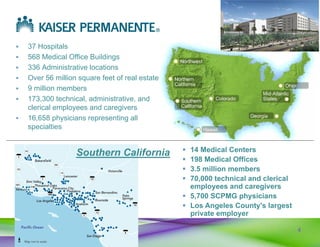
 37 Hospitals
 568 Medical Office Buildings
 336 Administrative locations
 Over 56 million square feet of real estate
 9 million members
 173,300 technical, administrative, and
clerical employees and caregivers
 16,658 physicians representing all
specialties
 14 Medical Centers
 198 Medical Offices
 3.5 million members
 70,000 technical and clerical
employees and caregivers
 5,700 SCPMG physicians
 Los Angeles County's largest
private employer
Southern California
5
Outline
• Introduction
– Waste Issues & their Costs in Healthcare
– Lean Principles
• Kaiser Permanente Story
– Understanding Baseline & Metrics Development
– Value Stream Mapping as a Tool to Ideate, Propose, Communicate,
and Drive Change
• Waste Exercise
• Conclusions
• Questions
6
INTRODUCTION
WASTE & LEAN
7
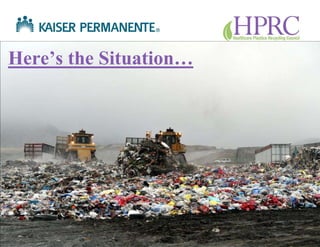
Here’s the Situation…
8
Waste Issues
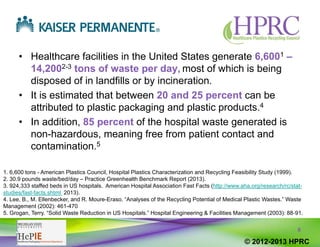
• Healthcare facilities in the United States generate 6,6001 –
14,2002-3 tons of waste per day, most of which is being
disposed of in landfills or by incineration.
• It is estimated that between 20 and 25 percent can be
attributed to plastic packaging and plastic products.4
• In addition, 85 percent of the hospital waste generated is
non-hazardous, meaning free from patient contact and
contamination.5
1. 6,600 tons - American Plastics Council, Hospital Plastics Characterization and Recycling Feasibility Study (1999).
2. 30.9 pounds waste/bed/day – Practice Greenhealth Benchmark Report (2013).
3. 924,333 staffed beds in US hospitals. American Hospital Association Fast Facts (http://www.aha.org/research/rc/stat-
studies/fast-facts.shtml 2013).
4. Lee, B., M. Ellenbecker, and R. Moure-Eraso. “Analyses of the Recycling Potential of Medical Plastic Wastes.” Waste
Management (2002): 461-470
5. Grogan, Terry. “Solid Waste Reduction in US Hospitals.” Hospital Engineering & Facilities Management (2003): 88‐91.
© 2012-2013 HPRC
9
Waste Characterization
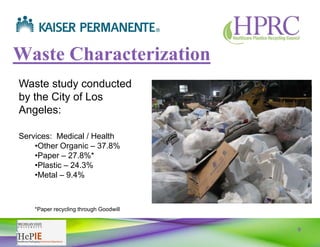
Waste study conducted
by the City of Los
Angeles:
Services: Medical / Health
•Other Organic – 37.8%
•Paper – 27.8%*
•Plastic – 24.3%
•Metal – 9.4%
*Paper recycling through Goodwill
CleanMed 2013_Less Waste using LEAN principles_April 25, 2013 © 2013 Partners Sustainable Initiatives
10
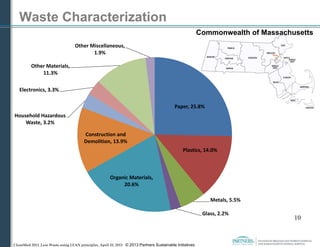
Waste Characterization
Paper, 25.8%
Plastics, 14.0%
Metals, 5.5%
Glass, 2.2%
Organic Materials, 
20.6%
Construction and 
Demolition, 13.9%
Household Hazardous 
Waste, 3.2%
Electronics, 3.3%
Other Materials, 
11.3%
Other Miscellaneous, 
1.9%
Commonwealth of Massachusetts
11
Cost of Waste
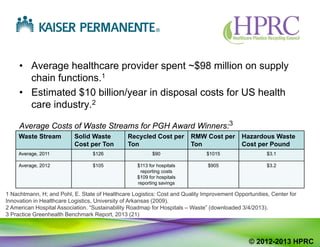
• Average healthcare provider spent ~$98 million on supply
chain functions.1
• Estimated $10 billion/year in disposal costs for US health
care industry.2
Average Costs of Waste Streams for PGH Award Winners:3
1 Nachtmann, H; and Pohl, E. State of Healthcare Logistics: Cost and Quality Improvement Opportunities, Center for
Innovation in Healthcare Logistics, University of Arkansas (2009).
2 American Hospital Association. “Sustainability Roadmap for Hospitals – Waste” (downloaded 3/4/2013).
3 Practice Greenhealth Benchmark Report, 2013 (21)
Waste Stream Solid Waste
Cost per Ton
Recycled Cost per
Ton
RMW Cost per
Ton
Hazardous Waste
Cost per Pound
Average, 2011 $126 $90 $1015 $3.1
Average, 2012 $105 $113 for hospitals
reporting costs
$109 for hospitals
reporting savings
$905 $3.2
© 2012-2013 HPRC
CleanMed 2013_Less Waste using LEAN principles_April 25, 2013 © 2013 Partners Sustainable Initiatives
12
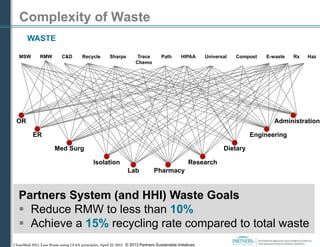
Complexity of Waste
OR
ER
Med Surg
Isolation
PharmacyLab
Research
Engineering
Administration
Dietary
MSW RMW C&D Recycle Sharps Trace
Chemo
Path HIPAA Universal Compost E-waste Rx Haz
WASTE
Partners System (and HHI) Waste Goals
 Reduce RMW to less than 10%
 Achieve a 15% recycling rate compared to total waste
13
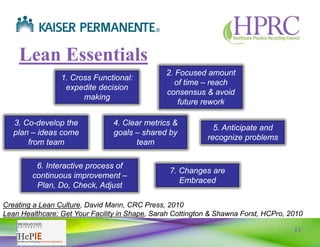
Lean Essentials
Creating a Lean Culture, David Mann, CRC Press, 2010
Lean Healthcare: Get Your Facility in Shape, Sarah Cottington & Shawna Forst, HCPro, 2010
1. Cross Functional:
expedite decision
making
2. Focused amount
of time – reach
consensus & avoid
future rework
3. Co-develop the
plan – ideas come
from team
4. Clear metrics &
goals – shared by
team
5. Anticipate and
recognize problems
6. Interactive process of
continuous improvement –
Plan, Do, Check, Adjust
7. Changes are
Embraced
14
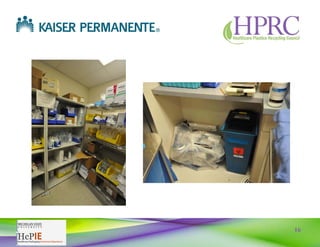
15
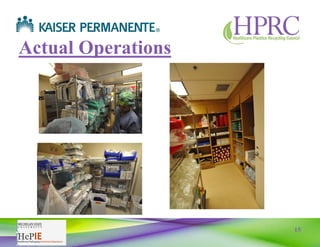
Actual Operations
16
17
18
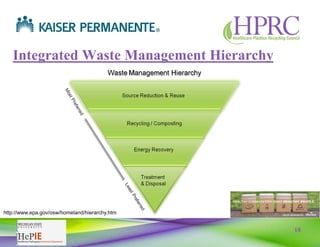
Integrated Waste Management Hierarchy
http://www.epa.gov/osw/homeland/hierarchy.htm
19
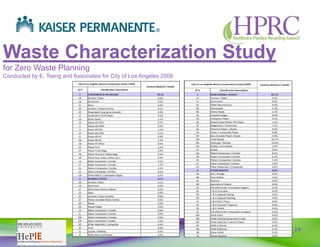
Waste Characterization Study
for Zero Waste Planning
Conducted by E. Tseng and Associates for City of Los Angeles 2009
20
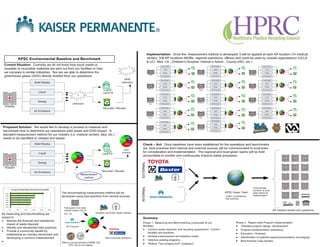
Three-Year Project
• Contractor establishes initial “Reference Baseline”
– Develop basic correlative environmental metrics
– Conduct on-site “Functional Assessments”
– Develop a tracking/monitoring database
• KP/Contractor conducts joint assessment of progress and update
metrics (training)
• KP conducts assessment / metrics under supervision of
contractor
21
Goals / Objectives of Solid Waste Baseline Study
1. Compliance with the Kaiser Permanente National Waste Minimization (NWM) policy of make a significant effort
to reduce the amount of waste that is generated by implementing waste reduction and recycling programs.
2. Promote the overall Kaiser Permanente environmental sustainability strategy which also promotes individual and
community health, environmental stewardship, cost savings and legal compliance by reducing the amount of waste
generated in Kaiser Permanente buildings and establishing waste minimization as part of it operational thinking.
3. Create a standardized comparative quantitative basis with legally and technically defensible environmental
metrics which can be used to be compare against other medical centers, cites, and other organizations/entities.
4. Create an institutionalized Kaiser Permanente infrastructure with trained personnel which can quantitatively
monitor, evaluate, track the progress of the implemented waste reduction and recycling programs and the disposal at
each medical center with legally and technically defensible environmental metrics.
5. Create an award-winning Kaiser Permanente solid waste reduction and recycling program which will be a UCLA
“Best Management Practices” (BMP) reference teaching model at and peer match model for the medical services
industry.
22
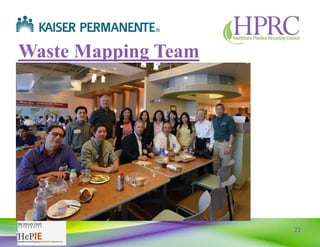
Waste Mapping Team
23
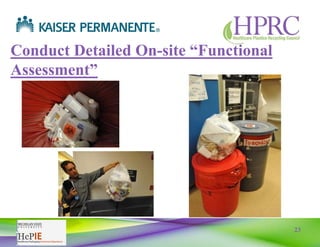
Conduct Detailed On-site “Functional
Assessment”
24
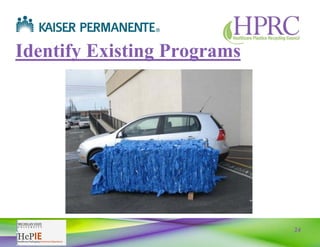
Identify Existing Programs
25
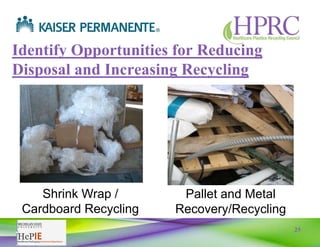
Identify Opportunities for Reducing
Disposal and Increasing Recycling
Shrink Wrap /
Cardboard Recycling
Pallet and Metal
Recovery/Recycling
26
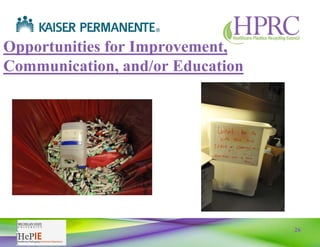
Opportunities for Improvement,
Communication, and/or Education
27
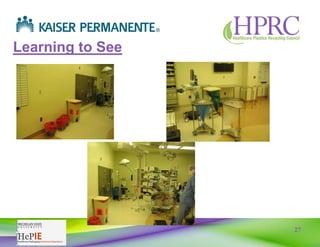
Learning to See
28
Joining efforts at the
Los Angeles Medical Center
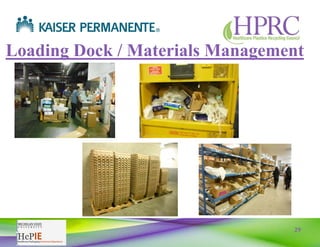
29
Loading Dock / Materials Management
30
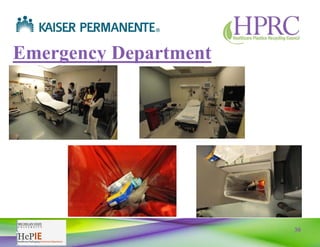
Emergency Department
31
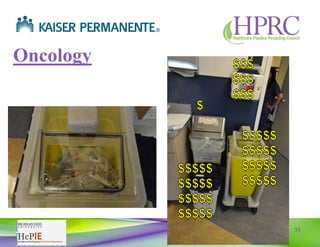
Oncology
32
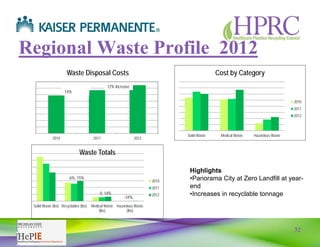
Regional Waste Profile 2012
Highlights
•Panorama City at Zero Landfill at year-
end
•Increases in recyclable tonnage
Solid Waste Medical Waste Hazardous Waste
Cost by Category
2010
2011
2012
2010 2011 2012
Waste Disposal Costs
14%
12% Increase
Solid Waste (lbs) Recyclables (lbs) Medical Waste
(lbs)
Hazardous Waste
(lbs)
Waste Totals
2010
2011
2012
-6%, 15%
0, 14%
-34%,
33
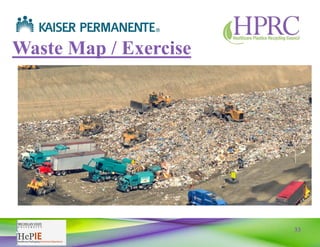
Waste Map / Exercise
34
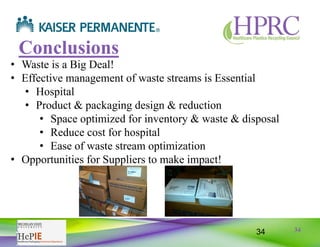
Conclusions
34
• Waste is a Big Deal!
• Effective management of waste streams is Essential
• Hospital
• Product & packaging design & reduction
• Space optimized for inventory & waste & disposal
• Reduce cost for hospital
• Ease of waste stream optimization
• Opportunities for Suppliers to make impact!
35
Questions?
36
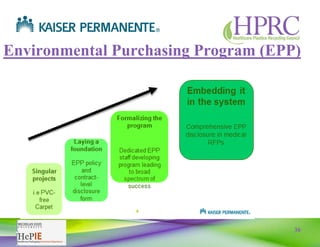
Environmental Purchasing Program (EPP)
37
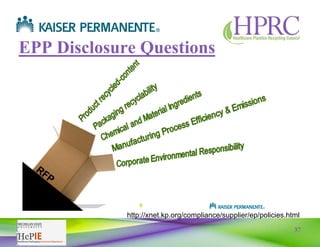
EPP Disclosure Questions
http://xnet.kp.org/compliance/supplier/ep/policies.html
38
39
Additional Questions?
• Contact Information:
–Millie Calistri-Yeh,
millie_calistriyeh@bd.com
–Tim Eng, timothy.c.eng@kp.org

Waste Mapping: Lean Techniques Applied in a Healthcare Setting

  • 1.
    1 Waste Mapping Lean TechniquesApplied in Healthcare October 3, 2013
  • 2.
    2 Speakers • Millie Calistri-Yeh,PhD – Senior Staff Engineer, Becton Dickinson – Leader, Technical Working Group, Healthcare Plastics Recycling Council • Timothy Eng, PE, CIE – Project Manager, Kaiser Permanente
  • 3.
    3 What is HPRC? HPRCis a private, technical coalition of industry peers across healthcare, recycling and waste management industries seeking to improve recyclability of plastic products within healthcare. HPRC Members Mission To inspire and enable the healthcare community to implement sustainable, cost- effective recycling solutions for plastic products and materials used in the delivery of healthcare. Value Chain Approach HPRC is unique in its focus on identification of plastics recycling barriers and solution development along the entire value chain. HPRC is seeking to affect plastics recycling from healthcare product design and manufacturing through product use, disposal and recycle. © 2013 HPRC
  • 4.
    4  37 Hospitals 568 Medical Office Buildings  336 Administrative locations  Over 56 million square feet of real estate  9 million members  173,300 technical, administrative, and clerical employees and caregivers  16,658 physicians representing all specialties  14 Medical Centers  198 Medical Offices  3.5 million members  70,000 technical and clerical employees and caregivers  5,700 SCPMG physicians  Los Angeles County's largest private employer Southern California
  • 5.
    5 Outline • Introduction – WasteIssues & their Costs in Healthcare – Lean Principles • Kaiser Permanente Story – Understanding Baseline & Metrics Development – Value Stream Mapping as a Tool to Ideate, Propose, Communicate, and Drive Change • Waste Exercise • Conclusions • Questions
  • 6.
  • 7.
  • 8.
    8 Waste Issues • Healthcarefacilities in the United States generate 6,6001 – 14,2002-3 tons of waste per day, most of which is being disposed of in landfills or by incineration. • It is estimated that between 20 and 25 percent can be attributed to plastic packaging and plastic products.4 • In addition, 85 percent of the hospital waste generated is non-hazardous, meaning free from patient contact and contamination.5 1. 6,600 tons - American Plastics Council, Hospital Plastics Characterization and Recycling Feasibility Study (1999). 2. 30.9 pounds waste/bed/day – Practice Greenhealth Benchmark Report (2013). 3. 924,333 staffed beds in US hospitals. American Hospital Association Fast Facts (http://www.aha.org/research/rc/stat- studies/fast-facts.shtml 2013). 4. Lee, B., M. Ellenbecker, and R. Moure-Eraso. “Analyses of the Recycling Potential of Medical Plastic Wastes.” Waste Management (2002): 461-470 5. Grogan, Terry. “Solid Waste Reduction in US Hospitals.” Hospital Engineering & Facilities Management (2003): 88‐91. © 2012-2013 HPRC
  • 9.
    9 Waste Characterization Waste studyconducted by the City of Los Angeles: Services: Medical / Health •Other Organic – 37.8% •Paper – 27.8%* •Plastic – 24.3% •Metal – 9.4% *Paper recycling through Goodwill
  • 10.
    CleanMed 2013_Less Waste using LEAN principles_April 25, 2013© 2013 Partners Sustainable Initiatives 10 Waste Characterization Paper, 25.8% Plastics, 14.0% Metals, 5.5% Glass, 2.2% Organic Materials,  20.6% Construction and  Demolition, 13.9% Household Hazardous  Waste, 3.2% Electronics, 3.3% Other Materials,  11.3% Other Miscellaneous,  1.9% Commonwealth of Massachusetts
  • 11.
    11 Cost of Waste •Average healthcare provider spent ~$98 million on supply chain functions.1 • Estimated $10 billion/year in disposal costs for US health care industry.2 Average Costs of Waste Streams for PGH Award Winners:3 1 Nachtmann, H; and Pohl, E. State of Healthcare Logistics: Cost and Quality Improvement Opportunities, Center for Innovation in Healthcare Logistics, University of Arkansas (2009). 2 American Hospital Association. “Sustainability Roadmap for Hospitals – Waste” (downloaded 3/4/2013). 3 Practice Greenhealth Benchmark Report, 2013 (21) Waste Stream Solid Waste Cost per Ton Recycled Cost per Ton RMW Cost per Ton Hazardous Waste Cost per Pound Average, 2011 $126 $90 $1015 $3.1 Average, 2012 $105 $113 for hospitals reporting costs $109 for hospitals reporting savings $905 $3.2 © 2012-2013 HPRC
  • 12.
    CleanMed 2013_Less Waste using LEAN principles_April 25, 2013© 2013 Partners Sustainable Initiatives 12 Complexity of Waste OR ER Med Surg Isolation PharmacyLab Research Engineering Administration Dietary MSW RMW C&D Recycle Sharps Trace Chemo Path HIPAA Universal Compost E-waste Rx Haz WASTE Partners System (and HHI) Waste Goals  Reduce RMW to less than 10%  Achieve a 15% recycling rate compared to total waste
  • 13.
    13 Lean Essentials Creating aLean Culture, David Mann, CRC Press, 2010 Lean Healthcare: Get Your Facility in Shape, Sarah Cottington & Shawna Forst, HCPro, 2010 1. Cross Functional: expedite decision making 2. Focused amount of time – reach consensus & avoid future rework 3. Co-develop the plan – ideas come from team 4. Clear metrics & goals – shared by team 5. Anticipate and recognize problems 6. Interactive process of continuous improvement – Plan, Do, Check, Adjust 7. Changes are Embraced
  • 14.
  • 15.
  • 16.
  • 17.
  • 18.
    18 Integrated Waste ManagementHierarchy http://www.epa.gov/osw/homeland/hierarchy.htm
  • 19.
    19 Waste Characterization Study forZero Waste Planning Conducted by E. Tseng and Associates for City of Los Angeles 2009
  • 20.
    20 Three-Year Project • Contractorestablishes initial “Reference Baseline” – Develop basic correlative environmental metrics – Conduct on-site “Functional Assessments” – Develop a tracking/monitoring database • KP/Contractor conducts joint assessment of progress and update metrics (training) • KP conducts assessment / metrics under supervision of contractor
  • 21.
    21 Goals / Objectivesof Solid Waste Baseline Study 1. Compliance with the Kaiser Permanente National Waste Minimization (NWM) policy of make a significant effort to reduce the amount of waste that is generated by implementing waste reduction and recycling programs. 2. Promote the overall Kaiser Permanente environmental sustainability strategy which also promotes individual and community health, environmental stewardship, cost savings and legal compliance by reducing the amount of waste generated in Kaiser Permanente buildings and establishing waste minimization as part of it operational thinking. 3. Create a standardized comparative quantitative basis with legally and technically defensible environmental metrics which can be used to be compare against other medical centers, cites, and other organizations/entities. 4. Create an institutionalized Kaiser Permanente infrastructure with trained personnel which can quantitatively monitor, evaluate, track the progress of the implemented waste reduction and recycling programs and the disposal at each medical center with legally and technically defensible environmental metrics. 5. Create an award-winning Kaiser Permanente solid waste reduction and recycling program which will be a UCLA “Best Management Practices” (BMP) reference teaching model at and peer match model for the medical services industry.
  • 22.
  • 23.
    23 Conduct Detailed On-site“Functional Assessment”
  • 24.
  • 25.
    25 Identify Opportunities forReducing Disposal and Increasing Recycling Shrink Wrap / Cardboard Recycling Pallet and Metal Recovery/Recycling
  • 26.
  • 27.
  • 28.
    28 Joining efforts atthe Los Angeles Medical Center
  • 29.
    29 Loading Dock /Materials Management
  • 30.
  • 31.
  • 32.
    32 Regional Waste Profile2012 Highlights •Panorama City at Zero Landfill at year- end •Increases in recyclable tonnage Solid Waste Medical Waste Hazardous Waste Cost by Category 2010 2011 2012 2010 2011 2012 Waste Disposal Costs 14% 12% Increase Solid Waste (lbs) Recyclables (lbs) Medical Waste (lbs) Hazardous Waste (lbs) Waste Totals 2010 2011 2012 -6%, 15% 0, 14% -34%,
  • 33.
  • 34.
    34 Conclusions 34 • Waste isa Big Deal! • Effective management of waste streams is Essential • Hospital • Product & packaging design & reduction • Space optimized for inventory & waste & disposal • Reduce cost for hospital • Ease of waste stream optimization • Opportunities for Suppliers to make impact!
  • 35.
  • 36.
  • 37.
  • 38.
  • 39.
    39 Additional Questions? • ContactInformation: –Millie Calistri-Yeh, millie_calistriyeh@bd.com –Tim Eng, timothy.c.eng@kp.org