A PRESENTATION ON
LOW CARBON SUPPLY CHAIN MANAGEMENT
PRESENTED BY - SUBMITTED TO
ITNESH KUMAR 1403340095 Mr . ALOK MANAS DUBEY
DEVANSH SINGH 1403340067 Under the Guidance
ANURAG SINGH 1403340045 of MR.VIVEK GUPTA
DIPENDRA KUMAR VERMA 1403340073
Department of mechanical engineering
RAJ KUMAR GOEL INSTITUTE OF TECHNOLOGY, GHAZIABAD
DR. A.P.J.ABDUL KALAM TECHNICAL UNIVERSITY, LUCKNOW
( 2017-2018 )
CONTENTS
• Why the project is chosen
• Describe the structure of supply chains
• What is Green Supply Chain Management?
• Low Carbon Supply Chain Management Principles
• Low Carbon Chain Management Best Practices
• Implementing Best Practices
• Methodology
• Summary
• References
WHY THE PROJECT IS CHOSEN
1. Project is chosen as the project as it is the requirement of the industry to have
sustainability in the development and production.
2. It is the requirement of the hour to save the environment and also be able have
efficient production this producing more with less input.
3. Also government is trying to promote sustainable development in the industry
thus it is becoming the field with scope in the present scenario.
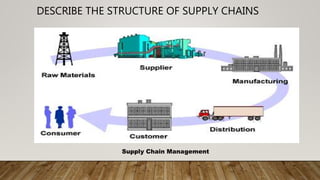
DESCRIBE THE STRUCTURE OF SUPPLY CHAINS
Supply Chain Management
WHAT IS GREEN SUPPLY CHAIN MANAGEMENT?
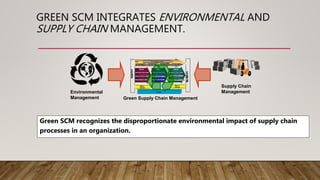
GREEN SCM INTEGRATES ENVIRONMENTAL AND
SUPPLY CHAIN MANAGEMENT.
Green SCM recognizes the disproportionate environmental impact of supply chain
processes in an organization.
Green Supply Chain Management
Environmental
Management
Supply Chain
Management
COMMERCIAL FIRMS HAVE HAD EARLY SUCCESS
USING GREEN SCM PRINCIPLES.
Texas Instruments: Saves $8 million
each year by reducing its transit
packaging budget for its
semiconductor business through
source reduction, recycling, and use of
reusable packaging systems (20%
annual savings).
Pepsi-Cola: Saved $44 million by
switching from corrugated to reusable
plastic shipping containers for one liter
and 20-ounce bottles, conserving 196
million pounds of corrugated material.
Samsung Electronics achieved a 40 %
reduction in CO2 emissions in 2011
compared to the 2008 baseline by
developing a greenhouse gas
emissions management system, which
monitors both direct and indirect
emissions associated with all the
relevant supply chain activities
(Samsung, 2012).
Toyota Motor Europe launched in 2011
its fifth five-year Environmental Action
Plan, one of which main objectives was
to establish a ‘low-carbon society’, which
entailed enhancing hybrid technology
for cars in the design phase, reducing
energy utilization and emissions in the
production stage, as well as optimizing
route planning to limit emissions in
logistics (Toyota, 2012).
GREEN SUPPLY CHAIN IMPROVES OPERATIONS BY
EMPLOYING AN ENVIRONMENTAL SOLUTION.
• Improves Agility—Green supply chain management help mitigate risks and speed
innovations.
• Increases Adaptability—Green supply chain analysis often lead to innovative
processes and continuous improvements.
• Promotes Alignment—Green supply chain management involves negotiating
policies with suppliers and customers, which results in better alignment of
business processes and principles.
LOW CARBON SUPPLY CHAIN MANAGEMENT
PRINCIPLES
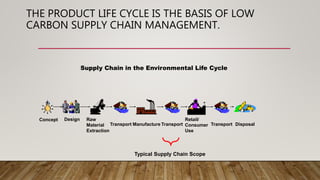
THE PRODUCT LIFE CYCLE IS THE BASIS OF LOW
CARBON SUPPLY CHAIN MANAGEMENT.
Supply Chain in the Environmental Life Cycle
Raw
Material
Extraction
Transport Manufacture Transport
Retail/
Consumer
Use
Transport Disposal
DesignConcept
Typical Supply Chain Scope
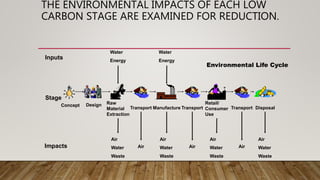
THE ENVIRONMENTAL IMPACTS OF EACH LOW
CARBON STAGE ARE EXAMINED FOR REDUCTION.
Environmental Life Cycle
Raw
Material
Extraction
Transport Manufacture Transport
Retail/
Consumer
Use
Transport Disposal
Air
Water
Waste
Air
Air
Water
Waste
Air
Air
Water
Waste
Air
Air
Water
Waste
Stage
Impacts
Water
Energy
Inputs
Water
Energy
DesignConcept
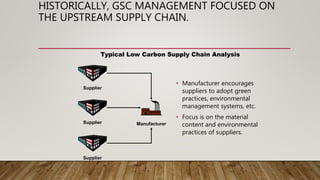
HISTORICALLY, GSC MANAGEMENT FOCUSED ON
THE UPSTREAM SUPPLY CHAIN.
• Manufacturer encourages
suppliers to adopt green
practices, environmental
management systems, etc.
• Focus is on the material
content and environmental
practices of suppliers.
Typical Low Carbon Supply Chain Analysis
Manufacturer
Supplier
Supplier
Supplier
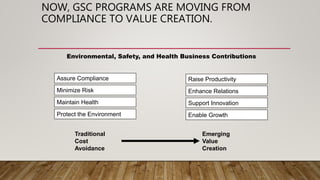
NOW, GSC PROGRAMS ARE MOVING FROM
COMPLIANCE TO VALUE CREATION.
Traditional
Cost
Avoidance
Emerging
Value
Creation
Environmental, Safety, and Health Business Contributions
Protect the Environment
Maintain Health
Minimize Risk
Assure Compliance
Enable Growth
Support Innovation
Enhance Relations
Raise Productivity
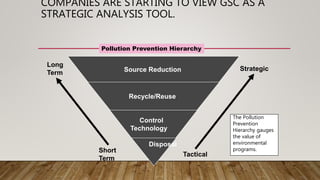
COMPANIES ARE STARTING TO VIEW GSC AS A
STRATEGIC ANALYSIS TOOL.
Source Reduction
Recycle/Reuse
Control
Technology
Disposal
Pollution Prevention Hierarchy
Strategic
Tactical
Long
Term
Short
Term
The Pollution
Prevention
Hierarchy gauges
the value of
environmental
programs.
LOW CARBON SUPPLY CHAIN MANAGEMENT BEST
PRACTICES
LOW CARBON SUPPLY CHAIN BEST PRACTICES
FOCUS ON THE BUSINESS RESULTS FIRST.
• Align green supply chain goals with
business goals
• Evaluate the supply chain as a single
life cycle system
• Use green supply chain analysis as a
catalyst for innovation
• Focus on source reduction to reduce
waste
Low Carbon Supply Chain Best Practices
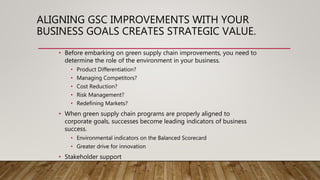
ALIGNING GSC IMPROVEMENTS WITH YOUR
BUSINESS GOALS CREATES STRATEGIC VALUE.
• Before embarking on green supply chain improvements, you need to
determine the role of the environment in your business.
• Product Differentiation?
• Managing Competitors?
• Cost Reduction?
• Risk Management?
• Redefining Markets?
• When green supply chain programs are properly aligned to
corporate goals, successes become leading indicators of business
success.
• Environmental indicators on the Balanced Scorecard
• Greater drive for innovation
• Stakeholder support
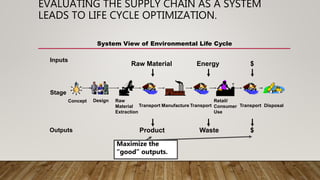
EVALUATING THE SUPPLY CHAIN AS A SYSTEM
LEADS TO LIFE CYCLE OPTIMIZATION.
System View of Environmental Life Cycle
Raw
Material
Extraction
Transport Manufacture Transport
Retail/
Consumer
Use
Transport Disposal
Product $Waste
Stage
Outputs
Raw Material
Inputs
Energy
DesignConcept
$
Maximize the
“good” outputs.
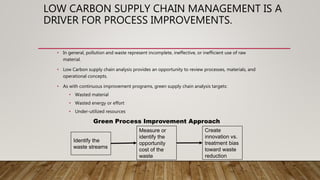
LOW CARBON SUPPLY CHAIN MANAGEMENT IS A
DRIVER FOR PROCESS IMPROVEMENTS.
• In general, pollution and waste represent incomplete, ineffective, or inefficient use of raw
material.
• Low Carbon supply chain analysis provides an opportunity to review processes, materials, and
operational concepts.
• As with continuous improvement programs, green supply chain analysis targets:
• Wasted material
• Wasted energy or effort
• Under-utilized resources
Identify the
waste streams
Measure or
identify the
opportunity
cost of the
waste
Create
innovation vs.
treatment bias
toward waste
reduction
Green Process Improvement Approach
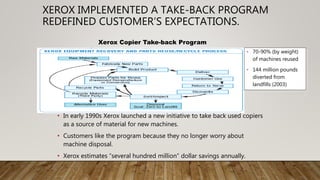
XEROX IMPLEMENTED A TAKE-BACK PROGRAM
REDEFINED CUSTOMER’S EXPECTATIONS.
• In early 1990s Xerox launched a new initiative to take back used copiers
as a source of material for new machines.
• Customers like the program because they no longer worry about
machine disposal.
• Xerox estimates “several hundred million” dollar savings annually.
Xerox Copier Take-back Program
• 70-90% (by weight)
of machines reused
• 144 million pounds
diverted from
landfills (2003)
IMPLEMENTING BEST PRACTICES
MAIN BARRIERS TO LOW CARBON SUPPLY CHAIN
WORKING
• Cost factors
• Shortage of capital
• Competing priorities
• Short-termism
• Convincing decision makers
• Supply chain isolation/distance from customer
• Company size and organisational capacity
• Lack of awareness, uncertainty and risk
LOW CARBON SUPPLY CHAIN EFFORTS NEED TO
RISE ABOVE THE COST CENTER VIEW.
• LC supply chain projects need to be clearly defined in terms of the
business value to the organization.
• Clear value will gain senior management support.
• Clear value will help secure buy-in from other organizations
• Environmental programs are viewed as business cost centers.
• Environmental, safety, and health (ESH) resources are often scarce in an
organization.
• ESH offices are targeted early during cost cutting programs.
• ESH offices have difficulty articulating their business value.
• Many executives have misconceptions of how green supply chain efforts
will impact their operations.
• Without a clear business value proposition, it is difficult to get executive
support for projects.
CONSIDER THE EXISTING BUSINESS MODEL
WHEN PLANNING GSC PROJECTS.
• Many businesses have internal hurdles that must be overcome for
any improvement effort.
• Inconsistency in supply chain operations (by unit, region, product, etc.)
• Business viewed through existing operations—resistance to change
• Focus on short term goals and short term results
• Limited partnership experience—especially in the environmental office.
• To be successful, the project manager needs to understand the
organization and plan for the applicable hurdles.
• Develop communication plan.
• Build a project team with broad functional representation.
• Clearly articulate project business value.
• Use outside experts where in-house expertise doesn’t exist.
SECTOR OF OPPORTUNITIES
1. Environmental and Clean Technologies (ECT):- Sustainable Transport, Building Technologies,
Recovery and Recycling, Water and Waste Water Treatment, Environmental Monitoring and
Instrumentation. Reprocessing of valuable resources as we move towards a zero waste society.
2. Food and Drink:- Waste management & re-use ( eg anaerobic digestion); sourcing for environmental
benefit; reducing carbon in supply chains and logistics; promotion, branding and labelling ; generating
heat/electricity from distillery and manufacturing co-products, creating and matching consumer
expectations for green products, reduced cost, increased competitiveness, marketing advantages.
3. Tourism:- ‘Green’ tourism products and services, tourism promotion.
4. Aerospace:- Lighter and more fuel-efficient aircraft materials/technologies.
5. Forest Industries:- Wood fuel and biomass for renewable heat and power; locally-sourced timber for
construction; carbon sequestration.
6. Life sciences:- Sustainable health, telehealth and clean technologies.
7. Agriculture:- Grow wider range of crops, ability to produce new plant/ animal based products leading
to greater income generation.
METHODOLGY
1.First we will join the company under project to get ourselves data that we need.
2. We will see and study the production methods of the company and check their efficiency.
3. Now we will see the pollution (I. e co2 gas) that being produced by the company and
various step that they to reduce it.
4. We will study their supply chain and understand the technique that they improve in their
supply chain management.
5. We will find the problem or discrepancies in the SCM and suggest way to improve them
and they provide ideal Low Carbon Supply Chain Management.
6. In this way we will be able to better understand SCM and various process, techniques
under it and its effect decreasing the pollution and cost efficiency.
7. All the reading will be presented in the tabulated form and thus easy to relate and
differentiate.
SUMMARY
IMPLEMENTING GREEN SUPPLY CHAIN PROPERLY
WILL DRIVE REAL BUSINESS VALUE.
• Green supply chain concepts manage environmental impacts where they occur—ideally before
they occur.
• Best practices focus on the business, not social, value that green supply chain management
creates.
• Align green supply chain goals with business goals
• Evaluate the supply chain as a single life cycle system
• Use environmental analysis as a catalyst for innovation
• Focus on source reduction to reduce waste
• Successful implementation requires raising the profile and perceived value of environmental
projects.
• Articulate project value in terms of business value
• Create the project to work within the organizational culture
REFFERENCES
• Forging New Links, GEMI, 2004
• The Triple-A Supply Chain, Lee, Harvard Business Review,
October 2004
Environmental Supply Chain Management, Carter and
Narasimhan, CAPS Research, 1998
• Source: Forging New Links, GEMI, 2004
• U.S. Environmental Protection Agency
• Bringing the Environment Down to Earth, Reinhardt,
HBR, July-August 1999
Environmental Supply Chain Management, Carter and
Narasimhan, CAPS Research, 1998
• Green and Competitive, Proter and van der Linfde, HBR,
Sept.-Oct. 1995
• Environmental Supply Chain Management, Carter and
Narasimhan, CAPS Research, 1998
• Economics of Hybrid Electric Technology: Military
Vehicles, 2002, LMI
Resource Costs of Supplying Power to a Battlefield, 2004,
LMI Research Institute
• Greening the Mail, 1999, LMI
• Green and Competitive, Porter and van der Linde, HBR,
Sept.-Oct. 1995
• Bringing the Environment Down to Earth, Reinhardt,
HBR, July-August 1999
Environment, Health, and Safety Progress Report: 2004,
Xerox Corporation
• Green Supply Chain Management in India - An Overview
Prashant Raman Associate Professor, Marketing,
Banasthali University, India
THE OPPORTUNITY TO MAKE A
DIFFERENCE HAS NEVER BEEN
GREATER
LET’S BE THE FIRST ONES
THANK YOU

Itnesh -Low carbon supply chain management

  • 1.
    A PRESENTATION ON LOWCARBON SUPPLY CHAIN MANAGEMENT PRESENTED BY - SUBMITTED TO ITNESH KUMAR 1403340095 Mr . ALOK MANAS DUBEY DEVANSH SINGH 1403340067 Under the Guidance ANURAG SINGH 1403340045 of MR.VIVEK GUPTA DIPENDRA KUMAR VERMA 1403340073 Department of mechanical engineering RAJ KUMAR GOEL INSTITUTE OF TECHNOLOGY, GHAZIABAD DR. A.P.J.ABDUL KALAM TECHNICAL UNIVERSITY, LUCKNOW ( 2017-2018 )
  • 2.
    CONTENTS • Why theproject is chosen • Describe the structure of supply chains • What is Green Supply Chain Management? • Low Carbon Supply Chain Management Principles • Low Carbon Chain Management Best Practices • Implementing Best Practices • Methodology • Summary • References
  • 3.
    WHY THE PROJECTIS CHOSEN 1. Project is chosen as the project as it is the requirement of the industry to have sustainability in the development and production. 2. It is the requirement of the hour to save the environment and also be able have efficient production this producing more with less input. 3. Also government is trying to promote sustainable development in the industry thus it is becoming the field with scope in the present scenario.
  • 4.
    DESCRIBE THE STRUCTUREOF SUPPLY CHAINS Supply Chain Management
  • 5.
    WHAT IS GREENSUPPLY CHAIN MANAGEMENT?
  • 6.
    GREEN SCM INTEGRATESENVIRONMENTAL AND SUPPLY CHAIN MANAGEMENT. Green SCM recognizes the disproportionate environmental impact of supply chain processes in an organization. Green Supply Chain Management Environmental Management Supply Chain Management
  • 7.
    COMMERCIAL FIRMS HAVEHAD EARLY SUCCESS USING GREEN SCM PRINCIPLES. Texas Instruments: Saves $8 million each year by reducing its transit packaging budget for its semiconductor business through source reduction, recycling, and use of reusable packaging systems (20% annual savings). Pepsi-Cola: Saved $44 million by switching from corrugated to reusable plastic shipping containers for one liter and 20-ounce bottles, conserving 196 million pounds of corrugated material. Samsung Electronics achieved a 40 % reduction in CO2 emissions in 2011 compared to the 2008 baseline by developing a greenhouse gas emissions management system, which monitors both direct and indirect emissions associated with all the relevant supply chain activities (Samsung, 2012). Toyota Motor Europe launched in 2011 its fifth five-year Environmental Action Plan, one of which main objectives was to establish a ‘low-carbon society’, which entailed enhancing hybrid technology for cars in the design phase, reducing energy utilization and emissions in the production stage, as well as optimizing route planning to limit emissions in logistics (Toyota, 2012).
  • 8.
    GREEN SUPPLY CHAINIMPROVES OPERATIONS BY EMPLOYING AN ENVIRONMENTAL SOLUTION. • Improves Agility—Green supply chain management help mitigate risks and speed innovations. • Increases Adaptability—Green supply chain analysis often lead to innovative processes and continuous improvements. • Promotes Alignment—Green supply chain management involves negotiating policies with suppliers and customers, which results in better alignment of business processes and principles.
  • 9.
    LOW CARBON SUPPLYCHAIN MANAGEMENT PRINCIPLES
  • 10.
    THE PRODUCT LIFECYCLE IS THE BASIS OF LOW CARBON SUPPLY CHAIN MANAGEMENT. Supply Chain in the Environmental Life Cycle Raw Material Extraction Transport Manufacture Transport Retail/ Consumer Use Transport Disposal DesignConcept Typical Supply Chain Scope
  • 11.
    THE ENVIRONMENTAL IMPACTSOF EACH LOW CARBON STAGE ARE EXAMINED FOR REDUCTION. Environmental Life Cycle Raw Material Extraction Transport Manufacture Transport Retail/ Consumer Use Transport Disposal Air Water Waste Air Air Water Waste Air Air Water Waste Air Air Water Waste Stage Impacts Water Energy Inputs Water Energy DesignConcept
  • 12.
    HISTORICALLY, GSC MANAGEMENTFOCUSED ON THE UPSTREAM SUPPLY CHAIN. • Manufacturer encourages suppliers to adopt green practices, environmental management systems, etc. • Focus is on the material content and environmental practices of suppliers. Typical Low Carbon Supply Chain Analysis Manufacturer Supplier Supplier Supplier
  • 13.
    NOW, GSC PROGRAMSARE MOVING FROM COMPLIANCE TO VALUE CREATION. Traditional Cost Avoidance Emerging Value Creation Environmental, Safety, and Health Business Contributions Protect the Environment Maintain Health Minimize Risk Assure Compliance Enable Growth Support Innovation Enhance Relations Raise Productivity
  • 14.
    COMPANIES ARE STARTINGTO VIEW GSC AS A STRATEGIC ANALYSIS TOOL. Source Reduction Recycle/Reuse Control Technology Disposal Pollution Prevention Hierarchy Strategic Tactical Long Term Short Term The Pollution Prevention Hierarchy gauges the value of environmental programs.
  • 15.
    LOW CARBON SUPPLYCHAIN MANAGEMENT BEST PRACTICES
  • 16.
    LOW CARBON SUPPLYCHAIN BEST PRACTICES FOCUS ON THE BUSINESS RESULTS FIRST. • Align green supply chain goals with business goals • Evaluate the supply chain as a single life cycle system • Use green supply chain analysis as a catalyst for innovation • Focus on source reduction to reduce waste Low Carbon Supply Chain Best Practices
  • 17.
    ALIGNING GSC IMPROVEMENTSWITH YOUR BUSINESS GOALS CREATES STRATEGIC VALUE. • Before embarking on green supply chain improvements, you need to determine the role of the environment in your business. • Product Differentiation? • Managing Competitors? • Cost Reduction? • Risk Management? • Redefining Markets? • When green supply chain programs are properly aligned to corporate goals, successes become leading indicators of business success. • Environmental indicators on the Balanced Scorecard • Greater drive for innovation • Stakeholder support
  • 18.
    EVALUATING THE SUPPLYCHAIN AS A SYSTEM LEADS TO LIFE CYCLE OPTIMIZATION. System View of Environmental Life Cycle Raw Material Extraction Transport Manufacture Transport Retail/ Consumer Use Transport Disposal Product $Waste Stage Outputs Raw Material Inputs Energy DesignConcept $ Maximize the “good” outputs.
  • 19.
    LOW CARBON SUPPLYCHAIN MANAGEMENT IS A DRIVER FOR PROCESS IMPROVEMENTS. • In general, pollution and waste represent incomplete, ineffective, or inefficient use of raw material. • Low Carbon supply chain analysis provides an opportunity to review processes, materials, and operational concepts. • As with continuous improvement programs, green supply chain analysis targets: • Wasted material • Wasted energy or effort • Under-utilized resources Identify the waste streams Measure or identify the opportunity cost of the waste Create innovation vs. treatment bias toward waste reduction Green Process Improvement Approach
  • 20.
    XEROX IMPLEMENTED ATAKE-BACK PROGRAM REDEFINED CUSTOMER’S EXPECTATIONS. • In early 1990s Xerox launched a new initiative to take back used copiers as a source of material for new machines. • Customers like the program because they no longer worry about machine disposal. • Xerox estimates “several hundred million” dollar savings annually. Xerox Copier Take-back Program • 70-90% (by weight) of machines reused • 144 million pounds diverted from landfills (2003)
  • 21.
  • 22.
    MAIN BARRIERS TOLOW CARBON SUPPLY CHAIN WORKING • Cost factors • Shortage of capital • Competing priorities • Short-termism • Convincing decision makers • Supply chain isolation/distance from customer • Company size and organisational capacity • Lack of awareness, uncertainty and risk
  • 23.
    LOW CARBON SUPPLYCHAIN EFFORTS NEED TO RISE ABOVE THE COST CENTER VIEW. • LC supply chain projects need to be clearly defined in terms of the business value to the organization. • Clear value will gain senior management support. • Clear value will help secure buy-in from other organizations • Environmental programs are viewed as business cost centers. • Environmental, safety, and health (ESH) resources are often scarce in an organization. • ESH offices are targeted early during cost cutting programs. • ESH offices have difficulty articulating their business value. • Many executives have misconceptions of how green supply chain efforts will impact their operations. • Without a clear business value proposition, it is difficult to get executive support for projects.
  • 24.
    CONSIDER THE EXISTINGBUSINESS MODEL WHEN PLANNING GSC PROJECTS. • Many businesses have internal hurdles that must be overcome for any improvement effort. • Inconsistency in supply chain operations (by unit, region, product, etc.) • Business viewed through existing operations—resistance to change • Focus on short term goals and short term results • Limited partnership experience—especially in the environmental office. • To be successful, the project manager needs to understand the organization and plan for the applicable hurdles. • Develop communication plan. • Build a project team with broad functional representation. • Clearly articulate project business value. • Use outside experts where in-house expertise doesn’t exist.
  • 25.
    SECTOR OF OPPORTUNITIES 1.Environmental and Clean Technologies (ECT):- Sustainable Transport, Building Technologies, Recovery and Recycling, Water and Waste Water Treatment, Environmental Monitoring and Instrumentation. Reprocessing of valuable resources as we move towards a zero waste society. 2. Food and Drink:- Waste management & re-use ( eg anaerobic digestion); sourcing for environmental benefit; reducing carbon in supply chains and logistics; promotion, branding and labelling ; generating heat/electricity from distillery and manufacturing co-products, creating and matching consumer expectations for green products, reduced cost, increased competitiveness, marketing advantages. 3. Tourism:- ‘Green’ tourism products and services, tourism promotion. 4. Aerospace:- Lighter and more fuel-efficient aircraft materials/technologies. 5. Forest Industries:- Wood fuel and biomass for renewable heat and power; locally-sourced timber for construction; carbon sequestration. 6. Life sciences:- Sustainable health, telehealth and clean technologies. 7. Agriculture:- Grow wider range of crops, ability to produce new plant/ animal based products leading to greater income generation.
  • 26.
    METHODOLGY 1.First we willjoin the company under project to get ourselves data that we need. 2. We will see and study the production methods of the company and check their efficiency. 3. Now we will see the pollution (I. e co2 gas) that being produced by the company and various step that they to reduce it. 4. We will study their supply chain and understand the technique that they improve in their supply chain management. 5. We will find the problem or discrepancies in the SCM and suggest way to improve them and they provide ideal Low Carbon Supply Chain Management. 6. In this way we will be able to better understand SCM and various process, techniques under it and its effect decreasing the pollution and cost efficiency. 7. All the reading will be presented in the tabulated form and thus easy to relate and differentiate.
  • 27.
  • 28.
    IMPLEMENTING GREEN SUPPLYCHAIN PROPERLY WILL DRIVE REAL BUSINESS VALUE. • Green supply chain concepts manage environmental impacts where they occur—ideally before they occur. • Best practices focus on the business, not social, value that green supply chain management creates. • Align green supply chain goals with business goals • Evaluate the supply chain as a single life cycle system • Use environmental analysis as a catalyst for innovation • Focus on source reduction to reduce waste • Successful implementation requires raising the profile and perceived value of environmental projects. • Articulate project value in terms of business value • Create the project to work within the organizational culture
  • 29.
    REFFERENCES • Forging NewLinks, GEMI, 2004 • The Triple-A Supply Chain, Lee, Harvard Business Review, October 2004 Environmental Supply Chain Management, Carter and Narasimhan, CAPS Research, 1998 • Source: Forging New Links, GEMI, 2004 • U.S. Environmental Protection Agency • Bringing the Environment Down to Earth, Reinhardt, HBR, July-August 1999 Environmental Supply Chain Management, Carter and Narasimhan, CAPS Research, 1998 • Green and Competitive, Proter and van der Linfde, HBR, Sept.-Oct. 1995 • Environmental Supply Chain Management, Carter and Narasimhan, CAPS Research, 1998 • Economics of Hybrid Electric Technology: Military Vehicles, 2002, LMI Resource Costs of Supplying Power to a Battlefield, 2004, LMI Research Institute • Greening the Mail, 1999, LMI • Green and Competitive, Porter and van der Linde, HBR, Sept.-Oct. 1995 • Bringing the Environment Down to Earth, Reinhardt, HBR, July-August 1999 Environment, Health, and Safety Progress Report: 2004, Xerox Corporation • Green Supply Chain Management in India - An Overview Prashant Raman Associate Professor, Marketing, Banasthali University, India
  • 30.
    THE OPPORTUNITY TOMAKE A DIFFERENCE HAS NEVER BEEN GREATER LET’S BE THE FIRST ONES THANK YOU

Editor's Notes

  • #7  Currently, there is no tool for performing Green Supply Chain analysis in conjunction with standard supply chain analysis.
  • #11 The life cycle approach views the impacts of a product on ES&H from the design phase through the disposal phase. This view leads to a greater understanding of the total impact of operating the system and can lead to design decisions that greatly improve long term performance and cost.
  • #19 The life cycle approach views the impacts of a product on ES&H from the design phase through the disposal phase. This view leads to a greater understanding of the total impact of operating the system and can lead to design decisions that greatly improve long term performance and cost.