ISCF Transforming Foundation
Industries- Fast Start
Applicant briefing
Tuesday 10th December 2019
1 Welcome and introductions
Scope, eligibility criteria
2 Part 1
Transforming Foundation Industries Overview
3 Part 2
Scope, eligibility criteria
4 Part 3
KTN Support
Agenda
• Tatiana Correia – Innovation Lead, Innovate UK
• Robert Quarshie – Head of Materials, KTN
Welcome and Introductions
Transforming Foundation
Industries: An introduction
Tatiana Correia
Innovation lead
We work with the government
to invest over £7 billion a year
in research and innovation by
partnering with academia and
industry to make the impossible,
possible. Through the UK’s nine
leading academic and industrial
funding councils, we create
knowledge with impact.
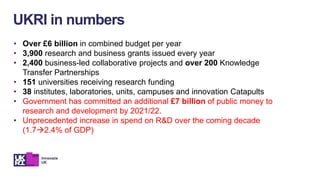
• Over £6 billion in combined budget per year
• 3,900 research and business grants issued every year
• 2,400 business-led collaborative projects and over 200 Knowledge
Transfer Partnerships
• 151 universities receiving research funding
• 38 institutes, laboratories, units, campuses and innovation Catapults
• Government has committed an additional £7 billion of public money to
research and development by 2021/22.
• Unprecedented increase in spend on R&D over the coming decade
(1.72.4% of GDP)
UKRI in numbers
Thefoundation
industries
Include ceramic, glass, cement, metals,
paper, and chemicals.
Worth £45bn to the UK and employ
500,000 people, mostly outside the
south east in areas of deprivation.
Challenges:
• by far the largest industrial
polluter, generating 10% of all
UK’s CO2 emissions
• capital intensive making it difficult
change and compete with new
plant from the developing world.
Pilot scale facilities for the
foundation industries
£15m for a glass focused
facility in North West
Enable scale up from bench
top
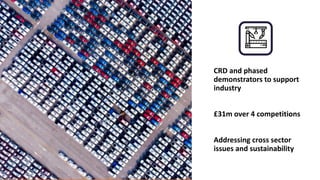
CRD and phased
demonstrators to support
industry
£31m over 4 competitions
Addressing cross sector
issues and sustainability
Technology transfer
£5m for a prosperity
partnership
Encouraging academics to
work with industry
partners
Sector strategy and
research needs
Research papers to give
the sector an identity
Help for the sector and
academics to work
together
Late stage finance
£10m to co-fund with
private equity
Targeting fast moving start-
ups with disruptive
technologies
£
Scope
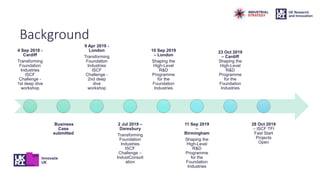
Background
4 Sep 2018 -
Cardiff
Transforming
Foundation
Industries
ISCF
Challenge -
1st deep dive
workshop
Business
Case
submitted
9 Apr 2019 -
London
Transforming
Foundation
Industries
ISCF
Challenge -
2nd deep
dive
workshop
2 Jul 2019 –
Daresbury
Transforming
Foundation
Industries
ISCF
Challenge –
IndustConsult
ation
10 Sep 2019
– London
Shaping the
High-Level
R&D
Programme
for the
Foundation
Industries
11 Sep 2019
–
Birmingham
Shaping the
High-Level
R&D
Programme
for the
Foundation
Industries
23 Oct 2019
– Cardiff
Shaping the
High-Level
R&D
Programme
for the
Foundation
Industries
28 Oct 2019
– ISCF TFI
Fast Start
Projects
Open
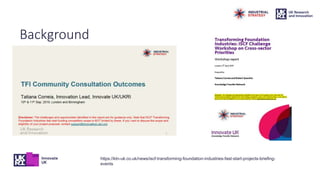
Background
https://ktn-uk.co.uk/news/iscf-transforming-foundation-industries-fast-start-projects-briefing-
events
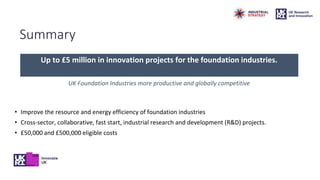
Summary
Up to £5 million in innovation projects for the foundation industries.
UK Foundation Industries more productive and globally competitive
• Improve the resource and energy efficiency of foundation industries
• Cross-sector, collaborative, fast start, industrial research and development (R&D) projects.
• £50,000 and £500,000 eligible costs
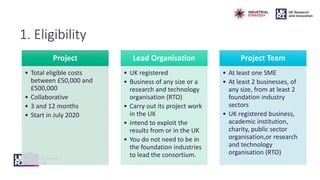
1. Eligibility
Project
• Total eligible costs
between £50,000 and
£500,000
• Collaborative
• 3 and 12 months
• Start in July 2020
Lead Organisation
• UK registered
• Business of any size or a
research and technology
organisation (RTO)
• Carry out its project work
in the UK
• intend to exploit the
results from or in the UK
• You do not need to be in
the foundation industries
to lead the consortium.
Project Team
• At least one SME
• At least 2 businesses, of
any size, from at least 2
foundation industry
sectors
• UK registered business,
academic institution,
charity, public sector
organisation,or research
and technology
organisation (RTO)
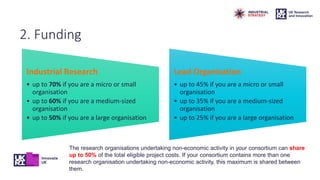
2. Funding
Industrial Research
• up to 70% if you are a micro or small
organisation
• up to 60% if you are a medium-sized
organisation
• up to 50% if you are a large organisation
Lead Organisation
• up to 45% if you are a micro or small
organisation
• up to 35% if you are a medium-sized
organisation
• up to 25% if you are a large organisation
The research organisations undertaking non-economic activity in your consortium can share
up to 50% of the total eligible project costs. If your consortium contains more than one
research organisation undertaking non-economic activity, this maximum is shared between
them.
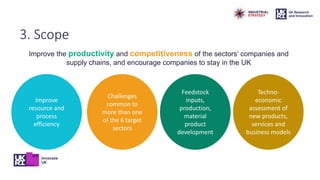
3. Scope
Improve the productivity and competitiveness of the sectors’ companies and
supply chains, and encourage companies to stay in the UK
Improve
resource and
process
efficiency
Challenges
common to
more than one
of the 6 target
sectors
Feedstock
inputs,
production,
material
product
development
Techno-
economic
assessment of
new products,
services and
business models
3. Scope
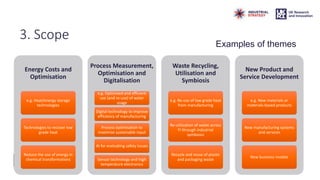
Examples of themes
Energy Costs and
Optimisation
e.g. Heat/energy storage
technologies
Technologies to recover low
grade heat
Reduce the use of energy in
chemical transformations
Process Measurement,
Optimisation and
Digitalisation
e.g. Optimised and efficient
use (and re-use) of water
usage
Digital technology to improve
efficiency of manufacturing
Process optimisation to
maximise sustainable input
AI for evaluating safety issues
Sensor technology and high
temperature electronics
Waste Recycling,
Utilisation and
Symbiosis
e.g. Re-use of low grade heat
from manufacturing
Re-utilisation of waste across
FI through industrial
symbiosis
Recycle and reuse of plastic
and packaging waste
New Product and
Service Development
e.g. New materials or
materials-based products
New manufacturing systems
and services
New business models
3. Scope
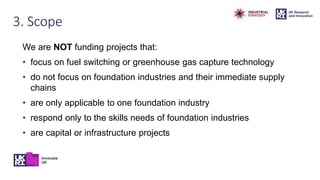
We are NOT funding projects that:
• focus on fuel switching or greenhouse gas capture technology
• do not focus on foundation industries and their immediate supply
chains
• are only applicable to one foundation industry
• respond only to the skills needs of foundation industries
• are capital or infrastructure projects
Support
If you want help to find a project partner or proposal review contact the
Knowledge Transfer Network.
If you need more information, email us at support@innovateuk.ukri.org or
call the competition helpline on 0300 321 4357 between 9am and 5:30pm,
Monday to Friday.
Tatiana Correia
ISCF TFI Innovation Lead
tatiana.correia@innovateuk.ukri.org
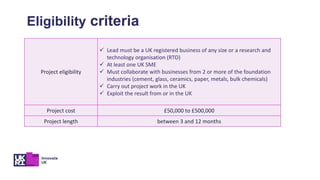
Eligibility criteria
Project eligibility
 Lead must be a UK registered business of any size or a research and
technology organisation (RTO)
 At least one UK SME
 Must collaborate with businesses from 2 or more of the foundation
industries (cement, glass, ceramics, paper, metals, bulk chemicals)
 Carry out project work in the UK
 Exploit the result from or in the UK
Project cost £50,000 to £500,000
Project length between 3 and 12 months
Eligibility criteria
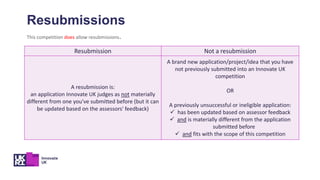
Resubmission Not a resubmission
A resubmission is:
an application Innovate UK judges as not materially
different from one you've submitted before (but it can
be updated based on the assessors' feedback)
A brand new application/project/idea that you have
not previously submitted into an Innovate UK
competition
OR
A previously unsuccessful or ineligible application:
 has been updated based on assessor feedback
 and is materially different from the application
submitted before
 and fits with the scope of this competition
Resubmissions
This competition does allow resubmissions.
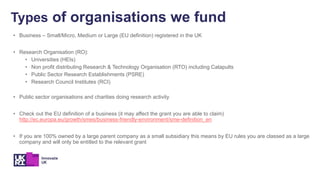
• Business – Small/Micro, Medium or Large (EU definition) registered in the UK
• Research Organisation (RO):
• Universities (HEIs)
• Non profit distributing Research & Technology Organisation (RTO) including Catapults
• Public Sector Research Establishments (PSRE)
• Research Council Institutes (RCI)
• Public sector organisations and charities doing research activity
• Check out the EU definition of a business (it may affect the grant you are able to claim)
http://ec.europa.eu/growth/smes/business-friendly-environment/sme-definition_en
• If you are 100% owned by a large parent company as a small subsidiary this means by EU rules you are classed as a large
company and will only be entitled to the relevant grant
Types of organisations we fund
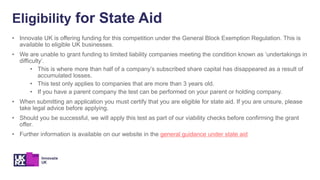
Eligibility for State Aid
• Innovate UK is offering funding for this competition under the General Block Exemption Regulation. This is
available to eligible UK businesses.
• We are unable to grant funding to limited liability companies meeting the condition known as ‘undertakings in
difficulty’.
• This is where more than half of a company’s subscribed share capital has disappeared as a result of
accumulated losses.
• This test only applies to companies that are more than 3 years old.
• If you have a parent company the test can be performed on your parent or holding company.
• When submitting an application you must certify that you are eligible for state aid. If you are unsure, please
take legal advice before applying.
• Should you be successful, we will apply this test as part of our viability checks before confirming the grant
offer.
• Further information is available on our website in the general guidance under state aid
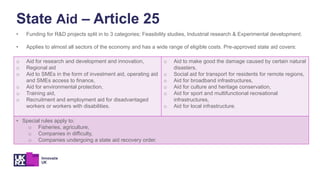
State Aid – Article 25
• Funding for R&D projects split in to 3 categories; Feasibility studies, Industrial research & Experimental development.
• Applies to almost all sectors of the economy and has a wide range of eligible costs. Pre-approved state aid covers:
o Aid for research and development and innovation,
o Regional aid
o Aid to SMEs in the form of investment aid, operating aid
and SMEs access to finance,
o Aid for environmental protection,
o Training aid,
o Recruitment and employment aid for disadvantaged
workers or workers with disabilities.
o Aid to make good the damage caused by certain natural
disasters,
o Social aid for transport for residents for remote regions,
o Aid for broadband infrastructures,
o Aid for culture and heritage conservation,
o Aid for sport and multifunctional recreational
infrastructures,
o Aid for local infrastructure.
• Special rules apply to:
o Fisheries, agriculture,
o Companies in difficulty,
o Companies undergoing a state aid recovery order.
• The aim of our State Aid scheme is to:
• optimise the level of funding to business and
• recognise the importance of research base to project
• At least 50% of total eligible project costs must be incurred by business
• The maximum level (50% of project costs) is shared by all research organisations in the project
You can make as many applications to this competition as you wish but please
bear in mind, if you are successful in multiple applications you will have to
provide justification that you can support all your projects within the timescales.
Participation Rules
In all collaborative projects there must be:
• at least one micro, small or medium-sized enterprise (SME)
• at least 2 businesses, of any size, from at least 2 foundation industry sectors
To collaborate with the lead organisation your organisation must:
• be a UK registered business, academic institution, charity, public sector organisation or research and technology
organisation (RTO)
• be invited to take part by the lead applicant
• enter its costs in the Innovation Funding Service
• The lead and at least one other organisation must claim funding.
• Your project can include partners that do not receive any of this competition’s funding, for example non-UK
businesses. Their costs will count towards the total eligible project costs.
• There must be evidence of effective collaboration
We would expect to see the structure and rationale of the collaboration described in the application.
What is collaboration?
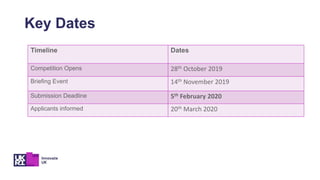
Timeline Dates
Competition Opens 28th October 2019
Briefing Event 14th November 2019
Submission Deadline 5th February 2020
Applicants informed 20th March 2020
Key Dates
@InnovateUK Innovate UKInnovate UK

WEBINAR: ISCF transforming foundation industries: fast start projects - Competition briefing

  • 1.
    ISCF Transforming Foundation Industries-Fast Start Applicant briefing Tuesday 10th December 2019
  • 2.
    1 Welcome andintroductions Scope, eligibility criteria 2 Part 1 Transforming Foundation Industries Overview 3 Part 2 Scope, eligibility criteria 4 Part 3 KTN Support Agenda
  • 3.
    • Tatiana Correia– Innovation Lead, Innovate UK • Robert Quarshie – Head of Materials, KTN Welcome and Introductions
  • 4.
    Transforming Foundation Industries: Anintroduction Tatiana Correia Innovation lead
  • 5.
    We work withthe government to invest over £7 billion a year in research and innovation by partnering with academia and industry to make the impossible, possible. Through the UK’s nine leading academic and industrial funding councils, we create knowledge with impact.
  • 6.
    • Over £6billion in combined budget per year • 3,900 research and business grants issued every year • 2,400 business-led collaborative projects and over 200 Knowledge Transfer Partnerships • 151 universities receiving research funding • 38 institutes, laboratories, units, campuses and innovation Catapults • Government has committed an additional £7 billion of public money to research and development by 2021/22. • Unprecedented increase in spend on R&D over the coming decade (1.72.4% of GDP) UKRI in numbers
  • 7.
    Thefoundation industries Include ceramic, glass,cement, metals, paper, and chemicals. Worth £45bn to the UK and employ 500,000 people, mostly outside the south east in areas of deprivation. Challenges: • by far the largest industrial polluter, generating 10% of all UK’s CO2 emissions • capital intensive making it difficult change and compete with new plant from the developing world.
  • 8.
    Pilot scale facilitiesfor the foundation industries £15m for a glass focused facility in North West Enable scale up from bench top
  • 9.
    CRD and phased demonstratorsto support industry £31m over 4 competitions Addressing cross sector issues and sustainability
  • 10.
    Technology transfer £5m fora prosperity partnership Encouraging academics to work with industry partners
  • 11.
    Sector strategy and researchneeds Research papers to give the sector an identity Help for the sector and academics to work together
  • 12.
    Late stage finance £10mto co-fund with private equity Targeting fast moving start- ups with disruptive technologies £
  • 13.
  • 14.
    Background 4 Sep 2018- Cardiff Transforming Foundation Industries ISCF Challenge - 1st deep dive workshop Business Case submitted 9 Apr 2019 - London Transforming Foundation Industries ISCF Challenge - 2nd deep dive workshop 2 Jul 2019 – Daresbury Transforming Foundation Industries ISCF Challenge – IndustConsult ation 10 Sep 2019 – London Shaping the High-Level R&D Programme for the Foundation Industries 11 Sep 2019 – Birmingham Shaping the High-Level R&D Programme for the Foundation Industries 23 Oct 2019 – Cardiff Shaping the High-Level R&D Programme for the Foundation Industries 28 Oct 2019 – ISCF TFI Fast Start Projects Open
  • 15.
  • 16.
    Summary Up to £5million in innovation projects for the foundation industries. UK Foundation Industries more productive and globally competitive • Improve the resource and energy efficiency of foundation industries • Cross-sector, collaborative, fast start, industrial research and development (R&D) projects. • £50,000 and £500,000 eligible costs
  • 17.
    1. Eligibility Project • Totaleligible costs between £50,000 and £500,000 • Collaborative • 3 and 12 months • Start in July 2020 Lead Organisation • UK registered • Business of any size or a research and technology organisation (RTO) • Carry out its project work in the UK • intend to exploit the results from or in the UK • You do not need to be in the foundation industries to lead the consortium. Project Team • At least one SME • At least 2 businesses, of any size, from at least 2 foundation industry sectors • UK registered business, academic institution, charity, public sector organisation,or research and technology organisation (RTO)
  • 18.
    2. Funding Industrial Research •up to 70% if you are a micro or small organisation • up to 60% if you are a medium-sized organisation • up to 50% if you are a large organisation Lead Organisation • up to 45% if you are a micro or small organisation • up to 35% if you are a medium-sized organisation • up to 25% if you are a large organisation The research organisations undertaking non-economic activity in your consortium can share up to 50% of the total eligible project costs. If your consortium contains more than one research organisation undertaking non-economic activity, this maximum is shared between them.
  • 19.
    3. Scope Improve theproductivity and competitiveness of the sectors’ companies and supply chains, and encourage companies to stay in the UK Improve resource and process efficiency Challenges common to more than one of the 6 target sectors Feedstock inputs, production, material product development Techno- economic assessment of new products, services and business models
  • 20.
    3. Scope Examples ofthemes Energy Costs and Optimisation e.g. Heat/energy storage technologies Technologies to recover low grade heat Reduce the use of energy in chemical transformations Process Measurement, Optimisation and Digitalisation e.g. Optimised and efficient use (and re-use) of water usage Digital technology to improve efficiency of manufacturing Process optimisation to maximise sustainable input AI for evaluating safety issues Sensor technology and high temperature electronics Waste Recycling, Utilisation and Symbiosis e.g. Re-use of low grade heat from manufacturing Re-utilisation of waste across FI through industrial symbiosis Recycle and reuse of plastic and packaging waste New Product and Service Development e.g. New materials or materials-based products New manufacturing systems and services New business models
  • 21.
    3. Scope We areNOT funding projects that: • focus on fuel switching or greenhouse gas capture technology • do not focus on foundation industries and their immediate supply chains • are only applicable to one foundation industry • respond only to the skills needs of foundation industries • are capital or infrastructure projects
  • 22.
    Support If you wanthelp to find a project partner or proposal review contact the Knowledge Transfer Network. If you need more information, email us at support@innovateuk.ukri.org or call the competition helpline on 0300 321 4357 between 9am and 5:30pm, Monday to Friday. Tatiana Correia ISCF TFI Innovation Lead tatiana.correia@innovateuk.ukri.org
  • 23.
  • 24.
    Project eligibility  Leadmust be a UK registered business of any size or a research and technology organisation (RTO)  At least one UK SME  Must collaborate with businesses from 2 or more of the foundation industries (cement, glass, ceramics, paper, metals, bulk chemicals)  Carry out project work in the UK  Exploit the result from or in the UK Project cost £50,000 to £500,000 Project length between 3 and 12 months Eligibility criteria
  • 25.
    Resubmission Not aresubmission A resubmission is: an application Innovate UK judges as not materially different from one you've submitted before (but it can be updated based on the assessors' feedback) A brand new application/project/idea that you have not previously submitted into an Innovate UK competition OR A previously unsuccessful or ineligible application:  has been updated based on assessor feedback  and is materially different from the application submitted before  and fits with the scope of this competition Resubmissions This competition does allow resubmissions.
  • 26.
    • Business –Small/Micro, Medium or Large (EU definition) registered in the UK • Research Organisation (RO): • Universities (HEIs) • Non profit distributing Research & Technology Organisation (RTO) including Catapults • Public Sector Research Establishments (PSRE) • Research Council Institutes (RCI) • Public sector organisations and charities doing research activity • Check out the EU definition of a business (it may affect the grant you are able to claim) http://ec.europa.eu/growth/smes/business-friendly-environment/sme-definition_en • If you are 100% owned by a large parent company as a small subsidiary this means by EU rules you are classed as a large company and will only be entitled to the relevant grant Types of organisations we fund
  • 27.
    Eligibility for StateAid • Innovate UK is offering funding for this competition under the General Block Exemption Regulation. This is available to eligible UK businesses. • We are unable to grant funding to limited liability companies meeting the condition known as ‘undertakings in difficulty’. • This is where more than half of a company’s subscribed share capital has disappeared as a result of accumulated losses. • This test only applies to companies that are more than 3 years old. • If you have a parent company the test can be performed on your parent or holding company. • When submitting an application you must certify that you are eligible for state aid. If you are unsure, please take legal advice before applying. • Should you be successful, we will apply this test as part of our viability checks before confirming the grant offer. • Further information is available on our website in the general guidance under state aid
  • 28.
    State Aid –Article 25 • Funding for R&D projects split in to 3 categories; Feasibility studies, Industrial research & Experimental development. • Applies to almost all sectors of the economy and has a wide range of eligible costs. Pre-approved state aid covers: o Aid for research and development and innovation, o Regional aid o Aid to SMEs in the form of investment aid, operating aid and SMEs access to finance, o Aid for environmental protection, o Training aid, o Recruitment and employment aid for disadvantaged workers or workers with disabilities. o Aid to make good the damage caused by certain natural disasters, o Social aid for transport for residents for remote regions, o Aid for broadband infrastructures, o Aid for culture and heritage conservation, o Aid for sport and multifunctional recreational infrastructures, o Aid for local infrastructure. • Special rules apply to: o Fisheries, agriculture, o Companies in difficulty, o Companies undergoing a state aid recovery order.
  • 29.
    • The aimof our State Aid scheme is to: • optimise the level of funding to business and • recognise the importance of research base to project • At least 50% of total eligible project costs must be incurred by business • The maximum level (50% of project costs) is shared by all research organisations in the project You can make as many applications to this competition as you wish but please bear in mind, if you are successful in multiple applications you will have to provide justification that you can support all your projects within the timescales. Participation Rules
  • 30.
    In all collaborativeprojects there must be: • at least one micro, small or medium-sized enterprise (SME) • at least 2 businesses, of any size, from at least 2 foundation industry sectors To collaborate with the lead organisation your organisation must: • be a UK registered business, academic institution, charity, public sector organisation or research and technology organisation (RTO) • be invited to take part by the lead applicant • enter its costs in the Innovation Funding Service • The lead and at least one other organisation must claim funding. • Your project can include partners that do not receive any of this competition’s funding, for example non-UK businesses. Their costs will count towards the total eligible project costs. • There must be evidence of effective collaboration We would expect to see the structure and rationale of the collaboration described in the application. What is collaboration?
  • 31.
    Timeline Dates Competition Opens28th October 2019 Briefing Event 14th November 2019 Submission Deadline 5th February 2020 Applicants informed 20th March 2020 Key Dates
  • 32.