Pathology Inflammation Lecture 6 and 7
1
Tissue Repair: Regeneration & Healing
Repair : Host response to replace dead tissue by Healthy tissue
• It occurs by Two processes
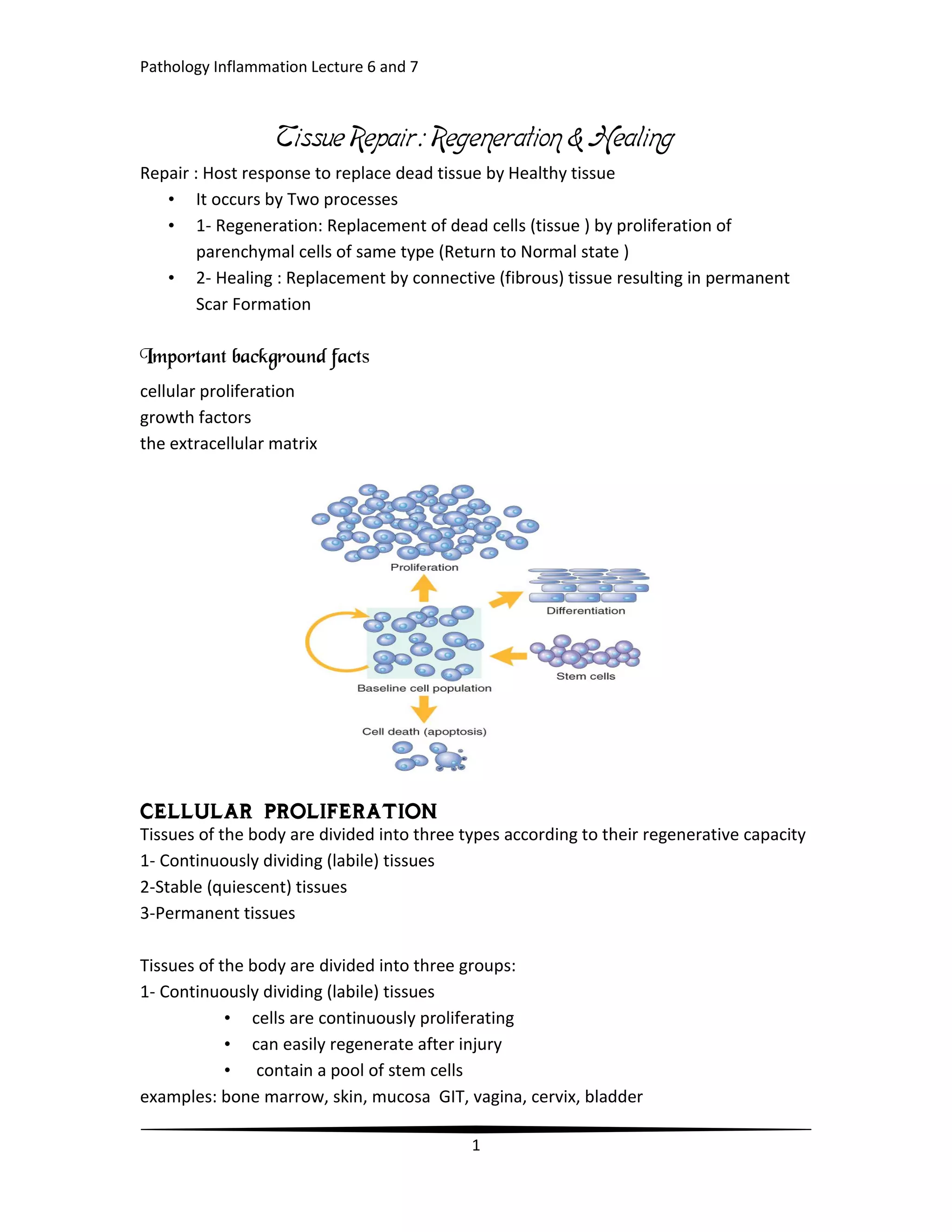
• 1- Regeneration: Replacement of dead cells (tissue ) by proliferation of
parenchymal cells of same type (Return to Normal state )
• 2- Healing : Replacement by connective (fibrous) tissue resulting in permanent
Scar Formation
Important background facts
cellular proliferation
growth factors
the extracellular matrix

Tissues of the body are divided into three types according to their regenerative capacity
1- Continuously dividing (labile) tissues
2-Stable (quiescent) tissues
3-Permanent tissues
Tissues of the body are divided into three groups:
1- Continuously dividing (labile) tissues
• cells are continuously proliferating
• can easily regenerate after injury
• contain a pool of stem cells
examples: bone marrow, skin, mucosa GIT, vagina, cervix, bladder
Pathology Inflammation Lecture 6 and 7
2
2.Stable cells: a cell which stop multiplication when growth is complete after birth but
retain ability to multiply when there is a need for that e.g. liver cells ,pancreas ,kidney
fibroblast ,endothelial cell&smooth muscle
3.Permanent cells: Stop multiplication early in neonatal life e.g. neuron ,nerve cardiac
muscle &skeletal muscle

• Very important in tissue repair.
• Actions:
• stimulate cell division and proliferation
• promote cell survival
• Huge list! Usually have “GF” in name:
• EGF
• TGF
• PDGF FGF


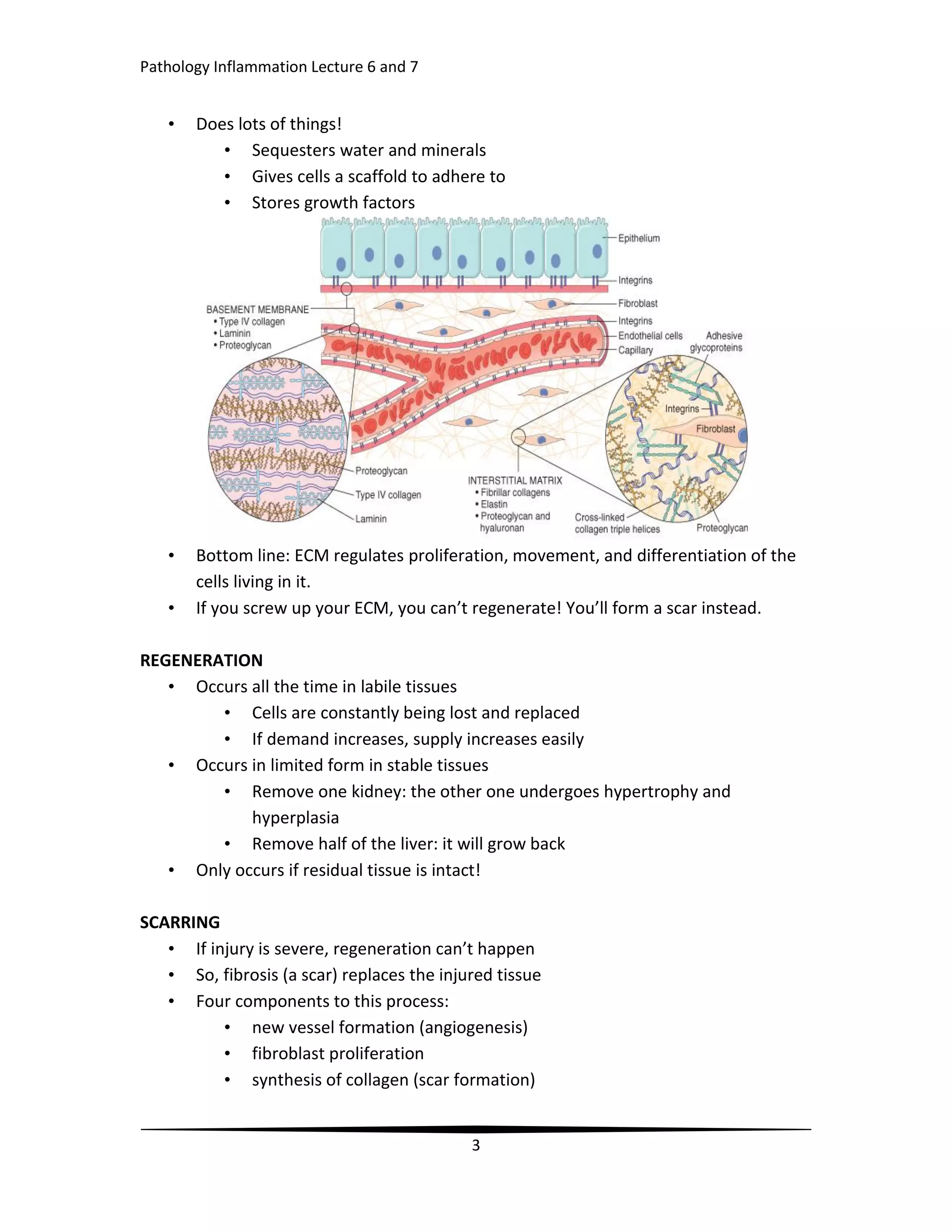
• ECM is the network that surrounds cells
• Two forms: interstitial matrix and basement membrane
Pathology Inflammation Lecture 6 and 7
3
• Does lots of things!
• Sequesters water and minerals
• Gives cells a scaffold to adhere to
• Stores growth factors
• Bottom line: ECM regulates proliferation, movement, and differentiation of the
cells living in it.
• If you screw up your ECM, you can’t regenerate! You’ll form a scar instead.
REGENERATION
• Occurs all the time in labile tissues
• Cells are constantly being lost and replaced
• If demand increases, supply increases easily
• Occurs in limited form in stable tissues
• Remove one kidney: the other one undergoes hypertrophy and
hyperplasia
• Remove half of the liver: it will grow back
• Only occurs if residual tissue is intact!
SCARRING
• If injury is severe, regeneration can’t happen
• So, fibrosis (a scar) replaces the injured tissue
• Four components to this process:
• new vessel formation (angiogenesis)
• fibroblast proliferation
• synthesis of collagen (scar formation)
Pathology Inflammation Lecture 6 and 7
4
• remodeling of scar
Healing of skin wounds
1.Healing by primary union (Primary or first intention)
2.Healing by secondary union (Second intention).
Healing by First Intention
• Occurs in small clean wounds that close easily
• Epithelial regeneration predominates over fibrosis
• Healing is fast, with minimal scarring/infection
• Examples: Well-approximated surgical incisions
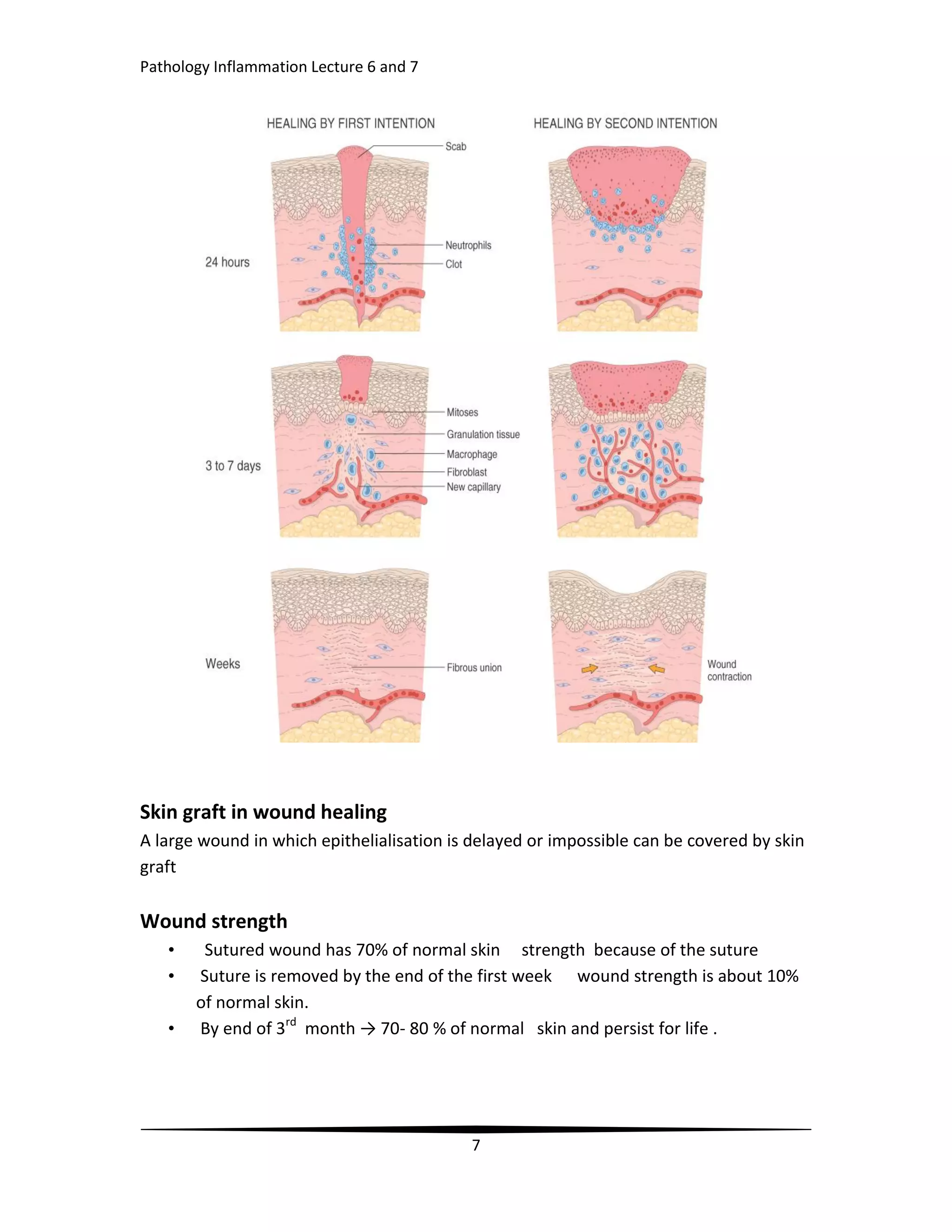
Healing by First Intention: Timeline
• By 24 hours
• By 3-7 days
• Weeks later
 By 24 hours
• clot forms
• neutrophils come in
• epithelium begins to regenerate
 By 3-7 days
• macrophages come in
• granulation tissue is formed
• new blood vessels
• fibroblasts
• collagen begins to bridge incision
• epithelium increases in thickness
 Weeks later
• granulation tissue gone
• collagen is remodeled
• epidermis full, mature (but without dermal appendages)
• eventually, scar forms
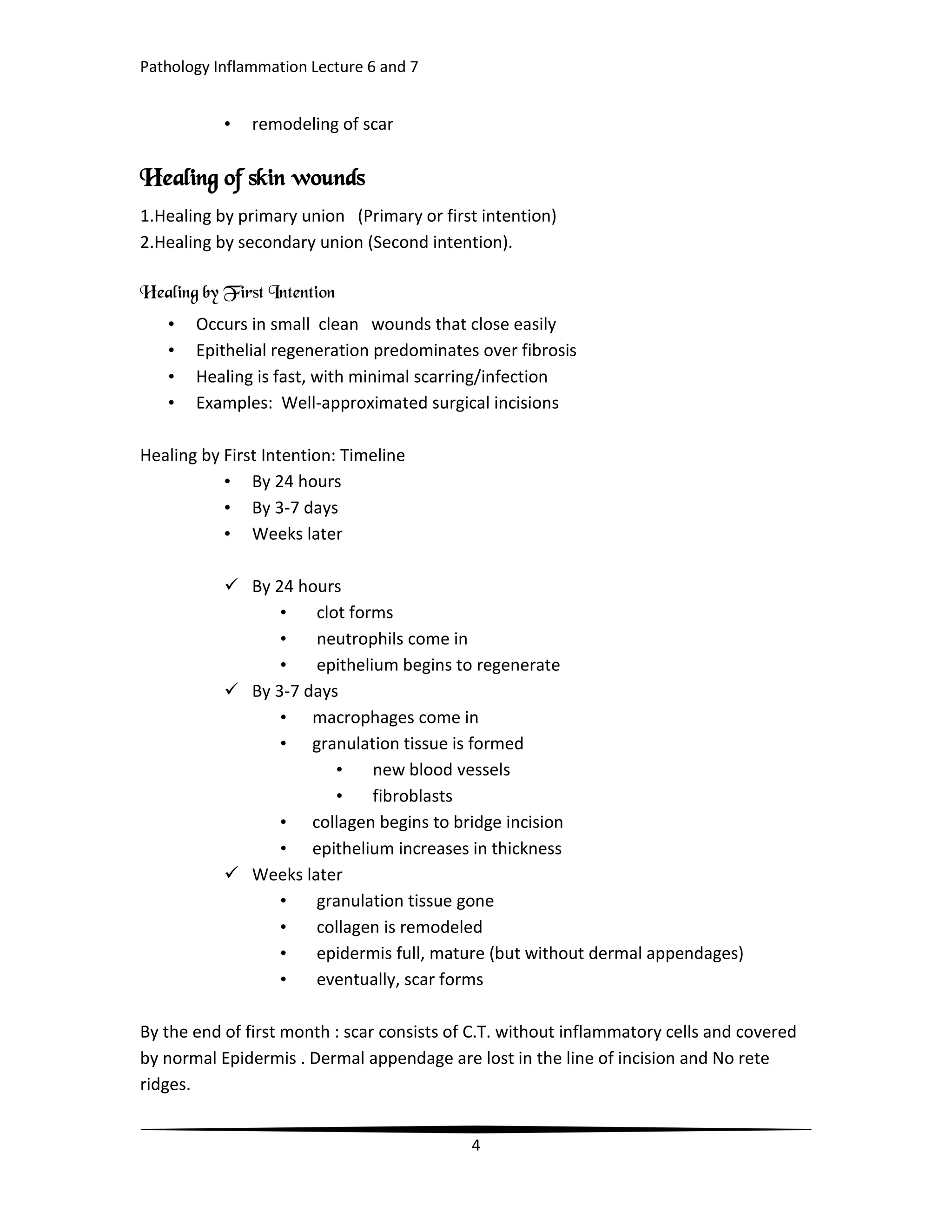
By the end of first month : scar consists of C.T. without inflammatory cells and covered
by normal Epidermis . Dermal appendage are lost in the line of incision and No rete
ridges.
Pathology Inflammation Lecture 6 and 7
5
Healing by primary union
• Injury
• Acute inflammation
• Removal of the tinny blood clot
• Formation of scab at the surface
• growth of epithelial cells
• granulation tissue is formed between the edges of the wound
• mature in to fibrous tissue

• Tissue of Healing
• Is formed by day 3—5
• Soft , pink , granular tissue
• Consists of proliferating fibroblast , newly – formed B.Vs (capillaries ) in loose
ECM and inflammatory cells (macrophage)
• progressively G.T. change and mature into dense Fibrous Tissue "(fibrosis) and
scar formation
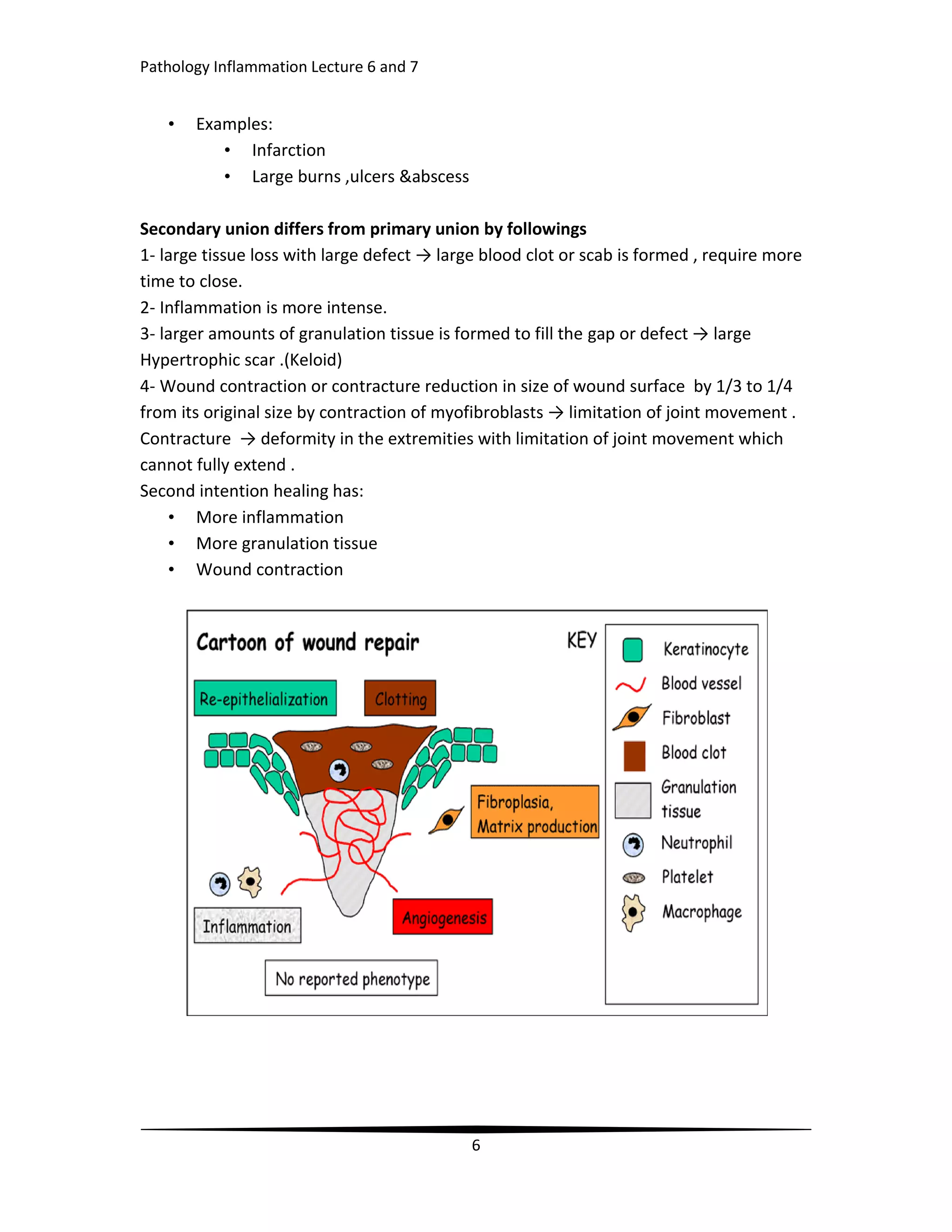
Wound which heal by secondary union
• Infected,
• contaminated wound,
• large blood clot,
• edges are widely separated
Healing by Second Intention
• Occurs in larger infected contaminated wounds that have gaps between wound
margins (widely separated edges)
• Fibrosis predominates over epithelial regeneration
• Healing is slower, with more inflammation and more granulation tissue
formation, and more scarring
Pathology Inflammation Lecture 6 and 7
6
• Examples:
• Infarction
• Large burns ,ulcers &abscess
Secondary union differs from primary union by followings
1- large tissue loss with large defect → large blood clot or scab is formed , require more
time to close.
2- Inflammation is more intense.
3- larger amounts of granulation tissue is formed to fill the gap or defect → large
Hypertrophic scar .(Keloid)
4- Wound contraction or contracture reduction in size of wound surface by 1/3 to 1/4
from its original size by contraction of myofibroblasts → limitation of joint movement .
Contracture → deformity in the extremities with limitation of joint movement which
cannot fully extend .
Second intention healing has:
• More inflammation
• More granulation tissue
• Wound contraction
Pathology Inflammation Lecture 6 and 7
7
Skin graft in wound healing
A large wound in which epithelialisation is delayed or impossible can be covered by skin
graft
Wound strength
• Sutured wound has 70% of normal skin strength because of the suture
• Suture is removed by the end of the first week wound strength is about 10%
of normal skin.
• By end of 3rd
month → 70- 80 % of normal skin and persist for life .
Pathology Inflammation Lecture 6 and 7
8
Complications of wound healing
• 1.Infections & Ulceration
• 2.Wound dehiscence
• 3.Implantation Epidermal cyst
• 4.Keloid formation.
• 5.Painfull scar.
• 6.Pigmented scar.
• 7.Weak scar.
• 8.Cicatrisation
• 9.Neoplastic changes
• 10.Exuberant granulation tissue
Keloid: Raised ugly hypertrophied scar tissue
Factors affecting wound Healing

1- Infection – is the single most important cause of delay in Healing .
2- Poor Blood supply: local venous obstruction, therosclerosis, DM will delay healing
pretibial skin wound heals much slower than face
3- Mechanical Factors : increased local pressure,Torsion, excessive movement →
wound to pull apart (wound Dehiscence)
4- Radiation therapy : inhibit cell proliferation ( radiotherapy for malignant tumour
is delayed until the surgical scar has been healed)
5- Foreign body in the wound
6- Adhesion to bony surface
7- Neoplastic changes (Tumour)

1- Protein – calorie malnutrition
2- Vit-c & Zink deficiency → inhibit collagen synthesis occurs in severe Burns &
intestinal fistula
3- Diabetes mellitus (DM)
4- Corticosteroid Treatment → inhibit fibrosis .
Pathology Inflammation Lecture 6 and 7
9
5- Renal Failure
6- Hematological diseases – leukemia
Neutropenia
7- Tumour cachexia.
Mechanisms of wound healing
1-Inflammation
2- Regeneration
3- Formation of new B.Vs (Angiogenesis).
4- Migration and proliferation of fibroblasts.
5- Deposition of ECM and collagen synthesis.
6- Maturation and scar remodeling by collagenase and gelatinase → collagen
degradation.
All these complicated process are controlled by variety of mechanism which involve
1-Chemical mediators
2-Growth factors:
e.g. macrophage G.F
Platelet G.F
Epidermal G.F. etc
3-Growth inhibiters: Tumour suppresser gene (Retinoblastoma gene)
4-Extracellular matrix (ECM)
• Not all injuries result in permanent damage; some are resolved almost
completely
• More often, there is some degree of scarring
• Scar is usually good (provides a resilient patch) but occasionally bad (can cause
permanent dysfunction)
With my best wishes

Tissue repair

  • 1.
    Pathology Inflammation Lecture6 and 7 1 Tissue Repair: Regeneration & Healing Repair : Host response to replace dead tissue by Healthy tissue • It occurs by Two processes • 1- Regeneration: Replacement of dead cells (tissue ) by proliferation of parenchymal cells of same type (Return to Normal state ) • 2- Healing : Replacement by connective (fibrous) tissue resulting in permanent Scar Formation Important background facts cellular proliferation growth factors the extracellular matrix  Tissues of the body are divided into three types according to their regenerative capacity 1- Continuously dividing (labile) tissues 2-Stable (quiescent) tissues 3-Permanent tissues Tissues of the body are divided into three groups: 1- Continuously dividing (labile) tissues • cells are continuously proliferating • can easily regenerate after injury • contain a pool of stem cells examples: bone marrow, skin, mucosa GIT, vagina, cervix, bladder
  • 2.
    Pathology Inflammation Lecture6 and 7 2 2.Stable cells: a cell which stop multiplication when growth is complete after birth but retain ability to multiply when there is a need for that e.g. liver cells ,pancreas ,kidney fibroblast ,endothelial cell&smooth muscle 3.Permanent cells: Stop multiplication early in neonatal life e.g. neuron ,nerve cardiac muscle &skeletal muscle  • Very important in tissue repair. • Actions: • stimulate cell division and proliferation • promote cell survival • Huge list! Usually have “GF” in name: • EGF • TGF • PDGF FGF   • ECM is the network that surrounds cells • Two forms: interstitial matrix and basement membrane
  • 3.
    Pathology Inflammation Lecture6 and 7 3 • Does lots of things! • Sequesters water and minerals • Gives cells a scaffold to adhere to • Stores growth factors • Bottom line: ECM regulates proliferation, movement, and differentiation of the cells living in it. • If you screw up your ECM, you can’t regenerate! You’ll form a scar instead. REGENERATION • Occurs all the time in labile tissues • Cells are constantly being lost and replaced • If demand increases, supply increases easily • Occurs in limited form in stable tissues • Remove one kidney: the other one undergoes hypertrophy and hyperplasia • Remove half of the liver: it will grow back • Only occurs if residual tissue is intact! SCARRING • If injury is severe, regeneration can’t happen • So, fibrosis (a scar) replaces the injured tissue • Four components to this process: • new vessel formation (angiogenesis) • fibroblast proliferation • synthesis of collagen (scar formation)
  • 4.
    Pathology Inflammation Lecture6 and 7 4 • remodeling of scar Healing of skin wounds 1.Healing by primary union (Primary or first intention) 2.Healing by secondary union (Second intention). Healing by First Intention • Occurs in small clean wounds that close easily • Epithelial regeneration predominates over fibrosis • Healing is fast, with minimal scarring/infection • Examples: Well-approximated surgical incisions Healing by First Intention: Timeline • By 24 hours • By 3-7 days • Weeks later  By 24 hours • clot forms • neutrophils come in • epithelium begins to regenerate  By 3-7 days • macrophages come in • granulation tissue is formed • new blood vessels • fibroblasts • collagen begins to bridge incision • epithelium increases in thickness  Weeks later • granulation tissue gone • collagen is remodeled • epidermis full, mature (but without dermal appendages) • eventually, scar forms By the end of first month : scar consists of C.T. without inflammatory cells and covered by normal Epidermis . Dermal appendage are lost in the line of incision and No rete ridges.
  • 5.
    Pathology Inflammation Lecture6 and 7 5 Healing by primary union • Injury • Acute inflammation • Removal of the tinny blood clot • Formation of scab at the surface • growth of epithelial cells • granulation tissue is formed between the edges of the wound • mature in to fibrous tissue  • Tissue of Healing • Is formed by day 3—5 • Soft , pink , granular tissue • Consists of proliferating fibroblast , newly – formed B.Vs (capillaries ) in loose ECM and inflammatory cells (macrophage) • progressively G.T. change and mature into dense Fibrous Tissue "(fibrosis) and scar formation Wound which heal by secondary union • Infected, • contaminated wound, • large blood clot, • edges are widely separated Healing by Second Intention • Occurs in larger infected contaminated wounds that have gaps between wound margins (widely separated edges) • Fibrosis predominates over epithelial regeneration • Healing is slower, with more inflammation and more granulation tissue formation, and more scarring
  • 6.
    Pathology Inflammation Lecture6 and 7 6 • Examples: • Infarction • Large burns ,ulcers &abscess Secondary union differs from primary union by followings 1- large tissue loss with large defect → large blood clot or scab is formed , require more time to close. 2- Inflammation is more intense. 3- larger amounts of granulation tissue is formed to fill the gap or defect → large Hypertrophic scar .(Keloid) 4- Wound contraction or contracture reduction in size of wound surface by 1/3 to 1/4 from its original size by contraction of myofibroblasts → limitation of joint movement . Contracture → deformity in the extremities with limitation of joint movement which cannot fully extend . Second intention healing has: • More inflammation • More granulation tissue • Wound contraction
  • 7.
    Pathology Inflammation Lecture6 and 7 7 Skin graft in wound healing A large wound in which epithelialisation is delayed or impossible can be covered by skin graft Wound strength • Sutured wound has 70% of normal skin strength because of the suture • Suture is removed by the end of the first week wound strength is about 10% of normal skin. • By end of 3rd month → 70- 80 % of normal skin and persist for life .
  • 8.
    Pathology Inflammation Lecture6 and 7 8 Complications of wound healing • 1.Infections & Ulceration • 2.Wound dehiscence • 3.Implantation Epidermal cyst • 4.Keloid formation. • 5.Painfull scar. • 6.Pigmented scar. • 7.Weak scar. • 8.Cicatrisation • 9.Neoplastic changes • 10.Exuberant granulation tissue Keloid: Raised ugly hypertrophied scar tissue Factors affecting wound Healing  1- Infection – is the single most important cause of delay in Healing . 2- Poor Blood supply: local venous obstruction, therosclerosis, DM will delay healing pretibial skin wound heals much slower than face 3- Mechanical Factors : increased local pressure,Torsion, excessive movement → wound to pull apart (wound Dehiscence) 4- Radiation therapy : inhibit cell proliferation ( radiotherapy for malignant tumour is delayed until the surgical scar has been healed) 5- Foreign body in the wound 6- Adhesion to bony surface 7- Neoplastic changes (Tumour)  1- Protein – calorie malnutrition 2- Vit-c & Zink deficiency → inhibit collagen synthesis occurs in severe Burns & intestinal fistula 3- Diabetes mellitus (DM) 4- Corticosteroid Treatment → inhibit fibrosis .
  • 9.
    Pathology Inflammation Lecture6 and 7 9 5- Renal Failure 6- Hematological diseases – leukemia Neutropenia 7- Tumour cachexia. Mechanisms of wound healing 1-Inflammation 2- Regeneration 3- Formation of new B.Vs (Angiogenesis). 4- Migration and proliferation of fibroblasts. 5- Deposition of ECM and collagen synthesis. 6- Maturation and scar remodeling by collagenase and gelatinase → collagen degradation. All these complicated process are controlled by variety of mechanism which involve 1-Chemical mediators 2-Growth factors: e.g. macrophage G.F Platelet G.F Epidermal G.F. etc 3-Growth inhibiters: Tumour suppresser gene (Retinoblastoma gene) 4-Extracellular matrix (ECM) • Not all injuries result in permanent damage; some are resolved almost completely • More often, there is some degree of scarring • Scar is usually good (provides a resilient patch) but occasionally bad (can cause permanent dysfunction) With my best wishes