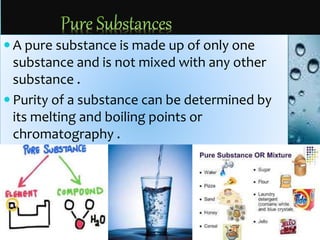
 A pure substance is made up of only one
substance and is not mixed with any other
substance .
 Purity of a substance can be determined by
its melting and boiling points or
chromatography .
:
Separation Of Mixtures
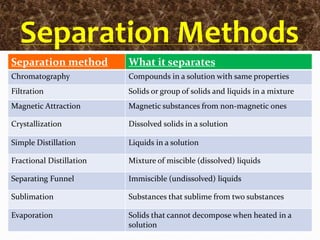
Separation Methods
Magnetic Attraction Magnetic substances from non-magnetic ones
Crystallization Dissolved solids in a solution
Simple Distillation Liquids in a solution
Fractional Distillation Mixture of miscible (dissolved) liquids
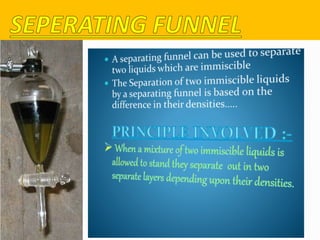
Separating Funnel Immiscible (undissolved) liquids
Sublimation Substances that sublime from two substances
Evaporation Solids that cannot decompose when heated in a
solution
Separation method What it separates
Chromatography Compounds in a solution with same properties
Filtration Solids or group of solids and liquids in a mixture
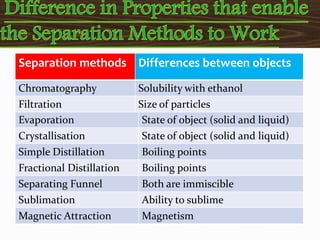
Evaporation State of object (solid and liquid)
Crystallisation State of object (solid and liquid)
Simple Distillation Boiling points
Fractional Distillation Boiling points
Separating Funnel Both are immiscible
Sublimation Ability to sublime
Magnetic Attraction Magnetism
Separation methods Differences between objects
Chromatography Solubility with ethanol
Filtration Size of particles
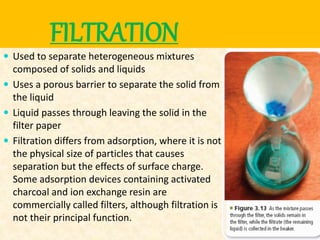
FILTRATION
 Used to separate heterogeneous mixtures
composed of solids and liquids
 Uses a porous barrier to separate the solid from
the liquid
 Liquid passes through leaving the solid in the
filter paper
 Filtration differs from adsorption, where it is not
the physical size of particles that causes
separation but the effects of surface charge.
Some adsorption devices containing activated
charcoal and ion exchange resin are
commercially called filters, although filtration is
not their principal function.
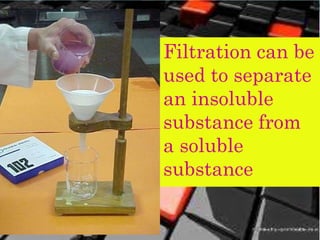
Filtration can be
used to separate
an insoluble
substance from
a soluble
substance
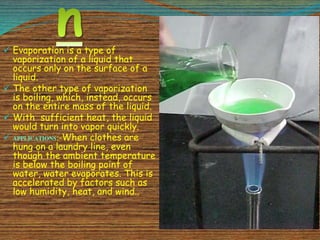
 Evaporation is a type of
vaporization of a liquid that
occurs only on the surface of a
liquid.
 The other type of vaporization
is boiling, which, instead, occurs
on the entire mass of the liquid.
 With sufficient heat, the liquid
would turn into vapor quickly.
 APPLICATIONS:-When clothes are
hung on a laundry line, even
though the ambient temperature
is below the boiling point of
water, water evaporates. This is
accelerated by factors such as
low humidity, heat, and wind..
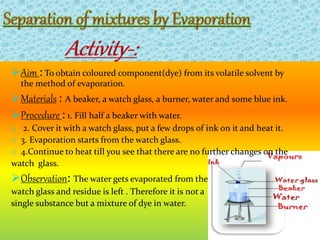
Aim : To obtain coloured component(dye) from its volatile solvent by
the method of evaporation.
Materials : A beaker, a watch glass, a burner, water and some blue ink.
Procedure : 1. Fill half a beaker with water.
o 2. Cover it with a watch glass, put a few drops of ink on it and heat it.
o 3. Evaporation starts from the watch glass.
o 4.Continue to heat till you see that there are no further changes on the
watch glass.
Observation: The water gets evaporated from the
watch glass and residue is left . Therefore it is not a
single substance but a mixture of dye in water.
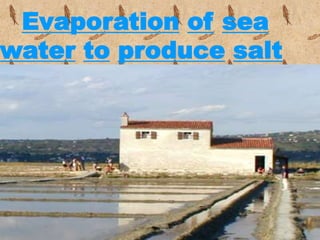
Evaporation of sea
water to produce salt
APPLICATION
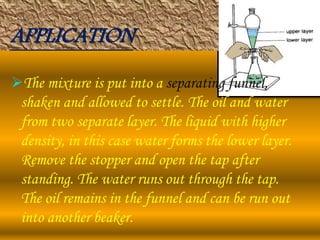
The mixture is put into a separating funnel,
shaken and allowed to settle. The oil and water
from two separate layer. The liquid with higher
density, in this case water forms the lower layer.
Remove the stopper and open the tap after
standing. The water runs out through the tap.
The oil remains in the funnel and can be run out
into another beaker.
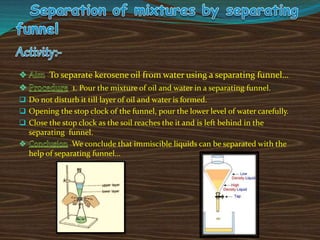
: To separate kerosene oil from water using a separating funnel…
: 1. Pour the mixture of oil and water in a separating funnel.
 Do not disturb it till layer of oil and water is formed.
 Opening the stop clock of the funnel, pour the lower level of water carefully.
 Close the stop clock as the soil reaches the it and is left behind in the
separating funnel.
: We conclude that immiscible liquids can be separated with the
help of separating funnel…
Most of the solids substances when heated changes into liquid and
finally into Vapours (or gas).
This vapour on cooling ,first forms liquid and finally the solids.
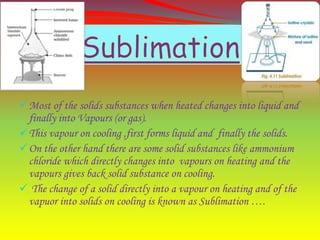
On the other hand there are some solid substances like ammonium
chloride which directly changes into vapours on heating and the
vapours gives back solid substance on cooling.
 The change of a solid directly into a vapour on heating and of the
vapuor into solids on cooling is known as Sublimation ….
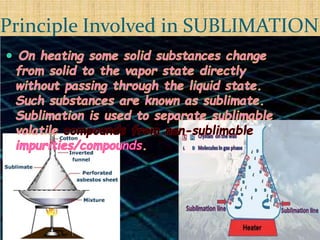
Principle Involved in SUBLIMATION
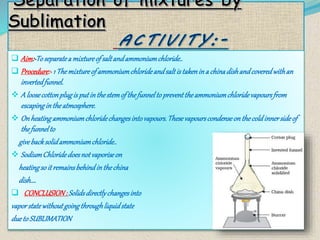
 Aim:-Toseparatea mixtureofsaltandammoniumchloride..
 Procedure:-1 Themixtureofammoniumchlorideandsaltistakenina chinadishandcoveredwithan
invertedfunnel.
 Aloosecottonplugisputinthestemofthefunneltopreventtheammoniumchloridevapoursfrom
escapingintheatmosphere.
 Onheatingammoniumchloridechangesintovapours.Thesevapourscondenseonthecoldinnersideof
thefunnelto
givebacksolidammoniumchloride..
 SodiumChloridedoesnotvaporiseon
heatingsoitremainsbehindinthechina
dish….
 CONCLUSION: Solidsdirectlychangesinto
vaporstatewithoutgoingthroughliquidstate
duetoSUBLIMATION
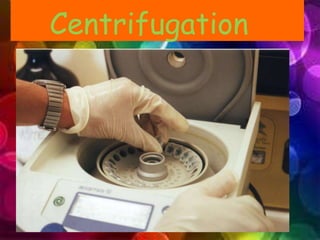
CENTRIFUGATION
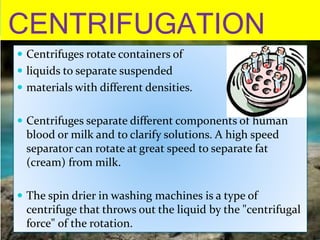
 Centrifuges rotate containers of
 liquids to separate suspended
 materials with different densities.
 Centrifuges separate different components of human
blood or milk and to clarify solutions. A high speed
separator can rotate at great speed to separate fat
(cream) from milk.
 The spin drier in washing machines is a type of
centrifuge that throws out the liquid by the "centrifugal
force" of the rotation.
Centrifugation
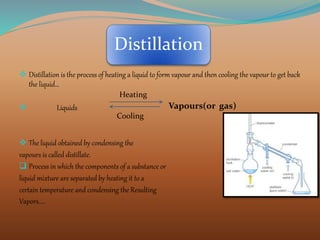
Distillation
 Distillation is the process of heating a liquid to form vapour and then cooling the vapour to get back
the liquid…
 Liquids
 The liquid obtained by condensing the
vapours is called distillate.
 Process in which the components of a substance or
liquid mixture are separated by heating it to a
certain temperature and condensing the Resulting
Vapors…..
Vapours(or gas)
Heating
Cooling
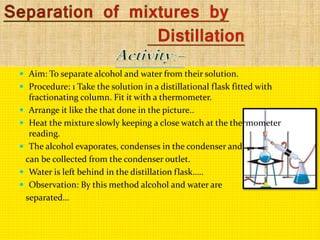
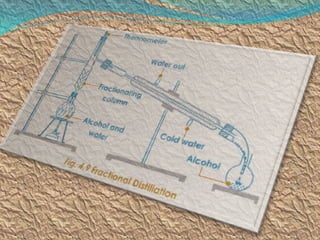
 Aim: To separate alcohol and water from their solution.
 Procedure: 1 Take the solution in a distillational flask fitted with
fractionating column. Fit it with a thermometer.
 Arrange it like the that done in the picture..
 Heat the mixture slowly keeping a close watch at the thermometer
reading.
 The alcohol evaporates, condenses in the condenser and
can be collected from the condenser outlet.
 Water is left behind in the distillation flask…..
 Observation: By this method alcohol and water are
separated…
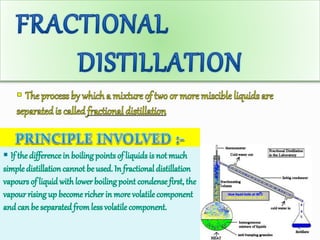
PROCEDURE
 Take a mixture of two liquids chloroform and benzene of which chloroform is
more volatile than benzene. When such a liquid mixture is heated, the
temperature rises slowly and the mixture starts boiling. The vapors formed
mainly consist of the more volatile liquid, i.e., chloroform with little of the less
volatile liquid, .i.e., benzene. As these vapors travel up in fractionating column ,
the vapours of less volatile liquid condense more readily than those of the more
volatile liquid. Therefore, the vapours rising above become richer in chloroform
and the liquid flowing down becomes richer in benzene. This process of
distillation is repeated in every point of fractionating column. As a result of
series of successive distillation, by the time vapours reach the top of the column
and escape into the condenser, they consist entirely of the more volatile
component. It is collected in a flask When the more volatile component has
completely distilled over, the temperature will again start rising and when the
boiling point of less volatile is reached, benzene starts distilling which is
collected in another flask. In this way, separation of two miscible liquids whose
boiling points differ by less than 25k can be achieved.
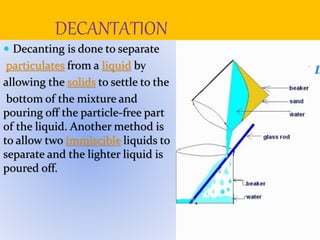
DECANTATION
 Decanting is done to separate
particulates from a liquid by
allowing the solids to settle to the
bottom of the mixture and
pouring off the particle-free part
of the liquid. Another method is
to allow two immiscible liquids to
separate and the lighter liquid is
poured off.
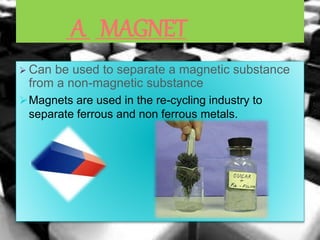
A MAGNET
 Can be used to separate a magnetic substance
from a non-magnetic substance
Magnets are used in the re-cycling industry to
separate ferrous and non ferrous metals.
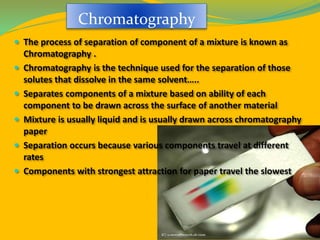
Chromatography
 The process of separation of component of a mixture is known as
Chromatography .
 Chromatography is the technique used for the separation of those
solutes that dissolve in the same solvent…..
 Separates components of a mixture based on ability of each
component to be drawn across the surface of another material
 Mixture is usually liquid and is usually drawn across chromatography
paper
 Separation occurs because various components travel at different
rates
 Components with strongest attraction for paper travel the slowest
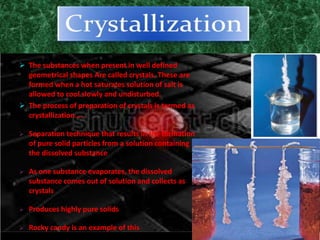
 The substances when present in well defined
geometrical shapes Are called crystals. These are
formed when a hot saturates solution of salt is
allowed to cool slowly and undisturbed.
 The process of preparation of crystals is termed as
crystallization…..
 Separation technique that results in the formation
of pure solid particles from a solution containing
the dissolved substance
 As one substance evaporates, the dissolved
substance comes out of solution and collects as
crystals
 Produces highly pure solids
 Rocky candy is an example of this
Yash – 43
Yash Lakra – 45
Harsh Phogat – 15
Tushar Chauhan - 40
THANK YOU FOR
WATCHING !!

Techniques of separation PPT for class 9

  • 4.
     A puresubstance is made up of only one substance and is not mixed with any other substance .  Purity of a substance can be determined by its melting and boiling points or chromatography .
  • 5.
  • 6.
  • 7.
    Separation Methods Magnetic AttractionMagnetic substances from non-magnetic ones Crystallization Dissolved solids in a solution Simple Distillation Liquids in a solution Fractional Distillation Mixture of miscible (dissolved) liquids Separating Funnel Immiscible (undissolved) liquids Sublimation Substances that sublime from two substances Evaporation Solids that cannot decompose when heated in a solution Separation method What it separates Chromatography Compounds in a solution with same properties Filtration Solids or group of solids and liquids in a mixture
  • 8.
    Evaporation State ofobject (solid and liquid) Crystallisation State of object (solid and liquid) Simple Distillation Boiling points Fractional Distillation Boiling points Separating Funnel Both are immiscible Sublimation Ability to sublime Magnetic Attraction Magnetism Separation methods Differences between objects Chromatography Solubility with ethanol Filtration Size of particles
  • 9.
    FILTRATION  Used toseparate heterogeneous mixtures composed of solids and liquids  Uses a porous barrier to separate the solid from the liquid  Liquid passes through leaving the solid in the filter paper  Filtration differs from adsorption, where it is not the physical size of particles that causes separation but the effects of surface charge. Some adsorption devices containing activated charcoal and ion exchange resin are commercially called filters, although filtration is not their principal function.
  • 10.
    Filtration can be usedto separate an insoluble substance from a soluble substance
  • 11.
     Evaporation isa type of vaporization of a liquid that occurs only on the surface of a liquid.  The other type of vaporization is boiling, which, instead, occurs on the entire mass of the liquid.  With sufficient heat, the liquid would turn into vapor quickly.  APPLICATIONS:-When clothes are hung on a laundry line, even though the ambient temperature is below the boiling point of water, water evaporates. This is accelerated by factors such as low humidity, heat, and wind..
  • 12.
    Aim : Toobtain coloured component(dye) from its volatile solvent by the method of evaporation. Materials : A beaker, a watch glass, a burner, water and some blue ink. Procedure : 1. Fill half a beaker with water. o 2. Cover it with a watch glass, put a few drops of ink on it and heat it. o 3. Evaporation starts from the watch glass. o 4.Continue to heat till you see that there are no further changes on the watch glass. Observation: The water gets evaporated from the watch glass and residue is left . Therefore it is not a single substance but a mixture of dye in water.
  • 13.
    Evaporation of sea waterto produce salt
  • 15.
    APPLICATION The mixture isput into a separating funnel, shaken and allowed to settle. The oil and water from two separate layer. The liquid with higher density, in this case water forms the lower layer. Remove the stopper and open the tap after standing. The water runs out through the tap. The oil remains in the funnel and can be run out into another beaker.
  • 16.
    : To separatekerosene oil from water using a separating funnel… : 1. Pour the mixture of oil and water in a separating funnel.  Do not disturb it till layer of oil and water is formed.  Opening the stop clock of the funnel, pour the lower level of water carefully.  Close the stop clock as the soil reaches the it and is left behind in the separating funnel. : We conclude that immiscible liquids can be separated with the help of separating funnel…
  • 17.
    Most of thesolids substances when heated changes into liquid and finally into Vapours (or gas). This vapour on cooling ,first forms liquid and finally the solids. On the other hand there are some solid substances like ammonium chloride which directly changes into vapours on heating and the vapours gives back solid substance on cooling.  The change of a solid directly into a vapour on heating and of the vapuor into solids on cooling is known as Sublimation ….
  • 18.
  • 19.
     Aim:-Toseparatea mixtureofsaltandammoniumchloride.. Procedure:-1 Themixtureofammoniumchlorideandsaltistakenina chinadishandcoveredwithan invertedfunnel.  Aloosecottonplugisputinthestemofthefunneltopreventtheammoniumchloridevapoursfrom escapingintheatmosphere.  Onheatingammoniumchloridechangesintovapours.Thesevapourscondenseonthecoldinnersideof thefunnelto givebacksolidammoniumchloride..  SodiumChloridedoesnotvaporiseon heatingsoitremainsbehindinthechina dish….  CONCLUSION: Solidsdirectlychangesinto vaporstatewithoutgoingthroughliquidstate duetoSUBLIMATION
  • 20.
    CENTRIFUGATION  Centrifuges rotatecontainers of  liquids to separate suspended  materials with different densities.  Centrifuges separate different components of human blood or milk and to clarify solutions. A high speed separator can rotate at great speed to separate fat (cream) from milk.  The spin drier in washing machines is a type of centrifuge that throws out the liquid by the "centrifugal force" of the rotation.
  • 21.
  • 22.
    Distillation  Distillation isthe process of heating a liquid to form vapour and then cooling the vapour to get back the liquid…  Liquids  The liquid obtained by condensing the vapours is called distillate.  Process in which the components of a substance or liquid mixture are separated by heating it to a certain temperature and condensing the Resulting Vapors….. Vapours(or gas) Heating Cooling
  • 24.
     Aim: Toseparate alcohol and water from their solution.  Procedure: 1 Take the solution in a distillational flask fitted with fractionating column. Fit it with a thermometer.  Arrange it like the that done in the picture..  Heat the mixture slowly keeping a close watch at the thermometer reading.  The alcohol evaporates, condenses in the condenser and can be collected from the condenser outlet.  Water is left behind in the distillation flask…..  Observation: By this method alcohol and water are separated…
  • 25.
    PROCEDURE  Take amixture of two liquids chloroform and benzene of which chloroform is more volatile than benzene. When such a liquid mixture is heated, the temperature rises slowly and the mixture starts boiling. The vapors formed mainly consist of the more volatile liquid, i.e., chloroform with little of the less volatile liquid, .i.e., benzene. As these vapors travel up in fractionating column , the vapours of less volatile liquid condense more readily than those of the more volatile liquid. Therefore, the vapours rising above become richer in chloroform and the liquid flowing down becomes richer in benzene. This process of distillation is repeated in every point of fractionating column. As a result of series of successive distillation, by the time vapours reach the top of the column and escape into the condenser, they consist entirely of the more volatile component. It is collected in a flask When the more volatile component has completely distilled over, the temperature will again start rising and when the boiling point of less volatile is reached, benzene starts distilling which is collected in another flask. In this way, separation of two miscible liquids whose boiling points differ by less than 25k can be achieved.
  • 28.
    DECANTATION  Decanting isdone to separate particulates from a liquid by allowing the solids to settle to the bottom of the mixture and pouring off the particle-free part of the liquid. Another method is to allow two immiscible liquids to separate and the lighter liquid is poured off.
  • 29.
    A MAGNET  Canbe used to separate a magnetic substance from a non-magnetic substance Magnets are used in the re-cycling industry to separate ferrous and non ferrous metals.
  • 31.
    Chromatography  The processof separation of component of a mixture is known as Chromatography .  Chromatography is the technique used for the separation of those solutes that dissolve in the same solvent…..  Separates components of a mixture based on ability of each component to be drawn across the surface of another material  Mixture is usually liquid and is usually drawn across chromatography paper  Separation occurs because various components travel at different rates  Components with strongest attraction for paper travel the slowest
  • 32.
     The substanceswhen present in well defined geometrical shapes Are called crystals. These are formed when a hot saturates solution of salt is allowed to cool slowly and undisturbed.  The process of preparation of crystals is termed as crystallization…..  Separation technique that results in the formation of pure solid particles from a solution containing the dissolved substance  As one substance evaporates, the dissolved substance comes out of solution and collects as crystals  Produces highly pure solids  Rocky candy is an example of this
  • 33.
    Yash – 43 YashLakra – 45 Harsh Phogat – 15 Tushar Chauhan - 40
  • 35.