Mixtures
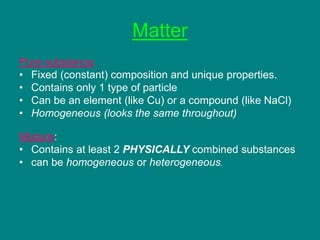
Matter
Pure substance:
• Fixed (constant) composition and unique properties.
• Contains only 1 type of particle
• Can be an element (like Cu) or a compound (like NaCl)
• Homogeneous (looks the same throughout)
Mixture:
• Contains at least 2 PHYSICALLY combined substances
• can be homogeneous or heterogeneous.
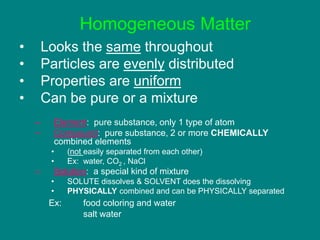
Homogeneous Matter
• Looks the same throughout
• Particles are evenly distributed
• Properties are uniform
• Can be pure or a mixture
– Element: pure substance, only 1 type of atom
– Compound: pure substance, 2 or more CHEMICALLY
combined elements
• (not easily separated from each other)
• Ex: water, CO2 , NaCl
– Solution: a special kind of mixture
• SOLUTE dissolves & SOLVENT does the dissolving
• PHYSICALLY combined and can be PHYSICALLY separated
Ex: food coloring and water
salt water
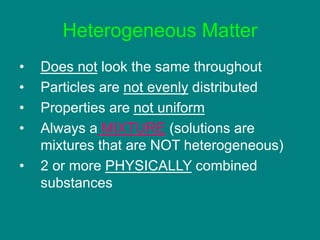
Heterogeneous Matter
• Does not look the same throughout
• Particles are not evenly distributed
• Properties are not uniform
• Always a MIXTURE (solutions are
mixtures that are NOT heterogeneous)
• 2 or more PHYSICALLY combined
substances
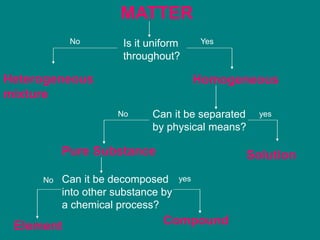
MATTER
Heterogeneous
mixture
Is it uniform
throughout?
No
Homogeneous
Yes
Can it be separated
by physical means?
Pure Substance Solution
Can it be decomposed
into other substance by
a chemical process?
Element Compound
No yes
No yes
Homogeneus Mixtures (Solutions)
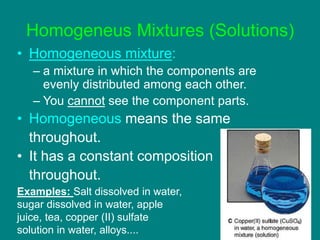
• Homogeneous mixture:
– a mixture in which the components are
evenly distributed among each other.
– You cannot see the component parts.
• Homogeneous means the same
throughout.
• It has a constant composition
throughout.
Examples: Salt dissolved in water,
sugar dissolved in water, apple
juice, tea, copper (II) sulfate
solution in water, alloys....
Solutions
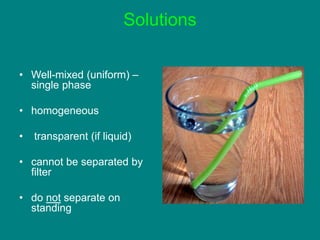
• Well-mixed (uniform) –
single phase
• homogeneous
• transparent (if liquid)
• cannot be separated by
filter
• do not separate on
standing
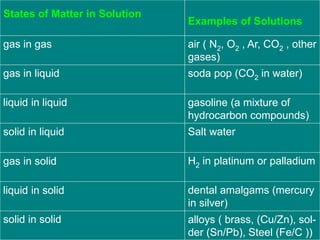
States of Matter in Solution
Examples of Solutions
gas in gas air ( N2, O2 , Ar, CO2 , other
gases)
gas in liquid soda pop (CO2 in water)
liquid in liquid gasoline (a mixture of
hydrocarbon compounds)
solid in liquid Salt water
gas in solid H2 in platinum or palladium
liquid in solid dental amalgams (mercury
in silver)
solid in solid alloys ( brass, (Cu/Zn), sol-
der (Sn/Pb), Steel (Fe/C ))
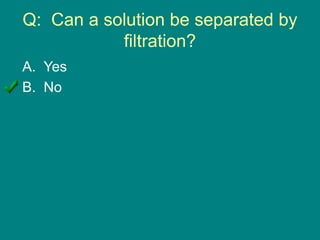
Q: Can a solution be separated by
filtration?
A. Yes
B. No
Heterogeneous Mixtures
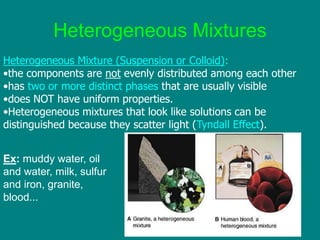
Heterogeneous Mixture (Suspension or Colloid):
•the components are not evenly distributed among each other
•has two or more distinct phases that are usually visible
•does NOT have uniform properties.
•Heterogeneous mixtures that look like solutions can be
distinguished because they scatter light (Tyndall Effect).
Ex: muddy water, oil
and water, milk, sulfur
and iron, granite,
blood...
Q: After passing through a muddy pond, the
water in a stream contains dirt particles.
Which of the following describes the stream?
A. solution
B. suspension
C. pure substance
D. colloid
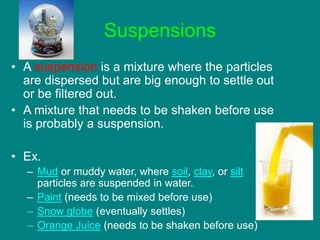
Suspensions
• A suspension is a mixture where the particles
are dispersed but are big enough to settle out
or be filtered out.
• A mixture that needs to be shaken before use
is probably a suspension.
• Ex.
– Mud or muddy water, where soil, clay, or silt
particles are suspended in water.
– Paint (needs to be mixed before use)
– Snow globe (eventually settles)
– Orange Juice (needs to be shaken before use)
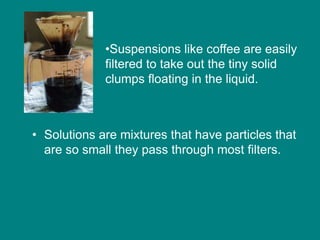
•Suspensions like coffee are easily
filtered to take out the tiny solid
clumps floating in the liquid.
• Solutions are mixtures that have particles that
are so small they pass through most filters.
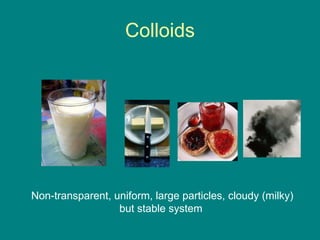
Colloids
Non-transparent, uniform, large particles, cloudy (milky)
but stable system
Colloids
Colloids
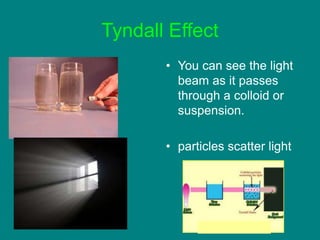
Tyndall Effect
• You can see the light
beam as it passes
through a colloid or
suspension.
• particles scatter light
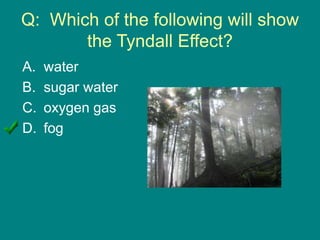
Q: Which of the following will show
the Tyndall Effect?
A. water
B. sugar water
C. oxygen gas
D. fog
Q: Which of the following is a
colloid?
A. milk
B. NaCl in water
C. sand and water
D. raisin bread
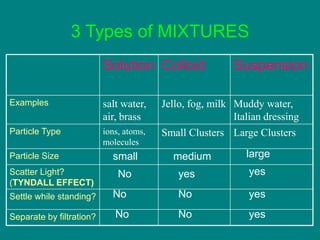
3 Types of MIXTURES
Solution Colloid Suspension
Examples salt water,
air, brass
Jello, fog, milk Muddy water,
Italian dressing
Particle Type ions, atoms,
molecules
Small Clusters Large Clusters
Particle Size
Scatter Light?
(TYNDALL EFFECT)
Settle while standing?
Separate by filtration?
small medium large
No
No
No
No
No
yes yes
yes
yes
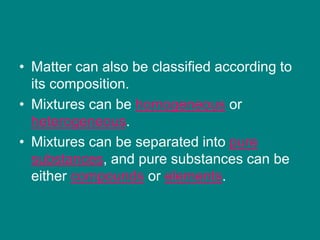
• Matter can also be classified according to
its composition.
• Mixtures can be homogeneous or
heterogeneous.
• Mixtures can be separated into pure
substances, and pure substances can be
either compounds or elements.
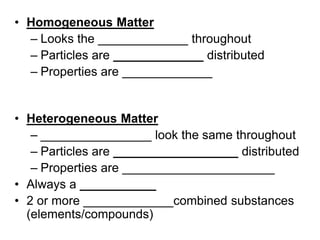
• Homogeneous Matter
– Looks the _____________ throughout
– Particles are _____________ distributed
– Properties are _____________
• Heterogeneous Matter
– ________________ look the same throughout
– Particles are __________________ distributed
– Properties are ______________________
• Always a ___________
• 2 or more _____________combined substances
(elements/compounds)
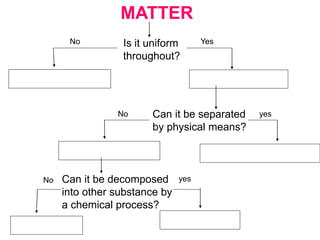
MATTER
Is it uniform
throughout?
No Yes
Can it be separated
by physical means?
Can it be decomposed
into other substance by
a chemical process?
No yes
No yes
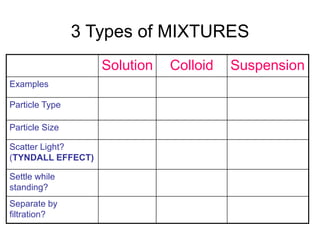
3 Types of MIXTURES
Solution Colloid Suspension
Examples
Particle Type
Particle Size
Scatter Light?
(TYNDALL EFFECT)
Settle while
standing?
Separate by
filtration?

Mixtures PPT.ppt

  • 1.
  • 2.
    Matter Pure substance: • Fixed(constant) composition and unique properties. • Contains only 1 type of particle • Can be an element (like Cu) or a compound (like NaCl) • Homogeneous (looks the same throughout) Mixture: • Contains at least 2 PHYSICALLY combined substances • can be homogeneous or heterogeneous.
  • 3.
    Homogeneous Matter • Looksthe same throughout • Particles are evenly distributed • Properties are uniform • Can be pure or a mixture – Element: pure substance, only 1 type of atom – Compound: pure substance, 2 or more CHEMICALLY combined elements • (not easily separated from each other) • Ex: water, CO2 , NaCl – Solution: a special kind of mixture • SOLUTE dissolves & SOLVENT does the dissolving • PHYSICALLY combined and can be PHYSICALLY separated Ex: food coloring and water salt water
  • 4.
    Heterogeneous Matter • Doesnot look the same throughout • Particles are not evenly distributed • Properties are not uniform • Always a MIXTURE (solutions are mixtures that are NOT heterogeneous) • 2 or more PHYSICALLY combined substances
  • 5.
    MATTER Heterogeneous mixture Is it uniform throughout? No Homogeneous Yes Canit be separated by physical means? Pure Substance Solution Can it be decomposed into other substance by a chemical process? Element Compound No yes No yes
  • 6.
    Homogeneus Mixtures (Solutions) •Homogeneous mixture: – a mixture in which the components are evenly distributed among each other. – You cannot see the component parts. • Homogeneous means the same throughout. • It has a constant composition throughout. Examples: Salt dissolved in water, sugar dissolved in water, apple juice, tea, copper (II) sulfate solution in water, alloys....
  • 7.
    Solutions • Well-mixed (uniform)– single phase • homogeneous • transparent (if liquid) • cannot be separated by filter • do not separate on standing
  • 8.
    States of Matterin Solution Examples of Solutions gas in gas air ( N2, O2 , Ar, CO2 , other gases) gas in liquid soda pop (CO2 in water) liquid in liquid gasoline (a mixture of hydrocarbon compounds) solid in liquid Salt water gas in solid H2 in platinum or palladium liquid in solid dental amalgams (mercury in silver) solid in solid alloys ( brass, (Cu/Zn), sol- der (Sn/Pb), Steel (Fe/C ))
  • 9.
    Q: Can asolution be separated by filtration? A. Yes B. No
  • 10.
    Heterogeneous Mixtures Heterogeneous Mixture(Suspension or Colloid): •the components are not evenly distributed among each other •has two or more distinct phases that are usually visible •does NOT have uniform properties. •Heterogeneous mixtures that look like solutions can be distinguished because they scatter light (Tyndall Effect). Ex: muddy water, oil and water, milk, sulfur and iron, granite, blood...
  • 11.
    Q: After passingthrough a muddy pond, the water in a stream contains dirt particles. Which of the following describes the stream? A. solution B. suspension C. pure substance D. colloid
  • 12.
    Suspensions • A suspensionis a mixture where the particles are dispersed but are big enough to settle out or be filtered out. • A mixture that needs to be shaken before use is probably a suspension. • Ex. – Mud or muddy water, where soil, clay, or silt particles are suspended in water. – Paint (needs to be mixed before use) – Snow globe (eventually settles) – Orange Juice (needs to be shaken before use)
  • 13.
    •Suspensions like coffeeare easily filtered to take out the tiny solid clumps floating in the liquid. • Solutions are mixtures that have particles that are so small they pass through most filters.
  • 14.
    Colloids Non-transparent, uniform, largeparticles, cloudy (milky) but stable system Colloids
  • 15.
    Colloids Tyndall Effect • Youcan see the light beam as it passes through a colloid or suspension. • particles scatter light
  • 16.
    Q: Which ofthe following will show the Tyndall Effect? A. water B. sugar water C. oxygen gas D. fog
  • 17.
    Q: Which ofthe following is a colloid? A. milk B. NaCl in water C. sand and water D. raisin bread
  • 18.
    3 Types ofMIXTURES Solution Colloid Suspension Examples salt water, air, brass Jello, fog, milk Muddy water, Italian dressing Particle Type ions, atoms, molecules Small Clusters Large Clusters Particle Size Scatter Light? (TYNDALL EFFECT) Settle while standing? Separate by filtration? small medium large No No No No No yes yes yes yes
  • 20.
    • Matter canalso be classified according to its composition. • Mixtures can be homogeneous or heterogeneous. • Mixtures can be separated into pure substances, and pure substances can be either compounds or elements.
  • 21.
    • Homogeneous Matter –Looks the _____________ throughout – Particles are _____________ distributed – Properties are _____________ • Heterogeneous Matter – ________________ look the same throughout – Particles are __________________ distributed – Properties are ______________________ • Always a ___________ • 2 or more _____________combined substances (elements/compounds)
  • 22.
    MATTER Is it uniform throughout? NoYes Can it be separated by physical means? Can it be decomposed into other substance by a chemical process? No yes No yes
  • 23.
    3 Types ofMIXTURES Solution Colloid Suspension Examples Particle Type Particle Size Scatter Light? (TYNDALL EFFECT) Settle while standing? Separate by filtration?