IRRITANT CONTACT
DERMATITIS
By Dr.Maria Saeed
What is irritant contact dermatitis?
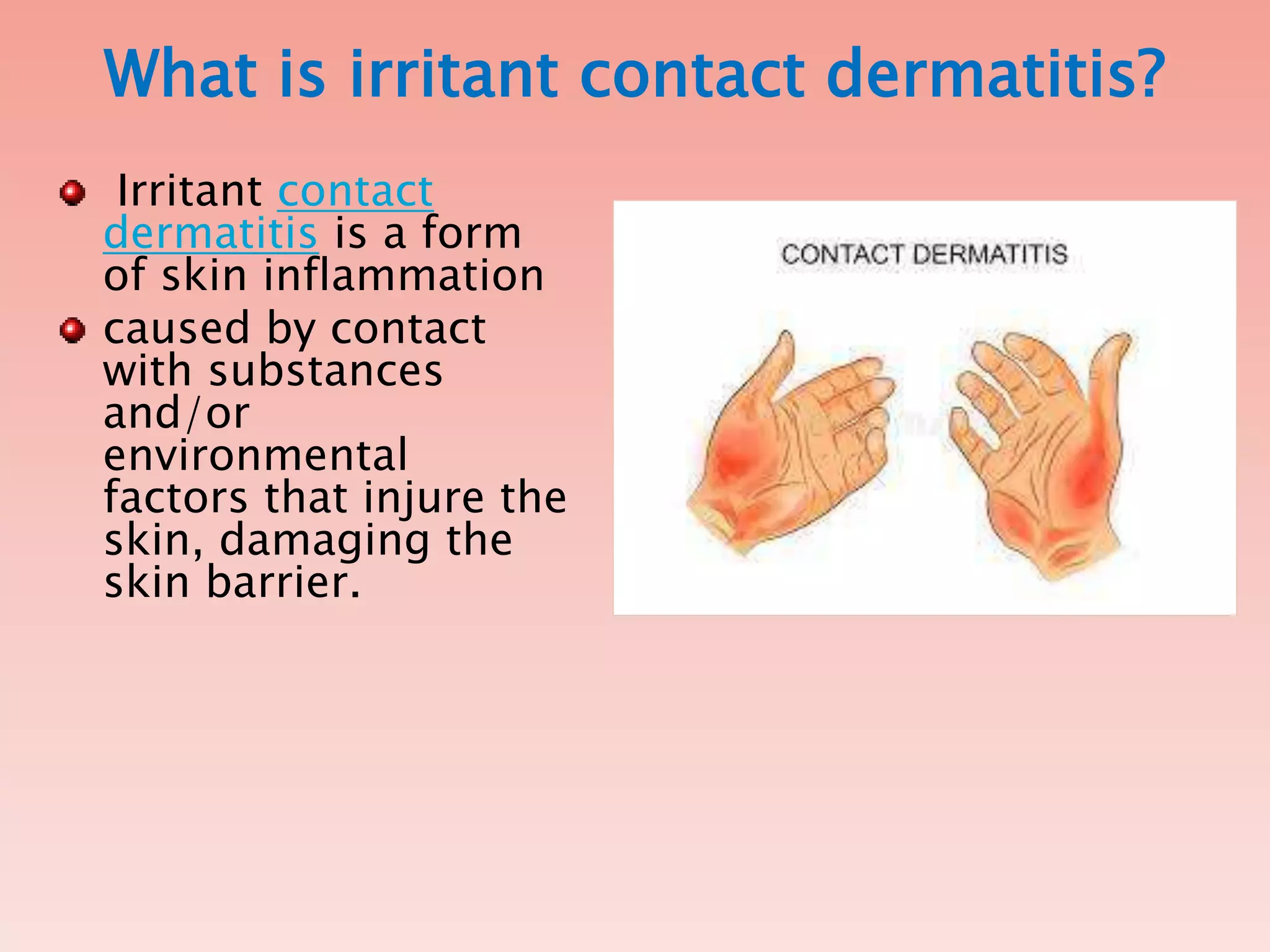
Irritant contact
dermatitis is a form
of skin inflammation
caused by contact
with substances
and/or
environmental
factors that injure the
skin, damaging the
skin barrier.
Types of irritant
contact dermatitis
Immune
mediated
Cosmetic
dermatitis
chelitis
Napkin
dermatitis
Air borne
irritant contact
dermatitis
Non immune
mediated
Phototoxic
contact
dermatitis
burns
Subjective
sensory irritation
Immediate‐type
stinging
Delayed‐type
stinging
Introduction and general
description
Reversible cellular injury may cause contact urticaria or
dermatitis dependent on the nature of the insult. Where there
is no apparent cellular injury, various sensory symptoms such
as stinging, smarting and burning may occur.
The following types of irritant contact reaction may be
distinguished:
Burns.
Irritant contact dermatitis:
• Acute (toxic) irritant contact dermatitis.
• Cumulative irritant/insult contact dermatitis.
Transient or immediate‐type, non‐immune, contact urticaria.
Symptomatic (subjective) irritant responses.
Other: pigmentary and granulomatous responses and those
localized to appendageal structures
•Irritant hand eczema 35%
•Atopic hand eczema 22%
•Allergic contact dermatitis 19%
•soaps (22.0% of cases)
•wet work (19.8%)
•petroleum
•products (8.7%), and cutting oils and
coolants (7.8%)
Epidemiology
• Females may be twice as
commonly affected as males
sex
Who gets irritant contact dermatitis?
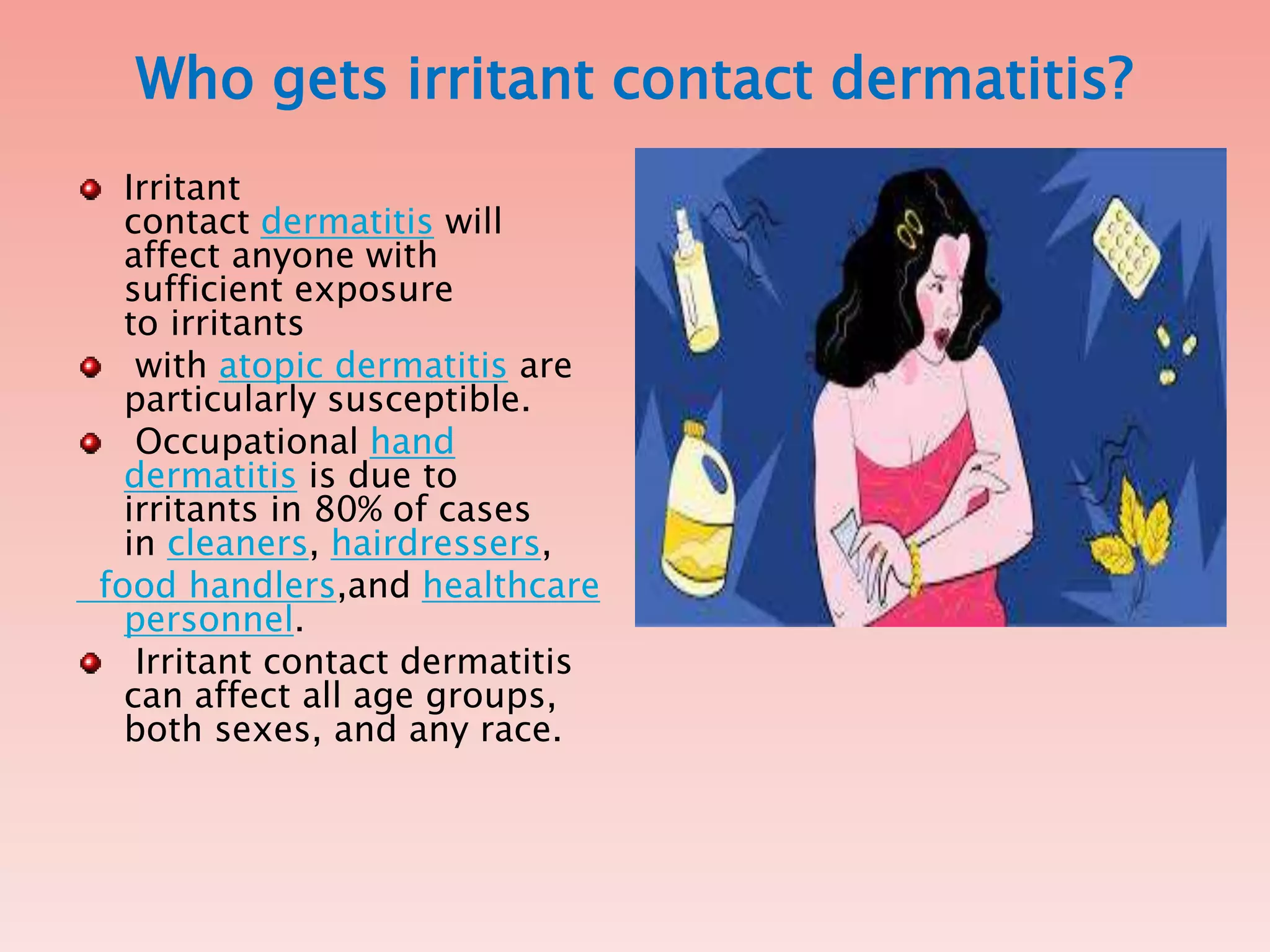
Irritant
contact dermatitis will
affect anyone with
sufficient exposure
to irritants
with atopic dermatitis are
particularly susceptible.
Occupational hand
dermatitis is due to
irritants in 80% of cases
in cleaners, hairdressers,
food handlers,and healthcare
personnel.
Irritant contact dermatitis
can affect all age groups,
both sexes, and any race.
What causes irritant contact dermatitis?
Irritant contact dermatitis develops when chemical or physical
agents damage the skin surface faster than the skin can
repair. Irritants remove oils and natural moisturising factor
from the outer layer of the skin, allowing chemical irritants to
penetrate the skin barrier and trigger inflammation.
common skin irritants
1) water, soaps, and, in the era of COVID-19, hand sanitisers.
2) Occupational irritants can include wet work, detergents,
solvents, acids, alkalis, adhesives, and metalworking fluids
3) Topical medications such as retinoids and benzoyl peroxide.
4) Friction, sweating, and heat are examples of environmental
factors
Common irritants
1.Household
cleaners 2. Industrial
Cleaning
agents
3.Alkalis
(cement)
4.Water and
wet work
5.Acids
6.Cutting
oils
7.Oxidizing
agent
8.Reducing
agents
9.Pesticides
10.Raw food
11.Desiccant
powder
12.Miscellan
eous
chemicals
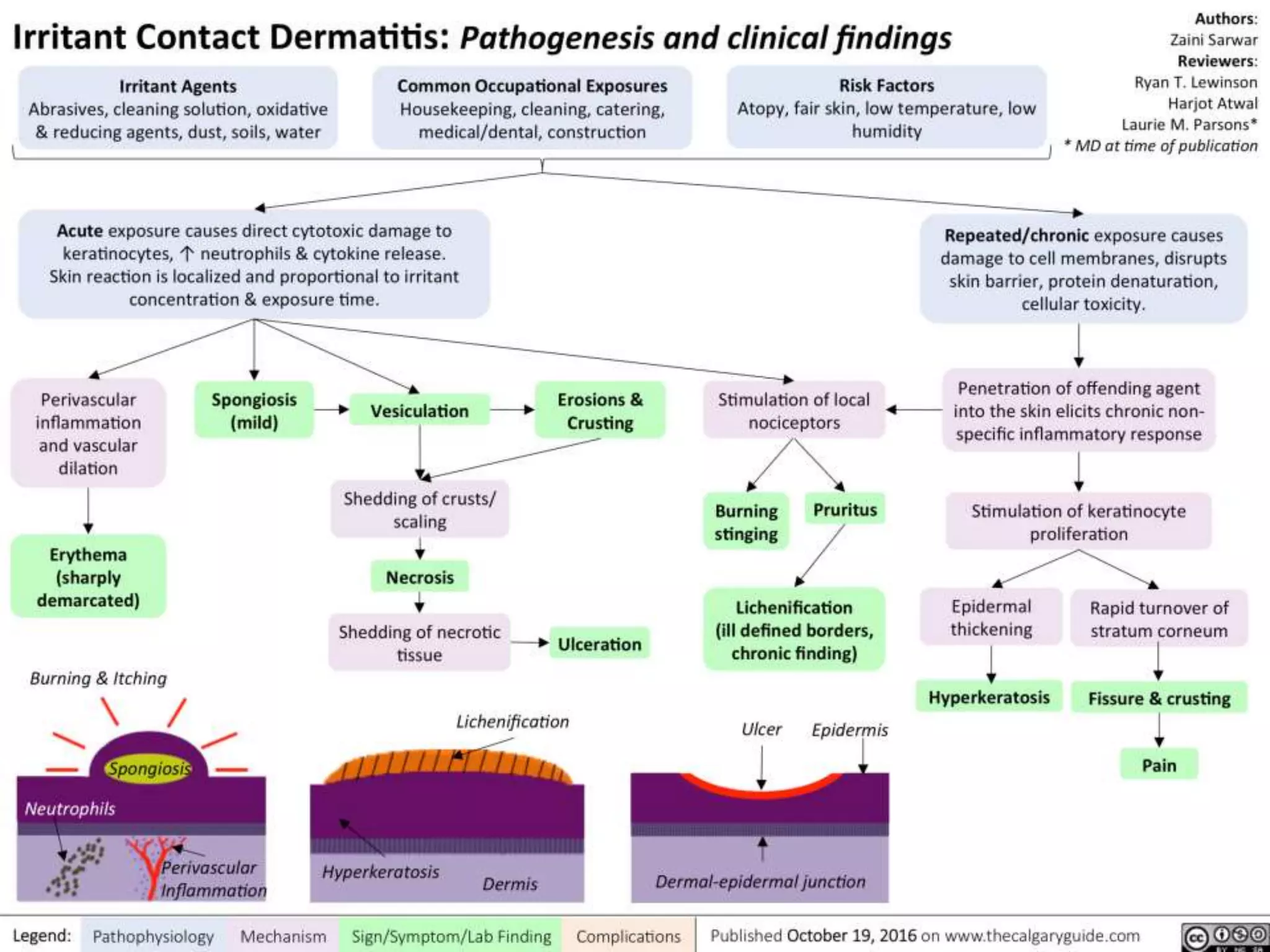
Pathophysiology
Skin barrier dysfunction is a key reason for irritation.
skin provides the first and most important line of defence
many substances penetrate readily into and through the
epidermis
principal epidermal barrier resides almost entirely in the
stratum corneum
Damage to the stratum corneum is normally followed by an
increase in percutaneous absorption and in transepidermal
water loss (TEWL)
lipids are arranged as stacked membrane sheets in the
intercellular space and are produced from lamellar granules
in the cells of the granular cell layer of the epidermis
tight junctions between epidermal cells have also been
shown to provide a block to water loss
filaggrin mutations may predispose to irritant contact
dermatitis
Mechanism of action of irritants
Detergents :
 Destruction of lysosomal enzymes in horny layer causing
dryness and scaling
 signs of chronic inflammation increased DNA synthesis,
acanthosis and changes in cellular metabolism
irritants such as croton oil and phenolesters are chemotactic :
for polymorphonuclear leukocytes at non‐toxic concentrations
may cause pustular reactions.
Organic solvents such as methanol or chloroform: will
damage blood vessels, causing hyperaemia.
dimethyl sulfoxide(DMSO): effective degranulator of mast
cells
barrier disruption has been shown to induce:
release of interleukin 1α (IL‐1α)
upregulation of tumour necrosis factor α
(TNF‐α) and granulocyte–macrophage colony‐stimulating
factor (GM‐CSF).
rise in Langerhans cell‐derived IL‐1α
stimulated by GM‐CSF and IL‐1α production.
the loss of the normal extracellular calcium gradient
stimulates
lamellar body secretion and barrier repair
Oxidative stress also contributes to the development of
inflammation with various
Histopathologic
changes
spongiosis
Perivascular infiltrates
Hyperkeratosis
acanthosis
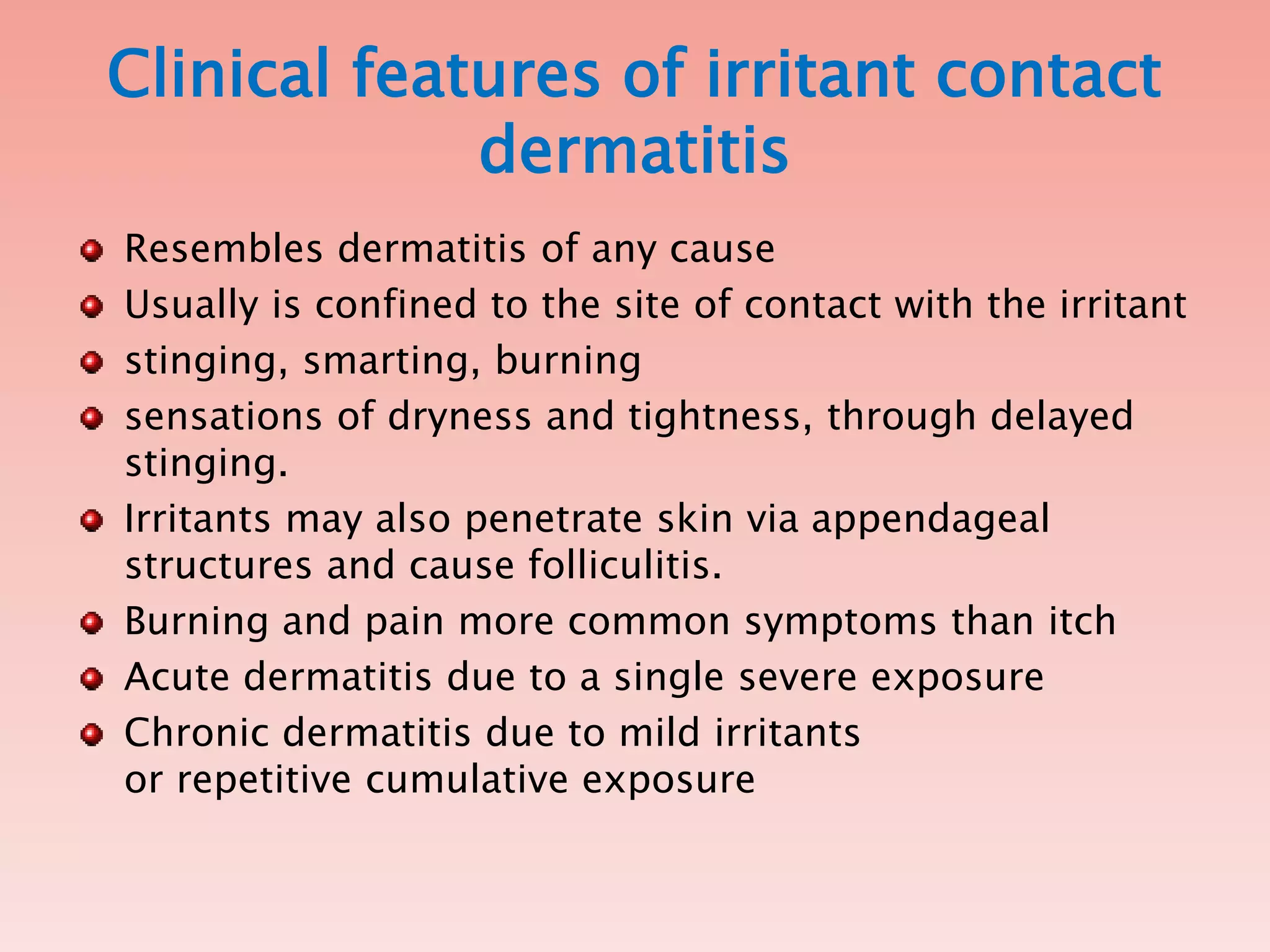
Clinical features of irritant contact
dermatitis
Resembles dermatitis of any cause
Usually is confined to the site of contact with the irritant
stinging, smarting, burning
sensations of dryness and tightness, through delayed
stinging.
Irritants may also penetrate skin via appendageal
structures and cause folliculitis.
Burning and pain more common symptoms than itch
Acute dermatitis due to a single severe exposure
Chronic dermatitis due to mild irritants
or repetitive cumulative exposure
Comparison between changes in acute
and chronic dermatitis
Acute CD
Localised well-defined,
redness, papules,
swelling, blistering
(vesicles/bullae)
Example: kneeling in wet
cement, which is very
alkaline, causing severe
dermatitis of the knees
Chronic CD
Initial dryness and
cracking of the skin
Evolves to
include inflammatory
changes with redness
and itch
May develop tolerance or
hardening with time
Examples include
dribble rash, napkin
dermatitis, housewife’s e
czema, ring dermatitis
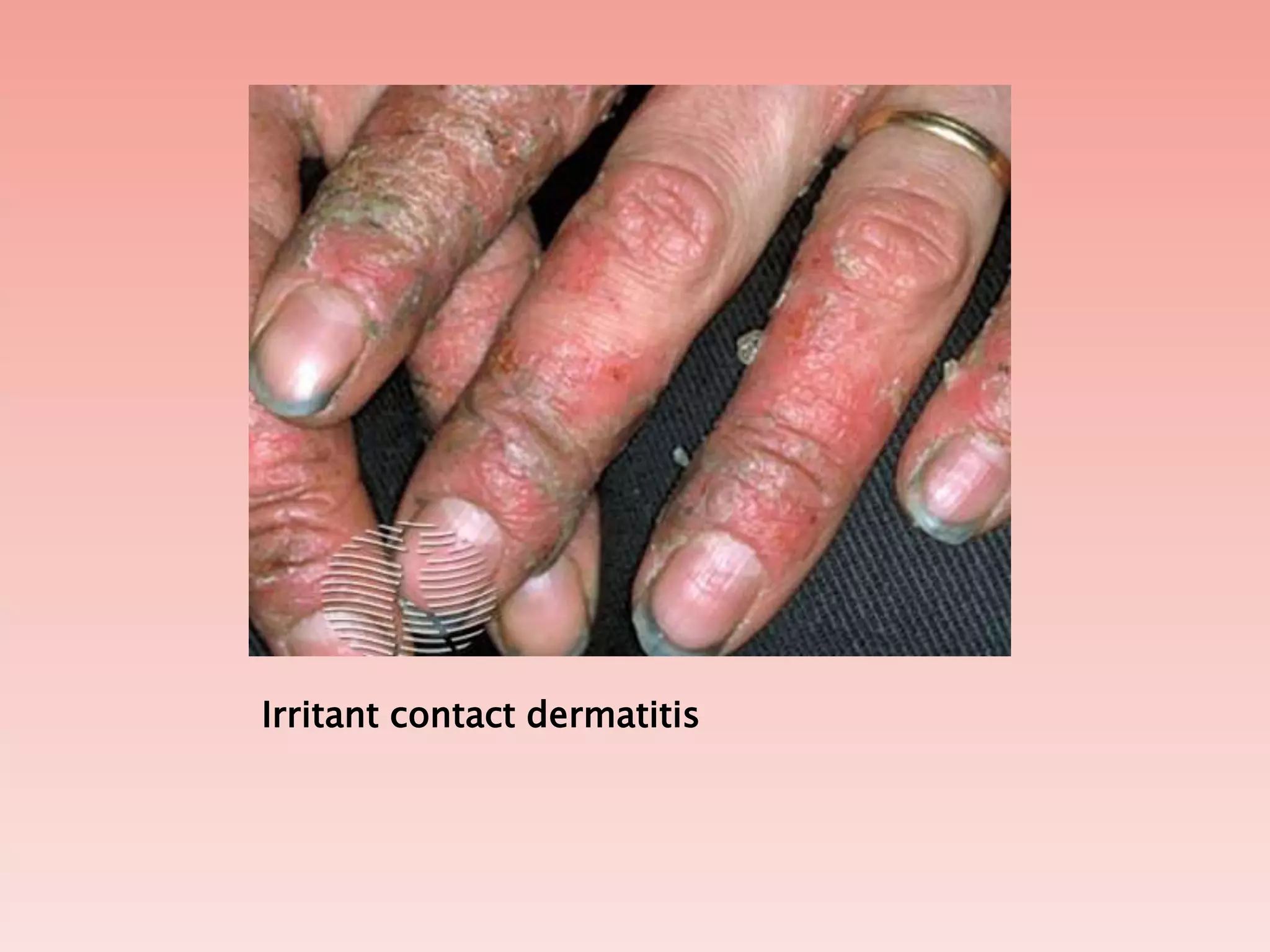
Irritant contact dermatitis
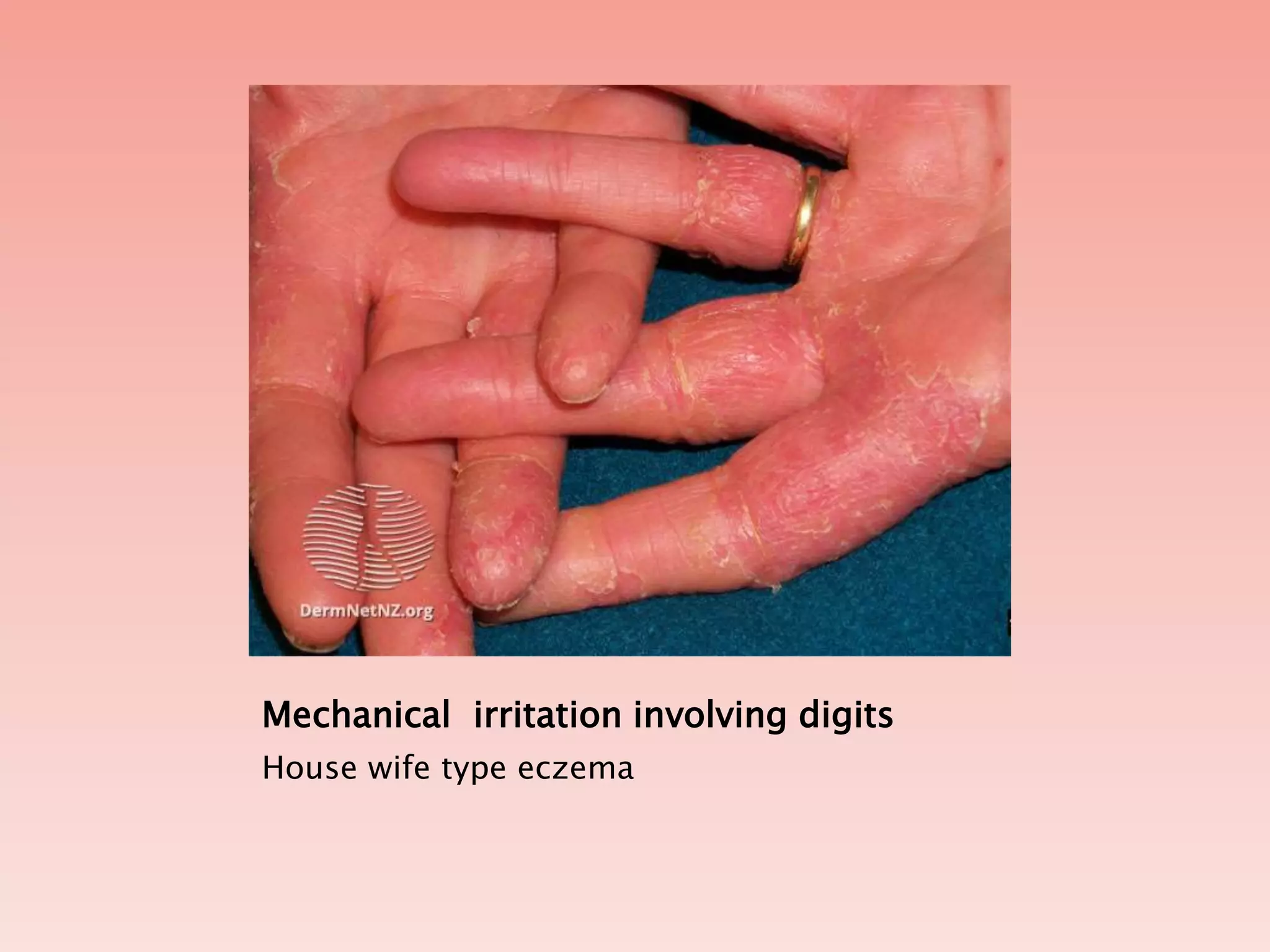
Mechanical irritation involving digits
House wife type eczema
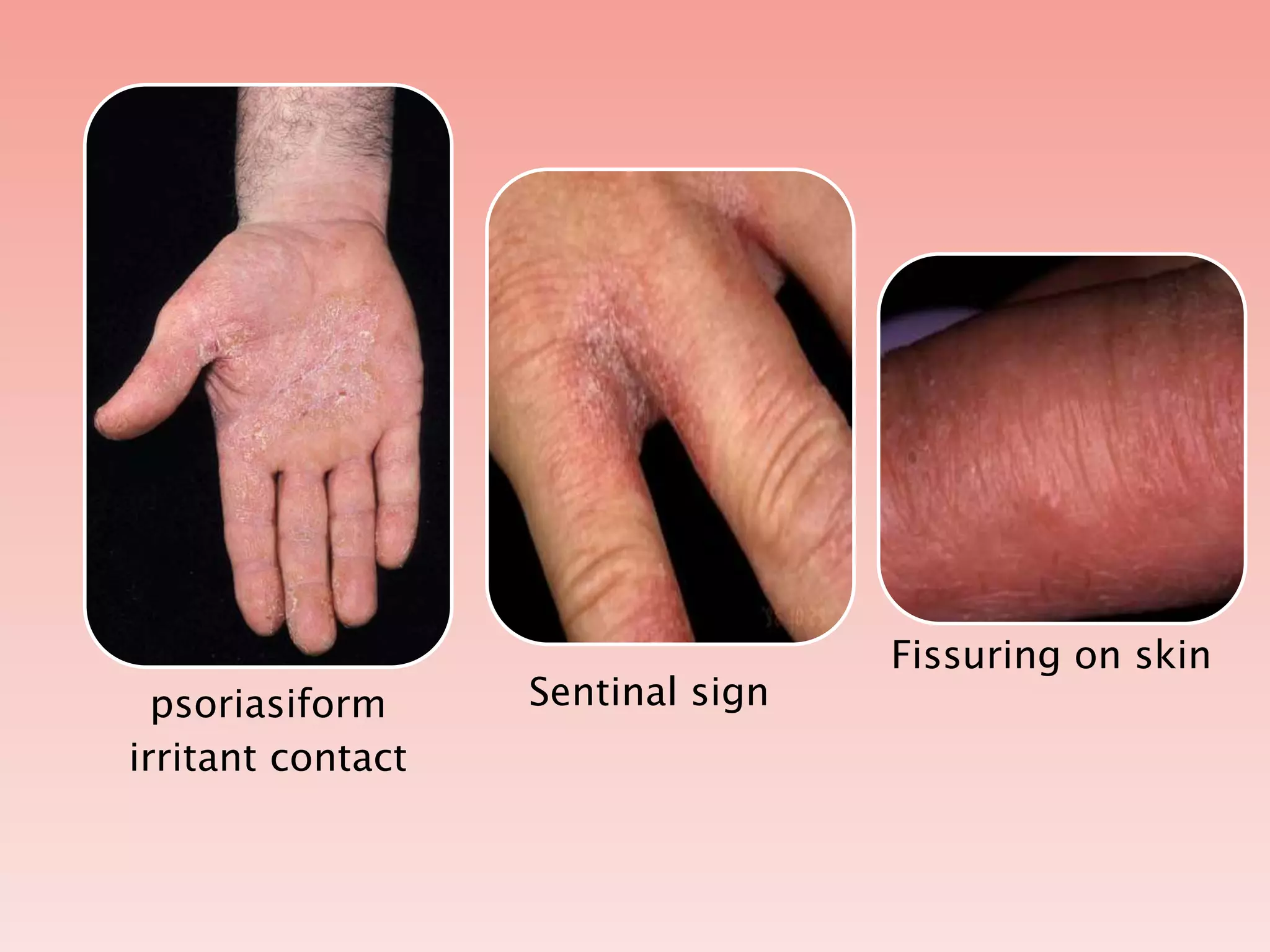
psoriasiform
irritant contact
Sentinal sign
Fissuring on skin
Classification of severity
no objective ways of classify severity
Non‐specific assessment: Dermatology Life Quality
Index (DLQI)
or quantify the irritant response by measuring:
• Erythema
• Transepidermal water loss
• Hydration
• Skin tightness
Interdigital dermatitis, also called the
‘sentinel sign’, is regarded as an early stage
of irritant contact dermatitis affecting the
hands. It is commonly seen in occupations
involving wet work.
Interdigital dermatitis
complications of irritant contact
dermatitis
• Disseminated
secondary
eczema
• Lichenification
• Secondary
bacterial
infections
DE
Diagnosis
Detailed medical history including
occupational exposures
clinical examination.
There is no test for irritant contact dermatitis.
Patch testing may be necessary to distinguish
it from allergic contact dermatitis.
Irritant and allergic contact dermatitis can co-
exist.
Differential diagnosis
• Allergic contact
dermatitis — which
may co-exist
• Other causes of hand
dermatitis such
as atopic hand
dermatitis
• Psoriasis
Treatment
General measures:
Avoidance of all potential
irritants
Emollients
Barrier creams
Specific measures:
Specific treatments for
some chemical irritants eg,
calcium gluconate gel for
hydrogen fluoride burn
Topical medications —
topical
steroids, calcineurin inhibit
ors, crisaborole
Phototherapy.
Irritant contact dermatitis by dr maria saeed

Irritant contact dermatitis by dr maria saeed

  • 1.
  • 2.
    What is irritantcontact dermatitis? Irritant contact dermatitis is a form of skin inflammation caused by contact with substances and/or environmental factors that injure the skin, damaging the skin barrier.
  • 3.
    Types of irritant contactdermatitis Immune mediated Cosmetic dermatitis chelitis Napkin dermatitis Air borne irritant contact dermatitis Non immune mediated Phototoxic contact dermatitis burns Subjective sensory irritation Immediate‐type stinging Delayed‐type stinging
  • 4.
    Introduction and general description Reversiblecellular injury may cause contact urticaria or dermatitis dependent on the nature of the insult. Where there is no apparent cellular injury, various sensory symptoms such as stinging, smarting and burning may occur. The following types of irritant contact reaction may be distinguished: Burns. Irritant contact dermatitis: • Acute (toxic) irritant contact dermatitis. • Cumulative irritant/insult contact dermatitis. Transient or immediate‐type, non‐immune, contact urticaria. Symptomatic (subjective) irritant responses. Other: pigmentary and granulomatous responses and those localized to appendageal structures
  • 6.
    •Irritant hand eczema35% •Atopic hand eczema 22% •Allergic contact dermatitis 19% •soaps (22.0% of cases) •wet work (19.8%) •petroleum •products (8.7%), and cutting oils and coolants (7.8%) Epidemiology • Females may be twice as commonly affected as males sex
  • 7.
    Who gets irritantcontact dermatitis? Irritant contact dermatitis will affect anyone with sufficient exposure to irritants with atopic dermatitis are particularly susceptible. Occupational hand dermatitis is due to irritants in 80% of cases in cleaners, hairdressers, food handlers,and healthcare personnel. Irritant contact dermatitis can affect all age groups, both sexes, and any race.
  • 8.
    What causes irritantcontact dermatitis? Irritant contact dermatitis develops when chemical or physical agents damage the skin surface faster than the skin can repair. Irritants remove oils and natural moisturising factor from the outer layer of the skin, allowing chemical irritants to penetrate the skin barrier and trigger inflammation. common skin irritants 1) water, soaps, and, in the era of COVID-19, hand sanitisers. 2) Occupational irritants can include wet work, detergents, solvents, acids, alkalis, adhesives, and metalworking fluids 3) Topical medications such as retinoids and benzoyl peroxide. 4) Friction, sweating, and heat are examples of environmental factors
  • 9.
    Common irritants 1.Household cleaners 2.Industrial Cleaning agents 3.Alkalis (cement) 4.Water and wet work 5.Acids 6.Cutting oils 7.Oxidizing agent 8.Reducing agents 9.Pesticides 10.Raw food 11.Desiccant powder 12.Miscellan eous chemicals
  • 11.
    Pathophysiology Skin barrier dysfunctionis a key reason for irritation. skin provides the first and most important line of defence many substances penetrate readily into and through the epidermis principal epidermal barrier resides almost entirely in the stratum corneum Damage to the stratum corneum is normally followed by an increase in percutaneous absorption and in transepidermal water loss (TEWL) lipids are arranged as stacked membrane sheets in the intercellular space and are produced from lamellar granules in the cells of the granular cell layer of the epidermis tight junctions between epidermal cells have also been shown to provide a block to water loss filaggrin mutations may predispose to irritant contact dermatitis
  • 13.
    Mechanism of actionof irritants Detergents :  Destruction of lysosomal enzymes in horny layer causing dryness and scaling  signs of chronic inflammation increased DNA synthesis, acanthosis and changes in cellular metabolism irritants such as croton oil and phenolesters are chemotactic : for polymorphonuclear leukocytes at non‐toxic concentrations may cause pustular reactions. Organic solvents such as methanol or chloroform: will damage blood vessels, causing hyperaemia. dimethyl sulfoxide(DMSO): effective degranulator of mast cells
  • 14.
    barrier disruption hasbeen shown to induce: release of interleukin 1α (IL‐1α) upregulation of tumour necrosis factor α (TNF‐α) and granulocyte–macrophage colony‐stimulating factor (GM‐CSF). rise in Langerhans cell‐derived IL‐1α stimulated by GM‐CSF and IL‐1α production. the loss of the normal extracellular calcium gradient stimulates lamellar body secretion and barrier repair Oxidative stress also contributes to the development of inflammation with various
  • 15.
  • 16.
    Clinical features ofirritant contact dermatitis Resembles dermatitis of any cause Usually is confined to the site of contact with the irritant stinging, smarting, burning sensations of dryness and tightness, through delayed stinging. Irritants may also penetrate skin via appendageal structures and cause folliculitis. Burning and pain more common symptoms than itch Acute dermatitis due to a single severe exposure Chronic dermatitis due to mild irritants or repetitive cumulative exposure
  • 17.
    Comparison between changesin acute and chronic dermatitis Acute CD Localised well-defined, redness, papules, swelling, blistering (vesicles/bullae) Example: kneeling in wet cement, which is very alkaline, causing severe dermatitis of the knees Chronic CD Initial dryness and cracking of the skin Evolves to include inflammatory changes with redness and itch May develop tolerance or hardening with time Examples include dribble rash, napkin dermatitis, housewife’s e czema, ring dermatitis
  • 18.
  • 19.
    Mechanical irritation involvingdigits House wife type eczema
  • 20.
  • 21.
    Classification of severity noobjective ways of classify severity Non‐specific assessment: Dermatology Life Quality Index (DLQI) or quantify the irritant response by measuring: • Erythema • Transepidermal water loss • Hydration • Skin tightness
  • 22.
    Interdigital dermatitis, alsocalled the ‘sentinel sign’, is regarded as an early stage of irritant contact dermatitis affecting the hands. It is commonly seen in occupations involving wet work. Interdigital dermatitis
  • 23.
    complications of irritantcontact dermatitis • Disseminated secondary eczema • Lichenification • Secondary bacterial infections DE
  • 24.
    Diagnosis Detailed medical historyincluding occupational exposures clinical examination. There is no test for irritant contact dermatitis. Patch testing may be necessary to distinguish it from allergic contact dermatitis. Irritant and allergic contact dermatitis can co- exist.
  • 25.
    Differential diagnosis • Allergiccontact dermatitis — which may co-exist • Other causes of hand dermatitis such as atopic hand dermatitis • Psoriasis
  • 26.
    Treatment General measures: Avoidance ofall potential irritants Emollients Barrier creams Specific measures: Specific treatments for some chemical irritants eg, calcium gluconate gel for hydrogen fluoride burn Topical medications — topical steroids, calcineurin inhibit ors, crisaborole Phototherapy.