International Research Journal of Engineering and Technology (IRJET) e-ISSN: 2395-0056
Volume: 07 Issue: 03 | Mar 2020 www.irjet.net p-ISSN: 2395-0072
© 2020, IRJET | Impact Factor value: 7.34 | ISO 9001:2008 Certified Journal | Page 3117
Single Image Super Resolution Using Machine Learning
Patel Safiyabegum1, Kulkarni Nikita2, Galate Alfa3, SabungarAnzalnagohar4, Khan Asiya5
1,2,3,4Student, Dept of Computer Science & Engineering, BMIT, Solapur, Maharashtra, India
5Professor, BMIT college of Engineering, Solapur, Maharashtra, India
---------------------------------------------------------------------***----------------------------------------------------------------------
Abstract - High resolution (HR) image reconstruction from
single low-resolution (LR) image is one of the most important
vision applications. Despite numerous algorithms have been
successfully proposed in recent years, efficient and robust
single image super resolution (SISR) reconstruction is still
challenging by several factors, such as inherent ambiguous
mapping between the HR and LR images, necessary use
exemplar images, andcomputationalload. Thispaperpresents
the single image super resolution algorithm which mainly
focuses on constructing a high quality and high-resolution
image from a low resolution, low quality image. It is useful in
many cases like medical imaging, satellite imaging,
surveillance, crime investigation and video applications etc.
Key Words: Super Resolution, Image Reconstruction,
Single Image Resolution Techniques, Resolution
enhancement.
I. INTRODUCTION
This project focuses on image super resolution to enhance
the quality of images by taking one low resolution image as
input and producing a high-quality image as a output. The
main advantage of using this algorithm is cost efficiency.It is
beneficial in areas like satellite produced images,
surveillance images from borders,crimeinvestigationand in
disease diagnose. The system uses FANN (Fastest Artificial
Neural Network) to map the resolutions of image. Before
mapping the system it retrieves the values of pixels,
PSNR(Peak Signal-To-Noise Ratio) and mean square
error(MSE) in image and trains itself to reducethenoiseand
errors from image and performs down sampling, up scaling
on image and generates datasets and stores in files color-
wise and then the datasets are given to neural network to
process and this process continues till it getsthesatisfactory
results and produces a high quality image to the user .
II. LITERATURE REVIEW
This system accepts low resolution image (i.e. noisy image,
blur parts etc.), system starts to capture the details of image.
The system itself makes multiple images which captures
different details of image and tries to find out patterns,
quality, contrast of image etc. The system takes small blocks
of image (16 * 16) and then it calculates noise ratio and
generates data sets those data sets are passed to neural
network and processed and generates a bicubic image from
blocks of input image. During this process actual loss of bits
in values is calculated. Once done with this stage the bicubic
image is given as input to ANN which in turn does the same
processing and generates a high-quality image.
This paper represents a fastest artificial neural network
algorithm which works so efficiently and gives maximum
throughput in less amount of time. The algorithm
automatically finds outs the edges corners, color contrast,
blurry part , noisy part from image . While performingimage
generation in high quality neural network creates a blank
image and transfers data calculated on data sets generated
and fill the blocks using nearest neighbor technique. This
whole system is divided into two parts namely train model
and then test model while training model has many small
modules.
1. Train model
Nowadays technology has emerged and grown a lot, having
high quality images has become necessity especiallyinareas
like defense, security, medical and crime investigation
departments having highly configured systems in dayto day
life even for general systems (public places,stores,shopping
malls) is difficult as it becomes expensive and requires high
maintenance. This project overcomes this drawback and
provides high resolution images in less time.
To train model the first task is to take low resolution images
and high-resolution images, after this step the next step isto
retrieve pixel values color wise and stores in 3 different files
(datasets). After these two steps next step is to create a
neural network by specifying numberofinputlayers,hidden
layers and output layers, learning rate after these datasets
are fed into the neural network and model starts to train
learns the difference between high and low resolution
images. Apart from this it detects the different edges of an
image and uses different methods and generates bicubic
image and does same processingon bicubicimageandlearns
aspects of image. This system can take images of any object
like human faces, animals, nature, image from a video like
from CCTV footage etc.
2. Test model
Second main part is to test the system. While testing on an
image user can give any low-resolution image as input and
user will get a high-resolution image as output. It gives
satisfactory results.
III. METHODOLOGY
i. FILTERING
At the beginning, images has to be inputted into the system
and it creates 16 x 16 blocks of image to capture each and
International Research Journal of Engineering and Technology (IRJET) e-ISSN: 2395-0056
Volume: 07 Issue: 03 | Mar 2020 www.irjet.net p-ISSN: 2395-0072
© 2020, IRJET | Impact Factor value: 7.34 | ISO 9001:2008 Certified Journal | Page 3118
every minor detail of image and simultaneously system
resizes those 16 x 16 blocks into 8 x 8 blocks to learn the
difference of pixel value finds PSNR(Peak signal to noise
ratio) values and store pixel values into files that files are
called datasets.
Datasets are stored in RGB color format, that generated
datasets are the main root of the project as it uses
supervised type learning data is labeled and classifying
image values color-wise makes system work faster. These
generated datasets are passed to ANN (artificial neural
network).
ii. BICUBIC INTERPOLATION
Image interpolation is the process of converting the image
from one resolution to other resolution. This process is
performed on a one-dimension basis row by row and then
column by column. Image interpolation estimates the
intermediate pixel between the known pixels by using
different interpolationkernel.Bi-cubic InterpolationIncubic
interpolation intensity at point is estimated from the
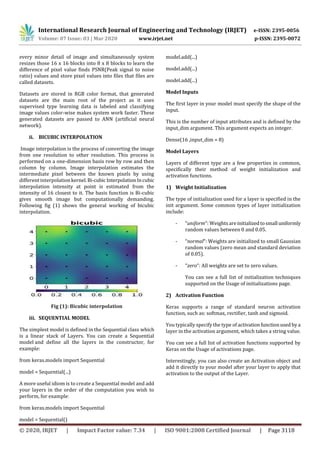
intensity of 16 closest to it. The basis function is Bi-cubic
gives smooth image but computationally demanding.
Following fig (1) shows the general working of bicubic
interpolation.
Fig (1): Bicubic interpolation
iii. SEQUENTIAL MODEL
The simplest model is defined in the Sequential class which
is a linear stack of Layers. You can create a Sequential
model and define all the layers in the constructor, for
example:
from keras.models import Sequential
model = Sequential(...)
A more useful idiom is to create a Sequential model and add
your layers in the order of the computation you wish to
perform, for example:
from keras.models import Sequential
model = Sequential()
model.add(...)
model.add(...)
model.add(...)
Model Inputs
The first layer in your model must specify the shape of the
input.
This is the number of input attributes and is defined by the
input_dim argument. This argument expects an integer.
Dense(16 ,input_dim = 8)
Model Layers
Layers of different type are a few properties in common,
specifically their method of weight initialization and
activation functions.
1) Weight Initialization
The type of initialization used for a layer is specified in the
init argument. Some common types of layer initialization
include:
- “uniform“: Weightsareinitializedtosmall uniformly
random values between 0 and 0.05.
- “normal“: Weights are initialized to small Gaussian
random values (zero mean and standard deviation
of 0.05).
- “zero“: All weights are set to zero values.
You can see a full list of initialization techniques
supported on the Usage of initializations page.
2) Activation Function
Keras supports a range of standard neuron activation
function, such as: softmax, rectifier, tanh and sigmoid.
You typically specify the type of activationfunctionused bya
layer in the activation argument, which takes a string value.
You can see a full list of activation functions supported by
Keras on the Usage of activations page.
Interestingly, you can also create an Activation object and
add it directly to your model after your layer to apply that
activation to the output of the Layer.
International Research Journal of Engineering and Technology (IRJET) e-ISSN: 2395-0056
Volume: 07 Issue: 03 | Mar 2020 www.irjet.net p-ISSN: 2395-0072
© 2020, IRJET | Impact Factor value: 7.34 | ISO 9001:2008 Certified Journal | Page 3119
3) Layer Types
There are large number of core Layer typesforstandard
neural networks. Some common and useful layer types
you can choose from are:
 Dense: Fully connectedlayerandthemostcommon
type of layer used on multi-layer perceptron
models.
 Dropout: Apply dropout to the model, setting a
fraction of inputs to zero to reduce over fitting.
 Merge: Combine the inputs from multiple models
into a single model.
 You can learn about the full list of core Keras layers
on the Core Layers page
Model Compilation
Once you have defined your model, it needs to be compiled.
This creates the efficient structures used by the underlying
backend (Theano or TensorFlow) in order to efficiently
execute your model during training.
You compile your model using the compile() function and it
accepts three important attributes:
1. Model optimizer.
2. Loss function.
3. Metrics.
model.compile(optimizer=, loss=, metrics=)
Model Prediction
Once you have trained your model, you can use it to make
predictions on test data or new data.
There are number of different outputtypesyoucancalculate
from your trained model, each calculated using a different
function call on your model object. For example:
 model.evaluate(): To calculate the loss values for
input data.
 model.predict(): To generate network output for
input data.
 model.predict_classes(): To generate class outputs
for input data.
 model.predict_proba(): To generate class
probabilities for input data
Summarize the Model
Once you are happy with your model you can finalize it. You
may wish to output a summary of your model. For example,
you can display a summary of a model by calling the
summary function, for example :
Model.summary()
IV. RESULT
V. CONCLUSIONS
1. We have constructed a deep neural network to
process and enhance quality of images .The major
advantage of the super resolutionapproachisthatit
may cost less and the existing LR imaging systems
can be still utilized.
2. Synthetic zooming of region of interest (ROI) is
another important application surveillance,
forensic, scientific, medical, and satellite imaging.
3. This application is most suitable for magnifying
objects in the scene such as the face of a criminal or
the license plate of a car.
VI. ACKNOWLEDGEMENT
This research was supported by BMIT collegeof engineering
Solapur. We are thankful to our guide
Prof. Asiya Khan who provided her expertise in Machine
Learning area that greatly assisted to perform the research.
VII. REFERENCES
[1] https://ieeexplore.ieee.org/document/7802119
[2] https://ieeexplore.ieee.org/document/5459271
[3] https://medium.com/@birla.deepak26/single-image-
super-resolution-using-gans-keras-aca310f33112
[4] https://medium.com/@jonathan_hui/gan-super-
resolution-gan-srgan-b471da7270ec

IRJET - Single Image Super Resolution using Machine Learning

  • 1.
    International Research Journalof Engineering and Technology (IRJET) e-ISSN: 2395-0056 Volume: 07 Issue: 03 | Mar 2020 www.irjet.net p-ISSN: 2395-0072 © 2020, IRJET | Impact Factor value: 7.34 | ISO 9001:2008 Certified Journal | Page 3117 Single Image Super Resolution Using Machine Learning Patel Safiyabegum1, Kulkarni Nikita2, Galate Alfa3, SabungarAnzalnagohar4, Khan Asiya5 1,2,3,4Student, Dept of Computer Science & Engineering, BMIT, Solapur, Maharashtra, India 5Professor, BMIT college of Engineering, Solapur, Maharashtra, India ---------------------------------------------------------------------***---------------------------------------------------------------------- Abstract - High resolution (HR) image reconstruction from single low-resolution (LR) image is one of the most important vision applications. Despite numerous algorithms have been successfully proposed in recent years, efficient and robust single image super resolution (SISR) reconstruction is still challenging by several factors, such as inherent ambiguous mapping between the HR and LR images, necessary use exemplar images, andcomputationalload. Thispaperpresents the single image super resolution algorithm which mainly focuses on constructing a high quality and high-resolution image from a low resolution, low quality image. It is useful in many cases like medical imaging, satellite imaging, surveillance, crime investigation and video applications etc. Key Words: Super Resolution, Image Reconstruction, Single Image Resolution Techniques, Resolution enhancement. I. INTRODUCTION This project focuses on image super resolution to enhance the quality of images by taking one low resolution image as input and producing a high-quality image as a output. The main advantage of using this algorithm is cost efficiency.It is beneficial in areas like satellite produced images, surveillance images from borders,crimeinvestigationand in disease diagnose. The system uses FANN (Fastest Artificial Neural Network) to map the resolutions of image. Before mapping the system it retrieves the values of pixels, PSNR(Peak Signal-To-Noise Ratio) and mean square error(MSE) in image and trains itself to reducethenoiseand errors from image and performs down sampling, up scaling on image and generates datasets and stores in files color- wise and then the datasets are given to neural network to process and this process continues till it getsthesatisfactory results and produces a high quality image to the user . II. LITERATURE REVIEW This system accepts low resolution image (i.e. noisy image, blur parts etc.), system starts to capture the details of image. The system itself makes multiple images which captures different details of image and tries to find out patterns, quality, contrast of image etc. The system takes small blocks of image (16 * 16) and then it calculates noise ratio and generates data sets those data sets are passed to neural network and processed and generates a bicubic image from blocks of input image. During this process actual loss of bits in values is calculated. Once done with this stage the bicubic image is given as input to ANN which in turn does the same processing and generates a high-quality image. This paper represents a fastest artificial neural network algorithm which works so efficiently and gives maximum throughput in less amount of time. The algorithm automatically finds outs the edges corners, color contrast, blurry part , noisy part from image . While performingimage generation in high quality neural network creates a blank image and transfers data calculated on data sets generated and fill the blocks using nearest neighbor technique. This whole system is divided into two parts namely train model and then test model while training model has many small modules. 1. Train model Nowadays technology has emerged and grown a lot, having high quality images has become necessity especiallyinareas like defense, security, medical and crime investigation departments having highly configured systems in dayto day life even for general systems (public places,stores,shopping malls) is difficult as it becomes expensive and requires high maintenance. This project overcomes this drawback and provides high resolution images in less time. To train model the first task is to take low resolution images and high-resolution images, after this step the next step isto retrieve pixel values color wise and stores in 3 different files (datasets). After these two steps next step is to create a neural network by specifying numberofinputlayers,hidden layers and output layers, learning rate after these datasets are fed into the neural network and model starts to train learns the difference between high and low resolution images. Apart from this it detects the different edges of an image and uses different methods and generates bicubic image and does same processingon bicubicimageandlearns aspects of image. This system can take images of any object like human faces, animals, nature, image from a video like from CCTV footage etc. 2. Test model Second main part is to test the system. While testing on an image user can give any low-resolution image as input and user will get a high-resolution image as output. It gives satisfactory results. III. METHODOLOGY i. FILTERING At the beginning, images has to be inputted into the system and it creates 16 x 16 blocks of image to capture each and
  • 2.
    International Research Journalof Engineering and Technology (IRJET) e-ISSN: 2395-0056 Volume: 07 Issue: 03 | Mar 2020 www.irjet.net p-ISSN: 2395-0072 © 2020, IRJET | Impact Factor value: 7.34 | ISO 9001:2008 Certified Journal | Page 3118 every minor detail of image and simultaneously system resizes those 16 x 16 blocks into 8 x 8 blocks to learn the difference of pixel value finds PSNR(Peak signal to noise ratio) values and store pixel values into files that files are called datasets. Datasets are stored in RGB color format, that generated datasets are the main root of the project as it uses supervised type learning data is labeled and classifying image values color-wise makes system work faster. These generated datasets are passed to ANN (artificial neural network). ii. BICUBIC INTERPOLATION Image interpolation is the process of converting the image from one resolution to other resolution. This process is performed on a one-dimension basis row by row and then column by column. Image interpolation estimates the intermediate pixel between the known pixels by using different interpolationkernel.Bi-cubic InterpolationIncubic interpolation intensity at point is estimated from the intensity of 16 closest to it. The basis function is Bi-cubic gives smooth image but computationally demanding. Following fig (1) shows the general working of bicubic interpolation. Fig (1): Bicubic interpolation iii. SEQUENTIAL MODEL The simplest model is defined in the Sequential class which is a linear stack of Layers. You can create a Sequential model and define all the layers in the constructor, for example: from keras.models import Sequential model = Sequential(...) A more useful idiom is to create a Sequential model and add your layers in the order of the computation you wish to perform, for example: from keras.models import Sequential model = Sequential() model.add(...) model.add(...) model.add(...) Model Inputs The first layer in your model must specify the shape of the input. This is the number of input attributes and is defined by the input_dim argument. This argument expects an integer. Dense(16 ,input_dim = 8) Model Layers Layers of different type are a few properties in common, specifically their method of weight initialization and activation functions. 1) Weight Initialization The type of initialization used for a layer is specified in the init argument. Some common types of layer initialization include: - “uniform“: Weightsareinitializedtosmall uniformly random values between 0 and 0.05. - “normal“: Weights are initialized to small Gaussian random values (zero mean and standard deviation of 0.05). - “zero“: All weights are set to zero values. You can see a full list of initialization techniques supported on the Usage of initializations page. 2) Activation Function Keras supports a range of standard neuron activation function, such as: softmax, rectifier, tanh and sigmoid. You typically specify the type of activationfunctionused bya layer in the activation argument, which takes a string value. You can see a full list of activation functions supported by Keras on the Usage of activations page. Interestingly, you can also create an Activation object and add it directly to your model after your layer to apply that activation to the output of the Layer.
  • 3.
    International Research Journalof Engineering and Technology (IRJET) e-ISSN: 2395-0056 Volume: 07 Issue: 03 | Mar 2020 www.irjet.net p-ISSN: 2395-0072 © 2020, IRJET | Impact Factor value: 7.34 | ISO 9001:2008 Certified Journal | Page 3119 3) Layer Types There are large number of core Layer typesforstandard neural networks. Some common and useful layer types you can choose from are:  Dense: Fully connectedlayerandthemostcommon type of layer used on multi-layer perceptron models.  Dropout: Apply dropout to the model, setting a fraction of inputs to zero to reduce over fitting.  Merge: Combine the inputs from multiple models into a single model.  You can learn about the full list of core Keras layers on the Core Layers page Model Compilation Once you have defined your model, it needs to be compiled. This creates the efficient structures used by the underlying backend (Theano or TensorFlow) in order to efficiently execute your model during training. You compile your model using the compile() function and it accepts three important attributes: 1. Model optimizer. 2. Loss function. 3. Metrics. model.compile(optimizer=, loss=, metrics=) Model Prediction Once you have trained your model, you can use it to make predictions on test data or new data. There are number of different outputtypesyoucancalculate from your trained model, each calculated using a different function call on your model object. For example:  model.evaluate(): To calculate the loss values for input data.  model.predict(): To generate network output for input data.  model.predict_classes(): To generate class outputs for input data.  model.predict_proba(): To generate class probabilities for input data Summarize the Model Once you are happy with your model you can finalize it. You may wish to output a summary of your model. For example, you can display a summary of a model by calling the summary function, for example : Model.summary() IV. RESULT V. CONCLUSIONS 1. We have constructed a deep neural network to process and enhance quality of images .The major advantage of the super resolutionapproachisthatit may cost less and the existing LR imaging systems can be still utilized. 2. Synthetic zooming of region of interest (ROI) is another important application surveillance, forensic, scientific, medical, and satellite imaging. 3. This application is most suitable for magnifying objects in the scene such as the face of a criminal or the license plate of a car. VI. ACKNOWLEDGEMENT This research was supported by BMIT collegeof engineering Solapur. We are thankful to our guide Prof. Asiya Khan who provided her expertise in Machine Learning area that greatly assisted to perform the research. VII. REFERENCES [1] https://ieeexplore.ieee.org/document/7802119 [2] https://ieeexplore.ieee.org/document/5459271 [3] https://medium.com/@birla.deepak26/single-image- super-resolution-using-gans-keras-aca310f33112 [4] https://medium.com/@jonathan_hui/gan-super- resolution-gan-srgan-b471da7270ec