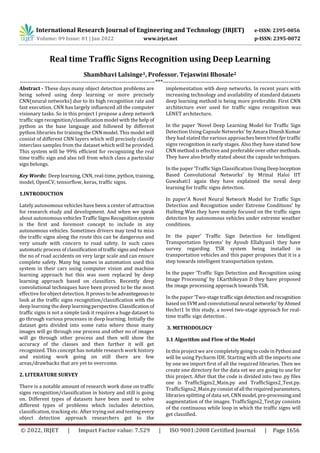
International Research Journal of Engineering and Technology (IRJET) e-ISSN: 2395-0056
Volume: 09 Issue: 01 | Jan 2022 www.irjet.net p-ISSN: 2395-0072
© 2022, IRJET | Impact Factor value: 7.529 | ISO 9001:2008 Certified Journal | Page 1656
Real time Traffic Signs Recognition using Deep Learning
Shambhavi Lalsinge1, Professor. Tejaswini Bhosale2
---------------------------------------------------------------------***----------------------------------------------------------------------
Abstract - These days many object detection problems are
being solved using deep learning or more precisely
CNN(neural networks) due to its high recognition rate and
fast execution. CNN has largely influenced all the computer
visionary tasks. So in this project I propose a deep network
traffic sign recognition/classification model with the help of
python as the base language and followed by different
python libraries for training the CNN model. This model will
consist of different CNN layers which will precisely classify
interclass samples from the dataset which will be provided.
This system will be 99% efficient for recognizing the real
time traffic sign and also tell from which class a particular
sign belongs.
Key Words: Deep learning, CNN, real-time, python,training,
model, OpenCV, tensorflow, keras, traffic signs.
1.INTRODUCTION
Lately autonomous vehicles have been a center of attraction
for research study and development. And when we speak
about autonomous vehicles Traffic SignsRecognitionsystem
is the first and foremost concept to include in any
autonomous vehicles. Sometimes drivers may tend to miss
the traffic signs along the route this can be dangerous and
very unsafe with concern to road safety. In such cases
automatic process of classification oftraffic signsandreduce
the no of road accidents on very large scale and can ensure
complete safety. Many big names in automation used this
system in their cars using computer vision and machine
learning approach but this was soon replaced by deep
learning approach based on classifiers. Recently deep
convolutional techniques have been proved to be the most
effective for object detection. Itprovesto beadvantegeous to
look at the traffic signs recognition/classification with the
deep learning the deep learningperspective. Classificationof
traffic signs is not a simple task it requires a huge dataset to
go through various processes in deep learning. Initially the
dataset gets divided into some ratio where those many
images will go through one process and other no of images
will go through other process and then will show the
accuracy of the classes and then further it will get
recognized. This concept has notable research work history
and existing work going on still there are few
areas/drawbacks that are yet to overcome.
2. LITERATURE SURVEY
There is a notable amount of research work done on traffic
signs recognition/classification in history and still is going
on. Different types of datasets have been used to solve
different types of problems which includes detection,
classification, tracking etc. After trying out and testing every
object detection approach researchers got to the
implementation with deep networks. In recent years with
increasing technology and availability of standard datasets
deep learning method is being more preferable. First CNN
architecture ever used for traffic signs recognition was
LENET architecture.
In the paper ‘Novel Deep Learning Model for Traffic Sign
Detection Using Capsule Networks’ by Amara DineshKumar
they had stated the various approaches been tried fpr traffic
signs recognition in early stages. Also they have stated how
CNN method is effective and preferable over other methods.
They have also briefly stated about the capsule techniques.
In the paper ‘Traffic Sign Classification UsingDeepInception
Based Convolutional Networks’ by Mrinal Haloi IIT
Guwahati1 again they have explained the noval deep
learning for traffic signs detection.
In paper’A Novel Neural Network Model for Traffic Sign
Detection and Recognition under Extreme Conditions’ by
Haifeng Wan they have mainly focused on the traffic signs
detection by autonomous vehicles under extreme weather
conditions.
In the paper’ Traffic Sign Detection for Intelligent
Transportation Systems’ by Ayoub Ellahyani1 they have
survey regarding TSR system being installed in
transportation vehicles and this paper proposes that it is a
step towards intelligent transportation system.
In the paper ‘Traffic Sign Detection and Recognition using
Image Processing’ by 1Karthikeyan D they have proposed
the image processing approach towards TSR.
In the paper ‘Two-stagetrafficsigndetectionandrecognition
based on SVM and convolutional neural networks’ byAhmed
Hechri1 In this study, a novel two-stage approach for real-
time traffic sign detection .
3. METHODOLOGY
3.1 Algorithm and Flow of the Model
In this project we are completely goingtocodeinPythonand
will be using Pycharm IDE. Starting with all the imports one
by one we import first of all the required libraries. Then we
create one directory for the data set we are going to use for
this project. After that the code is divided into two .py files
one is TrafficSigns2_Main.py and TrafficSigns2_Test.py.
TrafficSigns2_Main.py consistofall therequiredparameters,
libraries splitting of data set, CNN model,pre-processingand
augmentation of the images. TrafficSigns2_Test.py consists
of the continuous while loop in which the traffic signs will
get classified.
International Research Journal of Engineering and Technology (IRJET) e-ISSN: 2395-0056
Volume: 09 Issue: 01 | Jan 2022 www.irjet.net p-ISSN: 2395-0072
© 2022, IRJET | Impact Factor value: 7.529 | ISO 9001:2008 Certified Journal | Page 1657
In TrafficSigns2_Main.py starting with importing all the
libraries. Then followed by specifying some parameters for
processing the data set like defining the path for the dataset
and csv labels file, setting the image dimensions, epochs,
validation ratio etc. Then we import the images that will
basically detect the no of classes and import all the images
.After that we split the data into test and validation the ratio
is previously defined in the parameters. And we store the
images in all the x variables and all the labels in y variable.
Then we check if the no of images matches the no of labelsin
the data set.
Then we read our csv file and then we are going to plot and
visualize and see if we are collecting the correct data and
classifying it properly before we start the training process.
Moving on we are preprocessing our images converting it
into the grayscale and then equalizing it for the sake of
standardization. And store this preprocessed images in x
variable. Then at the end of it we are going to create our
convolutional model. There after we compile the model and
immediately the training starts. Once the training is done it
will show us our plot of the trained model. It will mainly plot
the validation loss and accuracy. Then we test our testing
dataset and export the score.
In TrafficSigns2_Test.py we also have imported some
libraries. Then we simply set the parameters like threshold
and framesizes. After that we set thecamera parameters.We
setup our camera and then we import the trained model file.
Then we again preprocess the images as wedidbefore.Then
we have our class names so that it getsdisplayedandcoming
to the end we have created a while loop that will
continuously run to give us our web camera imagesin which
it will predict the image and the class name and the
probability percentage of classification being accurate.
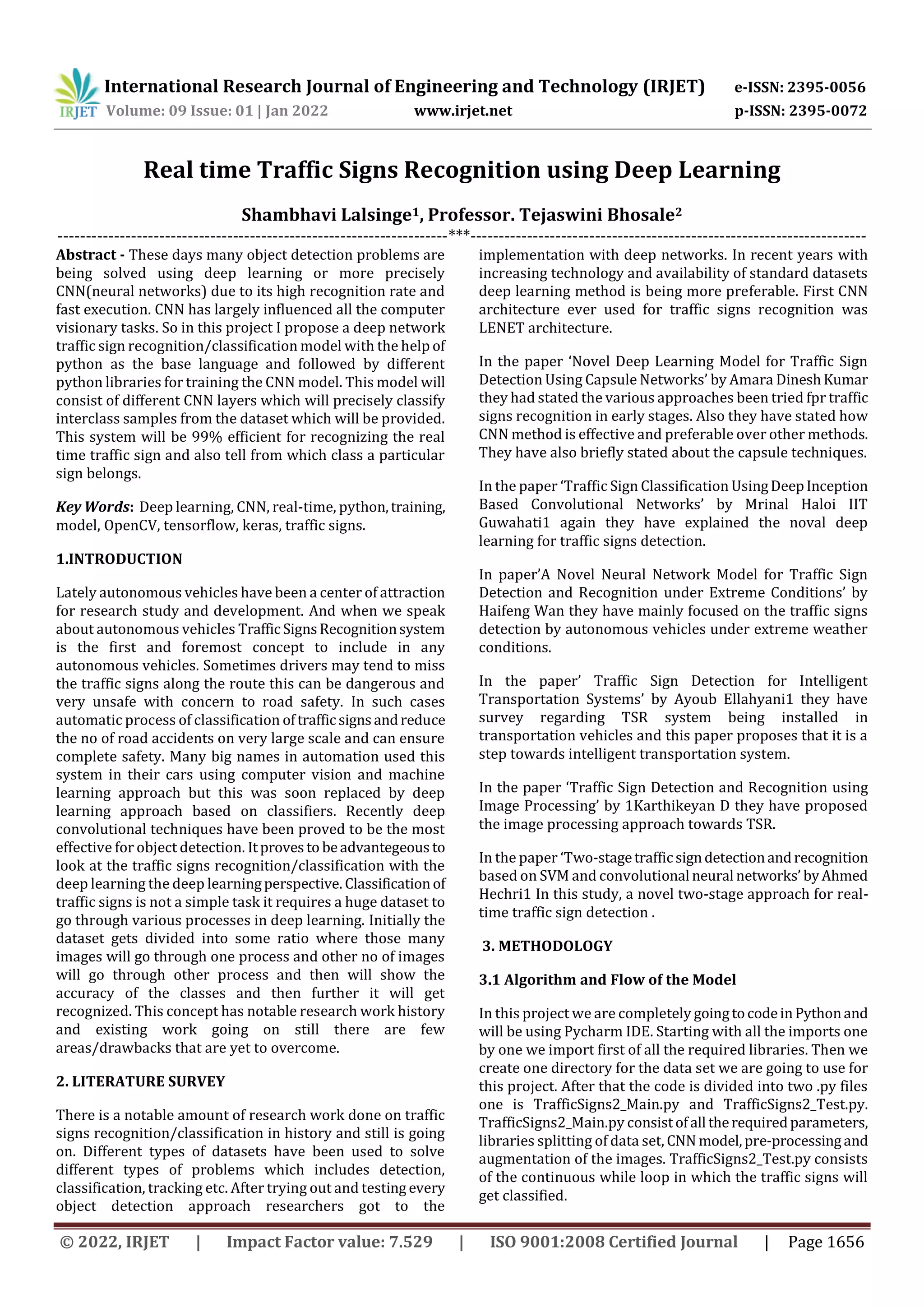
3.2 CNN Model Architecture
In the TrafficSigns2_Main.py we have also created the CNN
model .We have used the LeNet architecture for the model
here with few modifications. Themodel originallyconsistsof
total 7 layers. The layers consists of 3 convolutional layers,2
subsampling layers and 2 fully connected layers. First layer
is the input layer then there are 2 subsampling layers also
known as maxpooling layer thereafter it has the fully
connected layer and then lastly the output layer. Sobasically
CNN has layer division as 3 types namely convolutional
layers(Conv2D),pooling layers(Maxpooling2D) and fully
connected layers.(fig.1)
Fig.1 Standard LeNet Architecture
In fig.2 denotes the layers in a particular convolutional
model. It takes the images as input then breaks down the
images in small packets using the convolutional and pooling
layers and then finally with the help offullyconnectedlayers
classification takes place and then we see the particular
output.
Fig.2 CNN model architecture
In this particular project we have used LeNet architectureas
mentioned before. In this model we have few convolutional
layers, few pooling layers then we have few dropout layers
and at the end we have a dense layer which is nothing but
our output layer.
4. RESULTS AND DISCUSSIONS
When we run the main.py where training,splitting and
augmentation of the images is taking place.So firstly it will
detect the no of classes data set has so this particulardataset
has 43 classes detected and thereafter it will import each
class folder one by on e and it will put all of these in one
matrix with a corresponding class ID.After that it will split
tha data into training,testing and validation so here certain
no of images go for training certain for testing and some for
validation as shown in the fig.3 it has around 22000 images
for training,5000 images for validation and 6000 images for
testing.
Fig.3 Splitting of dataset
International Research Journal of Engineering and Technology (IRJET) e-ISSN: 2395-0056
Volume: 09 Issue: 01 | Jan 2022 www.irjet.net p-ISSN: 2395-0072
© 2022, IRJET | Impact Factor value: 7.529 | ISO 9001:2008 Certified Journal | Page 1658
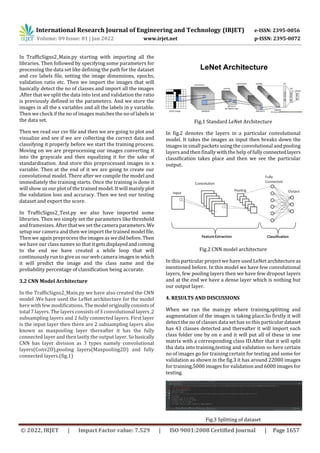
Once the splitting is done it will show the distribution of the
training dataset in graphical form.Studying this training
distribution it is important to know that we do not have
same no of images for each class.So as we can see in fig.4 we
have about 100 images for first class and similarly we have
about 1300 images for another class it clearly implies that
the distribution is not even so this may result in good
classification for one class and bad classification for another
class because the dataset is not evenly distributed for each
class.
Fig.4 Training Distribution
Fig.5 Each Class with Corresponding Label
Once this is done the pre-processing of the images will take
place that is the images will get converted to grayscaleandit
will show us one example augmented image so thattocheck
that the preprocessing is done properly.
Fig.6 One Example Augmented Image
After compiling the model(fig.7)thetraining will startfor the
10 epochs as parameter declared before and 2000 steps per
epochs.So 2000 images will train for 10 iterations to give
accuracy and loss of the model(fig.8).
Fig.7 CNN Model
Fig. 8 Training per epoch
In fig.8 accuracy,loss,val accuracy is seen. So the accuracy it
gets is around 0.95 which is fair enough to classify the
images i.e it might get good results.
After that it plots the graph for accuracy and loss of the
model it is getting fairly good results.For 10 epochs it is
giving good results.After 4 epochs it is going at the same
level.(fig.9)(fig.10)
Fig.9 Accuracy Plot
International Research Journal of Engineering and Technology (IRJET) e-ISSN: 2395-0056
Volume: 09 Issue: 01 | Jan 2022 www.irjet.net p-ISSN: 2395-0072
© 2022, IRJET | Impact Factor value: 7.529 | ISO 9001:2008 Certified Journal | Page 1659
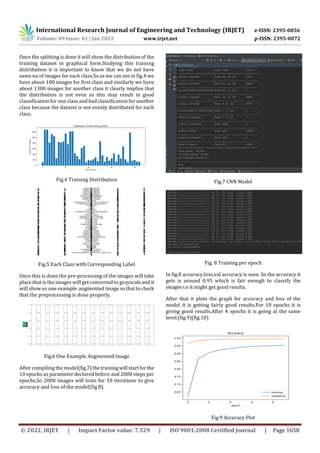
Fig.10 Loss Plot
Once training is done it shows us the real time classification
of the traffic signs using OpenCV and will show the labels,
class and probability of how much percent the classification
is true of the particular traffic sign.(fig.11)
Fig.11 Real time classification
5. CONCLUSIONS
From this proposed system we conclude thatafterbuildinga
efficient CNN model and training the dataset well it acquires
good classification results. And gives good accuracy results
as well.
Originally to get good training distribution it requires the
very big data sets but with the data sets that this system has
used will also yield good results.
In some existing autonomous vehicles they have this system
inbuilt but there could be many modifications and
improvisations in the system to run this in every vehicle
smoothly. Installing this systems in vehicles can control,
reduce upto 75% of accidents.
REFERENCES
[1] Traffic Sign Classification Using Deep Inception Based
Convolutional Networks Mrinal Haloi IIT Guwahati1.
[2] A Novel Neural Network Model forTrafficSignDetection
and RecognitionunderExtremeConditionsHaifeng Wan
, 1 Lei Gao , 2 Manman Su,1 Qinglong You,3 Hui Qu,1 and
Qirun Sun 1.
[3] Traffic Sign Detection for Intelligent Transportation
Systems: A Survey Ayoub Ellahyani1 a , Ilyas El Jaafari1
and Said Charfi2.
[4] Traffic Sign Detection and Recognition using Image
Processing 1Karthikeyan D, 2Enitha C, 3Bharathi S,
4Durkadevi K 1 Assistant Professor, 2,3,4 UG Scholar.
[5] Understanding Convolutional Neural Networks with A
Mathematical Model C.-C. Jay Kuo.

Real time Traffic Signs Recognition using Deep Learning

  • 1.
    International Research Journalof Engineering and Technology (IRJET) e-ISSN: 2395-0056 Volume: 09 Issue: 01 | Jan 2022 www.irjet.net p-ISSN: 2395-0072 © 2022, IRJET | Impact Factor value: 7.529 | ISO 9001:2008 Certified Journal | Page 1656 Real time Traffic Signs Recognition using Deep Learning Shambhavi Lalsinge1, Professor. Tejaswini Bhosale2 ---------------------------------------------------------------------***---------------------------------------------------------------------- Abstract - These days many object detection problems are being solved using deep learning or more precisely CNN(neural networks) due to its high recognition rate and fast execution. CNN has largely influenced all the computer visionary tasks. So in this project I propose a deep network traffic sign recognition/classification model with the help of python as the base language and followed by different python libraries for training the CNN model. This model will consist of different CNN layers which will precisely classify interclass samples from the dataset which will be provided. This system will be 99% efficient for recognizing the real time traffic sign and also tell from which class a particular sign belongs. Key Words: Deep learning, CNN, real-time, python,training, model, OpenCV, tensorflow, keras, traffic signs. 1.INTRODUCTION Lately autonomous vehicles have been a center of attraction for research study and development. And when we speak about autonomous vehicles Traffic SignsRecognitionsystem is the first and foremost concept to include in any autonomous vehicles. Sometimes drivers may tend to miss the traffic signs along the route this can be dangerous and very unsafe with concern to road safety. In such cases automatic process of classification oftraffic signsandreduce the no of road accidents on very large scale and can ensure complete safety. Many big names in automation used this system in their cars using computer vision and machine learning approach but this was soon replaced by deep learning approach based on classifiers. Recently deep convolutional techniques have been proved to be the most effective for object detection. Itprovesto beadvantegeous to look at the traffic signs recognition/classification with the deep learning the deep learningperspective. Classificationof traffic signs is not a simple task it requires a huge dataset to go through various processes in deep learning. Initially the dataset gets divided into some ratio where those many images will go through one process and other no of images will go through other process and then will show the accuracy of the classes and then further it will get recognized. This concept has notable research work history and existing work going on still there are few areas/drawbacks that are yet to overcome. 2. LITERATURE SURVEY There is a notable amount of research work done on traffic signs recognition/classification in history and still is going on. Different types of datasets have been used to solve different types of problems which includes detection, classification, tracking etc. After trying out and testing every object detection approach researchers got to the implementation with deep networks. In recent years with increasing technology and availability of standard datasets deep learning method is being more preferable. First CNN architecture ever used for traffic signs recognition was LENET architecture. In the paper ‘Novel Deep Learning Model for Traffic Sign Detection Using Capsule Networks’ by Amara DineshKumar they had stated the various approaches been tried fpr traffic signs recognition in early stages. Also they have stated how CNN method is effective and preferable over other methods. They have also briefly stated about the capsule techniques. In the paper ‘Traffic Sign Classification UsingDeepInception Based Convolutional Networks’ by Mrinal Haloi IIT Guwahati1 again they have explained the noval deep learning for traffic signs detection. In paper’A Novel Neural Network Model for Traffic Sign Detection and Recognition under Extreme Conditions’ by Haifeng Wan they have mainly focused on the traffic signs detection by autonomous vehicles under extreme weather conditions. In the paper’ Traffic Sign Detection for Intelligent Transportation Systems’ by Ayoub Ellahyani1 they have survey regarding TSR system being installed in transportation vehicles and this paper proposes that it is a step towards intelligent transportation system. In the paper ‘Traffic Sign Detection and Recognition using Image Processing’ by 1Karthikeyan D they have proposed the image processing approach towards TSR. In the paper ‘Two-stagetrafficsigndetectionandrecognition based on SVM and convolutional neural networks’ byAhmed Hechri1 In this study, a novel two-stage approach for real- time traffic sign detection . 3. METHODOLOGY 3.1 Algorithm and Flow of the Model In this project we are completely goingtocodeinPythonand will be using Pycharm IDE. Starting with all the imports one by one we import first of all the required libraries. Then we create one directory for the data set we are going to use for this project. After that the code is divided into two .py files one is TrafficSigns2_Main.py and TrafficSigns2_Test.py. TrafficSigns2_Main.py consistofall therequiredparameters, libraries splitting of data set, CNN model,pre-processingand augmentation of the images. TrafficSigns2_Test.py consists of the continuous while loop in which the traffic signs will get classified.
  • 2.
    International Research Journalof Engineering and Technology (IRJET) e-ISSN: 2395-0056 Volume: 09 Issue: 01 | Jan 2022 www.irjet.net p-ISSN: 2395-0072 © 2022, IRJET | Impact Factor value: 7.529 | ISO 9001:2008 Certified Journal | Page 1657 In TrafficSigns2_Main.py starting with importing all the libraries. Then followed by specifying some parameters for processing the data set like defining the path for the dataset and csv labels file, setting the image dimensions, epochs, validation ratio etc. Then we import the images that will basically detect the no of classes and import all the images .After that we split the data into test and validation the ratio is previously defined in the parameters. And we store the images in all the x variables and all the labels in y variable. Then we check if the no of images matches the no of labelsin the data set. Then we read our csv file and then we are going to plot and visualize and see if we are collecting the correct data and classifying it properly before we start the training process. Moving on we are preprocessing our images converting it into the grayscale and then equalizing it for the sake of standardization. And store this preprocessed images in x variable. Then at the end of it we are going to create our convolutional model. There after we compile the model and immediately the training starts. Once the training is done it will show us our plot of the trained model. It will mainly plot the validation loss and accuracy. Then we test our testing dataset and export the score. In TrafficSigns2_Test.py we also have imported some libraries. Then we simply set the parameters like threshold and framesizes. After that we set thecamera parameters.We setup our camera and then we import the trained model file. Then we again preprocess the images as wedidbefore.Then we have our class names so that it getsdisplayedandcoming to the end we have created a while loop that will continuously run to give us our web camera imagesin which it will predict the image and the class name and the probability percentage of classification being accurate. 3.2 CNN Model Architecture In the TrafficSigns2_Main.py we have also created the CNN model .We have used the LeNet architecture for the model here with few modifications. Themodel originallyconsistsof total 7 layers. The layers consists of 3 convolutional layers,2 subsampling layers and 2 fully connected layers. First layer is the input layer then there are 2 subsampling layers also known as maxpooling layer thereafter it has the fully connected layer and then lastly the output layer. Sobasically CNN has layer division as 3 types namely convolutional layers(Conv2D),pooling layers(Maxpooling2D) and fully connected layers.(fig.1) Fig.1 Standard LeNet Architecture In fig.2 denotes the layers in a particular convolutional model. It takes the images as input then breaks down the images in small packets using the convolutional and pooling layers and then finally with the help offullyconnectedlayers classification takes place and then we see the particular output. Fig.2 CNN model architecture In this particular project we have used LeNet architectureas mentioned before. In this model we have few convolutional layers, few pooling layers then we have few dropout layers and at the end we have a dense layer which is nothing but our output layer. 4. RESULTS AND DISCUSSIONS When we run the main.py where training,splitting and augmentation of the images is taking place.So firstly it will detect the no of classes data set has so this particulardataset has 43 classes detected and thereafter it will import each class folder one by on e and it will put all of these in one matrix with a corresponding class ID.After that it will split tha data into training,testing and validation so here certain no of images go for training certain for testing and some for validation as shown in the fig.3 it has around 22000 images for training,5000 images for validation and 6000 images for testing. Fig.3 Splitting of dataset
  • 3.
    International Research Journalof Engineering and Technology (IRJET) e-ISSN: 2395-0056 Volume: 09 Issue: 01 | Jan 2022 www.irjet.net p-ISSN: 2395-0072 © 2022, IRJET | Impact Factor value: 7.529 | ISO 9001:2008 Certified Journal | Page 1658 Once the splitting is done it will show the distribution of the training dataset in graphical form.Studying this training distribution it is important to know that we do not have same no of images for each class.So as we can see in fig.4 we have about 100 images for first class and similarly we have about 1300 images for another class it clearly implies that the distribution is not even so this may result in good classification for one class and bad classification for another class because the dataset is not evenly distributed for each class. Fig.4 Training Distribution Fig.5 Each Class with Corresponding Label Once this is done the pre-processing of the images will take place that is the images will get converted to grayscaleandit will show us one example augmented image so thattocheck that the preprocessing is done properly. Fig.6 One Example Augmented Image After compiling the model(fig.7)thetraining will startfor the 10 epochs as parameter declared before and 2000 steps per epochs.So 2000 images will train for 10 iterations to give accuracy and loss of the model(fig.8). Fig.7 CNN Model Fig. 8 Training per epoch In fig.8 accuracy,loss,val accuracy is seen. So the accuracy it gets is around 0.95 which is fair enough to classify the images i.e it might get good results. After that it plots the graph for accuracy and loss of the model it is getting fairly good results.For 10 epochs it is giving good results.After 4 epochs it is going at the same level.(fig.9)(fig.10) Fig.9 Accuracy Plot
  • 4.
    International Research Journalof Engineering and Technology (IRJET) e-ISSN: 2395-0056 Volume: 09 Issue: 01 | Jan 2022 www.irjet.net p-ISSN: 2395-0072 © 2022, IRJET | Impact Factor value: 7.529 | ISO 9001:2008 Certified Journal | Page 1659 Fig.10 Loss Plot Once training is done it shows us the real time classification of the traffic signs using OpenCV and will show the labels, class and probability of how much percent the classification is true of the particular traffic sign.(fig.11) Fig.11 Real time classification 5. CONCLUSIONS From this proposed system we conclude thatafterbuildinga efficient CNN model and training the dataset well it acquires good classification results. And gives good accuracy results as well. Originally to get good training distribution it requires the very big data sets but with the data sets that this system has used will also yield good results. In some existing autonomous vehicles they have this system inbuilt but there could be many modifications and improvisations in the system to run this in every vehicle smoothly. Installing this systems in vehicles can control, reduce upto 75% of accidents. REFERENCES [1] Traffic Sign Classification Using Deep Inception Based Convolutional Networks Mrinal Haloi IIT Guwahati1. [2] A Novel Neural Network Model forTrafficSignDetection and RecognitionunderExtremeConditionsHaifeng Wan , 1 Lei Gao , 2 Manman Su,1 Qinglong You,3 Hui Qu,1 and Qirun Sun 1. [3] Traffic Sign Detection for Intelligent Transportation Systems: A Survey Ayoub Ellahyani1 a , Ilyas El Jaafari1 and Said Charfi2. [4] Traffic Sign Detection and Recognition using Image Processing 1Karthikeyan D, 2Enitha C, 3Bharathi S, 4Durkadevi K 1 Assistant Professor, 2,3,4 UG Scholar. [5] Understanding Convolutional Neural Networks with A Mathematical Model C.-C. Jay Kuo.