International Research Journal of Engineering and Technology (IRJET) e-ISSN: 2395-0056
Volume: 07 Issue: 03 | Mar 2020 www.irjet.net p-ISSN: 2395-0072
© 2020, IRJET | Impact Factor value: 7.34 | ISO 9001:2008 Certified Journal | Page 2955
CONTENT BASED IMAGE CLASSIFICATION
PRIYANSHI AGGARWAL1, MUSKAAN MAHESHWARI2, PRACHI SHARMA3, PRATEEK AGARWAL4
1,2,3,4Student, Dept. of Computer Science, MIET, Meerut, India
---------------------------------------------------------------------***----------------------------------------------------------------------
Abstract - Multimedia content analysis has become an
essential part of the real world and digital images is an
influential part of this world. The complexity of the world is
increasing at a great pace especially the images, which are
increasing exponentially More than a million of images are
uploaded a different social media platforms on a daily basis.
Searching a specific kind of image from the chronicles has
been troublesome so In order to solve this problem, CBIC has
come into vision. CBIC has become very crucial in order to
retrieve millions of images uploaded everyday. InCBICimages
are grouped categorically and images are retrieved from this
large database on the basis of their visual content. For
example-Games images can be classified hierarchically as
indoor and outdoor images at the highest level and outdoor
images further be classified as badminton images, cricket etc.
Indoor images can be further classified as ludo, chess etc. The
performance of Content-Based Image Classification system
depends on efficient feature extraction andcorrectretrievalof
similar images. The essential concepts and studies related to
image classification and image representationareelaborated,
and further research directions are also mentioned to inspire
further studies in this area.
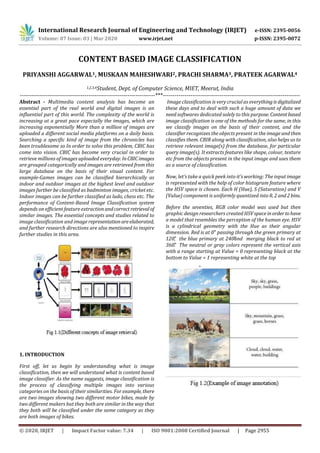
1. INTRODUCTION
First off, let us begin by understanding what is image
classification, then we will understand what is content based
image classifier. As the name suggests, image classification is
the process of classifying multiple images into various
categories on the basis of their similarities. For example, there
are two images showing two different motor bikes, made by
two different makers but they both are similar in the way that
they both will be classified under the same category as they
are both images of bikes.
Image classification is very crucial as everythingis digitalized
these days and to deal with such a huge amount of data we
need softwares dedicated solely to this purpose. Contentbased
image classification is one of the methods for the same, in this
we classify images on the basis of their content, and the
classifier recognizes the objects present in the image and then
classifies them. CBIR along with classification, also helps us to
retrieve relevant image(s) from the database, for particular
query image(s). It extracts features like shape, colour, texture
etc from the objects present in the input image and uses them
as a source of classification.
Now, let’s take a quick peek into it’s working: The input image
is represented with the help of color histogram feature where
the HSV space is chosen. Each H (Hue), S (Saturation) and V
(Value) component is uniformly quantized into 8, 2 and2bins.
Before the seventies, RGB color model was used but then
graphic design researchers created HSVspaceinordertohave
a model that resembles the perception of the human eye. HSV
is a cylindrical geometry with the Hue as their angular
dimension. Red is at 0° passing through the green primary at
120°, the blue primary at 240°and merging black to red at
360°. The neutral or gray colors represent the vertical axis
with a range starting at Value = 0 representing black at the
bottom to Value = 1 representing white at the top
International Research Journal of Engineering and Technology (IRJET) e-ISSN: 2395-0056
Volume: 07 Issue: 03 | Mar 2020 www.irjet.net p-ISSN: 2395-0072
© 2020, IRJET | Impact Factor value: 7.34 | ISO 9001:2008 Certified Journal | Page 2956
2. LITERATURE REVIEW
Existing systems for content based image classifier:-
1.”Zhao F,Huang Y,Wang L,Tan T” proposed a method for
multi-image retrieval in whicha deepconvolutional network
is merged with hash functions for performing hash codes
mappings.
2. ”Lin et al.” proposed a method for creating binary codes
using CNN for retrieval of large scale images.
3.”Shuijn Zhu And H.R. Tizhoosh” proposed Medical image
retrieval through SVN.
4.CBIR technique using color and texture information was
proposed by “Xiang-Yang Wang,et.al”. In this the image is
altered from RGB space to adversary chromaticityspace.The
text attributes were extracted using a rotation-invariant by
using Zernike chromaticity.
5.”G.Pass et.al. proposed a method for spatial features .The
model is not variant to scaling, rotation and shifting.
6.”Guo et al.” proposed a CBIR using ODBTC features for
constructing attributes of image such as BPF and CCF. Bit
pattern features are characterized by edge, shape and
content of image.
7.”Yamamoto” proposed a CBIR which uses multiple
histograms for taking into account spatial information of
colors.
3.LANGUAGE TO IMPLEMENT
The following languages and technologies are used in our
project 1)Python 2) Machine Learning 3)Deep Neural
Network
3.1 Python
Python is a simple, efficient and flexible programming
language. It is an object-oriented language that provides
efficiency to read the code in a simple way. It integrates the
system more efficiently. Python was created by Guido Van
Rossum in 1991 and it has 2 versions python2andpython3.
Python can be used for building an efficient content based
image classification as python contain a wide range of
libraries such as matplotlib. pyplot which is a collection of
command style functions that make matplotlib to work as
MATLAB. Each pypolt function makes changes to figure like
creating a figure or plotting lines etc. Also numpy can be
used for adding a support for building multi dimensional
image and matrices.
3.2 Machine Learning
Machine Learning is a technique to learn from examplesand
experience without programming it explicitly it is a type of
artificial intelligence that focuses on creating computer
programs that change accordingly when exposed to new
data. There are various libraries in machine learning which
include Matplotlib, Numpy, Panda, etc. The python libraries
matplotlib is used in our project. It is a very known library
for recognizing the data. It visualizes thepatternsinthedata.
It includes different types of charts and graphs in it such as
the histogram bar chart etc.Machinelearningcanbeusedfor
content based image classification as machine learning can
specify classes or category of query. Various machine
learning algorithms can be used for building training and
test models and can be used for increasing the efficiencyand
performance of the classifier. The algorithms are used as
they provide an accuracy by which we can specify whethera
model is efficient or how much accurate it is i.e. whether it is
capable of correctly classifying images in a dataset into
categories.
3.3 Deep Neural network
Deep Neural network is an artificial neural network with
more than 2 layers, it uses mathematical waystoprocess the
data. The phrase 'Deep Learning' is associated with deep
neural network because deep learning uses the concept of
artificial intelligence for classification is used in various
application such as computer vision and in fields like
robotics.
4. SCOPE
Content based image classification researches are favorable
but in the future, there is remarkable scope for research. In
the future, this system is also implemented in the field of
computer vision which deals with automated processing of
images from the real world. It can also be used in scientific
technology such as astronomy for the study of celestial
bodies such as commits, planets, etc. In future, the time for
classification and retrieval can also bereduced.Infuturethis
technique can be improved by using spatial informationand
the concept of deep learning.
Deep neural network is a network havingthreeor morethan
three layers of non-linear information stages. DNN consists
of (i)training a deep learning model froma largecollection of
training data;(ii) applying the trained deep model for
learning feature representations of CBIR.
5. CONCLUSION
The problems of image retrieval organization as well as the
percentage of similarity between images hasbeen examined
earlier in the paper, hence the used strategy to acquirethese
two tasks are discussed in our algorithm.In multimedia
retrieval, target images that are present in the database are
ranked by providing an appropriate score returned to the
user. This appropriate score is determined by the choice of
similarities. The chosen approach was the distance
measurement in this approach; theimagehasbeenshownas
a mixed sized vector and the relevance of content is
measured on the basis of the normalized distance between
International Research Journal of Engineering and Technology (IRJET) e-ISSN: 2395-0056
Volume: 07 Issue: 03 | Mar 2020 www.irjet.net p-ISSN: 2395-0072
© 2020, IRJET | Impact Factor value: 7.34 | ISO 9001:2008 Certified Journal | Page 2957
the vector of aggravating features. The task of development,
implementation, and use of various algorithms has resulted
in a classifier.
Z[l]=W[l]+A[l-1]+B[l] (Formula used)
ACKNOWLEDGEMENT
We wish to acknowledge the help of provided by technical
support staff in the ComputerSciencedepartmentofDr.A.P.J.
Abdul Kalam Technical University. We would also like to
show our deep appreciation tooursupervisor(“Mr.Baldivya
Mitra” Assistant Professor Meerut Institute of Engineering
& Technology, Meerut) who helped to finalize our
project.
REFERENCES
[1] Paulo M. Ferreira, Mário A.T. Figueiredo, Pedro M. Q.
Aguiar Content-Based Image Classification Department of
Electrical and Computer Engineering, Instituto Superior
técnico (IST), Av Rovisco Pais, 1049-001 Lisbon, Portugal
2015
[2] S.Rubini1 R.Divya, G.Divyalakshmi, Mr T.M. Senthil
Ganesan4 B.E Dept. of Computer Science & Engineering,
Velammal College of Engineering & Technology Madurai,
Tamil Nadu, India Assistant professor, Dept. of Computer
Science & Engineering, Velammal College of Engineering &
Technology Madurai, Tamil Nadu, India
[3] Baum, E.B. & Haussler, D. What Size Net Gives Valid
Generalization Neural Computation, Vol.1, No.1, 1989,151–
160.a
[4]M. E. J. Wood, N. W. Campbell, and B. T. Thomas,
“Iterative refinement byrelevancefeedback incontent-based
digital image retrieval,” In ACM Multimedia 98,pages13–20,
ACM, 1998
[5]Shujin Zhu and H.R. Tizhoosh, “Radon Features And
Barcodes For Medical Image Retrieval Via SVM”,
International Joint Conference on Neural Networks (IJCNN),
IEEE. 2016
[6]Monika Daga,KamleshLakhwani,“ANovel ContentBased
Image Retrieval Implemented By NSA Of AIS”, International
Journal Of Scientific & Technology Research,Volume2,Issue
7, July 2013 ISSN 2277- 8616.

IRJET - Content based Image Classification

  • 1.
    International Research Journalof Engineering and Technology (IRJET) e-ISSN: 2395-0056 Volume: 07 Issue: 03 | Mar 2020 www.irjet.net p-ISSN: 2395-0072 © 2020, IRJET | Impact Factor value: 7.34 | ISO 9001:2008 Certified Journal | Page 2955 CONTENT BASED IMAGE CLASSIFICATION PRIYANSHI AGGARWAL1, MUSKAAN MAHESHWARI2, PRACHI SHARMA3, PRATEEK AGARWAL4 1,2,3,4Student, Dept. of Computer Science, MIET, Meerut, India ---------------------------------------------------------------------***---------------------------------------------------------------------- Abstract - Multimedia content analysis has become an essential part of the real world and digital images is an influential part of this world. The complexity of the world is increasing at a great pace especially the images, which are increasing exponentially More than a million of images are uploaded a different social media platforms on a daily basis. Searching a specific kind of image from the chronicles has been troublesome so In order to solve this problem, CBIC has come into vision. CBIC has become very crucial in order to retrieve millions of images uploaded everyday. InCBICimages are grouped categorically and images are retrieved from this large database on the basis of their visual content. For example-Games images can be classified hierarchically as indoor and outdoor images at the highest level and outdoor images further be classified as badminton images, cricket etc. Indoor images can be further classified as ludo, chess etc. The performance of Content-Based Image Classification system depends on efficient feature extraction andcorrectretrievalof similar images. The essential concepts and studies related to image classification and image representationareelaborated, and further research directions are also mentioned to inspire further studies in this area. 1. INTRODUCTION First off, let us begin by understanding what is image classification, then we will understand what is content based image classifier. As the name suggests, image classification is the process of classifying multiple images into various categories on the basis of their similarities. For example, there are two images showing two different motor bikes, made by two different makers but they both are similar in the way that they both will be classified under the same category as they are both images of bikes. Image classification is very crucial as everythingis digitalized these days and to deal with such a huge amount of data we need softwares dedicated solely to this purpose. Contentbased image classification is one of the methods for the same, in this we classify images on the basis of their content, and the classifier recognizes the objects present in the image and then classifies them. CBIR along with classification, also helps us to retrieve relevant image(s) from the database, for particular query image(s). It extracts features like shape, colour, texture etc from the objects present in the input image and uses them as a source of classification. Now, let’s take a quick peek into it’s working: The input image is represented with the help of color histogram feature where the HSV space is chosen. Each H (Hue), S (Saturation) and V (Value) component is uniformly quantized into 8, 2 and2bins. Before the seventies, RGB color model was used but then graphic design researchers created HSVspaceinordertohave a model that resembles the perception of the human eye. HSV is a cylindrical geometry with the Hue as their angular dimension. Red is at 0° passing through the green primary at 120°, the blue primary at 240°and merging black to red at 360°. The neutral or gray colors represent the vertical axis with a range starting at Value = 0 representing black at the bottom to Value = 1 representing white at the top
  • 2.
    International Research Journalof Engineering and Technology (IRJET) e-ISSN: 2395-0056 Volume: 07 Issue: 03 | Mar 2020 www.irjet.net p-ISSN: 2395-0072 © 2020, IRJET | Impact Factor value: 7.34 | ISO 9001:2008 Certified Journal | Page 2956 2. LITERATURE REVIEW Existing systems for content based image classifier:- 1.”Zhao F,Huang Y,Wang L,Tan T” proposed a method for multi-image retrieval in whicha deepconvolutional network is merged with hash functions for performing hash codes mappings. 2. ”Lin et al.” proposed a method for creating binary codes using CNN for retrieval of large scale images. 3.”Shuijn Zhu And H.R. Tizhoosh” proposed Medical image retrieval through SVN. 4.CBIR technique using color and texture information was proposed by “Xiang-Yang Wang,et.al”. In this the image is altered from RGB space to adversary chromaticityspace.The text attributes were extracted using a rotation-invariant by using Zernike chromaticity. 5.”G.Pass et.al. proposed a method for spatial features .The model is not variant to scaling, rotation and shifting. 6.”Guo et al.” proposed a CBIR using ODBTC features for constructing attributes of image such as BPF and CCF. Bit pattern features are characterized by edge, shape and content of image. 7.”Yamamoto” proposed a CBIR which uses multiple histograms for taking into account spatial information of colors. 3.LANGUAGE TO IMPLEMENT The following languages and technologies are used in our project 1)Python 2) Machine Learning 3)Deep Neural Network 3.1 Python Python is a simple, efficient and flexible programming language. It is an object-oriented language that provides efficiency to read the code in a simple way. It integrates the system more efficiently. Python was created by Guido Van Rossum in 1991 and it has 2 versions python2andpython3. Python can be used for building an efficient content based image classification as python contain a wide range of libraries such as matplotlib. pyplot which is a collection of command style functions that make matplotlib to work as MATLAB. Each pypolt function makes changes to figure like creating a figure or plotting lines etc. Also numpy can be used for adding a support for building multi dimensional image and matrices. 3.2 Machine Learning Machine Learning is a technique to learn from examplesand experience without programming it explicitly it is a type of artificial intelligence that focuses on creating computer programs that change accordingly when exposed to new data. There are various libraries in machine learning which include Matplotlib, Numpy, Panda, etc. The python libraries matplotlib is used in our project. It is a very known library for recognizing the data. It visualizes thepatternsinthedata. It includes different types of charts and graphs in it such as the histogram bar chart etc.Machinelearningcanbeusedfor content based image classification as machine learning can specify classes or category of query. Various machine learning algorithms can be used for building training and test models and can be used for increasing the efficiencyand performance of the classifier. The algorithms are used as they provide an accuracy by which we can specify whethera model is efficient or how much accurate it is i.e. whether it is capable of correctly classifying images in a dataset into categories. 3.3 Deep Neural network Deep Neural network is an artificial neural network with more than 2 layers, it uses mathematical waystoprocess the data. The phrase 'Deep Learning' is associated with deep neural network because deep learning uses the concept of artificial intelligence for classification is used in various application such as computer vision and in fields like robotics. 4. SCOPE Content based image classification researches are favorable but in the future, there is remarkable scope for research. In the future, this system is also implemented in the field of computer vision which deals with automated processing of images from the real world. It can also be used in scientific technology such as astronomy for the study of celestial bodies such as commits, planets, etc. In future, the time for classification and retrieval can also bereduced.Infuturethis technique can be improved by using spatial informationand the concept of deep learning. Deep neural network is a network havingthreeor morethan three layers of non-linear information stages. DNN consists of (i)training a deep learning model froma largecollection of training data;(ii) applying the trained deep model for learning feature representations of CBIR. 5. CONCLUSION The problems of image retrieval organization as well as the percentage of similarity between images hasbeen examined earlier in the paper, hence the used strategy to acquirethese two tasks are discussed in our algorithm.In multimedia retrieval, target images that are present in the database are ranked by providing an appropriate score returned to the user. This appropriate score is determined by the choice of similarities. The chosen approach was the distance measurement in this approach; theimagehasbeenshownas a mixed sized vector and the relevance of content is measured on the basis of the normalized distance between
  • 3.
    International Research Journalof Engineering and Technology (IRJET) e-ISSN: 2395-0056 Volume: 07 Issue: 03 | Mar 2020 www.irjet.net p-ISSN: 2395-0072 © 2020, IRJET | Impact Factor value: 7.34 | ISO 9001:2008 Certified Journal | Page 2957 the vector of aggravating features. The task of development, implementation, and use of various algorithms has resulted in a classifier. Z[l]=W[l]+A[l-1]+B[l] (Formula used) ACKNOWLEDGEMENT We wish to acknowledge the help of provided by technical support staff in the ComputerSciencedepartmentofDr.A.P.J. Abdul Kalam Technical University. We would also like to show our deep appreciation tooursupervisor(“Mr.Baldivya Mitra” Assistant Professor Meerut Institute of Engineering & Technology, Meerut) who helped to finalize our project. REFERENCES [1] Paulo M. Ferreira, Mário A.T. Figueiredo, Pedro M. Q. Aguiar Content-Based Image Classification Department of Electrical and Computer Engineering, Instituto Superior técnico (IST), Av Rovisco Pais, 1049-001 Lisbon, Portugal 2015 [2] S.Rubini1 R.Divya, G.Divyalakshmi, Mr T.M. Senthil Ganesan4 B.E Dept. of Computer Science & Engineering, Velammal College of Engineering & Technology Madurai, Tamil Nadu, India Assistant professor, Dept. of Computer Science & Engineering, Velammal College of Engineering & Technology Madurai, Tamil Nadu, India [3] Baum, E.B. & Haussler, D. What Size Net Gives Valid Generalization Neural Computation, Vol.1, No.1, 1989,151– 160.a [4]M. E. J. Wood, N. W. Campbell, and B. T. Thomas, “Iterative refinement byrelevancefeedback incontent-based digital image retrieval,” In ACM Multimedia 98,pages13–20, ACM, 1998 [5]Shujin Zhu and H.R. Tizhoosh, “Radon Features And Barcodes For Medical Image Retrieval Via SVM”, International Joint Conference on Neural Networks (IJCNN), IEEE. 2016 [6]Monika Daga,KamleshLakhwani,“ANovel ContentBased Image Retrieval Implemented By NSA Of AIS”, International Journal Of Scientific & Technology Research,Volume2,Issue 7, July 2013 ISSN 2277- 8616.