International Research Journal of Engineering and Technology (IRJET) e-ISSN: 2395-0056
Volume: 05 Issue: 03 | Mar-2018 www.irjet.net p-ISSN: 2395-0072
© 2018, IRJET | Impact Factor value: 6.171 | ISO 9001:2008 Certified Journal | Page 3987
DNA CRYPTOGRAPHY
Karthiga S1, Murugavalli E2
1PG Scholar, Department of ECE, Thiagarajar college of Engineering, Madurai, India
2 Assistant Professor, Department of ECE, Thiagarajar college of Engineering, Madurai, India
---------------------------------------------------------------------***---------------------------------------------------------------------
Abstract - As traditional encryption algorithm have severe
security problems. The field of information security give
importance to the new way of protecting the data. The DNA
based cryptography has identified as new way of secure data
in the form DNA molecules which uses DNA strands to hidethe
information. The main objective of DNA cryptography is to
provide confidentiality when the persons sends data over a
network. This paper discuss about DNA Cryptography,
difference between traditional cryptography and DNA
Cryptography, various works done in the field of DNA
Cryptography
Key Words: Adenine, Thymine, Guanine, Cytosine,
Polymerase Chain Reaction, Primer
1. Introduction
In the digital world, data plays a vital importance in
the field of business, military etc… if the data is highly
sensitive and confidential it is necessary to protect the data.
Different techniques has been used to keeptheunauthorized
uses away such as cryptography, data hiding etc…
Cryptography is essential in both network and computer
security. It is the art of secret writing to protect the
information between two communication parties which
converts plain text into cipher text so that unauthorized
person cannot access the data. Traditional cryptography
applies complex and mathematical procedure to secure and
store the information. Due to this complex nature DNA
cryptosystem emerges. DNA Cryptosystem is the new
innovative approach used to encrypt the data in terms of
DNA sequence.
2. DNA & DNA Cryptography:
DNA (Deoxyribonucleic Acid) is a nucleic acid is the
backbone of all the living organisms. The DNA holds the
necessary genetic information which can help tobuild other
cellslike proteins and RNA (RibonucleicAcid),DNAisdouble
helix structure in which two strandsare coiled to each other
and it is made of nucleotidesThere are 4 basesin nucleotide
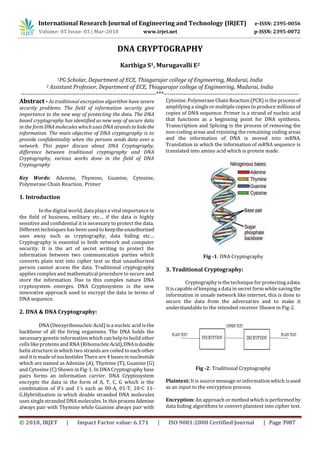
which are named as Adenine (A), Thymine (T), Guanine (G)
and Cytosine (C) Shown in Fig-1. In DNA Cryptography base
pairs forms an information carrier. DNA Cryptosystem
encrypts the data in the form of A, T, C, G which is the
combination of 0’s and 1’s such as 00-A, 01-T, 10-C 11-
G.Hybridization in which double stranded DNA molecules
uses single stranded DNA molecules. In this processAdenine
always pair with Thymine while Guanine always pair with
Cytosine. Polymerase Chain Reaction (PCR) isthe processof
amplifying a single or multiple copies to produce millions of
copies of DNA sequence. Primer is a strand of nucleic acid
that functions as a beginning point for DNA synthesis.
Transcription and Splicing is the process of removing the
non-coding areas and rejoining the remaining coding areas
and the information of DNA is moved into mRNA.
Translation in which the information of mRNA sequence is
translated into amino acid which is protein made.
Fig -1: DNA Cryptography
3. Traditional Cryptography:
Cryptography is the technique for protecting adata.
It is capable of keeping a data in secret form while savingthe
information in unsafe network like internet, this is done to
secure the data from the adversaries and to make it
understandable to the intended receiver Shown in Fig-2.
Fig -2: Traditional Cryptography
Plaintext: It is source message or information which isused
as an input to the encryption process.
Encryption: An approach or method which is performed by
data hiding algorithms to convert plaintext into cipher text.
International Research Journal of Engineering and Technology (IRJET) e-ISSN: 2395-0056
Volume: 05 Issue: 03 | Mar-2018 www.irjet.net p-ISSN: 2395-0072
© 2018, IRJET | Impact Factor value: 6.171 | ISO 9001:2008 Certified Journal | Page 3988
Cipher text: An encrypted message which sends to the
receiver using private or public channel.
Decryption: An inverse encryption process applies on
cipher text at receiver end for obtaining original message.
Table -1: Comparison of Traditional Cryptography and
DNA Cryptography
Table -2: Advantages and Disadvantage of different
Algorithm
4. Types of Cryptography:
There are three prominent branches or sub fields of
cryptography named as:
1) Modern Cryptography
2) Quantum Cryptography
3) DNA Cryptography.
These three fields depend upon different difficult problems
concerning to different disciplines for which there is no
known solution until now. The modern cryptography is
based upon the difficult mathematical problems such as
prime factorization, elliptic curve problem,forwhichthereis
no known solution found so far. Quantum cryptography
which is also relatively a new field, is based upon the
Heisenberg uncertainty principle of Physics, and DNA
cryptography dependsupon the difficultbiologicalprocesses
concerning to the field of DNA technology.
Table -3: Difference between Classical and Modern
Cryptography
5. Survey on DNA Cryptography:
Adelman [1] laid the foundationof DNA computing bygiving
solutions to the combinatorial problems using molecular
computation, one of which is “Hamiltonian path” problem.
He solved the instance of graph containing seven verticesby
encoding it into the molecular form by using an algorithm
and then computationaloperationswereperformedwiththe
help of some standard enzymes. This was solved by brute
force method.
Lipton [2] extended the work of Adleman by solvinganother
NP-complete problem called “satisfaction” by using DNA
molecules in a test tube to encode the graph for 2 bit
numbers.
Dan Boneh et al. applied the approaches of DNA computing
used by Adleman and Lipton, in order to break one of the
symmetric key algorithm used for cryptographic purposes
known asDES (Data Encryption Standard). They performed
biologicaloperations on the DNA strands in a test tube, such
as extraction, polymerization via DNA polymerase,
amplification via PCR and perform operations on the DNA
strandswhich have the encoding of binary strings.ThenDES
attack is planned by generating the DES-1 solution, due to
which key can be easily guessed from the ciphertext and
further evaluate the DES circuit, lookup table and XOR gates.
By using their molecular approach they broke DES inmerely
4 months[3]
International Research Journal of Engineering and Technology (IRJET) e-ISSN: 2395-0056
Volume: 05 Issue: 03 | Mar-2018 www.irjet.net p-ISSN: 2395-0072
© 2018, IRJET | Impact Factor value: 6.171 | ISO 9001:2008 Certified Journal | Page 3989
Table -4: Survey on DNA Cryptography
Qi Ouyang et al. applied the approaches of DNA molecular
theory in order to generate the solution for maximal clique
problem, which is another NP-complete problem. Thus
shows the efficiency of DNA: to solve Hard-problems and
vast parallelism inherent in it which makes the operations
fast.[4]
Chen et al. Proposed that hard problem can be solved by
DNA computing using various DNA operations. They solved
DES by using the DNA computing. [5]Chen et al.’s proposed
algorithm included three functions: initial function for
initialization of the key space with every possibility,
Encryption process, and third is to detect right
corresponding key. Algorithm referred as molecular sticker
algorithm which includes enzymes, short memory strands,
and tubes
MingXin et al. Introduced a symmetric-key DNA
cryptosystem using the inclusion of DNA biotechnology,
microarray into the cryptography technologies. In MingXin
et al.’s algorithm, encryption and decryption key formed by
use of DNA probes and ciphertext embeddedintomicroarray
(DNA chip). Security of algorithm based on theadvancement
of DNA chip.[6]
Shiu et al. Introduced three cryptographic approaches such
as Insertion method, Complementary pair method, and
Substitution method using the propertiesof DNA sequences.
They showed that substitution method is better than other
two approaches.
Liu et al. proposed a new data hiding approach using DNA
sequence and encrypted each character of ciphertext in a
word file. In Liu et al.’s algorithm, plaintext got convert into
DNA sequence using DNA coding. Chebyshev mapsgenerate
two pseudorandom DNA sequence XXOR and YPrimer, and
generate one time key using selected DNA sequence key.
XXOR added with message DNA sequence and then YPrimer
got attach with generated output. Aftersomeshiftoperations
had applied to the previous output, they got ciphertext. This
ciphertext encrypted in the word file and after conversionof
word to PDF. The generated PDF sent to the receiver as final
ciphertext.
Guangzhao Cui et al. proposed the public key encryption
technique that uses DNA synthesis, DNA digital coding and
PCR amplification to provide the security safeguard during
the communication. This encryption scheme has high
confidential strength.
Deepak Kumar and Shailendra Singh proposed a new secret
data writing techniquesbased on DNA sequences.Theyhave
explained this algorithm by using a simple example of
“HELLO” as a plaintext and generate a ssDNA One-time pad
key of 350 bits which is 70 times longer than the plaintext
and perform encryption and decryption on the plaintext
using symmetric key cryptography. So to find the exact key,
adversary hasto search among 4310 differentssDNAstrings
which is almost impossible [8].
Sabari Pramanik and Sanjit Kumar Setua proposed a new
parallel DNA cryptography technique using DNA molecular
structure and hybridization technique which certainly
minimize the time requirement. They have explained how
message is exchanging safely between sender and receiver
with an example.
Yunpeng Zhang et al. proposed a DNA cryptography based
on DNA fragment assembly.[10] In their algorithmtheyhave
clearly mentioned how sender converts the plaintext into
binary sequence and then into long chain of DNA, which is
further fragmented into small DNA chains.Keyofshortchain
International Research Journal of Engineering and Technology (IRJET) e-ISSN: 2395-0056
Volume: 05 Issue: 03 | Mar-2018 www.irjet.net p-ISSN: 2395-0072
© 2018, IRJET | Impact Factor value: 6.171 | ISO 9001:2008 Certified Journal | Page 3990
implantation takes place in the fragmentsandforwardtothe
receiver as a ciphertext and then receiver deciphers it and
starts fragment reassembly to obtain the plaintext.
Sadeg et al. worked on Central Dogma of Molecular Biology
(CDMB) and designed an algorithm that works better than
AES algorithm under various attacks. This proposed
algorithm involves three phases. In the first phase, plaintext
get convert into bits using the XOR operation with sub key
that was generated by sub key generator.Insecondandthird
phase long sequence of bits converted into ciphertext by
Transposition, CDMB, Permutation, and XOR operations.
Olga Tornea and Monica E. Borda [11] proposed a DNA
based cipher which is based on DNA indexing. They take the
random DNA sequence from the genetic database and useas
a One-time pad key, which is send to the receiver by a secure
communication channel. The encryption mechanisms takes
place by converting the plaintext into itsASCIIcodeandthen
converts it into the binary format which isconvertedintothe
DNA sequence (A, C, G, and T). Now DNA sequence formed is
search in the key sequence and writes down the index
numbers. The array of integer numbers obtained are our
ciphertext which is decrypted by the receiver only using the
key and index pointer.
6. Time Analysis:
Cryptographic techniques such as RSA, DES AES, Elliptical
Curve Cryptography etc., are not secure enough and it also
take much time for the processto take place. Due tothistime
complexity DNA Cryptography is emerged and time analysis
of different cryptographic technique is shown in Chart-1.
Elliptical Curve Cryptography technique consumes more
time for both encryption and decryption when comparing
with other cryptographic techniques DNA consumes less
time for encryption and decryption.
Chart -1: Time Analysis
7. Conclusion:
The world of information security is always on the pay
attention to protect the data that we transmit over non
secured communication. The attractiveness of these DNA
research trendsisfound the possibility ofprotectingthedata
and it also solve many difficult problems. With the
summarization of the progress of DNA cryptographic
research, the advantages, futuretrendsandseveralproblems
have also been identified. All the three kindsofcryptography
have their own advantages and disadvantages and can be
treated as the complement of each other in future security
applications. However, the difficulties that are identified in
other cryptography is overcomebyDNAcryptographywhich
can readily be implemented in the field of security.
REFERENCES
[1] Adleman. M. L (1994), Molecular Computation of
Solutions to Combinatorial Problems, Science, vol. 266,
pp. 1021- 1024.
[2] J. Lipton. R (1995), Using DNA to solve NP Complete
problems, Science, Vol. 268, pp. 542-545.
[3] Boneh. D (1996), Breaking DES using Molecular
computer, American Mathematical Society, pp 37-65.
[4] Ouyang Qi, D. Peter Kaplan, Liu Shumao and Albert
Libchaber (1997), DNA solution of the maximal clique
problem, Science 278, 5337, 446-449.
[5] Chen Jie (2003), A DNA-based bio molecular
cryptography design, Proceedingsof IEEE International
Symposium, Vol. 3, pp. III-822.
[6] Lai XueJia, MingXin Lu, Lei Qin, Han JunSong, and Fang
XiWen (2010),Asymmetric encryption and signature
method with DNA technology, Science China
Information Sciences 53, no. 3, pp. 506-514.
[7] Cui Guangzhao, Limin Qin, Yanfeng Wang, and Xuncai
Zhang (2008), An encryption scheme using DNA
technology, In Bio-Inspired Computing: Theories and
Applications, BICTA, 3rd IEEE International Conference
on, pp.37-42
[8] Deepak Kumar, and Shailendra Singh(2011),Secretdata
writing using DNA sequences, In Emerging Trends in
Networksand Computer CommunicationsETNCC),IEEE
International Conference on, pp. 402-405.
[9] Yunpeng Zhang, Bochen Fu, and Xianwei Zhang (2012),
DNA cryptography based on DNA Fragment assembly,
Information Science and Digital Content Technology
(ICIDT), 8th IEEE International Conference, Vol. 1, pp.
179-182.
[10] Olga Tornea, and Borda E. Monica (2013), Security and
complexity of a DNA-based cipher, In Roedunet
International Conference (Roedunet), 11thEEE
International Conference, pp. 1-5.
International Research Journal of Engineering and Technology (IRJET) e-ISSN: 2395-0056
Volume: 05 Issue: 03 | Mar-2018 www.irjet.net p-ISSN: 2395-0072
© 2018, IRJET | Impact Factor value: 6.171 | ISO 9001:2008 Certified Journal | Page 3991
[11] G. Cui, L. Cuiling, L. Haobin, and L. Xiaoguang, “DNA
computing and its application to information security
field”, IEEE Fifth International Conference on Natural
Computation, Tianjian, China, Aug. 2009, pp. 148 - 152.
[12] G. Cui, L. Qin, Y. Wang, and X. Zhang, “An encryption
scheme using DNA technology”, IEEE 3rd International
conference on Bio-Inspired Computing: Theories and
Applications (BICTA08), Adelaid, SA,Australia,2008,pp.
37–420.
[13] X. Guozhen, L. Mingxin, Q. Lei, and L. Xuejia,“Newfieldof
cryptography: DNA cryptography” Chinese Sience
Bulletin, Springer Verlag, Germany, vol. 51, 2006, pp.
1413–1420.
[14] Noorul Hussain Ubaidur Rahman, Chithralekha,
Balamurugan, Rajapandian, and Mariappan, "A Novel
DNA Computing based Encryption and Decryption
Algorithm", IEEE, 2015.
[15] G. Shanmuga Sundaram, S. Pavithra, A. Arthi, B. Madhu
Bala and S. Mahalakshmi, “Cellular AutomatabasedDNA
Cryptography Algorithm”, ISCO, IEEE, 2015.
[16] Asish Aich, Alo Sen, Satya Ranjan Dash, and
Satchidananda Dehuri, "A Symmetric Key Cryptosystem
using DNA Sequence with OTP Key", Springer, 2015.
[17] Ravi Gupta and Rahul Kumar Singh, "An Improved
Substitution method for Data Encryption using DNA
Sequence and CDMB", Springer, 2015.
[18] Samiha Marwan, Ahmed Shawish, Khaled Nagaty,“DNA-
based cryptographic method for data hiding in DNA
media”, Elsevier,2016.
[19] Tushar Mandge, and Vijay Choudhary, "A DNA
Encryption Technique Based on Matrix Manipulation
and Secure key Generation Scheme", IEEE, 2013.

IRJET- DNA Cryptography

  • 1.
    International Research Journalof Engineering and Technology (IRJET) e-ISSN: 2395-0056 Volume: 05 Issue: 03 | Mar-2018 www.irjet.net p-ISSN: 2395-0072 © 2018, IRJET | Impact Factor value: 6.171 | ISO 9001:2008 Certified Journal | Page 3987 DNA CRYPTOGRAPHY Karthiga S1, Murugavalli E2 1PG Scholar, Department of ECE, Thiagarajar college of Engineering, Madurai, India 2 Assistant Professor, Department of ECE, Thiagarajar college of Engineering, Madurai, India ---------------------------------------------------------------------***--------------------------------------------------------------------- Abstract - As traditional encryption algorithm have severe security problems. The field of information security give importance to the new way of protecting the data. The DNA based cryptography has identified as new way of secure data in the form DNA molecules which uses DNA strands to hidethe information. The main objective of DNA cryptography is to provide confidentiality when the persons sends data over a network. This paper discuss about DNA Cryptography, difference between traditional cryptography and DNA Cryptography, various works done in the field of DNA Cryptography Key Words: Adenine, Thymine, Guanine, Cytosine, Polymerase Chain Reaction, Primer 1. Introduction In the digital world, data plays a vital importance in the field of business, military etc… if the data is highly sensitive and confidential it is necessary to protect the data. Different techniques has been used to keeptheunauthorized uses away such as cryptography, data hiding etc… Cryptography is essential in both network and computer security. It is the art of secret writing to protect the information between two communication parties which converts plain text into cipher text so that unauthorized person cannot access the data. Traditional cryptography applies complex and mathematical procedure to secure and store the information. Due to this complex nature DNA cryptosystem emerges. DNA Cryptosystem is the new innovative approach used to encrypt the data in terms of DNA sequence. 2. DNA & DNA Cryptography: DNA (Deoxyribonucleic Acid) is a nucleic acid is the backbone of all the living organisms. The DNA holds the necessary genetic information which can help tobuild other cellslike proteins and RNA (RibonucleicAcid),DNAisdouble helix structure in which two strandsare coiled to each other and it is made of nucleotidesThere are 4 basesin nucleotide which are named as Adenine (A), Thymine (T), Guanine (G) and Cytosine (C) Shown in Fig-1. In DNA Cryptography base pairs forms an information carrier. DNA Cryptosystem encrypts the data in the form of A, T, C, G which is the combination of 0’s and 1’s such as 00-A, 01-T, 10-C 11- G.Hybridization in which double stranded DNA molecules uses single stranded DNA molecules. In this processAdenine always pair with Thymine while Guanine always pair with Cytosine. Polymerase Chain Reaction (PCR) isthe processof amplifying a single or multiple copies to produce millions of copies of DNA sequence. Primer is a strand of nucleic acid that functions as a beginning point for DNA synthesis. Transcription and Splicing is the process of removing the non-coding areas and rejoining the remaining coding areas and the information of DNA is moved into mRNA. Translation in which the information of mRNA sequence is translated into amino acid which is protein made. Fig -1: DNA Cryptography 3. Traditional Cryptography: Cryptography is the technique for protecting adata. It is capable of keeping a data in secret form while savingthe information in unsafe network like internet, this is done to secure the data from the adversaries and to make it understandable to the intended receiver Shown in Fig-2. Fig -2: Traditional Cryptography Plaintext: It is source message or information which isused as an input to the encryption process. Encryption: An approach or method which is performed by data hiding algorithms to convert plaintext into cipher text.
  • 2.
    International Research Journalof Engineering and Technology (IRJET) e-ISSN: 2395-0056 Volume: 05 Issue: 03 | Mar-2018 www.irjet.net p-ISSN: 2395-0072 © 2018, IRJET | Impact Factor value: 6.171 | ISO 9001:2008 Certified Journal | Page 3988 Cipher text: An encrypted message which sends to the receiver using private or public channel. Decryption: An inverse encryption process applies on cipher text at receiver end for obtaining original message. Table -1: Comparison of Traditional Cryptography and DNA Cryptography Table -2: Advantages and Disadvantage of different Algorithm 4. Types of Cryptography: There are three prominent branches or sub fields of cryptography named as: 1) Modern Cryptography 2) Quantum Cryptography 3) DNA Cryptography. These three fields depend upon different difficult problems concerning to different disciplines for which there is no known solution until now. The modern cryptography is based upon the difficult mathematical problems such as prime factorization, elliptic curve problem,forwhichthereis no known solution found so far. Quantum cryptography which is also relatively a new field, is based upon the Heisenberg uncertainty principle of Physics, and DNA cryptography dependsupon the difficultbiologicalprocesses concerning to the field of DNA technology. Table -3: Difference between Classical and Modern Cryptography 5. Survey on DNA Cryptography: Adelman [1] laid the foundationof DNA computing bygiving solutions to the combinatorial problems using molecular computation, one of which is “Hamiltonian path” problem. He solved the instance of graph containing seven verticesby encoding it into the molecular form by using an algorithm and then computationaloperationswereperformedwiththe help of some standard enzymes. This was solved by brute force method. Lipton [2] extended the work of Adleman by solvinganother NP-complete problem called “satisfaction” by using DNA molecules in a test tube to encode the graph for 2 bit numbers. Dan Boneh et al. applied the approaches of DNA computing used by Adleman and Lipton, in order to break one of the symmetric key algorithm used for cryptographic purposes known asDES (Data Encryption Standard). They performed biologicaloperations on the DNA strands in a test tube, such as extraction, polymerization via DNA polymerase, amplification via PCR and perform operations on the DNA strandswhich have the encoding of binary strings.ThenDES attack is planned by generating the DES-1 solution, due to which key can be easily guessed from the ciphertext and further evaluate the DES circuit, lookup table and XOR gates. By using their molecular approach they broke DES inmerely 4 months[3]
  • 3.
    International Research Journalof Engineering and Technology (IRJET) e-ISSN: 2395-0056 Volume: 05 Issue: 03 | Mar-2018 www.irjet.net p-ISSN: 2395-0072 © 2018, IRJET | Impact Factor value: 6.171 | ISO 9001:2008 Certified Journal | Page 3989 Table -4: Survey on DNA Cryptography Qi Ouyang et al. applied the approaches of DNA molecular theory in order to generate the solution for maximal clique problem, which is another NP-complete problem. Thus shows the efficiency of DNA: to solve Hard-problems and vast parallelism inherent in it which makes the operations fast.[4] Chen et al. Proposed that hard problem can be solved by DNA computing using various DNA operations. They solved DES by using the DNA computing. [5]Chen et al.’s proposed algorithm included three functions: initial function for initialization of the key space with every possibility, Encryption process, and third is to detect right corresponding key. Algorithm referred as molecular sticker algorithm which includes enzymes, short memory strands, and tubes MingXin et al. Introduced a symmetric-key DNA cryptosystem using the inclusion of DNA biotechnology, microarray into the cryptography technologies. In MingXin et al.’s algorithm, encryption and decryption key formed by use of DNA probes and ciphertext embeddedintomicroarray (DNA chip). Security of algorithm based on theadvancement of DNA chip.[6] Shiu et al. Introduced three cryptographic approaches such as Insertion method, Complementary pair method, and Substitution method using the propertiesof DNA sequences. They showed that substitution method is better than other two approaches. Liu et al. proposed a new data hiding approach using DNA sequence and encrypted each character of ciphertext in a word file. In Liu et al.’s algorithm, plaintext got convert into DNA sequence using DNA coding. Chebyshev mapsgenerate two pseudorandom DNA sequence XXOR and YPrimer, and generate one time key using selected DNA sequence key. XXOR added with message DNA sequence and then YPrimer got attach with generated output. Aftersomeshiftoperations had applied to the previous output, they got ciphertext. This ciphertext encrypted in the word file and after conversionof word to PDF. The generated PDF sent to the receiver as final ciphertext. Guangzhao Cui et al. proposed the public key encryption technique that uses DNA synthesis, DNA digital coding and PCR amplification to provide the security safeguard during the communication. This encryption scheme has high confidential strength. Deepak Kumar and Shailendra Singh proposed a new secret data writing techniquesbased on DNA sequences.Theyhave explained this algorithm by using a simple example of “HELLO” as a plaintext and generate a ssDNA One-time pad key of 350 bits which is 70 times longer than the plaintext and perform encryption and decryption on the plaintext using symmetric key cryptography. So to find the exact key, adversary hasto search among 4310 differentssDNAstrings which is almost impossible [8]. Sabari Pramanik and Sanjit Kumar Setua proposed a new parallel DNA cryptography technique using DNA molecular structure and hybridization technique which certainly minimize the time requirement. They have explained how message is exchanging safely between sender and receiver with an example. Yunpeng Zhang et al. proposed a DNA cryptography based on DNA fragment assembly.[10] In their algorithmtheyhave clearly mentioned how sender converts the plaintext into binary sequence and then into long chain of DNA, which is further fragmented into small DNA chains.Keyofshortchain
  • 4.
    International Research Journalof Engineering and Technology (IRJET) e-ISSN: 2395-0056 Volume: 05 Issue: 03 | Mar-2018 www.irjet.net p-ISSN: 2395-0072 © 2018, IRJET | Impact Factor value: 6.171 | ISO 9001:2008 Certified Journal | Page 3990 implantation takes place in the fragmentsandforwardtothe receiver as a ciphertext and then receiver deciphers it and starts fragment reassembly to obtain the plaintext. Sadeg et al. worked on Central Dogma of Molecular Biology (CDMB) and designed an algorithm that works better than AES algorithm under various attacks. This proposed algorithm involves three phases. In the first phase, plaintext get convert into bits using the XOR operation with sub key that was generated by sub key generator.Insecondandthird phase long sequence of bits converted into ciphertext by Transposition, CDMB, Permutation, and XOR operations. Olga Tornea and Monica E. Borda [11] proposed a DNA based cipher which is based on DNA indexing. They take the random DNA sequence from the genetic database and useas a One-time pad key, which is send to the receiver by a secure communication channel. The encryption mechanisms takes place by converting the plaintext into itsASCIIcodeandthen converts it into the binary format which isconvertedintothe DNA sequence (A, C, G, and T). Now DNA sequence formed is search in the key sequence and writes down the index numbers. The array of integer numbers obtained are our ciphertext which is decrypted by the receiver only using the key and index pointer. 6. Time Analysis: Cryptographic techniques such as RSA, DES AES, Elliptical Curve Cryptography etc., are not secure enough and it also take much time for the processto take place. Due tothistime complexity DNA Cryptography is emerged and time analysis of different cryptographic technique is shown in Chart-1. Elliptical Curve Cryptography technique consumes more time for both encryption and decryption when comparing with other cryptographic techniques DNA consumes less time for encryption and decryption. Chart -1: Time Analysis 7. Conclusion: The world of information security is always on the pay attention to protect the data that we transmit over non secured communication. The attractiveness of these DNA research trendsisfound the possibility ofprotectingthedata and it also solve many difficult problems. With the summarization of the progress of DNA cryptographic research, the advantages, futuretrendsandseveralproblems have also been identified. All the three kindsofcryptography have their own advantages and disadvantages and can be treated as the complement of each other in future security applications. However, the difficulties that are identified in other cryptography is overcomebyDNAcryptographywhich can readily be implemented in the field of security. REFERENCES [1] Adleman. M. L (1994), Molecular Computation of Solutions to Combinatorial Problems, Science, vol. 266, pp. 1021- 1024. [2] J. Lipton. R (1995), Using DNA to solve NP Complete problems, Science, Vol. 268, pp. 542-545. [3] Boneh. D (1996), Breaking DES using Molecular computer, American Mathematical Society, pp 37-65. [4] Ouyang Qi, D. Peter Kaplan, Liu Shumao and Albert Libchaber (1997), DNA solution of the maximal clique problem, Science 278, 5337, 446-449. [5] Chen Jie (2003), A DNA-based bio molecular cryptography design, Proceedingsof IEEE International Symposium, Vol. 3, pp. III-822. [6] Lai XueJia, MingXin Lu, Lei Qin, Han JunSong, and Fang XiWen (2010),Asymmetric encryption and signature method with DNA technology, Science China Information Sciences 53, no. 3, pp. 506-514. [7] Cui Guangzhao, Limin Qin, Yanfeng Wang, and Xuncai Zhang (2008), An encryption scheme using DNA technology, In Bio-Inspired Computing: Theories and Applications, BICTA, 3rd IEEE International Conference on, pp.37-42 [8] Deepak Kumar, and Shailendra Singh(2011),Secretdata writing using DNA sequences, In Emerging Trends in Networksand Computer CommunicationsETNCC),IEEE International Conference on, pp. 402-405. [9] Yunpeng Zhang, Bochen Fu, and Xianwei Zhang (2012), DNA cryptography based on DNA Fragment assembly, Information Science and Digital Content Technology (ICIDT), 8th IEEE International Conference, Vol. 1, pp. 179-182. [10] Olga Tornea, and Borda E. Monica (2013), Security and complexity of a DNA-based cipher, In Roedunet International Conference (Roedunet), 11thEEE International Conference, pp. 1-5.
  • 5.
    International Research Journalof Engineering and Technology (IRJET) e-ISSN: 2395-0056 Volume: 05 Issue: 03 | Mar-2018 www.irjet.net p-ISSN: 2395-0072 © 2018, IRJET | Impact Factor value: 6.171 | ISO 9001:2008 Certified Journal | Page 3991 [11] G. Cui, L. Cuiling, L. Haobin, and L. Xiaoguang, “DNA computing and its application to information security field”, IEEE Fifth International Conference on Natural Computation, Tianjian, China, Aug. 2009, pp. 148 - 152. [12] G. Cui, L. Qin, Y. Wang, and X. Zhang, “An encryption scheme using DNA technology”, IEEE 3rd International conference on Bio-Inspired Computing: Theories and Applications (BICTA08), Adelaid, SA,Australia,2008,pp. 37–420. [13] X. Guozhen, L. Mingxin, Q. Lei, and L. Xuejia,“Newfieldof cryptography: DNA cryptography” Chinese Sience Bulletin, Springer Verlag, Germany, vol. 51, 2006, pp. 1413–1420. [14] Noorul Hussain Ubaidur Rahman, Chithralekha, Balamurugan, Rajapandian, and Mariappan, "A Novel DNA Computing based Encryption and Decryption Algorithm", IEEE, 2015. [15] G. Shanmuga Sundaram, S. Pavithra, A. Arthi, B. Madhu Bala and S. Mahalakshmi, “Cellular AutomatabasedDNA Cryptography Algorithm”, ISCO, IEEE, 2015. [16] Asish Aich, Alo Sen, Satya Ranjan Dash, and Satchidananda Dehuri, "A Symmetric Key Cryptosystem using DNA Sequence with OTP Key", Springer, 2015. [17] Ravi Gupta and Rahul Kumar Singh, "An Improved Substitution method for Data Encryption using DNA Sequence and CDMB", Springer, 2015. [18] Samiha Marwan, Ahmed Shawish, Khaled Nagaty,“DNA- based cryptographic method for data hiding in DNA media”, Elsevier,2016. [19] Tushar Mandge, and Vijay Choudhary, "A DNA Encryption Technique Based on Matrix Manipulation and Secure key Generation Scheme", IEEE, 2013.